
A Guide to Tutoring Center Management System Hong Kong
Published: January 5, 2026 by Amy Ashford

A modern tutoring center management system is crucial for success in Hong Kong's competitive market. This software automates the entire operational loop, from capturing leads on WhatsApp to scheduling, automated billing, and complex teacher payroll, acting as a modern Teachworks alternative built for Asia. It helps centers reduce administrative tasks by up to 60%, eliminate booking errors, and improve cash flow.
To thrive in Hong Kong’s fiercely competitive tutoring market, you need more than great teachers. You need a rock-solid operational backbone. A tutoring centre management system provides that, acting as the central command hub for your entire business. It automates scheduling, billing, and parent communication.
Think of it as the brain that integrates these moving parts. By doing so, centres slash administrative costs, prevent costly errors, and free up their team to focus on what matters: delivering brilliant education. This guide shows you how to choose and implement the right system for your Hong Kong centre.
Why Do Hong Kong Tutoring Centres Need a Modern System?
Running a tutoring centre here is a unique challenge. You constantly juggle intense local competition, a changing student population, and high parental expectations. Managing this with a patchwork of spreadsheets, WhatsApp groups, and paper files is not sustainable for growth.
A dedicated management system tackles these exact problems. It is the difference between navigating the MTR with an old paper map versus a real-time journey planner app. One is slow and prone to mistakes; the other gives you clarity, efficiency, and the power to adapt quickly.
How to Navigate a Squeezed and Competitive Market
The ground is constantly shifting in Hong Kong's education sector. According to market analysis, the number of physical centres run by major local brands nearly halved between 2016 and mid-2024, dropping from 102 to just 56. This reflects a shrinking student population and aggressive expansion from mainland firms.
For any centre, from a small boutique with 5 teachers to a larger operation with 100, this volatility means efficiency is a survival strategy. In 2026, automation will no longer be optional for staying competitive and protecting profit margins from being eaten alive by administrative costs.
What Daily Operational Headaches Can a System Solve?
The daily grind of admin work can easily swallow hours that should be spent on teaching, marketing, or business strategy. A proper tutoring centre management system gives you that time back by putting repetitive, manual workflows on autopilot.
Here’s what that looks like in practice:
Reduced Administrative Burden: Automating tasks like generating invoices and calculating payroll can cut your admin time by up to 60%.
Elimination of Booking Errors: Smart scheduling features make it impossible to double-book a teacher or accidentally overfill a classroom.
Improved Cash Flow: With automated billing and integrated online payments, you get paid faster and spend far less time chasing down late fees.
Enhanced Data Security: You can centralize student information in a secure platform. Our guide on PDPO compliance for tutoring centres covers local requirements.
What Is a Tutoring Centre Management System?
At its core, a tutoring centre management system is a specialized software platform built to handle every part of an education business. It pulls four critical pillars together into one dashboard, creating a seamless workflow from lead capture to payroll.
Lead Capture & CRM: This handles new inquiries, often coming from WhatsApp, and guides potential students from a trial lesson to full enrolment.
Scheduling & Resource Management: This is the logistical core, coordinating teacher availability, student lessons, and booking physical rooms across multiple branches.
Billing & Invoicing: It automatically creates and sends invoices based on lesson attendance and makes it simple for parents to pay online.
Payroll & Compensation: This piece calculates what you owe each teacher based on their specific rules, from hourly rates to complex revenue-sharing models.
When a lesson is completed, the system automatically triggers the right invoice and the correct payroll calculation without any manual intervention. This complete integration is what defines a modern management system.
What Core Features Must Your Management System Have?
When choosing software for your tutoring centre, you need a system where each part solves a real, everyday problem specific to the Hong Kong market. The best systems integrate the entire operational loop, from capturing a new lead on WhatsApp to paying your top teachers accurately.
This mind map sums up the core challenges every Hong Kong tutoring centre is wrestling with right now.
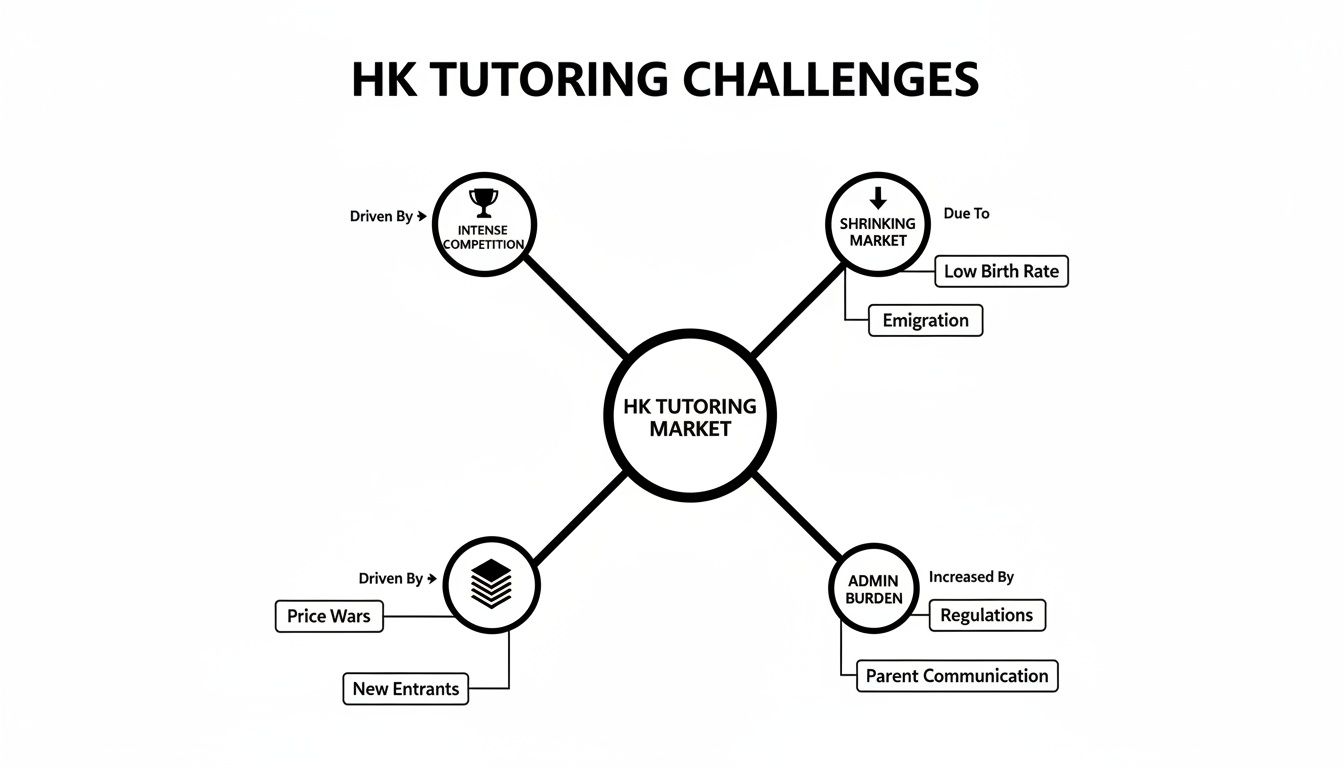
The combination of intense competition, a shrinking student pool, and a mountain of admin creates a perfect storm. A proper management system directly tackles this administrative burden, freeing you up to focus on teaching quality and business growth in 2026 and beyond.
What Is Smart Scheduling?
Smart scheduling is an automated process that finds the best possible lesson times by juggling multiple factors at once. It actively prevents conflicts and makes the most of your resources, like teachers and classrooms, across all your branches. It is much more than just a digital calendar.
Imagine a parent messages you on WhatsApp asking for a Primary 5 Maths class. Instead of checking multiple spreadsheets, a smart scheduler instantly shows every available teacher, room, and time combination. You confirm the booking in seconds, not minutes. This feature is essential for efficiency.
This core function should include:
Real-time conflict detection that makes it physically impossible to double-book a teacher or a classroom.
Multi-branch visibility so you can see availability across all your locations from a single screen.
Intelligent slot finding that suggests the best lesson times based on teacher skills, student level, and even room capacity.
Hybrid class support for seamlessly managing both in-person and online students in the same lesson.
How Does Automated Billing and Invoicing Work?
Automated billing connects lesson attendance directly to your invoicing. When a teacher marks a student as present, the system automatically creates the correct invoice and sends it to the parent. This simple connection eliminates hours of manual data entry and dramatically reduces human error.
This is especially important in Hong Kong, where centres offer prepaid packages, monthly subscriptions, and pay-as-you-go rates. The system must calculate everything perfectly every time. This automation ensures accuracy and improves your financial workflow.
Key features to look for include:
Integration with local payment gateways like Stripe to easily accept FPS, credit cards, and other common methods.
Automatic generation of invoices triggered by lesson completion or attendance.
Support for diverse billing models, including prepaid credits, recurring subscriptions, and package deals.
Automated reminders for overdue payments, which improves your cash flow without any awkward phone calls.
Manual vs. Automated System Comparison
Operational Task | Manual Method (Spreadsheets & WhatsApp) | Automated System (e.g., Tutorbase) |
|---|---|---|
Scheduling & Booking | 20-30 mins per booking. Back-and-forth messages, checking multiple sheets. High risk of double-booking. | Under 2 mins per booking. Instantly see all availability. Parents can even self-book online. Zero booking conflicts. |
Invoicing & Payments | 8-10 hours per month. Manually creating invoices, tracking payments, and sending reminders. Error rate of 5-10%. | Under 1 hour per month. Invoices are auto-generated and sent. Payments tracked automatically. Error rate near 0%. |
Teacher Payroll | 4-6 hours per month. Manually counting lessons from attendance sheets and calculating payouts based on different rates. | Under 30 mins per month. System pulls lesson data and auto-calculates payouts based on pre-set rules. |
Parent Communication | Disjointed and manual. Sending individual reminders and progress updates via WhatsApp or email. | Centralised. Automated reminders for lessons and payments. Parents can view progress notes in a dedicated portal. |
How to Handle Integrated Payroll for Flexible Teacher Contracts
An integrated payroll system automates teacher compensation by pulling data directly from the schedule and attendance records. This ensures every payout is accurate, even with the complex contract types common in Hong Kong tutoring centres. You no longer need to manually calculate pay.
You can set unique rules for each teacher. This includes higher rates for weekend classes, revenue-sharing agreements, or bonuses for teaching premium DSE subjects. The system handles all these calculations effortlessly, generating clear payout statements for you to review and approve.
A robust tutoring centre management system should also offer comprehensive document management capabilities. This helps you securely store teacher contracts and student records, similar to the functionality found in the top document management software for small businesses.
How Can CRM Improve Client Relationships?
A built-in Client Relationship Management (CRM) tool helps you manage the entire student journey. It starts by capturing enquiries from places like your website or WhatsApp. It then tracks every interaction until that student becomes a loyal, long-term client.
For example, you can log trial lesson feedback, spot attendance patterns, and view a student's complete payment history in one place. This 360-degree view allows for more personalised service and helps identify at-risk students. Learn more in our guide to tutoring analytics dashboards.
How to Choose the Right Management System for Your Centre
Picking a management system is a big decision that will shape your centre's future. It’s about finding a platform that fits how you work and where you want to go. The right system feels like a natural extension of your business, not just another piece of software.
You need to look at how a system handles growth, how easy it is for your team to use, and what kind of support you’ll get. When weighing your options, consider guides on choosing the best learning management systems for small businesses, as many core principles are the same.
Can It Scale with Your Ambition?
Scalability is a system's ability to grow without falling apart. A platform that works for five teachers in one location needs to work just as smoothly for 20 teachers across three branches. If you plan to expand, you need a system built for that journey.
What’s your five-year plan? Ask vendors how their platform handles an increase from 50 to 10,000 lessons weekly, a standard range for a growing Hong Kong centre. Your software must support your growth without friction, ensuring smooth operations as you expand your business.
Is the User Experience Truly Better?
A new system is meant to make life easier for everyone, including admin staff, teachers, and parents. If the interface is clunky or slow, your team won’t use it. You need something more intuitive than the chaotic mix of spreadsheets and WhatsApp you're probably using now.
Always request a live demonstration to see the software in action. Does its workflow actually simplify your day-to-day operations? A good user experience should feel obvious and require very little training. This is a critical factor in your decision-making process.
To get the most out of a demo, check out our comprehensive buyer's guide for tutoring software demos. It’s packed with the key questions you should be asking.
Does It Support Multi-Branch Operations?
For any centre with more than one location, this is non-negotiable. A proper tutoring centre management system for Hong Kong must give you a single, clear view of your entire operation while letting you manage each branch as its own unit. This central oversight is crucial for efficiency.
Look for essential features like:
Centralised scheduling that lets you filter by location.
Room and resource management for each individual branch.
Segmented financial reporting so you can see how each location is performing.
Standardised settings for courses and pricing that you can apply across all your branches at once.
Without this, you’ll end up juggling separate systems for each location. This approach creates headaches, duplicates work, and invites errors that can cost you time and money.
Modern vs. Legacy Systems: A Clear Comparison
Not all platforms are built the same. Legacy systems, like Teachworks, were often designed for a different era and lack modern automation. They typically have outdated interfaces and are not built with the specific needs of the Asian market in mind. A modern system offers a clear advantage.
Evaluation Criteria | Legacy System (e.g., Teachworks) | Modern System (e.g., Tutorbase) |
|---|---|---|
User Interface (UI) | Often dated, complex, and not mobile-friendly. | Clean, intuitive, and designed for ease of use on any device. |
Automation Level | Requires manual steps for key tasks like invoicing and payroll. | Automates the entire workflow from lesson attendance to payroll. |
Scheduling | Basic calendar functions that require manual checking for conflicts. | AI-powered slot finding and real-time conflict prevention. |
Multi-Branch Support | Limited functionality that struggles to manage multiple locations effectively. | Robust tools designed for seamless multi-branch room and staff management. |
Focus | Often built for a Western market with limited Asia-specific features. | Designed with Asian business models in mind, including flexible payroll. |
The regional after-school tutoring market is projected to grow by USD 130.8 billion through 2029, according to industry reports. Centres that ignore automation are already seeing 42% higher churn from simple booking errors alone. This data highlights the urgent need for modern, efficient systems.
Your Step-by-Step Plan for a Seamless System Migration
Moving to a new tutoring centre management system is a huge step forward. A structured, four-step approach is key to ensuring a smooth switch without disrupting your day-to-day operations. This plan helps you migrate from spreadsheets and WhatsApp chaos to a slick, automated system.

Adopting a new tutoring centre management system in Hong Kong isn't just a tech upgrade. It is about building a stronger operational foundation for growth. Following a plan ensures every piece of data is accounted for, your team feels confident, and your business keeps running smoothly.
Step 1: Prepare and Cleanse Your Data
First, you need to get your existing data ready for the move. This is a perfect chance to clean your records, ensuring you only bring over accurate and useful information. Start by gathering all essential information from your current sources like spreadsheets and Word documents.
Key data you’ll want to pull together includes:
Student Information: Full names, contact details, enrolled courses, and any important learning notes.
Teacher Profiles: Contact information, subjects they teach, and their specific payroll rates.
Payer Details: Records of who pays the fees for each student, along with their contact info.
Lesson History: A log of past attendance and billing is incredibly valuable for historical reporting.
Once you have it all in one place, comb through it. Look for duplicate entries, old contacts, and any inconsistencies. A clean dataset is the bedrock of an effective management system. It prevents future admin headaches and stops errors before they happen.
Step 2: Configure and Customise the System
Now you can set up the new system to mirror how your centre works. You’ll need to configure the software to handle your specific pricing models, scheduling rules, and payroll structures. This ensures the automation works exactly the way you need it to.
During this stage, you are essentially teaching the platform the unique rules of your business. This customization is critical for successful implementation.
Your configuration checklist should include:
Setting Up Locations: Defining your branches, individual classrooms, and their capacities.
Creating Subjects and Levels: Building out your full course catalogue, from DSE exam prep to primary-level English.
Defining Billing Rules: Inputting your various rates, including hourly charges, package deals, and prepaid credit options.
Configuring Payroll Schemes: Setting up each teacher's unique pay plan, whether it's revenue sharing, a flat rate, or weekend premiums.
Taking the time to get these details right means the software will automate tasks accurately. This will save you countless hours down the line.
Step 3: Train and Onboard Your Staff
A powerful system is only as good as the team using it. Effective, role-specific training is crucial for a smooth transition. The goal is to give each team member the skills they need for their daily tasks without overwhelming them with unnecessary features.
Your admin staff will need to master scheduling and billing. Your teachers just need to know how to mark attendance and check their schedules. A good software provider will offer resources like video tutorials, help guides, and direct support to make this easy.
Step 4: Go-Live and Get Ongoing Support
The "go-live" day is when you officially make the change. It's smart to pick a relatively quiet period, like the beginning of a new term, to make the switch. For the first week, you might want to run the new system alongside your old one to double-check everything.
Once you're live, ongoing support is key. Make sure your team knows exactly how to get help. A modern system should come with responsive customer support that can quickly sort out any initial issues. This ensures your migration is a successful long-term investment.
The Future of Tutoring Management in Hong Kong
The conversation around tutoring management is changing. It is no longer just about automating admin tasks. It’s about making smarter, data-driven decisions that grow your business. The future lies in systems that provide genuine business intelligence, not just basic management tools.
Looking towards 2026, Artificial Intelligence (AI) will become a standard feature. These tools will analyse your operation to suggest profitable class times, flag underutilised classrooms, and even predict future enrolment trends. This is the next evolution of tutoring management.
What Is Business Intelligence in Tutoring?
Business Intelligence (BI) in tutoring means using technology to analyze your own data to get clear, actionable answers to business questions. Instead of relying on gut feelings, BI helps you answer things like which marketing channel brings in the most valuable students.
BI can also identify your least profitable class times or which courses have the highest profit margin. This is the leap from just running your centre to strategically growing it. It moves you from managing tasks to managing performance, using real data.
Embracing Hybrid Learning Models
The line between online and in-person teaching has permanently blurred. A modern tutoring centre management system in Hong Kong must handle hybrid classrooms seamlessly. This means managing students who are physically present alongside those joining online.
This isn’t just a technical challenge; it is a massive opportunity. Offering flexible learning options opens your doors to a wider audience, including students from mainland China. Your software must manage both physical classroom capacity and digital resources at the same time.
The Growing Importance of Data Analytics
Relying on intuition alone is a risky strategy in today’s market. Advanced data analytics gives you an objective, clear picture of your centre’s health. It’s the difference between guessing what works and knowing what drives success for your business.
Your management system should be the analytical brain of your centre. It needs to give you detailed, easy-to-read reports on teacher performance, student progress, and classroom utilisation. When it does that, it becomes a strategic investment with a clear return.
The private tutoring market in Asia Pacific is projected to hit USD 123.5 billion by 2030. Efficiency and smart decisions will be crucial for capturing your slice of that pie. You can read more about these market projections to grasp the scale of the opportunity.
Preparing for Future Technological Trends
To stay ahead, you need to anticipate what’s next. The leading systems are built by people who have run education businesses themselves. They understand the unique pain points of operating in Asia and are building solutions for them. This direct experience is invaluable.
Choosing a forward-thinking platform like Tutorbase, founded in Hong Kong, positions your centre to adapt. It handles complex local payroll and streamlines lead management from WhatsApp. This focus on future-proofing your operations is what separates growing centres from those left behind.
Frequently Asked Questions

How does the system handle local Hong Kong payment methods?
A modern tutoring centre management system for Hong Kong connects directly with payment gateways like Stripe. This allows your centre to accept the payment methods parents actually use, such as credit cards, AlipayHK, and the Faster Payment System (FPS). When a parent pays an invoice online, the system automatically marks it as paid, speeding up your cash flow.
Is my student and staff data secure and PDPO compliant?
Yes, reputable management systems are built with data security and compliance with Hong Kong's Personal Data (Privacy) Ordinance (PDPO) as a top priority. Your data should be encrypted and stored on secure cloud servers. You should choose a provider that explicitly understands and commits to PDPO compliance to protect your students and your business's reputation.
Can the software manage complex teacher payroll?
Yes, a good system automates even the most complicated payroll calculations. You can set up unique pay rules for every teacher, including hourly rates, revenue-sharing agreements, or premium pay for weekends. The software calculates each teacher’s pay based on the lessons they’ve taught, which eliminates manual errors and saves hours of work each month.
How long does it take to migrate to a new system?
For a small or medium-sized centre with clean data, the entire migration process can often be completed in just one to two weeks. This timeline includes preparing your data, configuring the new system, training your staff, and the final go-live switch. A good provider will guide you through each step to make the transition as smooth as possible.
What is the main difference between a legacy system and a modern one?
The main difference is automation and user experience. Legacy systems often have clunky interfaces and require manual steps for tasks like billing. Modern systems, designed for the current market, automate the entire workflow from scheduling to payroll. They also have intuitive, mobile-friendly designs and are built to handle multi-branch operations seamlessly.
How does a management system improve lead capture from WhatsApp?
A modern system integrates directly with communication channels like WhatsApp. When a new inquiry comes in, it can automatically create a lead profile in your CRM. This ensures no potential student falls through the cracks. You can then track the entire journey from the initial message to trial lesson and final enrolment, all within one platform.
Can a system help with classroom and resource management?
Absolutely. A key feature is the ability to manage not just schedules but also physical resources. You can define each classroom's capacity, assign specific rooms to lessons, and prevent double-booking of your physical spaces. This is especially critical for centres operating across multiple branches in Hong Kong, ensuring you maximize the utilization of your facilities.
Ready to stop juggling spreadsheets and start scaling your centre with a system built for the Hong Kong market? See how Tutorbase can cut your admin work by 60% and get started at tutorbase.com/register.
A Guide to Tutoring Center Management System Hong Kong
Published: January 4, 2026 by Amy Ashford


A modern tutoring center management system is crucial for success in Hong Kong's competitive market. This software automates the entire operational loop, from capturing leads on WhatsApp to scheduling, automated billing, and complex teacher payroll, acting as a modern Teachworks alternative built for Asia. It helps centers reduce administrative tasks by up to 60%, eliminate booking errors, and improve cash flow.
To thrive in Hong Kong’s fiercely competitive tutoring market, you need more than great teachers. You need a rock-solid operational backbone. A tutoring centre management system provides that, acting as the central command hub for your entire business. It automates scheduling, billing, and parent communication.
Think of it as the brain that integrates these moving parts. By doing so, centres slash administrative costs, prevent costly errors, and free up their team to focus on what matters: delivering brilliant education. This guide shows you how to choose and implement the right system for your Hong Kong centre.
Why Do Hong Kong Tutoring Centres Need a Modern System?
Running a tutoring centre here is a unique challenge. You constantly juggle intense local competition, a changing student population, and high parental expectations. Managing this with a patchwork of spreadsheets, WhatsApp groups, and paper files is not sustainable for growth.
A dedicated management system tackles these exact problems. It is the difference between navigating the MTR with an old paper map versus a real-time journey planner app. One is slow and prone to mistakes; the other gives you clarity, efficiency, and the power to adapt quickly.
How to Navigate a Squeezed and Competitive Market
The ground is constantly shifting in Hong Kong's education sector. According to market analysis, the number of physical centres run by major local brands nearly halved between 2016 and mid-2024, dropping from 102 to just 56. This reflects a shrinking student population and aggressive expansion from mainland firms.
For any centre, from a small boutique with 5 teachers to a larger operation with 100, this volatility means efficiency is a survival strategy. In 2026, automation will no longer be optional for staying competitive and protecting profit margins from being eaten alive by administrative costs.
What Daily Operational Headaches Can a System Solve?
The daily grind of admin work can easily swallow hours that should be spent on teaching, marketing, or business strategy. A proper tutoring centre management system gives you that time back by putting repetitive, manual workflows on autopilot.
Here’s what that looks like in practice:
Reduced Administrative Burden: Automating tasks like generating invoices and calculating payroll can cut your admin time by up to 60%.
Elimination of Booking Errors: Smart scheduling features make it impossible to double-book a teacher or accidentally overfill a classroom.
Improved Cash Flow: With automated billing and integrated online payments, you get paid faster and spend far less time chasing down late fees.
Enhanced Data Security: You can centralize student information in a secure platform. Our guide on PDPO compliance for tutoring centres covers local requirements.
What Is a Tutoring Centre Management System?
At its core, a tutoring centre management system is a specialized software platform built to handle every part of an education business. It pulls four critical pillars together into one dashboard, creating a seamless workflow from lead capture to payroll.
Lead Capture & CRM: This handles new inquiries, often coming from WhatsApp, and guides potential students from a trial lesson to full enrolment.
Scheduling & Resource Management: This is the logistical core, coordinating teacher availability, student lessons, and booking physical rooms across multiple branches.
Billing & Invoicing: It automatically creates and sends invoices based on lesson attendance and makes it simple for parents to pay online.
Payroll & Compensation: This piece calculates what you owe each teacher based on their specific rules, from hourly rates to complex revenue-sharing models.
When a lesson is completed, the system automatically triggers the right invoice and the correct payroll calculation without any manual intervention. This complete integration is what defines a modern management system.
What Core Features Must Your Management System Have?
When choosing software for your tutoring centre, you need a system where each part solves a real, everyday problem specific to the Hong Kong market. The best systems integrate the entire operational loop, from capturing a new lead on WhatsApp to paying your top teachers accurately.
This mind map sums up the core challenges every Hong Kong tutoring centre is wrestling with right now.

The combination of intense competition, a shrinking student pool, and a mountain of admin creates a perfect storm. A proper management system directly tackles this administrative burden, freeing you up to focus on teaching quality and business growth in 2026 and beyond.
What Is Smart Scheduling?
Smart scheduling is an automated process that finds the best possible lesson times by juggling multiple factors at once. It actively prevents conflicts and makes the most of your resources, like teachers and classrooms, across all your branches. It is much more than just a digital calendar.
Imagine a parent messages you on WhatsApp asking for a Primary 5 Maths class. Instead of checking multiple spreadsheets, a smart scheduler instantly shows every available teacher, room, and time combination. You confirm the booking in seconds, not minutes. This feature is essential for efficiency.
This core function should include:
Real-time conflict detection that makes it physically impossible to double-book a teacher or a classroom.
Multi-branch visibility so you can see availability across all your locations from a single screen.
Intelligent slot finding that suggests the best lesson times based on teacher skills, student level, and even room capacity.
Hybrid class support for seamlessly managing both in-person and online students in the same lesson.
How Does Automated Billing and Invoicing Work?
Automated billing connects lesson attendance directly to your invoicing. When a teacher marks a student as present, the system automatically creates the correct invoice and sends it to the parent. This simple connection eliminates hours of manual data entry and dramatically reduces human error.
This is especially important in Hong Kong, where centres offer prepaid packages, monthly subscriptions, and pay-as-you-go rates. The system must calculate everything perfectly every time. This automation ensures accuracy and improves your financial workflow.
Key features to look for include:
Integration with local payment gateways like Stripe to easily accept FPS, credit cards, and other common methods.
Automatic generation of invoices triggered by lesson completion or attendance.
Support for diverse billing models, including prepaid credits, recurring subscriptions, and package deals.
Automated reminders for overdue payments, which improves your cash flow without any awkward phone calls.
Manual vs. Automated System Comparison
Operational Task | Manual Method (Spreadsheets & WhatsApp) | Automated System (e.g., Tutorbase) |
|---|---|---|
Scheduling & Booking | 20-30 mins per booking. Back-and-forth messages, checking multiple sheets. High risk of double-booking. | Under 2 mins per booking. Instantly see all availability. Parents can even self-book online. Zero booking conflicts. |
Invoicing & Payments | 8-10 hours per month. Manually creating invoices, tracking payments, and sending reminders. Error rate of 5-10%. | Under 1 hour per month. Invoices are auto-generated and sent. Payments tracked automatically. Error rate near 0%. |
Teacher Payroll | 4-6 hours per month. Manually counting lessons from attendance sheets and calculating payouts based on different rates. | Under 30 mins per month. System pulls lesson data and auto-calculates payouts based on pre-set rules. |
Parent Communication | Disjointed and manual. Sending individual reminders and progress updates via WhatsApp or email. | Centralised. Automated reminders for lessons and payments. Parents can view progress notes in a dedicated portal. |
How to Handle Integrated Payroll for Flexible Teacher Contracts
An integrated payroll system automates teacher compensation by pulling data directly from the schedule and attendance records. This ensures every payout is accurate, even with the complex contract types common in Hong Kong tutoring centres. You no longer need to manually calculate pay.
You can set unique rules for each teacher. This includes higher rates for weekend classes, revenue-sharing agreements, or bonuses for teaching premium DSE subjects. The system handles all these calculations effortlessly, generating clear payout statements for you to review and approve.
A robust tutoring centre management system should also offer comprehensive document management capabilities. This helps you securely store teacher contracts and student records, similar to the functionality found in the top document management software for small businesses.
How Can CRM Improve Client Relationships?
A built-in Client Relationship Management (CRM) tool helps you manage the entire student journey. It starts by capturing enquiries from places like your website or WhatsApp. It then tracks every interaction until that student becomes a loyal, long-term client.
For example, you can log trial lesson feedback, spot attendance patterns, and view a student's complete payment history in one place. This 360-degree view allows for more personalised service and helps identify at-risk students. Learn more in our guide to tutoring analytics dashboards.
How to Choose the Right Management System for Your Centre
Picking a management system is a big decision that will shape your centre's future. It’s about finding a platform that fits how you work and where you want to go. The right system feels like a natural extension of your business, not just another piece of software.
You need to look at how a system handles growth, how easy it is for your team to use, and what kind of support you’ll get. When weighing your options, consider guides on choosing the best learning management systems for small businesses, as many core principles are the same.
Can It Scale with Your Ambition?
Scalability is a system's ability to grow without falling apart. A platform that works for five teachers in one location needs to work just as smoothly for 20 teachers across three branches. If you plan to expand, you need a system built for that journey.
What’s your five-year plan? Ask vendors how their platform handles an increase from 50 to 10,000 lessons weekly, a standard range for a growing Hong Kong centre. Your software must support your growth without friction, ensuring smooth operations as you expand your business.
Is the User Experience Truly Better?
A new system is meant to make life easier for everyone, including admin staff, teachers, and parents. If the interface is clunky or slow, your team won’t use it. You need something more intuitive than the chaotic mix of spreadsheets and WhatsApp you're probably using now.
Always request a live demonstration to see the software in action. Does its workflow actually simplify your day-to-day operations? A good user experience should feel obvious and require very little training. This is a critical factor in your decision-making process.
To get the most out of a demo, check out our comprehensive buyer's guide for tutoring software demos. It’s packed with the key questions you should be asking.
Does It Support Multi-Branch Operations?
For any centre with more than one location, this is non-negotiable. A proper tutoring centre management system for Hong Kong must give you a single, clear view of your entire operation while letting you manage each branch as its own unit. This central oversight is crucial for efficiency.
Look for essential features like:
Centralised scheduling that lets you filter by location.
Room and resource management for each individual branch.
Segmented financial reporting so you can see how each location is performing.
Standardised settings for courses and pricing that you can apply across all your branches at once.
Without this, you’ll end up juggling separate systems for each location. This approach creates headaches, duplicates work, and invites errors that can cost you time and money.
Modern vs. Legacy Systems: A Clear Comparison
Not all platforms are built the same. Legacy systems, like Teachworks, were often designed for a different era and lack modern automation. They typically have outdated interfaces and are not built with the specific needs of the Asian market in mind. A modern system offers a clear advantage.
Evaluation Criteria | Legacy System (e.g., Teachworks) | Modern System (e.g., Tutorbase) |
|---|---|---|
User Interface (UI) | Often dated, complex, and not mobile-friendly. | Clean, intuitive, and designed for ease of use on any device. |
Automation Level | Requires manual steps for key tasks like invoicing and payroll. | Automates the entire workflow from lesson attendance to payroll. |
Scheduling | Basic calendar functions that require manual checking for conflicts. | AI-powered slot finding and real-time conflict prevention. |
Multi-Branch Support | Limited functionality that struggles to manage multiple locations effectively. | Robust tools designed for seamless multi-branch room and staff management. |
Focus | Often built for a Western market with limited Asia-specific features. | Designed with Asian business models in mind, including flexible payroll. |
The regional after-school tutoring market is projected to grow by USD 130.8 billion through 2029, according to industry reports. Centres that ignore automation are already seeing 42% higher churn from simple booking errors alone. This data highlights the urgent need for modern, efficient systems.
Your Step-by-Step Plan for a Seamless System Migration
Moving to a new tutoring centre management system is a huge step forward. A structured, four-step approach is key to ensuring a smooth switch without disrupting your day-to-day operations. This plan helps you migrate from spreadsheets and WhatsApp chaos to a slick, automated system.

Adopting a new tutoring centre management system in Hong Kong isn't just a tech upgrade. It is about building a stronger operational foundation for growth. Following a plan ensures every piece of data is accounted for, your team feels confident, and your business keeps running smoothly.
Step 1: Prepare and Cleanse Your Data
First, you need to get your existing data ready for the move. This is a perfect chance to clean your records, ensuring you only bring over accurate and useful information. Start by gathering all essential information from your current sources like spreadsheets and Word documents.
Key data you’ll want to pull together includes:
Student Information: Full names, contact details, enrolled courses, and any important learning notes.
Teacher Profiles: Contact information, subjects they teach, and their specific payroll rates.
Payer Details: Records of who pays the fees for each student, along with their contact info.
Lesson History: A log of past attendance and billing is incredibly valuable for historical reporting.
Once you have it all in one place, comb through it. Look for duplicate entries, old contacts, and any inconsistencies. A clean dataset is the bedrock of an effective management system. It prevents future admin headaches and stops errors before they happen.
Step 2: Configure and Customise the System
Now you can set up the new system to mirror how your centre works. You’ll need to configure the software to handle your specific pricing models, scheduling rules, and payroll structures. This ensures the automation works exactly the way you need it to.
During this stage, you are essentially teaching the platform the unique rules of your business. This customization is critical for successful implementation.
Your configuration checklist should include:
Setting Up Locations: Defining your branches, individual classrooms, and their capacities.
Creating Subjects and Levels: Building out your full course catalogue, from DSE exam prep to primary-level English.
Defining Billing Rules: Inputting your various rates, including hourly charges, package deals, and prepaid credit options.
Configuring Payroll Schemes: Setting up each teacher's unique pay plan, whether it's revenue sharing, a flat rate, or weekend premiums.
Taking the time to get these details right means the software will automate tasks accurately. This will save you countless hours down the line.
Step 3: Train and Onboard Your Staff
A powerful system is only as good as the team using it. Effective, role-specific training is crucial for a smooth transition. The goal is to give each team member the skills they need for their daily tasks without overwhelming them with unnecessary features.
Your admin staff will need to master scheduling and billing. Your teachers just need to know how to mark attendance and check their schedules. A good software provider will offer resources like video tutorials, help guides, and direct support to make this easy.
Step 4: Go-Live and Get Ongoing Support
The "go-live" day is when you officially make the change. It's smart to pick a relatively quiet period, like the beginning of a new term, to make the switch. For the first week, you might want to run the new system alongside your old one to double-check everything.
Once you're live, ongoing support is key. Make sure your team knows exactly how to get help. A modern system should come with responsive customer support that can quickly sort out any initial issues. This ensures your migration is a successful long-term investment.
The Future of Tutoring Management in Hong Kong
The conversation around tutoring management is changing. It is no longer just about automating admin tasks. It’s about making smarter, data-driven decisions that grow your business. The future lies in systems that provide genuine business intelligence, not just basic management tools.
Looking towards 2026, Artificial Intelligence (AI) will become a standard feature. These tools will analyse your operation to suggest profitable class times, flag underutilised classrooms, and even predict future enrolment trends. This is the next evolution of tutoring management.
What Is Business Intelligence in Tutoring?
Business Intelligence (BI) in tutoring means using technology to analyze your own data to get clear, actionable answers to business questions. Instead of relying on gut feelings, BI helps you answer things like which marketing channel brings in the most valuable students.
BI can also identify your least profitable class times or which courses have the highest profit margin. This is the leap from just running your centre to strategically growing it. It moves you from managing tasks to managing performance, using real data.
Embracing Hybrid Learning Models
The line between online and in-person teaching has permanently blurred. A modern tutoring centre management system in Hong Kong must handle hybrid classrooms seamlessly. This means managing students who are physically present alongside those joining online.
This isn’t just a technical challenge; it is a massive opportunity. Offering flexible learning options opens your doors to a wider audience, including students from mainland China. Your software must manage both physical classroom capacity and digital resources at the same time.
The Growing Importance of Data Analytics
Relying on intuition alone is a risky strategy in today’s market. Advanced data analytics gives you an objective, clear picture of your centre’s health. It’s the difference between guessing what works and knowing what drives success for your business.
Your management system should be the analytical brain of your centre. It needs to give you detailed, easy-to-read reports on teacher performance, student progress, and classroom utilisation. When it does that, it becomes a strategic investment with a clear return.
The private tutoring market in Asia Pacific is projected to hit USD 123.5 billion by 2030. Efficiency and smart decisions will be crucial for capturing your slice of that pie. You can read more about these market projections to grasp the scale of the opportunity.
Preparing for Future Technological Trends
To stay ahead, you need to anticipate what’s next. The leading systems are built by people who have run education businesses themselves. They understand the unique pain points of operating in Asia and are building solutions for them. This direct experience is invaluable.
Choosing a forward-thinking platform like Tutorbase, founded in Hong Kong, positions your centre to adapt. It handles complex local payroll and streamlines lead management from WhatsApp. This focus on future-proofing your operations is what separates growing centres from those left behind.
Frequently Asked Questions

How does the system handle local Hong Kong payment methods?
A modern tutoring centre management system for Hong Kong connects directly with payment gateways like Stripe. This allows your centre to accept the payment methods parents actually use, such as credit cards, AlipayHK, and the Faster Payment System (FPS). When a parent pays an invoice online, the system automatically marks it as paid, speeding up your cash flow.
Is my student and staff data secure and PDPO compliant?
Yes, reputable management systems are built with data security and compliance with Hong Kong's Personal Data (Privacy) Ordinance (PDPO) as a top priority. Your data should be encrypted and stored on secure cloud servers. You should choose a provider that explicitly understands and commits to PDPO compliance to protect your students and your business's reputation.
Can the software manage complex teacher payroll?
Yes, a good system automates even the most complicated payroll calculations. You can set up unique pay rules for every teacher, including hourly rates, revenue-sharing agreements, or premium pay for weekends. The software calculates each teacher’s pay based on the lessons they’ve taught, which eliminates manual errors and saves hours of work each month.
How long does it take to migrate to a new system?
For a small or medium-sized centre with clean data, the entire migration process can often be completed in just one to two weeks. This timeline includes preparing your data, configuring the new system, training your staff, and the final go-live switch. A good provider will guide you through each step to make the transition as smooth as possible.
What is the main difference between a legacy system and a modern one?
The main difference is automation and user experience. Legacy systems often have clunky interfaces and require manual steps for tasks like billing. Modern systems, designed for the current market, automate the entire workflow from scheduling to payroll. They also have intuitive, mobile-friendly designs and are built to handle multi-branch operations seamlessly.
How does a management system improve lead capture from WhatsApp?
A modern system integrates directly with communication channels like WhatsApp. When a new inquiry comes in, it can automatically create a lead profile in your CRM. This ensures no potential student falls through the cracks. You can then track the entire journey from the initial message to trial lesson and final enrolment, all within one platform.
Can a system help with classroom and resource management?
Absolutely. A key feature is the ability to manage not just schedules but also physical resources. You can define each classroom's capacity, assign specific rooms to lessons, and prevent double-booking of your physical spaces. This is especially critical for centres operating across multiple branches in Hong Kong, ensuring you maximize the utilization of your facilities.
Ready to stop juggling spreadsheets and start scaling your centre with a system built for the Hong Kong market? See how Tutorbase can cut your admin work by 60% and get started at tutorbase.com/register.
More from the Blog

A Guide to Tutoring Center Management System Hong Kong
Read Article
Read Article

A Guide to Tutoring Center Management System Hong Kong
Read Article
Read Article

Student Lead Tracking Software to Boost Tutoring Enrollments
Read Article
Read Article

Student Lead Tracking Software to Boost Tutoring Enrollments
Read Article
Read Article

The Ultimate Guide to an Online Inquiry Form for Your Tutoring Center
Read Article
Read Article

The Ultimate Guide to an Online Inquiry Form for Your Tutoring Center
Read Article
Read Article


