
What is the average price for tutoring? A guide to pricing that drives growth

Published: December 5, 2025 by Amy Ashford

Key Takeaway: The average price for tutoring in 2025 ranges from $25 to $80 per hour, with specialized subjects like test prep commanding over $150. However, successful tutoring centers are moving away from hourly billing to prepaid packages and credit systems. This shift improves cash flow, reduces client churn, and simplifies administration.

So, what's the going rate for a tutor? The simple answer is that the average price for tutoring is usually between $25 to $80 per hour.

But that simple answer hides a much more complex reality. Factors like the subject matter, the tutor's experience, and whether the session is online or in-person will dramatically shift that price tag. While knowing the hourly average is a decent starting point, successful tutoring businesses are moving beyond it.

What is the quick guide to tutoring prices?

Figuring out what to charge can feel like a challenge. Your first step is to get a handle on industry benchmarks. This gives you a solid foundation for setting rates that are both competitive in your market and sustainable for your business.

While hourly billing is familiar, it's best to see it as just one piece of a much larger pricing puzzle. This section breaks down the key pricing benchmarks you need to know for 2025. The chart below gives you a quick visual snapshot of the general price range you'll see in the market.
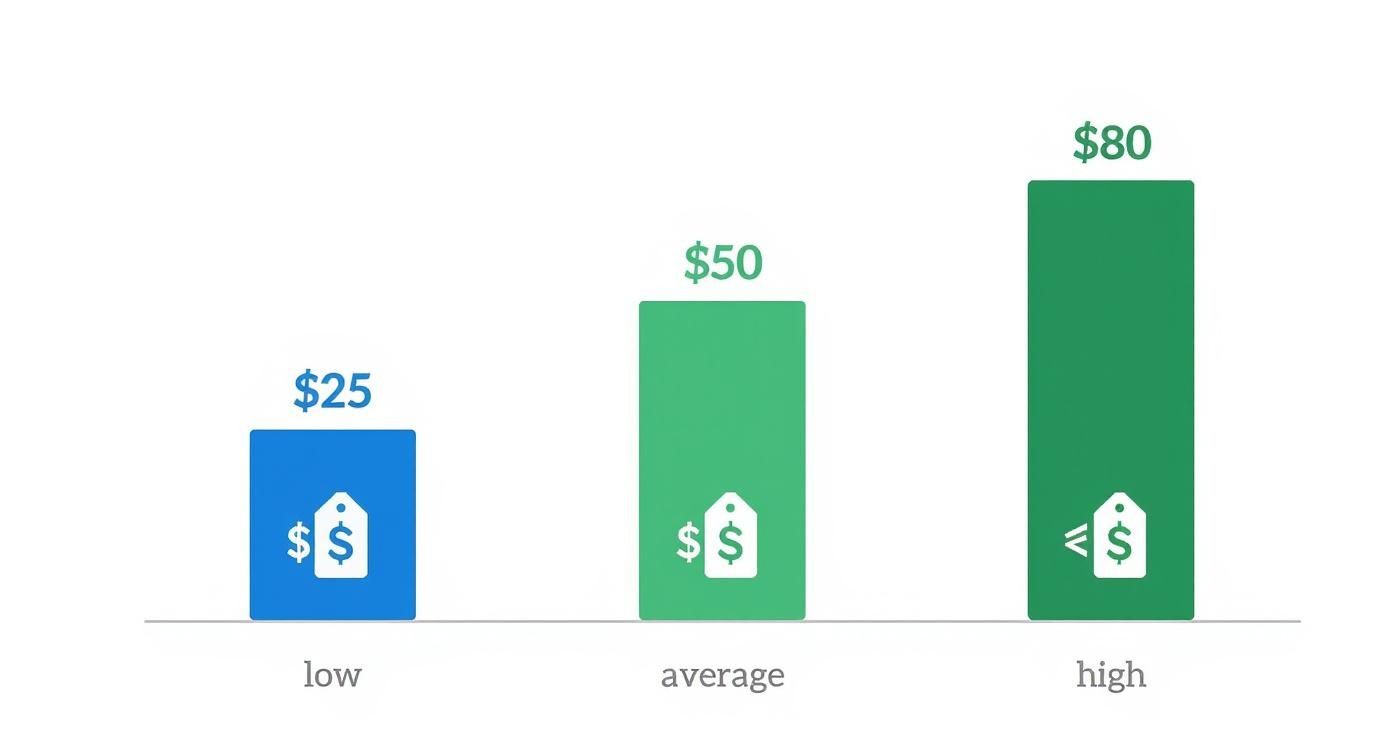
Bar chart illustrating low ($25), average ($50), and high ($80) price points.

As you can see, a $50 per hour rate is a common middle ground, but the floor and ceiling are far apart. Savvy business owners are increasingly adopting models like session packages and prepaid credits. These models encourage client commitment and create predictable revenue streams.

To give you a clearer picture, here is a breakdown of how rates can differ based on the subject and whether you're teaching online or meeting in person.

What are the average tutoring rates by subject and format?

Subject Area

Average Online Rate (per hour)

Average In-Person Rate (per hour)

K-12 Academic (Math/Reading)

$40 - $80

$50 - $90

Standardized Test Prep (SAT/ACT)

$80 - $150+

$90 - $170+

Language Instruction

$30 - $60

$40 - $70

Music Lessons

$40 - $75

$50 - $85

This table shows a clear trend: specialized subjects like test prep command higher prices. In-person tutoring often costs more to account for travel time. You can use these figures as a guide to position your own services effectively.

How much should you charge for tutoring?

Nailing your pricing is one of the most critical parts of running a tutoring business. You need to hit the sweet spot where your rates are competitive enough to bring in students. At the same time, they must be high enough to reflect the real value you're providing.

The first step is looking at the data. A highly specialized subject like AP Chemistry will always command a higher fee than elementary reading help. Location plays just as big a role. A tutor in New York can realistically charge more than one in Omaha due to cost of living differences.

How does price vary by subject and location?

The average price for tutoring swings wildly based on subject complexity and regional economics. Big cities with a higher cost of living almost always have higher tutoring rates than smaller towns. This geographic pricing gap is a huge factor you cannot ignore when setting your own rates.

For example, 2025 data shows that tutors in Seattle average $55 to $65 per hour, while their counterparts in Kansas City are closer to $40 to $48 per hour. That's the local economy's influence right there. The subject matter creates even wider gaps.

According to data from Care.com, specialized subjects always command premium prices because qualified instructors are harder to find. While general science tutoring might hover around $27.50 per hour, a complex subject like Mandarin Chinese can easily hit $75 per hour.

How do different subjects compare in price?

It all comes down to complexity and demand. Core subjects like math and English have a broad price range. However, niche subjects and high-stakes test prep will always sit at the top of the scale. This difference reflects the specialized knowledge needed to teach these topics well.

Here is a quick look at how pricing breaks down across different academic fields, based on current market data:

  • Academic Tutoring (K-12): Expect to see rates between $40 and $80 per hour, depending on the level (think algebra versus calculus).

  • Test Preparation (SAT/ACT): This is a premium service, often starting at $80 per hour and climbing to over $150 per hour for tutors with a proven track record.

  • Language Instruction: This varies from $30 per hour for a common language like Spanish to $60 per hour for Mandarin.

  • Music Lessons: Subjects like piano or guitar typically range from $40 to $75 per hour, influenced by the instructor's performance experience.

These numbers make it clear: there is no single "average price for tutoring." Pricing is a detailed calculation based on your expertise, your location, and what students are looking for. You can use a course fee calculator to model scenarios or review the latest tutoring price research on MyEngineeringBuddy.com.

What factors influence tutoring prices?

When you're trying to pin down the average price for tutoring, you will quickly find there is not a single, simple number. It is more like a sliding scale that moves based on a few key variables. A tutor's qualifications, the session format, and even technology can justify different price points.

Getting a handle on these factors is the key to setting rates that truly reflect the value you are providing. It is about building a price structure that is fair, competitive, and sustainable. A tutor’s background is easily one of the biggest drivers of cost.

How does tutor experience affect pricing?

A smart way to approach this is by structuring your pricing in tiers. This lets you match the experience levels on your team to a wider range of family budgets. It also ensures your most skilled educators are compensated fairly. It is a win-win.

This kind of tiered system creates a clear value ladder for your clients. They can easily see what they are paying for:

  • Beginner Tutors: These are often bright college students or recent grads. They are perfect for homework help and reinforcing core concepts, and their rates are the most accessible.

  • Intermediate Tutors: Think experienced educators, maybe with 5+ years of teaching behind them. They are equipped to handle more complex subjects and tackle specific learning challenges.

  • Advanced Tutors: These are your specialists, certified pros with advanced degrees or specific training (like Orton-Gillingham for dyslexia). They command the highest rates because their skills are rare and in high demand.

What is the difference between group and 1:1 pricing?

The session format itself has a huge impact on what you can charge. One-on-one tutoring offers the most personalized, focused attention, which is why it sits at the top of the pricing pyramid. Small group sessions are a powerful alternative.

Group sessions boost your revenue per teacher-hour. If you charge three students $50/hour each for a group class, you are bringing in $150 for that hour. This makes your services more affordable for families and maximizes your earning potential. You can learn more by checking out our guide on how to market tutoring online.

How does technology impact tutoring rates?

As of 2025, the average tutoring rate across the United States is hovering between $25 and $80 per hour. You will often find that online sessions are a bit more affordable than in-person ones. Technology is a big part of that equation.

New tools, like those found in AI-powered online math tutoring services, are changing what is possible. When tech makes a tutor more efficient, it can justify a competitive rate. The private tutoring market is projected to grow by an incredible $28.85 billion by 2029, highlighting surging demand.

Why is hourly pricing becoming outdated?

Let's be honest: the traditional pay-by-the-hour model is comfortable because it is familiar. But for tutoring centers, it is a source of administrative headaches and unpredictable revenue. Hourly pricing is dying in favor of packages and credits for a reason.

Modern alternatives like packages and prepaid credits do more than improve cash flow. They secure student commitment upfront and reduce the constant churn of clients dropping in and out. This shift turns your service from "selling time" into delivering a structured, high-value educational program.

While hourly billing seems straightforward, it holds many tutoring businesses back. Relying on a pay-as-you-go model leads to feast-or-famine revenue cycles. This makes it incredibly difficult to forecast income or manage expenses. That unpredictability is a massive operational risk.

On top of that, this model creates a never-ending cycle of admin work. You spend far too much time chasing individual payments and dealing with last-minute cancellations. Every hour billed separately is another invoice to send and another payment to track.

What are the downsides of hourly billing?

The problems with hourly pricing go beyond inconsistent cash flow. This model encourages a transactional relationship rather than a long-term partnership. When families pay one hour at a time, they feel less committed and are far more likely to cancel sessions.

This churn directly hammers your bottom line and wreaks havoc on your schedule. Just think about these common headaches:

  • Unpredictable Revenue: Your income swings wildly from week to week based on attendance, turning financial planning into a stressful guessing game.

  • Administrative Overload: Each session demands a separate billing action, from creating an invoice to following up on a late payment. It's a huge time sink.

  • Higher Client Churn: Without an upfront commitment, clients can easily pause or stop services, leaving you with empty, unpaid slots in your calendar.

A key psychological shift happens when you sell a package instead of an hour. You're no longer just a service provider; you become a partner in the student's long-term academic success, which builds loyalty and stability.

Why are packages and credits a better model?

Modern pricing structures, like selling session packages or using a prepaid credits system, solve the core problems of hourly billing. By collecting payment upfront for a block of sessions, you instantly improve your cash flow. This also locks in that client for a longer, more effective period.

This approach transforms the entire dynamic. Instead of selling disconnected hours, you are now delivering a complete educational program. For instance, a K-12 center might sell a 12-session package for $720 ($60/hr). A test prep center could offer a 20-session package for $2,400 ($120/hr).

This model delivers powerful advantages:

  • Improved Cash Flow: You get paid for multiple sessions at once, giving you the working capital you need to run and grow your business.

  • Reduced Churn: Clients are financially committed, which makes them far less likely to cancel appointments or discontinue your services. According to a 2024 Tutorbase study, centers using prepaid models see up to a 60% reduction in client churn.

  • Simplified Administration: One upfront payment replaces 10 or 20 individual invoices, dramatically cutting down on your billing workload.

With a system like Tutorbase, you can easily set up sophisticated pricing rules using Policy Packs. These let you automatically set premium rates for weekends, charge different fees for specific subjects, or enforce cancellation policies.

How can you implement modern pricing models?
A laptop displaying a 'PREPAID CREDITS' screen with data tables, alongside a plant and notebooks on a desk.

Moving beyond hourly payments requires a new playbook. When you shift to prepaid credits and packages, you guarantee revenue upfront. This simple change transforms your business from just selling time to delivering a structured, high-value program that increases cash flow.

The core idea is simple: instead of invoicing after every session, clients purchase credits in advance. A K-12 center might sell a 10-credit package for $700. A specialized test prep academy could offer a 30-credit package for $3,600. This approach secures commitment and boosts cash flow.

How do you structure prepaid credit packages?

Making this model work comes down to how you structure your packages. You need to create clear value propositions that nudge clients toward buying larger bundles. The goal is to make bigger commitments more attractive without devaluing your core service.

The best way to do this is by creating several tiers. Each tier should offer a slightly better per-session rate as a reward for the larger upfront investment. It is a natural way to encourage families to commit to a longer-term educational journey with your center.

  • Starter Package (10 Credits): This is perfect for new clients who want to try your services. Price this at your standard per-session rate.

  • Booster Package (20 Credits): Offer a 5% discount per session. This tier is for families ready to commit to a full term or semester.

  • Mastery Package (40 Credits): Provide a 10-15% discount per session. This package targets your most dedicated clients who see tutoring as a long-term investment.

This tiered approach simplifies the sales process. You can easily show families that the more they commit, the more they save. You can explore more options in our comprehensive guide to tutoring pricing models.

What are Policy Packs and why do you need them?

While credit packages manage your revenue, Policy Packs are your operational toolkit for protecting your bottom line. What is a Policy Pack? It is a set of pre-set rules that automatically handle tricky financial details, eliminating awkward conversations and manual invoice adjustments.

They are your automated business manager, enforcing your rules consistently and fairly. As technology advances, exploring innovations like AI tutors can open up entirely new ways to deliver and price your services, moving even further beyond the old hourly model.

Policy Packs codify the unwritten rules of your business. They protect your tutors' time and your center's revenue by automating policies that prevent financial losses from last-minute changes or no-shows.

Your Policy Pack should include clear, firm rules that are communicated to clients right from the start.

  • Weekend Premiums: Automatically add a 10-15% surcharge for sessions scheduled on high-demand Saturdays or Sundays.

  • Subject-Specific Rates: Assign different credit values to different services. For example, a standard math session might cost one credit, while a specialized Orton-Gillingham session costs 1.5 credits.

  • Cancellation Fees: Implement a strict but fair policy. A cancellation with more than 24 hours' notice might be free, but a last-minute cancellation forfeits the session credit.

By setting up these rules, you create a fair, transparent, and profitable operational framework. Software like Tutorbase automates these Policy Packs. This lets you implement any pricing model without spreadsheet gymnastics.

How does the global market affect your pricing?

It is easy to think of your local tutoring center as its own little world. However, you are actually part of a massive, booming global industry. Getting a handle on these bigger market trends can give you the confidence to set tutoring prices that truly reflect your value.

When you see your business as part of a thriving international market, justifying premium prices gets a whole lot easier. You are not just a neighborhood service; you are part of a critical educational ecosystem that families all over the world are investing in.

Why does global growth matter to you?

The private tutoring market is exploding, which tells you one thing clearly: the demand for personalized education is soaring everywhere. This is not just a flash in the pan. It is a fundamental shift in how families think about academic support.

This growth confirms that tutoring has gone from a "nice-to-have" supplement to a vital part of the education sector.

The global private tutoring market was valued at around $97.11 billion in 2023. According to Grand View Research, it is on track to hit $131.04 billion by 2025. This is a powerful signal that one-on-one learning support is a top priority for families worldwide.

How does online tutoring impact your local market?

The rise of online tutoring brings both challenges and opportunities. The U.S. online private tutoring market alone was worth $4.32 billion in 2024. It is expected to nearly double to $8.08 billion by 2030. Digitalization means your pool of clients is no longer limited by zip code.

To compete, you have to lean into what makes your center special. Maybe it is your deep knowledge of the local school curriculum or the community you build with in-person sessions. Understanding these global dynamics helps you position your business smartly. You can dig deeper into these tutoring statistics with our full analysis.

Frequently Asked Questions

How much should a beginner tutor charge per hour?

A beginner tutor, such as a college student, should typically charge between $25 and $40 per hour. This rate is competitive for basic homework help and subject reinforcement. It also reflects their experience level compared to more seasoned educators.

What is a fair price for online tutoring?

A fair price for online tutoring in 2025 generally ranges from $30 to $70 per hour. Rates for general subjects like K-12 math are on the lower end, while specialized areas like SAT prep or advanced science command prices at the higher end of that range.

How do I price group tutoring sessions?

To price group sessions, charge each student 60-70% of your one-on-one rate. For example, if your private rate is $60/hour, you could charge each student in a group of three about $40/hour. This increases your total hourly earnings to $120 while making tutoring more affordable for families.

Why should I use a prepaid credit model?

You should use a prepaid credit model because it secures revenue upfront, which dramatically improves cash flow. It also reduces client churn by over 60% by creating a financial commitment. This model also simplifies your administrative workload by eliminating the need to chase individual invoices.

How do you set a cancellation and no-show fee?

You should set a cancellation fee by requiring clients to provide at least 24 hours' notice to reschedule without penalty. For no-shows or cancellations within 24 hours, you should charge the full price of the session. This policy respects your tutor's time and protects your business from lost revenue.

What are Policy Packs?

Policy Packs are automated rule sets within tutoring management software. They enforce your business's specific pricing and operational rules. For example, they can automatically apply weekend premium rates, charge different fees for different subjects, or manage cancellation policies without any manual work.

How do I raise prices for existing clients?

To raise prices, you should give existing clients 60-90 days' advance notice. Frame the increase as an investment in quality, explaining it allows for better resources and top-tier tutors. Offering a small, one-time transitional discount can also help show you value their loyalty.

Should I list prices on my website?

Yes, you should list prices on your website. Price transparency builds trust with potential customers and acts as a filter. When families see your rates upfront, the inquiries you receive are from pre-qualified leads who are comfortable with the investment, saving you significant administrative time.

Ready to stop wrestling with spreadsheets and start managing your business efficiently? Tutorbase's Policy Packs let you implement any pricing model without spreadsheet gymnastics. Register for an account and see how you can transform your operations.

What is the average price for tutoring? A guide to pricing that drives growth

Published: December 2, 2025 by Amy Ashford

Key Takeaway: The average price for tutoring in 2025 ranges from $25 to $80 per hour, with specialized subjects like test prep commanding over $150. However, successful tutoring centers are moving away from hourly billing to prepaid packages and credit systems. This shift improves cash flow, reduces client churn, and simplifies administration.

So, what's the going rate for a tutor? The simple answer is that the average price for tutoring is usually between $25 to $80 per hour.

But that simple answer hides a much more complex reality. Factors like the subject matter, the tutor's experience, and whether the session is online or in-person will dramatically shift that price tag. While knowing the hourly average is a decent starting point, successful tutoring businesses are moving beyond it.

What is the quick guide to tutoring prices?

Figuring out what to charge can feel like a challenge. Your first step is to get a handle on industry benchmarks. This gives you a solid foundation for setting rates that are both competitive in your market and sustainable for your business.

While hourly billing is familiar, it's best to see it as just one piece of a much larger pricing puzzle. This section breaks down the key pricing benchmarks you need to know for 2025. The chart below gives you a quick visual snapshot of the general price range you'll see in the market.

Bar chart illustrating low ($25), average ($50), and high ($80) price points.

As you can see, a $50 per hour rate is a common middle ground, but the floor and ceiling are far apart. Savvy business owners are increasingly adopting models like session packages and prepaid credits. These models encourage client commitment and create predictable revenue streams.

To give you a clearer picture, here is a breakdown of how rates can differ based on the subject and whether you're teaching online or meeting in person.

What are the average tutoring rates by subject and format?

Subject Area

Average Online Rate (per hour)

Average In-Person Rate (per hour)

K-12 Academic (Math/Reading)

$40 - $80

$50 - $90

Standardized Test Prep (SAT/ACT)

$80 - $150+

$90 - $170+

Language Instruction

$30 - $60

$40 - $70

Music Lessons

$40 - $75

$50 - $85

This table shows a clear trend: specialized subjects like test prep command higher prices. In-person tutoring often costs more to account for travel time. You can use these figures as a guide to position your own services effectively.

How much should you charge for tutoring?

Nailing your pricing is one of the most critical parts of running a tutoring business. You need to hit the sweet spot where your rates are competitive enough to bring in students. At the same time, they must be high enough to reflect the real value you're providing.

The first step is looking at the data. A highly specialized subject like AP Chemistry will always command a higher fee than elementary reading help. Location plays just as big a role. A tutor in New York can realistically charge more than one in Omaha due to cost of living differences.

How does price vary by subject and location?

The average price for tutoring swings wildly based on subject complexity and regional economics. Big cities with a higher cost of living almost always have higher tutoring rates than smaller towns. This geographic pricing gap is a huge factor you cannot ignore when setting your own rates.

For example, 2025 data shows that tutors in Seattle average $55 to $65 per hour, while their counterparts in Kansas City are closer to $40 to $48 per hour. That's the local economy's influence right there. The subject matter creates even wider gaps.

According to data from Care.com, specialized subjects always command premium prices because qualified instructors are harder to find. While general science tutoring might hover around $27.50 per hour, a complex subject like Mandarin Chinese can easily hit $75 per hour.

How do different subjects compare in price?

It all comes down to complexity and demand. Core subjects like math and English have a broad price range. However, niche subjects and high-stakes test prep will always sit at the top of the scale. This difference reflects the specialized knowledge needed to teach these topics well.

Here is a quick look at how pricing breaks down across different academic fields, based on current market data:

  • Academic Tutoring (K-12): Expect to see rates between $40 and $80 per hour, depending on the level (think algebra versus calculus).

  • Test Preparation (SAT/ACT): This is a premium service, often starting at $80 per hour and climbing to over $150 per hour for tutors with a proven track record.

  • Language Instruction: This varies from $30 per hour for a common language like Spanish to $60 per hour for Mandarin.

  • Music Lessons: Subjects like piano or guitar typically range from $40 to $75 per hour, influenced by the instructor's performance experience.

These numbers make it clear: there is no single "average price for tutoring." Pricing is a detailed calculation based on your expertise, your location, and what students are looking for. You can use a course fee calculator to model scenarios or review the latest tutoring price research on MyEngineeringBuddy.com.

What factors influence tutoring prices?

When you're trying to pin down the average price for tutoring, you will quickly find there is not a single, simple number. It is more like a sliding scale that moves based on a few key variables. A tutor's qualifications, the session format, and even technology can justify different price points.

Getting a handle on these factors is the key to setting rates that truly reflect the value you are providing. It is about building a price structure that is fair, competitive, and sustainable. A tutor’s background is easily one of the biggest drivers of cost.

How does tutor experience affect pricing?

A smart way to approach this is by structuring your pricing in tiers. This lets you match the experience levels on your team to a wider range of family budgets. It also ensures your most skilled educators are compensated fairly. It is a win-win.

This kind of tiered system creates a clear value ladder for your clients. They can easily see what they are paying for:

  • Beginner Tutors: These are often bright college students or recent grads. They are perfect for homework help and reinforcing core concepts, and their rates are the most accessible.

  • Intermediate Tutors: Think experienced educators, maybe with 5+ years of teaching behind them. They are equipped to handle more complex subjects and tackle specific learning challenges.

  • Advanced Tutors: These are your specialists, certified pros with advanced degrees or specific training (like Orton-Gillingham for dyslexia). They command the highest rates because their skills are rare and in high demand.

What is the difference between group and 1:1 pricing?

The session format itself has a huge impact on what you can charge. One-on-one tutoring offers the most personalized, focused attention, which is why it sits at the top of the pricing pyramid. Small group sessions are a powerful alternative.

Group sessions boost your revenue per teacher-hour. If you charge three students $50/hour each for a group class, you are bringing in $150 for that hour. This makes your services more affordable for families and maximizes your earning potential. You can learn more by checking out our guide on how to market tutoring online.

How does technology impact tutoring rates?

As of 2025, the average tutoring rate across the United States is hovering between $25 and $80 per hour. You will often find that online sessions are a bit more affordable than in-person ones. Technology is a big part of that equation.

New tools, like those found in AI-powered online math tutoring services, are changing what is possible. When tech makes a tutor more efficient, it can justify a competitive rate. The private tutoring market is projected to grow by an incredible $28.85 billion by 2029, highlighting surging demand.

Why is hourly pricing becoming outdated?

Let's be honest: the traditional pay-by-the-hour model is comfortable because it is familiar. But for tutoring centers, it is a source of administrative headaches and unpredictable revenue. Hourly pricing is dying in favor of packages and credits for a reason.

Modern alternatives like packages and prepaid credits do more than improve cash flow. They secure student commitment upfront and reduce the constant churn of clients dropping in and out. This shift turns your service from "selling time" into delivering a structured, high-value educational program.

While hourly billing seems straightforward, it holds many tutoring businesses back. Relying on a pay-as-you-go model leads to feast-or-famine revenue cycles. This makes it incredibly difficult to forecast income or manage expenses. That unpredictability is a massive operational risk.

On top of that, this model creates a never-ending cycle of admin work. You spend far too much time chasing individual payments and dealing with last-minute cancellations. Every hour billed separately is another invoice to send and another payment to track.

What are the downsides of hourly billing?

The problems with hourly pricing go beyond inconsistent cash flow. This model encourages a transactional relationship rather than a long-term partnership. When families pay one hour at a time, they feel less committed and are far more likely to cancel sessions.

This churn directly hammers your bottom line and wreaks havoc on your schedule. Just think about these common headaches:

  • Unpredictable Revenue: Your income swings wildly from week to week based on attendance, turning financial planning into a stressful guessing game.

  • Administrative Overload: Each session demands a separate billing action, from creating an invoice to following up on a late payment. It's a huge time sink.

  • Higher Client Churn: Without an upfront commitment, clients can easily pause or stop services, leaving you with empty, unpaid slots in your calendar.

A key psychological shift happens when you sell a package instead of an hour. You're no longer just a service provider; you become a partner in the student's long-term academic success, which builds loyalty and stability.

Why are packages and credits a better model?

Modern pricing structures, like selling session packages or using a prepaid credits system, solve the core problems of hourly billing. By collecting payment upfront for a block of sessions, you instantly improve your cash flow. This also locks in that client for a longer, more effective period.

This approach transforms the entire dynamic. Instead of selling disconnected hours, you are now delivering a complete educational program. For instance, a K-12 center might sell a 12-session package for $720 ($60/hr). A test prep center could offer a 20-session package for $2,400 ($120/hr).

This model delivers powerful advantages:

  • Improved Cash Flow: You get paid for multiple sessions at once, giving you the working capital you need to run and grow your business.

  • Reduced Churn: Clients are financially committed, which makes them far less likely to cancel appointments or discontinue your services. According to a 2024 Tutorbase study, centers using prepaid models see up to a 60% reduction in client churn.

  • Simplified Administration: One upfront payment replaces 10 or 20 individual invoices, dramatically cutting down on your billing workload.

With a system like Tutorbase, you can easily set up sophisticated pricing rules using Policy Packs. These let you automatically set premium rates for weekends, charge different fees for specific subjects, or enforce cancellation policies.

How can you implement modern pricing models?

A laptop displaying a 'PREPAID CREDITS' screen with data tables, alongside a plant and notebooks on a desk.

Moving beyond hourly payments requires a new playbook. When you shift to prepaid credits and packages, you guarantee revenue upfront. This simple change transforms your business from just selling time to delivering a structured, high-value program that increases cash flow.

The core idea is simple: instead of invoicing after every session, clients purchase credits in advance. A K-12 center might sell a 10-credit package for $700. A specialized test prep academy could offer a 30-credit package for $3,600. This approach secures commitment and boosts cash flow.

How do you structure prepaid credit packages?

Making this model work comes down to how you structure your packages. You need to create clear value propositions that nudge clients toward buying larger bundles. The goal is to make bigger commitments more attractive without devaluing your core service.

The best way to do this is by creating several tiers. Each tier should offer a slightly better per-session rate as a reward for the larger upfront investment. It is a natural way to encourage families to commit to a longer-term educational journey with your center.

  • Starter Package (10 Credits): This is perfect for new clients who want to try your services. Price this at your standard per-session rate.

  • Booster Package (20 Credits): Offer a 5% discount per session. This tier is for families ready to commit to a full term or semester.

  • Mastery Package (40 Credits): Provide a 10-15% discount per session. This package targets your most dedicated clients who see tutoring as a long-term investment.

This tiered approach simplifies the sales process. You can easily show families that the more they commit, the more they save. You can explore more options in our comprehensive guide to tutoring pricing models.

What are Policy Packs and why do you need them?

While credit packages manage your revenue, Policy Packs are your operational toolkit for protecting your bottom line. What is a Policy Pack? It is a set of pre-set rules that automatically handle tricky financial details, eliminating awkward conversations and manual invoice adjustments.

They are your automated business manager, enforcing your rules consistently and fairly. As technology advances, exploring innovations like AI tutors can open up entirely new ways to deliver and price your services, moving even further beyond the old hourly model.

Policy Packs codify the unwritten rules of your business. They protect your tutors' time and your center's revenue by automating policies that prevent financial losses from last-minute changes or no-shows.

Your Policy Pack should include clear, firm rules that are communicated to clients right from the start.

  • Weekend Premiums: Automatically add a 10-15% surcharge for sessions scheduled on high-demand Saturdays or Sundays.

  • Subject-Specific Rates: Assign different credit values to different services. For example, a standard math session might cost one credit, while a specialized Orton-Gillingham session costs 1.5 credits.

  • Cancellation Fees: Implement a strict but fair policy. A cancellation with more than 24 hours' notice might be free, but a last-minute cancellation forfeits the session credit.

By setting up these rules, you create a fair, transparent, and profitable operational framework. Software like Tutorbase automates these Policy Packs. This lets you implement any pricing model without spreadsheet gymnastics.

How does the global market affect your pricing?

It is easy to think of your local tutoring center as its own little world. However, you are actually part of a massive, booming global industry. Getting a handle on these bigger market trends can give you the confidence to set tutoring prices that truly reflect your value.

When you see your business as part of a thriving international market, justifying premium prices gets a whole lot easier. You are not just a neighborhood service; you are part of a critical educational ecosystem that families all over the world are investing in.

Why does global growth matter to you?

The private tutoring market is exploding, which tells you one thing clearly: the demand for personalized education is soaring everywhere. This is not just a flash in the pan. It is a fundamental shift in how families think about academic support.

This growth confirms that tutoring has gone from a "nice-to-have" supplement to a vital part of the education sector.

The global private tutoring market was valued at around $97.11 billion in 2023. According to Grand View Research, it is on track to hit $131.04 billion by 2025. This is a powerful signal that one-on-one learning support is a top priority for families worldwide.

How does online tutoring impact your local market?

The rise of online tutoring brings both challenges and opportunities. The U.S. online private tutoring market alone was worth $4.32 billion in 2024. It is expected to nearly double to $8.08 billion by 2030. Digitalization means your pool of clients is no longer limited by zip code.

To compete, you have to lean into what makes your center special. Maybe it is your deep knowledge of the local school curriculum or the community you build with in-person sessions. Understanding these global dynamics helps you position your business smartly. You can dig deeper into these tutoring statistics with our full analysis.

Frequently Asked Questions

How much should a beginner tutor charge per hour?

A beginner tutor, such as a college student, should typically charge between $25 and $40 per hour. This rate is competitive for basic homework help and subject reinforcement. It also reflects their experience level compared to more seasoned educators.

What is a fair price for online tutoring?

A fair price for online tutoring in 2025 generally ranges from $30 to $70 per hour. Rates for general subjects like K-12 math are on the lower end, while specialized areas like SAT prep or advanced science command prices at the higher end of that range.

How do I price group tutoring sessions?

To price group sessions, charge each student 60-70% of your one-on-one rate. For example, if your private rate is $60/hour, you could charge each student in a group of three about $40/hour. This increases your total hourly earnings to $120 while making tutoring more affordable for families.

Why should I use a prepaid credit model?

You should use a prepaid credit model because it secures revenue upfront, which dramatically improves cash flow. It also reduces client churn by over 60% by creating a financial commitment. This model also simplifies your administrative workload by eliminating the need to chase individual invoices.

How do you set a cancellation and no-show fee?

You should set a cancellation fee by requiring clients to provide at least 24 hours' notice to reschedule without penalty. For no-shows or cancellations within 24 hours, you should charge the full price of the session. This policy respects your tutor's time and protects your business from lost revenue.

What are Policy Packs?

Policy Packs are automated rule sets within tutoring management software. They enforce your business's specific pricing and operational rules. For example, they can automatically apply weekend premium rates, charge different fees for different subjects, or manage cancellation policies without any manual work.

How do I raise prices for existing clients?

To raise prices, you should give existing clients 60-90 days' advance notice. Frame the increase as an investment in quality, explaining it allows for better resources and top-tier tutors. Offering a small, one-time transitional discount can also help show you value their loyalty.

Should I list prices on my website?

Yes, you should list prices on your website. Price transparency builds trust with potential customers and acts as a filter. When families see your rates upfront, the inquiries you receive are from pre-qualified leads who are comfortable with the investment, saving you significant administrative time.

Ready to stop wrestling with spreadsheets and start managing your business efficiently? Tutorbase's Policy Packs let you implement any pricing model without spreadsheet gymnastics. Register for an account and see how you can transform your operations.