
Average Tutoring Rates: A Clear Guide to Pricing Your Services in 2026

Published: December 12, 2025 by Amy Ashford

Key Takeaway: Average tutoring rates in 2026 range from $27-$55 per hour for online K-12 subjects to over $100 for specialized test prep. Your ideal price depends on your experience, the subject's complexity, your location, and the session format (online vs. in-person). A clear understanding of your profit margins is essential for building a sustainable business.

Trying to figure out what to charge for tutoring can feel complicated. Should you charge $25 an hour like a newer tutor? Or can you command over $100 like a seasoned test prep specialist?

The right price is a blend of your experience, the subject you teach, your location, and whether you meet students online or in person. This guide breaks down the market benchmarks and key factors you need to consider.

Understanding Tutoring Market Benchmarks

To set a rate that is both competitive and profitable, you must grasp what the market looks like. Pricing reflects your expertise, subject demand, and what local families are willing and able to pay. Get this wrong, and you either leave money on the table or price yourself out of the market.

In 2026, the average rate for online K-12 tutoring in the U.S. generally falls between $27 and $55 per hour. For in-person sessions, that bumps up to $35 to $68 per hour. Specialized subjects like test prep often pull in rates between $80 and $110 per hour.

This chart breaks down the average rates for the most common tutoring formats.
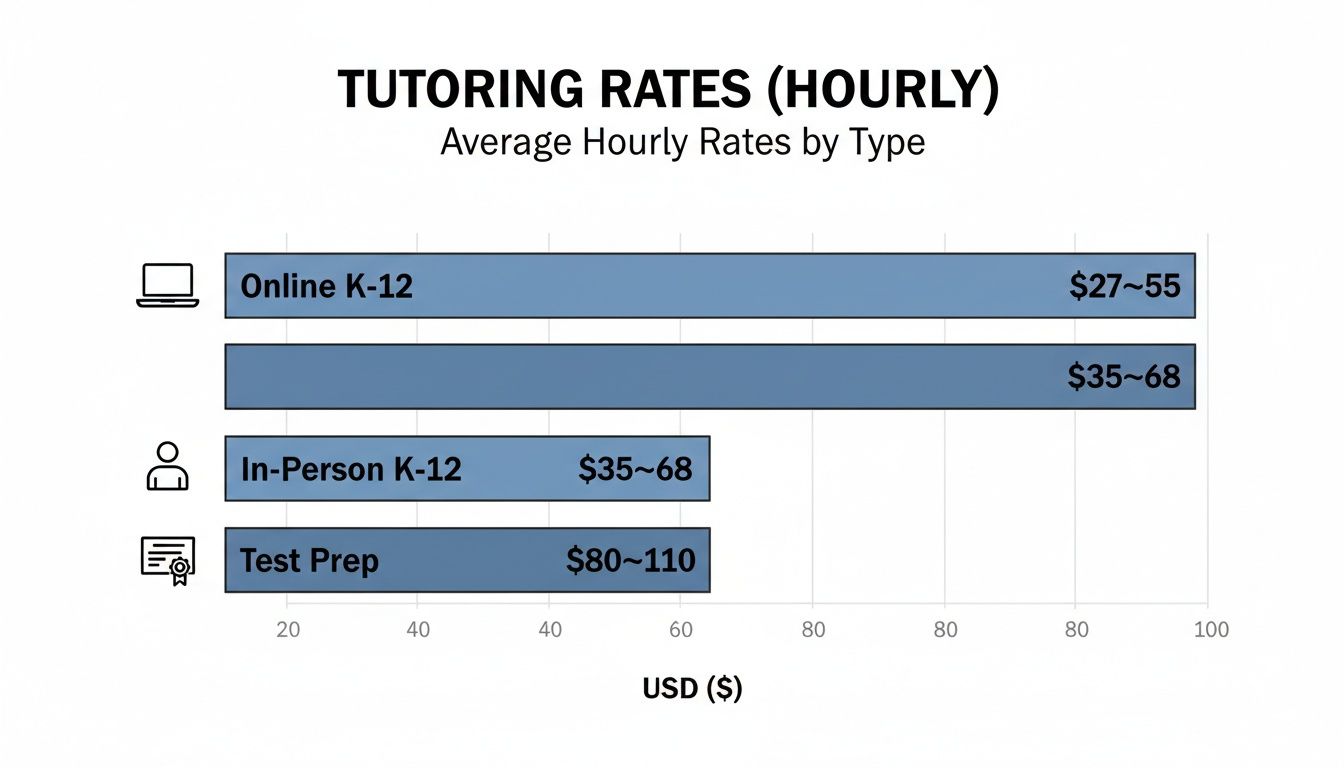
Bar chart displaying average hourly tutoring rates for Online K-12, In-Person K-12, and Test Prep.

As you can see, specialized services like test prep consistently fetch the highest rates. This is no surprise given the specific expertise and high stakes involved.

Average Hourly Tutoring Rates: A Comparison Table

Here is a quick-reference table summarizing the typical hourly rates you can expect across different tutoring categories. This provides a solid baseline for where your own services might fit.

Tutoring Category

Online Rate (per hour)

In-Person Rate (per hour)

K-12 Subjects

$27 – $55

$35 – $68

Test Prep (SAT, ACT, etc.)

$80 – $110

$90 – $125

Advanced STEM

$75 – $100

$85 – $115

College Level

$50 – $85

$60 – $95

These are just averages. Your unique skills, experience, and local market conditions will ultimately determine your final pricing. To build a strategy that truly fits your business, explore our detailed guide on tutoring pricing models.

Navigating The Global Tutoring Landscape

The private tutoring market is a massive, multi-billion dollar industry that is growing fast. Understanding the economic forces, popular services, and the online versus in-person dynamic is crucial for positioning your business to win. A global perspective helps you make smarter decisions about your offerings and pricing.

A desk with a laptop displaying 'SET YOUR RATES', a calculator, coffee cup, and notebook.

The global private tutoring market is expanding at an impressive clip. This growth is driven by rising academic competition and a worldwide shift toward seeing supplementary education as a necessity, not a luxury. This creates a huge opportunity for tutoring businesses ready to meet the demand.

What is the size of the tutoring market?

The numbers speak for themselves. In 2023, the global private tutoring market was valued at roughly $97.11 billion, a jump of nearly 6% from the year before. Projections show the market expanding at a compound annual growth rate (CAGR) of around 7% through 2030, which points to a very healthy industry. You can dig deeper into recent tutoring statistics.

It is also important to know what kind of tutoring is driving this growth. Academic tutoring is the undisputed heavyweight, making up a massive 68.2% of the global market share. Non-academic tutoring, which covers everything from hobbies to sports coaching, accounts for the other 31.8%.

What key forces drive industry expansion?

Several key trends push the industry forward, and they influence everything from student demand to the average rates you can realistically charge. Understanding them helps you align your business with what today's clients are looking for.

  • Increased Academic Competition: Intense competition for university admissions and jobs pushes parents and students to seek tutoring for an academic edge, especially for high-stakes exams.

  • Addressing Learning Gaps: The need to close learning gaps has become a major driver. High-dosage tutoring is now widely recognized as an effective way to help students catch up, which has sent demand soaring.

  • Globalization of Education: Students now compete on a global stage. This pushes families to invest in services like language instruction and prep for international exams, broadening the market even further.

The Shift Between In-Person and Online Tutoring

The delivery of tutoring is also changing dramatically. While in-person tutoring was once the only option, digital platforms have permanently reshaped the landscape. The choice between online and in-person is now a key decision for both tutors and families.

Online tutoring offers convenience and often a lower price, eliminating geographical limits. Conversely, in-person tutoring provides a direct connection that many students and parents prefer, especially for younger kids. The most successful tutoring businesses will likely offer a hybrid model, catering to different preferences.

What Really Determines Your Tutoring Rate?

Your pricing tells a story about the value and expertise you bring. It explains why one tutor can charge $30 an hour while a specialist commands $150 for the same 60 minutes. Figuring out what to charge requires looking at a few key factors to build a fair and profitable pricing structure.

How do experience and credentials impact price?

Your background is the bedrock of your pricing. A tutor with a master's degree and a decade of teaching experience can confidently charge more than a college student. These qualifications signal deeper expertise and a proven history of results.

Consider where you fall on this spectrum:

  • Years of Experience: Tutors with 5+ years of professional experience often charge 25-50% more than newcomers. This experience translates into a refined teaching style.

  • Educational Background: A PhD in Chemistry or a state teaching license justifies premium rates, especially for high-level subjects like AP Chemistry.

  • Proven Results: If you can show a track record, like helping students boost their SAT scores by an average of 200 points, you have a powerful reason to charge a premium.

How do subject matter and grade level affect rates?

Not all subjects are created equal in the market. More specialized and high-stakes subjects command higher rates. A student’s grade level also makes a big difference, as the material gets more complex. Helping a third-grader with reading requires a different toolkit than prepping a junior for the AP Calculus exam.

Tutoring for specialized tests like the SAT, ACT, or LSAT almost always fetches the highest rates. Market data from Wyzant shows these services can run from $80 to $150 per hour. The stakes are high, the expertise is rare, and the outcome directly impacts a student's future.

Subject Category

Elementary School

Middle School

High School (AP/IB)

General Homework Help

$30 - $50

$35 - $60

$40 - $70

Math & Science

$40 - $60

$50 - $75

$65 - $100

Test Preparation

N/A

$60 - $85

$80 - $150

What is the role of location and session format?

Where and how you teach plays a huge role in what you can charge. Tutors in high-cost-of-living areas like New York or San Francisco naturally have higher rates. If you are the only AP Physics tutor in town, you also have more pricing power. The format of the lesson is the other big variable.

  • In-Person Tutoring: Rates are often 10-25% higher to cover travel time and costs. Many parents still value a direct connection and will pay for it.

  • Online Tutoring: With no travel and lower overhead, you can offer more competitive pricing. This also expands your potential market beyond your immediate area.

  • Group Sessions: You can earn a higher overall hourly rate while offering a lower cost per student. For instance, charging three students $40/hour each nets you $120/hour.

How To Calculate Your Actual Profit Margins

Knowing your hourly rate is just the first piece of the puzzle. Real profitability comes from understanding what is left after all costs are paid. This separates a business that is just running from one that is actually thriving. Let’s break down how to calculate your margins step-by-step.

An adult tutor, wearing glasses, helps a young student with academic work at a desk with stacked books.

First, you need to calculate your gross profit. Gross profit is your total revenue minus the direct cost of delivering your service, which is primarily tutor pay. This number tells you how much money each session generates before you factor in overhead. Next, you must account for your operating costs.

How do I identify my core business expenses?

To get a true picture of your profitability, you must identify every single business expense. These overhead costs can silently eat away at your revenue if you do not watch them closely. Your list needs to cover both fixed and variable expenses.

Common operating costs typically include:

  • Rent or Mortgage: The cost for your physical tutoring space.

  • Utilities: Electricity, internet, and phone bills.

  • Marketing and Advertising: Money spent on flyers, online ads, or social media.

  • Software Subscriptions: Fees for scheduling, billing, and management platforms.

  • Curriculum and Materials: The price of workbooks, online resources, and printing.

  • Insurance and Professional Fees: Business liability insurance and accounting services.

A Step-by-Step Margin Calculation

Let's walk through a real-world example. Imagine your tutoring center brought in $20,000 in revenue last month. During that month, you paid your tutors $11,000. That leaves you with a gross profit of $9,000.

Now, let's subtract operating costs, which we will say added up to $4,500 for the month. Your net profit, the money you actually keep, is $4,500. To find your net profit margin, you divide net profit by total revenue: ($4,500 / $20,000) = 0.225. This gives you a net profit margin of 22.5%.

A healthy net profit margin for a tutoring business typically falls between 15% and 25%. If yours is below that, you might need to adjust pricing or trim costs. Our course fee calculator is a great tool for experimenting with different scenarios.

Sample Margin Calculation: A Comparison Table

This table breaks down revenue, tutor pay, and operating costs to reveal the final profit margin in a typical scenario.

Financial Metric

Example Calculation

Result

Total Monthly Revenue

500 tutoring hours @ $40/hour

$20,000

Cost of Services (Tutor Pay)

Tutors paid 55% of revenue

-$11,000

Gross Profit

$20,000 - $11,000

$9,000

Operating Costs

Rent, software, marketing, etc.

-$4,500

Net Profit

$9,000 - $4,500

$4,500

Net Profit Margin

($4,500 / $20,000) x 100

22.5%

This calculation shows that for every dollar your business earns, you keep 22.5 cents as profit. Running this analysis regularly helps you make smarter decisions about rates, expenses, and growth.

How Technology is Reshaping Tutoring Prices

A calculator, pen, and financial documents on a wooden desk with the text 'KNOW YOUR MARGIN'.

Technology is a major factor in setting modern tutoring rates. Platforms that automate scheduling and billing can slash your administrative overhead. This gives you the flexibility to boost profit margins or offer more competitive prices. At the same time, you must bake the cost of sophisticated software into your pricing.

The global private tutoring market is projected to hit $192.09 billion by 2029, a huge jump from $131.04 billion in 2025. This surge is overwhelmingly driven by digital platforms and AI. You can dig into more academic tutoring market trends from Research and Markets.

What is tutoring center billing automation?

Tutoring center billing automation is the use of software to handle financial tasks like invoicing, payment collection, and payroll without manual intervention. Manual billing is a time drain. Creating invoices, chasing payments, and juggling payment methods are admin tasks that steal time from growing your business. This is where automation changes the game.

An automated billing system does the heavy lifting for you. It can instantly send an accurate invoice when a tutor marks a lesson as complete. This saves hours of work and eliminates human errors that eat away at your revenue.

How does automation reduce overhead costs?

By putting administrative workflows on autopilot, you can reclaim a huge chunk of your operational budget. A smart scheduling system prevents costly double-bookings. This efficiency means you can serve more students without hiring more admin staff.

The benefits are real and measurable:

  • Fewer Admin Hours: Centers using management software report an average 60% reduction in time spent on administrative tasks.

  • Faster Payments: Automated reminders and simple online payment options mean you get paid quicker, which improves cash flow.

  • No More Costly Errors: Automation eliminates manual data entry for payroll and invoicing, preventing expensive mistakes.

Understanding the return on investment of tutoring management software is crucial here. The initial software cost is often paid back quickly through time savings and fewer operational headaches.

The Influence of AI and Digital Learning Tools

The other side of the tech coin is the rising cost of advanced learning tools. AI-powered platforms, virtual reality labs, and interactive curricula can deliver an incredible educational experience. This absolutely justifies a higher price point. But these premium tools come with subscription fees that become a direct business expense.

Technology Type

Impact on Costs

Impact on Pricing

Management Software

Reduces administrative overhead and labour costs.

Allows for more competitive pricing or higher profit margins.

AI Learning Platforms

Increases monthly subscription expenses.

Justifies premium rates due to enhanced learning outcomes.

Virtual Classroom Tools

Adds costs for licenses and maintenance.

Can be offset by savings from reduced physical classroom needs.

Technology gives you a powerful lever to refine your business model. Automation helps you control costs, while advanced learning tools let you create a premium service. A comprehensive platform like Tutorbase helps achieve this by combining smart scheduling with automated billing and payroll.

A Framework for Setting and Raising Your Rates

Setting your tutoring rates is a strategic decision. It requires balancing what the market will bear with your business goals. Getting it right takes solid market research, a clear definition of your value, and a pricing model built for growth. The same rules apply when it is time to raise rates.

A solid framework takes the guesswork out of the process. This is your action plan for setting initial prices and knowing when and how to increase them. This is how you stay competitive and profitable in 2026 and beyond.

How can I start with smart market research?

Before you set a price, you must understand the local landscape. Sizing up your competitors’ rates gives you a crucial baseline. This is not about copying them; it is about positioning yourself intelligently. You need to know the going rate for similar subjects and experience levels in your area.

First, identify 5-7 direct competitors. Look at both independent tutors and established centers. Then, document their pricing for services that overlap with yours.

  • Look for patterns: Are online sessions always cheaper? By how much?

  • Identify premium services: What are specialists charging for AP Physics or SAT prep?

  • Note the outliers: Who is charging way more or less than everyone else, and why?

How do I communicate my value, not just my price?

Once you have landed on a number, you have to own it. New clients are not just looking at the price; they are trying to understand the value behind it. Your pricing conversations should always focus on outcomes, not just hours. Instead of saying, "We charge $70 per hour," frame it with the benefit.

When it comes to raising rates for existing clients, transparency is everything. Give them plenty of notice, at least 30-60 days, and briefly explain the reason. A small, well-explained annual increase usually goes over much better than a sudden, large hike.

To build a robust pricing framework, you can borrow techniques from other industries. Exploring concepts like scenario analysis in finance can help you predict how different pricing structures might impact your bottom line under various market conditions.

Automate Your Operations to Protect Margins

Finally, remember that setting the right rate is only half the battle; you also have to protect your profit margins. Administrative tasks like scheduling, invoicing, and chasing payments are hidden costs that quietly eat away at your earnings. Automating these workflows is one of the fastest ways to boost your bottom line.

Platforms designed for tutoring centers can slash this admin time. By streamlining your day-to-day operations, you ensure more of every dollar goes toward growth. This efficiency gives you the stability to invest in quality and scale your business. To see how automation can improve your profitability, check out platforms like Tutorbase.

Frequently Asked Questions About Tutoring Rates

Got questions about setting your tutoring rates? You're not alone. This is where most center owners and solo tutors get stuck. Let's clear up the confusion with some straight-to-the-point answers.

How much should I charge for tutoring per hour?

The right rate for tutoring depends on your experience, the subject's difficulty, your location, and the session format. A new K-12 tutor might charge $25 to $40 per hour. A seasoned test-prep specialist with a proven track record could command $80 to $150. Researching local competitor rates is the best first step.

Should online tutoring be cheaper than in-person?

Yes, in most cases online tutoring should be cheaper. Online tutoring eliminates travel time and costs for both the tutor and the client, so it is common to pass on those savings. Many tutors price their online sessions about 10% to 20% lower than their in-person rates, making it an attractive option for families.

How do I set prices for group tutoring sessions?

You should charge less per student for group tutoring than your one-on-one rate, but ensure the total hourly earning is higher. For example, if you charge $60/hour for private tutoring, you could offer a group session for three students at $35/hour each. Each family saves money, and you now earn $105/hour.

What is a fair pay rate for my tutors?

A common and sustainable model for a tutoring center is to pay tutors 40% to 60% of the client's fee. For instance, if you charge a student $70/hour for a session, paying the tutor $35 (50%) is a standard split. This keeps pay competitive enough to attract top talent while leaving enough margin to cover business costs.

How often should I re-evaluate my tutoring rates?

You should review your tutoring rates at least once a year. Consider factors like inflation, any new qualifications you have gained, and changes in the local market. A long waitlist of prospective clients is a strong indicator that your rates may be too low and an increase is warranted.

How do I justify a rate increase to existing clients?

When you raise your rates, be transparent and give families at least 30 to 60 days' notice. Frame the increase as an investment in their child's success, mentioning new curriculum, advanced tutor certifications, or new learning software. When clients see the added value, they are more likely to understand.

What factors justify charging a premium rate?

You can charge a premium rate if you have advanced degrees (Master's or PhD), 10+ years of experience, or specialized certifications. A documented track record of exceptional student results, such as helping students consistently score in the top 1% on standardized tests, also justifies a higher price.

Can I offer different rates for different subjects?

Yes, it is standard practice to charge more for subjects that require a deeper level of expertise. Tutoring for AP Calculus or LSAT prep demands more specialized knowledge than helping a third-grader with reading. Your pricing should reflect this difference in complexity and value.

Running a tutoring business is about more than just teaching—it's about managing endless admin tasks. Tutorbase streamlines your scheduling, billing, and payroll, cutting down your admin work by up to 60% so you can focus on growth. See how you can improve your margins by visiting tutorbase.com/register.

Average Tutoring Rates: A Clear Guide to Pricing Your Services in 2026

Published: December 11, 2025 by Amy Ashford

Key Takeaway: Average tutoring rates in 2026 range from $27-$55 per hour for online K-12 subjects to over $100 for specialized test prep. Your ideal price depends on your experience, the subject's complexity, your location, and the session format (online vs. in-person). A clear understanding of your profit margins is essential for building a sustainable business.

Trying to figure out what to charge for tutoring can feel complicated. Should you charge $25 an hour like a newer tutor? Or can you command over $100 like a seasoned test prep specialist?

The right price is a blend of your experience, the subject you teach, your location, and whether you meet students online or in person. This guide breaks down the market benchmarks and key factors you need to consider.

Understanding Tutoring Market Benchmarks

To set a rate that is both competitive and profitable, you must grasp what the market looks like. Pricing reflects your expertise, subject demand, and what local families are willing and able to pay. Get this wrong, and you either leave money on the table or price yourself out of the market.

In 2026, the average rate for online K-12 tutoring in the U.S. generally falls between $27 and $55 per hour. For in-person sessions, that bumps up to $35 to $68 per hour. Specialized subjects like test prep often pull in rates between $80 and $110 per hour.

This chart breaks down the average rates for the most common tutoring formats.

Bar chart displaying average hourly tutoring rates for Online K-12, In-Person K-12, and Test Prep.

As you can see, specialized services like test prep consistently fetch the highest rates. This is no surprise given the specific expertise and high stakes involved.

Average Hourly Tutoring Rates: A Comparison Table

Here is a quick-reference table summarizing the typical hourly rates you can expect across different tutoring categories. This provides a solid baseline for where your own services might fit.

Tutoring Category

Online Rate (per hour)

In-Person Rate (per hour)

K-12 Subjects

$27 – $55

$35 – $68

Test Prep (SAT, ACT, etc.)

$80 – $110

$90 – $125

Advanced STEM

$75 – $100

$85 – $115

College Level

$50 – $85

$60 – $95

These are just averages. Your unique skills, experience, and local market conditions will ultimately determine your final pricing. To build a strategy that truly fits your business, explore our detailed guide on tutoring pricing models.

Navigating The Global Tutoring Landscape

The private tutoring market is a massive, multi-billion dollar industry that is growing fast. Understanding the economic forces, popular services, and the online versus in-person dynamic is crucial for positioning your business to win. A global perspective helps you make smarter decisions about your offerings and pricing.

A desk with a laptop displaying 'SET YOUR RATES', a calculator, coffee cup, and notebook.

The global private tutoring market is expanding at an impressive clip. This growth is driven by rising academic competition and a worldwide shift toward seeing supplementary education as a necessity, not a luxury. This creates a huge opportunity for tutoring businesses ready to meet the demand.

What is the size of the tutoring market?

The numbers speak for themselves. In 2023, the global private tutoring market was valued at roughly $97.11 billion, a jump of nearly 6% from the year before. Projections show the market expanding at a compound annual growth rate (CAGR) of around 7% through 2030, which points to a very healthy industry. You can dig deeper into recent tutoring statistics.

It is also important to know what kind of tutoring is driving this growth. Academic tutoring is the undisputed heavyweight, making up a massive 68.2% of the global market share. Non-academic tutoring, which covers everything from hobbies to sports coaching, accounts for the other 31.8%.

What key forces drive industry expansion?

Several key trends push the industry forward, and they influence everything from student demand to the average rates you can realistically charge. Understanding them helps you align your business with what today's clients are looking for.

  • Increased Academic Competition: Intense competition for university admissions and jobs pushes parents and students to seek tutoring for an academic edge, especially for high-stakes exams.

  • Addressing Learning Gaps: The need to close learning gaps has become a major driver. High-dosage tutoring is now widely recognized as an effective way to help students catch up, which has sent demand soaring.

  • Globalization of Education: Students now compete on a global stage. This pushes families to invest in services like language instruction and prep for international exams, broadening the market even further.

The Shift Between In-Person and Online Tutoring

The delivery of tutoring is also changing dramatically. While in-person tutoring was once the only option, digital platforms have permanently reshaped the landscape. The choice between online and in-person is now a key decision for both tutors and families.

Online tutoring offers convenience and often a lower price, eliminating geographical limits. Conversely, in-person tutoring provides a direct connection that many students and parents prefer, especially for younger kids. The most successful tutoring businesses will likely offer a hybrid model, catering to different preferences.

What Really Determines Your Tutoring Rate?

Your pricing tells a story about the value and expertise you bring. It explains why one tutor can charge $30 an hour while a specialist commands $150 for the same 60 minutes. Figuring out what to charge requires looking at a few key factors to build a fair and profitable pricing structure.

How do experience and credentials impact price?

Your background is the bedrock of your pricing. A tutor with a master's degree and a decade of teaching experience can confidently charge more than a college student. These qualifications signal deeper expertise and a proven history of results.

Consider where you fall on this spectrum:

  • Years of Experience: Tutors with 5+ years of professional experience often charge 25-50% more than newcomers. This experience translates into a refined teaching style.

  • Educational Background: A PhD in Chemistry or a state teaching license justifies premium rates, especially for high-level subjects like AP Chemistry.

  • Proven Results: If you can show a track record, like helping students boost their SAT scores by an average of 200 points, you have a powerful reason to charge a premium.

How do subject matter and grade level affect rates?

Not all subjects are created equal in the market. More specialized and high-stakes subjects command higher rates. A student’s grade level also makes a big difference, as the material gets more complex. Helping a third-grader with reading requires a different toolkit than prepping a junior for the AP Calculus exam.

Tutoring for specialized tests like the SAT, ACT, or LSAT almost always fetches the highest rates. Market data from Wyzant shows these services can run from $80 to $150 per hour. The stakes are high, the expertise is rare, and the outcome directly impacts a student's future.

Subject Category

Elementary School

Middle School

High School (AP/IB)

General Homework Help

$30 - $50

$35 - $60

$40 - $70

Math & Science

$40 - $60

$50 - $75

$65 - $100

Test Preparation

N/A

$60 - $85

$80 - $150

What is the role of location and session format?

Where and how you teach plays a huge role in what you can charge. Tutors in high-cost-of-living areas like New York or San Francisco naturally have higher rates. If you are the only AP Physics tutor in town, you also have more pricing power. The format of the lesson is the other big variable.

  • In-Person Tutoring: Rates are often 10-25% higher to cover travel time and costs. Many parents still value a direct connection and will pay for it.

  • Online Tutoring: With no travel and lower overhead, you can offer more competitive pricing. This also expands your potential market beyond your immediate area.

  • Group Sessions: You can earn a higher overall hourly rate while offering a lower cost per student. For instance, charging three students $40/hour each nets you $120/hour.

How To Calculate Your Actual Profit Margins

Knowing your hourly rate is just the first piece of the puzzle. Real profitability comes from understanding what is left after all costs are paid. This separates a business that is just running from one that is actually thriving. Let’s break down how to calculate your margins step-by-step.

An adult tutor, wearing glasses, helps a young student with academic work at a desk with stacked books.

First, you need to calculate your gross profit. Gross profit is your total revenue minus the direct cost of delivering your service, which is primarily tutor pay. This number tells you how much money each session generates before you factor in overhead. Next, you must account for your operating costs.

How do I identify my core business expenses?

To get a true picture of your profitability, you must identify every single business expense. These overhead costs can silently eat away at your revenue if you do not watch them closely. Your list needs to cover both fixed and variable expenses.

Common operating costs typically include:

  • Rent or Mortgage: The cost for your physical tutoring space.

  • Utilities: Electricity, internet, and phone bills.

  • Marketing and Advertising: Money spent on flyers, online ads, or social media.

  • Software Subscriptions: Fees for scheduling, billing, and management platforms.

  • Curriculum and Materials: The price of workbooks, online resources, and printing.

  • Insurance and Professional Fees: Business liability insurance and accounting services.

A Step-by-Step Margin Calculation

Let's walk through a real-world example. Imagine your tutoring center brought in $20,000 in revenue last month. During that month, you paid your tutors $11,000. That leaves you with a gross profit of $9,000.

Now, let's subtract operating costs, which we will say added up to $4,500 for the month. Your net profit, the money you actually keep, is $4,500. To find your net profit margin, you divide net profit by total revenue: ($4,500 / $20,000) = 0.225. This gives you a net profit margin of 22.5%.

A healthy net profit margin for a tutoring business typically falls between 15% and 25%. If yours is below that, you might need to adjust pricing or trim costs. Our course fee calculator is a great tool for experimenting with different scenarios.

Sample Margin Calculation: A Comparison Table

This table breaks down revenue, tutor pay, and operating costs to reveal the final profit margin in a typical scenario.

Financial Metric

Example Calculation

Result

Total Monthly Revenue

500 tutoring hours @ $40/hour

$20,000

Cost of Services (Tutor Pay)

Tutors paid 55% of revenue

-$11,000

Gross Profit

$20,000 - $11,000

$9,000

Operating Costs

Rent, software, marketing, etc.

-$4,500

Net Profit

$9,000 - $4,500

$4,500

Net Profit Margin

($4,500 / $20,000) x 100

22.5%

This calculation shows that for every dollar your business earns, you keep 22.5 cents as profit. Running this analysis regularly helps you make smarter decisions about rates, expenses, and growth.

How Technology is Reshaping Tutoring Prices

A calculator, pen, and financial documents on a wooden desk with the text 'KNOW YOUR MARGIN'.

Technology is a major factor in setting modern tutoring rates. Platforms that automate scheduling and billing can slash your administrative overhead. This gives you the flexibility to boost profit margins or offer more competitive prices. At the same time, you must bake the cost of sophisticated software into your pricing.

The global private tutoring market is projected to hit $192.09 billion by 2029, a huge jump from $131.04 billion in 2025. This surge is overwhelmingly driven by digital platforms and AI. You can dig into more academic tutoring market trends from Research and Markets.

What is tutoring center billing automation?

Tutoring center billing automation is the use of software to handle financial tasks like invoicing, payment collection, and payroll without manual intervention. Manual billing is a time drain. Creating invoices, chasing payments, and juggling payment methods are admin tasks that steal time from growing your business. This is where automation changes the game.

An automated billing system does the heavy lifting for you. It can instantly send an accurate invoice when a tutor marks a lesson as complete. This saves hours of work and eliminates human errors that eat away at your revenue.

How does automation reduce overhead costs?

By putting administrative workflows on autopilot, you can reclaim a huge chunk of your operational budget. A smart scheduling system prevents costly double-bookings. This efficiency means you can serve more students without hiring more admin staff.

The benefits are real and measurable:

  • Fewer Admin Hours: Centers using management software report an average 60% reduction in time spent on administrative tasks.

  • Faster Payments: Automated reminders and simple online payment options mean you get paid quicker, which improves cash flow.

  • No More Costly Errors: Automation eliminates manual data entry for payroll and invoicing, preventing expensive mistakes.

Understanding the return on investment of tutoring management software is crucial here. The initial software cost is often paid back quickly through time savings and fewer operational headaches.

The Influence of AI and Digital Learning Tools

The other side of the tech coin is the rising cost of advanced learning tools. AI-powered platforms, virtual reality labs, and interactive curricula can deliver an incredible educational experience. This absolutely justifies a higher price point. But these premium tools come with subscription fees that become a direct business expense.

Technology Type

Impact on Costs

Impact on Pricing

Management Software

Reduces administrative overhead and labour costs.

Allows for more competitive pricing or higher profit margins.

AI Learning Platforms

Increases monthly subscription expenses.

Justifies premium rates due to enhanced learning outcomes.

Virtual Classroom Tools

Adds costs for licenses and maintenance.

Can be offset by savings from reduced physical classroom needs.

Technology gives you a powerful lever to refine your business model. Automation helps you control costs, while advanced learning tools let you create a premium service. A comprehensive platform like Tutorbase helps achieve this by combining smart scheduling with automated billing and payroll.

A Framework for Setting and Raising Your Rates

Setting your tutoring rates is a strategic decision. It requires balancing what the market will bear with your business goals. Getting it right takes solid market research, a clear definition of your value, and a pricing model built for growth. The same rules apply when it is time to raise rates.

A solid framework takes the guesswork out of the process. This is your action plan for setting initial prices and knowing when and how to increase them. This is how you stay competitive and profitable in 2026 and beyond.

How can I start with smart market research?

Before you set a price, you must understand the local landscape. Sizing up your competitors’ rates gives you a crucial baseline. This is not about copying them; it is about positioning yourself intelligently. You need to know the going rate for similar subjects and experience levels in your area.

First, identify 5-7 direct competitors. Look at both independent tutors and established centers. Then, document their pricing for services that overlap with yours.

  • Look for patterns: Are online sessions always cheaper? By how much?

  • Identify premium services: What are specialists charging for AP Physics or SAT prep?

  • Note the outliers: Who is charging way more or less than everyone else, and why?

How do I communicate my value, not just my price?

Once you have landed on a number, you have to own it. New clients are not just looking at the price; they are trying to understand the value behind it. Your pricing conversations should always focus on outcomes, not just hours. Instead of saying, "We charge $70 per hour," frame it with the benefit.

When it comes to raising rates for existing clients, transparency is everything. Give them plenty of notice, at least 30-60 days, and briefly explain the reason. A small, well-explained annual increase usually goes over much better than a sudden, large hike.

To build a robust pricing framework, you can borrow techniques from other industries. Exploring concepts like scenario analysis in finance can help you predict how different pricing structures might impact your bottom line under various market conditions.

Automate Your Operations to Protect Margins

Finally, remember that setting the right rate is only half the battle; you also have to protect your profit margins. Administrative tasks like scheduling, invoicing, and chasing payments are hidden costs that quietly eat away at your earnings. Automating these workflows is one of the fastest ways to boost your bottom line.

Platforms designed for tutoring centers can slash this admin time. By streamlining your day-to-day operations, you ensure more of every dollar goes toward growth. This efficiency gives you the stability to invest in quality and scale your business. To see how automation can improve your profitability, check out platforms like Tutorbase.

Frequently Asked Questions About Tutoring Rates

Got questions about setting your tutoring rates? You're not alone. This is where most center owners and solo tutors get stuck. Let's clear up the confusion with some straight-to-the-point answers.

How much should I charge for tutoring per hour?

The right rate for tutoring depends on your experience, the subject's difficulty, your location, and the session format. A new K-12 tutor might charge $25 to $40 per hour. A seasoned test-prep specialist with a proven track record could command $80 to $150. Researching local competitor rates is the best first step.

Should online tutoring be cheaper than in-person?

Yes, in most cases online tutoring should be cheaper. Online tutoring eliminates travel time and costs for both the tutor and the client, so it is common to pass on those savings. Many tutors price their online sessions about 10% to 20% lower than their in-person rates, making it an attractive option for families.

How do I set prices for group tutoring sessions?

You should charge less per student for group tutoring than your one-on-one rate, but ensure the total hourly earning is higher. For example, if you charge $60/hour for private tutoring, you could offer a group session for three students at $35/hour each. Each family saves money, and you now earn $105/hour.

What is a fair pay rate for my tutors?

A common and sustainable model for a tutoring center is to pay tutors 40% to 60% of the client's fee. For instance, if you charge a student $70/hour for a session, paying the tutor $35 (50%) is a standard split. This keeps pay competitive enough to attract top talent while leaving enough margin to cover business costs.

How often should I re-evaluate my tutoring rates?

You should review your tutoring rates at least once a year. Consider factors like inflation, any new qualifications you have gained, and changes in the local market. A long waitlist of prospective clients is a strong indicator that your rates may be too low and an increase is warranted.

How do I justify a rate increase to existing clients?

When you raise your rates, be transparent and give families at least 30 to 60 days' notice. Frame the increase as an investment in their child's success, mentioning new curriculum, advanced tutor certifications, or new learning software. When clients see the added value, they are more likely to understand.

What factors justify charging a premium rate?

You can charge a premium rate if you have advanced degrees (Master's or PhD), 10+ years of experience, or specialized certifications. A documented track record of exceptional student results, such as helping students consistently score in the top 1% on standardized tests, also justifies a higher price.

Can I offer different rates for different subjects?

Yes, it is standard practice to charge more for subjects that require a deeper level of expertise. Tutoring for AP Calculus or LSAT prep demands more specialized knowledge than helping a third-grader with reading. Your pricing should reflect this difference in complexity and value.

Running a tutoring business is about more than just teaching—it's about managing endless admin tasks. Tutorbase streamlines your scheduling, billing, and payroll, cutting down your admin work by up to 60% so you can focus on growth. See how you can improve your margins by visiting tutorbase.com/register.