
How Much to Charge for Tutoring: A 2026 Pricing Guide
Published: December 14, 2025 by Amy Ashford

Setting your tutoring rate involves calculating your costs, researching market prices, and communicating your value. The national average tutoring rate in 2026 ranges from $40 to $80 per hour, but specialized subjects in major cities can command over $150 per hour. Start by determining your break-even point and then adjust your price based on your expertise, subject demand, and location.
Your Quick Guide to Setting Tutoring Rates
Figuring out how much to charge for tutoring is more than just picking a number. Your rate communicates your value, covers your costs, and determines if your business thrives. You need to set a rate that makes your business profitable from day one.
Start by calculating a baseline rate that covers all your expenses, not just your teaching time. Once you have your baseline, research your competitors. This market research helps you position your services competitively, ensuring you don't undervalue your skills or price yourself out of the market.
Several key factors will influence your pricing:
Your Expertise & Credentials: Tutors with advanced degrees or specialized certifications can confidently charge a premium.
Subject Demand: A calculus or coding tutor will almost always command a higher rate than a history tutor. It is simple supply and demand.
Geographic Location: Rates in major metro areas like New York are consistently higher than in smaller towns. Your zip code matters.
According to NCES data from 2024, only 28% of eighth graders were proficient in math. This statistic highlights the massive demand for qualified tutors and supports stronger pricing for instructors who deliver real results. Thinking through these factors gives you a solid framework for setting a fair and strategic rate.
Calculating Your True Cost of Tutoring
Before you set a profitable tutoring rate, you must know what it costs to run your business. The goal is to account for every expense, from software subscriptions to insurance, so you can find your true break-even point. This detailed cost analysis is the foundation of a smart pricing strategy.
Many tutors only value the hour they spend with a student. They forget the ecosystem of costs that supports that hour. You should tally up every business-related expense. If you are new to this, learning how to track your business expenses effectively is a great first step.
This simple flow chart breaks down the process. It all starts with understanding your baseline costs.
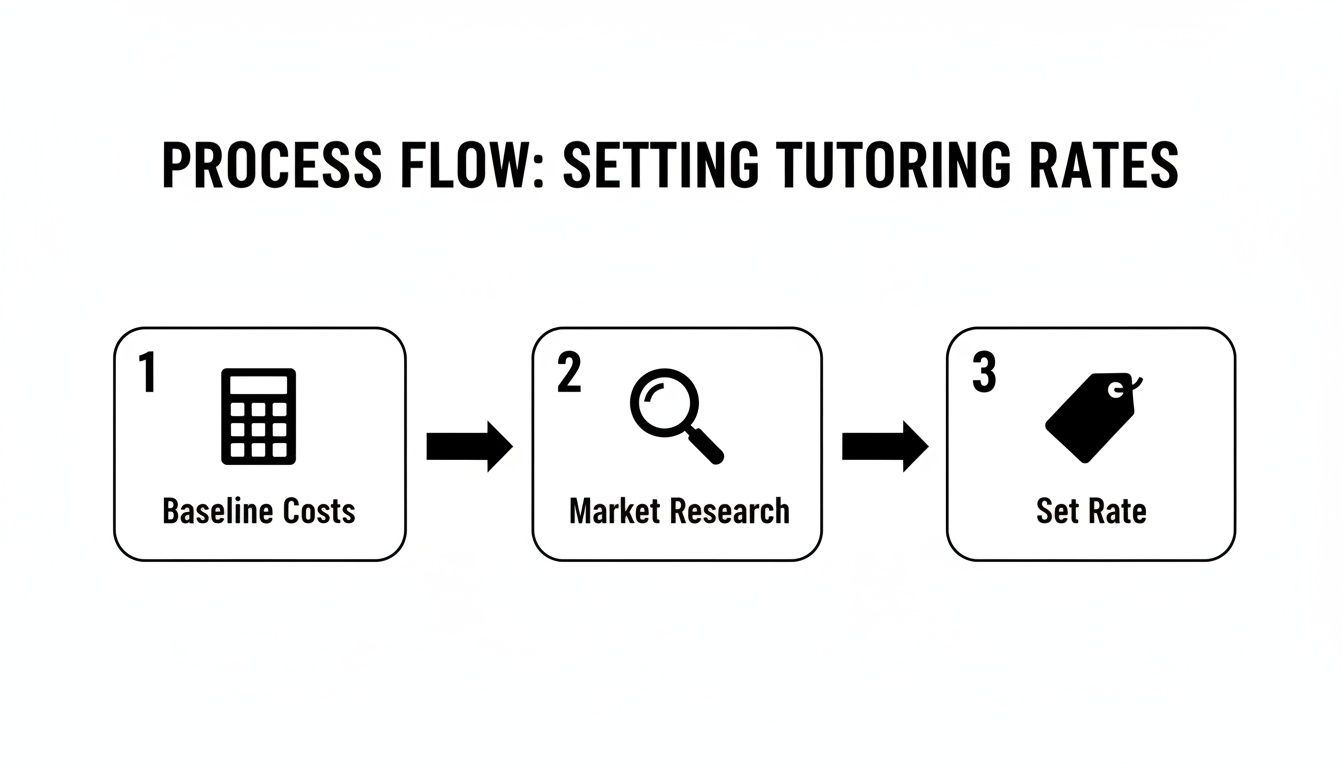
A profitable rate is not a number you pick out of thin air. It is the result of careful calculation and research.
What Are Direct Business Costs?
Direct costs are expenses tied directly to delivering your tutoring services. Think of them as the costs you incur for each student or session. They are often variable, meaning they increase as you teach more.
Common direct costs for tutors include:
Curriculum & Software: Subscriptions to educational platforms, digital whiteboards, or specialized learning tools.
Teaching Supplies: Workbooks, stationery, printer ink, and any other physical materials you use in sessions.
Payment Processing Fees: Services like Stripe or PayPal usually take a cut of each transaction, typically around 2.9% + $0.30.
How do you identify your indirect business costs?
Indirect costs, or overhead, are what you pay to keep your business running, whether you have one student or one hundred. These costs are usually fixed and predictable. Ignoring them is one of the fastest ways to become unprofitable.
Overlooking just one or two indirect costs, like your annual insurance premium, can eat away at your profit margins by 10-15% over the year.
Common indirect costs include:
Marketing & Advertising: The cost of social media ads, website hosting, or printing flyers.
Insurance: Business liability insurance is non-negotiable for protecting yourself and your company.
Professional Development: Fees for courses, certifications, or conferences that keep your skills sharp.
Bank Fees: Monthly charges for your business bank account.
Office & Utilities: For those with a physical location, this is your rent, internet, and electricity bills.
How do you calculate your break-even point?
Your break-even point is the absolute minimum you need to earn to cover all your costs. At this point, you are not making a profit, but you are not losing money either. Knowing this number is critical for survival.
First, add up all your monthly direct and indirect costs. Let's say your total monthly expenses come to $1,200. That is your target. You must earn at least that much just to stay in business.
Next, you can figure out your break-even hourly rate. If you plan to tutor for 40 hours a month, the math is straightforward:
$1,200 (Total Costs) / 40 (Billable Hours) = $30 per hour
This tells you that $30 per hour is the lowest possible rate you can charge to cover your expenses. Anything you charge above that is your profit.
Researching Local and Online Tutoring Rates
Setting your rates without knowing what competitors charge is like flying blind. You must figure out the going rate for tutors in your area to find the sweet spot. Get it wrong, and you either leave money on the table or price yourself out of the market. Your costs tell you the minimum you need to charge, but the market tells you what is possible.
How does geographic location cause rate disparities?
Where you operate matters a lot. A tutor in New York City can easily command a higher rate than someone in a small Midwestern town. The cost of living and local demand are in different leagues. This is true for both in-person and online tutoring.
Major Metropolitan Areas: Tutors in cities like Los Angeles, Boston, and Chicago can often charge 25-40% more than the national average.
Suburban and Rural Areas: Here, rates tend to stick closer to the national average, sometimes a bit below, because the cost of living is lower.
Even if you only tutor online, your location influences what people think you are worth. Parents often have a price anchored in their minds based on what is normal in their area.
Research shows the national average for tutoring is between $40 and $80 per hour. In high-cost-of-living areas, specialized tutors can easily charge $150 per hour or more.
How Subject and Grade Level Influence Price
Not all tutoring subjects are equal in the eyes of the market. It comes down to supply and demand. You will almost always make more as a high school calculus tutor than as an elementary school reading tutor. Fewer people can expertly teach calculus.
Specialization is your ticket to charging premium rates. Think of it as a hierarchy:
High-Demand Test Prep: This is the top tier. SAT, ACT, LSAT, and GRE tutors command the highest prices.
Advanced STEM Subjects: Next are subjects like AP Calculus, Physics, Chemistry, and Computer Science.
General K-12 Subjects: Core subjects like Math and English have more competition and more moderate pricing.
Humanities and Arts: Subjects like History often have the most tutors available, which keeps rates lower.
The student's age also plays a huge role. Helping a third-grader with multiplication is different from tutoring a university student in organic chemistry. Your pricing must reflect that complexity.
What are practical methods for competitor research?
Finding out what other tutors and centers charge takes some digging, but the data you gather is valuable. Your goal is to get a clear picture of the pricing landscape for your specific niche.
Here are a few effective ways to get information:
Browse Tutoring Marketplaces: Websites like Wyzant and Tutor.com are treasure troves of information. Filter by subject, location, and experience.
Analyze Local Tutoring Centers: Check the websites of local centers. Many list their package prices and hourly rates.
Use Local Online Forums: Dive into local parent groups on social media. You will find parents talking openly about what they are paying for tutoring.
Once you have this information, put it into a simple spreadsheet. Track the competitor, their subject, and their rates. This data will help you finalize a pricing structure that is both competitive and profitable.
Designing Your Pricing and Service Packages
Relying on a single hourly rate is a common mistake. It caps your income and leaves you vulnerable to cancellations. Creating compelling service packages encourages longer-term commitment and generates predictable revenue. This shift positions your business for serious growth.

One-on-One vs. Small Group Sessions
First, decide what kind of sessions you will offer. Both one-on-one and small group formats have their place. Offering both is a smart way to diversify your income and appeal to different budgets.
One-on-One Tutoring: This is your premium service. It delivers the most personalized support and commands the highest rate.
Small Group Workshops: Capping groups at 3-5 students fosters collaborative learning. This model makes your services more accessible and can boost your hourly earnings.
A diversified offer sheet lets you meet families where they are. A student struggling with foundational math might need one-on-one sessions, while friends prepping for the SATs could thrive in a workshop.
How to Craft Prepaid Tutoring Packages
Prepaid packages lock in client commitment and stabilize your cash flow. You offer a discount in exchange for an upfront payment for multiple sessions. Parents save money, and you reduce no-shows.
A 10-session bundle is a classic example. Let's say your standard rate is $70/hour. A block of 10 sessions would normally be $700. By offering a 15% discount, the client pays just $595 upfront, saving $105.
For a deeper dive, check out this guide on tutoring pricing models.
Setting Up Recurring Monthly Subscriptions
Monthly subscriptions provide the most predictable revenue. You sell ongoing access to your expertise for a flat, recurring fee. This model transforms your business from one-off transactions into a continuous educational partnership.
This works especially well for students needing long-term support. You could offer four 60-minute sessions per month for a flat rate of $250. Parents love the simple budgeting, and you get guaranteed income.
Here is a comparison of these three common pricing structures:
Feature | Pay-Per-Hour | Prepaid Packages | Monthly Subscriptions |
|---|---|---|---|
Client Commitment | Low (session-to-session) | Medium (fixed number of sessions) | High (ongoing relationship) |
Income Predictability | Low and variable | Medium (upfront lump sums) | High (stable recurring revenue) |
Administrative Work | High (invoicing per session) | Medium (one invoice per package) | Low (automated monthly billing) |
Best For | New clients testing your service | Test prep, exam cramming | Long-term academic support |
A hybrid approach often works best. You might use pay-per-hour for an initial trial, then guide families toward a package or subscription once they see your value.
Communicating Your Value and Setting Firm Policies
Your tutoring rate reflects your value, and you must know how to talk about it. Confidently presenting your prices requires a clear strategy and firm policies. These policies protect your time, manage client expectations, and reinforce your professionalism.
How to Justify Your Tutoring Rates
When a parent asks about your pricing, they are really asking, "Why are you worth this much?" Your answer should be a confident summary of your unique value. You sell results and expertise, not just an hour of your time.
Focus the conversation on these three areas:
Your Qualifications and Experience: Lead with your credentials. Mention your degree, certifications, and years of experience.
Your Customized Approach: Explain that you build tailored lesson plans based on each student's learning style and goals.
Your Proven Track Record: Use concrete numbers to show you get results. For example, mention that "85% of my SAT prep students last year increased their scores by over 150 points."
Establishing Non-Negotiable Business Policies
Clear, firm policies are the bedrock of a professional tutoring business. They prevent misunderstandings and protect your income. These rules need to be established from the beginning and included in your service agreement.
Having a written policy is about setting professional boundaries. It ensures both you and your clients have a clear understanding of expectations. This prevents disputes and builds mutual respect.
What Should My Cancellation Policy Include?
A strong cancellation policy is essential. Without one, last-minute cancellations will leave you with unpaid gaps in your schedule. Your policy needs to be clear and consistently enforced.
Here are the key elements to include:
Required Notice Period: Specify how much advance notice a client must give. A 24-hour notice period is the industry standard.
Late Cancellation Fee: Clearly state the penalty for cancelling after the notice period. Most tutors charge the full price of the scheduled session.
No-Show Policy: Define what happens if a student does not show up. This should also result in a charge for the full session fee.
Handling Late Payments and Invoicing
Chasing payments is stressful and unprofessional. A clear, automated payment policy eliminates this friction. The goal is to make getting paid as seamless as possible, ensuring consistent cash flow.
Your payment policy should specify:
Payment Due Dates: State exactly when payment is expected (e.g., "Payment is due at the time of booking").
Accepted Payment Methods: List how clients can pay you, whether through Stripe, bank transfer, or PayPal.
Late Payment Fees: Implement a small fee for overdue invoices. A charge of 1.5% per month on the outstanding balance is common practice.
Streamlining Your Invoicing and Payment Process
Getting paid should not be the hardest part of running your business. An efficient billing system is the key to consistent cash flow and less time spent on admin. It also frees you up to do what you do best, which is to teach. Automating how you invoice and collect payments is a game-changer.
Choosing Your Payment Methods
Making it easy for clients to pay you is the best way to get paid on time. The goal is to remove all friction from the payment process. In 2026, families expect digital convenience.
Consider offering a few of these options:
Online Payment Processors: Services like Stripe and PayPal are industry standards. They let clients pay with a credit card in seconds.
Direct Bank Transfers: Also called ACH transfers, these are often free or very low-cost. They are a fantastic option for recurring payments.
Mobile Payment Apps: Venmo or Zelle can work for solo tutors, but they lack professional invoicing features for a growing business.
How to Select the Right Invoicing Software
Manually creating invoices is a time-suck and prone to mistakes. Good invoicing software handles the whole process for you. It makes you look more professional and helps you get paid faster.
When shopping for a platform, look for these key features:
Automated Invoice Generation: The system should create invoices automatically after sessions are completed.
Recurring Billing: This is non-negotiable for clients on monthly plans. It automatically charges their card on file.
Payment Reminders: The software should send polite, automated nudges for overdue invoices.
For a simple solution, you can start with a free tutoring invoice generator to create professional documents. Businesses that automate invoicing get paid, on average, 14 days faster than those doing it manually, a huge boost to cash flow.
To modernize your payment process, check out this comprehensive guide to digital invoicing and e-invoices. Adopting these methods allows you to scale your operations without getting buried in paperwork.
Frequently Asked Questions About Tutoring Rates
Should I charge a different rate for online versus in-person tutoring?
Yes, you should charge a different rate for online versus in-person tutoring. Your in-person rate should be higher to account for travel time and expenses. A 10-20% surcharge on top of your online rate is a fair way to compensate for the extra logistics involved with in-person sessions.
When is it appropriate to offer a discount on tutoring?
You should only offer a discount strategically to reward commitment. Good examples include offering a 10-15% discount for paying for a package of sessions upfront, a small discount for sibling enrollments, or a referral bonus credit when a current client brings you a new family.
How should I handle a request for a free trial session?
You should not offer a full, free tutoring session. A better approach is to offer a complimentary 15-20 minute consultation or assessment. This is a professional intake process that allows you to showcase your expertise, diagnose the student's needs, and build rapport without devaluing your teaching time.
How often should I raise my tutoring rates?
You should review your tutoring rates annually. A modest increase of 3-5% each year is standard practice in a service business. This increase helps you keep up with inflation and reflects your growing experience. Be sure to give existing clients at least 30-60 days' notice before any price change takes effect.
What is a good hourly rate for a new tutor in 2026?
A good hourly rate for a new tutor in 2026 is typically between $25 and $40 per hour. This rate can vary based on your location, subject expertise, and educational background. Always calculate your break-even point first to ensure this starting rate covers all your business costs.
How much should I charge for group tutoring sessions?
You should charge each student in a group session about 60-70% of your one-on-one rate. For example, if your private rate is $60/hour, you could charge each student in a group of three $40/hour. This makes your service more affordable for them while increasing your total hourly earnings to $120/hour.
Can I charge different rates for different subjects?
Yes, you can and should charge different rates for different subjects. Rates should be based on supply and demand. Specialized, high-demand subjects like AP Calculus, physics, or high-level test prep (SAT, LSAT) can command significantly higher rates than general subjects like elementary reading or middle school history.
Managing scheduling, invoicing, and payroll can take hours away from teaching. Tutorbase automates your entire administrative workflow, giving you back time to focus on student success. See how you can streamline your operations at tutorbase.com/register.
How Much to Charge for Tutoring: A 2026 Pricing Guide
Published: December 14, 2025 by Amy Ashford


Setting your tutoring rate involves calculating your costs, researching market prices, and communicating your value. The national average tutoring rate in 2026 ranges from $40 to $80 per hour, but specialized subjects in major cities can command over $150 per hour. Start by determining your break-even point and then adjust your price based on your expertise, subject demand, and location.
Your Quick Guide to Setting Tutoring Rates
Figuring out how much to charge for tutoring is more than just picking a number. Your rate communicates your value, covers your costs, and determines if your business thrives. You need to set a rate that makes your business profitable from day one.
Start by calculating a baseline rate that covers all your expenses, not just your teaching time. Once you have your baseline, research your competitors. This market research helps you position your services competitively, ensuring you don't undervalue your skills or price yourself out of the market.
Several key factors will influence your pricing:
Your Expertise & Credentials: Tutors with advanced degrees or specialized certifications can confidently charge a premium.
Subject Demand: A calculus or coding tutor will almost always command a higher rate than a history tutor. It is simple supply and demand.
Geographic Location: Rates in major metro areas like New York are consistently higher than in smaller towns. Your zip code matters.
According to NCES data from 2024, only 28% of eighth graders were proficient in math. This statistic highlights the massive demand for qualified tutors and supports stronger pricing for instructors who deliver real results. Thinking through these factors gives you a solid framework for setting a fair and strategic rate.
Calculating Your True Cost of Tutoring
Before you set a profitable tutoring rate, you must know what it costs to run your business. The goal is to account for every expense, from software subscriptions to insurance, so you can find your true break-even point. This detailed cost analysis is the foundation of a smart pricing strategy.
Many tutors only value the hour they spend with a student. They forget the ecosystem of costs that supports that hour. You should tally up every business-related expense. If you are new to this, learning how to track your business expenses effectively is a great first step.
This simple flow chart breaks down the process. It all starts with understanding your baseline costs.

A profitable rate is not a number you pick out of thin air. It is the result of careful calculation and research.
What Are Direct Business Costs?
Direct costs are expenses tied directly to delivering your tutoring services. Think of them as the costs you incur for each student or session. They are often variable, meaning they increase as you teach more.
Common direct costs for tutors include:
Curriculum & Software: Subscriptions to educational platforms, digital whiteboards, or specialized learning tools.
Teaching Supplies: Workbooks, stationery, printer ink, and any other physical materials you use in sessions.
Payment Processing Fees: Services like Stripe or PayPal usually take a cut of each transaction, typically around 2.9% + $0.30.
How do you identify your indirect business costs?
Indirect costs, or overhead, are what you pay to keep your business running, whether you have one student or one hundred. These costs are usually fixed and predictable. Ignoring them is one of the fastest ways to become unprofitable.
Overlooking just one or two indirect costs, like your annual insurance premium, can eat away at your profit margins by 10-15% over the year.
Common indirect costs include:
Marketing & Advertising: The cost of social media ads, website hosting, or printing flyers.
Insurance: Business liability insurance is non-negotiable for protecting yourself and your company.
Professional Development: Fees for courses, certifications, or conferences that keep your skills sharp.
Bank Fees: Monthly charges for your business bank account.
Office & Utilities: For those with a physical location, this is your rent, internet, and electricity bills.
How do you calculate your break-even point?
Your break-even point is the absolute minimum you need to earn to cover all your costs. At this point, you are not making a profit, but you are not losing money either. Knowing this number is critical for survival.
First, add up all your monthly direct and indirect costs. Let's say your total monthly expenses come to $1,200. That is your target. You must earn at least that much just to stay in business.
Next, you can figure out your break-even hourly rate. If you plan to tutor for 40 hours a month, the math is straightforward:
$1,200 (Total Costs) / 40 (Billable Hours) = $30 per hour
This tells you that $30 per hour is the lowest possible rate you can charge to cover your expenses. Anything you charge above that is your profit.
Researching Local and Online Tutoring Rates
Setting your rates without knowing what competitors charge is like flying blind. You must figure out the going rate for tutors in your area to find the sweet spot. Get it wrong, and you either leave money on the table or price yourself out of the market. Your costs tell you the minimum you need to charge, but the market tells you what is possible.
How does geographic location cause rate disparities?
Where you operate matters a lot. A tutor in New York City can easily command a higher rate than someone in a small Midwestern town. The cost of living and local demand are in different leagues. This is true for both in-person and online tutoring.
Major Metropolitan Areas: Tutors in cities like Los Angeles, Boston, and Chicago can often charge 25-40% more than the national average.
Suburban and Rural Areas: Here, rates tend to stick closer to the national average, sometimes a bit below, because the cost of living is lower.
Even if you only tutor online, your location influences what people think you are worth. Parents often have a price anchored in their minds based on what is normal in their area.
Research shows the national average for tutoring is between $40 and $80 per hour. In high-cost-of-living areas, specialized tutors can easily charge $150 per hour or more.
How Subject and Grade Level Influence Price
Not all tutoring subjects are equal in the eyes of the market. It comes down to supply and demand. You will almost always make more as a high school calculus tutor than as an elementary school reading tutor. Fewer people can expertly teach calculus.
Specialization is your ticket to charging premium rates. Think of it as a hierarchy:
High-Demand Test Prep: This is the top tier. SAT, ACT, LSAT, and GRE tutors command the highest prices.
Advanced STEM Subjects: Next are subjects like AP Calculus, Physics, Chemistry, and Computer Science.
General K-12 Subjects: Core subjects like Math and English have more competition and more moderate pricing.
Humanities and Arts: Subjects like History often have the most tutors available, which keeps rates lower.
The student's age also plays a huge role. Helping a third-grader with multiplication is different from tutoring a university student in organic chemistry. Your pricing must reflect that complexity.
What are practical methods for competitor research?
Finding out what other tutors and centers charge takes some digging, but the data you gather is valuable. Your goal is to get a clear picture of the pricing landscape for your specific niche.
Here are a few effective ways to get information:
Browse Tutoring Marketplaces: Websites like Wyzant and Tutor.com are treasure troves of information. Filter by subject, location, and experience.
Analyze Local Tutoring Centers: Check the websites of local centers. Many list their package prices and hourly rates.
Use Local Online Forums: Dive into local parent groups on social media. You will find parents talking openly about what they are paying for tutoring.
Once you have this information, put it into a simple spreadsheet. Track the competitor, their subject, and their rates. This data will help you finalize a pricing structure that is both competitive and profitable.
Designing Your Pricing and Service Packages
Relying on a single hourly rate is a common mistake. It caps your income and leaves you vulnerable to cancellations. Creating compelling service packages encourages longer-term commitment and generates predictable revenue. This shift positions your business for serious growth.

One-on-One vs. Small Group Sessions
First, decide what kind of sessions you will offer. Both one-on-one and small group formats have their place. Offering both is a smart way to diversify your income and appeal to different budgets.
One-on-One Tutoring: This is your premium service. It delivers the most personalized support and commands the highest rate.
Small Group Workshops: Capping groups at 3-5 students fosters collaborative learning. This model makes your services more accessible and can boost your hourly earnings.
A diversified offer sheet lets you meet families where they are. A student struggling with foundational math might need one-on-one sessions, while friends prepping for the SATs could thrive in a workshop.
How to Craft Prepaid Tutoring Packages
Prepaid packages lock in client commitment and stabilize your cash flow. You offer a discount in exchange for an upfront payment for multiple sessions. Parents save money, and you reduce no-shows.
A 10-session bundle is a classic example. Let's say your standard rate is $70/hour. A block of 10 sessions would normally be $700. By offering a 15% discount, the client pays just $595 upfront, saving $105.
For a deeper dive, check out this guide on tutoring pricing models.
Setting Up Recurring Monthly Subscriptions
Monthly subscriptions provide the most predictable revenue. You sell ongoing access to your expertise for a flat, recurring fee. This model transforms your business from one-off transactions into a continuous educational partnership.
This works especially well for students needing long-term support. You could offer four 60-minute sessions per month for a flat rate of $250. Parents love the simple budgeting, and you get guaranteed income.
Here is a comparison of these three common pricing structures:
Feature | Pay-Per-Hour | Prepaid Packages | Monthly Subscriptions |
|---|---|---|---|
Client Commitment | Low (session-to-session) | Medium (fixed number of sessions) | High (ongoing relationship) |
Income Predictability | Low and variable | Medium (upfront lump sums) | High (stable recurring revenue) |
Administrative Work | High (invoicing per session) | Medium (one invoice per package) | Low (automated monthly billing) |
Best For | New clients testing your service | Test prep, exam cramming | Long-term academic support |
A hybrid approach often works best. You might use pay-per-hour for an initial trial, then guide families toward a package or subscription once they see your value.
Communicating Your Value and Setting Firm Policies
Your tutoring rate reflects your value, and you must know how to talk about it. Confidently presenting your prices requires a clear strategy and firm policies. These policies protect your time, manage client expectations, and reinforce your professionalism.
How to Justify Your Tutoring Rates
When a parent asks about your pricing, they are really asking, "Why are you worth this much?" Your answer should be a confident summary of your unique value. You sell results and expertise, not just an hour of your time.
Focus the conversation on these three areas:
Your Qualifications and Experience: Lead with your credentials. Mention your degree, certifications, and years of experience.
Your Customized Approach: Explain that you build tailored lesson plans based on each student's learning style and goals.
Your Proven Track Record: Use concrete numbers to show you get results. For example, mention that "85% of my SAT prep students last year increased their scores by over 150 points."
Establishing Non-Negotiable Business Policies
Clear, firm policies are the bedrock of a professional tutoring business. They prevent misunderstandings and protect your income. These rules need to be established from the beginning and included in your service agreement.
Having a written policy is about setting professional boundaries. It ensures both you and your clients have a clear understanding of expectations. This prevents disputes and builds mutual respect.
What Should My Cancellation Policy Include?
A strong cancellation policy is essential. Without one, last-minute cancellations will leave you with unpaid gaps in your schedule. Your policy needs to be clear and consistently enforced.
Here are the key elements to include:
Required Notice Period: Specify how much advance notice a client must give. A 24-hour notice period is the industry standard.
Late Cancellation Fee: Clearly state the penalty for cancelling after the notice period. Most tutors charge the full price of the scheduled session.
No-Show Policy: Define what happens if a student does not show up. This should also result in a charge for the full session fee.
Handling Late Payments and Invoicing
Chasing payments is stressful and unprofessional. A clear, automated payment policy eliminates this friction. The goal is to make getting paid as seamless as possible, ensuring consistent cash flow.
Your payment policy should specify:
Payment Due Dates: State exactly when payment is expected (e.g., "Payment is due at the time of booking").
Accepted Payment Methods: List how clients can pay you, whether through Stripe, bank transfer, or PayPal.
Late Payment Fees: Implement a small fee for overdue invoices. A charge of 1.5% per month on the outstanding balance is common practice.
Streamlining Your Invoicing and Payment Process
Getting paid should not be the hardest part of running your business. An efficient billing system is the key to consistent cash flow and less time spent on admin. It also frees you up to do what you do best, which is to teach. Automating how you invoice and collect payments is a game-changer.

Choosing Your Payment Methods
Making it easy for clients to pay you is the best way to get paid on time. The goal is to remove all friction from the payment process. In 2026, families expect digital convenience.
Consider offering a few of these options:
Online Payment Processors: Services like Stripe and PayPal are industry standards. They let clients pay with a credit card in seconds.
Direct Bank Transfers: Also called ACH transfers, these are often free or very low-cost. They are a fantastic option for recurring payments.
Mobile Payment Apps: Venmo or Zelle can work for solo tutors, but they lack professional invoicing features for a growing business.
How to Select the Right Invoicing Software
Manually creating invoices is a time-suck and prone to mistakes. Good invoicing software handles the whole process for you. It makes you look more professional and helps you get paid faster.
When shopping for a platform, look for these key features:
Automated Invoice Generation: The system should create invoices automatically after sessions are completed.
Recurring Billing: This is non-negotiable for clients on monthly plans. It automatically charges their card on file.
Payment Reminders: The software should send polite, automated nudges for overdue invoices.
For a simple solution, you can start with a free tutoring invoice generator to create professional documents. Businesses that automate invoicing get paid, on average, 14 days faster than those doing it manually, a huge boost to cash flow.
To modernize your payment process, check out this comprehensive guide to digital invoicing and e-invoices. Adopting these methods allows you to scale your operations without getting buried in paperwork.
Frequently Asked Questions About Tutoring Rates
Should I charge a different rate for online versus in-person tutoring?
Yes, you should charge a different rate for online versus in-person tutoring. Your in-person rate should be higher to account for travel time and expenses. A 10-20% surcharge on top of your online rate is a fair way to compensate for the extra logistics involved with in-person sessions.
When is it appropriate to offer a discount on tutoring?
You should only offer a discount strategically to reward commitment. Good examples include offering a 10-15% discount for paying for a package of sessions upfront, a small discount for sibling enrollments, or a referral bonus credit when a current client brings you a new family.
How should I handle a request for a free trial session?
You should not offer a full, free tutoring session. A better approach is to offer a complimentary 15-20 minute consultation or assessment. This is a professional intake process that allows you to showcase your expertise, diagnose the student's needs, and build rapport without devaluing your teaching time.
How often should I raise my tutoring rates?
You should review your tutoring rates annually. A modest increase of 3-5% each year is standard practice in a service business. This increase helps you keep up with inflation and reflects your growing experience. Be sure to give existing clients at least 30-60 days' notice before any price change takes effect.
What is a good hourly rate for a new tutor in 2026?
A good hourly rate for a new tutor in 2026 is typically between $25 and $40 per hour. This rate can vary based on your location, subject expertise, and educational background. Always calculate your break-even point first to ensure this starting rate covers all your business costs.
How much should I charge for group tutoring sessions?
You should charge each student in a group session about 60-70% of your one-on-one rate. For example, if your private rate is $60/hour, you could charge each student in a group of three $40/hour. This makes your service more affordable for them while increasing your total hourly earnings to $120/hour.
Can I charge different rates for different subjects?
Yes, you can and should charge different rates for different subjects. Rates should be based on supply and demand. Specialized, high-demand subjects like AP Calculus, physics, or high-level test prep (SAT, LSAT) can command significantly higher rates than general subjects like elementary reading or middle school history.
Managing scheduling, invoicing, and payroll can take hours away from teaching. Tutorbase automates your entire administrative workflow, giving you back time to focus on student success. See how you can streamline your operations at tutorbase.com/register.