
How to Start a Tuition Centre in Hong Kong: A Complete Guide

Published: December 29, 2025 by Amy Ashford

Key Takeaway: Starting a successful tuition centre in Hong Kong requires three critical steps. You must first identify a profitable niche through market research. Next, you must navigate the Education Bureau's (EDB) strict licensing and safety requirements. Finally, you need to implement efficient operational systems, especially for billing and scheduling, to ensure long-term growth.

Your Blueprint for a Hong Kong Tuition Centre

This guide is your complete playbook for launching a thriving educational business in one of the world's most competitive markets. You must understand Hong Kong's unique, demanding environment. For a solid legal and corporate foundation, this founder's guide to setting up a business in Hong Kong is an excellent resource.

We will break down every essential phase into clear, actionable advice. From your initial market research to choosing the right technology, each step is critical. Consider this your roadmap to launching a successful and scalable education business in 2026 and beyond. A quick summary of the key stages follows.

Startup Checklist At a Glance

Phase

Key Action Items

Primary Goal

Phase 1: Foundation & Validation

Market research, niche selection, legal entity registration.

Confirm market demand and establish a legal business structure.

Phase 2: Licensing & Premises

Secure premises, meet EDB requirements, apply for school license.

Achieve full legal compliance to operate as a tuition centre.

Phase 3: Academic & Operations Setup

Develop curriculum, create timetables, set pricing, hire tutors.

Build the core educational product and operational team.

Phase 4: Launch & Growth

Implement student acquisition marketing, refine operational workflows.

Attract the first cohort of students and establish stable revenue.

This checklist maps the path from idea to opening day. Now, let's detail the first phase: validating your idea.

How to Find Your Niche in the Hong Kong Tutoring Market

Before you rent a space, you need to answer one crucial question. Who will you serve, and why should they choose you? Hong Kong's tutoring market is packed, so your success hinges on finding a profitable niche. You must conduct targeted market research to find an underserved student group and build a strong reputation.

Hong Kong’s education scene is a massive opportunity, but you cannot jump in without a clear strategy. The city’s unique culture creates a fiercely competitive environment where parents have high expectations. This is not a casual demand for homework help; it's a results-driven need for supplemental education.

The appetite for tutoring across the region is enormous. According to Technavio, the after-school tutoring sector in nearby China will grow by a staggering USD 130.8 billion between 2025 and 2029. This growth is fueled by parents demanding measurable results, a trend directly impacting Hong Kong. You can read the full research about these market trends to see the opportunity.

How Do You Identify a Profitable Niche?

To stand out, you have to specialize. Generic, all-subject centres often struggle against established chains with massive marketing budgets. Instead, focus your research on identifying specific, underserved needs. Your goal is to become the go-to expert for a particular type of student.

Consider these high-demand areas where you could build a strong brand:

  • Exam Preparation: Go deep on high-stakes exams. Become the master of the Hong Kong Diploma of Secondary Education (HKDSE), the IB, or A-Levels.

  • International Curricula: Cater specifically to students in international schools. They need focused support for programs like IGCSE, AP courses, or SAT/ACT prep.

  • Specialized Subjects: Build your brand around excellence in one tough subject. This could be advanced mathematics, STEM, or Mandarin for non-native speakers.

  • Age-Specific Programs: Zero in on a specific age group. You could be the best place for early years English phonics or primary school interview preparation.

A specialized centre offering intensive IB Chemistry tutoring will always attract more committed clients and command higher fees than a generalist centre.

Analyzing the Competitive Landscape

Once you have a potential niche, it's time to analyze your competitors. Do not just glance at their websites. You need to dig deeper. Find out how they deliver their services and, more importantly, where the gaps are. This is how you will craft your Unique Selling Proposition (USP).

A USP is the specific benefit that makes your tuition centre better than the rest. It answers the parent's unspoken question: "Why should I trust you with my child's future?"

Crafting a Compelling Unique Selling Proposition

Your USP needs to be sharp, clear, and persuasive. It becomes the heart of all your marketing. A strong USP is not a vague claim like "we have the best tutors." It is a specific, verifiable promise that resonates with parents.

This table shows the difference between a weak and a strong USP.

Weak USP (Vague & Common)

Strong USP (Specific & Unique)

"High-quality tutoring services."

"We guarantee a 1-grade improvement in HKDSE Maths, or the next term is free."

"Experienced and qualified tutors."

"All our tutors are certified IB examiners with over 10 years of classroom experience."

"Personalized learning plans."

"We use proprietary diagnostic tests to create a data-driven learning roadmap for every student."

The stronger examples give parents a concrete reason to choose you. This specific promise turns a curious parent into an enrolled student.

Navigating Hong Kong's Legal and Licensing Maze

Before you can think about lesson plans, you must tackle the legal side. Setting up a tuition centre in Hong Kong is a detailed, bureaucratic, and non-negotiable process. The Education Bureau (EDB) is at the heart of it all. Getting this right from day one saves you from delays and serious legal trouble.

First, you need a proper legal business entity. Most centres register as a Limited Company. This structure separates your personal assets from the business. If something goes wrong, your personal finances are protected. This is a crucial first step before you sign a lease.

What is the EDB School License?

The EDB School License is your official approval from the government, certifying that your centre is safe, properly managed, and up to standard. You cannot legally operate or collect fees from more than a handful of students without it. The EDB uses this license to protect students and parents.

All the forms, guidelines, and checklists you need are on the EDB’s official portal for school registration. You should become very familiar with this website.

This portal breaks down the entire process. It covers everything from the first application form to the final compliance checks for your premises.

Why Finding a Compliant Location is Half the Battle

Many new owners get stuck here. Finding the right space is not just about a good location or affordable rent. Your premises must meet strict government codes. The EDB will not review your application until your location is fully compliant.

Your chosen location will be inspected by several different departments:

  • Fire Safety: The Fire Services Department (FSD) has a long list of requirements, including proper exits and extinguishers. You will need a valid Certificate of Fire Service Installation.

  • Building Safety: The Buildings Department needs to confirm the space is structurally sound. For many older buildings, this means getting a Certificate of Structural Safety.

  • Health and Sanitation: This covers everything from proper ventilation and lighting to having enough toilets for your planned number of students.

Before you sign a lease, you should bring in a licensed contractor who knows the EDB's rules. A site assessment can spot issues that could cost you thousands.

How Do I Calculate Room Capacity?

The EDB has specific formulas for calculating how many students you can legally have in a classroom. This is not a guideline; it is a hard limit tied directly to your license. The calculation is based on factors like usable floor area and ceiling height. Violating this can lead to fines or license suspension.

The Application and Approval Grind

Once your business is registered and you have a compliant location, you will submit your application to the EDB. This includes floor plans, safety certificates, and manager credentials. Be prepared to wait. The approval process can take 3 to 6 months, and often longer if there are issues.

As you get your operations in order, remember that handling student data comes with its own set of rules. You should review our guide to PDPO compliance for tutoring centres.

Building Your Operational and Staffing Foundation

A successful tuition centre is built on a solid foundation. This includes a well-designed curriculum, smart pricing, and qualified staff. But the secret to scaling is creating streamlined operational workflows from day one. You must connect attendance, billing, and payroll to avoid administrative chaos.

How to Design a Compelling Curriculum and Timetable

Your curriculum is your promise to parents. It must be structured, logical, and aligned with the academic goals of your niche. First, you need to outline the key learning objectives for every course you offer. From there, you can break those goals down into individual lesson plans.

Once your curriculum is mapped out, you can start building a timetable. You should think about peak hours for students, which are usually after school and on weekends. Factor in your tutors' availability. Smart scheduling avoids clashes and ensures every classroom is used efficiently.

Setting Competitive Pricing and Packages

Pricing in the Hong Kong market is fierce. You must research what similar centres are charging, but do not just copy them. Your prices should reflect the value you provide. I recommend offering a mix of pricing models to appeal to different families.

  • Pay-per-lesson: This gives parents maximum flexibility and is a great way to attract new students.

  • Package deals: Selling blocks of 10 or 20 lessons at a discount encourages commitment and boosts cash flow.

  • Monthly subscriptions: This provides predictable, recurring revenue that makes financial planning much easier.

This visual shows the basic legal steps you must complete before hiring.
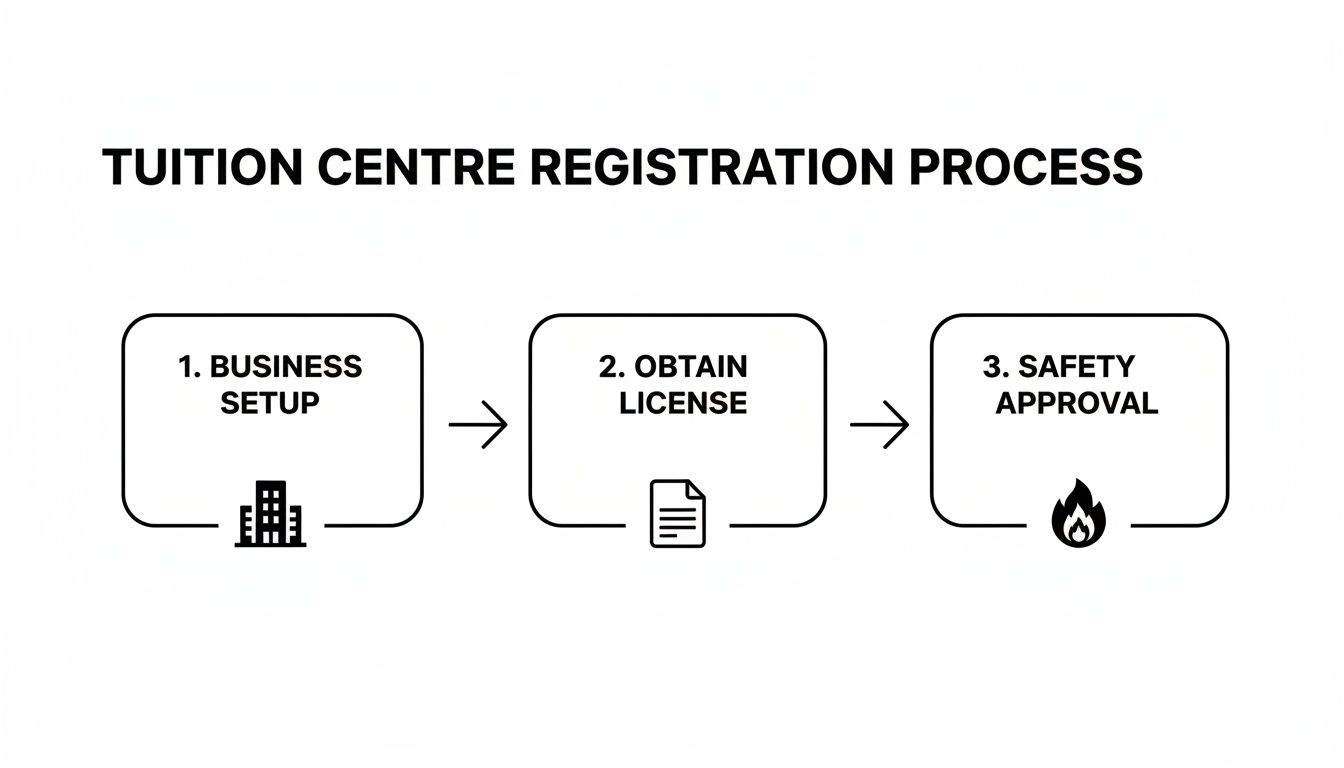
Diagram illustrating the three-step tuition centre registration process: business setup, obtain license, and safety approval.

This flow is non-negotiable. Business registration, getting your license, and passing all safety inspections are the sequential hurdles you must clear.

Hiring Qualified Tutors and Navigating Contracts

Your tutors are the face of your business. Their quality directly shapes your reputation, so you should not cut corners here. When hiring, you must verify that every candidate meets the EDB's requirements for teacher registration. Look for people with the right academic credentials and real teaching experience.

For a deeper dive into finding talent, check our guide on how to hire tutors for your centre. You will also need to figure out the right mix of employment contracts.

Contract Type

Best For

Key Considerations

Full-Time

Core, long-term staff who handle key subjects.

Provides stability but requires a higher commitment (MPF, benefits).

Part-Time

Tutors with specific expertise for a few hours a week.

Offers flexibility but may result in less commitment to the centre.

Freelance/Contractor

Highly specialized tutors for short-term exam prep courses.

Easiest administratively, but you have the least control over their methods.

Designing Efficient Operational Workflows

Trying to run your business with spreadsheets and WhatsApp groups is a recipe for disaster. This approach is slow, prone to errors, and will consume countless hours. The single biggest operational mistake is failing to connect attendance directly to billing and payroll. Every lesson taught should automatically trigger an invoice and a payroll entry.

This operational challenge is playing out across the market. The number of centres run by major operators in Hong Kong has dropped by nearly 50% since 2016. Meanwhile, tech-savvy mainland giants like New Oriental are entering the market.

A properly streamlined workflow should be simple:

  1. Attendance is Marked: A tutor marks a student as "attended" in a central system.

  2. Invoice is Triggered: The system automatically generates an invoice or deducts a credit.

  3. Payroll is Calculated: The completed lesson is added to the tutor's timesheet.

Automating this flow is the most important investment you can make in your centre's future.

How Do I Choose My Technology Stack for Seamless Growth?

Your choice of technology will either limit your growth or accelerate it. Moving away from manual processes towards an integrated system is the most important operational decision you will make. The right platform automates your scheduling, billing, and payroll, freeing you to focus on education.

In Hong Kong's fierce market, operational efficiency is a core competitive advantage. The global private tutoring industry is set to hit $123,511.4 million by 2030, with Asia-Pacific leading the charge. This signals a massive opportunity as online tutoring grows at 11.3% annually. You can see the full market projections on einpresswire.com.

What Is a Tutoring Management System?

A Tutoring Management System (TMS) is a specialized software platform built to handle all the admin tasks of a learning centre. It combines scheduling, automated billing, payroll, student management, and communication into one central hub. It replaces the mess of separate spreadsheets, calendars, and invoicing apps.

Think of it as the central nervous system for your business. This direct link eliminates manual data entry and human errors.

Core Features That Drive Efficiency

When you are looking at different options, focus on the features that solve the biggest operational headaches. These tools are designed to stop revenue leakage and save you dozens of hours every week.

Here’s what to look for:

  • Intelligent Scheduling: Tools that prevent you from double-booking tutors or rooms. The best systems can suggest available slots.

  • Automated Billing Workflows: The system must generate invoices automatically when attendance is marked. This ensures you never forget to bill for a lesson.

  • Flexible Payroll Calculations: Your software has to handle different pay structures, including per-hour rates, per-lesson fees, and revenue sharing.

  • Integrated Parent & Student Portals: A secure portal where parents can view schedules, track progress, and pay invoices online is a game-changer.

The most critical function of a modern TMS is its ability to create an unbroken data chain from attendance to invoice to payroll.

Technology Comparison: Old School vs Modern Platform

The difference between spreadsheets and a dedicated platform becomes clear when you put them side-by-side. The old-school approach has huge hidden costs in wasted time and lost revenue. Exploring your options is a key step. Our comparison of the best tutoring software available in Hong Kong can help.

Here’s a direct comparison of the two approaches:

Function

Traditional Method (Spreadsheets, Manual)

Modern Platform (e.g., Tutorbase)

Scheduling

Manual calendar entries; high risk of double-bookings.

Automated conflict detection; suggests optimal slots.

Billing

Manually creating invoices one by one; easy to miss lessons.

Invoices are automatically generated from attendance records.

Payments

Chasing parents via messages; manual tracking of payments.

Integrated online payments; automatic reminders and receipts.

Payroll

Calculating pay by hand from timesheets; complex and prone to errors.

Automatically calculates pay based on completed lessons.

Scalability

Extremely difficult to manage beyond 50 students.

Built to handle hundreds of tutors and thousands of students.

Choosing a modern platform is a strategic decision that builds a scalable foundation for your business.

Winning and Keeping Your First Students

Once your centre is ready, your focus shifts to filling your classrooms. A smart student acquisition plan in Hong Kong blends online marketing with trusted, traditional methods. Then comes the hard part: keeping them. Student retention boils down to creating a seamless, positive experience for families.

A female tutor smiles and interacts with a child and a man, discussing student retention.

It is time to launch a marketing playbook built for the Hong Kong market. The goal is to turn curious parents into long-term clients.

What is the best initial marketing playbook?

Your first goal is to build awareness and get the phone to ring. You should concentrate your efforts on channels where Hong Kong parents are already searching for educational support.

  • Build a Localized Online Presence: Start with a professional website and claim your Google Business Profile. Weave local SEO into your site’s content (e.g., "IB tutoring in Central").

  • Leverage Local Social Media: Use Facebook and WhatsApp. More importantly, be active on forums like Baby Kingdom where thousands of parents discuss tutors.

  • Run a Compelling Open House: Host an event for prospective families. Offer free trial classes and let them meet your best tutors.

  • Launch a Referral Program: Word-of-mouth is powerful in Hong Kong. Offer existing parents a 15% discount off their next month's fees for every new student they refer.

An open house lets parents experience your centre's atmosphere, turning a tentative query into a confident enrollment.

Designing a Smooth Student Onboarding Process

Your process for converting interest into a paying student needs to be polished. A clunky or slow onboarding experience will lose a potential client.

Keep your process simple and direct:

  1. Initial Contact: Respond to inquiries within a few hours with a clear call to action, like scheduling a consultation.

  2. Assessment & Consultation: Offer a short, free assessment to gauge the student's needs and showcase your expertise.

  3. Registration & Payment: Make signing up as painless as possible. Use online forms and simple payment links to eliminate friction.

How Do You Maximize Student Retention?

Acquiring a new student can cost five times more than keeping an existing one, according to research from Bain & Company. Your long-term success depends on keeping current families happy. This guide on customer retention vs. acquisition strategies has excellent insights on this balance.

A solid retention strategy comes down to communication and results.

  • Provide Consistent Progress Reports: Send monthly updates that outline what the student has learned and their achievements.

  • Maintain Open Communication Channels: A parent portal makes it easy for parents to ask questions and get timely updates.

  • Simplify the Payment Experience: Automated invoicing and online payment options remove a major headache for parents.

Winning students is about sharp marketing, but keeping them is about delivering an exceptional and reliable experience.

FAQ: Starting a Tuition Centre in Hong Kong

How much does it cost to open a tuition centre in Hong Kong?

You should budget between HK$300,000 and HK$600,000 for a small to medium-sized centre in a non-prime district. This covers the rental deposit (typically 3 months), renovations to meet EDB safety standards, licensing fees, furniture, and initial marketing costs to attract your first students.

Do I need a special license to run a tuition centre?

Yes, you absolutely need a School License from the Education Bureau (EDB) to operate legally. This license is only granted after your premises pass strict inspections from the Fire Services Department, Buildings Department, and Health Department. Operating without this license is illegal.

What qualifications must my tutors have?

Every tutor you hire must be a Permitted Teacher as defined by the Education Bureau (EDB). This means they need to hold appropriate academic qualifications, typically a university degree or equivalent, and must pass a background check. You are responsible for verifying these credentials before hiring.

What is the most common reason for application delays?

The biggest legal hurdle and most common cause of delays is finding a property that meets all government safety and building codes. Many new owners find a location they like, only to discover it needs expensive and time-consuming upgrades to pass inspections, delaying their opening by six months or more.

How can I effectively market a new tuition centre in Hong Kong?

A successful marketing strategy combines digital and traditional methods. Focus on hyper-local SEO (e.g., "DSE Maths tutor in Mong Kok") and get active in online parent forums like Baby Kingdom. Also, implement a strong referral program, offering a discount (like 15% off) to existing parents who refer new students.

Can I operate a tuition centre from my home?

No, you generally cannot operate a formal tuition centre from a residential apartment in Hong Kong. The premises must comply with specific building and fire safety regulations for commercial or educational use, which residential buildings almost never meet. You must secure a compliant commercial property.

What is the EDB's role after I open?

The Education Bureau (EDB) continues to oversee your centre after it opens. They conduct periodic inspections to ensure you maintain compliance with all regulations, from teacher qualifications and curriculum standards to building safety and student capacity limits. Non-compliance can lead to warnings, fines, or license revocation.

Ready to stop wasting time on manual admin and focus on growing your tuition centre? Tutorbase automates your scheduling, billing, and payroll so you can run your business more efficiently. Start your free trial at tutorbase.com/register today.

How to Start a Tuition Centre in Hong Kong: A Complete Guide

Published: December 28, 2025 by Amy Ashford

Key Takeaway: Starting a successful tuition centre in Hong Kong requires three critical steps. You must first identify a profitable niche through market research. Next, you must navigate the Education Bureau's (EDB) strict licensing and safety requirements. Finally, you need to implement efficient operational systems, especially for billing and scheduling, to ensure long-term growth.

Your Blueprint for a Hong Kong Tuition Centre

This guide is your complete playbook for launching a thriving educational business in one of the world's most competitive markets. You must understand Hong Kong's unique, demanding environment. For a solid legal and corporate foundation, this founder's guide to setting up a business in Hong Kong is an excellent resource.

We will break down every essential phase into clear, actionable advice. From your initial market research to choosing the right technology, each step is critical. Consider this your roadmap to launching a successful and scalable education business in 2026 and beyond. A quick summary of the key stages follows.

Startup Checklist At a Glance

Phase

Key Action Items

Primary Goal

Phase 1: Foundation & Validation

Market research, niche selection, legal entity registration.

Confirm market demand and establish a legal business structure.

Phase 2: Licensing & Premises

Secure premises, meet EDB requirements, apply for school license.

Achieve full legal compliance to operate as a tuition centre.

Phase 3: Academic & Operations Setup

Develop curriculum, create timetables, set pricing, hire tutors.

Build the core educational product and operational team.

Phase 4: Launch & Growth

Implement student acquisition marketing, refine operational workflows.

Attract the first cohort of students and establish stable revenue.

This checklist maps the path from idea to opening day. Now, let's detail the first phase: validating your idea.

How to Find Your Niche in the Hong Kong Tutoring Market

Before you rent a space, you need to answer one crucial question. Who will you serve, and why should they choose you? Hong Kong's tutoring market is packed, so your success hinges on finding a profitable niche. You must conduct targeted market research to find an underserved student group and build a strong reputation.

Hong Kong’s education scene is a massive opportunity, but you cannot jump in without a clear strategy. The city’s unique culture creates a fiercely competitive environment where parents have high expectations. This is not a casual demand for homework help; it's a results-driven need for supplemental education.

The appetite for tutoring across the region is enormous. According to Technavio, the after-school tutoring sector in nearby China will grow by a staggering USD 130.8 billion between 2025 and 2029. This growth is fueled by parents demanding measurable results, a trend directly impacting Hong Kong. You can read the full research about these market trends to see the opportunity.

How Do You Identify a Profitable Niche?

To stand out, you have to specialize. Generic, all-subject centres often struggle against established chains with massive marketing budgets. Instead, focus your research on identifying specific, underserved needs. Your goal is to become the go-to expert for a particular type of student.

Consider these high-demand areas where you could build a strong brand:

  • Exam Preparation: Go deep on high-stakes exams. Become the master of the Hong Kong Diploma of Secondary Education (HKDSE), the IB, or A-Levels.

  • International Curricula: Cater specifically to students in international schools. They need focused support for programs like IGCSE, AP courses, or SAT/ACT prep.

  • Specialized Subjects: Build your brand around excellence in one tough subject. This could be advanced mathematics, STEM, or Mandarin for non-native speakers.

  • Age-Specific Programs: Zero in on a specific age group. You could be the best place for early years English phonics or primary school interview preparation.

A specialized centre offering intensive IB Chemistry tutoring will always attract more committed clients and command higher fees than a generalist centre.

Analyzing the Competitive Landscape

Once you have a potential niche, it's time to analyze your competitors. Do not just glance at their websites. You need to dig deeper. Find out how they deliver their services and, more importantly, where the gaps are. This is how you will craft your Unique Selling Proposition (USP).

A USP is the specific benefit that makes your tuition centre better than the rest. It answers the parent's unspoken question: "Why should I trust you with my child's future?"

Crafting a Compelling Unique Selling Proposition

Your USP needs to be sharp, clear, and persuasive. It becomes the heart of all your marketing. A strong USP is not a vague claim like "we have the best tutors." It is a specific, verifiable promise that resonates with parents.

This table shows the difference between a weak and a strong USP.

Weak USP (Vague & Common)

Strong USP (Specific & Unique)

"High-quality tutoring services."

"We guarantee a 1-grade improvement in HKDSE Maths, or the next term is free."

"Experienced and qualified tutors."

"All our tutors are certified IB examiners with over 10 years of classroom experience."

"Personalized learning plans."

"We use proprietary diagnostic tests to create a data-driven learning roadmap for every student."

The stronger examples give parents a concrete reason to choose you. This specific promise turns a curious parent into an enrolled student.

Navigating Hong Kong's Legal and Licensing Maze

Before you can think about lesson plans, you must tackle the legal side. Setting up a tuition centre in Hong Kong is a detailed, bureaucratic, and non-negotiable process. The Education Bureau (EDB) is at the heart of it all. Getting this right from day one saves you from delays and serious legal trouble.

First, you need a proper legal business entity. Most centres register as a Limited Company. This structure separates your personal assets from the business. If something goes wrong, your personal finances are protected. This is a crucial first step before you sign a lease.

What is the EDB School License?

The EDB School License is your official approval from the government, certifying that your centre is safe, properly managed, and up to standard. You cannot legally operate or collect fees from more than a handful of students without it. The EDB uses this license to protect students and parents.

All the forms, guidelines, and checklists you need are on the EDB’s official portal for school registration. You should become very familiar with this website.

This portal breaks down the entire process. It covers everything from the first application form to the final compliance checks for your premises.

Why Finding a Compliant Location is Half the Battle

Many new owners get stuck here. Finding the right space is not just about a good location or affordable rent. Your premises must meet strict government codes. The EDB will not review your application until your location is fully compliant.

Your chosen location will be inspected by several different departments:

  • Fire Safety: The Fire Services Department (FSD) has a long list of requirements, including proper exits and extinguishers. You will need a valid Certificate of Fire Service Installation.

  • Building Safety: The Buildings Department needs to confirm the space is structurally sound. For many older buildings, this means getting a Certificate of Structural Safety.

  • Health and Sanitation: This covers everything from proper ventilation and lighting to having enough toilets for your planned number of students.

Before you sign a lease, you should bring in a licensed contractor who knows the EDB's rules. A site assessment can spot issues that could cost you thousands.

How Do I Calculate Room Capacity?

The EDB has specific formulas for calculating how many students you can legally have in a classroom. This is not a guideline; it is a hard limit tied directly to your license. The calculation is based on factors like usable floor area and ceiling height. Violating this can lead to fines or license suspension.

The Application and Approval Grind

Once your business is registered and you have a compliant location, you will submit your application to the EDB. This includes floor plans, safety certificates, and manager credentials. Be prepared to wait. The approval process can take 3 to 6 months, and often longer if there are issues.

As you get your operations in order, remember that handling student data comes with its own set of rules. You should review our guide to PDPO compliance for tutoring centres.

Building Your Operational and Staffing Foundation

A successful tuition centre is built on a solid foundation. This includes a well-designed curriculum, smart pricing, and qualified staff. But the secret to scaling is creating streamlined operational workflows from day one. You must connect attendance, billing, and payroll to avoid administrative chaos.

How to Design a Compelling Curriculum and Timetable

Your curriculum is your promise to parents. It must be structured, logical, and aligned with the academic goals of your niche. First, you need to outline the key learning objectives for every course you offer. From there, you can break those goals down into individual lesson plans.

Once your curriculum is mapped out, you can start building a timetable. You should think about peak hours for students, which are usually after school and on weekends. Factor in your tutors' availability. Smart scheduling avoids clashes and ensures every classroom is used efficiently.

Setting Competitive Pricing and Packages

Pricing in the Hong Kong market is fierce. You must research what similar centres are charging, but do not just copy them. Your prices should reflect the value you provide. I recommend offering a mix of pricing models to appeal to different families.

  • Pay-per-lesson: This gives parents maximum flexibility and is a great way to attract new students.

  • Package deals: Selling blocks of 10 or 20 lessons at a discount encourages commitment and boosts cash flow.

  • Monthly subscriptions: This provides predictable, recurring revenue that makes financial planning much easier.

This visual shows the basic legal steps you must complete before hiring.

Diagram illustrating the three-step tuition centre registration process: business setup, obtain license, and safety approval.

This flow is non-negotiable. Business registration, getting your license, and passing all safety inspections are the sequential hurdles you must clear.

Hiring Qualified Tutors and Navigating Contracts

Your tutors are the face of your business. Their quality directly shapes your reputation, so you should not cut corners here. When hiring, you must verify that every candidate meets the EDB's requirements for teacher registration. Look for people with the right academic credentials and real teaching experience.

For a deeper dive into finding talent, check our guide on how to hire tutors for your centre. You will also need to figure out the right mix of employment contracts.

Contract Type

Best For

Key Considerations

Full-Time

Core, long-term staff who handle key subjects.

Provides stability but requires a higher commitment (MPF, benefits).

Part-Time

Tutors with specific expertise for a few hours a week.

Offers flexibility but may result in less commitment to the centre.

Freelance/Contractor

Highly specialized tutors for short-term exam prep courses.

Easiest administratively, but you have the least control over their methods.

Designing Efficient Operational Workflows

Trying to run your business with spreadsheets and WhatsApp groups is a recipe for disaster. This approach is slow, prone to errors, and will consume countless hours. The single biggest operational mistake is failing to connect attendance directly to billing and payroll. Every lesson taught should automatically trigger an invoice and a payroll entry.

This operational challenge is playing out across the market. The number of centres run by major operators in Hong Kong has dropped by nearly 50% since 2016. Meanwhile, tech-savvy mainland giants like New Oriental are entering the market.

A properly streamlined workflow should be simple:

  1. Attendance is Marked: A tutor marks a student as "attended" in a central system.

  2. Invoice is Triggered: The system automatically generates an invoice or deducts a credit.

  3. Payroll is Calculated: The completed lesson is added to the tutor's timesheet.

Automating this flow is the most important investment you can make in your centre's future.

How Do I Choose My Technology Stack for Seamless Growth?

Your choice of technology will either limit your growth or accelerate it. Moving away from manual processes towards an integrated system is the most important operational decision you will make. The right platform automates your scheduling, billing, and payroll, freeing you to focus on education.

In Hong Kong's fierce market, operational efficiency is a core competitive advantage. The global private tutoring industry is set to hit $123,511.4 million by 2030, with Asia-Pacific leading the charge. This signals a massive opportunity as online tutoring grows at 11.3% annually. You can see the full market projections on einpresswire.com.

What Is a Tutoring Management System?

A Tutoring Management System (TMS) is a specialized software platform built to handle all the admin tasks of a learning centre. It combines scheduling, automated billing, payroll, student management, and communication into one central hub. It replaces the mess of separate spreadsheets, calendars, and invoicing apps.

Think of it as the central nervous system for your business. This direct link eliminates manual data entry and human errors.

Core Features That Drive Efficiency

When you are looking at different options, focus on the features that solve the biggest operational headaches. These tools are designed to stop revenue leakage and save you dozens of hours every week.

Here’s what to look for:

  • Intelligent Scheduling: Tools that prevent you from double-booking tutors or rooms. The best systems can suggest available slots.

  • Automated Billing Workflows: The system must generate invoices automatically when attendance is marked. This ensures you never forget to bill for a lesson.

  • Flexible Payroll Calculations: Your software has to handle different pay structures, including per-hour rates, per-lesson fees, and revenue sharing.

  • Integrated Parent & Student Portals: A secure portal where parents can view schedules, track progress, and pay invoices online is a game-changer.

The most critical function of a modern TMS is its ability to create an unbroken data chain from attendance to invoice to payroll.

Technology Comparison: Old School vs Modern Platform

The difference between spreadsheets and a dedicated platform becomes clear when you put them side-by-side. The old-school approach has huge hidden costs in wasted time and lost revenue. Exploring your options is a key step. Our comparison of the best tutoring software available in Hong Kong can help.

Here’s a direct comparison of the two approaches:

Function

Traditional Method (Spreadsheets, Manual)

Modern Platform (e.g., Tutorbase)

Scheduling

Manual calendar entries; high risk of double-bookings.

Automated conflict detection; suggests optimal slots.

Billing

Manually creating invoices one by one; easy to miss lessons.

Invoices are automatically generated from attendance records.

Payments

Chasing parents via messages; manual tracking of payments.

Integrated online payments; automatic reminders and receipts.

Payroll

Calculating pay by hand from timesheets; complex and prone to errors.

Automatically calculates pay based on completed lessons.

Scalability

Extremely difficult to manage beyond 50 students.

Built to handle hundreds of tutors and thousands of students.

Choosing a modern platform is a strategic decision that builds a scalable foundation for your business.

Winning and Keeping Your First Students

Once your centre is ready, your focus shifts to filling your classrooms. A smart student acquisition plan in Hong Kong blends online marketing with trusted, traditional methods. Then comes the hard part: keeping them. Student retention boils down to creating a seamless, positive experience for families.

A female tutor smiles and interacts with a child and a man, discussing student retention.

It is time to launch a marketing playbook built for the Hong Kong market. The goal is to turn curious parents into long-term clients.

What is the best initial marketing playbook?

Your first goal is to build awareness and get the phone to ring. You should concentrate your efforts on channels where Hong Kong parents are already searching for educational support.

  • Build a Localized Online Presence: Start with a professional website and claim your Google Business Profile. Weave local SEO into your site’s content (e.g., "IB tutoring in Central").

  • Leverage Local Social Media: Use Facebook and WhatsApp. More importantly, be active on forums like Baby Kingdom where thousands of parents discuss tutors.

  • Run a Compelling Open House: Host an event for prospective families. Offer free trial classes and let them meet your best tutors.

  • Launch a Referral Program: Word-of-mouth is powerful in Hong Kong. Offer existing parents a 15% discount off their next month's fees for every new student they refer.

An open house lets parents experience your centre's atmosphere, turning a tentative query into a confident enrollment.

Designing a Smooth Student Onboarding Process

Your process for converting interest into a paying student needs to be polished. A clunky or slow onboarding experience will lose a potential client.

Keep your process simple and direct:

  1. Initial Contact: Respond to inquiries within a few hours with a clear call to action, like scheduling a consultation.

  2. Assessment & Consultation: Offer a short, free assessment to gauge the student's needs and showcase your expertise.

  3. Registration & Payment: Make signing up as painless as possible. Use online forms and simple payment links to eliminate friction.

How Do You Maximize Student Retention?

Acquiring a new student can cost five times more than keeping an existing one, according to research from Bain & Company. Your long-term success depends on keeping current families happy. This guide on customer retention vs. acquisition strategies has excellent insights on this balance.

A solid retention strategy comes down to communication and results.

  • Provide Consistent Progress Reports: Send monthly updates that outline what the student has learned and their achievements.

  • Maintain Open Communication Channels: A parent portal makes it easy for parents to ask questions and get timely updates.

  • Simplify the Payment Experience: Automated invoicing and online payment options remove a major headache for parents.

Winning students is about sharp marketing, but keeping them is about delivering an exceptional and reliable experience.

FAQ: Starting a Tuition Centre in Hong Kong

How much does it cost to open a tuition centre in Hong Kong?

You should budget between HK$300,000 and HK$600,000 for a small to medium-sized centre in a non-prime district. This covers the rental deposit (typically 3 months), renovations to meet EDB safety standards, licensing fees, furniture, and initial marketing costs to attract your first students.

Do I need a special license to run a tuition centre?

Yes, you absolutely need a School License from the Education Bureau (EDB) to operate legally. This license is only granted after your premises pass strict inspections from the Fire Services Department, Buildings Department, and Health Department. Operating without this license is illegal.

What qualifications must my tutors have?

Every tutor you hire must be a Permitted Teacher as defined by the Education Bureau (EDB). This means they need to hold appropriate academic qualifications, typically a university degree or equivalent, and must pass a background check. You are responsible for verifying these credentials before hiring.

What is the most common reason for application delays?

The biggest legal hurdle and most common cause of delays is finding a property that meets all government safety and building codes. Many new owners find a location they like, only to discover it needs expensive and time-consuming upgrades to pass inspections, delaying their opening by six months or more.

How can I effectively market a new tuition centre in Hong Kong?

A successful marketing strategy combines digital and traditional methods. Focus on hyper-local SEO (e.g., "DSE Maths tutor in Mong Kok") and get active in online parent forums like Baby Kingdom. Also, implement a strong referral program, offering a discount (like 15% off) to existing parents who refer new students.

Can I operate a tuition centre from my home?

No, you generally cannot operate a formal tuition centre from a residential apartment in Hong Kong. The premises must comply with specific building and fire safety regulations for commercial or educational use, which residential buildings almost never meet. You must secure a compliant commercial property.

What is the EDB's role after I open?

The Education Bureau (EDB) continues to oversee your centre after it opens. They conduct periodic inspections to ensure you maintain compliance with all regulations, from teacher qualifications and curriculum standards to building safety and student capacity limits. Non-compliance can lead to warnings, fines, or license revocation.

Ready to stop wasting time on manual admin and focus on growing your tuition centre? Tutorbase automates your scheduling, billing, and payroll so you can run your business more efficiently. Start your free trial at tutorbase.com/register today.