
How to Create a Positive Learning Environment in Your Tutoring Center

Published: January 5, 2026 by Amy Ashford

A positive learning environment is more than a friendly classroom; it's a strategic asset where students feel safe, supported, and motivated. This atmosphere, built on psychological safety, supportive relationships, and structured operations, directly fuels student success, boosts retention rates by up to 42%, and drives business growth for tutoring centers.

A positive learning environment is the secret ingredient that makes learning stick. It is a space where students feel safe, supported, and genuinely motivated to show up and try. For tutoring centers, getting this right is a strategic asset that directly fuels student success and business growth.

What is a positive learning environment?

A positive learning environment is an educational setting where emotional, physical, and structural supports help students flourish. You can think of it as a space where making a mistake is seen as part of the learning process, not a reason for embarrassment. This supportive atmosphere is built on a few core pillars.

Core Components of a Positive Learning Environment

Component

Description

Impact on Tutoring Center

Psychological Safety

Students feel secure enough to ask questions, voice opinions, and take academic risks without fear of judgment.

Higher student engagement, better problem-solving skills, and increased confidence.

Supportive Relationships

Tutors build genuine rapport, showing they care about a student's progress and well-being, not just their test scores.

Increased student motivation, higher attendance rates, and stronger loyalty to your center.

Structured Operations

Clear schedules, predictable routines, and transparent communication reduce anxiety for students and parents alike.

Fewer no-shows, smoother parent interactions, and a more professional, trustworthy reputation.

When these three components are in place, your tutoring center stops being just a service. It becomes a community where students genuinely want to be.

Why does this environment matter for your business?

Cultivating this kind of atmosphere is a powerful business strategy. When students feel valued, they engage more deeply, attend regularly, and achieve better results. This translates into higher retention rates and word-of-mouth referrals.

A truly positive learning environment gives students permission to grow. It is a space where mistakes become learning moments, curiosity sparks community, and every voice matters. This foundation is critical for both academic and personal development.

Data supports this connection. A 2023 meta-analysis cited by Edutopia found classrooms fostering positivity saw student engagement climb by 25-30%. Tutoring centers that prioritize emotional safety report 42% higher retention rates.

Strong parent communication holds this ecosystem together. By understanding what makes a peaceful and welcoming classroom, you build a reputation as a trusted partner.

The Three Pillars of a Thriving Learning Space

A thriving learning space stands on three core pillars: psychological safety, supportive relationships, and structured operations. Getting these right creates a consistent, reliable, and positive environment where students and tutors can do their best work. Each pillar props up the others, forming a rock-solid foundation.
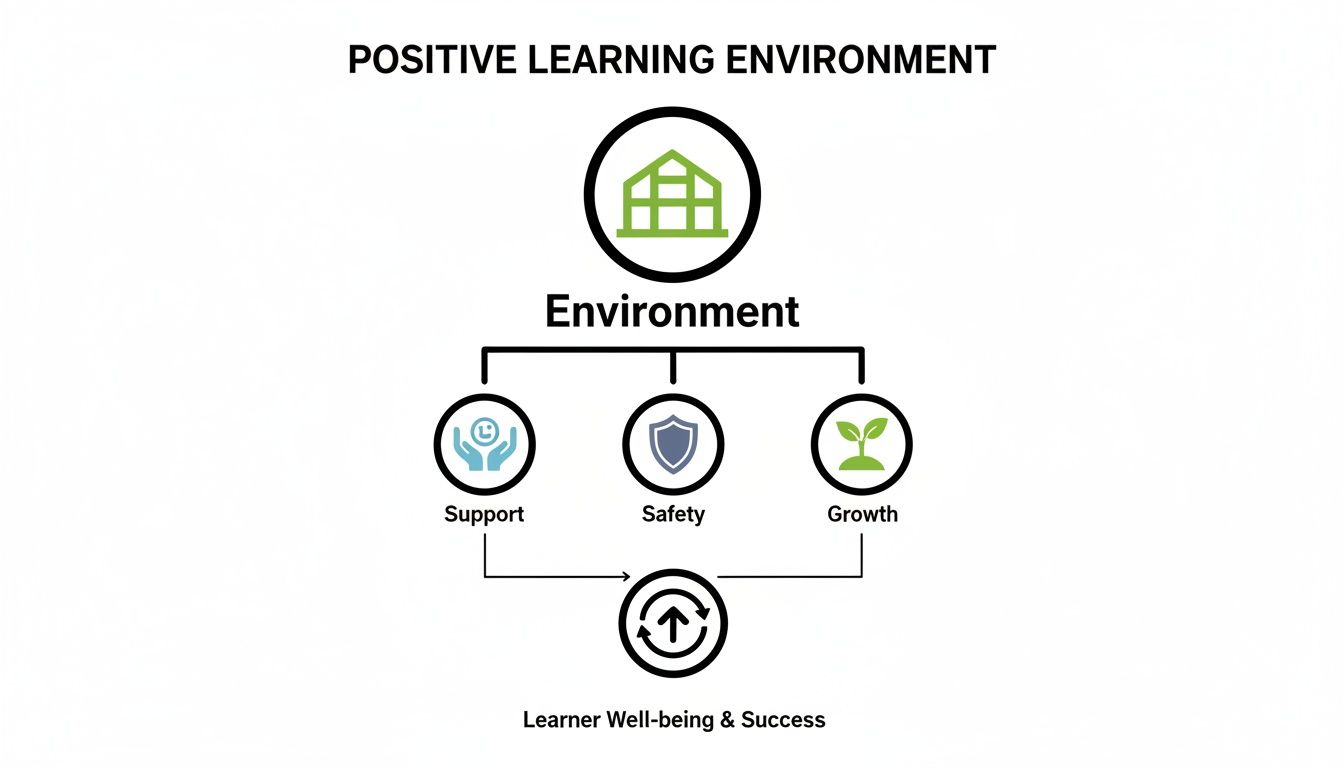
Diagram illustrating a positive learning environment, showing support, safety, and growth leading to learner well-being and success.

It all starts with that base layer of support and safety. Once that's in place, growth isn't just possible, it's natural.

How do you build psychological safety?

Psychological safety is the quiet confidence a student has to make mistakes or ask questions without worrying about judgment. When students feel safe, they take the academic risks essential for deep, lasting learning. You can build this feeling with intentional practices.

  • Frame mistakes as discoveries. When a student gets an answer wrong, reframe it as part of the process. Say something like, "That's a great attempt. Let's look at it from another angle."

  • Celebrate questions. Praise students for asking questions, no matter how basic. This sends a powerful message that curiosity is valued more than having the right answer.

  • Set clear ground rules. Establish and communicate simple classroom rules that boil down to one thing: respecting everyone's ideas and efforts.

How do supportive relationships impact learning?

Students need to feel a real connection with their tutors. We're talking about relationships built on trust, empathy, and mutual respect. This human connection is what turns a tutoring session from a simple transaction into a meaningful mentorship.

The data on this is striking. According to the OECD's 2022 PISA report, students in supportive settings score 52 points higher in math and reading. That gain is equivalent to nearly two years of schooling.

Why are structured operations essential?

The final pillar is the operational backbone holding everything together. Structured operations mean predictable schedules, transparent policies, and reliable communication. When your business administration runs smoothly, it lowers anxiety for everyone, students, parents, and tutors included.

A thriving learning space involves developing strong internal capabilities. This is often achieved through effective practices and can be supported by leadership training to build high-performing teams that reinforce operational excellence.

This consistency creates a calm, professional atmosphere. For instance, parents appreciate automated reminders and clear invoicing because it removes guesswork. Tutors thrive with reliable schedules, letting them focus on teaching instead of administrative tasks.

How Operational Chaos Erodes Student Trust

Even the most talented tutors cannot do their best work in a disorganized environment. When your back-office operations are messy, it directly creates a negative student experience. This slowly chips away at the trust you have worked so hard to build.
A man intently views a digital calendar on a tablet, with papers and a notebook on his desk.

This operational chaos undermines a student's sense of security and value. When your systems are inconsistent, families feel the stress. This runs completely counter to the stability needed for a positive learning environment.

What does operational friction look like?

Imagine a parent arriving for their child's session, only to find out the tutor was double-booked. Or picture a student who connects with a great tutor, but scheduling conflicts make it impossible to book consistent lessons. These moments create disappointment and doubt.

This kind of friction usually appears in a few common ways:

  • Scheduling Errors: A double-booked tutor or an overbooked classroom sends a clear message: "you've been forgotten." It communicates that a student's time isn't valued.

  • Billing Surprises: An unexpected invoice or a confusing charge can create immediate tension with parents. That financial stress can sour their perception of your entire service.

  • Inconsistent Communication: When parents get conflicting information about session times or policies, it erodes their confidence in your center's professionalism and reliability.

These administrative headaches tell students and their families that your operations are not set up to support them.

For a student, a predictable schedule is a form of safety. When their session is reliably at the same time, with the same tutor, it creates a routine they can depend on, freeing their mental energy to focus purely on learning.

The Hidden Cost of Manual Administration

The root of the problem is often outdated, manual processes. Owners who spend 10+ hours weekly on administrative tasks are pulled away from nurturing their team and refining educational programs. Their focus gets stuck on spreadsheets, not students.

Tutors feel the strain, too. When systems are clunky, they spend time confirming schedules instead of preparing lessons. This administrative burden distracts them from building supportive relationships, which is the cornerstone of a healthy learning environment.

Exploring tools that offer automated lesson reminders for tutoring centers is a simple first step to reclaim this lost time.

Using Technology to Build a Positive Culture

The right technology can turn your center into a smooth, supportive space. When you automate tasks like scheduling and billing, you eliminate the daily chaos that erodes trust. This frees your team to focus on building the relationships that define a positive learning environment.

A smiling teacher helps a young student use a tablet in a modern classroom.

Instead of letting administrative friction sour your learning environment, you can use automation to create a seamless experience. This simple shift moves your center from reactive problem-solving to proactive culture-building. Technology handles the logistics so your people can handle the relationships.

How can smart scheduling reduce frustration?

Scheduling is often the most common source of frustration for everyone. Smart scheduling tools actively prevent conflicts before they happen. They can instantly match students with the right tutors based on availability, subject, and location.

This removes the frustrating back-and-forth emails that eat up time. For families, it means a simple, reliable booking process. For your team, it means no more double-booked tutors or over-capacity classrooms.

The global private tutoring market, valued at USD 131.04 billion in 2025, is projected to soar to USD 192.09 billion by 2029. This growth is fueled by centers using modern tools for conflict-free scheduling, which report 50% higher capacity utilization. For example, real-time conflict detection alone can slash administrative busywork by 60%, as detailed in a recent academic tutoring report on ResearchAndMarkets.com.

Does automated invoicing build parent trust?

Financial interactions can either build or break trust with parents. Automated invoicing creates transparency and predictability that families appreciate. When invoices are generated automatically based on attended lessons, it eliminates surprise charges and manual errors.

That consistency sends a powerful message of professionalism and reliability. Parents know what to expect and when to expect it, which strengthens their confidence in your center. A predictable billing cycle makes them feel respected and valued.

A seamless administrative experience is the invisible foundation of a positive learning environment. When parents trust your billing and scheduling, they can relax and focus on their child's educational progress, knowing the logistics are handled professionally.

How do centralized profiles improve communication?

Keeping everyone on the same page is vital for creating a supportive atmosphere. Centralized student and tutor profiles act as a single source of truth. Everyone, from the front desk to the tutor, can access learning goals, attendance history, and important parent notes.

This eliminates confusion and ensures every interaction is informed and personal. When a parent calls with a question, your staff can provide an immediate, accurate answer. This coordination makes families feel known and cared for. For more ideas, check out our guide on using a digital online whiteboard for tutoring.

Manual vs Automated Operations: Impact on Environment

The table below shows how much difference a smart system makes. It contrasts the stress of manual admin with the trust-building outcomes of an automated platform like Tutorbase.

Operational Task

Manual Method (e.g., Spreadsheets)

Automated Method (e.g., Tutorbase)

Impact on Environment

Scheduling

Prone to double-bookings and constant errors.

Real-time conflict detection and smart matching.

Reduces stress and frustration for students and staff.

Invoicing

Inconsistent, time-consuming, and often contains errors.

Automatic generation based on actual attendance.

Increases parent trust and perceived professionalism.

Communication

Fragmented information, relies on memory or sticky notes.

Centralized profiles with complete student history.

Creates a cohesive, informed, and supportive experience.

Automating these core tasks is about creating an environment where teaching and learning can thrive. It eliminates preventable administrative headaches.

How to Measure Your Learning Environment

A positive learning environment is a measurable asset for your business. You can track its health by blending hard data, like student retention, with human feedback from satisfaction surveys. This turns a vague concept into a data-driven strategy you can improve.

You can't fix what you don't measure. Tracking specific Key Performance Indicators (KPIs) tells you how healthy your learning environment is. These metrics give you objective feedback on whether your strategies are working.

Start with the hard numbers that directly connect to your bottom line. These quantitative metrics tell a story about student and parent loyalty.

  • Student Retention Rate: A high retention rate, say 90% from one term to the next, signals that students feel supported and are hitting their goals.

  • Session Attendance Trends: Consistent attendance is a direct sign of engagement. Keep an eye on the average number of sessions per student each month. A dip could be a warning sign.

  • Parent Renewal Rates: When a package runs out, do parents sign back up? A renewal rate north of 85% shows they see real value and trust your center.

Getting to the "Why" with Qualitative Feedback

Numbers only tell half the story. To understand the why behind the data, you need to hear directly from the people involved. This is where you get real insight into what students and parents are actually experiencing.

Well-designed surveys are your best friend here. Just keep them short and to the point to get more responses.

A healthy learning environment is built on feedback. Actively listening to students, parents, and tutors is the single best way to catch small issues before they become big problems and to double down on what you’re already doing right.

Here are a few questions you can adapt for your own surveys:

Sample Survey Questions for Parents

  1. On a scale of 1-10, how likely are you to recommend us to a friend or colleague?

  2. How would you describe the communication you receive from our tutors and staff?

  3. What's one thing we could do to make your child's learning experience even better?

How to Scale Positivity as Your Center Grows

As you expand, your biggest challenge is keeping your unique culture alive. The secret is to standardize your best practices with smart, scalable systems. Things like multi-location management and automated payroll are non-negotiable. They help you keep the amazing tutors who are the heart of your positive learning environment.

Your tutoring center is thriving, and growth feels like the next step. How do you ensure the supportive, positive learning environment that got you here is replicated at every new location? The answer lies in shifting from personality-driven processes to system-driven excellence.

Without a consistent operational playbook, each new location can easily drift and develop its own micro-culture. That kind of inconsistency can tarnish your brand.

Standardizing Your Best Practices

To scale that feeling of positivity, you must codify what makes your environment great. This means creating a clear, repeatable playbook that anyone can follow.

  • Consistent Onboarding: Build a standardized training program for every new tutor. It should cover your specific methods for building rapport, giving feedback, and making students feel seen.

  • Operational Uniformity: Use one single management platform across all locations. This guarantees every student and parent gets the same professional, reliable experience.

This approach ensures that whether a student walks into your first location or your tenth, they get the same high-quality, supportive experience.

As you grow, your operational backbone becomes your cultural backbone. Reliable, automated systems free up your location managers and tutors to focus on people, not paperwork, protecting the positive culture that fuels your success.

How do scalable systems retain top talent?

Your best tutors are your positive culture. As you expand, keeping them happy is priority one. This is where multi-location management tools and automated payroll become absolutely critical.

These systems make sure your tutors are paid accurately and on time, no matter which branch they taught at. It’s a simple, powerful way to show you value their contribution. This builds loyalty and dramatically reduces turnover.

When your tutors feel supported by efficient, reliable systems, they can pour all their energy into creating that positive learning environment for your students.

Ready to build a scalable foundation for your growing center? See how Tutorbase provides the tools to manage multiple locations seamlessly. Get started and learn more.

Frequently Asked Questions

What is a positive learning environment?

A positive learning environment is a space where students feel psychologically safe, supported by their tutors, and guided by structured, predictable operations. This combination reduces anxiety, boosts engagement, and allows students to take the academic risks necessary for growth.

Why is a positive learning environment important?

A positive learning environment is important because it directly impacts student outcomes and business health. Studies show it increases student engagement by up to 30% and can improve retention rates by 42%, leading to better academic results, higher client loyalty, and stronger word-of-mouth referrals for your tutoring center.

How can I improve our learning environment on a tight budget?

You can improve your learning environment on a tight budget by focusing on high-impact, low-cost actions. Train tutors in positive reinforcement techniques, establish clear communication protocols with parents, and create predictable routines for students. These actions build psychological safety and trust, which are the foundation of a great atmosphere.

What is the most important factor for a positive environment?

The single most important factor for a positive environment is the relationship between the tutor and the student. A supportive, trusting connection gives students the confidence to engage, ask questions, and take academic risks. Your operational systems should protect and empower this relationship above all else.

How soon can I see results from these changes?

You will feel some changes, like improved staff and student morale from better communication, almost immediately. Bigger business results, such as higher student retention and better renewal rates, typically start appearing within three to six months as trust and loyalty take root.

Can technology really create a human-centric environment?

Yes, the right technology can help create a human-centric environment. The goal of automation is not to replace human connection but to eliminate impersonal tasks like scheduling and invoicing. This frees up your team's time and mental energy to focus on building relationships and providing personalized support.

Ready to eliminate the operational chaos that’s holding your culture back? Tutorbase provides the smart scheduling, automated billing, and multi-location management tools you need to build a truly positive learning environment. Register for a demo at tutorbase.com/register.

How to Create a Positive Learning Environment in Your Tutoring Center

Published: January 5, 2026 by Amy Ashford

A positive learning environment is more than a friendly classroom; it's a strategic asset where students feel safe, supported, and motivated. This atmosphere, built on psychological safety, supportive relationships, and structured operations, directly fuels student success, boosts retention rates by up to 42%, and drives business growth for tutoring centers.

A positive learning environment is the secret ingredient that makes learning stick. It is a space where students feel safe, supported, and genuinely motivated to show up and try. For tutoring centers, getting this right is a strategic asset that directly fuels student success and business growth.

What is a positive learning environment?

A positive learning environment is an educational setting where emotional, physical, and structural supports help students flourish. You can think of it as a space where making a mistake is seen as part of the learning process, not a reason for embarrassment. This supportive atmosphere is built on a few core pillars.

Core Components of a Positive Learning Environment

Component

Description

Impact on Tutoring Center

Psychological Safety

Students feel secure enough to ask questions, voice opinions, and take academic risks without fear of judgment.

Higher student engagement, better problem-solving skills, and increased confidence.

Supportive Relationships

Tutors build genuine rapport, showing they care about a student's progress and well-being, not just their test scores.

Increased student motivation, higher attendance rates, and stronger loyalty to your center.

Structured Operations

Clear schedules, predictable routines, and transparent communication reduce anxiety for students and parents alike.

Fewer no-shows, smoother parent interactions, and a more professional, trustworthy reputation.

When these three components are in place, your tutoring center stops being just a service. It becomes a community where students genuinely want to be.

Why does this environment matter for your business?

Cultivating this kind of atmosphere is a powerful business strategy. When students feel valued, they engage more deeply, attend regularly, and achieve better results. This translates into higher retention rates and word-of-mouth referrals.

A truly positive learning environment gives students permission to grow. It is a space where mistakes become learning moments, curiosity sparks community, and every voice matters. This foundation is critical for both academic and personal development.

Data supports this connection. A 2023 meta-analysis cited by Edutopia found classrooms fostering positivity saw student engagement climb by 25-30%. Tutoring centers that prioritize emotional safety report 42% higher retention rates.

Strong parent communication holds this ecosystem together. By understanding what makes a peaceful and welcoming classroom, you build a reputation as a trusted partner.

The Three Pillars of a Thriving Learning Space

A thriving learning space stands on three core pillars: psychological safety, supportive relationships, and structured operations. Getting these right creates a consistent, reliable, and positive environment where students and tutors can do their best work. Each pillar props up the others, forming a rock-solid foundation.

Diagram illustrating a positive learning environment, showing support, safety, and growth leading to learner well-being and success.

It all starts with that base layer of support and safety. Once that's in place, growth isn't just possible, it's natural.

How do you build psychological safety?

Psychological safety is the quiet confidence a student has to make mistakes or ask questions without worrying about judgment. When students feel safe, they take the academic risks essential for deep, lasting learning. You can build this feeling with intentional practices.

  • Frame mistakes as discoveries. When a student gets an answer wrong, reframe it as part of the process. Say something like, "That's a great attempt. Let's look at it from another angle."

  • Celebrate questions. Praise students for asking questions, no matter how basic. This sends a powerful message that curiosity is valued more than having the right answer.

  • Set clear ground rules. Establish and communicate simple classroom rules that boil down to one thing: respecting everyone's ideas and efforts.

How do supportive relationships impact learning?

Students need to feel a real connection with their tutors. We're talking about relationships built on trust, empathy, and mutual respect. This human connection is what turns a tutoring session from a simple transaction into a meaningful mentorship.

The data on this is striking. According to the OECD's 2022 PISA report, students in supportive settings score 52 points higher in math and reading. That gain is equivalent to nearly two years of schooling.

Why are structured operations essential?

The final pillar is the operational backbone holding everything together. Structured operations mean predictable schedules, transparent policies, and reliable communication. When your business administration runs smoothly, it lowers anxiety for everyone, students, parents, and tutors included.

A thriving learning space involves developing strong internal capabilities. This is often achieved through effective practices and can be supported by leadership training to build high-performing teams that reinforce operational excellence.

This consistency creates a calm, professional atmosphere. For instance, parents appreciate automated reminders and clear invoicing because it removes guesswork. Tutors thrive with reliable schedules, letting them focus on teaching instead of administrative tasks.

How Operational Chaos Erodes Student Trust

Even the most talented tutors cannot do their best work in a disorganized environment. When your back-office operations are messy, it directly creates a negative student experience. This slowly chips away at the trust you have worked so hard to build.

A man intently views a digital calendar on a tablet, with papers and a notebook on his desk.

This operational chaos undermines a student's sense of security and value. When your systems are inconsistent, families feel the stress. This runs completely counter to the stability needed for a positive learning environment.

What does operational friction look like?

Imagine a parent arriving for their child's session, only to find out the tutor was double-booked. Or picture a student who connects with a great tutor, but scheduling conflicts make it impossible to book consistent lessons. These moments create disappointment and doubt.

This kind of friction usually appears in a few common ways:

  • Scheduling Errors: A double-booked tutor or an overbooked classroom sends a clear message: "you've been forgotten." It communicates that a student's time isn't valued.

  • Billing Surprises: An unexpected invoice or a confusing charge can create immediate tension with parents. That financial stress can sour their perception of your entire service.

  • Inconsistent Communication: When parents get conflicting information about session times or policies, it erodes their confidence in your center's professionalism and reliability.

These administrative headaches tell students and their families that your operations are not set up to support them.

For a student, a predictable schedule is a form of safety. When their session is reliably at the same time, with the same tutor, it creates a routine they can depend on, freeing their mental energy to focus purely on learning.

The Hidden Cost of Manual Administration

The root of the problem is often outdated, manual processes. Owners who spend 10+ hours weekly on administrative tasks are pulled away from nurturing their team and refining educational programs. Their focus gets stuck on spreadsheets, not students.

Tutors feel the strain, too. When systems are clunky, they spend time confirming schedules instead of preparing lessons. This administrative burden distracts them from building supportive relationships, which is the cornerstone of a healthy learning environment.

Exploring tools that offer automated lesson reminders for tutoring centers is a simple first step to reclaim this lost time.

Using Technology to Build a Positive Culture

The right technology can turn your center into a smooth, supportive space. When you automate tasks like scheduling and billing, you eliminate the daily chaos that erodes trust. This frees your team to focus on building the relationships that define a positive learning environment.

A smiling teacher helps a young student use a tablet in a modern classroom.

Instead of letting administrative friction sour your learning environment, you can use automation to create a seamless experience. This simple shift moves your center from reactive problem-solving to proactive culture-building. Technology handles the logistics so your people can handle the relationships.

How can smart scheduling reduce frustration?

Scheduling is often the most common source of frustration for everyone. Smart scheduling tools actively prevent conflicts before they happen. They can instantly match students with the right tutors based on availability, subject, and location.

This removes the frustrating back-and-forth emails that eat up time. For families, it means a simple, reliable booking process. For your team, it means no more double-booked tutors or over-capacity classrooms.

The global private tutoring market, valued at USD 131.04 billion in 2025, is projected to soar to USD 192.09 billion by 2029. This growth is fueled by centers using modern tools for conflict-free scheduling, which report 50% higher capacity utilization. For example, real-time conflict detection alone can slash administrative busywork by 60%, as detailed in a recent academic tutoring report on ResearchAndMarkets.com.

Does automated invoicing build parent trust?

Financial interactions can either build or break trust with parents. Automated invoicing creates transparency and predictability that families appreciate. When invoices are generated automatically based on attended lessons, it eliminates surprise charges and manual errors.

That consistency sends a powerful message of professionalism and reliability. Parents know what to expect and when to expect it, which strengthens their confidence in your center. A predictable billing cycle makes them feel respected and valued.

A seamless administrative experience is the invisible foundation of a positive learning environment. When parents trust your billing and scheduling, they can relax and focus on their child's educational progress, knowing the logistics are handled professionally.

How do centralized profiles improve communication?

Keeping everyone on the same page is vital for creating a supportive atmosphere. Centralized student and tutor profiles act as a single source of truth. Everyone, from the front desk to the tutor, can access learning goals, attendance history, and important parent notes.

This eliminates confusion and ensures every interaction is informed and personal. When a parent calls with a question, your staff can provide an immediate, accurate answer. This coordination makes families feel known and cared for. For more ideas, check out our guide on using a digital online whiteboard for tutoring.

Manual vs Automated Operations: Impact on Environment

The table below shows how much difference a smart system makes. It contrasts the stress of manual admin with the trust-building outcomes of an automated platform like Tutorbase.

Operational Task

Manual Method (e.g., Spreadsheets)

Automated Method (e.g., Tutorbase)

Impact on Environment

Scheduling

Prone to double-bookings and constant errors.

Real-time conflict detection and smart matching.

Reduces stress and frustration for students and staff.

Invoicing

Inconsistent, time-consuming, and often contains errors.

Automatic generation based on actual attendance.

Increases parent trust and perceived professionalism.

Communication

Fragmented information, relies on memory or sticky notes.

Centralized profiles with complete student history.

Creates a cohesive, informed, and supportive experience.

Automating these core tasks is about creating an environment where teaching and learning can thrive. It eliminates preventable administrative headaches.

How to Measure Your Learning Environment

A positive learning environment is a measurable asset for your business. You can track its health by blending hard data, like student retention, with human feedback from satisfaction surveys. This turns a vague concept into a data-driven strategy you can improve.

You can't fix what you don't measure. Tracking specific Key Performance Indicators (KPIs) tells you how healthy your learning environment is. These metrics give you objective feedback on whether your strategies are working.

Start with the hard numbers that directly connect to your bottom line. These quantitative metrics tell a story about student and parent loyalty.

  • Student Retention Rate: A high retention rate, say 90% from one term to the next, signals that students feel supported and are hitting their goals.

  • Session Attendance Trends: Consistent attendance is a direct sign of engagement. Keep an eye on the average number of sessions per student each month. A dip could be a warning sign.

  • Parent Renewal Rates: When a package runs out, do parents sign back up? A renewal rate north of 85% shows they see real value and trust your center.

Getting to the "Why" with Qualitative Feedback

Numbers only tell half the story. To understand the why behind the data, you need to hear directly from the people involved. This is where you get real insight into what students and parents are actually experiencing.

Well-designed surveys are your best friend here. Just keep them short and to the point to get more responses.

A healthy learning environment is built on feedback. Actively listening to students, parents, and tutors is the single best way to catch small issues before they become big problems and to double down on what you’re already doing right.

Here are a few questions you can adapt for your own surveys:

Sample Survey Questions for Parents

  1. On a scale of 1-10, how likely are you to recommend us to a friend or colleague?

  2. How would you describe the communication you receive from our tutors and staff?

  3. What's one thing we could do to make your child's learning experience even better?

How to Scale Positivity as Your Center Grows

As you expand, your biggest challenge is keeping your unique culture alive. The secret is to standardize your best practices with smart, scalable systems. Things like multi-location management and automated payroll are non-negotiable. They help you keep the amazing tutors who are the heart of your positive learning environment.

Your tutoring center is thriving, and growth feels like the next step. How do you ensure the supportive, positive learning environment that got you here is replicated at every new location? The answer lies in shifting from personality-driven processes to system-driven excellence.

Without a consistent operational playbook, each new location can easily drift and develop its own micro-culture. That kind of inconsistency can tarnish your brand.

Standardizing Your Best Practices

To scale that feeling of positivity, you must codify what makes your environment great. This means creating a clear, repeatable playbook that anyone can follow.

  • Consistent Onboarding: Build a standardized training program for every new tutor. It should cover your specific methods for building rapport, giving feedback, and making students feel seen.

  • Operational Uniformity: Use one single management platform across all locations. This guarantees every student and parent gets the same professional, reliable experience.

This approach ensures that whether a student walks into your first location or your tenth, they get the same high-quality, supportive experience.

As you grow, your operational backbone becomes your cultural backbone. Reliable, automated systems free up your location managers and tutors to focus on people, not paperwork, protecting the positive culture that fuels your success.

How do scalable systems retain top talent?

Your best tutors are your positive culture. As you expand, keeping them happy is priority one. This is where multi-location management tools and automated payroll become absolutely critical.

These systems make sure your tutors are paid accurately and on time, no matter which branch they taught at. It’s a simple, powerful way to show you value their contribution. This builds loyalty and dramatically reduces turnover.

When your tutors feel supported by efficient, reliable systems, they can pour all their energy into creating that positive learning environment for your students.

Ready to build a scalable foundation for your growing center? See how Tutorbase provides the tools to manage multiple locations seamlessly. Get started and learn more.

Frequently Asked Questions

What is a positive learning environment?

A positive learning environment is a space where students feel psychologically safe, supported by their tutors, and guided by structured, predictable operations. This combination reduces anxiety, boosts engagement, and allows students to take the academic risks necessary for growth.

Why is a positive learning environment important?

A positive learning environment is important because it directly impacts student outcomes and business health. Studies show it increases student engagement by up to 30% and can improve retention rates by 42%, leading to better academic results, higher client loyalty, and stronger word-of-mouth referrals for your tutoring center.

How can I improve our learning environment on a tight budget?

You can improve your learning environment on a tight budget by focusing on high-impact, low-cost actions. Train tutors in positive reinforcement techniques, establish clear communication protocols with parents, and create predictable routines for students. These actions build psychological safety and trust, which are the foundation of a great atmosphere.

What is the most important factor for a positive environment?

The single most important factor for a positive environment is the relationship between the tutor and the student. A supportive, trusting connection gives students the confidence to engage, ask questions, and take academic risks. Your operational systems should protect and empower this relationship above all else.

How soon can I see results from these changes?

You will feel some changes, like improved staff and student morale from better communication, almost immediately. Bigger business results, such as higher student retention and better renewal rates, typically start appearing within three to six months as trust and loyalty take root.

Can technology really create a human-centric environment?

Yes, the right technology can help create a human-centric environment. The goal of automation is not to replace human connection but to eliminate impersonal tasks like scheduling and invoicing. This frees up your team's time and mental energy to focus on building relationships and providing personalized support.

Ready to eliminate the operational chaos that’s holding your culture back? Tutorbase provides the smart scheduling, automated billing, and multi-location management tools you need to build a truly positive learning environment. Register for a demo at tutorbase.com/register.