
How Do You Write a Tutoring Business Plan?
Published: December 5, 2025 by Amy Ashford

A strong tutoring business plan is your strategic playbook for success. This document outlines your company's mission, services, target market, and financial model, providing a clear roadmap for securing funding and making informed decisions. It is the foundational blueprint that turns your vision into an actionable strategy.
Why Do You Need a Business Plan for Your Tutoring Center?
Your business plan is an indispensable tool that translates your vision into a concrete strategy. It provides the framework you need to navigate growth and manage daily operations. The plan helps you measure what's working, ensuring you build a sustainable and profitable business.
Does a Business Plan Guarantee Success?
No document can guarantee success, but a well-researched plan dramatically improves your odds. It helps you identify potential risks and spot market opportunities before investing significant time and money. A good plan grounds your ambitions in solid data and strategic foresight.
For example, your market analysis might reveal a high demand for specialized ACT prep in your area that competitors overlook. This insight allows you to create a focused service that attracts a specific, motivated clientele. You can gain a powerful foothold right from the start.
This process connects the dots between your core mission, services, and market.
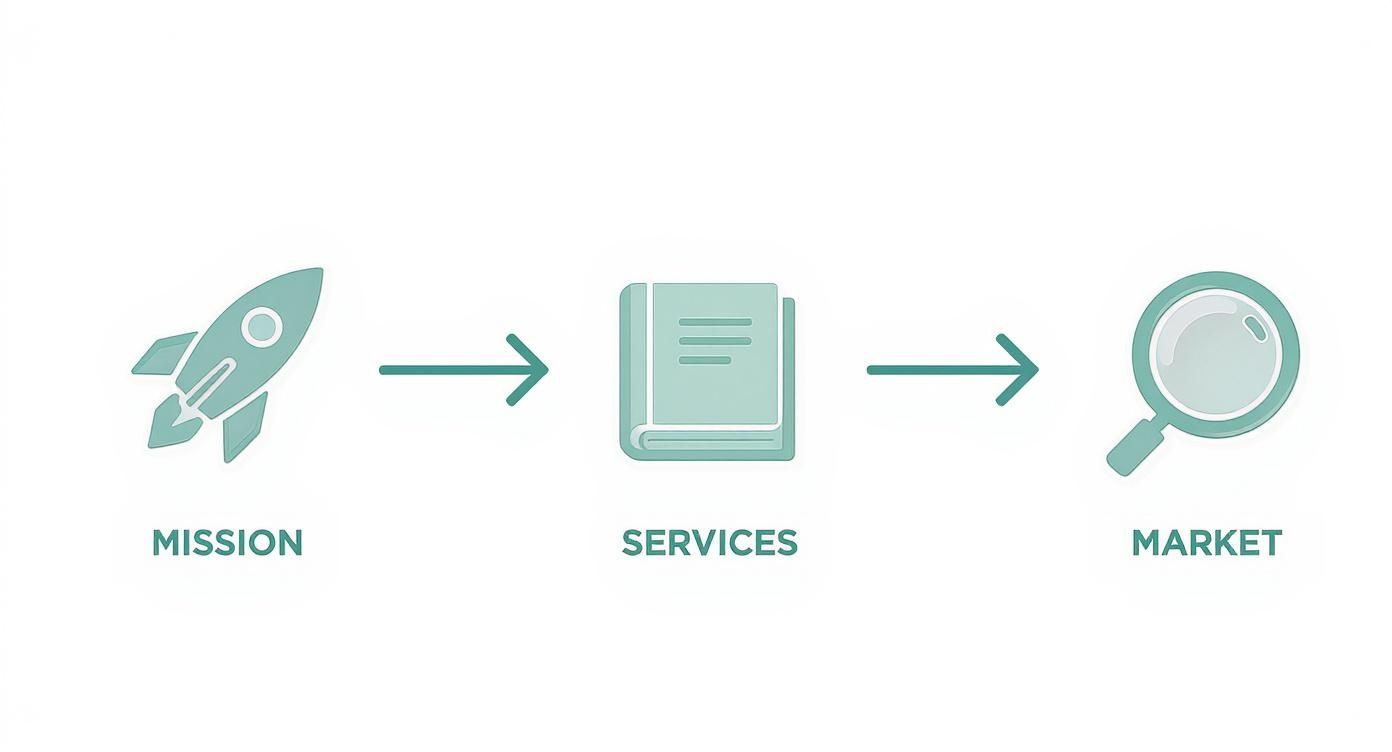
As the diagram shows, a clear mission directly informs the services you offer. It also defines the market you target, creating a cohesive and powerful business strategy.
What Is the Current Tutoring Market Size?
Understanding the health of the industry is critical for your plan's credibility. The global private tutoring market is expanding rapidly. In 2023, the market was valued at around $97.11 billion, a 6% jump from the previous year. You can find more tutoring market trends on consumeraffairs.com.
A business plan is your first line of defense against costly mistakes. It helps you anticipate challenges in your financial projections and operational model, allowing you to build a more resilient company from the start.
Creating a comprehensive plan delivers huge benefits during the process itself.
Clarity of Purpose: You will define your mission, vision, and unique value proposition. What makes your tutoring center different?
Financial Foresight: You will project startup costs, set smart pricing, and forecast revenue. This ensures your business is financially viable.
Strategic Direction: The plan provides a clear path for your marketing and operations. It keeps your entire team aligned.
Securing Investment: A professional, well-researched plan is non-negotiable if you seek a bank loan or want to attract investors.
To help you get started, here's a breakdown of the essential sections.
What are the Core Components of a Tutoring Business Plan?
Component | What It Covers | Key Question to Answer |
|---|---|---|
Executive Summary | A concise overview of the entire plan, highlighting your mission, key offerings, and financial outlook. | What is the elevator pitch for my tutoring business? |
Market Analysis | Research on your target audience, local competition, and industry trends. | Who are my ideal students, and what does the competitive landscape look like? |
Services & Pricing | A detailed description of the tutoring services you'll provide and your pricing strategy. | What specific problems do my services solve, and what is their value? |
Operations Plan | The day-to-day logistics: scheduling, staffing, location, and technology stack. | How will I deliver my services efficiently and consistently? |
Financial Projections | Startup costs, revenue forecasts, break-even analysis, and key performance indicators (KPIs). | What are the numbers behind the business, and when will it be profitable? |
Go-to-Market Plan | Your strategy for marketing, sales, and student acquisition. | How will I find and attract my first 50 students? |
Risk & Contingency | Identification of potential risks and a plan to mitigate them. | What could go wrong, and how will I handle it? |
Each component builds on the last, creating a comprehensive picture of your business. This is useful for you and for any potential investor.
How Do You Analyze Your Local Tutoring Market?
A deep dive into your local market is the bedrock of a solid business plan. This involves identifying your ideal student and understanding your competitors. It helps you spot gaps in the market that your business can fill.
This research stops you from building a business on guesswork. Instead of assuming what parents want, you will use real data. This groundwork influences everything from your service offerings to your marketing messages.
What is a Target Market in Tutoring?
A target market is the specific group of students and parents you want to help. Getting laser-focused here is non-negotiable. You cannot be everything to everyone, so defining your audience gives you a massive advantage.
For instance, instead of offering a vague "math tutoring" service, get specific:
Students: 6th to 8th graders at Lincoln Middle School struggling with pre-algebra.
Parents: Busy, dual-income households who prioritize academics but lack time for homework battles.
The Problem: Their child is losing confidence in math, and they worry about high school.
Now you are not just a math tutor. You are a specialist solving a specific, urgent problem.
How Can You Pinpoint Your Ideal Student?
To find your ideal student, think beyond basic demographics like age and grade. You must understand their goals and frustrations. What keeps their parents up at night? A great way to do this is by creating a "student persona."
Let's imagine you offer SAT prep. Your persona might be "Ambitious Alex." He's a high school junior aiming for a 1400+ score for engineering school. Alex works hard but struggles with pacing in the math section.
You are no longer creating a generic SAT course. You are designing a program to help students like Alex master tricky math concepts and timing strategies.
The global private tutoring market is exploding. Projections show it will grow at a compound annual growth rate (CAGR) of about 10% between 2025 and 2029. By 2029, it's expected to be a $192 billion industry. This signals massive demand. You can find more tutoring market growth projections at einpresswire.com.
How Should You Scope Out Local Competition?
Sizing up competitors is not about copying them. It is about finding the moves they are not making. Start by listing every tutoring center within a 10-mile radius. Include independent tutors you find online.
For each competitor, dig into the details:
Their Services: What subjects and age groups do they focus on? Are they in-person, online, or a mix?
Their Pricing: What is their hourly rate? Do they offer packages or subscriptions? Is pricing easy to find?
Their Reputation: Scour their website, social media, and online reviews. Note what parents praise and what they complain about.
This detective work helps you find your unique opening. Maybe others focus on K-8 math. This leaves a lane for you to become the expert for high school AP science prep.
How Should You Structure Your Tutoring Services and Pricing?

Your service menu and pricing model are the engine of your business plan. The goal is to create a clear mix of services, like one-on-one and group sessions. Pair it with a pricing strategy that guarantees predictable revenue and shows parents your value.
This is where your vision gets real. This section of your plan spells out exactly what you sell and for how much. It must be specific, backed by your market analysis, and built for profitability.
Will You Offer One-on-One or Group Sessions?
Your first big decision is how you will deliver tutoring. Each format has pros and cons. Most successful centers offer a mix to appeal to more families.
One-on-One Tutoring: This is your premium, high-touch service. It's perfect for students who need intensive prep. You can charge top dollar for this personalized attention, but it does not scale well.
Small Group Tutoring (2-5 students): This model makes tutoring more affordable for parents and more profitable for you. A single tutor can generate more revenue per hour. Students often benefit from learning with peers.
The right blend depends on your market. If you found a big demand for affordable homework help, group sessions are a no-brainer. If you serve students with learning differences, one-on-one sessions will be your core offering.
In your tutoring business plan, define your target revenue ratio. For example, you might project that 70% of revenue will come from small group classes and 30% from premium one-on-one tutoring. This detail is crucial for forecasting revenue.
What Is a Pricing Strategy?
A pricing strategy is the logic behind how you charge for your services. It involves packaging your offerings to create predictable income. It also encourages long-term commitment and communicates the value of your tutoring.
Good pricing should feel consistent with your brand. If you position yourself as an elite test prep service, your prices must reflect that. If you are a community-focused program, your pricing should be accessible.
How Should You Price Your Tutoring Services?
Your pricing model has a massive impact on cash flow and client retention. A pay-as-you-go model leads to inconsistent revenue. Successful centers in 2025 are shifting to packages and subscriptions to stabilize their income.
Here are the most common models:
Package Deals: You sell a block of sessions upfront, for example 10 or 20 hours, at a slight discount. This is great for cash flow and client commitment.
Monthly Subscriptions: Clients pay a flat monthly fee for a set number of sessions. This creates predictable recurring revenue, a game-changer for budgeting.
Pay-As-You-Go: This classic hourly model offers flexibility but is the least stable for your business. Reserve it for trial sessions or one-off help.
Picking the right model is a major decision. For a deeper dive into the numbers and psychology, check our guide on tutoring pricing models.
How Do Different Tutoring Pricing Models Compare?
Deciding how to charge can be tough. Here is a quick breakdown of the main options to help you align with your business goals.
Pricing Model | How It Works | Best For |
|---|---|---|
Pay-As-You-Go | Clients pay per session or per hour after it occurs. | Occasional homework help, trial sessions, or drop-in services. |
Package Bundles | Clients purchase a set number of sessions in advance, often at a discount. | Test preparation (SAT, ACT), final exam cramming, or specific skill bootcamps. |
Monthly Subscription | Clients pay a recurring flat fee for a guaranteed number of sessions per month. | Ongoing, long-term academic support for core subjects like math and reading. |
Many centers find success by offering a combination. You might use a monthly subscription for core clients and packages for seasonal test prep. This flexibility meets different family needs while building a stable financial foundation.
How Do You Plan Your Day-to-Day Tutoring Operations?

Smooth daily operations are the engine of a successful tutoring business. Your business plan must detail the client journey from onboarding to progress reporting. It should specify how technology will automate these tasks.
Execution is everything. This section of your plan proves your model is a workable reality. It is all about the nitty-gritty of your day-to-day workflow. A well-defined operational plan shows you can deliver a high-quality, efficient service.
How Will You Manage Scheduling?
Scheduling is one of the biggest operational headaches for any tutoring center. Your business plan needs a rock-solid answer for handling bookings and tutor assignments. Using spreadsheets is a recipe for double-bookings and wasted admin time.
Get specific about your system and consider these questions:
Student Booking: How will families book, reschedule, or cancel? Will they call, email, or use an online portal?
Tutor Assignments: What is your process for pairing a student with the perfect tutor?
Room Management: For physical centers, how do you plan to allocate classrooms to prevent conflicts?
What Does Your Client Onboarding Process Look Like?
First impressions matter. A clunky onboarding process can sour a family’s experience. Your plan should map out a seamless journey that turns an interested parent into an enrolled student.
A strong onboarding workflow should include:
Initial Consultation: A structured chat to understand the student’s needs, goals, and learning style.
Assessment: A quick diagnostic test to get a baseline and pinpoint where they need help.
Tutor Matching: A thoughtful process for pairing the student with the best-fit instructor.
Welcome Packet: A simple package with policies, login info, and contact details.
This approach creates consistency and sets clear expectations. It gives your tutors everything they need for a personalized learning plan.
How Will You Track Student Progress?
Parents need to see that their investment is paying off. This is non-negotiable for client retention. Your plan must detail how you will monitor academic growth and communicate that progress.
This creates a powerful feedback loop that builds trust. Your plan might state that tutors complete a brief report after every session. These notes can be compiled into a monthly report and emailed to parents.
You should also ensure your tutors teach students effective textbook study strategies. This empowers them to become more independent learners.
Will You Use a Physical or Online Platform?
The choice between a brick-and-mortar center, an online model, or a hybrid will shape your operations. The online private tutoring market is exploding, valued at $37.74 billion in 2023. Its projected annual growth of over 7.7% makes it impossible to ignore.
Here is how this decision impacts your workflow:
Online Operations: You will need a reliable virtual classroom platform and tools for sharing digital resources.
Physical Operations: This involves managing classroom capacity, ensuring a safe environment, and handling in-person logistics.
Your plan must be clear about your chosen model. Detail the specific technology and processes you will use to support it.
How Do You Forecast Your Tutoring Business Financials?

The financial projections in your plan are where your strategy meets reality. Lenders and investors scrutinize this section to see if your business is viable. You need a detailed budget, a realistic revenue forecast, and a clear understanding of key metrics.
This is where your entire business plan comes together in black and white. Your financial forecast shows you have done your homework on costs, revenue potential, and profitability. It must be thorough and supported by your market analysis.
How Do You Create a Startup Budget?
First, you need a comprehensive startup budget. This is an honest list of every expense you will face before opening. Getting granular here is the best way to avoid financial surprises.
Account for both one-time setup costs and recurring monthly expenses for at least six months. This gives you a clear picture of the total capital you need to launch and sustain the business.
Essential Startup Costs to Include:
One-Time Expenses:
Business registration and legal fees
Security deposit for a physical space
Furniture, computers, and other hardware
Initial curriculum and textbook purchases
Recurring Monthly Expenses:
Rent and utilities
Software subscriptions (like Tutorbase for management)
Marketing and advertising costs
Tutor salaries and payroll taxes
Insurance (liability, property)
How Do You Project Your Revenue?
Projecting revenue starts with a sales forecast. This is an educated guess based on your pricing, student capacity, and market demand. You should map this out for your first three years, breaking the first year down by month.
Start with your capacity. If you have five tutors working 20 hours a week, you have 100 total tutoring hours available. Next, estimate a realistic tutor utilization rate, the percentage of hours you expect to fill.
From there, the math is straightforward. Multiply your billable hours by your average hourly rate. For example, 25 filled hours per week at $60/hour equals $1,500 in weekly revenue. Smart plans model a few different scenarios.
What are Key Financial Statements to Include?
Organize your projections into standard financial statements. These documents give a professional view of your business’s financial health and are non-negotiable for funding.
Profit and Loss (P&L) Statement: This shows your revenues, costs, and expenses over a period. It answers one question: are you making money?
Cash Flow Projection: This tracks the actual cash moving in and out of your bank account. It is critical for managing liquidity.
Balance Sheet: This provides a snapshot of your assets, liabilities, and equity at a single point in time.
Which Metrics Should You Track?
Beyond the big three statements, you need to track key performance indicators (KPIs). These numbers give you real-time insight into your business's efficiency. They help you make smart, data-driven decisions.
Important KPIs for a Tutoring Center:
Metric | What It Measures | Why It Matters |
|---|---|---|
Client Acquisition Cost (CAC) | The average cost to sign up one new student (Marketing Spend / New Students). | Helps you determine if your marketing channels are worth the money. |
Customer Lifetime Value (CLV) | The total revenue you can expect from a single student over their entire time with you. | A high CLV is a great sign of strong student retention and service value. |
Tutor Utilization Rate | The percentage of a tutor's available hours that are booked for paid sessions. | This is a core indicator of your scheduling efficiency and day-to-day profitability. |
Monthly Recurring Revenue (MRR) | Your predictable monthly income from subscription-based services or packages. | This is the most important metric for proving stable, scalable growth to investors. |
Getting your pricing right is the foundation for these forecasts. To experiment with different models, a course fee calculator can be a huge help. It lets you model scenarios and see how small tweaks change the financial picture.
How Do You Craft Your Marketing and Growth Strategy?
A great service needs a great marketing plan to find students. Your tutoring business plan must outline specific, low-cost marketing channels to attract your first clients. It must also detail a clear strategy for sustainable, long-term growth.
Your go-to-market strategy is where the rubber meets the road. It details how you will find, attract, and keep a steady stream of students. This plan needs to be practical, measurable, and focused.
How Can You Market a New Tutoring Business?
When starting out, you do not need a massive advertising budget. Some of the most effective marketing channels are local and low-cost. The goal is to focus on grassroots efforts that build trust.
Local SEO: This is completely non-negotiable in 2025. You must show up when a local parent searches "math tutor near me." Create a detailed Google Business Profile and ask happy clients for reviews.
School Partnerships: Build relationships with local schools, guidance counselors, and PTAs. Offer to run a free homework-help workshop. Becoming a trusted educational partner is a powerful marketing move.
Referral Programs: Encourage word-of-mouth marketing. Create a simple program where current families get a discount for every new student they refer. This turns customers into salespeople.
What Should Your Digital Marketing Plan Include?
Think of your website as your digital storefront. It needs to be professional, welcoming, and easy to navigate. A strong foundation for your online presence relies on an effective site architecture for SEO, the backbone of digital marketing.
At a minimum, your website should clearly state who you help, what you offer, and how to get started. For more advanced strategies, our guide on how to market your tutoring services online covers social media content and targeted ads.
How Do You Plan for Sustainable Growth?
Once you have a steady flow of clients, your business plan must focus on the future. Sustainable growth is about making smart, strategic moves. It increases your revenue without watering down service quality.
How Do You Compare Strategies for Scaling Your Tutoring Business?
Growth Strategy | Description | Key Considerations |
|---|---|---|
Add New Services | Introduce new subjects, high-demand test prep courses (e.g., ACT, GMAT), or specialized workshops. | You'll need to hire tutors with new specializations and potentially develop fresh curriculum. |
Launch an Online Program | Offer virtual one-on-one or group sessions to expand your reach beyond your local area. | This involves investing in a reliable virtual classroom platform and shifting marketing focus. |
Open a New Location | Replicate your successful model in a neighboring town or another part of your city. | This demands rock-solid, standardized operational processes and a strong location manager. |
Franchise Your Model | Package your brand, curriculum, and operational systems for other entrepreneurs to buy and run. | This is the most complex option, requiring significant legal and logistical setup. |
What are Common Questions About Tutoring Business Plans?
As you pull all the pieces together, a few common questions always pop up. Let's tackle them head-on so you can move forward with confidence. Your business plan should be a practical guide, not a novel.
Your business plan is a living document you should return to for big decisions. A strong focus on your financial projections and client acquisition strategy separates a useful plan from one that gathers dust.
How Long Should a Tutoring Business Plan Be?
Keep your tutoring business plan concise, aiming for 15 to 25 pages. This length provides enough space for market research, operational details, and financial models without overwhelming readers. Lenders and investors appreciate clarity and a plan that gets straight to the point.
Which Section Do Investors Care About Most?
Investors care most about two sections: financial projections and your marketing and growth strategy. The numbers prove your business can be profitable. Your marketing plan shows you have a realistic way to find and keep students, demonstrating a clear path to profit.
Your business plan is telling the story of your company's future. The financial section is the climax, it’s where you prove the story has a happy and profitable ending. Make sure your numbers are grounded in solid research and realistic assumptions.
How Can I Accurately Estimate Startup Costs?
To get a realistic number, break your costs into two buckets: one-time expenses and recurring monthly expenses. This prevents underestimating the cash you need to launch and survive the first six months.
One-Time Costs: Include business registration fees, furniture, security deposits, and initial marketing materials.
Recurring Costs: This is your ongoing burn rate. It includes rent, utilities, software subscriptions (like your Tutorbase plan), insurance, and tutor salaries.
Do not guess. Get quotes for insurance and check commercial real estate listings. When you add up these detailed lists, you will have a startup budget you can defend.
How Often Should I Update My Business Plan?
Treat your business plan as a living document and review it at least once a year. You should also update it before any major business change, like applying for a loan or expanding to a new location. Keeping your plan current ensures it remains a relevant, useful tool.
Frequently Asked Questions (FAQ)
What is the first step in creating a tutoring business plan?
The first step is the executive summary. While written last, it summarizes your entire plan, including your mission, services, target market, and financial highlights. It forces you to clarify your core concept into a concise pitch.
How do I define my target market for a tutoring service?
Define your target market by creating a "student persona." Go beyond demographics like age and grade. Identify their specific academic challenges, goals, and the problems their parents are trying to solve. For example, "high school sophomores struggling with AP Chemistry concepts."
What financial information must be in my business plan?
Your plan must include a startup budget, a 3-year revenue projection (with the first year broken down by month), a profit and loss statement, a cash flow projection, and a balance sheet. Also, identify key performance indicators (KPIs) like Client Acquisition Cost (CAC).
Should my tutoring business be online or in-person?
The decision depends on your market analysis and startup budget. Online businesses have lower overhead but require strong digital marketing. In-person centers build local trust but involve higher costs for rent and utilities. Many new businesses in 2025 use a hybrid model.
How do I price my tutoring services effectively?
Effective pricing involves choosing a model that ensures stable revenue. Monthly subscriptions or pre-paid packages are generally better than a pay-as-you-go hourly rate. Your price should reflect the value you provide and be competitive within your local market.
What makes a tutoring business plan successful?
A successful plan is realistic, well-researched, and specific. It demonstrates a deep understanding of the target market and competition. It also presents clear, data-backed financial projections and a practical plan for acquiring students.
Ready to stop spending over 10 hours a week on manual admin and start growing your tutoring center? Tutorbase automates your scheduling, billing, and payroll, eliminating double-bookings and chasing payments for good. See how our AI-powered platform can cut your admin overhead by 60% and get a demo at tutorbase.com/register.
How Do You Write a Tutoring Business Plan?
Published: December 1, 2025 by Amy Ashford


A strong tutoring business plan is your strategic playbook for success. This document outlines your company's mission, services, target market, and financial model, providing a clear roadmap for securing funding and making informed decisions. It is the foundational blueprint that turns your vision into an actionable strategy.
Why Do You Need a Business Plan for Your Tutoring Center?
Your business plan is an indispensable tool that translates your vision into a concrete strategy. It provides the framework you need to navigate growth and manage daily operations. The plan helps you measure what's working, ensuring you build a sustainable and profitable business.
Does a Business Plan Guarantee Success?
No document can guarantee success, but a well-researched plan dramatically improves your odds. It helps you identify potential risks and spot market opportunities before investing significant time and money. A good plan grounds your ambitions in solid data and strategic foresight.
For example, your market analysis might reveal a high demand for specialized ACT prep in your area that competitors overlook. This insight allows you to create a focused service that attracts a specific, motivated clientele. You can gain a powerful foothold right from the start.
This process connects the dots between your core mission, services, and market.

As the diagram shows, a clear mission directly informs the services you offer. It also defines the market you target, creating a cohesive and powerful business strategy.
What Is the Current Tutoring Market Size?
Understanding the health of the industry is critical for your plan's credibility. The global private tutoring market is expanding rapidly. In 2023, the market was valued at around $97.11 billion, a 6% jump from the previous year. You can find more tutoring market trends on consumeraffairs.com.
A business plan is your first line of defense against costly mistakes. It helps you anticipate challenges in your financial projections and operational model, allowing you to build a more resilient company from the start.
Creating a comprehensive plan delivers huge benefits during the process itself.
Clarity of Purpose: You will define your mission, vision, and unique value proposition. What makes your tutoring center different?
Financial Foresight: You will project startup costs, set smart pricing, and forecast revenue. This ensures your business is financially viable.
Strategic Direction: The plan provides a clear path for your marketing and operations. It keeps your entire team aligned.
Securing Investment: A professional, well-researched plan is non-negotiable if you seek a bank loan or want to attract investors.
To help you get started, here's a breakdown of the essential sections.
What are the Core Components of a Tutoring Business Plan?
Component | What It Covers | Key Question to Answer |
|---|---|---|
Executive Summary | A concise overview of the entire plan, highlighting your mission, key offerings, and financial outlook. | What is the elevator pitch for my tutoring business? |
Market Analysis | Research on your target audience, local competition, and industry trends. | Who are my ideal students, and what does the competitive landscape look like? |
Services & Pricing | A detailed description of the tutoring services you'll provide and your pricing strategy. | What specific problems do my services solve, and what is their value? |
Operations Plan | The day-to-day logistics: scheduling, staffing, location, and technology stack. | How will I deliver my services efficiently and consistently? |
Financial Projections | Startup costs, revenue forecasts, break-even analysis, and key performance indicators (KPIs). | What are the numbers behind the business, and when will it be profitable? |
Go-to-Market Plan | Your strategy for marketing, sales, and student acquisition. | How will I find and attract my first 50 students? |
Risk & Contingency | Identification of potential risks and a plan to mitigate them. | What could go wrong, and how will I handle it? |
Each component builds on the last, creating a comprehensive picture of your business. This is useful for you and for any potential investor.
How Do You Analyze Your Local Tutoring Market?
A deep dive into your local market is the bedrock of a solid business plan. This involves identifying your ideal student and understanding your competitors. It helps you spot gaps in the market that your business can fill.
This research stops you from building a business on guesswork. Instead of assuming what parents want, you will use real data. This groundwork influences everything from your service offerings to your marketing messages.
What is a Target Market in Tutoring?
A target market is the specific group of students and parents you want to help. Getting laser-focused here is non-negotiable. You cannot be everything to everyone, so defining your audience gives you a massive advantage.
For instance, instead of offering a vague "math tutoring" service, get specific:
Students: 6th to 8th graders at Lincoln Middle School struggling with pre-algebra.
Parents: Busy, dual-income households who prioritize academics but lack time for homework battles.
The Problem: Their child is losing confidence in math, and they worry about high school.
Now you are not just a math tutor. You are a specialist solving a specific, urgent problem.
How Can You Pinpoint Your Ideal Student?
To find your ideal student, think beyond basic demographics like age and grade. You must understand their goals and frustrations. What keeps their parents up at night? A great way to do this is by creating a "student persona."
Let's imagine you offer SAT prep. Your persona might be "Ambitious Alex." He's a high school junior aiming for a 1400+ score for engineering school. Alex works hard but struggles with pacing in the math section.
You are no longer creating a generic SAT course. You are designing a program to help students like Alex master tricky math concepts and timing strategies.
The global private tutoring market is exploding. Projections show it will grow at a compound annual growth rate (CAGR) of about 10% between 2025 and 2029. By 2029, it's expected to be a $192 billion industry. This signals massive demand. You can find more tutoring market growth projections at einpresswire.com.
How Should You Scope Out Local Competition?
Sizing up competitors is not about copying them. It is about finding the moves they are not making. Start by listing every tutoring center within a 10-mile radius. Include independent tutors you find online.
For each competitor, dig into the details:
Their Services: What subjects and age groups do they focus on? Are they in-person, online, or a mix?
Their Pricing: What is their hourly rate? Do they offer packages or subscriptions? Is pricing easy to find?
Their Reputation: Scour their website, social media, and online reviews. Note what parents praise and what they complain about.
This detective work helps you find your unique opening. Maybe others focus on K-8 math. This leaves a lane for you to become the expert for high school AP science prep.
How Should You Structure Your Tutoring Services and Pricing?

Your service menu and pricing model are the engine of your business plan. The goal is to create a clear mix of services, like one-on-one and group sessions. Pair it with a pricing strategy that guarantees predictable revenue and shows parents your value.
This is where your vision gets real. This section of your plan spells out exactly what you sell and for how much. It must be specific, backed by your market analysis, and built for profitability.
Will You Offer One-on-One or Group Sessions?
Your first big decision is how you will deliver tutoring. Each format has pros and cons. Most successful centers offer a mix to appeal to more families.
One-on-One Tutoring: This is your premium, high-touch service. It's perfect for students who need intensive prep. You can charge top dollar for this personalized attention, but it does not scale well.
Small Group Tutoring (2-5 students): This model makes tutoring more affordable for parents and more profitable for you. A single tutor can generate more revenue per hour. Students often benefit from learning with peers.
The right blend depends on your market. If you found a big demand for affordable homework help, group sessions are a no-brainer. If you serve students with learning differences, one-on-one sessions will be your core offering.
In your tutoring business plan, define your target revenue ratio. For example, you might project that 70% of revenue will come from small group classes and 30% from premium one-on-one tutoring. This detail is crucial for forecasting revenue.
What Is a Pricing Strategy?
A pricing strategy is the logic behind how you charge for your services. It involves packaging your offerings to create predictable income. It also encourages long-term commitment and communicates the value of your tutoring.
Good pricing should feel consistent with your brand. If you position yourself as an elite test prep service, your prices must reflect that. If you are a community-focused program, your pricing should be accessible.
How Should You Price Your Tutoring Services?
Your pricing model has a massive impact on cash flow and client retention. A pay-as-you-go model leads to inconsistent revenue. Successful centers in 2025 are shifting to packages and subscriptions to stabilize their income.
Here are the most common models:
Package Deals: You sell a block of sessions upfront, for example 10 or 20 hours, at a slight discount. This is great for cash flow and client commitment.
Monthly Subscriptions: Clients pay a flat monthly fee for a set number of sessions. This creates predictable recurring revenue, a game-changer for budgeting.
Pay-As-You-Go: This classic hourly model offers flexibility but is the least stable for your business. Reserve it for trial sessions or one-off help.
Picking the right model is a major decision. For a deeper dive into the numbers and psychology, check our guide on tutoring pricing models.
How Do Different Tutoring Pricing Models Compare?
Deciding how to charge can be tough. Here is a quick breakdown of the main options to help you align with your business goals.
Pricing Model | How It Works | Best For |
|---|---|---|
Pay-As-You-Go | Clients pay per session or per hour after it occurs. | Occasional homework help, trial sessions, or drop-in services. |
Package Bundles | Clients purchase a set number of sessions in advance, often at a discount. | Test preparation (SAT, ACT), final exam cramming, or specific skill bootcamps. |
Monthly Subscription | Clients pay a recurring flat fee for a guaranteed number of sessions per month. | Ongoing, long-term academic support for core subjects like math and reading. |
Many centers find success by offering a combination. You might use a monthly subscription for core clients and packages for seasonal test prep. This flexibility meets different family needs while building a stable financial foundation.
How Do You Plan Your Day-to-Day Tutoring Operations?

Smooth daily operations are the engine of a successful tutoring business. Your business plan must detail the client journey from onboarding to progress reporting. It should specify how technology will automate these tasks.
Execution is everything. This section of your plan proves your model is a workable reality. It is all about the nitty-gritty of your day-to-day workflow. A well-defined operational plan shows you can deliver a high-quality, efficient service.
How Will You Manage Scheduling?
Scheduling is one of the biggest operational headaches for any tutoring center. Your business plan needs a rock-solid answer for handling bookings and tutor assignments. Using spreadsheets is a recipe for double-bookings and wasted admin time.
Get specific about your system and consider these questions:
Student Booking: How will families book, reschedule, or cancel? Will they call, email, or use an online portal?
Tutor Assignments: What is your process for pairing a student with the perfect tutor?
Room Management: For physical centers, how do you plan to allocate classrooms to prevent conflicts?
What Does Your Client Onboarding Process Look Like?
First impressions matter. A clunky onboarding process can sour a family’s experience. Your plan should map out a seamless journey that turns an interested parent into an enrolled student.
A strong onboarding workflow should include:
Initial Consultation: A structured chat to understand the student’s needs, goals, and learning style.
Assessment: A quick diagnostic test to get a baseline and pinpoint where they need help.
Tutor Matching: A thoughtful process for pairing the student with the best-fit instructor.
Welcome Packet: A simple package with policies, login info, and contact details.
This approach creates consistency and sets clear expectations. It gives your tutors everything they need for a personalized learning plan.
How Will You Track Student Progress?
Parents need to see that their investment is paying off. This is non-negotiable for client retention. Your plan must detail how you will monitor academic growth and communicate that progress.
This creates a powerful feedback loop that builds trust. Your plan might state that tutors complete a brief report after every session. These notes can be compiled into a monthly report and emailed to parents.
You should also ensure your tutors teach students effective textbook study strategies. This empowers them to become more independent learners.
Will You Use a Physical or Online Platform?
The choice between a brick-and-mortar center, an online model, or a hybrid will shape your operations. The online private tutoring market is exploding, valued at $37.74 billion in 2023. Its projected annual growth of over 7.7% makes it impossible to ignore.
Here is how this decision impacts your workflow:
Online Operations: You will need a reliable virtual classroom platform and tools for sharing digital resources.
Physical Operations: This involves managing classroom capacity, ensuring a safe environment, and handling in-person logistics.
Your plan must be clear about your chosen model. Detail the specific technology and processes you will use to support it.
How Do You Forecast Your Tutoring Business Financials?

The financial projections in your plan are where your strategy meets reality. Lenders and investors scrutinize this section to see if your business is viable. You need a detailed budget, a realistic revenue forecast, and a clear understanding of key metrics.
This is where your entire business plan comes together in black and white. Your financial forecast shows you have done your homework on costs, revenue potential, and profitability. It must be thorough and supported by your market analysis.
How Do You Create a Startup Budget?
First, you need a comprehensive startup budget. This is an honest list of every expense you will face before opening. Getting granular here is the best way to avoid financial surprises.
Account for both one-time setup costs and recurring monthly expenses for at least six months. This gives you a clear picture of the total capital you need to launch and sustain the business.
Essential Startup Costs to Include:
One-Time Expenses:
Business registration and legal fees
Security deposit for a physical space
Furniture, computers, and other hardware
Initial curriculum and textbook purchases
Recurring Monthly Expenses:
Rent and utilities
Software subscriptions (like Tutorbase for management)
Marketing and advertising costs
Tutor salaries and payroll taxes
Insurance (liability, property)
How Do You Project Your Revenue?
Projecting revenue starts with a sales forecast. This is an educated guess based on your pricing, student capacity, and market demand. You should map this out for your first three years, breaking the first year down by month.
Start with your capacity. If you have five tutors working 20 hours a week, you have 100 total tutoring hours available. Next, estimate a realistic tutor utilization rate, the percentage of hours you expect to fill.
From there, the math is straightforward. Multiply your billable hours by your average hourly rate. For example, 25 filled hours per week at $60/hour equals $1,500 in weekly revenue. Smart plans model a few different scenarios.
What are Key Financial Statements to Include?
Organize your projections into standard financial statements. These documents give a professional view of your business’s financial health and are non-negotiable for funding.
Profit and Loss (P&L) Statement: This shows your revenues, costs, and expenses over a period. It answers one question: are you making money?
Cash Flow Projection: This tracks the actual cash moving in and out of your bank account. It is critical for managing liquidity.
Balance Sheet: This provides a snapshot of your assets, liabilities, and equity at a single point in time.
Which Metrics Should You Track?
Beyond the big three statements, you need to track key performance indicators (KPIs). These numbers give you real-time insight into your business's efficiency. They help you make smart, data-driven decisions.
Important KPIs for a Tutoring Center:
Metric | What It Measures | Why It Matters |
|---|---|---|
Client Acquisition Cost (CAC) | The average cost to sign up one new student (Marketing Spend / New Students). | Helps you determine if your marketing channels are worth the money. |
Customer Lifetime Value (CLV) | The total revenue you can expect from a single student over their entire time with you. | A high CLV is a great sign of strong student retention and service value. |
Tutor Utilization Rate | The percentage of a tutor's available hours that are booked for paid sessions. | This is a core indicator of your scheduling efficiency and day-to-day profitability. |
Monthly Recurring Revenue (MRR) | Your predictable monthly income from subscription-based services or packages. | This is the most important metric for proving stable, scalable growth to investors. |
Getting your pricing right is the foundation for these forecasts. To experiment with different models, a course fee calculator can be a huge help. It lets you model scenarios and see how small tweaks change the financial picture.
How Do You Craft Your Marketing and Growth Strategy?
A great service needs a great marketing plan to find students. Your tutoring business plan must outline specific, low-cost marketing channels to attract your first clients. It must also detail a clear strategy for sustainable, long-term growth.
Your go-to-market strategy is where the rubber meets the road. It details how you will find, attract, and keep a steady stream of students. This plan needs to be practical, measurable, and focused.
How Can You Market a New Tutoring Business?
When starting out, you do not need a massive advertising budget. Some of the most effective marketing channels are local and low-cost. The goal is to focus on grassroots efforts that build trust.
Local SEO: This is completely non-negotiable in 2025. You must show up when a local parent searches "math tutor near me." Create a detailed Google Business Profile and ask happy clients for reviews.
School Partnerships: Build relationships with local schools, guidance counselors, and PTAs. Offer to run a free homework-help workshop. Becoming a trusted educational partner is a powerful marketing move.
Referral Programs: Encourage word-of-mouth marketing. Create a simple program where current families get a discount for every new student they refer. This turns customers into salespeople.
What Should Your Digital Marketing Plan Include?
Think of your website as your digital storefront. It needs to be professional, welcoming, and easy to navigate. A strong foundation for your online presence relies on an effective site architecture for SEO, the backbone of digital marketing.
At a minimum, your website should clearly state who you help, what you offer, and how to get started. For more advanced strategies, our guide on how to market your tutoring services online covers social media content and targeted ads.
How Do You Plan for Sustainable Growth?
Once you have a steady flow of clients, your business plan must focus on the future. Sustainable growth is about making smart, strategic moves. It increases your revenue without watering down service quality.
How Do You Compare Strategies for Scaling Your Tutoring Business?
Growth Strategy | Description | Key Considerations |
|---|---|---|
Add New Services | Introduce new subjects, high-demand test prep courses (e.g., ACT, GMAT), or specialized workshops. | You'll need to hire tutors with new specializations and potentially develop fresh curriculum. |
Launch an Online Program | Offer virtual one-on-one or group sessions to expand your reach beyond your local area. | This involves investing in a reliable virtual classroom platform and shifting marketing focus. |
Open a New Location | Replicate your successful model in a neighboring town or another part of your city. | This demands rock-solid, standardized operational processes and a strong location manager. |
Franchise Your Model | Package your brand, curriculum, and operational systems for other entrepreneurs to buy and run. | This is the most complex option, requiring significant legal and logistical setup. |
What are Common Questions About Tutoring Business Plans?
As you pull all the pieces together, a few common questions always pop up. Let's tackle them head-on so you can move forward with confidence. Your business plan should be a practical guide, not a novel.
Your business plan is a living document you should return to for big decisions. A strong focus on your financial projections and client acquisition strategy separates a useful plan from one that gathers dust.
How Long Should a Tutoring Business Plan Be?
Keep your tutoring business plan concise, aiming for 15 to 25 pages. This length provides enough space for market research, operational details, and financial models without overwhelming readers. Lenders and investors appreciate clarity and a plan that gets straight to the point.
Which Section Do Investors Care About Most?
Investors care most about two sections: financial projections and your marketing and growth strategy. The numbers prove your business can be profitable. Your marketing plan shows you have a realistic way to find and keep students, demonstrating a clear path to profit.
Your business plan is telling the story of your company's future. The financial section is the climax, it’s where you prove the story has a happy and profitable ending. Make sure your numbers are grounded in solid research and realistic assumptions.
How Can I Accurately Estimate Startup Costs?
To get a realistic number, break your costs into two buckets: one-time expenses and recurring monthly expenses. This prevents underestimating the cash you need to launch and survive the first six months.
One-Time Costs: Include business registration fees, furniture, security deposits, and initial marketing materials.
Recurring Costs: This is your ongoing burn rate. It includes rent, utilities, software subscriptions (like your Tutorbase plan), insurance, and tutor salaries.
Do not guess. Get quotes for insurance and check commercial real estate listings. When you add up these detailed lists, you will have a startup budget you can defend.
How Often Should I Update My Business Plan?
Treat your business plan as a living document and review it at least once a year. You should also update it before any major business change, like applying for a loan or expanding to a new location. Keeping your plan current ensures it remains a relevant, useful tool.
Frequently Asked Questions (FAQ)
What is the first step in creating a tutoring business plan?
The first step is the executive summary. While written last, it summarizes your entire plan, including your mission, services, target market, and financial highlights. It forces you to clarify your core concept into a concise pitch.
How do I define my target market for a tutoring service?
Define your target market by creating a "student persona." Go beyond demographics like age and grade. Identify their specific academic challenges, goals, and the problems their parents are trying to solve. For example, "high school sophomores struggling with AP Chemistry concepts."
What financial information must be in my business plan?
Your plan must include a startup budget, a 3-year revenue projection (with the first year broken down by month), a profit and loss statement, a cash flow projection, and a balance sheet. Also, identify key performance indicators (KPIs) like Client Acquisition Cost (CAC).
Should my tutoring business be online or in-person?
The decision depends on your market analysis and startup budget. Online businesses have lower overhead but require strong digital marketing. In-person centers build local trust but involve higher costs for rent and utilities. Many new businesses in 2025 use a hybrid model.
How do I price my tutoring services effectively?
Effective pricing involves choosing a model that ensures stable revenue. Monthly subscriptions or pre-paid packages are generally better than a pay-as-you-go hourly rate. Your price should reflect the value you provide and be competitive within your local market.
What makes a tutoring business plan successful?
A successful plan is realistic, well-researched, and specific. It demonstrates a deep understanding of the target market and competition. It also presents clear, data-backed financial projections and a practical plan for acquiring students.
Ready to stop spending over 10 hours a week on manual admin and start growing your tutoring center? Tutorbase automates your scheduling, billing, and payroll, eliminating double-bookings and chasing payments for good. See how our AI-powered platform can cut your admin overhead by 60% and get a demo at tutorbase.com/register.