


The cost of tutoring software ranges from $50 per month for solo tutors to over $2,000 per month for large, multi-location centers. The final price depends on the number of students you manage, the features you need (like automated billing and payroll), and the overall scale of your operation.
A Quick Overview Of Tutoring Software Costs

When you look at pricing, it’s easy to fixate on the monthly fee. That’s a mistake. The smart way to think about it is as a strategic investment. The right platform doesn't just cost money; it generates a real return by reclaiming lost admin hours, eliminating booking errors, and boosting student retention.
For many tutoring center owners, the 10+ hours spent every week wrestling with manual scheduling in Google Calendar and creating invoices in QuickBooks is a massive hidden expense. It's time you could be spending on teaching or growing the business.
The global private tutoring market is booming, and that growth means competition is fierce. Efficiency is everything. If you're managing 50 to 10,000+ lessons a week with a mess of spreadsheets and clunky legacy platforms like Teachworks or TutorCruncher, you are leaving money on the table.
Viewing your software as just another line item on a budget is the wrong approach. A modern platform like Tutorbase is designed to deliver a measurable return on your investment. By automating manual work, it can slash administrative time by up to 60%. For a mid-sized center, that translates into thousands of dollars saved every single year.
Typical Software Pricing Tiers
To give you a clearer picture of where your business might fit, let's break down the common pricing structures you will encounter. Most vendors package their features into tiers, each built for a specific business size. This setup helps you avoid paying for features you don't need, while giving you a clear path to upgrade as you grow.
Knowing how much tutoring software costs in each tier helps you plan your budget, not just for today but for the future.
Here’s a simple table to show what you can generally expect at each level.
Typical Tutoring Software Cost Tiers
| Tier | Typical Monthly Cost | Best For | Core Features |
|---|---|---|---|
| Basic | $50 – $150 | Solo tutors or centers with fewer than 5 teachers and 50 students. | Includes fundamental scheduling, basic student profiles, and simple invoicing capabilities. |
| Growth | $150 – $600 | Small to medium-sized centers with 5-20 teachers and 50-500 students. | Adds parent portals, automated billing, multi-branch management, and teacher payroll. |
| Enterprise | $600 – $2,000+ | Large multi-location operations with 20-100+ teachers and 500+ students. | Offers advanced features like multi-brand support, API access, and dedicated onboarding. |
As you can see, the feature set expands significantly as you move up. The key is to find the tier that matches your current operational needs without locking you into a system you'll outgrow in six months.
Understanding Common Pricing Models
When you ask, "how much does tutoring software cost?" the real answer isn't a single number. It’s determined by how the vendor charges you, not just what they charge. Getting a handle on the most common subscription pricing models is the first step to finding a platform that grows with you, not against you.
Per-User or Per-Teacher Pricing
This is the model you will see most often. You pay a set fee for each teacher or administrator on the platform. For a small center with a handful of tutors, this can look incredibly affordable at first glance. The major catch is that it penalizes you for growth.
Every time you hire a new teacher to meet rising student demand, your software bill goes up. This creates a painful conflict where your success directly increases your operating costs. It’s a model that works against your ambitions to scale.
Tiered Pricing Based On Students or Lessons
Tiered pricing is another popular choice. Vendors create different packages that support a certain number of active students or a maximum number of lessons each month. For instance, a "Growth" tier might cover you for up to 200 students and 1,000 lessons.
This model gives you more predictability than paying per teacher since your costs are tied to your overall business volume, not just your headcount. The main headache comes when you’re on the edge of a tier. Adding just one more student could force you into a significant price jump, making growth feel like a punishment.
Usage-Based or Consumption Pricing
A less common model is usage-based pricing. Here, your cost is directly linked to how much you use specific features, like the number of invoices you generate or SMS messages you send. While it seems fair on the surface (you only pay for what you use), it can make your monthly bills wildly unpredictable. A busy enrollment month could trigger a surprisingly large invoice, making it a challenge to budget accurately.
A platform like Tutorbase was designed to break these frustrating cycles. Our pricing scales predictably with your business, not just your teacher count. This simple shift turns your software from a necessary evil into a strategic tool that actively supports your growth journey.
Key Factors That Influence Software Price

The monthly subscription price is just the starting point. To understand what software is going to cost, you need to look under the hood at the factors that build that final number. The price on a website is almost never the full story. Understanding these factors helps you compare platforms honestly and keeps you from overpaying for capacity you don’t need.
Core Pricing Drivers
Most of the time, the biggest factors driving your monthly or annual fee are tied directly to the scale of your operation.
- Number of Students and Teachers: This is the most obvious one. More people means more data to store and more schedules to manage. Platforms usually create pricing tiers based on these counts.
- Number of Locations or Branches: Juggling operations for a single center is one thing; keeping multiple branches in sync is entirely different. Software with strong multi-location management, like Tutorbase, commands a higher price because it centralizes your data and prevents administrative chaos.
- Lesson Volume: Some platforms base their pricing on how many lessons you run each month. This model can be great because it ties your costs directly to your revenue. The flip side is that it can lead to unpredictable bills, especially during your busiest seasons.
The Impact of Feature Complexity
Once you get past the size of your business, the depth of the features you need plays a massive role in the final cost. Every platform can handle basic scheduling. It’s the advanced automation and specialized tools where you find real value—and higher price tags.
For example, a simple hourly payroll calculator is standard. A system like Tutorbase that manages complex pay structures (with base salaries, variable commissions, revenue sharing, and overtime) is solving a much bigger problem. It’s worth taking time to explore the full range of tutoring software features. If you need multi-brand support or a built-in CRM, you should expect to invest more.
Uncovering Hidden Costs
The price on the sticker is rarely what you pay. Many vendors tack on extra fees for essential services, which can inflate your total investment. You have to ask about these potential charges before you sign anything.
The after-school tutoring market is growing rapidly, but many centers are crushed by the costs of disconnected tools. Decision-makers at multi-location businesses can waste over $20,000 annually per site on manual tasks, making solid, all-in-one software more critical than ever. (Read the full research on the after-school tutoring market at 360 Research Reports.)
Be on the lookout for these common extra costs:
- Onboarding and Setup Fees: Many providers charge a one-time fee to configure your account and train your staff. This can range from a few hundred to several thousand dollars.
- Data Migration Charges: Moving existing student, teacher, and schedule data from spreadsheets or another system is a heavy lift. Vendors will often charge you to handle this migration.
- Mandatory Support Packages: Some companies might offer "free" basic support but push you into a paid premium package for faster response times.
- Third-Party Integration Costs: If your software doesn't include key functions like payroll or a CRM, you’re stuck paying for separate tools and potentially a developer to connect them. An all-in-one platform like Tutorbase saves you money by including these features from the start.
Calculating The Real Return On Your Investment
Smart business owners know the difference between price and value. When you look at tutoring software, it's a mistake to get hung up on the monthly fee. The real question isn't "What's the price?" but "What's the return?" The right software is an engine for growth, not just another expense.
To see the whole picture, you need to look at both the Total Cost of Ownership (TCO) and the Return on Investment (ROI). This means going beyond the monthly fee to put a dollar value on the hidden costs of your current, inefficient manual processes.
Quantifying The Hidden Costs Of Manual Work
Think about all the time your team spends on tasks that a machine should be doing. Every hour spent manually creating invoices, chasing payments, or untangling a double-booked classroom has a real, tangible cost.
Let's do some quick math. If your operations manager spends just 10 hours a week on admin tasks that software could automate, and you value their time at a conservative $50 per hour, you're losing $2,000 every month in wasted productivity. That’s a staggering $24,000 a year in sunk costs, even before you consider lost revenue from booking errors or students who drop out.
This is exactly where an investment in a platform like Tutorbase starts to pay for itself. Our customers see an average 60% reduction in admin time. That $2,000 monthly productivity loss gets slashed to just $800, saving you $1,200 per month or $14,400 per year. A software subscription that costs a few hundred dollars a month suddenly looks like a bargain.
From Cost Savings To Revenue Growth
True ROI isn't just about cutting administrative waste. It’s also about measurable gains in revenue and client retention. Before you start crunching numbers, it helps to have a solid grasp of understanding Return on Investment (ROI). This concept is key to connecting your software investment directly to business growth.
Consider these powerful outcomes:
- Increased Renewals: When billing is seamless and scheduling is error-free, parents have a better experience. Tutorbase users report a 42% increase in monthly renewals because the operational side of the business just works, building trust and satisfaction.
- Faster Onboarding: A slow, manual enrollment process gives leads too much time to go elsewhere. By automating trial bookings and follow-ups, you can onboard new students 3x faster, converting more inquiries into paying customers.
- Maximized Capacity: Every double-booked room or scheduling conflict is lost revenue. By eliminating these errors completely, you ensure every available classroom and teacher slot can be filled, maximizing your earning potential.
When you combine direct cost savings with this tangible revenue growth, the ROI becomes undeniable. You can dive deeper into these concepts in our detailed guide on the ROI of tutoring management software. The right platform stops being a cost center and becomes your most valuable growth asset.
How Tutorbase Delivers Superior Value
When you evaluate tutoring software, the real question isn't "how much does it cost?" but "how much value will it create?" Many legacy platforms lure you in with a low sticker price but leave you with the same operational headaches that cost you thousands in wasted time and lost revenue.
True value comes from turning administrative chaos into scalable efficiency. It’s about smart automation that directly impacts your bottom line. Platforms like Teachworks or TutorCruncher might cover basic scheduling, but they often leave your team to manually bridge the gaps in billing, payroll, and complex booking. That’s where hidden costs pile up.
The right software doesn't just manage your work; it transforms it into measurable growth.
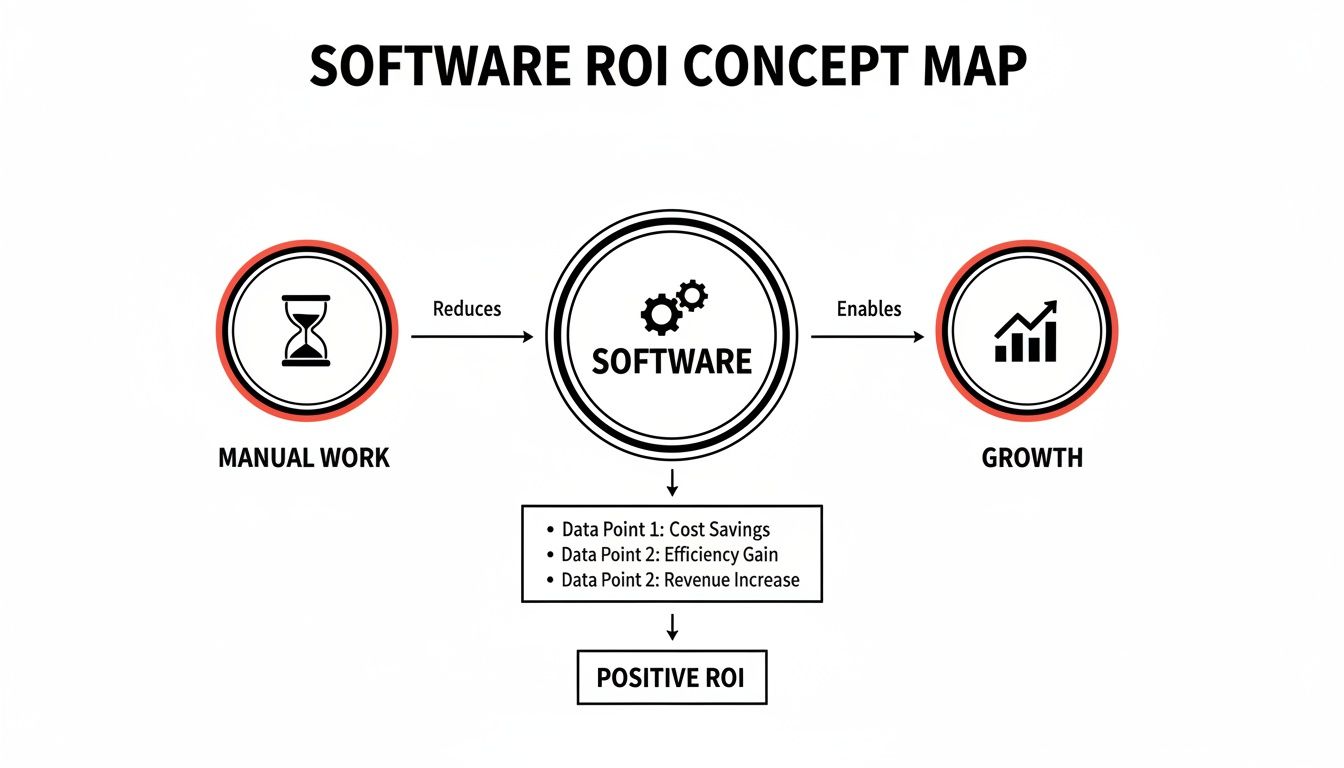
This is the core idea behind Tutorbase. We’re tutoring centre owners ourselves, and we built this platform to solve the exact problems that hold businesses back. Every feature is designed to connect directly to a business result.
From Feature Lists to Financial Outcomes
A simple feature checklist doesn't tell the whole story. What really matters is how those features translate into hours saved and revenue captured. Tutorbase is built so that every capability delivers a specific, quantifiable business advantage that older systems can't match.
Here’s how our approach delivers real value where others fall short:
- Smarter Scheduling: Forget cross-referencing calendars. Our AI-powered Find Slot tool instantly finds the best teacher, room, and time combinations. This cuts the average booking process from over 10 minutes down to under two, freeing up your staff to handle more enrollments.
- Automated Billing: We eliminate the error-prone task of creating invoices by hand. Tutorbase automatically generates invoices straight from lesson attendance records. What used to take hours every week now takes just a few clicks.
- Complex Payroll, Solved: While alternatives choke on anything beyond a basic hourly rate, Tutorbase handles the complex payroll models that growing centers actually use. Think revenue sharing, base salary plus variables, and overtime premiums—all calculated accurately, without a single manual spreadsheet.
Built for Growth, Not Just for Today
Scalability is where the return on investment really becomes clear. Lots of platforms work fine when you have a small team, but they start to slow down as you expand to multiple locations or manage thousands of weekly lessons.
Tutorbase was engineered to handle the complexity of multi-branch operations from a single dashboard. You can manage rooms, staff, and branding across different locations seamlessly, without the performance lags that plague older systems. This isn’t a "nice-to-have"—it's essential for any ambitious centre planning to expand.
Feature Comparison: Tutorbase Vs The Alternatives
When you compare Tutorbase to the alternatives, the conversation shifts from price to value. A slightly higher monthly fee becomes insignificant when the platform is saving you thousands of dollars in administrative costs and capturing revenue you were previously losing. The table below highlights the key functional differences that give Tutorbase users a significantly higher ROI.
| Feature | Tutorbase | Teachworks / TutorCruncher |
|---|---|---|
| Smart Scheduling | ✅ AI-powered Find Slot saves 8+ mins per booking. | ❌ Manual calendar searching is slow. |
| Billing Automation | ✅ Fully automated from attendance records. | ⚠️ Semi-manual process is prone to errors. |
| Complex Payroll | ✅ Native support for all pay models. | ❌ Basic hourly rates only. |
| Multi-Branch Mgmt. | ✅ Centralized, seamless room & staff control. | ❌ Limited, clunky, and prone to issues. |
| WhatsApp Integration | ✅ Native CRM lead capture. | ❌ Not available. |
The platform with the lowest price tag is rarely the one that delivers the most value. By automating the high-friction, time-consuming tasks that drain your resources, Tutorbase frees your team to focus on what actually grows the business: teaching and building relationships with families.
A Practical Checklist for Choosing Tutoring Software
Picking the right tutoring management software is a huge decision. It’s going to touch every part of your business. To make a choice you won't regret, you need a clear, methodical way to evaluate your options. This checklist will help you cut through the sales pitches and move from a sea of options to a smart, strategic investment.
Map Your Core Workflows Before You See a Single Demo
Before you book a demo, you need to know your business inside and out. Don't let a salesperson tell you what you need. Instead, map out your most critical, day-to-day processes.
- Student Onboarding: What are the exact steps from a new parent inquiry to their first paid lesson?
- Scheduling: How do you currently book a recurring weekly lesson? What happens when someone needs to reschedule?
- Billing Cycle: What's your end-of-month process for generating invoices, chasing payments, and handling prepaid lesson credits?
- Teacher Payroll: How do you calculate pay for a tutor with a mixed compensation model, like a base rate plus a per-student bonus?
When you map these workflows first, you force vendors to show you how their software solves your real-world problems, not just demo generic features.
Ask the Tough Questions During Demos
A demo is your chance to pressure-test a platform. Get past the glossy presentation and ask direct questions that reveal a system’s true strengths and weaknesses.
Here are some essential questions to have ready:
- Performance at Scale: "Our goal is to double our lesson volume. Can you show me how your system performs when managing 10,000 lessons per week?"
- Implementation Timeline: "For a center our size, what's the average time from signing the contract to being fully operational? What are the most common roadblocks?"
- Total Cost of Ownership: "Beyond the monthly subscription, what are all the other potential fees? I'm talking about onboarding, data migration, and premium support."
- Support and Training: "What exactly does your standard support package include? What are your guaranteed response times, and who will I be speaking to?"
Watch for These Red Flags
Knowing what to avoid is just as important as knowing what to look for. Certain behaviors from a vendor are clear warning signs that they might not be the right long-term partner for your growing business. A software platform should feel like a strategic partner invested in your growth, not a vendor trying to nickel-and-dime you with endless add-ons.
Keep a sharp eye out for these red flags:
- Reliance on Paid Add-ons: If essential features like a parent portal or automated invoicing cost extra, the advertised price is misleading.
- Vague Answers on Scalability: If a vendor can’t show you clear evidence of clients operating at your target scale, it’s likely because their software can’t handle the load.
- No Clear Product Roadmap: A good partner is always improving their product. Ask them what new features are coming in the next six to twelve months. If you get silence or vague promises, that’s a bad sign.
Frequently Asked Questions About Tutoring Software Costs
To wrap things up, let's tackle the most common questions we hear from tutoring centres when they're weighing their software options.
What is tutoring management software?
Tutoring management software is a platform that centralizes the core administrative tasks of a tutoring business. This includes student scheduling, automated billing, teacher payroll, room management, and lead tracking. It replaces fragmented tools like spreadsheets and calendars with a single, integrated system to reduce manual work and increase efficiency.
Is free tutoring software a good idea?
Free software is tempting, but "free" almost always has hidden costs. What you save on a monthly subscription, you pay for in wasted admin time, a higher chance of booking errors, and the headache of migrating to a paid system once you outgrow the free tool's limits. For any business with serious growth plans, free software is a temporary patch, not a long-term foundation.
How long does it take to migrate from spreadsheets?
Moving from spreadsheets or an old system to a modern platform like Tutorbase is probably faster than you imagine. A good provider will guide you through exporting your data and mapping it correctly into the new system. For a mid-sized centre with a few hundred students, the entire switch can often be done in just one to two weeks.
What level of support should I expect for my fee?
Your subscription fee should get you more than just a login. At a minimum, you should expect a solid knowledge base and email support that responds within 24 hours. Platforms built for growing businesses usually offer more, such as live chat, phone support, or a dedicated account manager. Always ask exactly what level of support is included so you don't get hit with surprise fees.
Can software handle complex teacher payroll?
Yes, but only the right software can. Many basic tools can only handle simple hourly rates, forcing you back to spreadsheets for anything more complicated. A powerful platform like Tutorbase is designed to manage the reality of how tutoring centres pay their staff: revenue sharing, base pay plus bonuses, tiered rates, and contractor invoices. This automates one of the most time-consuming tasks you face each month.
Ready to see how an all-in-one platform can eliminate administrative waste and drive real growth for your tutoring business? Tutorbase replaces fragmented tools with a single, powerful system designed for scale. Start your free trial today and discover a better way to manage your center.


