


Key Takeaway: Math tutor prices in 2026 typically range from $30 to over $100 per hour, influenced heavily by the tutor's experience, the student's academic level, and the lesson format (private, group, or online). For tutoring centers, setting competitive rates means understanding these factors and implementing a smart pricing model, like packages or subscriptions, to boost revenue and retention.
Getting your math tutor prices right is the first step to building a profitable and competitive tutoring center. You must balance what parents expect to pay with the operational costs of your business.
What Are Typical Math Tutor Prices in 2026?
Before setting your rates, you need a solid benchmark. The private tutoring market is growing rapidly, expected to reach $120.25 billion in 2024, with math tutoring as a leading segment. This demand pushes prices up by 7-10% annually. While many tutors charge between $30 and $80, rates can exceed £60 per hour in competitive UK markets for specialized test prep.
This chart breaks down the average hourly rates across common tutoring formats.
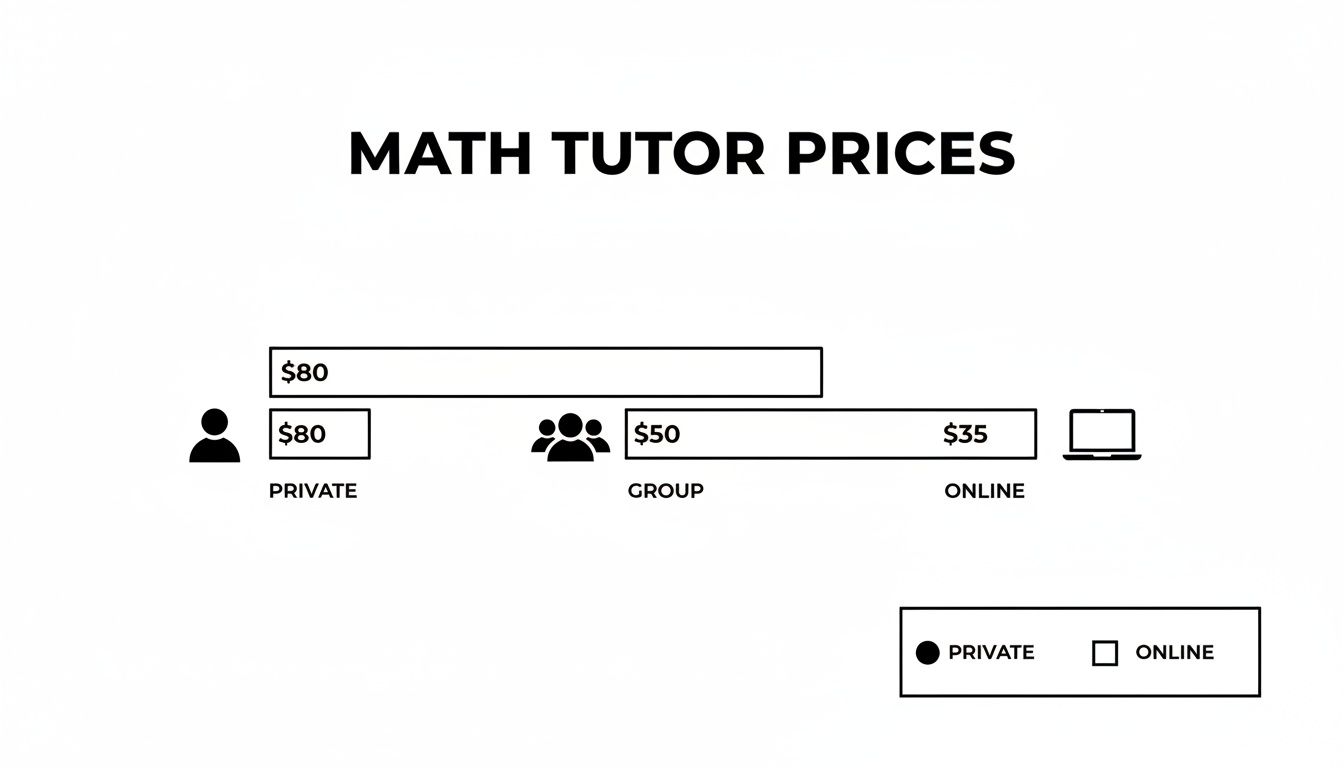
The numbers show that private, in-person sessions consistently command the highest prices. In contrast, online tutoring provides a more affordable entry point for many families. This price variation allows you to build a service menu that caters to different budgets and needs.
A Deeper Look at Rates by Level
A student’s academic level is a major factor shaping your pricing. Tutoring advanced subjects requires deeper expertise, which naturally comes at a premium. Helping a third-grader with multiplication is different from guiding a high school senior through AP Calculus. Your pricing must reflect that difference.
Here’s a breakdown of what families are paying in 2026 across different formats and student levels.
Average Math Tutor Prices by Format and Level (2026)
| Student Level | Private Tutoring (In-Person) | Group Tutoring (4-6 Students) | Online Tutoring (1-on-1) |
|---|---|---|---|
| Elementary School (K-5) | $40 - $65 | $25 - $40 | $30 - $50 |
| Middle School (6-8) | $50 - $75 | $30 - $45 | $35 - $55 |
| High School (9-12) | $60 - $90 | $40 - $60 | $45 - $70 |
| Test Prep (SAT/ACT) | $75 - $120+ | $50 - $80 | $60 - $100 |
| College/University | $80 - $150+ | $60 - $90 | $70 - $110 |
The data shows that test preparation is a premium service regardless of delivery method. This is due to the high-stakes nature of exams like the SAT and ACT and the specialized strategies effective tutors must master.
Tutoring centers that build a reputation for expert test prep can position themselves as high-value providers and command top-tier rates. You can dive deeper into this topic in our complete guide to average rates for tutoring.
What Factors Drive Your Tutoring Rates?

Ever wonder why one math tutor can charge $90 an hour while another asks for just $30? It’s not random. Understanding the factors behind math tutor prices is key to creating a rate card that is both fair to families and profitable for your business. Think of it like adjusting sliders on a soundboard; each factor moves the final price up or down.
A certified teacher prepping a student for AP Calculus in a major city is at the top end. A university student teaching basic algebra online will land somewhere completely different. Once you understand these factors, you can build a logical pricing structure that reflects the value you provide.
Tutor Experience and Credentials
This is the big one. A tutor's background is the most influential factor in what you can charge because it directly signals their expertise. A seasoned, state-certified teacher with a master’s degree brings more to the table than an undergraduate student, and your pricing should reflect that.
Think about your team in these tiers:
- University Students: They offer solid subject knowledge for foundational math and are a great, accessible option for many families.
- Subject Matter Experts: These are professionals with degrees in math or a related field. They bring deep, specialized knowledge that justifies a higher rate.
- Certified Teachers: Educators with years of classroom experience and teaching credentials can command the highest prices. They have proven pedagogical skills and know how to manage a student’s learning journey.
Your prices should directly reflect the expertise of your staff. A center with highly qualified tutors can and should charge more because you're selling a premium service.
Subject Complexity and Student Level
The academic level you teach has a huge impact on your pricing. Tutoring a third-grader in arithmetic is fundamentally different from preparing a high school senior for the AP Calculus BC exam. The more advanced the subject, the more expertise is needed, and the higher the price should be.
High-stakes test prep, especially for exams like the SAT or ACT, is a classic premium service. Tutors in this space must master not just the content but also test-taking strategies, pacing, and psychology. This specialized skill creates immense value for parents, who will invest more for those results.
Lesson Format and Location
How and where you teach creates different price points. Each format has its own operational costs and perceived value, giving you a logical way to tier your offerings. Your physical location also plays a huge role. Tutoring rates in major cities are often 25-50% higher than in suburban or rural areas due to a higher cost of living and greater demand.
- Private In-Person: This is your white-glove service. It offers undivided attention and a personal touch but has the highest costs (travel time, facility use). It should always be your highest-priced option.
- Group Sessions: By teaching several students at once, you can offer a lower price per student while often increasing your total hourly revenue. It’s a win-win for maximizing your resources.
- Online Tutoring: With minimal overhead (no rent, no travel), online sessions are usually the most affordable option. This format also broadens your market, letting you reach students anywhere.
A Global View on Tutoring Market Prices

The rates you set for your tutoring center are influenced by powerful economic forces and cultural expectations. Getting a handle on this global context is essential, especially if you operate in a diverse city or plan to offer services to an international audience. Think of it like tuning an audio mixer: your price is a blend of local demand, cultural value placed on education, and economic realities.
A price that’s perfectly tuned for one market might completely miss the mark in another.
The Asia Pacific Market
When it comes to private tutoring, the Asia Pacific region is the heavyweight champion. This is driven by intense, exam-focused cultures where academic success is a top family priority. In tutoring hotspots like China and India, the demand for top-tier math instruction is extremely high. This pressure-cooker environment means families will invest a huge slice of their income for an academic edge.
A recent analysis shows Asia Pacific commands a massive 60.85% share of the private tutoring market. In big cities, math sessions can average $20 to $50 per hour, with families often spending 10-20% of their household income on tutoring. You can dig into the full market analysis to see how these numbers stack up worldwide.
Rates in Europe and North America
The tutoring markets in Europe and North America are huge but follow different rules. Here, pricing is tied more to a tutor's credentials and subject-matter expertise than just exam performance. For example, the UK market is projected to hit $2.34 billion by 2026, with math tutors typically charging between £30 and £70 per hour. The higher rates are for specialists with deep knowledge of A-levels or other high-stakes exams.
In Western markets, parents often pay a premium for a true expert in a specific field, like STEM or advanced placement courses, rather than a generalist.
The United States follows a similar pattern. With over 182,700 tutors in the country as of 2022, a specialist math tutor can command a median rate of $45 per hour. It’s all part of a market seeing a steady 7% compound annual growth rate from its $97.11 billion valuation in 2023. Understanding these global benchmarks helps you set prices with more confidence, ensuring they are strategic, not just competitive.
How Do You Choose the Right Pricing Model?
Knowing what to charge is half the battle; the other half is how you charge. This is where you move from setting a rate to building a real business that attracts clients, encourages them to stay, and generates predictable revenue. The right pricing structure offers value that fits different family needs, from flexibility for new clients to reliable schedules for long-term support. You can think about this in terms of the general principles of valuing and pricing goods and services.
Let's break down the three most common models successful tutoring centers use.
Per-Hour or Per-Lesson Rates
This is the classic pay-as-you-go model. It’s simple, direct, and often the easiest for new families to accept. A straightforward hourly rate gives them maximum flexibility and a low-risk way to try your services without a big upfront commitment. It's a great fit for students needing homework help or focused prep for a single test. However, it offers zero revenue predictability and does little to encourage long-term student retention.
Lesson Packages
This is where you start building commitment. Offering packages, like bundles of 10, 20, or 40 lessons, is a fantastic way to secure revenue upfront and encourage long-term thinking. Parents typically get a small discount on the per-hour rate, and in return, you get guaranteed cash flow and a more predictable schedule. Packages are perfect for families who know their child needs consistent support over a whole semester.
Key Takeaway: Package deals transform one-time clients into committed students. A parent who buys a 20-lesson package is thinking in terms of months, not just the next tutoring session, which is a significant win for student retention.
Monthly Subscriptions
For tutoring centers, the subscription model is the gold standard for creating stable, recurring revenue. Families pay a flat monthly fee for a set number of sessions, like one or two lessons per week. This approach smooths out your income and makes billing incredibly simple. Subscriptions are ideal for parents committed to long-term academic improvement who appreciate the consistency of a fixed monthly cost. For your center, this model makes forecasting revenue and managing cash flow much easier.
For a deeper dive, check out our complete guide on tutoring pricing models for more detailed examples.
Deciding which model to offer is one thing; managing them all at once is where things get tricky. Below is a quick comparison to help you see which approach might work best for your business.
Comparing Pricing Models for Tutoring Centers
This table breaks down the pros, cons, and best-fit scenarios for each of the three main pricing models.
| Pricing Model | Best For | Pros | Cons |
|---|---|---|---|
| Per-Hour Rate | New clients, short-term needs (e.g., test prep), or occasional homework help. | Maximum flexibility for clients; low barrier to entry. | Unpredictable revenue; low student retention. |
| Lesson Packages | Students needing consistent help over a semester; securing upfront revenue. | Boosts cash flow; improves client commitment and retention. | Requires a larger upfront payment from the client. |
| Monthly Subscriptions | Families committed to long-term improvement; creating predictable revenue. | The most stable and predictable revenue stream; simplifies billing. | Less flexibility for clients who may need to pause sessions. |
The real challenge isn't just picking one model but managing several at the same time. This is where a modern tutoring management system becomes essential. For instance, Tutorbase automates billing for packages and subscriptions. Its Policy Packs feature lets you define complex pricing rules for different locations, services, and students, then enforces them automatically. This eliminates manual tracking and lets you focus on growth.
Boosting Profitability Without Raising Prices
While setting the right price is important, true profitability comes from working smarter, not harder. Successful tutoring centers grow their margins by plugging the leaks where time and money quietly drain away. The secret isn't a price hike; it's reclaiming the 10+ hours of weekly admin that eat into your resources. Think about the time you spend manually creating invoices, chasing late payments, and untangling costly double-bookings.
These "small" tasks add up and directly chip away at your bottom line.
Unify Operations to Maximize Revenue
Fragmented tools are a huge source of lost revenue. Using Google Calendar for scheduling, QuickBooks for billing, and a spreadsheet for payroll creates gaps for errors and wastes hours on repetitive data entry. A unified platform tackles these problems head-on. For example, when your scheduling and billing are integrated, every lesson marked "Attended" can automatically create a line item on an invoice.
This simple step can turn hours of admin into minutes of review. The same automation applies to payroll, ensuring your tutors are paid accurately and on time without manual calculations. With a system like Tutorbase billing, this process becomes completely seamless.
Plug Costly Leaks and Boost Renewals
Getting your operations in order delivers real financial wins. Eliminating double-bookings prevents lost revenue and unhappy clients. Ensuring your classes are full means you get the most value out of every session. By automating tasks like prepaid credit tracking and package management with a system like Tutorbase, you not only improve efficiency but also enhance the client experience, which keeps them coming back.
Tutoring centers that automate operations see dramatic results, including a 60% reduction in admin time, zero double-bookings, and a 42% increase in monthly renewals. You can find more insights on how operational efficiency impacts the private tutoring market.
By focusing on these internal improvements, you can serve more students with less effort. This isn't just about saving a few hours; it's a direct strategy to boost your profit, increase student retention, and build a more resilient business, all without raising your prices.
Frequently Asked Questions About Math Tutor Pricing
 Pricing can keep a tutoring business owner up at night. Am I charging too much? Too little? The good news is, you don’t have to guess. Here are straightforward answers to the most common questions we hear about setting math tutor rates.
How Much Should I Charge for Math Tutoring?
A good starting point is to look at what other tutors in your area are charging. For private, one-on-one sessions in a typical North American city, rates generally fall between $40 and $80 per hour. Adjust this baseline based on your tutors' credentials, the student’s grade level, and your business costs. Tutoring for AP Calculus should always command a higher rate than helping a third-grader with their times tables.
For group sessions, charging each student about 60-70% of your private rate makes your service more accessible while boosting your total earnings per hour.
Are Online Math Tutors Cheaper Than In-Person Tutors?
Yes, as a general rule, online math tutors are often 20-30% more affordable than in-person tutors. You'll commonly see online rates hover between $25 and $50 per hour. This price difference comes down to overhead. Online tutors don't have travel time, gas costs, or rent for a physical space. They can pass those savings on to their clients.
However, a highly specialized tutor for SAT or GMAT prep can still charge premium rates, whether they teach online or in person.
What Is the Best Pricing Model for a Tutoring Center?
For most tutoring centers, a hybrid pricing model works best. This approach blends the best of a few different strategies to give families options while building a stable business.
- Offer per-hour rates for maximum flexibility to attract new clients.
- Sell lesson packages (like bundles of 10 or 20 sessions) to secure revenue upfront and improve student retention.
- Use monthly subscriptions to create steady, predictable income and simplify your billing process.
The secret isn't picking just one model; it's managing all of them without creating a headache. A solid tutoring management system like Tutorbase can automate these different pricing rules, letting you offer flexible options without getting bogged down in admin work.
How Can I Justify Higher Math Tutor Prices to Parents?
To charge a premium, you must show you deliver a premium service. Parents will pay more when they see a clear return on their investment: better grades, more confidence, and real progress.
Focus on communicating your value in these three areas:
- Showcase Your Tutors: Highlight their specific degrees, teaching experience, and proven track records.
- Let Others Do the Talking: Use testimonials, positive reviews, and success stories from other students to build credibility and trust.
- Emphasize Your Program: Walk parents through your structured curriculum, personalized learning plans, and the professional progress reports they will receive.
A polished and organized experience also signals quality. When scheduling, billing, and communication are handled seamlessly, it reinforces the message that they're investing in a professional service worth every penny.
Managing different pricing models, justifying your rates, and keeping clients happy all come back to running an efficient operation. Tutorbase brings your scheduling, billing, and payroll into one place so you can offer flexible pricing without creating more work. Stop losing time and start boosting your bottom line—explore Tutorbase at tutorbase.com/register.


