


Key Takeaway: Effective stress management for teachers in 2026 isn't about wellness apps; it's about fixing the broken operational systems that cause burnout. For tutoring centers, reducing administrative chaos through automation directly lowers teacher stress, improves retention, and protects your business.
Why is Teacher Stress Your #1 Business Risk?
 As a tutoring center owner, you know your teachers are your most valuable asset. But when they are overwhelmed by stress, the quality of your teaching plummets, student satisfaction drops, and your center’s reputation is on the line. Teacher stress isn't a personal issue; it's a direct operational risk.
The data is impossible to ignore. A staggering 95% of K-12 educators report feeling work-related stress, with a 2023 survey finding that 45% of teachers called the school year the most stressful of their careers. This crisis hasn't abated. You can read more about these teacher stress survey findings to see just how deep the problem runs.
How Does Admin Chaos Fuel Teacher Stress?
In a tutoring center, this stress is often magnified by operational chaos. While low pay or student behavior are big issues in schools, the 28% of teachers who list administrative burdens as a primary source of stress is a number you can directly control.
In a tutoring business, "administrative burden" means the hours your teachers waste on manual tasks. This includes navigating confusing spreadsheets to avoid double-bookings, calculating their own pay, and chasing parents for late payments. These are system problems, not personal failings.
This constant administrative friction creates a frustrating work environment filled with uncertainty. It's the burnout trigger that no amount of mindfulness apps or "self-care" advice can fix. By spotting the signs, you can treat the cause (operational inefficiency) instead of just the symptoms.
Connecting Teacher Stress to Operational Inefficiencies
| Observable Sign in Teachers | Potential Operational Cause |
|---|---|
| Frequent last-minute schedule changes or confusion | Manual scheduling process using spreadsheets or fragmented tools |
| Showing up late or appearing flustered before lessons | No single source of truth for schedules; teachers must confirm availability daily |
| Complaining about pay discrepancies or late payments | Manual payroll calculations from attendance logs, leading to errors |
| Spending time on their phone before or after sessions | Communicating with admin or parents about scheduling and billing |
| High tutor turnover rate | Burnout from a frustrating and inefficient work environment |
The True Cost of Inefficiency
Think about the non-teaching tasks that land on your teachers' plates every day:
- Checking multiple calendars or text threads for their next lesson.
- Manually logging attendance for payroll and client billing.
- Fielding questions from parents about invoicing mistakes.
- Updating their availability across several disconnected platforms.
When handled manually, each of these small tasks chips away at a teacher’s focus and energy. Tackling this operational drag is the single most impactful form of stress management for teachers you can provide. It protects your team and, in doing so, protects your business.
Recognizing the Warning Signs of Teacher Burnout
It’s easy to mistake teacher burnout for just a bad week. The key difference is persistence. Burnout is a workplace phenomenon, not a personal failing, with clear symptoms you can learn to spot. It quietly chips away at lesson quality and the positive atmosphere you’ve worked to build in your center.
The burnout crisis among educators is real. A shocking 44% of American K-12 teachers report they feel burned out frequently or always. In tutoring centers, this stress is often directly tied to administrative chaos, from navigating a mess of disconnected tools to spending hours chasing down payments. You can explore the deep-seated causes of teacher burnout to better understand the scale of this issue.
Emotional and Behavioral Indicators
Often, the first sign of burnout is a shift in attitude. A teacher who was once full of ideas might suddenly become cynical or detached. You might notice a general lack of energy or passion, even when they're teaching subjects they once loved.
This emotional exhaustion can spill over into their behavior. Keep an eye out for signs of depersonalization, where teachers start treating students and parents with less empathy and patience. They might seem irritable or withdrawn, creating a negative learning environment that affects student retention.
Physical and Cognitive Symptoms
Chronic stress always takes a physical toll. A teacher on the verge of burnout might call in sick more often with complaints like headaches or constant fatigue. They might look perpetually exhausted, a classic sign that stress is disrupting their sleep and ability to recover.
Mentally, burnout often shows up as "brain fog." Teachers may struggle to concentrate, which can lead to forgetfulness and disorganization. This is where you’ll start to see business-impacting mistakes, like errors in attendance logging or forgetting to prep for a lesson.
Burnout isn't just a feeling; it's a direct threat to your operations. When a teacher is mentally exhausted, they are more likely to make errors that impact your bottom line. These aren't signs of incompetence but symptoms of a system at its breaking point.
What are the operational red flags of burnout?
The most concrete evidence of burnout often appears in your day-to-day operations. A sudden increase in mistakes is a major red flag. Keep an eye on a few key areas:
- Scheduling and Attendance Errors: Frequent mistakes in logging lesson statuses (e.g., "Attended" vs. "No-show") disrupt both billing and payroll accuracy.
- Increased Cancellations: A noticeable uptick in last-minute lesson cancellations or requests for time off can signal that a teacher is feeling completely overwhelmed.
- Lack of Proactive Communication: A teacher who stops flagging student issues, offering feedback, or engaging with parents is showing signs of disengagement.
- Resistance to New Methods: A previously adaptable teacher who now pushes back on new technology or simple process changes might be running on empty.
Identifying these signs is the first, most crucial step. When you see them as symptoms of a systemic problem, you can shift from blame to problem-solving. It’s how you protect both your teachers and your business.
Practical Coping Strategies Your Teachers Can Use Today
 While you work on systemic fixes, your teachers need tools they can use right now to manage day-to-day pressure. These are actionable techniques that help them regain a sense of control. The goal is not just to tell them what to do, but to make it easy enough to actually implement.
Data shows that while 78% of teachers say they prioritize self-care, 43% feel guilty taking time for it, and 78% skip it entirely due to overwhelming workloads. Even simple, effective strategies like mindfulness (rated 8.2/10 by teachers) get pushed aside when time is short.
Introduce Mindfulness and Grounding Techniques
Chronic stress weakens the prefrontal cortex, the part of the brain responsible for decision-making and staying calm. Simple mindfulness practices can help push back. Encourage your team to try a quick reset between lessons; it doesn't need to be a 20-minute meditation session.
- Box Breathing: Inhale for four seconds, hold for four, exhale for four, and hold for four. Repeating this cycle 3-5 times can quickly calm the nervous system.
- The 5-4-3-2-1 Method: Have them silently name five things they can see, four things they can feel, three things they can hear, two things they can smell, and one thing they can taste. This grounding technique pulls focus away from anxious thoughts.
Time-Blocking and Digital Organization
A huge source of teacher stress is feeling pulled in a dozen directions at once. The constant notifications, looming prep work, and parent emails create cognitive overload. Teach your staff to "batch" similar tasks into specific time blocks to create pockets of focused work.
A teacher’s inbox can feel like a battleground. Beyond just managing time, a big part of stress relief comes from digital organization. For example, learning how to achieve mental clarity with Inbox Zero is a skill that frees up a surprising amount of mental energy.
When teachers have a clear plan, they feel more in control. This proactive mindset is best supported by systems that eliminate manual work. For instance, using a tool like Tutorbase scheduling to find an open slot instantly eliminates the need to dig through calendars and email threads.
How Systemic Fixes Eliminate Teacher Stress for Good
Mindfulness apps and deep-breathing exercises are temporary fixes. To truly tackle teacher stress, you must fix the broken operational systems that are burning them out. The biggest and most fixable source of this exhaustion is administrative chaos.
Imagine a typical day for a teacher at a center running on manual processes. Their morning involves a flurry of texts to confirm their schedule. Before their first lesson, they waste 20 minutes hunting for a parent's note in an old email thread. After teaching, they spend another hour logging attendance and calculating their pay.
This isn't an exaggeration; it's the daily reality in countless tutoring centers. The stress isn't from teaching. It’s the result of constant friction from a disorganized system. That friction kills passion and leads straight to burnout.
A Streamlined Day, A Healthier Teacher
Now, imagine that same teacher's day supported by an integrated platform like Tutorbase. They wake up and see their accurate, conflict-free schedule in a single dashboard. Student notes, attendance history, and learning goals are all in one place, ready with a click.
When the last class ends, they simply mark each session complete. The system handles the rest. It automatically updates the student’s record, calculates pay based on their specific contract, and generates a precise invoice for the parent. The teacher goes home with a clear head, ready to focus on tomorrow's lessons, not today's paperwork.
How Systemic Fixes Reduce Teacher Workload
Fixing these broken processes is the most powerful form of stress management you can offer. It sends a clear message: you value their time and well-being. When you ditch fragmented tools for a unified system, you directly remove the daily headaches that wear them down.
Here’s how an integrated platform tackles the biggest stressors head-on:
- Eliminates Scheduling Anxiety: Automated conflict detection gives teachers a reliable, predictable work life, ending double-bookings and last-minute scrambles.
- Removes Payroll Uncertainty: When pay is automatically calculated from attendance, teachers stop wasting time verifying earnings and can trust they will be paid correctly.
- Stops Payment Chasing: Automated invoicing and payment reminders take teachers completely out of the awkward role of chasing late payments.
Smart policies combined with powerful software build a more resilient operation. By investing in a platform like Tutorbase for tutoring centers, you’re not just buying software; you’re investing in a healthier, more stable, and more effective teaching environment. You can also explore creative scheduling ideas from resources like this guide to shift work schedules that don't burn out your team.
Building a Stress-Resilient Tutoring Center in 2026
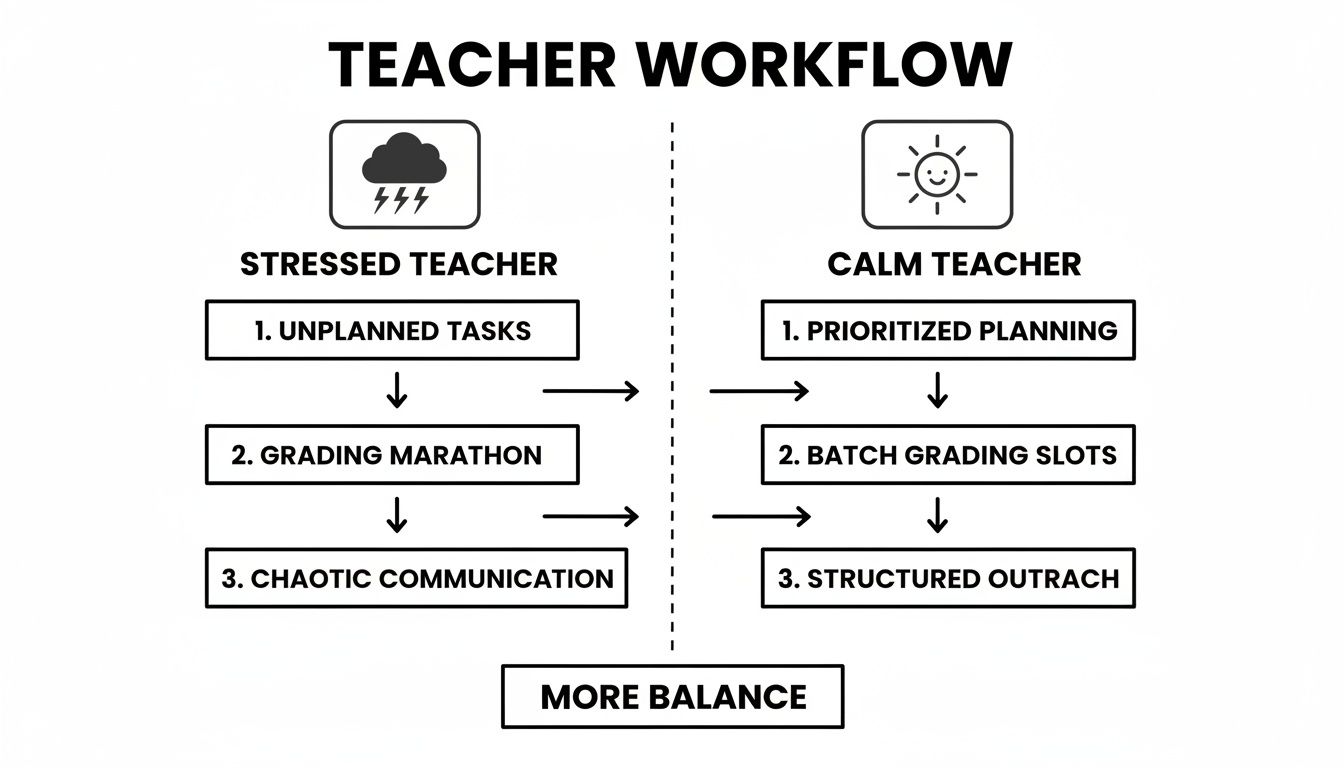
All the deep breathing exercises in the world can't fix a fundamentally stressful system. To build a tutoring center that prevents teacher stress, you have to fix the daily operational snags that drain your team's energy. Real change happens when you automate the administrative chaos.
Think about the time lost just booking a single lesson. The endless loop of emails ("Are you free Tuesday at 4?") creates frustration and mental clutter. An AI-powered scheduling tool like Tutorbase's "Find Slot" turns that 10-minute headache into a 30-second click, giving your teachers back their focus.
Eradicate Payroll Anxiety with Automation
Few things cause more anxiety than inconsistent pay. When your payroll relies on manual spreadsheets, mistakes are inevitable. A teacher who constantly has to chase down corrections feels undervalued and anxious.
Automated payroll completely changes the game. When a teacher marks a lesson as "Attended" in the system, the data should flow directly and accurately to their paycheck. This builds trust and financial predictability, which are the bedrock of a low-stress environment.
A predictable paycheck is a cornerstone of a low-stress work environment. When teachers trust the system to pay them correctly and on time, they can focus their mental energy on their students, not on auditing their own income.
A robust system handles complex pay structures, like per-student rates or weekend premiums, automatically. Exploring a dedicated solution like Tutorbase payroll shows you exactly how to manage multiple pay models without the administrative headache, ensuring every teacher is paid accurately, every single time.
From Manual Chaos to Automated Calm
Seeing exactly how a smart system replaces manual work makes the benefits crystal clear. The table below compares the high-stress manual process with the low-stress automated alternative for common, everyday tasks.
Manual vs Automated Center Operations
| Task | Manual Process (High Stress) | Automated with Tutorbase (Low Stress) |
|---|---|---|
| Scheduling a New Student | Endless email chains to find a slot. High risk of double-booking. | Instantly find teacher and room availability with a "Find Slot" feature. Zero conflicts. |
| Managing Payroll | Manually calculating hours, rates, and premiums from spreadsheets. High chance of error. | Payroll is auto-calculated from attendance data based on each teacher's individual contract. |
| Handling Cancellations | Chasing parents for fees and manually adjusting invoices and schedules. | Cancellation policies are enforced automatically, applying fees and opening up slots as needed. |
| Tracking Student Progress | Notes are scattered across emails, texts, and physical files. Hard to find or share. | Centralized teacher notes are available per-lesson and saved permanently for easy access. |
| Billing and Invoicing | Hours spent creating individual invoices and chasing down late payments from families. | Invoices are generated automatically from attendance. Parents get auto-reminders for payments. |
Implementing these systems goes far beyond just "being more efficient." It's a fundamental strategy for stress management for teachers. You're showing your team you value their time and well-being by removing the operational burdens that lead directly to burnout.
FAQ: Stress Management for Teachers
Here are answers to common questions we hear from tutoring center owners about tackling teacher stress at their business.
Isn't a Little Stress Just Part of the Job?
Temporary pressure from a tight deadline is normal. Chronic stress and burnout are different. They are a sign that your systems are broken, not that your teachers aren't resilient enough. The biggest culprit is often relentless administrative chaos, like manual scheduling and payroll errors.
My Teachers Are Too Swamped for Wellness Programs. What Now?
If your teachers are too burned out to attend a workshop on burnout, it means they have a critical lack of time. Instead of adding another meeting, give them their time back. Automate the tasks that drain their energy, like scheduling, payroll, and billing.
How Can a Piece of Software Actually Prevent Burnout?
Software like Tutorbase prevents burnout by creating operational stability. When a teacher knows their schedule is always accurate, their pay will be correct, and they won't face a double-booking, a huge layer of daily anxiety disappears. This frees up their mental energy for teaching.
What is the biggest cause of teacher stress in tutoring centers?
While student behavior can be a factor, the most significant and controllable cause of stress in tutoring centers is administrative burden. Fragmented systems for scheduling, billing, and payroll create constant friction, errors, and wasted time, leading directly to frustration and burnout.
How does automating payroll reduce teacher stress?
Automating payroll with a system like Tutorbase eliminates manual calculations, which are prone to errors. This ensures teachers are paid accurately and on time, every time, for all their lessons, including those with complex rates. This financial predictability removes a major source of anxiety.
Can better scheduling really improve a teacher's well-being?
Yes, absolutely. Manual scheduling leads to double-bookings, last-minute changes, and constant back-and-forth communication. An automated system with conflict detection provides a stable, reliable schedule, giving teachers peace of mind and allowing them to focus on lesson preparation instead of logistics.
Ready to cut out the admin chaos that’s burning out your teachers? See how Tutorbase automates your scheduling, billing, and payroll to build a more supportive and efficient tutoring center. Get started at tutorbase.com/register.


