
Finding the Best Language School CRM Singapore

Published: January 3, 2026 by Amy Ashford

A specialized language school CRM is your operational hub for managing multiple programs, branches, and brands in Singapore. It automates scheduling, billing, and communication, cutting administrative work by up to 60%. This guide covers essential features, compares top platforms, and shows the real ROI for your enrichment center.

Why Should You Use a Specialised CRM for Your Singapore Language School?

If you manage a language school in Singapore, you need a very specific toolset. Generic CRMs are great for sales teams, but they miss the mark for enrichment center workflows. How do you manage Mandarin, English, and German programs under one business umbrella? A dedicated language school CRM provides the operational backbone you need.

What is a Language School CRM?

A language school CRM (Customer Relationship Management) is software designed for education management. Its purpose is to reduce administrative friction for students, parents, and staff. The platform combines scheduling, billing, and communication into one seamless system, unlike standard sales-focused CRMs.

Here’s what that looks like in practice:

  • Centralised Administration: You can run multiple brands, like 'The French School' and 'The German School', from a single dashboard.

  • Branded Student Experience: When students log in, they only see their specific school's branding. This avoids confusion and maintains a professional look.

  • Flexible Teacher Management: You can assign a teacher to classes across different brands. This helps you maximize staff usage without complicating the student portals.

The education sector across Asia is moving quickly towards digital operations. Research shows 68% of language schools in similar markets still use spreadsheets. This costs owners over 12 hours a week in manual admin, time a modern CRM is proven to reclaim. You can find more insights on the Singapore language learning market on DeepMarketInsights.

A purpose-built CRM for a language school in Singapore is a strategic asset. It turns administrative chaos into clean, efficient operations. This frees you up to focus on teaching quality, not paperwork.

Language School CRM Comparison Singapore

When you choose a system, you must compare how platforms handle Singaporean enrichment center needs. This guide will evaluate leading options. We will focus on how well they manage complex, local requirements for your school.

Feature

Generic CRM (e.g., Salesforce)

Specialised Language School CRM (e.g., Tutorbase)

Primary Focus

Sales pipelines and marketing automation.

The entire student lifecycle, from scheduling to progress.

Scheduling

Basic calendar functions, not built for group classes.

Advanced scheduling for group and private lessons with conflict detection.

Billing

Standard invoicing, lacking support for class packages.

Automated invoicing based on attendance with credit package support.

Multi-Brand Support

Requires expensive customisation or separate accounts.

Natively supports managing multiple school brands from one dashboard.

What Are the Essential Features of a Language School CRM?

If you run a language school in Singapore, a generic CRM will not work. Your software needs to handle multi-brand support, complex scheduling, and local payment methods. These are core tools you need to streamline operations and grow your enrichment centre in 2026.

Choosing the right software means finding a platform built for Singapore's education market. Standard CRMs fail under an enrichment centre's workflows. A proper language school crm singapore solution tackles these challenges directly.

The system must manage everything from a teacher's availability to attendance-triggered invoicing. The real goal is to cut the time you spend on manual admin. School owners can easily lose over 12 hours per week to spreadsheets.

Core CRM Features for Singapore Language Schools

Feature

Why It Is Critical in Singapore

Impact on Daily Operations

Multi-Brand & Multi-Branch Support

Operators run distinct brands (e.g., 'The French School') or locations.

You can manage all entities from one dashboard with separate branding.

Flexible Group & Private Scheduling

Enrichment centres juggle recurring group classes and private lessons.

The system prevents double-booking teachers or rooms and saves time.

Automated Billing & Local Payments

Manual invoicing is slow and error-prone for modern parents.

The CRM automatically generates invoices and integrates with Stripe.

Automated Teacher Payroll

Calculating pay based on different rates is an administrative headache.

It automatically calculates teacher pay, ensuring accuracy and saving hours.

Integrated Room Management

Physical space is a premium, so you must manage classrooms efficiently.

It provides a central view of all room bookings and prevents clashes.

Parent & Student Portal

Parents expect 24/7 self-service access to schedules and payments.

The portal reduces inbound calls and empowers parents to manage bookings.

WhatsApp & SMS Integration

WhatsApp is the primary communication channel for parents in Singapore.

It streamlines communication for reminders and marketing.

These features form the operational backbone of a modern, efficient language school. Without them, you leave time, money, and customer satisfaction on the table.

How Does a CRM Handle Multi-Brand and Multi-Branch Management?

It is common for Singapore language schools to operate multiple brands or locations. A powerful CRM lets you manage distinct businesses like 'The German School' and 'The French School' from one dashboard. This feature saves a massive amount of time.

This ensures your admin team gets a unified view. Meanwhile, the student and parent experience remains completely separate and on-brand. When a parent logs into 'The French School' portal, they see only that school's branding. It keeps things professional and avoids confusion.

It also simplifies resource management. You can schedule a teacher who speaks German and French for classes at both schools without logistical issues. The system handles availability centrally. You can learn more in our guide on lead capture software for language schools.

Can a CRM Improve Scheduling and Room Booking?

Great scheduling is the heartbeat of any language school. Your CRM must juggle booking one-to-one private lessons and multi-student group classes effortlessly. This means managing recurring schedules, different lesson types, and teacher availability across all your branches.

Automated conflict detection is a crucial function. The system should prevent you from double-booking a teacher or a classroom. A modern CRM will suggest the next available slots when a conflict arises. This turns a potential headache into a quick fix.

A scenario where you book a walk-in trial class for an occupied room leads to a poor customer experience. A CRM with integrated room management prevents this. It ensures your front desk has accurate, real-time availability information.

How Can a CRM Automate Billing and Payroll?

Manual invoicing is not scalable. A must-have CRM feature is automated billing triggered by class attendance. When a teacher marks a student as present, the system instantly generates the correct invoice. This is based on pre-set rates for that class or package.

This automation extends to local payment gateways like Stripe. It gives parents an easy way to pay online. The system also handles different billing models popular in Singapore. These include prepaid credit packages, per-lesson payments, and monthly subscriptions.

Automating payroll is just as important. The system calculates teacher pay based on lessons taught. It easily handles different contract types like hourly rates or revenue-sharing models. This removes the need for manual calculations and ensures everyone gets paid accurately.

Comparing Top CRM Solutions: Tutorbase vs Teachworks vs TutorCruncher

Choosing a language school CRM in Singapore depends on your operational needs. Tutorbase is built for multi-brand management and intelligent automation, making it ideal for scaling enrichment centres. Teachworks and TutorCruncher offer solid, simpler solutions that work well for smaller schools.

When you look for a language school CRM in Singapore, the choice is between specialized platforms and older systems. School directors must ask how each system solves real, day-to-day problems. A competitive market requires efficient tools that address specific operational headaches.

This guide compares Tutorbase with Teachworks and TutorCruncher. We will focus on managing multiple school brands, automating complex schedules, and scaling operations across branches.

Which CRM is Best for Multi-Brand and Multi-Branch Management?

Successful language schools in Singapore often expand to a second location or launch a new brand. Suddenly, your admin complexity explodes if your software is not built for it. You need a system that grows with you.

  • Tutorbase: Was designed specifically for this scenario. You can run all schools from a single dashboard. Student and parent portals stay completely separate with unique branding.

  • Teachworks & TutorCruncher: These systems often treat each location as a separate account. This means admins constantly log in and out of different systems.
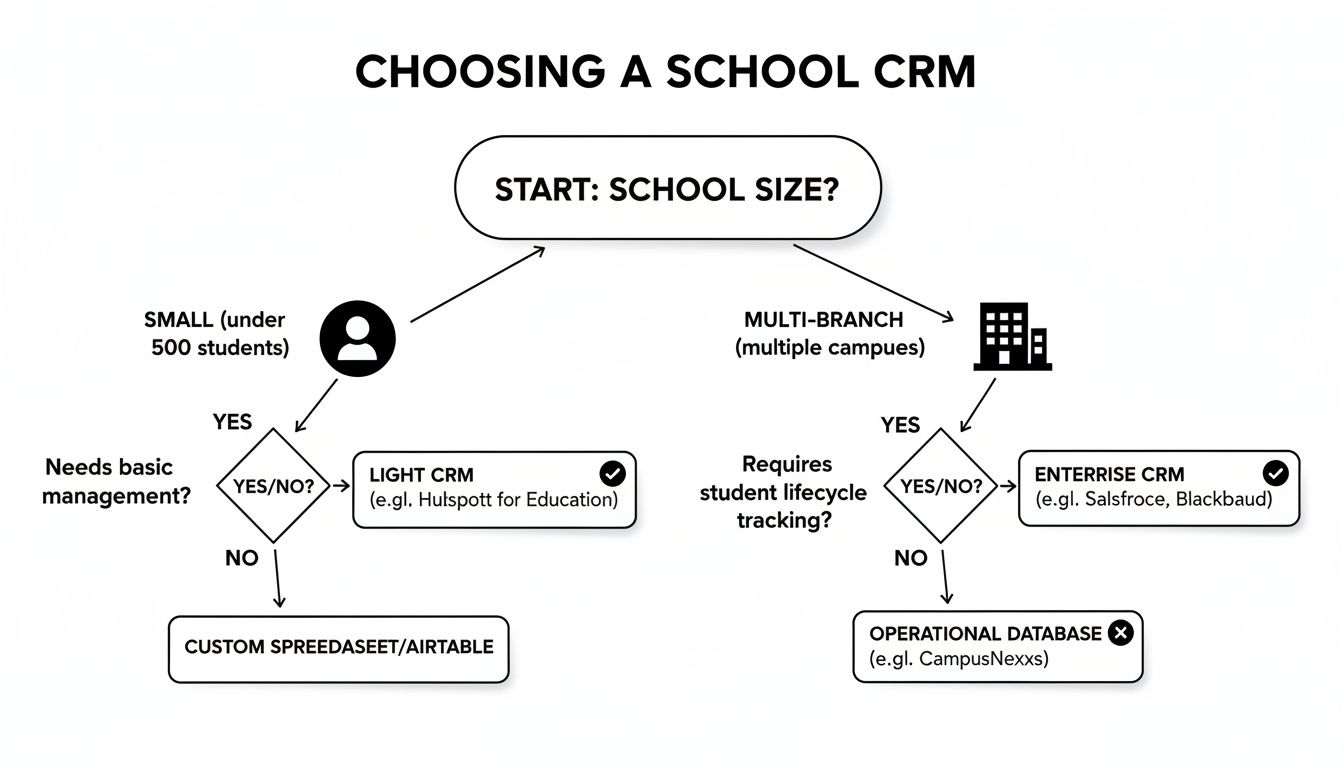
Flowchart showing how to choose a school CRM based on school size and management needs.

As the flowchart shows, single-location schools have many options. Once you manage multiple branches, a unified CRM like Tutorbase becomes essential.

How Does Intelligent Scheduling Compare to Manual Calendars?

Efficient scheduling is the engine of any language school. An intelligent system that finds slots for you saves hours of admin time each week. This directly impacts your bottom line and staff productivity.

Tutorbase has an AI-powered 'Find Slot' feature. When a new enrollment request comes in, the system instantly scans teacher availability, room capacity, and subject needs. It then provides a list of perfect time slots, cutting out manual guesswork.

In contrast, platforms like Teachworks and TutorCruncher depend on traditional calendar views. An administrator must manually scan different calendars and check room schedules. This is slower and can lead to human error, like double-booking.

What's the Difference in Billing and Payroll Automation?

Manual invoicing is a huge operational bottleneck. Generating invoices from attendance, chasing payments, and calculating payroll are tasks that require automation. Many older systems still depend on manual clicks to get these jobs done.

Tutorbase's Approach: Tutorbase automates the entire financial cycle. A teacher marks attendance, and the system instantly generates the invoice. The system handles single lessons, credit package deductions, or subscriptions without admin intervention.

Payroll receives the same treatment. The system calculates teacher pay based on lessons taught. It handles complex contracts with different hourly rates, per-lesson fees, or revenue-sharing models.

Teachworks & TutorCruncher's Approach: These platforms can create invoices, but the process is less automatic. Admins often need to trigger invoice creation in batches. It is functional but adds extra steps and more room for mistakes.

Their payroll features are also more basic. They handle simple hourly rates but often struggle with complex contracts. This means owners often return to spreadsheets to finalize payroll.

Feature Showdown: Tutorbase vs Legacy Systems

What does this mean for a busy school director in Singapore? This table compares platforms based on the operational challenges you face daily.

Operational Challenge

The Tutorbase Solution

The Teachworks & TutorCruncher Approach

Best Fit for Singapore Schools

Managing Multiple Brands/Branches

A single dashboard provides a unified view with separate, branded portals.

Requires separate accounts, leading to data fragmentation.

Tutorbase is superior for any school with more than one location or brand.

Scheduling New Trial Classes

The 'Find Slot' feature instantly finds available teacher/room combinations.

Relies on slow manual calendar checking prone to errors.

Tutorbase's intelligent scheduling offers a distinct competitive advantage.

Handling Complex Teacher Payroll

Fully automated payroll supports diverse contracts like revenue sharing.

Generally limited to basic hourly rate calculations.

Schools with freelance contracts will find Tutorbase's flexibility essential.

Automating Invoicing

Attendance marking automatically triggers invoice generation in real time.

Invoicing is often a separate, manual step requiring batch processing.

Tutorbase's automation reduces workload and improves cash flow.

Ultimately, the best language school CRM in Singapore depends on your school's current stage. Teachworks and TutorCruncher work for smaller centres. For ambitious, multi-branch businesses, Tutorbase is purpose-built to help you grow without the pains.

How a Modern CRM Solves Real-World Scenarios

A modern CRM for language schools solves complex operational puzzles. For centres in Singapore, this means running multiple brands from one dashboard. It also means handling walk-in trial classes without double-booking and automating tricky payroll. Tools like Tutorbase turn administrative nightmares into smooth, automated workflows.

Scenario One: How do you manage a multi-brand school?

Many education businesses in Singapore run more than one brand. For instance, you might operate 'The German School' and 'The French School'. This creates a massive administrative challenge when sharing resources like teachers.

Managing this with spreadsheets is a recipe for disaster. It means endless tabs and a huge risk of human error. An admin could easily send a 'German School' newsletter to 'French School' parents, creating brand confusion.

A modern CRM like Tutorbase is designed for this problem.

  • Unified Admin Dashboard: Your team gets a bird's-eye view from a central dashboard. They can manage schedules and reports for both brands without logging in and out.

  • Separate Parent Portals: When a parent from 'The French School' logs in, they only see that school's branding, courses, and messages.

  • Shared Resources: You can schedule a qualified teacher for classes across both brands from one calendar. Their availability updates in real-time for everyone.

Scenario Two: How do you handle walk-in trial classes?

A parent walks into your Jurong branch wanting to sign up for a trial class right now. Your staff needs to know instantly which classrooms are free and which teachers are available. Now, multiply that complexity across multiple branches.

Relying on a shared spreadsheet or WhatsApp group is slow and unreliable. Staff in Tampines might book a room not realizing the Jurong team just gave it away. This leads to double-bookings and frustrated parents.

A purpose-built CRM prevents this chaos entirely. An intelligent scheduling feature, like Tutorbase’s ‘Find Spot’ tool, lets staff filter all available class openings across every branch in seconds. They can book a trial on the spot with 100% accurate data.

Scenario Three: How do you automate freelance teacher payroll?

Language schools in Singapore often use freelance teachers. A freelancer might charge different rates for different subjects and work varied hours each month. Calculating their pay manually is a tedious, error-prone chore that can lead to disputes.

An operations manager could spend hours cross-referencing attendance sheets with teacher contracts. A specialized CRM automates this whole process. As our guide on how a tutoring CRM can help convert inquiries to enrollments explains, backend efficiency fuels growth.

  1. Set Custom Rates: You configure each teacher’s unique pay rules once. This can include $50/hr for beginner classes and a +15% rate for Sundays.

  2. Attendance Drives Payroll: When a teacher marks a lesson as complete, the system automatically calculates their earnings.

  3. Generate Accurate Statements: At the end of the pay period, you can generate a detailed payout statement with a single click.

How Do You Calculate the ROI of a Language School CRM?

Switching to a modern CRM is an investment, not just an expense. To justify the cost, you need to look at its return on investment (ROI). You can calculate the financial benefits a platform like Tutorbase can bring by focusing on trackable numbers.

This includes the dollar value of saved administrative hours. It also includes money recovered from billing errors and the financial upside of better student retention. These metrics show the clear value of a CRM.

How to Quantify Saved Administrative Time

First, figure out the value of time saved. School administrators often spend 10+ hours a week on manual work. A good CRM can slash this admin burden by as much as 60%, giving you that time back.

Here’s a quick example for a mid-sized Singaporean language centre.

  • Admin Hours Saved: 10 hours/week x 60% reduction = 6 hours saved per week.

  • Annual Hours Saved: 6 hours/week x 52 weeks = 312 hours saved per year.

  • Monetary Value: Assuming an admin's rate is $25/hour, the annual saving is 312 hours x $25/hour = $7,800.

That $7,800 is a direct saving. You can now put this time into growth activities like marketing or curriculum improvement.

How to Recover Lost Revenue

Next, you need to plug revenue leaks. Inefficient operations can cause revenue leakage between 20-30%. This comes from chasing late payments and miscalculating payroll.

Here’s how a CRM stops the bleeding:

  • Eliminating Billing Errors: Automated invoicing prevents under-billing. Saving just one $500 package fee per month adds $6,000 back to your annual revenue.

  • Preventing Double-Bookings: A double-booked room means lost trial classes. Preventing just two lost trial conversions a month (at $500 each) adds $12,000 in annual revenue.

Market trends support this. Southeast Asia's online language market is projected to hit USD 1.3 billion by 2032. One study found 55% of directors said fragmented tools were their biggest headache. You can read the full research about the online language learning market.

What is the Financial Impact of Student Retention?

A smoother customer experience directly impacts your bottom line by improving student retention. When you give parents an easy-to-use portal, they are more likely to stick with your school. This simple change provides a significant financial boost.

A small 5% increase in customer retention can boost profitability by 25% to 95%. For our example school, improving retention by just 5% could mean keeping 10 extra students per year. That translates to $20,000+ in protected revenue.

Your CRM Migration and Implementation Checklist

Switching to a new language school CRM is a major upgrade. A smooth migration depends on clean data, smart configuration, and team training. Following a clear checklist helps you move from messy spreadsheets without derailing your school's operations.

Business colleagues collaborate on a migration checklist, viewing data on a tablet and paper.

The idea of moving to a new system can feel daunting. The biggest fears are data loss and operational downtime. Breaking the process into manageable steps turns a chaotic project into a controlled upgrade.

Phase 1: How should I prepare my data for migration?

Before you import a single file, you must clean your existing data. This is the single most important step. Start by pulling all student, parent, and teacher information into one standardized format.

  • Standardise Naming Conventions: Ensure names and contact details are consistent.

  • Remove Duplicates: Hunt down and merge any duplicate profiles for students or parents.

  • Archive Old Records: Decide which inactive student records to archive versus import. This keeps your new CRM tidy.

A clean data import is the foundation of a successful CRM implementation. The old saying "garbage in, garbage out" is a real risk. Spending an extra week cleaning data now saves months of headaches later.

Phase 2: How do I configure the new CRM?

Once your data is clean, set up the new CRM to match your school’s operations. This is where you define the core rules that will automate your daily grind. You need to set up class types, define billing rules, and map out payroll structures before you go live.

Getting this initial setup right ensures the system works for you from day one. For a detailed walkthrough, our comprehensive tutoring software implementation plan provides clear, step-by-step instructions.

Phase 3: How do I train staff and roll out the system?

Great software is useless if your team cannot use it. Proper staff training is non-negotiable. Run hands-on sessions for administrators, teachers, and front-desk staff. Focus on the tasks specific to their roles.

Instead of flipping a switch overnight, go for a phased rollout. You could start with just one branch or a single language program. This approach lets you find and fix issues on a smaller scale. This minimizes disruption and builds team confidence.

FAQ: Language School CRM Singapore

What is a language school CRM?

A language school CRM (Customer Relationship Management) is specialized software. It helps you manage the entire student lifecycle, including enrollment, scheduling, billing, and parent communication. It is designed specifically for the workflows of an education center in Singapore.

Why is multi-brand support important for a Singapore CRM?

Many enrichment businesses in Singapore operate multiple distinct brands (e.g., 'The French School,' 'The German School'). Multi-brand support allows you to manage all these programs from a single administrative dashboard while providing a separate, branded portal for each school's students and parents.

How does a CRM automate billing for language schools?

A CRM automates billing by linking it directly to class attendance. When a teacher marks a student as present, the system automatically generates an invoice or deducts a credit from a prepaid package. This eliminates manual errors and improves cash flow for your school.

Can a CRM handle different teacher payroll rates?

Yes, a modern language school CRM can automate complex payroll calculations. You can set custom pay rates for each teacher, including different hourly fees for various subjects, weekend premiums, or even revenue-sharing models, ensuring accurate and timely payments.

How long does it take to implement a new CRM?

A typical CRM implementation takes between two to four weeks. The timeline depends on the cleanliness of your existing data and the complexity of your school's operations. The process includes data preparation, system configuration, and staff training.

Does a language school CRM integrate with local payment methods?

Absolutely. A CRM designed for the Singapore market will integrate with local payment gateways like Stripe. This allows parents to pay for classes easily and securely online using credit cards, improving the payment experience and reducing late payments.

What is the main benefit of a CRM over spreadsheets?

The main benefit is automation and centralization. A CRM automates time-consuming tasks like scheduling, invoicing, and payroll, reducing administrative work by up to 60%. It also provides a single source of truth for all school data, eliminating the errors and inefficiencies of using multiple spreadsheets.

Ready to eliminate administrative headaches and scale your language school? Tutorbase provides the automation and multi-brand management tools built for Singapore's dynamic education market. tutorbase.com/register

Finding the Best Language School CRM Singapore

Published: December 31, 2025 by Amy Ashford

A specialized language school CRM is your operational hub for managing multiple programs, branches, and brands in Singapore. It automates scheduling, billing, and communication, cutting administrative work by up to 60%. This guide covers essential features, compares top platforms, and shows the real ROI for your enrichment center.

Why Should You Use a Specialised CRM for Your Singapore Language School?

If you manage a language school in Singapore, you need a very specific toolset. Generic CRMs are great for sales teams, but they miss the mark for enrichment center workflows. How do you manage Mandarin, English, and German programs under one business umbrella? A dedicated language school CRM provides the operational backbone you need.

What is a Language School CRM?

A language school CRM (Customer Relationship Management) is software designed for education management. Its purpose is to reduce administrative friction for students, parents, and staff. The platform combines scheduling, billing, and communication into one seamless system, unlike standard sales-focused CRMs.

Here’s what that looks like in practice:

  • Centralised Administration: You can run multiple brands, like 'The French School' and 'The German School', from a single dashboard.

  • Branded Student Experience: When students log in, they only see their specific school's branding. This avoids confusion and maintains a professional look.

  • Flexible Teacher Management: You can assign a teacher to classes across different brands. This helps you maximize staff usage without complicating the student portals.

The education sector across Asia is moving quickly towards digital operations. Research shows 68% of language schools in similar markets still use spreadsheets. This costs owners over 12 hours a week in manual admin, time a modern CRM is proven to reclaim. You can find more insights on the Singapore language learning market on DeepMarketInsights.

A purpose-built CRM for a language school in Singapore is a strategic asset. It turns administrative chaos into clean, efficient operations. This frees you up to focus on teaching quality, not paperwork.

Language School CRM Comparison Singapore

When you choose a system, you must compare how platforms handle Singaporean enrichment center needs. This guide will evaluate leading options. We will focus on how well they manage complex, local requirements for your school.

Feature

Generic CRM (e.g., Salesforce)

Specialised Language School CRM (e.g., Tutorbase)

Primary Focus

Sales pipelines and marketing automation.

The entire student lifecycle, from scheduling to progress.

Scheduling

Basic calendar functions, not built for group classes.

Advanced scheduling for group and private lessons with conflict detection.

Billing

Standard invoicing, lacking support for class packages.

Automated invoicing based on attendance with credit package support.

Multi-Brand Support

Requires expensive customisation or separate accounts.

Natively supports managing multiple school brands from one dashboard.

What Are the Essential Features of a Language School CRM?

If you run a language school in Singapore, a generic CRM will not work. Your software needs to handle multi-brand support, complex scheduling, and local payment methods. These are core tools you need to streamline operations and grow your enrichment centre in 2026.

Choosing the right software means finding a platform built for Singapore's education market. Standard CRMs fail under an enrichment centre's workflows. A proper language school crm singapore solution tackles these challenges directly.

The system must manage everything from a teacher's availability to attendance-triggered invoicing. The real goal is to cut the time you spend on manual admin. School owners can easily lose over 12 hours per week to spreadsheets.

Core CRM Features for Singapore Language Schools

Feature

Why It Is Critical in Singapore

Impact on Daily Operations

Multi-Brand & Multi-Branch Support

Operators run distinct brands (e.g., 'The French School') or locations.

You can manage all entities from one dashboard with separate branding.

Flexible Group & Private Scheduling

Enrichment centres juggle recurring group classes and private lessons.

The system prevents double-booking teachers or rooms and saves time.

Automated Billing & Local Payments

Manual invoicing is slow and error-prone for modern parents.

The CRM automatically generates invoices and integrates with Stripe.

Automated Teacher Payroll

Calculating pay based on different rates is an administrative headache.

It automatically calculates teacher pay, ensuring accuracy and saving hours.

Integrated Room Management

Physical space is a premium, so you must manage classrooms efficiently.

It provides a central view of all room bookings and prevents clashes.

Parent & Student Portal

Parents expect 24/7 self-service access to schedules and payments.

The portal reduces inbound calls and empowers parents to manage bookings.

WhatsApp & SMS Integration

WhatsApp is the primary communication channel for parents in Singapore.

It streamlines communication for reminders and marketing.

These features form the operational backbone of a modern, efficient language school. Without them, you leave time, money, and customer satisfaction on the table.

How Does a CRM Handle Multi-Brand and Multi-Branch Management?

It is common for Singapore language schools to operate multiple brands or locations. A powerful CRM lets you manage distinct businesses like 'The German School' and 'The French School' from one dashboard. This feature saves a massive amount of time.

This ensures your admin team gets a unified view. Meanwhile, the student and parent experience remains completely separate and on-brand. When a parent logs into 'The French School' portal, they see only that school's branding. It keeps things professional and avoids confusion.

It also simplifies resource management. You can schedule a teacher who speaks German and French for classes at both schools without logistical issues. The system handles availability centrally. You can learn more in our guide on lead capture software for language schools.

Can a CRM Improve Scheduling and Room Booking?

Great scheduling is the heartbeat of any language school. Your CRM must juggle booking one-to-one private lessons and multi-student group classes effortlessly. This means managing recurring schedules, different lesson types, and teacher availability across all your branches.

Automated conflict detection is a crucial function. The system should prevent you from double-booking a teacher or a classroom. A modern CRM will suggest the next available slots when a conflict arises. This turns a potential headache into a quick fix.

A scenario where you book a walk-in trial class for an occupied room leads to a poor customer experience. A CRM with integrated room management prevents this. It ensures your front desk has accurate, real-time availability information.

How Can a CRM Automate Billing and Payroll?

Manual invoicing is not scalable. A must-have CRM feature is automated billing triggered by class attendance. When a teacher marks a student as present, the system instantly generates the correct invoice. This is based on pre-set rates for that class or package.

This automation extends to local payment gateways like Stripe. It gives parents an easy way to pay online. The system also handles different billing models popular in Singapore. These include prepaid credit packages, per-lesson payments, and monthly subscriptions.

Automating payroll is just as important. The system calculates teacher pay based on lessons taught. It easily handles different contract types like hourly rates or revenue-sharing models. This removes the need for manual calculations and ensures everyone gets paid accurately.

Comparing Top CRM Solutions: Tutorbase vs Teachworks vs TutorCruncher

Choosing a language school CRM in Singapore depends on your operational needs. Tutorbase is built for multi-brand management and intelligent automation, making it ideal for scaling enrichment centres. Teachworks and TutorCruncher offer solid, simpler solutions that work well for smaller schools.

When you look for a language school CRM in Singapore, the choice is between specialized platforms and older systems. School directors must ask how each system solves real, day-to-day problems. A competitive market requires efficient tools that address specific operational headaches.

This guide compares Tutorbase with Teachworks and TutorCruncher. We will focus on managing multiple school brands, automating complex schedules, and scaling operations across branches.

Which CRM is Best for Multi-Brand and Multi-Branch Management?

Successful language schools in Singapore often expand to a second location or launch a new brand. Suddenly, your admin complexity explodes if your software is not built for it. You need a system that grows with you.

  • Tutorbase: Was designed specifically for this scenario. You can run all schools from a single dashboard. Student and parent portals stay completely separate with unique branding.

  • Teachworks & TutorCruncher: These systems often treat each location as a separate account. This means admins constantly log in and out of different systems.

Flowchart showing how to choose a school CRM based on school size and management needs.

As the flowchart shows, single-location schools have many options. Once you manage multiple branches, a unified CRM like Tutorbase becomes essential.

How Does Intelligent Scheduling Compare to Manual Calendars?

Efficient scheduling is the engine of any language school. An intelligent system that finds slots for you saves hours of admin time each week. This directly impacts your bottom line and staff productivity.

Tutorbase has an AI-powered 'Find Slot' feature. When a new enrollment request comes in, the system instantly scans teacher availability, room capacity, and subject needs. It then provides a list of perfect time slots, cutting out manual guesswork.

In contrast, platforms like Teachworks and TutorCruncher depend on traditional calendar views. An administrator must manually scan different calendars and check room schedules. This is slower and can lead to human error, like double-booking.

What's the Difference in Billing and Payroll Automation?

Manual invoicing is a huge operational bottleneck. Generating invoices from attendance, chasing payments, and calculating payroll are tasks that require automation. Many older systems still depend on manual clicks to get these jobs done.

Tutorbase's Approach: Tutorbase automates the entire financial cycle. A teacher marks attendance, and the system instantly generates the invoice. The system handles single lessons, credit package deductions, or subscriptions without admin intervention.

Payroll receives the same treatment. The system calculates teacher pay based on lessons taught. It handles complex contracts with different hourly rates, per-lesson fees, or revenue-sharing models.

Teachworks & TutorCruncher's Approach: These platforms can create invoices, but the process is less automatic. Admins often need to trigger invoice creation in batches. It is functional but adds extra steps and more room for mistakes.

Their payroll features are also more basic. They handle simple hourly rates but often struggle with complex contracts. This means owners often return to spreadsheets to finalize payroll.

Feature Showdown: Tutorbase vs Legacy Systems

What does this mean for a busy school director in Singapore? This table compares platforms based on the operational challenges you face daily.

Operational Challenge

The Tutorbase Solution

The Teachworks & TutorCruncher Approach

Best Fit for Singapore Schools

Managing Multiple Brands/Branches

A single dashboard provides a unified view with separate, branded portals.

Requires separate accounts, leading to data fragmentation.

Tutorbase is superior for any school with more than one location or brand.

Scheduling New Trial Classes

The 'Find Slot' feature instantly finds available teacher/room combinations.

Relies on slow manual calendar checking prone to errors.

Tutorbase's intelligent scheduling offers a distinct competitive advantage.

Handling Complex Teacher Payroll

Fully automated payroll supports diverse contracts like revenue sharing.

Generally limited to basic hourly rate calculations.

Schools with freelance contracts will find Tutorbase's flexibility essential.

Automating Invoicing

Attendance marking automatically triggers invoice generation in real time.

Invoicing is often a separate, manual step requiring batch processing.

Tutorbase's automation reduces workload and improves cash flow.

Ultimately, the best language school CRM in Singapore depends on your school's current stage. Teachworks and TutorCruncher work for smaller centres. For ambitious, multi-branch businesses, Tutorbase is purpose-built to help you grow without the pains.

How a Modern CRM Solves Real-World Scenarios

A modern CRM for language schools solves complex operational puzzles. For centres in Singapore, this means running multiple brands from one dashboard. It also means handling walk-in trial classes without double-booking and automating tricky payroll. Tools like Tutorbase turn administrative nightmares into smooth, automated workflows.

Scenario One: How do you manage a multi-brand school?

Many education businesses in Singapore run more than one brand. For instance, you might operate 'The German School' and 'The French School'. This creates a massive administrative challenge when sharing resources like teachers.

Managing this with spreadsheets is a recipe for disaster. It means endless tabs and a huge risk of human error. An admin could easily send a 'German School' newsletter to 'French School' parents, creating brand confusion.

A modern CRM like Tutorbase is designed for this problem.

  • Unified Admin Dashboard: Your team gets a bird's-eye view from a central dashboard. They can manage schedules and reports for both brands without logging in and out.

  • Separate Parent Portals: When a parent from 'The French School' logs in, they only see that school's branding, courses, and messages.

  • Shared Resources: You can schedule a qualified teacher for classes across both brands from one calendar. Their availability updates in real-time for everyone.

Scenario Two: How do you handle walk-in trial classes?

A parent walks into your Jurong branch wanting to sign up for a trial class right now. Your staff needs to know instantly which classrooms are free and which teachers are available. Now, multiply that complexity across multiple branches.

Relying on a shared spreadsheet or WhatsApp group is slow and unreliable. Staff in Tampines might book a room not realizing the Jurong team just gave it away. This leads to double-bookings and frustrated parents.

A purpose-built CRM prevents this chaos entirely. An intelligent scheduling feature, like Tutorbase’s ‘Find Spot’ tool, lets staff filter all available class openings across every branch in seconds. They can book a trial on the spot with 100% accurate data.

Scenario Three: How do you automate freelance teacher payroll?

Language schools in Singapore often use freelance teachers. A freelancer might charge different rates for different subjects and work varied hours each month. Calculating their pay manually is a tedious, error-prone chore that can lead to disputes.

An operations manager could spend hours cross-referencing attendance sheets with teacher contracts. A specialized CRM automates this whole process. As our guide on how a tutoring CRM can help convert inquiries to enrollments explains, backend efficiency fuels growth.

  1. Set Custom Rates: You configure each teacher’s unique pay rules once. This can include $50/hr for beginner classes and a +15% rate for Sundays.

  2. Attendance Drives Payroll: When a teacher marks a lesson as complete, the system automatically calculates their earnings.

  3. Generate Accurate Statements: At the end of the pay period, you can generate a detailed payout statement with a single click.

How Do You Calculate the ROI of a Language School CRM?

Switching to a modern CRM is an investment, not just an expense. To justify the cost, you need to look at its return on investment (ROI). You can calculate the financial benefits a platform like Tutorbase can bring by focusing on trackable numbers.

This includes the dollar value of saved administrative hours. It also includes money recovered from billing errors and the financial upside of better student retention. These metrics show the clear value of a CRM.

How to Quantify Saved Administrative Time

First, figure out the value of time saved. School administrators often spend 10+ hours a week on manual work. A good CRM can slash this admin burden by as much as 60%, giving you that time back.

Here’s a quick example for a mid-sized Singaporean language centre.

  • Admin Hours Saved: 10 hours/week x 60% reduction = 6 hours saved per week.

  • Annual Hours Saved: 6 hours/week x 52 weeks = 312 hours saved per year.

  • Monetary Value: Assuming an admin's rate is $25/hour, the annual saving is 312 hours x $25/hour = $7,800.

That $7,800 is a direct saving. You can now put this time into growth activities like marketing or curriculum improvement.

How to Recover Lost Revenue

Next, you need to plug revenue leaks. Inefficient operations can cause revenue leakage between 20-30%. This comes from chasing late payments and miscalculating payroll.

Here’s how a CRM stops the bleeding:

  • Eliminating Billing Errors: Automated invoicing prevents under-billing. Saving just one $500 package fee per month adds $6,000 back to your annual revenue.

  • Preventing Double-Bookings: A double-booked room means lost trial classes. Preventing just two lost trial conversions a month (at $500 each) adds $12,000 in annual revenue.

Market trends support this. Southeast Asia's online language market is projected to hit USD 1.3 billion by 2032. One study found 55% of directors said fragmented tools were their biggest headache. You can read the full research about the online language learning market.

What is the Financial Impact of Student Retention?

A smoother customer experience directly impacts your bottom line by improving student retention. When you give parents an easy-to-use portal, they are more likely to stick with your school. This simple change provides a significant financial boost.

A small 5% increase in customer retention can boost profitability by 25% to 95%. For our example school, improving retention by just 5% could mean keeping 10 extra students per year. That translates to $20,000+ in protected revenue.

Your CRM Migration and Implementation Checklist

Switching to a new language school CRM is a major upgrade. A smooth migration depends on clean data, smart configuration, and team training. Following a clear checklist helps you move from messy spreadsheets without derailing your school's operations.

Business colleagues collaborate on a migration checklist, viewing data on a tablet and paper.

The idea of moving to a new system can feel daunting. The biggest fears are data loss and operational downtime. Breaking the process into manageable steps turns a chaotic project into a controlled upgrade.

Phase 1: How should I prepare my data for migration?

Before you import a single file, you must clean your existing data. This is the single most important step. Start by pulling all student, parent, and teacher information into one standardized format.

  • Standardise Naming Conventions: Ensure names and contact details are consistent.

  • Remove Duplicates: Hunt down and merge any duplicate profiles for students or parents.

  • Archive Old Records: Decide which inactive student records to archive versus import. This keeps your new CRM tidy.

A clean data import is the foundation of a successful CRM implementation. The old saying "garbage in, garbage out" is a real risk. Spending an extra week cleaning data now saves months of headaches later.

Phase 2: How do I configure the new CRM?

Once your data is clean, set up the new CRM to match your school’s operations. This is where you define the core rules that will automate your daily grind. You need to set up class types, define billing rules, and map out payroll structures before you go live.

Getting this initial setup right ensures the system works for you from day one. For a detailed walkthrough, our comprehensive tutoring software implementation plan provides clear, step-by-step instructions.

Phase 3: How do I train staff and roll out the system?

Great software is useless if your team cannot use it. Proper staff training is non-negotiable. Run hands-on sessions for administrators, teachers, and front-desk staff. Focus on the tasks specific to their roles.

Instead of flipping a switch overnight, go for a phased rollout. You could start with just one branch or a single language program. This approach lets you find and fix issues on a smaller scale. This minimizes disruption and builds team confidence.

FAQ: Language School CRM Singapore

What is a language school CRM?

A language school CRM (Customer Relationship Management) is specialized software. It helps you manage the entire student lifecycle, including enrollment, scheduling, billing, and parent communication. It is designed specifically for the workflows of an education center in Singapore.

Why is multi-brand support important for a Singapore CRM?

Many enrichment businesses in Singapore operate multiple distinct brands (e.g., 'The French School,' 'The German School'). Multi-brand support allows you to manage all these programs from a single administrative dashboard while providing a separate, branded portal for each school's students and parents.

How does a CRM automate billing for language schools?

A CRM automates billing by linking it directly to class attendance. When a teacher marks a student as present, the system automatically generates an invoice or deducts a credit from a prepaid package. This eliminates manual errors and improves cash flow for your school.

Can a CRM handle different teacher payroll rates?

Yes, a modern language school CRM can automate complex payroll calculations. You can set custom pay rates for each teacher, including different hourly fees for various subjects, weekend premiums, or even revenue-sharing models, ensuring accurate and timely payments.

How long does it take to implement a new CRM?

A typical CRM implementation takes between two to four weeks. The timeline depends on the cleanliness of your existing data and the complexity of your school's operations. The process includes data preparation, system configuration, and staff training.

Does a language school CRM integrate with local payment methods?

Absolutely. A CRM designed for the Singapore market will integrate with local payment gateways like Stripe. This allows parents to pay for classes easily and securely online using credit cards, improving the payment experience and reducing late payments.

What is the main benefit of a CRM over spreadsheets?

The main benefit is automation and centralization. A CRM automates time-consuming tasks like scheduling, invoicing, and payroll, reducing administrative work by up to 60%. It also provides a single source of truth for all school data, eliminating the errors and inefficiencies of using multiple spreadsheets.

Ready to eliminate administrative headaches and scale your language school? Tutorbase provides the automation and multi-brand management tools built for Singapore's dynamic education market. tutorbase.com/register