
The Ultimate Music Academy CRM Guide

Published: January 12, 2026 by Amy Ashford

A music academy CRM is the digital conductor for your school, automating tedious admin work so you can focus on teaching. This software centralizes recurring lesson schedules, practice room bookings, automated invoices, and complex teacher payroll into one unified system, reducing errors and providing a clear path for growth.

What is a Music Academy CRM?

A music academy CRM is specialized software that acts as the central hub for your school's business operations. It integrates scattered spreadsheets, calendars, and payment logs into a single, unified system. This tool manages everything from student data and parent communication to scheduling and finances.

Unlike a generic CRM, a music academy crm understands the unique rhythm of a music school. It handles complex recurring 1-on-1 lessons, practice room bookings, and diverse teacher payroll models. The software becomes the command center for your day-to-day activities.

Why is a CRM the Conductor for Your Operations?

Running your school without a central system is like conducting an orchestra where every musician plays from different sheet music. Schedules clash, payments get missed, and communication falls apart. The right software brings harmony to this potential chaos.

This operational clarity is more important than ever in 2026. The music education industry has become highly professionalized, changing how private academies must operate. As schools take a bigger role in developing talent, they must function like structured institutions, a trend explored in the Journal of Popular Music Education.

It’s More Than Just a Database

A common mistake is thinking a CRM is just a glorified contact list. A true music academy CRM is an active management tool. It does not just hold information; it triggers actions and automates workflows based on that data.

For example, when a teacher marks a student as attended, the system can instantly generate an invoice and calculate the teacher's pay. This prevents manual entry and impacts your bottom line. A 5–10% scheduling error rate in an academy with 80–150 lessons per week can cost thousands in lost billable hours annually.

Core Functions of a Music Academy CRM

A purpose-built CRM solves the specific headaches that music school owners face every day. It provides solutions that fit your world.

Here’s what you should expect to see:

  • Intelligent Scheduling: The software manages recurring 1-on-1 lessons, group classes, and teacher availability. It prevents you from double-booking a teacher or a room.

  • Automated Billing: It creates invoices automatically from attendance records. The system also handles various payment models, including per-lesson, monthly subscriptions, or prepaid packages.

  • Flexible Payroll: It accurately calculates teacher pay based on per-lesson rates, revenue splits, or hybrid models common in music education.

  • Room Management: It tracks the availability of every practice room and studio. This helps you maximize the use of your physical space without conflicts.

  • Parent and Student Communication: It provides a central place for reminders, progress reports, and announcements, keeping clients engaged.

By pulling all this into one place, a music academy crm lifts the administrative weight off your shoulders. This frees you to focus on delivering amazing music education.

If you’re ready to bring this harmony to your operations, it might be time to explore a dedicated platform like Tutorbase.

Essential Features Your Music School Needs

A generic CRM will not work for a music school because your operations are unique. You need a system with features built for music education to solve your biggest administrative headaches. These tools turn a contact list into a powerful command center.

Think of it like this: a music academy CRM acts as the central hub, connecting all the moving parts of your school so they work together in harmony.
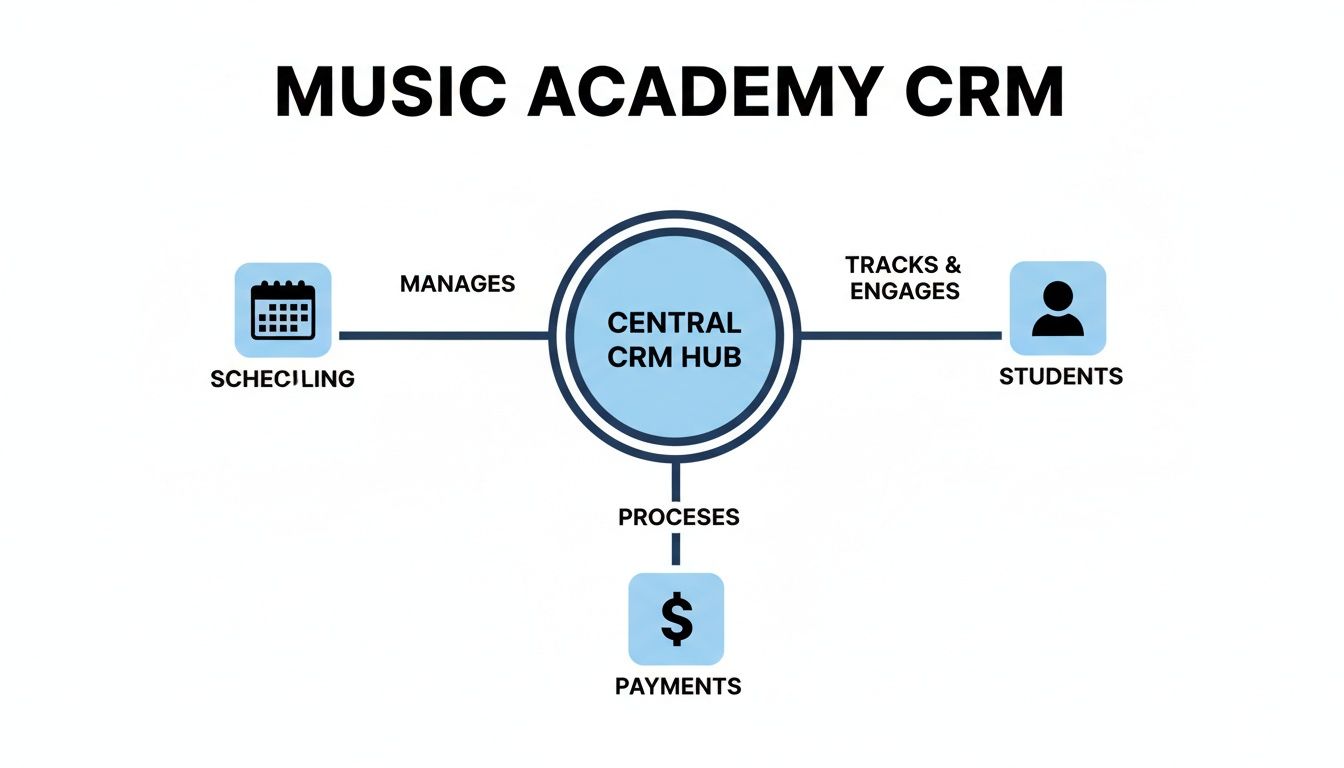
A diagram illustrates a Music Academy CRM system, managing scheduling, student engagement, and processing payments through a central hub.

The right features directly tackle the most common sources of wasted time and lost revenue. They give you back hours to focus on what really matters: your students and your teaching staff.

How Can You Achieve Smart Scheduling For Music Lessons?

Managing schedules with spreadsheets and shared calendars often leads to disaster. A proper music academy crm offers intelligent scheduling that understands the nuances of 1-on-1 and group lessons. It manages recurring patterns and stops conflicts before they happen.

A solid scheduling feature should let you:

  • Set up recurring one-on-one lessons that repeat weekly or bi-weekly, pairing a student with a specific teacher.

  • Manage teacher availability with clear, repeating patterns, so the system knows when a teacher is free for new students.

  • Detect conflicts automatically, flagging any potential double-bookings for teachers or practice rooms instantly.

A study by Zippia found that employees spend an average of 3.1 hours per week on tasks that could be automated. For a music school owner, a good CRM can do this scheduling work in seconds.

Automated Billing And Invoicing

Manually creating invoices and chasing late payments is a massive drain on your resources. Automated billing is a non-negotiable feature that directly impacts your cash flow. The system should link attendance records directly to billing for a seamless workflow.

A robust system will also integrate with reliable payment processing solutions to handle tuition and fees. This lets you offer parents easy online payment options through platforms like Stripe. For more on this, see our guide on tutoring software integrations.

A great system will easily handle different charging methods:

  • Pay-per-lesson or pay-per-hour billing.

  • Monthly or term-based subscription plans.

  • Prepaid lesson packages or credit systems.

This flexibility means you accommodate client needs while ensuring you get paid on time, every time.

How Does Flexible Payroll Automation Help?

Teacher payroll at a music school is rarely straightforward. A specialized CRM takes this headache away by automating the calculations. This eliminates human error and ensures your teachers are paid accurately and on time.

This automation is essential for handling common pay structures:

  • Percentage-of-revenue splits, where teachers earn a set percentage of the lesson fee.

  • Per-lesson or per-hour rates that vary by teacher experience or the subject taught.

  • Hybrid models that mix a base rate with performance bonuses.

By automating payroll, you reclaim hours spent on tedious calculations. You also build incredible trust and loyalty with your teaching staff.

Dedicated Room Management

Your practice rooms and studios are valuable assets. A dedicated room management feature inside your CRM treats your physical spaces with the importance they deserve. It prevents double-bookings and helps you find opportunities for private practice rentals.

This gives you a clear, centralized view of every room in your academy. You can see availability, book rooms for lessons, and stop the costly conflicts that disrupt your school’s flow. It helps you maximize the use of your space.

Before we move on, here’s a quick comparison of manual methods versus a dedicated music academy CRM.

Comparing Manual Methods to a Music Academy CRM

Administrative Task

The Manual Method Problem

The Music Academy CRM Solution

Lesson Scheduling

Time-consuming emails; high risk of double-booking a teacher or room.

Instantly find available slots based on teacher and room availability; automated conflict detection.

Billing & Invoicing

Hours spent manually creating invoices; difficult to track payments.

Invoices are generated automatically from attendance records; online payment integration.

Teacher Payroll

Complex and error-prone spreadsheet calculations; inaccurate payments.

Automatically calculates pay based on pre-set rules (revenue share, per-lesson rates).

Room Booking

No central view of room availability, leading to conflicts and underutilized spaces.

Centralized calendar for all rooms, preventing double-bookings and maximizing usage.

A system built for music academies transforms your old processes. It frees you up to run a smarter, smoother, and more profitable school.

Why Spreadsheets Are Costing Your School Money

Running a music school on spreadsheets creates more problems than it solves. While they seem free, these tools have hidden costs like wasted time, lost revenue, and damaged parent relationships. They are a bottleneck to growth.
Text 'STOP SPREADSHEET ERRORS' over a desk with spreadsheets, sticky notes, a pencil, and a piano.

The biggest risk is human error. A single misplaced number can spiral into double-booked lessons, missed appointments, or incorrect invoices. Every mistake frustrates parents and tutors, hits your bottom line, and damages your school's reputation.

The True Cost of Manual Administration

Picture this: you are spending your weekend manually cross-referencing attendance sheets with payment records. This is not just an inconvenience; it is a huge operational risk holding your business back. Every hour on these tasks is an hour not spent on teaching or marketing.

This is why so many organizers stop relying on manual methods like spreadsheets for essential tasks. The risk of errors is just too high. The lesson applies directly to managing a packed lesson timetable.

For a mid-sized academy with 150–400 students and 10–25 tutors, a CRM that ties scheduling to billing is essential. Parents value responsiveness and flexibility. If you cannot deliver, they will find a school that can.

Revenue Leakage and Wasted Time

Manual processes are notorious for causing "revenue leakage." These are the small, unbilled lessons or untracked payments that quietly add up. Without an automated system, it is easy to lose track of who has paid.

The time sink is staggering when you break it down:

  • Manual Invoicing: Creating, sending, and tracking invoices can eat up 5-10 hours every month.

  • Chasing Payments: Following up on overdue accounts takes time away from revenue-generating activities.

  • Complex Payroll: Calculating tutor pay with percentage-of-revenue models is an error-prone nightmare.

These manual tasks don't just cost you time; they limit your school's potential. A music academy crm reclaims dozens of hours each month and eliminates these financial risks. To see what that transition looks like, check our guide on how to move from spreadsheets to tutoring software.

How to Choose the Right Music Academy CRM

Choosing the right music academy CRM is a huge decision. A system that does not fit your unique needs is just another frustrating subscription. To make a confident choice, you need a clear framework for evaluation.

Does It Master Your Scheduling Complexity?

Scheduling is the heart of any music school. If your software cannot handle its rhythms, you are in for a world of pain. Generic calendar tools often fall apart when faced with recurring lessons and coordinating both people and rooms.

Your top priority is finding a system that manages your specific workflow.

When evaluating a platform, ask:

  • Can it easily handle recurring 1:1 lessons that automatically repeat every week?

  • Does it let you set complex teacher availability with repeating patterns (like every Tuesday from 4-8 PM)?

  • Will it automatically flag scheduling conflicts for teachers and rooms to prevent double-bookings?

Can It Handle Your Billing and Payroll Models?

Your financial workflows are as unique as your teaching methods. The right system should adapt to how you do business, automating the process to save time. The same goes for paying your teachers.

Research from Zippia shows that automation can slash payroll errors by up to 80%. This massive improvement builds trust and keeps your staff happy.

Ask any potential vendor these questions:

  • Does it support multiple billing models, like per-lesson payments, prepaid packages, and monthly subscriptions?

  • Can it automate payroll for contractors based on percentage splits or varied per-lesson rates?

  • Does it integrate with online payment gateways like Stripe for convenient parent payments?

Does It Maximise Your Physical Space?

Your practice rooms and studios are revenue-generating assets. A CRM with solid room management helps you get the most out of them. It prevents costly clashes and shows you where you have opportunities for extra bookings.

The software should give you a clear, central view of all your rooms, even across multiple locations. It needs to be simple to see availability and book spaces for lessons, rehearsals, or private practice.

A dedicated music academy CRM adopts a system that understands the specific operational cadence of a music school. Before you make a call, it’s helpful to see how different systems stack up.

Music Academy CRM Evaluation Checklist

Feature Area

Critical Question to Ask

Why It Matters

Scheduling

Does it handle recurring lessons and teacher availability patterns?

Prevents constant manual tweaks and reduces human error.

Billing

Can it automate invoices for various models (packages, subscriptions)?

Saves dozens of hours a month and improves cash flow.

Payroll

Does it calculate pay based on revenue-share or per-lesson rates?

Ensures accurate, timely payments, boosting teacher morale.

Room Management

Can you manage and book multiple rooms without conflicts?

Maximizes the use of your physical assets and prevents disruptions.

User Experience

Is the interface intuitive for both admin staff and teachers?

A system that’s hard to use won’t be adopted, wasting your investment.

By walking through this checklist, you can systematically compare your options. Taking the time to evaluate these core areas will ensure your investment pays off for years.

Ready to see how a system built for music academies can transform your operations? Explore how Tutorbase can help you at tutorbase.com/register.

Calculating the ROI of Your CRM Investment
A desk with a laptop displaying charts and graphs, a calculator, and a text overlay 'MEASURE CRM ROI'.

A specialized music academy crm is not just another monthly expense. It is a strategic investment designed to give you a real, measurable return that goes far beyond simple convenience. This software tackles your biggest time sinks and revenue leaks.

Thinking about the software in terms of return on investment (ROI) changes the conversation from "How much does it cost?" to "How much value does it create?". It becomes a tool for growth, often paying for itself within months. For a deeper dive, our analysis on the ROI of tutoring management software breaks down the numbers.

How Can You Quantify Saved Administrative Time?

The first return you will see is getting your time back. Most music school owners spend over 10 hours a week on manual scheduling, chasing invoices, and payroll calculations. A CRM automates these workflows, turning lost hours into productive time.

What could you do with that recovered time?

  • Marketing and outreach to fill your schedules.

  • Developing new programmes or workshops to create new revenue.

  • Mentoring your teachers to improve lesson quality.

Put a dollar value on your time and the ROI becomes clear. If you value your time at $40 per hour, saving 10 hours a week adds up to $1,600 per month in reclaimed value. That is tangible growth potential.

Eliminating Revenue Leakage

Manual systems are full of holes. Every missed invoice, unbilled make-up lesson, and scheduling mistake is money walking out the door. An automated system plugs these leaks by tying attendance directly to billing, ensuring every lesson is invoiced correctly.

For instance, a music academy crm makes double-bookings impossible, which means no more cancelled lessons and lost income. It also tracks prepaid lesson packages with perfect accuracy. These small fixes add up fast, directly boosting your bottom line.

How a CRM Boosts Student Retention

A smooth, professional experience keeps students and parents happy. Automated reminders slash no-shows, while an online payment portal gives parents the modern convenience they expect in 2026. A good CRM centralizes all communication, making your school look organized and reliable.

In an academy with 200 students, sending just two progress updates per month plus fee reminders creates 400–600 outbound communications monthly. A music academy CRM handles these touchpoints effortlessly, letting you provide top-tier service without hiring more staff, a trend backed by recent music industry market analyses.

A CRM helps you maximize the value of your biggest assets: your teachers and your rooms. By optimizing schedules and room utilization, you ensure you operate at peak efficiency, which is the fastest way to increase profitability.

Investing in a platform like Tutorbase isn't just about managing your school. It's about building a more profitable and sustainable business. Find out how we can help at tutorbase.com/register.

Frequently Asked Questions about Music Academy CRM

What is a music academy CRM used for?

A music academy CRM is a software tool used to manage all administrative aspects of a music school. Its primary functions include scheduling recurring lessons, automating billing and invoicing, processing complex teacher payroll, managing practice room bookings, and centralizing parent communication.

How is a music academy CRM different from a generic CRM?

A music academy CRM is specifically designed for the unique needs of music education. Unlike generic CRMs, it includes features for managing complex recurring schedules, handling teacher payroll models like revenue-sharing, and booking physical assets like practice rooms and studios.

Can a CRM automate teacher payroll for music schools?

Yes, a key benefit of a specialized music academy CRM is its ability to automate complex payroll. You can set rules for different pay structures, such as per-lesson rates, percentage-of-revenue splits, or hybrid models. The system then calculates pay automatically based on attendance records, reducing errors and saving time.

Will a CRM help manage practice room bookings?

Absolutely. A good music academy CRM includes a room management module. This feature provides a centralized calendar to view availability and book practice rooms or studios, which prevents double-bookings and helps you maximize the use of your physical space.

How much time can I save by using a music academy CRM?

Music school owners can save an average of 10 hours per week by automating administrative tasks. A CRM eliminates manual work related to scheduling, invoicing, chasing payments, and calculating payroll, freeing you to focus on growing your school and improving your educational programs.

Is a CRM affordable for a small music school?

Yes, most CRM platforms offer tiered pricing that scales with the size of your school. The cost is often less than hiring an administrative assistant, and the return on investment comes from time savings, elimination of revenue leakage from billing errors, and improved student retention.

Can a CRM handle scheduling for both 1-on-1 and group lessons?

Yes, a robust music academy CRM is built to handle the complexities of both private and group lessons. It allows you to set up recurring schedules for individual students with specific teachers and also manage rosters, schedules, and billing for group classes or workshops.

Ready to stop juggling spreadsheets and start running a more efficient, profitable music school? Tutorbase centralizes your scheduling, billing, payroll, and room management so you can focus on what matters most. See how our platform can transform your operations at tutorbase.com/register.

The Ultimate Music Academy CRM Guide

Published: January 9, 2026 by Amy Ashford

A music academy CRM is the digital conductor for your school, automating tedious admin work so you can focus on teaching. This software centralizes recurring lesson schedules, practice room bookings, automated invoices, and complex teacher payroll into one unified system, reducing errors and providing a clear path for growth.

What is a Music Academy CRM?

A music academy CRM is specialized software that acts as the central hub for your school's business operations. It integrates scattered spreadsheets, calendars, and payment logs into a single, unified system. This tool manages everything from student data and parent communication to scheduling and finances.

Unlike a generic CRM, a music academy crm understands the unique rhythm of a music school. It handles complex recurring 1-on-1 lessons, practice room bookings, and diverse teacher payroll models. The software becomes the command center for your day-to-day activities.

Why is a CRM the Conductor for Your Operations?

Running your school without a central system is like conducting an orchestra where every musician plays from different sheet music. Schedules clash, payments get missed, and communication falls apart. The right software brings harmony to this potential chaos.

This operational clarity is more important than ever in 2026. The music education industry has become highly professionalized, changing how private academies must operate. As schools take a bigger role in developing talent, they must function like structured institutions, a trend explored in the Journal of Popular Music Education.

It’s More Than Just a Database

A common mistake is thinking a CRM is just a glorified contact list. A true music academy CRM is an active management tool. It does not just hold information; it triggers actions and automates workflows based on that data.

For example, when a teacher marks a student as attended, the system can instantly generate an invoice and calculate the teacher's pay. This prevents manual entry and impacts your bottom line. A 5–10% scheduling error rate in an academy with 80–150 lessons per week can cost thousands in lost billable hours annually.

Core Functions of a Music Academy CRM

A purpose-built CRM solves the specific headaches that music school owners face every day. It provides solutions that fit your world.

Here’s what you should expect to see:

  • Intelligent Scheduling: The software manages recurring 1-on-1 lessons, group classes, and teacher availability. It prevents you from double-booking a teacher or a room.

  • Automated Billing: It creates invoices automatically from attendance records. The system also handles various payment models, including per-lesson, monthly subscriptions, or prepaid packages.

  • Flexible Payroll: It accurately calculates teacher pay based on per-lesson rates, revenue splits, or hybrid models common in music education.

  • Room Management: It tracks the availability of every practice room and studio. This helps you maximize the use of your physical space without conflicts.

  • Parent and Student Communication: It provides a central place for reminders, progress reports, and announcements, keeping clients engaged.

By pulling all this into one place, a music academy crm lifts the administrative weight off your shoulders. This frees you to focus on delivering amazing music education.

If you’re ready to bring this harmony to your operations, it might be time to explore a dedicated platform like Tutorbase.

Essential Features Your Music School Needs

A generic CRM will not work for a music school because your operations are unique. You need a system with features built for music education to solve your biggest administrative headaches. These tools turn a contact list into a powerful command center.

Think of it like this: a music academy CRM acts as the central hub, connecting all the moving parts of your school so they work together in harmony.

A diagram illustrates a Music Academy CRM system, managing scheduling, student engagement, and processing payments through a central hub.

The right features directly tackle the most common sources of wasted time and lost revenue. They give you back hours to focus on what really matters: your students and your teaching staff.

How Can You Achieve Smart Scheduling For Music Lessons?

Managing schedules with spreadsheets and shared calendars often leads to disaster. A proper music academy crm offers intelligent scheduling that understands the nuances of 1-on-1 and group lessons. It manages recurring patterns and stops conflicts before they happen.

A solid scheduling feature should let you:

  • Set up recurring one-on-one lessons that repeat weekly or bi-weekly, pairing a student with a specific teacher.

  • Manage teacher availability with clear, repeating patterns, so the system knows when a teacher is free for new students.

  • Detect conflicts automatically, flagging any potential double-bookings for teachers or practice rooms instantly.

A study by Zippia found that employees spend an average of 3.1 hours per week on tasks that could be automated. For a music school owner, a good CRM can do this scheduling work in seconds.

Automated Billing And Invoicing

Manually creating invoices and chasing late payments is a massive drain on your resources. Automated billing is a non-negotiable feature that directly impacts your cash flow. The system should link attendance records directly to billing for a seamless workflow.

A robust system will also integrate with reliable payment processing solutions to handle tuition and fees. This lets you offer parents easy online payment options through platforms like Stripe. For more on this, see our guide on tutoring software integrations.

A great system will easily handle different charging methods:

  • Pay-per-lesson or pay-per-hour billing.

  • Monthly or term-based subscription plans.

  • Prepaid lesson packages or credit systems.

This flexibility means you accommodate client needs while ensuring you get paid on time, every time.

How Does Flexible Payroll Automation Help?

Teacher payroll at a music school is rarely straightforward. A specialized CRM takes this headache away by automating the calculations. This eliminates human error and ensures your teachers are paid accurately and on time.

This automation is essential for handling common pay structures:

  • Percentage-of-revenue splits, where teachers earn a set percentage of the lesson fee.

  • Per-lesson or per-hour rates that vary by teacher experience or the subject taught.

  • Hybrid models that mix a base rate with performance bonuses.

By automating payroll, you reclaim hours spent on tedious calculations. You also build incredible trust and loyalty with your teaching staff.

Dedicated Room Management

Your practice rooms and studios are valuable assets. A dedicated room management feature inside your CRM treats your physical spaces with the importance they deserve. It prevents double-bookings and helps you find opportunities for private practice rentals.

This gives you a clear, centralized view of every room in your academy. You can see availability, book rooms for lessons, and stop the costly conflicts that disrupt your school’s flow. It helps you maximize the use of your space.

Before we move on, here’s a quick comparison of manual methods versus a dedicated music academy CRM.

Comparing Manual Methods to a Music Academy CRM

Administrative Task

The Manual Method Problem

The Music Academy CRM Solution

Lesson Scheduling

Time-consuming emails; high risk of double-booking a teacher or room.

Instantly find available slots based on teacher and room availability; automated conflict detection.

Billing & Invoicing

Hours spent manually creating invoices; difficult to track payments.

Invoices are generated automatically from attendance records; online payment integration.

Teacher Payroll

Complex and error-prone spreadsheet calculations; inaccurate payments.

Automatically calculates pay based on pre-set rules (revenue share, per-lesson rates).

Room Booking

No central view of room availability, leading to conflicts and underutilized spaces.

Centralized calendar for all rooms, preventing double-bookings and maximizing usage.

A system built for music academies transforms your old processes. It frees you up to run a smarter, smoother, and more profitable school.

Why Spreadsheets Are Costing Your School Money

Running a music school on spreadsheets creates more problems than it solves. While they seem free, these tools have hidden costs like wasted time, lost revenue, and damaged parent relationships. They are a bottleneck to growth.

Text 'STOP SPREADSHEET ERRORS' over a desk with spreadsheets, sticky notes, a pencil, and a piano.

The biggest risk is human error. A single misplaced number can spiral into double-booked lessons, missed appointments, or incorrect invoices. Every mistake frustrates parents and tutors, hits your bottom line, and damages your school's reputation.

The True Cost of Manual Administration

Picture this: you are spending your weekend manually cross-referencing attendance sheets with payment records. This is not just an inconvenience; it is a huge operational risk holding your business back. Every hour on these tasks is an hour not spent on teaching or marketing.

This is why so many organizers stop relying on manual methods like spreadsheets for essential tasks. The risk of errors is just too high. The lesson applies directly to managing a packed lesson timetable.

For a mid-sized academy with 150–400 students and 10–25 tutors, a CRM that ties scheduling to billing is essential. Parents value responsiveness and flexibility. If you cannot deliver, they will find a school that can.

Revenue Leakage and Wasted Time

Manual processes are notorious for causing "revenue leakage." These are the small, unbilled lessons or untracked payments that quietly add up. Without an automated system, it is easy to lose track of who has paid.

The time sink is staggering when you break it down:

  • Manual Invoicing: Creating, sending, and tracking invoices can eat up 5-10 hours every month.

  • Chasing Payments: Following up on overdue accounts takes time away from revenue-generating activities.

  • Complex Payroll: Calculating tutor pay with percentage-of-revenue models is an error-prone nightmare.

These manual tasks don't just cost you time; they limit your school's potential. A music academy crm reclaims dozens of hours each month and eliminates these financial risks. To see what that transition looks like, check our guide on how to move from spreadsheets to tutoring software.

How to Choose the Right Music Academy CRM

Choosing the right music academy CRM is a huge decision. A system that does not fit your unique needs is just another frustrating subscription. To make a confident choice, you need a clear framework for evaluation.

Does It Master Your Scheduling Complexity?

Scheduling is the heart of any music school. If your software cannot handle its rhythms, you are in for a world of pain. Generic calendar tools often fall apart when faced with recurring lessons and coordinating both people and rooms.

Your top priority is finding a system that manages your specific workflow.

When evaluating a platform, ask:

  • Can it easily handle recurring 1:1 lessons that automatically repeat every week?

  • Does it let you set complex teacher availability with repeating patterns (like every Tuesday from 4-8 PM)?

  • Will it automatically flag scheduling conflicts for teachers and rooms to prevent double-bookings?

Can It Handle Your Billing and Payroll Models?

Your financial workflows are as unique as your teaching methods. The right system should adapt to how you do business, automating the process to save time. The same goes for paying your teachers.

Research from Zippia shows that automation can slash payroll errors by up to 80%. This massive improvement builds trust and keeps your staff happy.

Ask any potential vendor these questions:

  • Does it support multiple billing models, like per-lesson payments, prepaid packages, and monthly subscriptions?

  • Can it automate payroll for contractors based on percentage splits or varied per-lesson rates?

  • Does it integrate with online payment gateways like Stripe for convenient parent payments?

Does It Maximise Your Physical Space?

Your practice rooms and studios are revenue-generating assets. A CRM with solid room management helps you get the most out of them. It prevents costly clashes and shows you where you have opportunities for extra bookings.

The software should give you a clear, central view of all your rooms, even across multiple locations. It needs to be simple to see availability and book spaces for lessons, rehearsals, or private practice.

A dedicated music academy CRM adopts a system that understands the specific operational cadence of a music school. Before you make a call, it’s helpful to see how different systems stack up.

Music Academy CRM Evaluation Checklist

Feature Area

Critical Question to Ask

Why It Matters

Scheduling

Does it handle recurring lessons and teacher availability patterns?

Prevents constant manual tweaks and reduces human error.

Billing

Can it automate invoices for various models (packages, subscriptions)?

Saves dozens of hours a month and improves cash flow.

Payroll

Does it calculate pay based on revenue-share or per-lesson rates?

Ensures accurate, timely payments, boosting teacher morale.

Room Management

Can you manage and book multiple rooms without conflicts?

Maximizes the use of your physical assets and prevents disruptions.

User Experience

Is the interface intuitive for both admin staff and teachers?

A system that’s hard to use won’t be adopted, wasting your investment.

By walking through this checklist, you can systematically compare your options. Taking the time to evaluate these core areas will ensure your investment pays off for years.

Ready to see how a system built for music academies can transform your operations? Explore how Tutorbase can help you at tutorbase.com/register.

Calculating the ROI of Your CRM Investment

A desk with a laptop displaying charts and graphs, a calculator, and a text overlay 'MEASURE CRM ROI'.

A specialized music academy crm is not just another monthly expense. It is a strategic investment designed to give you a real, measurable return that goes far beyond simple convenience. This software tackles your biggest time sinks and revenue leaks.

Thinking about the software in terms of return on investment (ROI) changes the conversation from "How much does it cost?" to "How much value does it create?". It becomes a tool for growth, often paying for itself within months. For a deeper dive, our analysis on the ROI of tutoring management software breaks down the numbers.

How Can You Quantify Saved Administrative Time?

The first return you will see is getting your time back. Most music school owners spend over 10 hours a week on manual scheduling, chasing invoices, and payroll calculations. A CRM automates these workflows, turning lost hours into productive time.

What could you do with that recovered time?

  • Marketing and outreach to fill your schedules.

  • Developing new programmes or workshops to create new revenue.

  • Mentoring your teachers to improve lesson quality.

Put a dollar value on your time and the ROI becomes clear. If you value your time at $40 per hour, saving 10 hours a week adds up to $1,600 per month in reclaimed value. That is tangible growth potential.

Eliminating Revenue Leakage

Manual systems are full of holes. Every missed invoice, unbilled make-up lesson, and scheduling mistake is money walking out the door. An automated system plugs these leaks by tying attendance directly to billing, ensuring every lesson is invoiced correctly.

For instance, a music academy crm makes double-bookings impossible, which means no more cancelled lessons and lost income. It also tracks prepaid lesson packages with perfect accuracy. These small fixes add up fast, directly boosting your bottom line.

How a CRM Boosts Student Retention

A smooth, professional experience keeps students and parents happy. Automated reminders slash no-shows, while an online payment portal gives parents the modern convenience they expect in 2026. A good CRM centralizes all communication, making your school look organized and reliable.

In an academy with 200 students, sending just two progress updates per month plus fee reminders creates 400–600 outbound communications monthly. A music academy CRM handles these touchpoints effortlessly, letting you provide top-tier service without hiring more staff, a trend backed by recent music industry market analyses.

A CRM helps you maximize the value of your biggest assets: your teachers and your rooms. By optimizing schedules and room utilization, you ensure you operate at peak efficiency, which is the fastest way to increase profitability.

Investing in a platform like Tutorbase isn't just about managing your school. It's about building a more profitable and sustainable business. Find out how we can help at tutorbase.com/register.

Frequently Asked Questions about Music Academy CRM

What is a music academy CRM used for?

A music academy CRM is a software tool used to manage all administrative aspects of a music school. Its primary functions include scheduling recurring lessons, automating billing and invoicing, processing complex teacher payroll, managing practice room bookings, and centralizing parent communication.

How is a music academy CRM different from a generic CRM?

A music academy CRM is specifically designed for the unique needs of music education. Unlike generic CRMs, it includes features for managing complex recurring schedules, handling teacher payroll models like revenue-sharing, and booking physical assets like practice rooms and studios.

Can a CRM automate teacher payroll for music schools?

Yes, a key benefit of a specialized music academy CRM is its ability to automate complex payroll. You can set rules for different pay structures, such as per-lesson rates, percentage-of-revenue splits, or hybrid models. The system then calculates pay automatically based on attendance records, reducing errors and saving time.

Will a CRM help manage practice room bookings?

Absolutely. A good music academy CRM includes a room management module. This feature provides a centralized calendar to view availability and book practice rooms or studios, which prevents double-bookings and helps you maximize the use of your physical space.

How much time can I save by using a music academy CRM?

Music school owners can save an average of 10 hours per week by automating administrative tasks. A CRM eliminates manual work related to scheduling, invoicing, chasing payments, and calculating payroll, freeing you to focus on growing your school and improving your educational programs.

Is a CRM affordable for a small music school?

Yes, most CRM platforms offer tiered pricing that scales with the size of your school. The cost is often less than hiring an administrative assistant, and the return on investment comes from time savings, elimination of revenue leakage from billing errors, and improved student retention.

Can a CRM handle scheduling for both 1-on-1 and group lessons?

Yes, a robust music academy CRM is built to handle the complexities of both private and group lessons. It allows you to set up recurring schedules for individual students with specific teachers and also manage rosters, schedules, and billing for group classes or workshops.

Ready to stop juggling spreadsheets and start running a more efficient, profitable music school? Tutorbase centralizes your scheduling, billing, payroll, and room management so you can focus on what matters most. See how our platform can transform your operations at tutorbase.com/register.