
A Guide to Average Tutoring Rates and Pricing Your Services
Published: December 12, 2025 by Amy Ashford

Key Takeaway: In 2026, average tutoring rates range from $25 to over $100 per hour. This wide variation depends on the tutor's experience, subject complexity, and location. Setting the right price requires balancing your business costs with market value to ensure profitability.
Thinking about what to charge for tutoring can feel like trying to hit a moving target. In 2026, the going rate can be anywhere from $25 to over $100 per hour. That huge range comes down to a few key things: the tutor's experience, the subject's complexity, and your location.
Nailing your pricing means finding the sweet spot between what the market will bear and what your business needs to stay profitable. It's a balancing act, but one you can get right.
What Factors Decode Tutoring Prices?

The first step to setting your own rates is getting a solid handle on what's behind the numbers. This guide will break down the market benchmarks and all the variables that shape what parents are willing to pay. We will look at how prices swing from one city to the next.
Before you can set your rates, you need a feel for the bigger picture. The private tutoring industry is not a small, niche market. It is a massive, booming global business. That growth creates both opportunities and new pricing pressures for tutoring centers everywhere.
Rising academic competition and a growing belief among parents that extra support is essential for success drive this growth. As more families seek out tutors, that demand directly impacts what you can charge. This makes understanding the market the first step in building a smart pricing strategy.
The Sheer Scale of the Tutoring Industry
The global private tutoring market is huge, and it’s getting bigger every year. In 2023, it was valued at $97.11 billion. Projections show it rocketing to nearly $154.8 billion by 2030, growing at a steady clip of almost 7% each year. This is a stable, vital part of the education world.
You can dig into these tutoring statistics to get the full story, but the trajectory is clear.
This growth isn’t happening the same way everywhere. While traditional, in-person tutoring still holds the lion's share of the market (74%), the real action is happening online.
Offline Tutoring: The classic, face-to-face model is still the biggest piece of the pie.
Online Tutoring: This is where the explosive growth is. It is projected to expand at a rate of 7.7% annually, thanks to better technology and families wanting more flexible learning options.
What Types of Tutoring Are Most In-Demand?
When you break down the market, one thing becomes crystal clear: academics rule. Core school subjects make up the bulk of tutoring services. This shapes what parents expect to pay and how most tutoring businesses market themselves.
Academic tutoring is the dominant force, accounting for 68.2% of the entire market. Non-academic subjects, like music or art, make up the other 31.8%. This shows that helping students with their core curriculum drives the industry's revenue.
This split is a big deal for your business. If you focus on academic subjects, you plug into the largest, most established part of the market. But it also means you will have more competition, which makes your pricing even more important.
A Quick Look at Regional Differences
While tutoring is a global trend, the market is not spread out evenly. The Asia Pacific region is the current heavyweight, holding 35.16% of the market share in 2022. This is largely thanks to a strong cultural focus on education and government support for digital learning.
Other regions are seeing solid growth, too. North America, for example, is expected to grow at a healthy 6.0% annually from 2023 onward. Knowing these regional trends helps you place your own business in context. This ensures your prices make sense for your local community.
What Are the Average Tutoring Rates in the United States?
Before you set your prices, you need a solid grasp of what the market looks like. Figuring out the typical cost of tutoring in the United States is the first, most crucial step. Rates swing wildly depending on the subject’s difficulty, the tutor's experience, and the session format.
The tutoring market is segmented, not one single entity. This breakdown shows you where the real demand is.
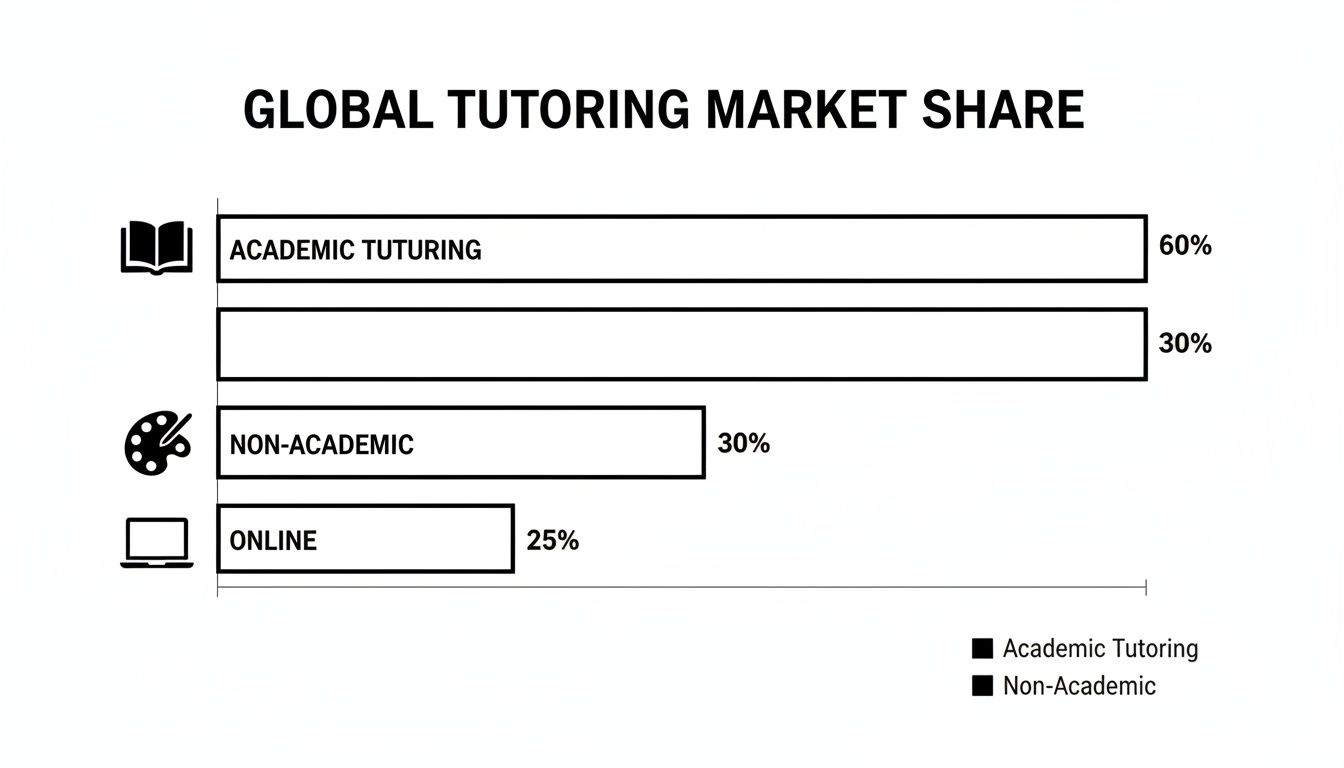
As you can see, traditional academic subjects are the bread and butter of the tutoring world. This foundation influences most of the pricing you will encounter.
How Much Do Tutors Charge for K-12 Subjects?
For standard K-12 subjects like math, English, and history, pricing is usually more accessible. Think of these rates as your baseline. You will adjust them for more specialized services.
In 2026, online sessions for these core subjects typically land between $27 and $55 per hour. In-person tutoring naturally commands a higher price, usually in the $35 to $68 per hour range. This covers the tutor's travel time and related expenses.
Why Does Specialized Tutoring Cost More?
When you get into more advanced or specialized fields, the rates jump significantly. Subjects like advanced STEM courses and standardized test prep (think SAT, ACT, GMAT) demand a much deeper level of expertise.
For these high-demand areas, it is common to see rates from $80 to $110 per hour, sometimes even higher. This premium is driven by a few key factors:
Expert Qualifications: Tutors in these fields often hold advanced degrees or specialized certifications.
High-Stakes Outcomes: A great score can be the ticket to a top university or thousands in scholarship money.
Complex Material: The content is just plain harder than standard high school algebra.
The U.S. tutoring market is set to explode, with projected growth of $28.85 billion between 2025 and 2029. This growth is fueled by new tech, AI-powered learning tools, and the rise of hybrid models that blend online and in-person instruction.
What Trends Are Shaping U.S. Tutoring Prices in 2026?
Average tutoring rates are constantly shaped by powerful trends in education. For instance, the recent push for government-funded high-dosage tutoring programs has massively increased demand. High-dosage tutoring is an intensive, one-on-one or small-group instruction model.
Currently, about 46% of U.S. public schools offer these intensive programs. This signals the value of focused tutoring to the market. This, combined with a 6% increase in median wages for tutors in 2024, has nudged rates upward. You can find more details in our full guide on the tutoring business.
Average Hourly Tutoring Rates Comparison Table
This table summarizes typical hourly tutoring rates based on subject level and format in the U.S. Use it to benchmark your pricing.
Tutoring Type | Average Online Rate (per hour) | Average In-Person Rate (per hour) |
|---|---|---|
Elementary School (K-5) | $25 - $40 | $30 - $50 |
Middle School (6-8) | $30 - $50 | $35 - $60 |
High School (9-12) | $35 - $65 | $45 - $75 |
SAT/ACT Test Prep | $70 - $150 | $80 - $200 |
Advanced STEM (AP/College) | $60 - $120 | $75 - $180 |
Keep these figures in mind as a starting point. Your final rates will depend on your specific location, your tutors' qualifications, and the unique value you offer.
How Do Online Tutoring Rates Compare to In-Person?
It is a common assumption that online tutoring is always the budget-friendly choice. Often, it is. Without the built-in costs of travel and physical materials, virtual sessions can offer a more accessible price point. But the real story is about value and fit.
While online learning offers incredible flexibility, some students thrive with the connection of an in-person tutor. The digital classroom, however, has exploded for a reason. For many, it is a superior learning environment packed with powerful tools.
The market numbers back this up. The online tutoring space was worth $5.43 billion in 2021 and is projected to more than double, hitting $11.4 billion by 2028. Flexibility and technology drive this growth. In fact, 85% of online tutors say tech tools are critical for engagement, according to online tutoring statistics on zipdo.co.
What is the Difference Between Synchronous vs. Asynchronous Rates?
When you look at online tutoring prices, the biggest difference comes down to lesson delivery.
Synchronous learning is live, real-time instruction over a video call. This method mimics the one-on-one attention of in-person tutoring. Because of that direct interaction, it is typically priced in a similar range.
Asynchronous learning involves pre-recorded lessons and materials students work through on their own time. This model is more scalable for a business and generally more affordable for families.
What Factors Drive Online Tutoring Prices?
Several key factors shape the average rates for online tutoring. Since you cut out the overhead of a physical location, online rates can be more competitive. That does not mean they are always cheap. Premium services still fetch premium prices.
Generally, you can expect online tutoring to cost anywhere from $25 to $80 per hour. This wide range reflects the tutor's qualifications, the subject's difficulty, and whether it is a private or group session.
Online tutoring smashes geographical barriers, giving you access to a global talent pool. You can hire a top-tier calculus tutor from another state without paying a premium for their high-cost location. You can then pass this saving on to your clients.
How Do You Overcome Virtual Learning Challenges?
Despite its advantages, online tutoring has one major hurdle: student retention. The average dropout rate for online courses hovers around 25%. This is significantly higher than the 15% dropout rate in traditional classrooms.
Successful online businesses create engaging, interactive sessions. You need dynamic tools, clear goals, and constant communication with students and parents. Building a virtual environment students genuinely want to show up for is key. For more, check our guide on how to start online tutoring.
Key Factors That Influence Tutoring Rates
Knowing national averages is a great start, but those numbers are just part of the story. The price a parent is willing to pay is a dynamic figure shaped by several important variables. These factors signal value, expertise, and convenience.
To set competitive and fair prices, you need to understand these factors and how they affect a family’s perception of value. Each element plays a role in justifying your final rate.
Tutor Experience and Qualifications
One of the biggest factors is the tutor's background. A seasoned educator with a master's degree and 15 years of classroom experience will command a higher rate than a college undergraduate. Their proven track record offers greater value.
Credentials act as a powerful signal of quality. Parents often pay a premium for tutors with specialized certifications, advanced degrees, or extensive experience with specific curricula.
Example 1: A high school student offering peer tutoring for algebra might charge $25 per hour.
Example 2: A certified teacher with a decade of experience teaching AP Calculus could reasonably charge $90 per hour.
Subject Matter Complexity
Not all subjects are equal in the tutoring market. Basic elementary reading help is a different service from preparing a student for a university-level organic chemistry exam. The more specialized and difficult the subject, the higher the rate you can set.
This pricing difference comes down to supply and demand. Far fewer individuals are qualified to teach quantum physics than middle school history. This scarcity allows qualified tutors in complex fields to charge significantly more.
A study by education analysts found that specialized tutors in fields like advanced sciences can earn up to 75% more per hour than those teaching general K-8 subjects. This premium reflects the intensive knowledge required to teach complex material effectively.
Geographic Location and Cost of Living
Where your business operates has a massive impact on your pricing. A center in a high-cost urban area like New York City will have much higher overhead. These costs, like rent and staff wages, must be baked into your rates.
Local market demand also plays a huge role. In affluent, competitive school districts, parents may view tutoring as a standard educational expense. This creates a much higher price tolerance. In areas with lower average incomes, you will need to price your services more accessibly.
Lesson Format: One-on-One vs. Group
The format of the lesson is a final, crucial factor. One-on-one sessions offer the most personalized attention. This exclusivity and customization justify the highest price point.
Group sessions allow you to serve multiple students at once. While each student receives less individual attention, the shared cost makes it more affordable for parents. This model can be highly profitable for your business.
To explore this further, you can review different tutoring pricing models in our guide.
Pricing Factor Comparison Table
This comparative look shows how different factors can shift your tutoring rates from a baseline average.
Factor | Lower Rate Example | Higher Rate Example |
|---|---|---|
Tutor Qualification | College student tutor | PhD-level certified educator |
Subject Complexity | 5th-grade math homework help | AP Physics C test preparation |
Geographic Location | Rural Midwest town | Downtown San Francisco |
Lesson Format | Group session (4-6 students) | Private one-on-one session |
A tutoring session is not a one-size-fits-all product. By thoughtfully considering each of these factors, you can build a pricing structure that reflects the true value you provide.
How to Set Profitable Tutoring Rates for Your Business
Knowing market averages is one thing; turning that data into a smart pricing strategy is another. Setting the right rates is a balancing act between your costs, profit goals, and what families in your area will pay. The aim is to build a pricing structure that covers your bills and fuels growth.
Step 1: Calculate Your Total Overhead Costs
Before you think about profit, you need to know your break-even point. This is the minimum revenue required to cover all your business expenses. Start by listing every monthly expense, from rent and software to marketing and insurance.
Fixed Costs: Rent, insurance premiums, and management software subscriptions.
Variable Costs: Teacher payroll, marketing campaigns, and curriculum materials.
One-Time Costs: New laptops for your team or software setup fees.
Add it all up. That final number is the absolute minimum you must earn each month to stay in business.
Step 2: Determine Your Desired Profit Margin
Now, decide how much profit you want to make. A profit margin is the percentage of revenue left after all costs are paid. A service business like tutoring should aim for a healthy margin between 15% and 25%.
For example, if your total monthly overhead is $10,000, a 20% profit margin means your revenue target is $12,000. This gives you $2,000 in profit to reinvest in growth, hire better tutors, or upgrade your technology.
Step 3: Research Competitor Pricing Strategically
With your numbers sorted, look at your competition. The goal is not to copy their prices. It is to understand where you fit in the local market. Find out what direct competitors charge and what they deliver for that price.
Look for gaps in the market. Maybe everyone else focuses on large group sessions, creating an opening for your premium one-on-one services. Understanding their pricing helps you position your services and highlight your unique value.
Step 4: Choose the Right Pricing Model
You have a few ways to structure your rates. The model you pick should match your services and what your ideal clients are looking for.
Hourly Rates: The classic model, perfect for drop-in sessions or occasional help.
Package Deals: Selling lessons in bulk (e.g., a 10-hour block) at a slight discount to improve cash flow.
Subscription Plans: A recurring monthly fee for a set number of sessions, creating predictable revenue.
Many successful centers use a mix of these models. You can experiment with different structures using a course fee calculator to see how each one affects your revenue.
Step 5: Communicate Value to Justify Your Rates
Finally, a price is just a number until you attach value to it. Clearly explain to parents what they get for their investment. This could be your tutors' Ivy League degrees, your proprietary curriculum, or your proven track record of boosting grades by 15%.
When you communicate effectively, a price tag becomes a measure of value. By showing what makes your center stand out, you can charge rates that reflect your quality and set your business up for long-term success.
Frequently Asked Questions About Tutoring Rates
How much should I charge for tutoring per hour in 2026?
A tutor's hourly rate should reflect their experience, the subject's difficulty, and local market demand. A new tutor for elementary math might charge around $30 per hour. A certified teacher with a decade of SAT prep experience could reasonably command $100 or more per hour in 2026.
What is a fair rate to pay a tutor?
A fair rate respects a tutor's expertise, preparation time, and the results they deliver. For tutoring centers, a fair rate must also include a margin to cover overhead and allow for reinvestment in resources. Consider the tutor's credentials, proven results, and local market benchmarks.
Why do tutoring centers charge more than independent tutors?
Tutoring centers have higher rates because they cover a wider range of costs beyond the tutor's time. These expenses provide a structured, safe, and professional learning environment. Costs include rent, utilities, administrative staff salaries, curriculum investment, and tutor vetting and training.
Are tutoring package deals worth it?
Yes, package deals benefit both your business and your clients. Families save money with a discounted hourly rate for buying sessions in bulk. For your business, packages improve cash flow, encourage long-term commitment, and reduce administrative work.
How can I justify higher tutoring rates to parents?
You justify higher rates by clearly demonstrating premium value. Frame your prices around the results you deliver, like a 2-point average ACT score increase. Highlight specific benefits, such as your tutors' advanced degrees, proprietary teaching methods, or detailed progress reports.
How do I know if my tutoring rates are competitive?
Your rates are competitive when they align with the local market while covering your costs and desired profit margin. The goal is to offer the best value, not be the cheapest option. Conduct a competitive analysis every six months to stay informed.
Can I offer different rates for online vs. in-person tutoring?
Yes, it is common to price online and in-person sessions differently. Online tutoring typically has lower overhead (no travel costs or physical space), allowing you to pass savings to clients. This makes your online services more accessible and expands your customer base.
What is high-dosage tutoring?
High-dosage tutoring is an intensive educational support model. It involves frequent, consistent sessions (often multiple times per week) in a one-on-one or small-group setting. This method has proven effective in accelerating student learning and is increasingly funded by schools.
Ready to stop wasting time on manual admin and start focusing on growth? Tutorbase automates your scheduling, billing, and payroll, cutting overhead by up to 60% and giving you back hours every week. See how you can build a more profitable tutoring business by visiting tutorbase.com/register.
A Guide to Average Tutoring Rates and Pricing Your Services
Published: December 11, 2025 by Amy Ashford


Key Takeaway: In 2026, average tutoring rates range from $25 to over $100 per hour. This wide variation depends on the tutor's experience, subject complexity, and location. Setting the right price requires balancing your business costs with market value to ensure profitability.
Thinking about what to charge for tutoring can feel like trying to hit a moving target. In 2026, the going rate can be anywhere from $25 to over $100 per hour. That huge range comes down to a few key things: the tutor's experience, the subject's complexity, and your location.
Nailing your pricing means finding the sweet spot between what the market will bear and what your business needs to stay profitable. It's a balancing act, but one you can get right.
What Factors Decode Tutoring Prices?

The first step to setting your own rates is getting a solid handle on what's behind the numbers. This guide will break down the market benchmarks and all the variables that shape what parents are willing to pay. We will look at how prices swing from one city to the next.
Before you can set your rates, you need a feel for the bigger picture. The private tutoring industry is not a small, niche market. It is a massive, booming global business. That growth creates both opportunities and new pricing pressures for tutoring centers everywhere.
Rising academic competition and a growing belief among parents that extra support is essential for success drive this growth. As more families seek out tutors, that demand directly impacts what you can charge. This makes understanding the market the first step in building a smart pricing strategy.
The Sheer Scale of the Tutoring Industry
The global private tutoring market is huge, and it’s getting bigger every year. In 2023, it was valued at $97.11 billion. Projections show it rocketing to nearly $154.8 billion by 2030, growing at a steady clip of almost 7% each year. This is a stable, vital part of the education world.
You can dig into these tutoring statistics to get the full story, but the trajectory is clear.
This growth isn’t happening the same way everywhere. While traditional, in-person tutoring still holds the lion's share of the market (74%), the real action is happening online.
Offline Tutoring: The classic, face-to-face model is still the biggest piece of the pie.
Online Tutoring: This is where the explosive growth is. It is projected to expand at a rate of 7.7% annually, thanks to better technology and families wanting more flexible learning options.
What Types of Tutoring Are Most In-Demand?
When you break down the market, one thing becomes crystal clear: academics rule. Core school subjects make up the bulk of tutoring services. This shapes what parents expect to pay and how most tutoring businesses market themselves.
Academic tutoring is the dominant force, accounting for 68.2% of the entire market. Non-academic subjects, like music or art, make up the other 31.8%. This shows that helping students with their core curriculum drives the industry's revenue.
This split is a big deal for your business. If you focus on academic subjects, you plug into the largest, most established part of the market. But it also means you will have more competition, which makes your pricing even more important.
A Quick Look at Regional Differences
While tutoring is a global trend, the market is not spread out evenly. The Asia Pacific region is the current heavyweight, holding 35.16% of the market share in 2022. This is largely thanks to a strong cultural focus on education and government support for digital learning.
Other regions are seeing solid growth, too. North America, for example, is expected to grow at a healthy 6.0% annually from 2023 onward. Knowing these regional trends helps you place your own business in context. This ensures your prices make sense for your local community.
What Are the Average Tutoring Rates in the United States?
Before you set your prices, you need a solid grasp of what the market looks like. Figuring out the typical cost of tutoring in the United States is the first, most crucial step. Rates swing wildly depending on the subject’s difficulty, the tutor's experience, and the session format.
The tutoring market is segmented, not one single entity. This breakdown shows you where the real demand is.

As you can see, traditional academic subjects are the bread and butter of the tutoring world. This foundation influences most of the pricing you will encounter.
How Much Do Tutors Charge for K-12 Subjects?
For standard K-12 subjects like math, English, and history, pricing is usually more accessible. Think of these rates as your baseline. You will adjust them for more specialized services.
In 2026, online sessions for these core subjects typically land between $27 and $55 per hour. In-person tutoring naturally commands a higher price, usually in the $35 to $68 per hour range. This covers the tutor's travel time and related expenses.
Why Does Specialized Tutoring Cost More?
When you get into more advanced or specialized fields, the rates jump significantly. Subjects like advanced STEM courses and standardized test prep (think SAT, ACT, GMAT) demand a much deeper level of expertise.
For these high-demand areas, it is common to see rates from $80 to $110 per hour, sometimes even higher. This premium is driven by a few key factors:
Expert Qualifications: Tutors in these fields often hold advanced degrees or specialized certifications.
High-Stakes Outcomes: A great score can be the ticket to a top university or thousands in scholarship money.
Complex Material: The content is just plain harder than standard high school algebra.
The U.S. tutoring market is set to explode, with projected growth of $28.85 billion between 2025 and 2029. This growth is fueled by new tech, AI-powered learning tools, and the rise of hybrid models that blend online and in-person instruction.
What Trends Are Shaping U.S. Tutoring Prices in 2026?
Average tutoring rates are constantly shaped by powerful trends in education. For instance, the recent push for government-funded high-dosage tutoring programs has massively increased demand. High-dosage tutoring is an intensive, one-on-one or small-group instruction model.
Currently, about 46% of U.S. public schools offer these intensive programs. This signals the value of focused tutoring to the market. This, combined with a 6% increase in median wages for tutors in 2024, has nudged rates upward. You can find more details in our full guide on the tutoring business.
Average Hourly Tutoring Rates Comparison Table
This table summarizes typical hourly tutoring rates based on subject level and format in the U.S. Use it to benchmark your pricing.
Tutoring Type | Average Online Rate (per hour) | Average In-Person Rate (per hour) |
|---|---|---|
Elementary School (K-5) | $25 - $40 | $30 - $50 |
Middle School (6-8) | $30 - $50 | $35 - $60 |
High School (9-12) | $35 - $65 | $45 - $75 |
SAT/ACT Test Prep | $70 - $150 | $80 - $200 |
Advanced STEM (AP/College) | $60 - $120 | $75 - $180 |
Keep these figures in mind as a starting point. Your final rates will depend on your specific location, your tutors' qualifications, and the unique value you offer.
How Do Online Tutoring Rates Compare to In-Person?
It is a common assumption that online tutoring is always the budget-friendly choice. Often, it is. Without the built-in costs of travel and physical materials, virtual sessions can offer a more accessible price point. But the real story is about value and fit.
While online learning offers incredible flexibility, some students thrive with the connection of an in-person tutor. The digital classroom, however, has exploded for a reason. For many, it is a superior learning environment packed with powerful tools.
The market numbers back this up. The online tutoring space was worth $5.43 billion in 2021 and is projected to more than double, hitting $11.4 billion by 2028. Flexibility and technology drive this growth. In fact, 85% of online tutors say tech tools are critical for engagement, according to online tutoring statistics on zipdo.co.
What is the Difference Between Synchronous vs. Asynchronous Rates?
When you look at online tutoring prices, the biggest difference comes down to lesson delivery.
Synchronous learning is live, real-time instruction over a video call. This method mimics the one-on-one attention of in-person tutoring. Because of that direct interaction, it is typically priced in a similar range.
Asynchronous learning involves pre-recorded lessons and materials students work through on their own time. This model is more scalable for a business and generally more affordable for families.
What Factors Drive Online Tutoring Prices?
Several key factors shape the average rates for online tutoring. Since you cut out the overhead of a physical location, online rates can be more competitive. That does not mean they are always cheap. Premium services still fetch premium prices.
Generally, you can expect online tutoring to cost anywhere from $25 to $80 per hour. This wide range reflects the tutor's qualifications, the subject's difficulty, and whether it is a private or group session.
Online tutoring smashes geographical barriers, giving you access to a global talent pool. You can hire a top-tier calculus tutor from another state without paying a premium for their high-cost location. You can then pass this saving on to your clients.
How Do You Overcome Virtual Learning Challenges?
Despite its advantages, online tutoring has one major hurdle: student retention. The average dropout rate for online courses hovers around 25%. This is significantly higher than the 15% dropout rate in traditional classrooms.
Successful online businesses create engaging, interactive sessions. You need dynamic tools, clear goals, and constant communication with students and parents. Building a virtual environment students genuinely want to show up for is key. For more, check our guide on how to start online tutoring.
Key Factors That Influence Tutoring Rates
Knowing national averages is a great start, but those numbers are just part of the story. The price a parent is willing to pay is a dynamic figure shaped by several important variables. These factors signal value, expertise, and convenience.
To set competitive and fair prices, you need to understand these factors and how they affect a family’s perception of value. Each element plays a role in justifying your final rate.
Tutor Experience and Qualifications
One of the biggest factors is the tutor's background. A seasoned educator with a master's degree and 15 years of classroom experience will command a higher rate than a college undergraduate. Their proven track record offers greater value.
Credentials act as a powerful signal of quality. Parents often pay a premium for tutors with specialized certifications, advanced degrees, or extensive experience with specific curricula.
Example 1: A high school student offering peer tutoring for algebra might charge $25 per hour.
Example 2: A certified teacher with a decade of experience teaching AP Calculus could reasonably charge $90 per hour.
Subject Matter Complexity
Not all subjects are equal in the tutoring market. Basic elementary reading help is a different service from preparing a student for a university-level organic chemistry exam. The more specialized and difficult the subject, the higher the rate you can set.
This pricing difference comes down to supply and demand. Far fewer individuals are qualified to teach quantum physics than middle school history. This scarcity allows qualified tutors in complex fields to charge significantly more.
A study by education analysts found that specialized tutors in fields like advanced sciences can earn up to 75% more per hour than those teaching general K-8 subjects. This premium reflects the intensive knowledge required to teach complex material effectively.
Geographic Location and Cost of Living
Where your business operates has a massive impact on your pricing. A center in a high-cost urban area like New York City will have much higher overhead. These costs, like rent and staff wages, must be baked into your rates.
Local market demand also plays a huge role. In affluent, competitive school districts, parents may view tutoring as a standard educational expense. This creates a much higher price tolerance. In areas with lower average incomes, you will need to price your services more accessibly.
Lesson Format: One-on-One vs. Group
The format of the lesson is a final, crucial factor. One-on-one sessions offer the most personalized attention. This exclusivity and customization justify the highest price point.
Group sessions allow you to serve multiple students at once. While each student receives less individual attention, the shared cost makes it more affordable for parents. This model can be highly profitable for your business.
To explore this further, you can review different tutoring pricing models in our guide.
Pricing Factor Comparison Table
This comparative look shows how different factors can shift your tutoring rates from a baseline average.
Factor | Lower Rate Example | Higher Rate Example |
|---|---|---|
Tutor Qualification | College student tutor | PhD-level certified educator |
Subject Complexity | 5th-grade math homework help | AP Physics C test preparation |
Geographic Location | Rural Midwest town | Downtown San Francisco |
Lesson Format | Group session (4-6 students) | Private one-on-one session |
A tutoring session is not a one-size-fits-all product. By thoughtfully considering each of these factors, you can build a pricing structure that reflects the true value you provide.
How to Set Profitable Tutoring Rates for Your Business

Knowing market averages is one thing; turning that data into a smart pricing strategy is another. Setting the right rates is a balancing act between your costs, profit goals, and what families in your area will pay. The aim is to build a pricing structure that covers your bills and fuels growth.
Step 1: Calculate Your Total Overhead Costs
Before you think about profit, you need to know your break-even point. This is the minimum revenue required to cover all your business expenses. Start by listing every monthly expense, from rent and software to marketing and insurance.
Fixed Costs: Rent, insurance premiums, and management software subscriptions.
Variable Costs: Teacher payroll, marketing campaigns, and curriculum materials.
One-Time Costs: New laptops for your team or software setup fees.
Add it all up. That final number is the absolute minimum you must earn each month to stay in business.
Step 2: Determine Your Desired Profit Margin
Now, decide how much profit you want to make. A profit margin is the percentage of revenue left after all costs are paid. A service business like tutoring should aim for a healthy margin between 15% and 25%.
For example, if your total monthly overhead is $10,000, a 20% profit margin means your revenue target is $12,000. This gives you $2,000 in profit to reinvest in growth, hire better tutors, or upgrade your technology.
Step 3: Research Competitor Pricing Strategically
With your numbers sorted, look at your competition. The goal is not to copy their prices. It is to understand where you fit in the local market. Find out what direct competitors charge and what they deliver for that price.
Look for gaps in the market. Maybe everyone else focuses on large group sessions, creating an opening for your premium one-on-one services. Understanding their pricing helps you position your services and highlight your unique value.
Step 4: Choose the Right Pricing Model
You have a few ways to structure your rates. The model you pick should match your services and what your ideal clients are looking for.
Hourly Rates: The classic model, perfect for drop-in sessions or occasional help.
Package Deals: Selling lessons in bulk (e.g., a 10-hour block) at a slight discount to improve cash flow.
Subscription Plans: A recurring monthly fee for a set number of sessions, creating predictable revenue.
Many successful centers use a mix of these models. You can experiment with different structures using a course fee calculator to see how each one affects your revenue.
Step 5: Communicate Value to Justify Your Rates
Finally, a price is just a number until you attach value to it. Clearly explain to parents what they get for their investment. This could be your tutors' Ivy League degrees, your proprietary curriculum, or your proven track record of boosting grades by 15%.
When you communicate effectively, a price tag becomes a measure of value. By showing what makes your center stand out, you can charge rates that reflect your quality and set your business up for long-term success.
Frequently Asked Questions About Tutoring Rates
How much should I charge for tutoring per hour in 2026?
A tutor's hourly rate should reflect their experience, the subject's difficulty, and local market demand. A new tutor for elementary math might charge around $30 per hour. A certified teacher with a decade of SAT prep experience could reasonably command $100 or more per hour in 2026.
What is a fair rate to pay a tutor?
A fair rate respects a tutor's expertise, preparation time, and the results they deliver. For tutoring centers, a fair rate must also include a margin to cover overhead and allow for reinvestment in resources. Consider the tutor's credentials, proven results, and local market benchmarks.
Why do tutoring centers charge more than independent tutors?
Tutoring centers have higher rates because they cover a wider range of costs beyond the tutor's time. These expenses provide a structured, safe, and professional learning environment. Costs include rent, utilities, administrative staff salaries, curriculum investment, and tutor vetting and training.
Are tutoring package deals worth it?
Yes, package deals benefit both your business and your clients. Families save money with a discounted hourly rate for buying sessions in bulk. For your business, packages improve cash flow, encourage long-term commitment, and reduce administrative work.
How can I justify higher tutoring rates to parents?
You justify higher rates by clearly demonstrating premium value. Frame your prices around the results you deliver, like a 2-point average ACT score increase. Highlight specific benefits, such as your tutors' advanced degrees, proprietary teaching methods, or detailed progress reports.
How do I know if my tutoring rates are competitive?
Your rates are competitive when they align with the local market while covering your costs and desired profit margin. The goal is to offer the best value, not be the cheapest option. Conduct a competitive analysis every six months to stay informed.
Can I offer different rates for online vs. in-person tutoring?
Yes, it is common to price online and in-person sessions differently. Online tutoring typically has lower overhead (no travel costs or physical space), allowing you to pass savings to clients. This makes your online services more accessible and expands your customer base.
What is high-dosage tutoring?
High-dosage tutoring is an intensive educational support model. It involves frequent, consistent sessions (often multiple times per week) in a one-on-one or small-group setting. This method has proven effective in accelerating student learning and is increasingly funded by schools.
Ready to stop wasting time on manual admin and start focusing on growth? Tutorbase automates your scheduling, billing, and payroll, cutting overhead by up to 60% and giving you back hours every week. See how you can build a more profitable tutoring business by visiting tutorbase.com/register.