
The Best Scheduling Software for Language Schools in 2024
Published: January 8, 2026 by Amy Ashford


The best scheduling software for a language school isn't just a digital calendar; it's a centralized command center. It replaces the chaotic mix of spreadsheets, calendars, and billing tools with a single platform that automates everything from booking multi-level classes to calculating complex teacher payroll, saving directors over 10 hours of admin work every week.
A specialized system like Tutorbase is designed to handle the unique operational needs of language education, such as managing hybrid attendance, tracking prepaid lesson packages, and preventing double-bookings across multiple branches, turning administrative friction into streamlined growth.
Why Generic Calendars Cost Your Language School Money
Picture this: a school director juggles timetables for different CEFR levels, tries to manage room bookings across multiple locations, and manually chases down late payments. This is the daily reality for many schools trying to operate with generic tools like Google Calendar, QuickBooks, and a mountain of spreadsheets. These tools fail because they don't understand the business logic of a language school.

The Problem With Fragmented Systems
When your scheduling, billing, and student management live in separate, disconnected systems, you create an administrative burden that costs you time and money. A simple request to book a trial Spanish lesson can take over ten minutes as your staff cross-references multiple calendars and spreadsheets to find a qualified teacher, an available room, and a suitable time slot.
This fragmented approach leads directly to major operational failures:
Costly Double-Bookings: Teachers get assigned to two classes at once, and rooms are booked beyond their capacity, leading to frustrated students and staff.
Revenue Leakage: Missed payments and unenforced cancellation policies slip through the cracks of manual tracking, directly impacting your bottom line.
Administrative Burnout: Staff spend over 10 hours a week on repetitive tasks like manual invoicing and payroll calculations instead of focusing on student engagement.
No Operational Visibility: It's impossible to see your capacity utilization, balance teacher workloads, or get a clear view of your school's financial health.
The core issue is that generic tools lack the specific logic for language school operations. They can’t manage multi-level curricula, track hybrid attendance, or automate complex payroll with weekend premiums.
The academic scheduling software market is projected to skyrocket from USD 14.2 billion in 2025 to USD 51.3 billion by 2035. This massive growth is driven by schools adopting specialized digital tools to solve these exact problems. You can learn more about the future of academic scheduling from recent market analysis.
The Need For A Specialized Solution
A dedicated platform built for language schools changes everything. It turns chaotic workflows into smooth, automated processes because it understands the relationships between students, teachers, subjects (like IELTS or DELF prep), proficiency levels (A1, B2), and physical rooms.
This integration is the key. It moves you from constantly putting out fires to proactively building a sustainable, growing business. By centralizing operations, you can finally focus on education, not administration.
What to Look For in Language School Management Software
Choosing the right scheduling software for your language school is about more than a calendar. You need a system that understands the unique rhythm of language education, from tracking nuanced student progress to managing the logistics of hybrid classrooms. The right choice turns administrative chaos into a smooth, profitable operation.

Multi-Level Curriculum Management
The heart of your school is its structured curriculum. Whether you follow the CEFR framework (A1, B1, B2, etc.) or prep students for exams like IELTS or DELF, your software must reflect that structure. Generic tools that just let you create a "French Class" simply won't cut it.
You need the ability to define subjects and assign specific levels to them. This stops a student aiming for a B2 exam from being accidentally dropped into an A1 beginner's group. This level of detail is critical for:
Accurate Placement: Getting new students into the right group based on their actual proficiency.
Progress Tracking: Clearly mapping a student's journey through your curriculum over months or years.
Teacher Qualification Matching: Ensuring only teachers certified to teach advanced levels are assigned to those classes.
True Hybrid and Multi-Branch Support
Modern language schools are rarely just one thing. Many operate a hybrid model, with some students in the classroom and others joining online—often in the same session. Your software must handle this complexity within a single class roster, tracking each student's attendance based on how they showed up.
For schools with more than one physical location, multi-branch management is non-negotiable. A good platform lets you manage schedules, room availability, and teacher assignments across all your branches from one central dashboard. This prevents overbooked rooms and gives you a bird's-eye view of your capacity everywhere.
An integrated system that connects curriculum, scheduling, and room management is the foundation for operational efficiency. It eliminates the data silos that cause booking errors and administrative friction, creating a single source of truth for your entire school.
Integrated CRM And Lead Management
Your school’s growth depends on its ability to turn inquiries into enrollments. An integrated Customer Relationship Management (CRM) system is your engine for managing this pipeline. It needs to capture leads from your website, phone calls, and even a WhatsApp widget.
Once a lead is in the system, you can track their entire journey from "New Inquiry" to "Trial Scheduled" and finally to "Converted." This provides priceless data on conversion rates and helps you spot where potential students are falling through the cracks. Beyond core scheduling, look for platforms that integrate with or enable the use of advanced educational content tools, such as those leveraging leading Text-to-Speech (TTS) API providers to generate high-quality audio for lessons and practice.
Flexible And Automated Scheduling
Manual scheduling is a soul-crushing time drain. Look for software that brings intelligent automation to the table. For instance, an AI-powered "Find Slot" tool can instantly surface every possible teacher, room, and time combination for a new booking request, cutting a ten-minute task down to less than two.
Just as important is solid support for recurring lessons. You should be able to set up a weekly or bi-weekly class that runs for the whole term with a single click. This feature alone is a massive time-saver for your regular group classes and private tutoring sessions. You can learn more about how this works in our guide on recurring lesson scheduling software.
The online language learning market is exploding, projected to race from USD 21.06 billion in 2025 to USD 44.38 billion by 2030. That kind of growth demands tools that can keep up.
Comparing The Top Language School Software: Tutorbase vs. The Alternatives
Choosing the right software isn't about ticking boxes on a feature list. It's about how the platform performs under pressure during the high-stakes tasks that define your business. A simple "booking feature" in one tool can be worlds apart from an intelligent, automated process in another.
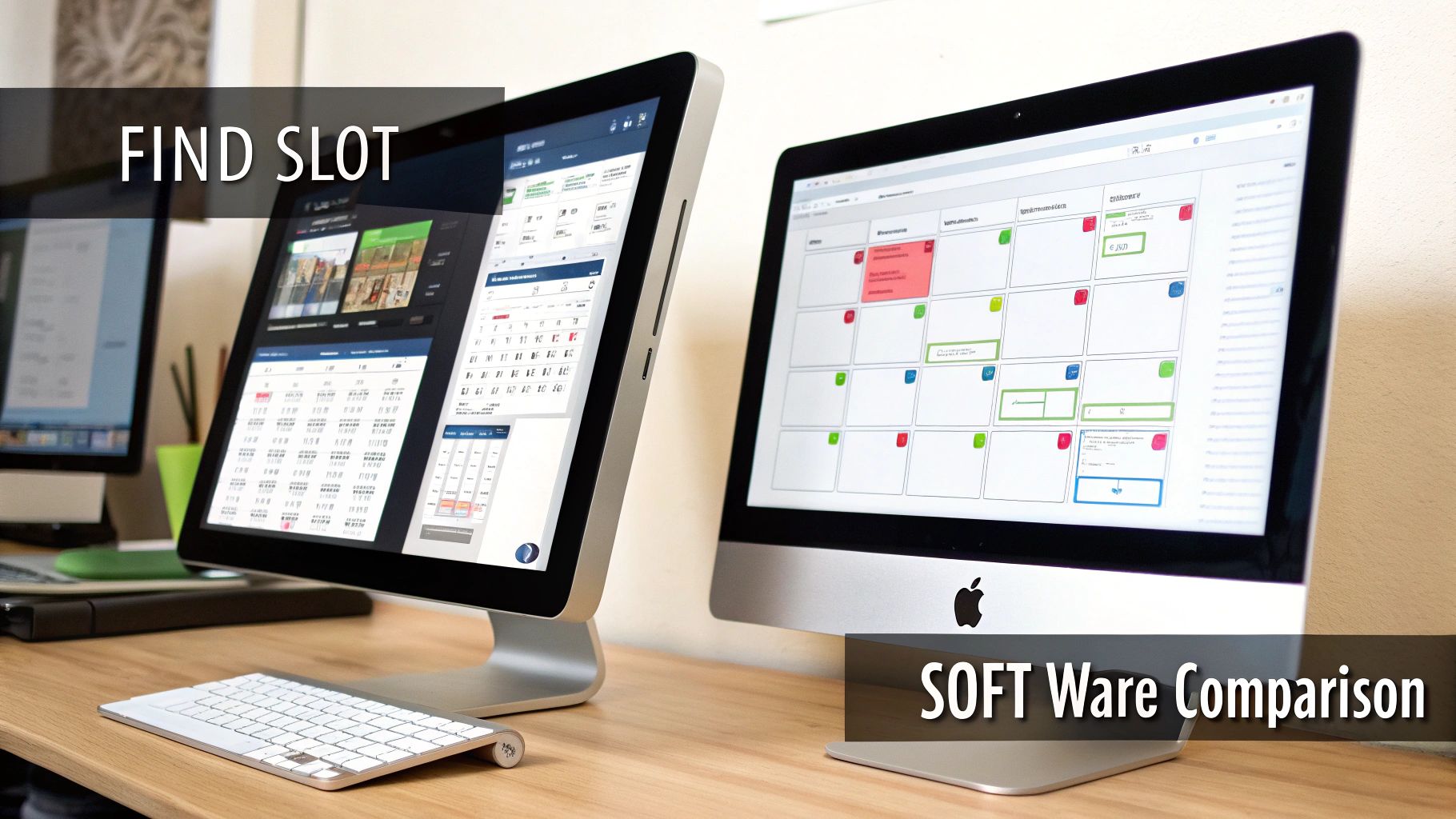
This comparison breaks down top contenders—Tutorbase, Teachworks, and TutorCruncher—through the lens of real-world scenarios. We'll examine booking a trial lesson, managing prepaid packages, and automating invoicing to highlight the differences that truly impact your efficiency and bottom line.
How do I book a new trial lesson?
A potential student's first interaction with your school is often booking a trial. This single process can be a seamless, two-minute experience that impresses a new family or a frustrating ten-minute hunt that sends them elsewhere. The difference is all in the software's intelligence.
With Tutorbase: The AI-powered Find Slot feature turns this into a simple query. An admin just enters the student's needs (e.g., "Spanish, Level A2, Tuesday afternoon"). The system instantly scans every qualified teacher's availability, cross-references it with open rooms, and provides a list of perfect time slots. A booking is confirmed in under two minutes, speeding up student onboarding by 3x.
With Teachworks or TutorCruncher: This is a completely manual grind. The admin must first find a teacher qualified for the language and level. Then, they open that teacher's calendar, open the room schedule in a separate tab, and manually hunt for an overlapping slot. This "calendar tetris" is slow, prone to human error, and a massive administrative headache.
How do I manage prepaid lesson packages?
Prepaid lesson packages are the lifeblood of a language school's cash flow, but manual tracking is a recipe for disaster. The best software automates this entire cycle, from the initial sale to the very last lesson.
A key differentiator is whether the prepaid credit system is a native, fully integrated feature or just a tacked-on extra. Native systems connect attendance directly to credit balances, which cuts out manual work and stops revenue from slipping through the cracks.
In Tutorbase, the prepaid credit system is a native feature. When a student buys a 10-lesson package, their account is credited. After each class, the teacher marks attendance, and the system automatically deducts one lesson credit. Parents even get automated low-balance alerts, prompting them to top up.
In contrast, platforms like Teachworks and TutorCruncher offer limited or add-on-based package management. This often forces an admin to periodically cross-check attendance logs against package purchases to update balances by hand, leaving the door open for billing errors.
Comparison Table: Language School Software Features
To get a clearer picture, let's look at a side-by-side comparison of how these platforms handle the core features that matter most to a growing language school. This table highlights where modern, AI-driven tools pull ahead of more traditional systems.
Feature | Tutorbase | Teachworks | TutorCruncher |
|---|---|---|---|
Trial Lesson Booking | ✅ AI-Powered "Find Slot" finds teacher & room matches in seconds. | ❌ Manual process. Requires cross-referencing multiple calendars. | ❌ Manual process. Admin must manually find teacher and room availability. |
Prepaid Credits | ✅ Native & fully automated. Credits auto-deduct with attendance. | Limited. Often requires manual reconciliation of balances. | Add-on feature. Can require manual checks to ensure accuracy. |
Invoicing | ✅ Fully Automated. Invoices are generated directly from attendance records. | Semi-Manual. Requires admin review for cancellations & no-shows. | Semi-Manual. Needs manual adjustments for exceptions to the schedule. |
Complex Payroll | ✅ Built-in support. Handles multiple rates, premiums, and revenue share. | Basic hourly rates only. Requires exporting data for complex calculations. | Primarily hourly. Complex models need manual work in spreadsheets. |
Multi-Branch Rooms | ✅ Manage all rooms from one dashboard. | Limited. Basic support for multiple locations. | Limited. Can be cumbersome for multiple sites. |
Multi-Brand | ✅ Run separate brands from one account. | ❌ Not supported. | ❌ Not supported. |
WhatsApp Integration | ✅ Capture leads directly into CRM. | ❌ Not supported. | ❌ Not supported. |
As you can see, the difference isn't just about if a feature exists, but how it's implemented. Fully automated systems save hours of administrative work and reduce costly errors, allowing you to focus on growth.
How do I handle complex teacher payroll?
To attract top talent, language schools often need creative payroll models, like revenue sharing, weekend pay bumps, or higher rates for advanced courses (like DELF B2 prep). Generic payroll software and most management tools just can't keep up.
Tutorbase was built for this complexity. You can set up multiple pay rates for a single teacher: their standard hourly rate, a higher rate for weekend classes, a premium for an IELTS prep course, and even a revenue share percentage. The system automatically calculates the correct total based on their attendance records. No spreadsheets needed.
On the other hand, platforms like Teachworks and TutorCruncher are designed for simple, hourly payroll. Calculating pay with multiple variables means exporting data to Excel for manual number-crunching. This adds hours of admin work and dramatically increases the risk of expensive payroll mistakes.
The language learning software developers' industry in the U.S. is booming, hitting $6.7 billion in 2025 after a staggering 22.4% annual growth rate. In this competitive market, the best software stands out with features competitors can't match, like native prepaid credits, multi-brand support, and scalable payroll that includes revenue share and subject-specific premiums. These are the tools that allow a language school to scale effectively. You can dive deeper into these trends by reading the full report on the language learning software market.
How Automated Billing and Payroll Drive Profitability
Scheduling is just one piece of the puzzle. The real financial engine of your language school—billing and payroll—is where good operations translate directly into a healthier bottom line. Moving away from manual tools like QuickBooks and Excel is a strategic decision to plug revenue leaks, reduce admin time by 60%, and boost your profitability.
An integrated system completely changes how you manage money. Auto-generated invoices tied directly to attendance, prepaid credit systems that send low-balance alerts, and automated enforcement of your cancellation policies stop you from chasing payments and start building predictable cash flow.
Eliminating Revenue Leakage with Automated Invoicing
Manual invoicing is a minefield of potential errors. A missed lesson, an unbilled package, or a forgotten late fee might seem small, but these drips add up to a significant financial drain over a year. The best scheduling software for language schools eliminates this risk by linking billing directly to your daily operations.
Here’s how it works in the real world:
Attendance-Driven Invoices: A teacher marks a student as "Attended," and the system automatically adds the charge to their next invoice. There is zero manual data entry, which means zero chance of forgetting to bill for a completed class.
Prepaid Credit Automation: For schools selling lesson packages, the software acts like a digital wallet. After each class, it deducts a credit from the student's balance. When they're running low, it pings the parent with an automated reminder, preventing service gaps and securing your revenue upfront.
Cancellation Policy Enforcement: You set the rules—for example, a 24-hour notice—and the software becomes your enforcer. If a student cancels late, the system automatically applies the fee you've defined. Your policies are applied consistently, no awkward conversations required.
This shift transforms billing from a reactive, error-prone task that takes hours into a proactive, reliable revenue stream that you can manage in minutes.
Attracting Top Talent with Flexible Payroll
To attract and keep the best language instructors, you often need to offer more than a simple hourly wage. Competitive compensation might mean premiums for weekend classes, higher rates for advanced exam prep (like DELF B2 or IELTS), or even revenue-sharing models. Generic payroll tools and spreadsheets just can't keep up.
Modern management software is built for these nuanced scenarios. You can create sophisticated pay rules that run automatically, setting multiple rates for a single teacher based on the specific classes they taught. The system calculates their earnings perfectly, every time. This kind of accuracy and timeliness is a huge factor in teacher satisfaction and retention.
Of course, to truly streamline operations and enhance profitability, language schools should also explore the broader workflow automation benefits that go beyond just finance.
For any language school looking to scale, managing complex pay structures without errors is non-negotiable. We take a closer look at how modern software can simplify this in our deep dive into sessions and payroll management. By automating these critical financial workflows, you free up a massive amount of admin time, letting you focus on what really matters: educational quality and growing your business.
Choosing The Right Software For Your School's Growth Stage
Not all language schools are built the same. The software that works for a small, single-location studio will buckle under the pressure of a multi-branch academy. The key is finding a system that solves your problems right now while giving you a clear path to scale. It's all about matching the features to your specific stage of growth.

Your decision to automate isn't just about saving a few hours—it's about building a more profitable school. This decision tree lays it out plainly: manual processes leak revenue, while smart automation drives profit.
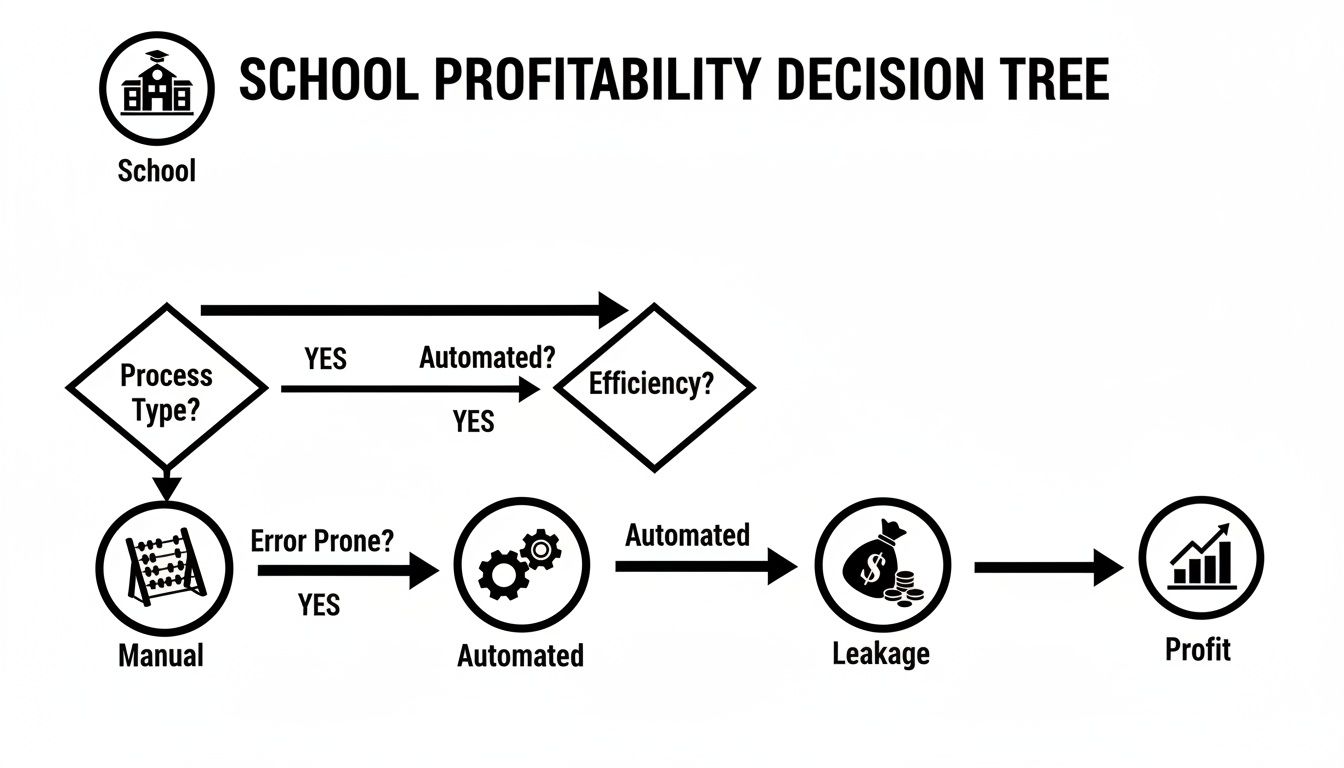
As you can see, your operational choices have a direct line to your financial outcomes. An automated, integrated system isn't a cost center; it's the foundation for sustainable growth.
For The Growing Single-Location School
If you're managing 5-15 teachers and feeling the pain of manual scheduling and billing, your top priority is automation. Your small admin team is likely sinking over 10 hours a week into tasks that software could handle in minutes. You are almost certainly losing money to double-bookings and unenforced cancellation policies.
At this stage, your non-negotiables are:
Automated Scheduling: You need a system that eliminates double-bookings and makes setting up recurring lessons a one-click affair.
Integrated Billing: Look for software that generates invoices directly from attendance and handles prepaid lesson packages to fix your cash flow.
Centralized Communication: Basic email and SMS reminders are a must-have to reduce no-shows and keep parents in the loop without constant effort.
This is the point where you ditch the messy spreadsheets and scattered calendars for a single source of truth. The goal is simple: get your time back, plug revenue leaks, and build a solid operational foundation.
For The Multi-Branch Language Academy
Once you expand to two or more locations with over 20 teachers, a new layer of complexity emerges. Your biggest headaches are now maintaining consistency across branches and getting a bird's-eye view of the entire operation. Centralized control becomes an absolute necessity.
Your must-have feature list gets more sophisticated:
Multi-Branch Management: You need a unified dashboard to manage schedules, teachers, and rooms across all your locations without logging in and out of different accounts.
Advanced Room Management: This means tracking capacity, specific features (like whiteboards or projectors), and availability for every single classroom at every branch.
Complex Payroll Models: To attract top talent, your software must handle varied pay rates, weekend premiums, and even revenue-sharing agreements.
Multi-Brand Support: If you run different brands under one roof (say, a language school and a test prep center), you need a platform that can manage them separately while sharing resources.
Running multiple locations brings its own unique scheduling chaos. We dive deeper into solving these specific problems in our guide on finding the right multi-location scheduling software.
For The Specialized Test Prep Center
Whether you focus on IELTS, TOEFL, DELF, or Goethe exams, your needs are laser-focused. Your business model relies on matching the right student with the right specialist teacher and managing intricate pricing packages that align with exam cycles. Generic software just won't cut it.
Key features for any serious test prep center include:
Advanced Curriculum Tagging: You must be able to tag teachers and classes by specialty and level, like "IELTS Band 7+ Speaking" or "DELF B2 Writing." This is non-negotiable for smart scheduling.
Flexible Pricing Policies: Your software has to handle complex packages, like a 20-hour intensive course with a hard expiration date or monthly subscriptions for ongoing mock exam support.
Detailed Student Tracking: The ability to log detailed notes on student progress and share them directly with parents is what demonstrates your value and drives renewals.
Picking software that aligns with your growth stage ensures you invest in a tool that solves today’s problems and is ready for tomorrow’s ambitions.
Frequently Asked Questions (FAQ)
Moving your language school to a dedicated management platform is a big step. It’s normal to wonder how it will handle your school's unique quirks, from your curriculum structure to getting your team on board. Here are some straight-up answers to the questions we hear most from school owners and directors.
How does scheduling software handle different language levels and curricula like CEFR?
The best platforms let you build out your own custom subjects and levels. For a language school, that means you can create "French" as a subject, then add specific levels like "A1 - Beginner," "A2 - Elementary," and even "DELF B1 Prep." When you set up a class, you just tag it with the right level. This also applies to teachers and students, ensuring someone looking for an advanced class only sees options with qualified teachers.
Can this software manage both online and in-person classes for a hybrid language school?
Yes, modern platforms are built for the hybrid model. You can label any class as "in-person," "online," or "hybrid." For hybrid classes, the system can track which students are physically in the room and which are joining remotely for each session. This distinction flows right into your attendance records for accurate, automated billing and ensures physical rooms are correctly allocated.
What is the process for migrating from spreadsheets and Google Calendar?
A good software provider will guide you through migration. The process usually starts with importing your data from CSV files containing your student, teacher, and class information. You can often import your schedule from Google Calendar using an iCal link. A dedicated onboarding specialist should then walk you through setting up your services, pricing, and payroll rules to get your school running on the new platform with minimal disruption.
A smooth migration isn't just about moving data; it's about translating your school's way of doing things into an automated system. A good onboarding team will help you configure everything from your cancellation policy to complex teacher pay rates before you go live.
How does automated billing work with prepaid lesson packages?
Automated billing for prepaid packages is a game-changer that can slash your admin work by up to 60% and improve cash flow. A parent buys a package—say, 10 Spanish classes—and that credit is added to their account. Each time the student attends a lesson and the teacher marks them as "Attended," the software automatically deducts one lesson from their balance. The system can also send automated low-balance alerts, prompting them to top up.
Can this software manage multiple school locations?
Absolutely. True multi-branch software allows you to manage all locations from a single dashboard. You can view schedules, assign teachers, and book rooms across all branches without logging into separate accounts. This provides a centralized overview of your entire operation, preventing conflicts and allowing you to optimize resource use across all your sites.
Is it possible to have different branding for different programs?
Yes, platforms with multi-brand support allow you to run different business lines under one roof while maintaining separate branding. For example, you could have a general language school and a specialized test prep center, each with its own student portal, logo, and communications, while still sharing teachers and rooms in the backend. This is essential for larger businesses serving diverse markets.
Ready to stop juggling spreadsheets and see how an all-in-one platform can transform your language school? Register for a free trial with Tutorbase and discover how to automate your scheduling, billing, and payroll in minutes. Get started at tutorbase.com/register.
The Best Scheduling Software for Language Schools in 2024
Published: January 7, 2026 by Amy Ashford


The best scheduling software for a language school isn't just a digital calendar; it's a centralized command center. It replaces the chaotic mix of spreadsheets, calendars, and billing tools with a single platform that automates everything from booking multi-level classes to calculating complex teacher payroll, saving directors over 10 hours of admin work every week.
A specialized system like Tutorbase is designed to handle the unique operational needs of language education, such as managing hybrid attendance, tracking prepaid lesson packages, and preventing double-bookings across multiple branches, turning administrative friction into streamlined growth.
Why Generic Calendars Cost Your Language School Money
Picture this: a school director juggles timetables for different CEFR levels, tries to manage room bookings across multiple locations, and manually chases down late payments. This is the daily reality for many schools trying to operate with generic tools like Google Calendar, QuickBooks, and a mountain of spreadsheets. These tools fail because they don't understand the business logic of a language school.

The Problem With Fragmented Systems
When your scheduling, billing, and student management live in separate, disconnected systems, you create an administrative burden that costs you time and money. A simple request to book a trial Spanish lesson can take over ten minutes as your staff cross-references multiple calendars and spreadsheets to find a qualified teacher, an available room, and a suitable time slot.
This fragmented approach leads directly to major operational failures:
Costly Double-Bookings: Teachers get assigned to two classes at once, and rooms are booked beyond their capacity, leading to frustrated students and staff.
Revenue Leakage: Missed payments and unenforced cancellation policies slip through the cracks of manual tracking, directly impacting your bottom line.
Administrative Burnout: Staff spend over 10 hours a week on repetitive tasks like manual invoicing and payroll calculations instead of focusing on student engagement.
No Operational Visibility: It's impossible to see your capacity utilization, balance teacher workloads, or get a clear view of your school's financial health.
The core issue is that generic tools lack the specific logic for language school operations. They can’t manage multi-level curricula, track hybrid attendance, or automate complex payroll with weekend premiums.
The academic scheduling software market is projected to skyrocket from USD 14.2 billion in 2025 to USD 51.3 billion by 2035. This massive growth is driven by schools adopting specialized digital tools to solve these exact problems. You can learn more about the future of academic scheduling from recent market analysis.
The Need For A Specialized Solution
A dedicated platform built for language schools changes everything. It turns chaotic workflows into smooth, automated processes because it understands the relationships between students, teachers, subjects (like IELTS or DELF prep), proficiency levels (A1, B2), and physical rooms.
This integration is the key. It moves you from constantly putting out fires to proactively building a sustainable, growing business. By centralizing operations, you can finally focus on education, not administration.
What to Look For in Language School Management Software
Choosing the right scheduling software for your language school is about more than a calendar. You need a system that understands the unique rhythm of language education, from tracking nuanced student progress to managing the logistics of hybrid classrooms. The right choice turns administrative chaos into a smooth, profitable operation.

Multi-Level Curriculum Management
The heart of your school is its structured curriculum. Whether you follow the CEFR framework (A1, B1, B2, etc.) or prep students for exams like IELTS or DELF, your software must reflect that structure. Generic tools that just let you create a "French Class" simply won't cut it.
You need the ability to define subjects and assign specific levels to them. This stops a student aiming for a B2 exam from being accidentally dropped into an A1 beginner's group. This level of detail is critical for:
Accurate Placement: Getting new students into the right group based on their actual proficiency.
Progress Tracking: Clearly mapping a student's journey through your curriculum over months or years.
Teacher Qualification Matching: Ensuring only teachers certified to teach advanced levels are assigned to those classes.
True Hybrid and Multi-Branch Support
Modern language schools are rarely just one thing. Many operate a hybrid model, with some students in the classroom and others joining online—often in the same session. Your software must handle this complexity within a single class roster, tracking each student's attendance based on how they showed up.
For schools with more than one physical location, multi-branch management is non-negotiable. A good platform lets you manage schedules, room availability, and teacher assignments across all your branches from one central dashboard. This prevents overbooked rooms and gives you a bird's-eye view of your capacity everywhere.
An integrated system that connects curriculum, scheduling, and room management is the foundation for operational efficiency. It eliminates the data silos that cause booking errors and administrative friction, creating a single source of truth for your entire school.
Integrated CRM And Lead Management
Your school’s growth depends on its ability to turn inquiries into enrollments. An integrated Customer Relationship Management (CRM) system is your engine for managing this pipeline. It needs to capture leads from your website, phone calls, and even a WhatsApp widget.
Once a lead is in the system, you can track their entire journey from "New Inquiry" to "Trial Scheduled" and finally to "Converted." This provides priceless data on conversion rates and helps you spot where potential students are falling through the cracks. Beyond core scheduling, look for platforms that integrate with or enable the use of advanced educational content tools, such as those leveraging leading Text-to-Speech (TTS) API providers to generate high-quality audio for lessons and practice.
Flexible And Automated Scheduling
Manual scheduling is a soul-crushing time drain. Look for software that brings intelligent automation to the table. For instance, an AI-powered "Find Slot" tool can instantly surface every possible teacher, room, and time combination for a new booking request, cutting a ten-minute task down to less than two.
Just as important is solid support for recurring lessons. You should be able to set up a weekly or bi-weekly class that runs for the whole term with a single click. This feature alone is a massive time-saver for your regular group classes and private tutoring sessions. You can learn more about how this works in our guide on recurring lesson scheduling software.
The online language learning market is exploding, projected to race from USD 21.06 billion in 2025 to USD 44.38 billion by 2030. That kind of growth demands tools that can keep up.
Comparing The Top Language School Software: Tutorbase vs. The Alternatives
Choosing the right software isn't about ticking boxes on a feature list. It's about how the platform performs under pressure during the high-stakes tasks that define your business. A simple "booking feature" in one tool can be worlds apart from an intelligent, automated process in another.

This comparison breaks down top contenders—Tutorbase, Teachworks, and TutorCruncher—through the lens of real-world scenarios. We'll examine booking a trial lesson, managing prepaid packages, and automating invoicing to highlight the differences that truly impact your efficiency and bottom line.
How do I book a new trial lesson?
A potential student's first interaction with your school is often booking a trial. This single process can be a seamless, two-minute experience that impresses a new family or a frustrating ten-minute hunt that sends them elsewhere. The difference is all in the software's intelligence.
With Tutorbase: The AI-powered Find Slot feature turns this into a simple query. An admin just enters the student's needs (e.g., "Spanish, Level A2, Tuesday afternoon"). The system instantly scans every qualified teacher's availability, cross-references it with open rooms, and provides a list of perfect time slots. A booking is confirmed in under two minutes, speeding up student onboarding by 3x.
With Teachworks or TutorCruncher: This is a completely manual grind. The admin must first find a teacher qualified for the language and level. Then, they open that teacher's calendar, open the room schedule in a separate tab, and manually hunt for an overlapping slot. This "calendar tetris" is slow, prone to human error, and a massive administrative headache.
How do I manage prepaid lesson packages?
Prepaid lesson packages are the lifeblood of a language school's cash flow, but manual tracking is a recipe for disaster. The best software automates this entire cycle, from the initial sale to the very last lesson.
A key differentiator is whether the prepaid credit system is a native, fully integrated feature or just a tacked-on extra. Native systems connect attendance directly to credit balances, which cuts out manual work and stops revenue from slipping through the cracks.
In Tutorbase, the prepaid credit system is a native feature. When a student buys a 10-lesson package, their account is credited. After each class, the teacher marks attendance, and the system automatically deducts one lesson credit. Parents even get automated low-balance alerts, prompting them to top up.
In contrast, platforms like Teachworks and TutorCruncher offer limited or add-on-based package management. This often forces an admin to periodically cross-check attendance logs against package purchases to update balances by hand, leaving the door open for billing errors.
Comparison Table: Language School Software Features
To get a clearer picture, let's look at a side-by-side comparison of how these platforms handle the core features that matter most to a growing language school. This table highlights where modern, AI-driven tools pull ahead of more traditional systems.
Feature | Tutorbase | Teachworks | TutorCruncher |
|---|---|---|---|
Trial Lesson Booking | ✅ AI-Powered "Find Slot" finds teacher & room matches in seconds. | ❌ Manual process. Requires cross-referencing multiple calendars. | ❌ Manual process. Admin must manually find teacher and room availability. |
Prepaid Credits | ✅ Native & fully automated. Credits auto-deduct with attendance. | Limited. Often requires manual reconciliation of balances. | Add-on feature. Can require manual checks to ensure accuracy. |
Invoicing | ✅ Fully Automated. Invoices are generated directly from attendance records. | Semi-Manual. Requires admin review for cancellations & no-shows. | Semi-Manual. Needs manual adjustments for exceptions to the schedule. |
Complex Payroll | ✅ Built-in support. Handles multiple rates, premiums, and revenue share. | Basic hourly rates only. Requires exporting data for complex calculations. | Primarily hourly. Complex models need manual work in spreadsheets. |
Multi-Branch Rooms | ✅ Manage all rooms from one dashboard. | Limited. Basic support for multiple locations. | Limited. Can be cumbersome for multiple sites. |
Multi-Brand | ✅ Run separate brands from one account. | ❌ Not supported. | ❌ Not supported. |
WhatsApp Integration | ✅ Capture leads directly into CRM. | ❌ Not supported. | ❌ Not supported. |
As you can see, the difference isn't just about if a feature exists, but how it's implemented. Fully automated systems save hours of administrative work and reduce costly errors, allowing you to focus on growth.
How do I handle complex teacher payroll?
To attract top talent, language schools often need creative payroll models, like revenue sharing, weekend pay bumps, or higher rates for advanced courses (like DELF B2 prep). Generic payroll software and most management tools just can't keep up.
Tutorbase was built for this complexity. You can set up multiple pay rates for a single teacher: their standard hourly rate, a higher rate for weekend classes, a premium for an IELTS prep course, and even a revenue share percentage. The system automatically calculates the correct total based on their attendance records. No spreadsheets needed.
On the other hand, platforms like Teachworks and TutorCruncher are designed for simple, hourly payroll. Calculating pay with multiple variables means exporting data to Excel for manual number-crunching. This adds hours of admin work and dramatically increases the risk of expensive payroll mistakes.
The language learning software developers' industry in the U.S. is booming, hitting $6.7 billion in 2025 after a staggering 22.4% annual growth rate. In this competitive market, the best software stands out with features competitors can't match, like native prepaid credits, multi-brand support, and scalable payroll that includes revenue share and subject-specific premiums. These are the tools that allow a language school to scale effectively. You can dive deeper into these trends by reading the full report on the language learning software market.
How Automated Billing and Payroll Drive Profitability
Scheduling is just one piece of the puzzle. The real financial engine of your language school—billing and payroll—is where good operations translate directly into a healthier bottom line. Moving away from manual tools like QuickBooks and Excel is a strategic decision to plug revenue leaks, reduce admin time by 60%, and boost your profitability.
An integrated system completely changes how you manage money. Auto-generated invoices tied directly to attendance, prepaid credit systems that send low-balance alerts, and automated enforcement of your cancellation policies stop you from chasing payments and start building predictable cash flow.
Eliminating Revenue Leakage with Automated Invoicing
Manual invoicing is a minefield of potential errors. A missed lesson, an unbilled package, or a forgotten late fee might seem small, but these drips add up to a significant financial drain over a year. The best scheduling software for language schools eliminates this risk by linking billing directly to your daily operations.
Here’s how it works in the real world:
Attendance-Driven Invoices: A teacher marks a student as "Attended," and the system automatically adds the charge to their next invoice. There is zero manual data entry, which means zero chance of forgetting to bill for a completed class.
Prepaid Credit Automation: For schools selling lesson packages, the software acts like a digital wallet. After each class, it deducts a credit from the student's balance. When they're running low, it pings the parent with an automated reminder, preventing service gaps and securing your revenue upfront.
Cancellation Policy Enforcement: You set the rules—for example, a 24-hour notice—and the software becomes your enforcer. If a student cancels late, the system automatically applies the fee you've defined. Your policies are applied consistently, no awkward conversations required.
This shift transforms billing from a reactive, error-prone task that takes hours into a proactive, reliable revenue stream that you can manage in minutes.
Attracting Top Talent with Flexible Payroll
To attract and keep the best language instructors, you often need to offer more than a simple hourly wage. Competitive compensation might mean premiums for weekend classes, higher rates for advanced exam prep (like DELF B2 or IELTS), or even revenue-sharing models. Generic payroll tools and spreadsheets just can't keep up.
Modern management software is built for these nuanced scenarios. You can create sophisticated pay rules that run automatically, setting multiple rates for a single teacher based on the specific classes they taught. The system calculates their earnings perfectly, every time. This kind of accuracy and timeliness is a huge factor in teacher satisfaction and retention.
Of course, to truly streamline operations and enhance profitability, language schools should also explore the broader workflow automation benefits that go beyond just finance.
For any language school looking to scale, managing complex pay structures without errors is non-negotiable. We take a closer look at how modern software can simplify this in our deep dive into sessions and payroll management. By automating these critical financial workflows, you free up a massive amount of admin time, letting you focus on what really matters: educational quality and growing your business.
Choosing The Right Software For Your School's Growth Stage
Not all language schools are built the same. The software that works for a small, single-location studio will buckle under the pressure of a multi-branch academy. The key is finding a system that solves your problems right now while giving you a clear path to scale. It's all about matching the features to your specific stage of growth.

Your decision to automate isn't just about saving a few hours—it's about building a more profitable school. This decision tree lays it out plainly: manual processes leak revenue, while smart automation drives profit.

As you can see, your operational choices have a direct line to your financial outcomes. An automated, integrated system isn't a cost center; it's the foundation for sustainable growth.
For The Growing Single-Location School
If you're managing 5-15 teachers and feeling the pain of manual scheduling and billing, your top priority is automation. Your small admin team is likely sinking over 10 hours a week into tasks that software could handle in minutes. You are almost certainly losing money to double-bookings and unenforced cancellation policies.
At this stage, your non-negotiables are:
Automated Scheduling: You need a system that eliminates double-bookings and makes setting up recurring lessons a one-click affair.
Integrated Billing: Look for software that generates invoices directly from attendance and handles prepaid lesson packages to fix your cash flow.
Centralized Communication: Basic email and SMS reminders are a must-have to reduce no-shows and keep parents in the loop without constant effort.
This is the point where you ditch the messy spreadsheets and scattered calendars for a single source of truth. The goal is simple: get your time back, plug revenue leaks, and build a solid operational foundation.
For The Multi-Branch Language Academy
Once you expand to two or more locations with over 20 teachers, a new layer of complexity emerges. Your biggest headaches are now maintaining consistency across branches and getting a bird's-eye view of the entire operation. Centralized control becomes an absolute necessity.
Your must-have feature list gets more sophisticated:
Multi-Branch Management: You need a unified dashboard to manage schedules, teachers, and rooms across all your locations without logging in and out of different accounts.
Advanced Room Management: This means tracking capacity, specific features (like whiteboards or projectors), and availability for every single classroom at every branch.
Complex Payroll Models: To attract top talent, your software must handle varied pay rates, weekend premiums, and even revenue-sharing agreements.
Multi-Brand Support: If you run different brands under one roof (say, a language school and a test prep center), you need a platform that can manage them separately while sharing resources.
Running multiple locations brings its own unique scheduling chaos. We dive deeper into solving these specific problems in our guide on finding the right multi-location scheduling software.
For The Specialized Test Prep Center
Whether you focus on IELTS, TOEFL, DELF, or Goethe exams, your needs are laser-focused. Your business model relies on matching the right student with the right specialist teacher and managing intricate pricing packages that align with exam cycles. Generic software just won't cut it.
Key features for any serious test prep center include:
Advanced Curriculum Tagging: You must be able to tag teachers and classes by specialty and level, like "IELTS Band 7+ Speaking" or "DELF B2 Writing." This is non-negotiable for smart scheduling.
Flexible Pricing Policies: Your software has to handle complex packages, like a 20-hour intensive course with a hard expiration date or monthly subscriptions for ongoing mock exam support.
Detailed Student Tracking: The ability to log detailed notes on student progress and share them directly with parents is what demonstrates your value and drives renewals.
Picking software that aligns with your growth stage ensures you invest in a tool that solves today’s problems and is ready for tomorrow’s ambitions.
Frequently Asked Questions (FAQ)
Moving your language school to a dedicated management platform is a big step. It’s normal to wonder how it will handle your school's unique quirks, from your curriculum structure to getting your team on board. Here are some straight-up answers to the questions we hear most from school owners and directors.
How does scheduling software handle different language levels and curricula like CEFR?
The best platforms let you build out your own custom subjects and levels. For a language school, that means you can create "French" as a subject, then add specific levels like "A1 - Beginner," "A2 - Elementary," and even "DELF B1 Prep." When you set up a class, you just tag it with the right level. This also applies to teachers and students, ensuring someone looking for an advanced class only sees options with qualified teachers.
Can this software manage both online and in-person classes for a hybrid language school?
Yes, modern platforms are built for the hybrid model. You can label any class as "in-person," "online," or "hybrid." For hybrid classes, the system can track which students are physically in the room and which are joining remotely for each session. This distinction flows right into your attendance records for accurate, automated billing and ensures physical rooms are correctly allocated.
What is the process for migrating from spreadsheets and Google Calendar?
A good software provider will guide you through migration. The process usually starts with importing your data from CSV files containing your student, teacher, and class information. You can often import your schedule from Google Calendar using an iCal link. A dedicated onboarding specialist should then walk you through setting up your services, pricing, and payroll rules to get your school running on the new platform with minimal disruption.
A smooth migration isn't just about moving data; it's about translating your school's way of doing things into an automated system. A good onboarding team will help you configure everything from your cancellation policy to complex teacher pay rates before you go live.
How does automated billing work with prepaid lesson packages?
Automated billing for prepaid packages is a game-changer that can slash your admin work by up to 60% and improve cash flow. A parent buys a package—say, 10 Spanish classes—and that credit is added to their account. Each time the student attends a lesson and the teacher marks them as "Attended," the software automatically deducts one lesson from their balance. The system can also send automated low-balance alerts, prompting them to top up.
Can this software manage multiple school locations?
Absolutely. True multi-branch software allows you to manage all locations from a single dashboard. You can view schedules, assign teachers, and book rooms across all branches without logging into separate accounts. This provides a centralized overview of your entire operation, preventing conflicts and allowing you to optimize resource use across all your sites.
Is it possible to have different branding for different programs?
Yes, platforms with multi-brand support allow you to run different business lines under one roof while maintaining separate branding. For example, you could have a general language school and a specialized test prep center, each with its own student portal, logo, and communications, while still sharing teachers and rooms in the backend. This is essential for larger businesses serving diverse markets.
Ready to stop juggling spreadsheets and see how an all-in-one platform can transform your language school? Register for a free trial with Tutorbase and discover how to automate your scheduling, billing, and payroll in minutes. Get started at tutorbase.com/register.
More from the Blog

January 6, 2026
12 Best Apps for Tracking Tutoring Hours in 2026
Read Article
Read Article

January 6, 2026
12 Best Apps for Tracking Tutoring Hours in 2026
Read Article
Read Article

January 6, 2026
The Best Client Management Software For Tutors
Read Article
Read Article

January 6, 2026
The Best Client Management Software For Tutors
Read Article
Read Article

January 6, 2026
12 Best Software for Managing Group Tutoring in 2026
Read Article
Read Article

January 6, 2026
12 Best Software for Managing Group Tutoring in 2026
Read Article
Read Article


