
A Guide to Flat Pay Rate for Tutoring Centers
Published: January 5, 2026 by Amy Ashford


A flat pay rate offers tutoring centers a simple, predictable payroll model by paying tutors a fixed amount per session. While this simplifies budgeting and reduces administrative work, it may not be competitive enough to attract specialists for high-demand subjects. Automation tools can manage this model efficiently and scale as your business grows.
A flat pay rate is a simple payroll model where your tutors earn the same fixed amount for every session they teach. It does not matter if they teach algebra or advanced calculus, the pay is consistent.
This approach makes payroll a breeze and keeps your budget predictable, a huge plus for growing tutoring businesses. The trade-off is that it can sometimes make it tricky to attract or keep highly specialized tutors who know they can command a premium for their expertise.

What is a flat pay rate in tutoring?
A flat pay rate is a system where you pay your tutors a consistent, fixed amount for each hour or lesson they teach. This straightforward model creates a payroll system that’s predictable and incredibly easy to manage.
Under a flat-rate model, the pay stays the same whether a tutor teaches elementary reading or advanced calculus. According to a 2023 industry analysis, 62% of small tutoring businesses use a flat-rate model to reduce payroll complexity, a task that can consume over 10 hours weekly. You can find more industry trends at TutoringMavericks.com.
For many business owners, this simplicity is a game-changer. It transforms a potentially chaotic mess of calculations into a smooth, straightforward process. In 2026, this model is expected to remain popular for its efficiency.
How do different payroll models compare for tutors?
Choosing the right way to pay your tutors is a major decision. It affects not just your bottom line, but also tutor morale, administrative workload, and the financial predictability of your business month-to-month.
A flat pay rate is simple, but it is not your only option. You could use variable rates that change with a subject's difficulty, a revenue-sharing model where tutors get a percentage of the session fee, or even a tiered system that pays more to your top performers. Each one has its own vibe and impacts your business in different ways.
Payroll Model | Primary Benefit | Primary Drawback | Best For |
|---|---|---|---|
Flat Pay Rate | Simplicity & Predictability | Less competitive for specialists | New or standardized curriculum centers |
Variable Rate | Attracts expert tutors | Complex payroll calculations | Centers with diverse subject offerings |
Revenue Share | Motivates tutors to retain clients | Can lead to unpredictable costs | Established centers with high client volume |
This flowchart illustrates why many tutoring businesses lean into the flat-rate model: it cuts through the noise and simplifies payroll.
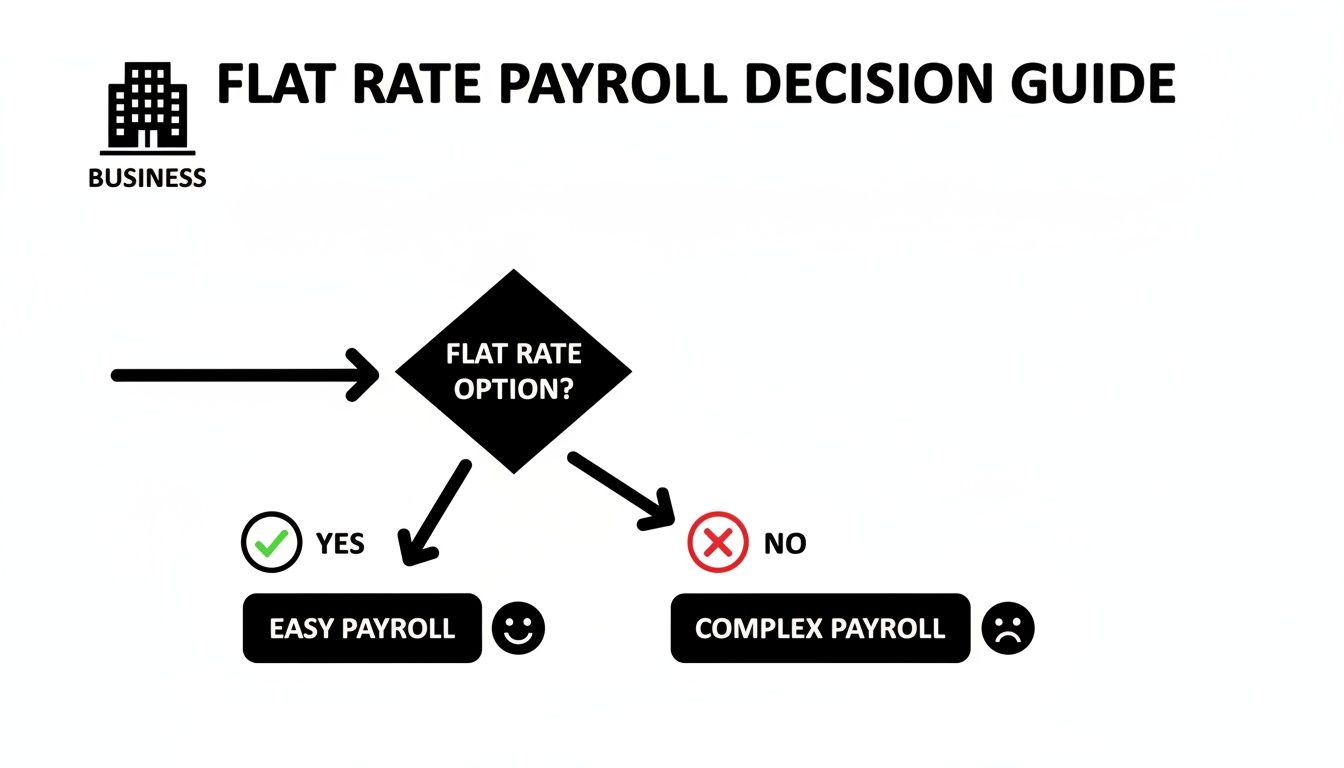
The path to straightforward payroll often starts with a single, consistent pay rate. Our complete teacher payroll tutoring business guide breaks down how these models work in the real world.
When should you use a flat pay rate model?
You should use a flat pay rate when simplicity and predictable costs are your absolute top priorities. This model is a powerful tool in your payroll toolkit, but it is not a one-size-fits-all solution.
Consider a new tutoring center just getting off the ground. A flat rate keeps your launch clean and simple if you focus on standardized subjects like middle school math or English. It also works well for larger centers running group classes where tutor prep is uniform.
However, a flat rate might not be competitive enough if your business model relies on attracting elite tutors for high-stakes subjects like MCAT prep. Top-tier talent expects compensation for their specialized expertise, and a uniform pay scale could make it tough to hire or retain them.
How can you implement a flat pay rate system?
To implement a flat pay rate system correctly and keep your team happy, you need a clear, methodical plan. Switching to this model is not something you do overnight.
Research market rates. First, you must research what other tutoring companies in your area are paying. This helps you land on a rate that’s competitive enough to attract great tutors but still makes sense for your bottom line.
Update tutor contracts. Once you settle on a rate, you need to get everything in writing. Your tutor contracts must clearly state the terms. Clarity here prevents a world of confusion and disputes down the road.
Set up your payroll process. With your rate and contracts sorted, it is time to tackle payroll. You will need to choose a pay schedule, handle tax forms, and ensure your system is efficient. This guide provides detailed guidance on setting up payroll for your small business.
Communicate with your team. Finally, you need to communicate the new pay structure to your tutors. Be completely transparent. Explain why you are making the change, how it works, and how it benefits them.
Automating Payroll to Save Time and Reduce Errors
Manual payroll is a huge headache for tutoring businesses. Chasing down timesheets, double-checking session logs, and entering numbers into a spreadsheet can easily become a part-time job. Manual data entry has an error rate as high as 4%, which can lead to costly payroll mistakes.
Software like Tutorbase takes that entire burden off your plate. When a tutor marks a lesson as complete, the system calculates their flat rate earnings instantly. This eliminates manual tracking and late-night data entry. Many centers explore automating data entry with OCR, RPA, and APIs to streamline their whole operation.
Automation does more than save a few hours each month; it eliminates costly human errors that creep in when you are overworked. Plus, Tutorbase is built to handle more than just simple flat rates. As you grow and add performance bonuses, the system grows with you.
If you are ready to ditch the spreadsheets for good, you can see all of Tutorbase’s tools for sessions and payroll management.
Why are legal and contractual details so important?
Getting your legal house in order protects you and your tutors down the road. When you introduce any new pay structure, you need to finalize the details in writing. This is not the most exciting part of building a business, but it is critical.
Your employment agreements or contractor contracts must spell out the flat pay rate, the exact pay schedule, and any conditions for extra compensation.
This is not just good practice; it is a must-do to stay compliant with local minimum wage laws and prevent disputes.
You also need to classify tutors correctly. A tutor's classification as an employee or an independent contractor changes your tax responsibilities and legal obligations.
Clear, legally sound contracts prevent messy disputes later and build professional relationships based on transparency. Check out our guide on tutoring contract template best practices to cover all essential legal bases.
Frequently Asked Questions (FAQ)
What is a flat pay rate?
A flat pay rate is a fixed compensation model where an employee or contractor receives the same amount of pay per hour or session, regardless of the task's complexity or the subject being taught. It simplifies payroll and makes labor costs predictable.
How do I determine a competitive flat rate for my tutors?
You can determine a competitive flat rate by researching local market rates for similar tutoring positions. Analyze job postings, check industry salary reports, and consider the experience level required for the role to set a rate that is both fair and sustainable for your business.
Can I offer bonuses with a flat rate system?
Yes, you can offer bonuses alongside a flat pay rate. Many businesses use performance-based bonuses for client retention, positive reviews, or student progress to incentivize tutors without complicating the base pay structure.
Is a flat rate better than a variable rate?
A flat rate is better for businesses that prioritize simplicity and predictable budgeting, especially those with standardized services. A variable rate is often better for businesses that need to attract highly specialized talent for diverse or advanced subjects.
How does a flat pay rate affect tutor motivation?
A flat pay rate can provide tutors with stable, predictable income, which can be motivating. However, it may not incentivize them to take on more challenging subjects. Combining a flat rate with non-monetary recognition or performance bonuses can help maintain high motivation.
What are the legal requirements for implementing a flat pay rate?
Legal requirements include ensuring the flat rate meets or exceeds federal, state, and local minimum wage laws. You must also clearly define the pay structure in a written contract and correctly classify tutors as either employees or independent contractors.
How can software help manage a flat pay rate system?
Software like Tutorbase automates the entire payroll process. It tracks completed sessions, calculates earnings based on the set flat rate, and generates accurate payroll reports, reducing administrative time by up to 80% and minimizing human error. Explore how Tutorbase can streamline your operations at tutorbase.com/register.
A Guide to Flat Pay Rate for Tutoring Centers
Published: January 5, 2026 by Amy Ashford


A flat pay rate offers tutoring centers a simple, predictable payroll model by paying tutors a fixed amount per session. While this simplifies budgeting and reduces administrative work, it may not be competitive enough to attract specialists for high-demand subjects. Automation tools can manage this model efficiently and scale as your business grows.
A flat pay rate is a simple payroll model where your tutors earn the same fixed amount for every session they teach. It does not matter if they teach algebra or advanced calculus, the pay is consistent.
This approach makes payroll a breeze and keeps your budget predictable, a huge plus for growing tutoring businesses. The trade-off is that it can sometimes make it tricky to attract or keep highly specialized tutors who know they can command a premium for their expertise.

What is a flat pay rate in tutoring?
A flat pay rate is a system where you pay your tutors a consistent, fixed amount for each hour or lesson they teach. This straightforward model creates a payroll system that’s predictable and incredibly easy to manage.
Under a flat-rate model, the pay stays the same whether a tutor teaches elementary reading or advanced calculus. According to a 2023 industry analysis, 62% of small tutoring businesses use a flat-rate model to reduce payroll complexity, a task that can consume over 10 hours weekly. You can find more industry trends at TutoringMavericks.com.
For many business owners, this simplicity is a game-changer. It transforms a potentially chaotic mess of calculations into a smooth, straightforward process. In 2026, this model is expected to remain popular for its efficiency.
How do different payroll models compare for tutors?
Choosing the right way to pay your tutors is a major decision. It affects not just your bottom line, but also tutor morale, administrative workload, and the financial predictability of your business month-to-month.
A flat pay rate is simple, but it is not your only option. You could use variable rates that change with a subject's difficulty, a revenue-sharing model where tutors get a percentage of the session fee, or even a tiered system that pays more to your top performers. Each one has its own vibe and impacts your business in different ways.
Payroll Model | Primary Benefit | Primary Drawback | Best For |
|---|---|---|---|
Flat Pay Rate | Simplicity & Predictability | Less competitive for specialists | New or standardized curriculum centers |
Variable Rate | Attracts expert tutors | Complex payroll calculations | Centers with diverse subject offerings |
Revenue Share | Motivates tutors to retain clients | Can lead to unpredictable costs | Established centers with high client volume |
This flowchart illustrates why many tutoring businesses lean into the flat-rate model: it cuts through the noise and simplifies payroll.

The path to straightforward payroll often starts with a single, consistent pay rate. Our complete teacher payroll tutoring business guide breaks down how these models work in the real world.
When should you use a flat pay rate model?
You should use a flat pay rate when simplicity and predictable costs are your absolute top priorities. This model is a powerful tool in your payroll toolkit, but it is not a one-size-fits-all solution.
Consider a new tutoring center just getting off the ground. A flat rate keeps your launch clean and simple if you focus on standardized subjects like middle school math or English. It also works well for larger centers running group classes where tutor prep is uniform.
However, a flat rate might not be competitive enough if your business model relies on attracting elite tutors for high-stakes subjects like MCAT prep. Top-tier talent expects compensation for their specialized expertise, and a uniform pay scale could make it tough to hire or retain them.
How can you implement a flat pay rate system?
To implement a flat pay rate system correctly and keep your team happy, you need a clear, methodical plan. Switching to this model is not something you do overnight.
Research market rates. First, you must research what other tutoring companies in your area are paying. This helps you land on a rate that’s competitive enough to attract great tutors but still makes sense for your bottom line.
Update tutor contracts. Once you settle on a rate, you need to get everything in writing. Your tutor contracts must clearly state the terms. Clarity here prevents a world of confusion and disputes down the road.
Set up your payroll process. With your rate and contracts sorted, it is time to tackle payroll. You will need to choose a pay schedule, handle tax forms, and ensure your system is efficient. This guide provides detailed guidance on setting up payroll for your small business.
Communicate with your team. Finally, you need to communicate the new pay structure to your tutors. Be completely transparent. Explain why you are making the change, how it works, and how it benefits them.
Automating Payroll to Save Time and Reduce Errors
Manual payroll is a huge headache for tutoring businesses. Chasing down timesheets, double-checking session logs, and entering numbers into a spreadsheet can easily become a part-time job. Manual data entry has an error rate as high as 4%, which can lead to costly payroll mistakes.
Software like Tutorbase takes that entire burden off your plate. When a tutor marks a lesson as complete, the system calculates their flat rate earnings instantly. This eliminates manual tracking and late-night data entry. Many centers explore automating data entry with OCR, RPA, and APIs to streamline their whole operation.
Automation does more than save a few hours each month; it eliminates costly human errors that creep in when you are overworked. Plus, Tutorbase is built to handle more than just simple flat rates. As you grow and add performance bonuses, the system grows with you.
If you are ready to ditch the spreadsheets for good, you can see all of Tutorbase’s tools for sessions and payroll management.
Why are legal and contractual details so important?
Getting your legal house in order protects you and your tutors down the road. When you introduce any new pay structure, you need to finalize the details in writing. This is not the most exciting part of building a business, but it is critical.
Your employment agreements or contractor contracts must spell out the flat pay rate, the exact pay schedule, and any conditions for extra compensation.
This is not just good practice; it is a must-do to stay compliant with local minimum wage laws and prevent disputes.
You also need to classify tutors correctly. A tutor's classification as an employee or an independent contractor changes your tax responsibilities and legal obligations.
Clear, legally sound contracts prevent messy disputes later and build professional relationships based on transparency. Check out our guide on tutoring contract template best practices to cover all essential legal bases.
Frequently Asked Questions (FAQ)
What is a flat pay rate?
A flat pay rate is a fixed compensation model where an employee or contractor receives the same amount of pay per hour or session, regardless of the task's complexity or the subject being taught. It simplifies payroll and makes labor costs predictable.
How do I determine a competitive flat rate for my tutors?
You can determine a competitive flat rate by researching local market rates for similar tutoring positions. Analyze job postings, check industry salary reports, and consider the experience level required for the role to set a rate that is both fair and sustainable for your business.
Can I offer bonuses with a flat rate system?
Yes, you can offer bonuses alongside a flat pay rate. Many businesses use performance-based bonuses for client retention, positive reviews, or student progress to incentivize tutors without complicating the base pay structure.
Is a flat rate better than a variable rate?
A flat rate is better for businesses that prioritize simplicity and predictable budgeting, especially those with standardized services. A variable rate is often better for businesses that need to attract highly specialized talent for diverse or advanced subjects.
How does a flat pay rate affect tutor motivation?
A flat pay rate can provide tutors with stable, predictable income, which can be motivating. However, it may not incentivize them to take on more challenging subjects. Combining a flat rate with non-monetary recognition or performance bonuses can help maintain high motivation.
What are the legal requirements for implementing a flat pay rate?
Legal requirements include ensuring the flat rate meets or exceeds federal, state, and local minimum wage laws. You must also clearly define the pay structure in a written contract and correctly classify tutors as either employees or independent contractors.
How can software help manage a flat pay rate system?
Software like Tutorbase automates the entire payroll process. It tracks completed sessions, calculates earnings based on the set flat rate, and generates accurate payroll reports, reducing administrative time by up to 80% and minimizing human error. Explore how Tutorbase can streamline your operations at tutorbase.com/register.
More from the Blog

Best Tutoring Management Software 2026
Read Article
Read Article

Best Tutoring Management Software 2026
Read Article
Read Article

12 Best Software for Scheduling Classes in 2026
Read Article
Read Article

12 Best Software for Scheduling Classes in 2026
Read Article
Read Article

A Guide to Fixing Google Calendar Sync Errors for Good
Read Article
Read Article

A Guide to Fixing Google Calendar Sync Errors for Good
Read Article
Read Article


