
How to Write a Tutor Position Description That Attracts Top Educators
Published: January 5, 2026 by Amy Ashford


A great tutor position description is a recruitment tool. It must clearly outline responsibilities, qualifications, and compensation to attract skilled educators. By optimizing for clarity and impact, you reduce time spent on mismatched applications and build a stronger team from the start.
What is a Tutor Position Description?
A tutor position description is a formal document that outlines the responsibilities, qualifications, and expectations for a tutoring role. It serves as the primary tool for attracting and filtering candidates. Think of it as your first sales pitch to the best educators out there.
It’s your chance to communicate your mission. You show candidates what success looks like in the role and you are upfront about compensation. Getting this right helps attract dedicated tutors who believe in what you're doing and makes your hiring process more effective.
Why is a good job description so important in 2026?
A generic tutor position description attracts generic applicants. To find truly passionate educators, your post must tell a story about your center's mission. A compelling summary pulls people in, showing them the impact they can make, not just the tasks they'll perform.
This is more important than ever. The private tutoring market is booming, valued between $70.4 billion and $131.04 billion and projected to rocket past $171.3 billion. The best tutors have their pick of opportunities. To learn more, read the full research about the private tutoring market to understand the competitive landscape.
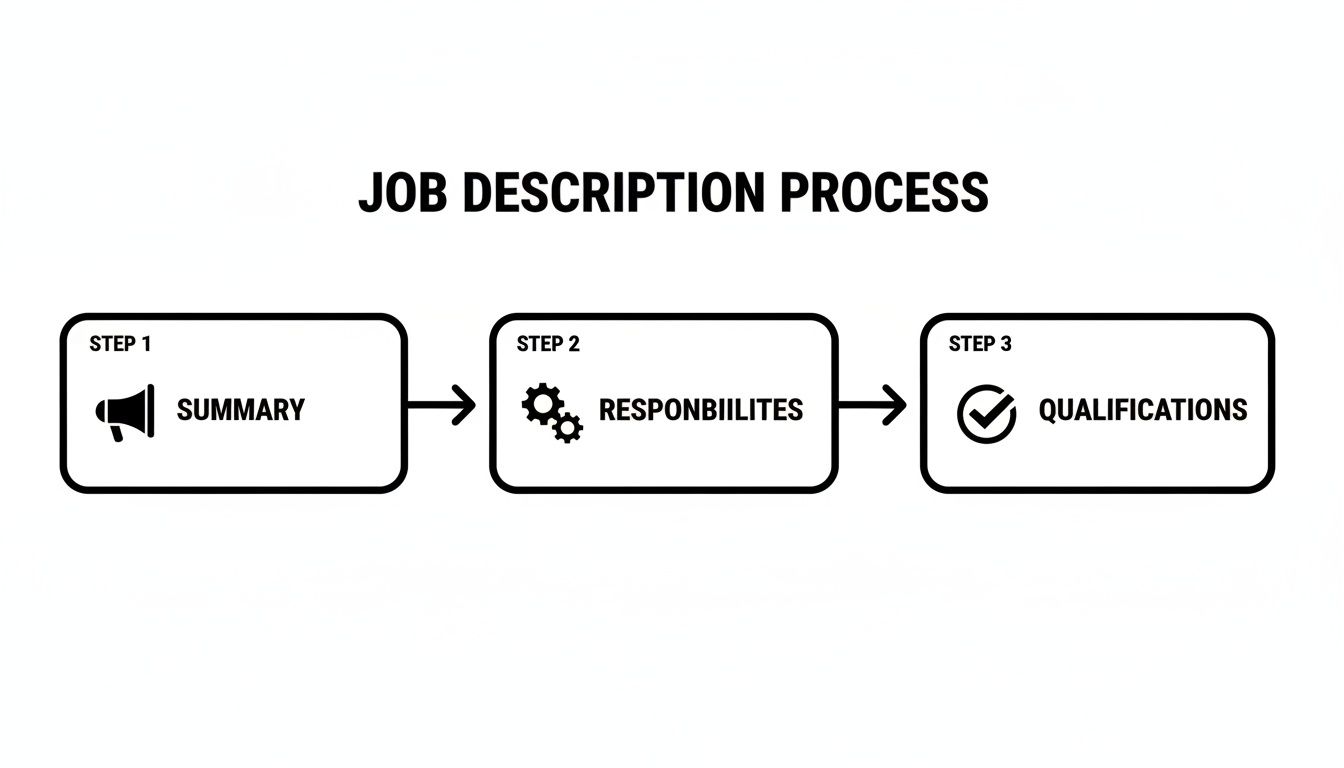
This simple structure ensures candidates immediately understand the role, its purpose, and whether they are the right fit.
The Essential Components of a Tutor Job Description
Every great job description is built on a few non-negotiable sections. Nailing these fundamentals ensures you are not just listing a job, but marketing an opportunity. This table breaks down what each section does and gives you a quick example.
Section | What It Achieves | Example Snippet |
|---|---|---|
Job Title | Grabs attention and sets clear expectations. | Lead SAT/ACT Math and Science Tutor |
Summary | Sells the "why", your mission and culture. | Join a team dedicated to closing learning gaps and empowering students to achieve their full academic potential. |
Responsibilities | Frames duties around impact, not just tasks. | Mentor students in 1:1 settings to build confidence and mastery in Algebra, Geometry, and Calculus. |
Qualifications | Filters for must-have skills vs. nice-to-haves. | Required: Bachelor's degree in a STEM field. Preferred: 1+ year of online tutoring experience. |
Pay & Benefits | Provides transparency and attracts serious candidates. | Competitive hourly rate of $25-$35, based on experience, plus performance-based bonuses. |
About Us | Reinforces your brand and what makes you unique. | For over 10 years, [Your Center Name] has helped over 2,000 students in our community succeed. |
By making sure each of these components is thoughtfully written, you create a description that is both informative and compelling.
How do I frame responsibilities with impact?
Write about responsibilities using active, results-focused language. Instead of a passive list of chores, show candidates the impact they will have. This reframes the role from a task-doer to a genuine educator, which is far more appealing to people who are serious about teaching.
It also sets crystal-clear expectations from day one.
Instead of: "Assist students with homework."
Try: "Guide students to achieve a 15% average grade improvement through targeted homework support and concept reinforcement."
Instead of: "Track student attendance."
Try: "Maintain accurate records of student progress and attendance to inform instructional adjustments and communicate effectively with parents."
Should I differentiate between "Must-Haves" and "Nice-to-Haves"?
Yes, clearly separating your essential qualifications from preferred ones widens your talent pool. It is tempting to list every desired skill as a "requirement," but that scares off great candidates who might be missing just one thing on your wish list.
For instance, a degree in the subject matter might be non-negotiable. However, prior experience with a niche curriculum could be a bonus. This distinction respects everyone's time, yours and the applicants', and prevents you from missing a fantastic candidate with 90% of what you need.
Here is how that might look in practice:
Required: Bachelor’s degree in Mathematics or a related field.
Required: Minimum of two years of experience tutoring high school-level algebra and calculus.
Preferred: Experience with SAT/ACT test preparation methodologies.
Preferred: Familiarity with online teaching platforms like Zoom or Google Classroom.
Optimizing Your Post for Modern Hiring Platforms

The most perfectly written job description is useless if the right people never see it. Today’s tutors search on Indeed, LinkedIn, and education-specific job boards. Your post must catch the eye of a talented educator and play nice with platform algorithms.
Put yourself in a candidate's shoes. A top-tier math tutor searches for specific phrases like “SAT math tutor” or “online algebra tutor.” Weaving these kinds of keywords into your description is essential for visibility.
How can I make my post ATS-Friendly?
An Applicant Tracking System (ATS) is software that scans resumes and job descriptions for keywords, filtering candidates before a human gets involved. A staggering 99% of Fortune 500 companies use an ATS. If your job description is formatted in a way the ATS cannot read, it might get rejected.
Making your post ATS-friendly is simple. Just stick to these rules:
Use Standard Headings: Stick to clear, universally understood titles like "Responsibilities" and "Qualifications."
Choose Simple Bullet Points: List duties and requirements using standard round or square bullets.
Avoid Special Characters: Stick to standard text and punctuation. Funky fonts or emojis can cause errors.
These small tweaks make a massive difference in getting your post seen by more qualified people.
Matching Keywords to Candidate Searches
The words you choose are your most powerful tool. Phrasing your requirements to match what a great tutor would actually search for is how you win the visibility game. Think about the language an experienced educator uses to describe their own skills.
For example, instead of a vague requirement like "subject matter expertise," get specific. A tutor with a Ph.D. in Physics is not searching for a generic job. They are looking for an “AP Physics tutor” role.
Mastering these modern candidate sourcing strategies is critical for cutting through the noise. It is about being proactive, not just posting and praying.
How to Differentiate One-on-One vs. Group Instructor Roles?
A one-size-fits-all job description does not work for tutors. The skills for an SAT prep coach are completely different from those needed for an ESL tutor. Your job post has to reflect that.
When hiring for a one-on-one role, focus on personalization and rapport. These tutors are mentors who tailor their approach to a single student's learning style. Your language needs to highlight that intimate, customized dynamic. Use phrases like “developing personalized learning plans.”
For a group instructor, you need someone who can command a room and manage different personalities. The key skills shift toward classroom management and differentiated instruction. You will want to emphasize “leading dynamic classroom engagement.”
Tailoring Descriptions for Specialized Subjects
Specialist tutors look for roles that recognize their unique skill sets. An ESL tutor is more than a grammar expert; they are often a cultural guide. A test prep tutor is a strategist with deep content mastery for high-stakes exams.
For an ESL Tutor: Use phrases like “fostering a supportive, immersive language environment” and “assessing language proficiency using CEFR standards.”
For a Test Prep Tutor: Focus on results. Highlight qualifications like a “proven track record of improving student scores by an average of 150 points on the SAT” and “expertise in test-taking strategies.”
What About Online Tutoring Roles?
The demand for virtual educators has exploded. Online tutoring is the fastest-growing part of the education market, valued at over $10 billion and projected to climb to nearly $24 billion by 2028 with a 14.5% annual growth rate. You can discover more insights about the online tutoring market on Grandview Research.
For an online tutor, you must specify the tech and communication skills required.
Technical Proficiency: State the required familiarity with platforms like Zoom, Google Classroom, or any specific learning management system (LMS).
Digital Engagement: Look for candidates who can “create engaging virtual learning experiences” and “utilize digital whiteboards effectively.”
Communication: Strong written communication is vital for providing feedback and talking to parents through email.
Clearly defining requirements for different settings, including the many available jobs for home tutors, helps you attract candidates who are a great fit.
Keywords and Skills for Specialized Tutor Roles
This table breaks down the essential skills and ATS-friendly keywords to use when crafting job descriptions for different types of tutors.
Tutor Role | Key Skills to Emphasize | ATS-Friendly Keywords |
|---|---|---|
One-on-One Tutor | Rapport building, personalized instruction, adaptability, student motivation, goal setting |
|
Group Instructor | Classroom management, differentiated instruction, public speaking, group dynamics, engagement strategies |
|
ESL Tutor | Cross-cultural communication, language proficiency assessment (CEFR/IELTS), patience, immersion techniques |
|
Test Prep Tutor | Content mastery (SAT/ACT/GRE), test-taking strategies, score improvement tracking, time management |
|
Online Tutor | Digital literacy, virtual engagement tools (whiteboards, polls), strong written communication, tech troubleshooting |
|
Lead Tutor | Mentorship, curriculum development, quality assurance, training, team leadership, parent communication |
|
Using these specific terms helps your job post rank higher in searches and acts as a filter, attracting candidates with the exact experience you need.
Getting Real About Compensation and Benefits
Being vague about pay is one of the fastest ways to lose a great candidate. A clear, upfront discussion about compensation in your job description is a non-negotiable for attracting serious professionals and building trust.
This is especially true in today's market. As the tutoring market expands by a 10% CAGR, competition for top talent is fierce. Offering premium pay for high-demand subjects like STEM and test prep has become standard. You can dig into the latest tutoring market findings on Research and Markets to see the trends for yourself.
How should I break down pay models?
Candidates need to know exactly how they will get paid. Different models work for different roles, so your description must spell out which one applies. This helps applicants know if the role is a financial fit before they apply.
Hourly Rate: This is the most common model. Be specific with the range, like "$25-$35 per hour, commensurate with experience."
Salaried Position: This is usually for full-time or lead tutors and offers a stable income. State the annual salary clearly.
Performance Bonuses: If you offer incentives, define them. Mention things like bonuses for student retention or test score improvements.
Transparent pay structures show you respect a candidate's time and skill.
What's the difference between a W-2 and a 1099 tutor?
You must clearly state the employment type, as it has massive tax and benefit implications. A W-2 employee is on your company’s payroll, meaning you withhold taxes from their paycheck. A 1099 contractor is an independent business owner responsible for handling their own taxes.
This distinction impacts everything from scheduling flexibility to eligibility for benefits. Being direct prevents surprises and ensures you attract candidates who are comfortable with the arrangement. Our tutoring rates pricing guide can help you set competitive compensation for either model.
Your job description needs to be explicit. Just add a simple sentence like: "This is a part-time W-2 employee position" or "We are seeking an independent 1099 contractor for this role."
That single line clarifies the legal and financial setup from day one.
From Application to First Day: The Hiring Experience
A great tutor position description gets people in the door, but what happens next convinces them to stay. The journey from application to training tells a story about your tutoring center. A professional, organized process shows applicants you are a supportive, well-run organization.
This journey starts when applications begin rolling in. You need an efficient way to screen résumés to quickly spot qualified candidates. A great starting point is to familiarize yourself with a solid guide to the pre-employment screening process.
Crafting Interview Questions That Reveal Teaching Talent
Once you have narrowed down your list, the interview is where you dig deeper than the résumé. You need questions that get to the heart of their teaching philosophy, adaptability, and problem-solving skills.
Here are a few examples to get you started:
To see their teaching style: "Tell me about a time you had to change your approach for a student. What did you do, and what was the result?"
To gauge how they handle challenges: "Imagine you have a consistently unmotivated student. What steps would you take to re-engage them?"
To check for a culture fit: "What is the single most important quality a tutor can have? How do you demonstrate that in your work?"
Designing an Onboarding Process for Success
A smooth hiring process should flow into a structured, welcoming onboarding experience. New hires are 58% more likely to still be with a company after three years if they went through a structured onboarding program. The point is to equip your new tutors to be effective from day one.
Your onboarding should cover everything from your curriculum and teaching methods to the software you use. A thorough process ensures every new team member is aligned with your standards.
For a deeper dive into hiring strategies, from sourcing to screening, check out our complete playbook on how to hire tutors.
FAQ: Answering Your Top Questions About Writing a Tutor Position Description
How much salary information should I include in a job description?
You should always include a pay range in a job description. Vague phrases like "competitive pay" can be a red flag for candidates. A specific range, like “$25-$35 per hour, based on experience,” filters out misaligned applicants and shows you are a transparent employer, which builds trust.
Should I list specific software skills as a requirement?
Yes, you should list specific software skills, especially if the role is online or hybrid. Being upfront about the tech your team uses helps attract candidates who can start with minimal technical training. For example, state "Proficiency with Zoom and Google Classroom required."
How do I describe the ideal candidate’s personality?
You should focus on observable behaviors and skills instead of listing personality traits like "friendly" or "patient." Describe what a great candidate does. For example, instead of asking for a 'patient' person, describe the need for someone who can "skillfully re-explain complex concepts using multiple approaches."
How should I handle remote vs. in-person details?
You must be crystal clear about the work location from the start, ideally in the job title or summary. State plainly whether a role is fully remote, hybrid, or requires on-site presence. For instance, a job title could be "Remote SAT Math Tutor (East Coast Hours)."
What is the most important part of a tutor job description?
The most important part of a tutor job description is clarity across all sections. This includes a clear job title, a compelling summary of the role's impact, specific responsibilities, distinct qualifications (must-haves vs. nice-to-haves), and a transparent compensation range. Each element works together to attract the right talent.
Ready to streamline your scheduling, billing, and payroll? Tutorbase eliminates hours of weekly admin so you can focus on what matters most: your students and teachers. See how our all-in-one platform can help you grow your tutoring center at tutorbase.com/register
How to Write a Tutor Position Description That Attracts Top Educators
Published: January 3, 2026 by Amy Ashford


A great tutor position description is a recruitment tool. It must clearly outline responsibilities, qualifications, and compensation to attract skilled educators. By optimizing for clarity and impact, you reduce time spent on mismatched applications and build a stronger team from the start.
What is a Tutor Position Description?
A tutor position description is a formal document that outlines the responsibilities, qualifications, and expectations for a tutoring role. It serves as the primary tool for attracting and filtering candidates. Think of it as your first sales pitch to the best educators out there.
It’s your chance to communicate your mission. You show candidates what success looks like in the role and you are upfront about compensation. Getting this right helps attract dedicated tutors who believe in what you're doing and makes your hiring process more effective.
Why is a good job description so important in 2026?
A generic tutor position description attracts generic applicants. To find truly passionate educators, your post must tell a story about your center's mission. A compelling summary pulls people in, showing them the impact they can make, not just the tasks they'll perform.
This is more important than ever. The private tutoring market is booming, valued between $70.4 billion and $131.04 billion and projected to rocket past $171.3 billion. The best tutors have their pick of opportunities. To learn more, read the full research about the private tutoring market to understand the competitive landscape.

This simple structure ensures candidates immediately understand the role, its purpose, and whether they are the right fit.
The Essential Components of a Tutor Job Description
Every great job description is built on a few non-negotiable sections. Nailing these fundamentals ensures you are not just listing a job, but marketing an opportunity. This table breaks down what each section does and gives you a quick example.
Section | What It Achieves | Example Snippet |
|---|---|---|
Job Title | Grabs attention and sets clear expectations. | Lead SAT/ACT Math and Science Tutor |
Summary | Sells the "why", your mission and culture. | Join a team dedicated to closing learning gaps and empowering students to achieve their full academic potential. |
Responsibilities | Frames duties around impact, not just tasks. | Mentor students in 1:1 settings to build confidence and mastery in Algebra, Geometry, and Calculus. |
Qualifications | Filters for must-have skills vs. nice-to-haves. | Required: Bachelor's degree in a STEM field. Preferred: 1+ year of online tutoring experience. |
Pay & Benefits | Provides transparency and attracts serious candidates. | Competitive hourly rate of $25-$35, based on experience, plus performance-based bonuses. |
About Us | Reinforces your brand and what makes you unique. | For over 10 years, [Your Center Name] has helped over 2,000 students in our community succeed. |
By making sure each of these components is thoughtfully written, you create a description that is both informative and compelling.
How do I frame responsibilities with impact?
Write about responsibilities using active, results-focused language. Instead of a passive list of chores, show candidates the impact they will have. This reframes the role from a task-doer to a genuine educator, which is far more appealing to people who are serious about teaching.
It also sets crystal-clear expectations from day one.
Instead of: "Assist students with homework."
Try: "Guide students to achieve a 15% average grade improvement through targeted homework support and concept reinforcement."
Instead of: "Track student attendance."
Try: "Maintain accurate records of student progress and attendance to inform instructional adjustments and communicate effectively with parents."
Should I differentiate between "Must-Haves" and "Nice-to-Haves"?
Yes, clearly separating your essential qualifications from preferred ones widens your talent pool. It is tempting to list every desired skill as a "requirement," but that scares off great candidates who might be missing just one thing on your wish list.
For instance, a degree in the subject matter might be non-negotiable. However, prior experience with a niche curriculum could be a bonus. This distinction respects everyone's time, yours and the applicants', and prevents you from missing a fantastic candidate with 90% of what you need.
Here is how that might look in practice:
Required: Bachelor’s degree in Mathematics or a related field.
Required: Minimum of two years of experience tutoring high school-level algebra and calculus.
Preferred: Experience with SAT/ACT test preparation methodologies.
Preferred: Familiarity with online teaching platforms like Zoom or Google Classroom.
Optimizing Your Post for Modern Hiring Platforms

The most perfectly written job description is useless if the right people never see it. Today’s tutors search on Indeed, LinkedIn, and education-specific job boards. Your post must catch the eye of a talented educator and play nice with platform algorithms.
Put yourself in a candidate's shoes. A top-tier math tutor searches for specific phrases like “SAT math tutor” or “online algebra tutor.” Weaving these kinds of keywords into your description is essential for visibility.
How can I make my post ATS-Friendly?
An Applicant Tracking System (ATS) is software that scans resumes and job descriptions for keywords, filtering candidates before a human gets involved. A staggering 99% of Fortune 500 companies use an ATS. If your job description is formatted in a way the ATS cannot read, it might get rejected.
Making your post ATS-friendly is simple. Just stick to these rules:
Use Standard Headings: Stick to clear, universally understood titles like "Responsibilities" and "Qualifications."
Choose Simple Bullet Points: List duties and requirements using standard round or square bullets.
Avoid Special Characters: Stick to standard text and punctuation. Funky fonts or emojis can cause errors.
These small tweaks make a massive difference in getting your post seen by more qualified people.
Matching Keywords to Candidate Searches
The words you choose are your most powerful tool. Phrasing your requirements to match what a great tutor would actually search for is how you win the visibility game. Think about the language an experienced educator uses to describe their own skills.
For example, instead of a vague requirement like "subject matter expertise," get specific. A tutor with a Ph.D. in Physics is not searching for a generic job. They are looking for an “AP Physics tutor” role.
Mastering these modern candidate sourcing strategies is critical for cutting through the noise. It is about being proactive, not just posting and praying.
How to Differentiate One-on-One vs. Group Instructor Roles?
A one-size-fits-all job description does not work for tutors. The skills for an SAT prep coach are completely different from those needed for an ESL tutor. Your job post has to reflect that.
When hiring for a one-on-one role, focus on personalization and rapport. These tutors are mentors who tailor their approach to a single student's learning style. Your language needs to highlight that intimate, customized dynamic. Use phrases like “developing personalized learning plans.”
For a group instructor, you need someone who can command a room and manage different personalities. The key skills shift toward classroom management and differentiated instruction. You will want to emphasize “leading dynamic classroom engagement.”
Tailoring Descriptions for Specialized Subjects
Specialist tutors look for roles that recognize their unique skill sets. An ESL tutor is more than a grammar expert; they are often a cultural guide. A test prep tutor is a strategist with deep content mastery for high-stakes exams.
For an ESL Tutor: Use phrases like “fostering a supportive, immersive language environment” and “assessing language proficiency using CEFR standards.”
For a Test Prep Tutor: Focus on results. Highlight qualifications like a “proven track record of improving student scores by an average of 150 points on the SAT” and “expertise in test-taking strategies.”
What About Online Tutoring Roles?
The demand for virtual educators has exploded. Online tutoring is the fastest-growing part of the education market, valued at over $10 billion and projected to climb to nearly $24 billion by 2028 with a 14.5% annual growth rate. You can discover more insights about the online tutoring market on Grandview Research.
For an online tutor, you must specify the tech and communication skills required.
Technical Proficiency: State the required familiarity with platforms like Zoom, Google Classroom, or any specific learning management system (LMS).
Digital Engagement: Look for candidates who can “create engaging virtual learning experiences” and “utilize digital whiteboards effectively.”
Communication: Strong written communication is vital for providing feedback and talking to parents through email.
Clearly defining requirements for different settings, including the many available jobs for home tutors, helps you attract candidates who are a great fit.
Keywords and Skills for Specialized Tutor Roles
This table breaks down the essential skills and ATS-friendly keywords to use when crafting job descriptions for different types of tutors.
Tutor Role | Key Skills to Emphasize | ATS-Friendly Keywords |
|---|---|---|
One-on-One Tutor | Rapport building, personalized instruction, adaptability, student motivation, goal setting |
|
Group Instructor | Classroom management, differentiated instruction, public speaking, group dynamics, engagement strategies |
|
ESL Tutor | Cross-cultural communication, language proficiency assessment (CEFR/IELTS), patience, immersion techniques |
|
Test Prep Tutor | Content mastery (SAT/ACT/GRE), test-taking strategies, score improvement tracking, time management |
|
Online Tutor | Digital literacy, virtual engagement tools (whiteboards, polls), strong written communication, tech troubleshooting |
|
Lead Tutor | Mentorship, curriculum development, quality assurance, training, team leadership, parent communication |
|
Using these specific terms helps your job post rank higher in searches and acts as a filter, attracting candidates with the exact experience you need.
Getting Real About Compensation and Benefits
Being vague about pay is one of the fastest ways to lose a great candidate. A clear, upfront discussion about compensation in your job description is a non-negotiable for attracting serious professionals and building trust.
This is especially true in today's market. As the tutoring market expands by a 10% CAGR, competition for top talent is fierce. Offering premium pay for high-demand subjects like STEM and test prep has become standard. You can dig into the latest tutoring market findings on Research and Markets to see the trends for yourself.
How should I break down pay models?
Candidates need to know exactly how they will get paid. Different models work for different roles, so your description must spell out which one applies. This helps applicants know if the role is a financial fit before they apply.
Hourly Rate: This is the most common model. Be specific with the range, like "$25-$35 per hour, commensurate with experience."
Salaried Position: This is usually for full-time or lead tutors and offers a stable income. State the annual salary clearly.
Performance Bonuses: If you offer incentives, define them. Mention things like bonuses for student retention or test score improvements.
Transparent pay structures show you respect a candidate's time and skill.
What's the difference between a W-2 and a 1099 tutor?
You must clearly state the employment type, as it has massive tax and benefit implications. A W-2 employee is on your company’s payroll, meaning you withhold taxes from their paycheck. A 1099 contractor is an independent business owner responsible for handling their own taxes.
This distinction impacts everything from scheduling flexibility to eligibility for benefits. Being direct prevents surprises and ensures you attract candidates who are comfortable with the arrangement. Our tutoring rates pricing guide can help you set competitive compensation for either model.
Your job description needs to be explicit. Just add a simple sentence like: "This is a part-time W-2 employee position" or "We are seeking an independent 1099 contractor for this role."
That single line clarifies the legal and financial setup from day one.
From Application to First Day: The Hiring Experience
A great tutor position description gets people in the door, but what happens next convinces them to stay. The journey from application to training tells a story about your tutoring center. A professional, organized process shows applicants you are a supportive, well-run organization.
This journey starts when applications begin rolling in. You need an efficient way to screen résumés to quickly spot qualified candidates. A great starting point is to familiarize yourself with a solid guide to the pre-employment screening process.
Crafting Interview Questions That Reveal Teaching Talent
Once you have narrowed down your list, the interview is where you dig deeper than the résumé. You need questions that get to the heart of their teaching philosophy, adaptability, and problem-solving skills.
Here are a few examples to get you started:
To see their teaching style: "Tell me about a time you had to change your approach for a student. What did you do, and what was the result?"
To gauge how they handle challenges: "Imagine you have a consistently unmotivated student. What steps would you take to re-engage them?"
To check for a culture fit: "What is the single most important quality a tutor can have? How do you demonstrate that in your work?"
Designing an Onboarding Process for Success
A smooth hiring process should flow into a structured, welcoming onboarding experience. New hires are 58% more likely to still be with a company after three years if they went through a structured onboarding program. The point is to equip your new tutors to be effective from day one.
Your onboarding should cover everything from your curriculum and teaching methods to the software you use. A thorough process ensures every new team member is aligned with your standards.
For a deeper dive into hiring strategies, from sourcing to screening, check out our complete playbook on how to hire tutors.
FAQ: Answering Your Top Questions About Writing a Tutor Position Description
How much salary information should I include in a job description?
You should always include a pay range in a job description. Vague phrases like "competitive pay" can be a red flag for candidates. A specific range, like “$25-$35 per hour, based on experience,” filters out misaligned applicants and shows you are a transparent employer, which builds trust.
Should I list specific software skills as a requirement?
Yes, you should list specific software skills, especially if the role is online or hybrid. Being upfront about the tech your team uses helps attract candidates who can start with minimal technical training. For example, state "Proficiency with Zoom and Google Classroom required."
How do I describe the ideal candidate’s personality?
You should focus on observable behaviors and skills instead of listing personality traits like "friendly" or "patient." Describe what a great candidate does. For example, instead of asking for a 'patient' person, describe the need for someone who can "skillfully re-explain complex concepts using multiple approaches."
How should I handle remote vs. in-person details?
You must be crystal clear about the work location from the start, ideally in the job title or summary. State plainly whether a role is fully remote, hybrid, or requires on-site presence. For instance, a job title could be "Remote SAT Math Tutor (East Coast Hours)."
What is the most important part of a tutor job description?
The most important part of a tutor job description is clarity across all sections. This includes a clear job title, a compelling summary of the role's impact, specific responsibilities, distinct qualifications (must-haves vs. nice-to-haves), and a transparent compensation range. Each element works together to attract the right talent.
Ready to streamline your scheduling, billing, and payroll? Tutorbase eliminates hours of weekly admin so you can focus on what matters most: your students and teachers. See how our all-in-one platform can help you grow your tutoring center at tutorbase.com/register
More from the Blog

January 3, 2026
A Guide to Fixing Google Calendar Sync Errors for Good
Read Article
Read Article

January 3, 2026
A Guide to Fixing Google Calendar Sync Errors for Good
Read Article
Read Article

January 3, 2026
How to Write a Tutor Position Description That Attracts Top Educators
Read Article
Read Article

January 3, 2026
How to Write a Tutor Position Description That Attracts Top Educators
Read Article
Read Article

January 4, 2026
How a Parent Portal for Tutoring Can Transform Your Center
Read Article
Read Article

January 4, 2026
How a Parent Portal for Tutoring Can Transform Your Center
Read Article
Read Article


