
The Essential Tutoring Contract Template For Your Business
Published: December 9, 2025 by Amy Ashford

A strong tutoring contract template is your blueprint for success. It establishes clear expectations with clients, prevents disputes over payments and cancellations, and builds a professional foundation from day one. Using a formal agreement signals you run a serious, trustworthy business.
Why is a Strong Tutoring Contract Essential?
A tutoring contract is the official roadmap for your client relationships. It details everything from payment schedules to cancellation policies. This clarity reduces confusion and potential conflict. When everyone understands their responsibilities, you build trust and respect.

Operating without a formal agreement exposes your business to common issues. Imagine clients constantly canceling last-minute or questioning payment terms. A contract provides a pre-agreed framework for these situations. It saves you significant time and stress.
Prevent Common Business Headaches
A well-crafted contract is your defense against operational problems. It provides a clear path for several key issues. This turns potential disputes into simple procedural matters.
With a contract, you can proactively handle:
Late or Missed Payments: Your contract will outline due dates, accepted payment methods, and any penalties for late payments. This removes ambiguity and simplifies invoice collection.
Last-Minute Cancellations: This is a major concern for tutors. Clearly define your cancellation policy. State that you require 24 hours' notice and specify fees for late cancellations.
Scope Creep: Outline exactly what services you provide, including subjects, session length, and frequency. This prevents clients from expecting extra services not covered in the original agreement.
Disagreements on Responsibilities: The contract defines the obligations for both the tutor and the client. This ensures everyone is on the same page about their role in the student's success.
How to Build Professionalism and Trust
Handing a new client a professional contract demonstrates that you take your work seriously. It communicates that you are organized and committed to delivering high-quality service. This act instantly sets you apart from less formal tutors and builds immediate confidence.
A tutoring contract is a mark of professionalism. It proves you run a legitimate business and are dedicated to a structured, effective learning environment.
The global private tutoring market reached a value of $97.11 billion in 2023 and is growing rapidly. This growth means more competition. Formalizing your operations with a contract is crucial to stand out and manage clients professionally. You can learn more about the scale of the global tutoring market and its growth.
Download Your Free Tutoring Contract Template
Why start from scratch? A solid tutoring contract template provides a professional, legally-sound foundation. Think of it as a blueprint covering all critical areas. It saves you the headache of drafting a complex document from zero.
We created a comprehensive, easy-to-use template to get you started quickly. Just choose the format that works best for you:
Download as a Word Document: Perfect for easy editing on your desktop.
Download as a PDF: A print-ready version for those who prefer signing in person.
Access as a Google Doc: Ideal for collaborating and customizing in the cloud.
What Is Included In The Template?
Our template is not a bare-bones, generic document. We packed it with essential sections for a robust agreement that protects everyone involved. It serves as your starting point.
You will find clearly defined clauses for:
Client and Student Information
Scope of Tutoring Services
Tutor and Client Responsibilities
Payment Terms and Schedule
Cancellation and Rescheduling Policies
Termination Clause
In the following sections, we will guide you on how to customize each part. As you refine your own contract, examples like these business process documentation templates can offer structural ideas. This template is designed to grow with your business.
How to Customize Your Tutoring Contract Clause By Clause
A template is a great starting point, but not the finish line. An effective contract is tailored to how your business actually operates. It transforms a generic document into a powerful tool that protects you and sets clear expectations.
Getting this right means digging into the details of each clause. You must ensure it fits your specific services, pricing, and policies. Let's walk through that process.

Before customizing, you need to understand the big picture. Here are the non-negotiable sections every tutoring agreement needs.
Essential Clauses For Your Tutoring Contract
Clause | Purpose | Key Customization Points |
|---|---|---|
Scope of Services | Clearly defines what you will (and will not) do, preventing scope creep. | Subjects, session length/frequency, location (online/in-person), and excluded services. |
Payment Terms | Outlines rates, billing cycles, and consequences for late payments. | Session/package rates, invoice dates, due dates, accepted payment methods, and late fees. |
Cancellation Policy | Protects your time and income from last-minute cancellations. | Required notice period (e.g., 24 hours), fees for late cancellations, and your policy for tutor cancellations. |
Confidentiality | Reassures clients that student information will be kept private. | Specify what data you collect, how it's stored, and who has access. |
Limitation of Liability | Defines the boundaries of your legal responsibility. | Clarify you don't guarantee specific grades or test scores, but commit to professional service. |
Termination | Provides a clear, professional process for ending the agreement. | Notice period required from the client, grounds for termination by the center, and final payment procedures. |
Now, let's break down how to customize each of these for your unique business.
Defining The Scope Of Services
This is where most disputes begin. A vague service description invites scope creep, which is when a client requests services beyond the agreed-upon scope. You need to be ruthlessly specific here to prevent misunderstandings.
Your goal is to leave zero room for interpretation. Think of this clause as the official rulebook for the relationship.
For instance, your clause should detail:
Subjects Covered: Be precise. Instead of "Math," write "Algebra II" or "AP Calculus BC."
Session Structure: Specify the length (e.g., 60-minute sessions), frequency ("twice weekly"), and format ("one-on-one" or "group class of up to 5 students").
Location: State exactly where sessions happen: "in-person at our 123 Main St. center" or "conducted online via Zoom."
Excluded Services: This is just as important. Add a line like, "This agreement does not include college application essay review or communication with the student's school teachers."
How To Outline Payment Terms And Rates
Nothing creates awkwardness faster than confusion about money. This clause must spell out your fee structure, payment schedule, and accepted methods. Ambiguity here is a direct path to late payments and chasing invoices.
Be direct and make it easy to understand. Your payment clause is the tool you will use to ensure consistent cash flow.
Key details to include are:
Rates: State the exact cost, like "$75 per one-hour session" or "$500 for a package of 8 sessions."
Billing Cycle: Define when invoices are sent and payments are due (e.g., "Invoices are sent on the 1st of each month and are due by the 5th").
Accepted Payment Methods: List them all, such as credit cards via Stripe, bank transfer, or cash.
Late Fees: Specify penalties for overdue payments. For example, "A late fee of $25 will be applied to any invoice more than 7 days overdue."
Setting the right price is the foundation of this clause. If you are still figuring that out, you can check out our guide on setting tutoring rates.
What Should A Cancellation Policy Include?
A firm but fair cancellation policy is non-negotiable. It protects your tutors' time and your income. Without it, you will lose revenue from last-minute changes that leave you with empty, unpaid slots.
This clause sets a professional boundary from day one. You need to communicate it clearly and enforce it consistently.
A strong policy should specify:
Notice Period: The minimum time required for a penalty-free cancellation, such as "24-hour advance written notice is required to cancel or reschedule a session."
Cancellation Fee: The consequence for missing that window. For example, "Cancellations made with less than 24 hours' notice will be charged the full session fee."
Tutor Cancellations: What happens if one of your tutors has to cancel? Outline the procedure, like, "If the tutor cancels a session, a make-up session will be scheduled at no additional cost to the client."
Establishing Confidentiality And Liability
Protecting student information and your business's legal standing is paramount. The confidentiality clause builds trust by reassuring clients their data is safe. The limitation of liability clause defines the scope of your professional responsibility.
These clauses are not just legal jargon. They signal professionalism and manage risk.
A Limitation of Liability clause clarifies that you cannot guarantee specific academic outcomes. You promise to provide excellent tutoring, but you cannot guarantee an A+ or a perfect test score.
The global online tutoring market is projected to hit $22.67 billion by 2030. This makes data protection a major focus. Strong contracts now often include clauses addressing compliance with regulations like GDPR.
How Do You Handle Contract Termination?
Every agreement needs a clear exit strategy. The termination clause outlines how and when either you or the client can end the tutoring relationship. This ensures a professional process for parting ways if things don't work out.
This clause prevents abrupt, messy endings. It should specify the required notice period and how to handle outstanding payments.
A solid termination clause includes:
Termination by Client: The client must provide a specific amount of notice, like "14 days' written notice."
Termination by Tutor/Center: You can also terminate the contract for reasons like non-payment or repeated policy violations, also with written notice.
Final Payments: State clearly that all outstanding fees must be settled upon termination.
Employee Tutors vs Independent Contractors
One of the first big decisions is whether to classify tutors as employees or independent contractors. This choice shapes your legal obligations, tax responsibilities, and control over your team. Getting this right is non-negotiable for compliance.
What is the Core Difference?
The core difference is control. Government bodies like the IRS analyze the degree of behavioral and financial control you have over your tutors. This helps them determine the tutor's status.
An employee tutor works directly for you. You set their schedule, provide mandatory training, and dictate their teaching methods. They are on your payroll, you withhold taxes, and they receive a W-2 form.
An independent contractor runs their own business. They offer their expertise to your center with more autonomy. They use their own methods, manage their hours, and are paid per session. You issue them a 1099 form, and they handle their own taxes.
Why is Correct Classification Important?
Choosing the wrong classification can be an expensive mistake. The IRS takes worker misclassification seriously because it often results in unpaid payroll taxes. If you get it wrong, you could face back taxes, hefty fines, and interest payments.
This decision also defines your relationship with your tutors. Employees may be entitled to benefits like health insurance and paid time off. It determines the kind of tutoring contract template you need and sets the tone for your operational model.
Key Factors in Determining Tutor Status
The IRS looks at the whole relationship, usually broken down into three categories.
Behavioral Control: Do you direct how the tutor does their work? If you provide specific instructions, require your curriculum, or mandate training, it points toward an employee relationship.
Financial Control: Do you control the business side of the tutor's job? Consider how they are paid, whether you reimburse expenses, and who provides teaching materials. If you handle all financial logistics, they look more like an employee.
Relationship of the Parties: Is there a written contract spelling out the relationship? Do you offer employee-style benefits? A permanent relationship often suggests employment.
This distinction is also crucial for tutors looking for work. If you are on the job hunt, check out our guide on different jobs for home tutors to understand what to expect.
The core question is always about control. If you dictate the "how, when, and where" of the tutoring sessions, you are likely dealing with an employee, not a contractor.
Employee Tutor vs Independent Contractor Comparison
This table provides a direct comparison to help you classify tutors correctly. Use it to understand the legal and financial duties associated with each choice.
Factor | Employee Tutor | Independent Contractor Tutor |
|---|---|---|
Tax Form | Receives a W-2 form. | Receives a 1099-NEC form. |
Tax Withholding | Employer withholds income, Social Security, and Medicare taxes. | Responsible for their own self-employment taxes. |
Control | Employer has significant control over how work is done. | Has significant autonomy and controls their own methods. |
Training | Typically receives ongoing training from the employer. | Provides their own training and uses their own expertise. |
Benefits | May be eligible for benefits like health insurance and PTO. | Not eligible for employer-provided benefits. |
Tools & Equipment | Employer usually provides necessary materials and equipment. | Generally uses their own tools, materials, and equipment. |
Permanency | Relationship is typically ongoing and continuous. | Relationship is often temporary or project-based. |
The right choice depends on your business model. Employees are suitable for a standardized teaching method. Contractors are a better fit if you value flexibility and specialized expertise without the overhead.
How to Automate Contract Management
As your business grows, manually managing contracts becomes inefficient. Chasing down signed agreements in email folders or filing cabinets is a huge time sink. Automating this process saves your sanity.
Good tutoring management software digitizes your agreements. It connects them directly to client and tutor profiles. This turns your static tutoring contract template into a powerful tool for automating payroll and billing.
What is Contract Management Automation?
Contract management automation uses software to handle the creation, signing, and storage of agreements. Instead of printing a document, you send a digital version for electronic signature. A legally binding electronic signature, or e-signature, is a digital way to get consent on a contract.
Once signed, the software stores the contract securely. It can pull key data, like a tutor's pay rate, for other tasks. This makes e-signatures essential for a fully digital and legally sound workflow.
The process starts with getting tutor classification right. Choosing the correct contract is critical.
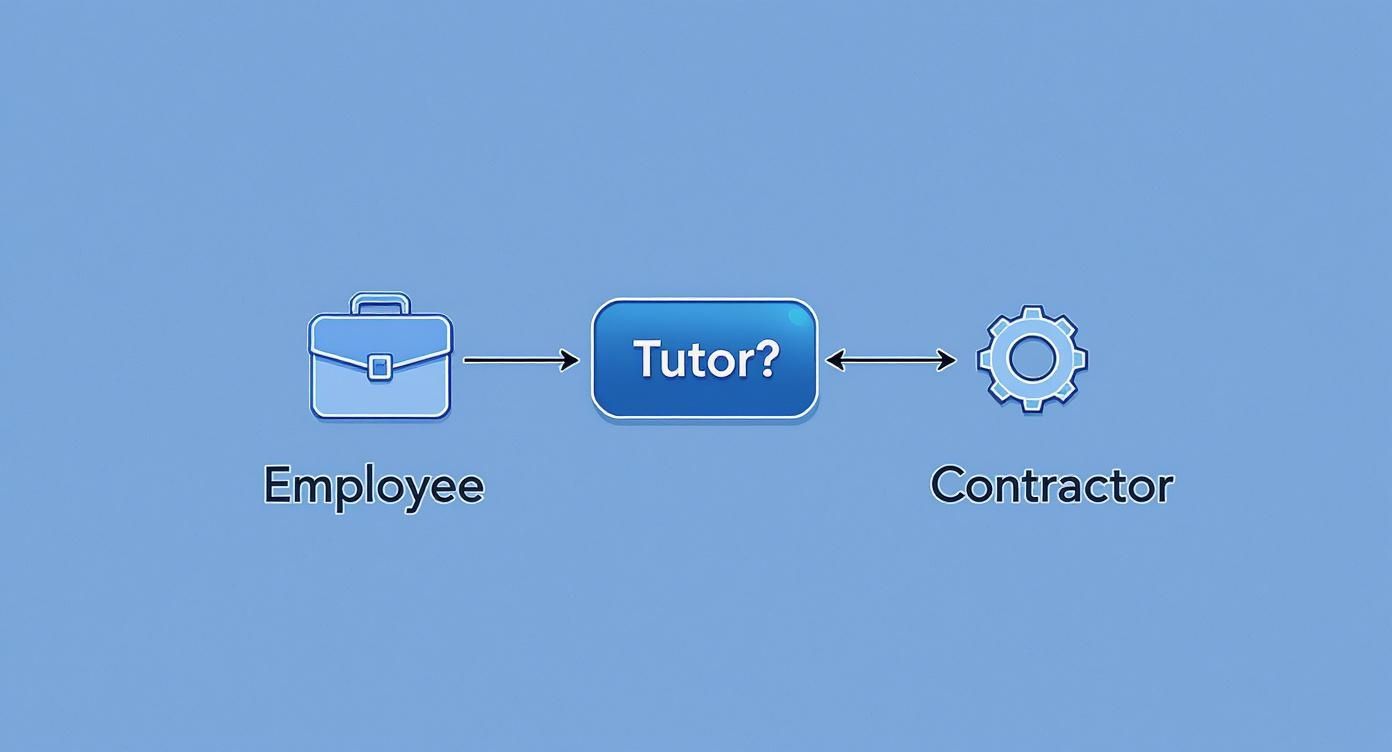
As the diagram shows, the main difference often boils down to your level of control.
Centralize Your Contract Storage
The first step toward automation is getting everything in one place. Tutoring management software acts as a central digital hub. Every signed agreement is linked directly to a tutor or client profile.
No more digging through random computer folders. A centralized system means you can pull up any contract in seconds. Everything is organized and accessible.
How to Link Contracts to Billing and Payroll
Connecting contract data to your daily operations eliminates manual work. For instance, a tutor’s pay rate is saved in their profile with their contract. The system then automatically calculates what they are owed based on their lessons.
Here’s what that looks like in practice:
The system grabs a tutor’s specific hourly rate from their profile.
It calculates their total pay based on lesson attendance for that pay period.
A detailed payout statement is generated automatically for them to review.
This completely removes manual payroll calculations in spreadsheets, which are prone to errors. You can learn more about automating session and payroll management. The same logic applies to client billing. The software automatically applies the correct rates to invoices.
The U.S. private tutoring market is projected to grow by $28.85 billion between 2025 and 2029, with new technology as a major driver. Automated systems for contract management are essential for keeping up with this growth.
Legal Considerations And Best Practices
A solid tutoring contract template is a great start, but you must ensure it's legally sound. Your contract is an enforceable document that must follow local rules. Getting this right protects your business and keeps everything fair for your clients.
The smartest move is to have a qualified local attorney review your contract. Laws around consumer rights and employment vary significantly by state or country. A standard clause in California might be unenforceable in New York.
An attorney's review is an investment in your business's legal health. It ensures your agreement is not just well-written but fully enforceable. This can prevent costly disputes down the road.
Best Practices For Finalizing Your Contract
Once your contract is polished and legally vetted, you need a professional process for using it. How you present, sign, and store contracts is just as important as what’s inside. It sets the tone for your client relationships.
A clear, simple process for signing and storing contracts avoids confusion.
Present It Clearly: When sending the contract, briefly explain its purpose. Frame it as a tool that creates clarity and protects both parties.
Use Electronic Signatures: In 2026, using legally binding e-signature platforms is the standard. It is easier for clients and provides a secure, verifiable record.
Store Contracts Securely: Keep all signed contracts in one central, secure place. Tutoring management software links each agreement directly to a client's profile for instant access.
Handle Updates Formally: If terms need to change, a verbal agreement is not enough. Issue a formal amendment or a new contract that both parties must sign. This ensures everyone is on the same page.
Following these steps transforms your contract into a cornerstone of your professional operations.
A well-managed contract process builds trust from the start. For multi-branch centers, standardizing this workflow ensures consistency and compliance. You can explore how Tutorbase helps manage these processes and automates compliance.
FAQ Section: Your Tutoring Contract Questions Answered
What should I do if a client wants to change the contract?
You should handle requests for changes formally to avoid confusion. Verbal agreements are difficult to enforce. Always get modifications in writing using a formal amendment or addendum. This document outlines the change, and both parties must sign it to make it a legally binding part of the original contract.
Do I need a separate contract for online tutoring?
Yes, you need a separate contract for online tutoring. A generic agreement for in-person services does not cover the unique challenges of virtual sessions. Your online tutoring contract should include clauses on technology requirements, session recording policies, data privacy, and platform usage (e.g., Zoom).
Are electronic signatures legally binding on a tutoring contract?
Yes, electronic signatures are legally binding in most jurisdictions, including the United States, under the ESIGN Act of 2000. They carry the same legal weight as a handwritten signature. Use a reputable e-signature service to create a digital audit trail, which adds a layer of security and verification.
How do I write a contract for a minor student?
When tutoring a minor, your legal agreement must be with their parent or legal guardian. Minors cannot legally enter into a binding contract. The contract should name the student receiving the services, but the parent or guardian is responsible for all legal and financial obligations and must be the one to sign.
What happens if a client breaches the contract?
If a client breaches the contract (e.g., by not paying), your termination clause should outline the next steps. First, send a formal written notice identifying the breach and referencing the contract. If the issue is not resolved, your dispute resolution clause will guide further action, which could include mediation or small claims court for non-payment.
Why is a 'Limitation of Liability' clause important?
A limitation of liability clause is important because it defines the scope of your professional responsibility. It clarifies that while you commit to providing high-quality, professional tutoring services, you cannot guarantee specific academic outcomes, such as a particular grade or test score. This manages client expectations and protects your business from unreasonable claims.
How often should I review and update my tutoring contract template?
You should review your tutoring contract template at least once a year or whenever there are significant changes to your business or local laws. Changes could include new services, updated pricing, or new regulations affecting consumer rights or data privacy. Keeping your contract current ensures it remains relevant and legally compliant in 2026 and beyond.
Streamline your entire contract process, from signing to payroll automation. Tutorbase helps you securely store agreements, link them to client profiles, and use the data to eliminate hours of weekly admin. See how it works at tutorbase.com/register.
The Essential Tutoring Contract Template For Your Business
Published: December 9, 2025 by Amy Ashford


A strong tutoring contract template is your blueprint for success. It establishes clear expectations with clients, prevents disputes over payments and cancellations, and builds a professional foundation from day one. Using a formal agreement signals you run a serious, trustworthy business.
Why is a Strong Tutoring Contract Essential?
A tutoring contract is the official roadmap for your client relationships. It details everything from payment schedules to cancellation policies. This clarity reduces confusion and potential conflict. When everyone understands their responsibilities, you build trust and respect.

Operating without a formal agreement exposes your business to common issues. Imagine clients constantly canceling last-minute or questioning payment terms. A contract provides a pre-agreed framework for these situations. It saves you significant time and stress.
Prevent Common Business Headaches
A well-crafted contract is your defense against operational problems. It provides a clear path for several key issues. This turns potential disputes into simple procedural matters.
With a contract, you can proactively handle:
Late or Missed Payments: Your contract will outline due dates, accepted payment methods, and any penalties for late payments. This removes ambiguity and simplifies invoice collection.
Last-Minute Cancellations: This is a major concern for tutors. Clearly define your cancellation policy. State that you require 24 hours' notice and specify fees for late cancellations.
Scope Creep: Outline exactly what services you provide, including subjects, session length, and frequency. This prevents clients from expecting extra services not covered in the original agreement.
Disagreements on Responsibilities: The contract defines the obligations for both the tutor and the client. This ensures everyone is on the same page about their role in the student's success.
How to Build Professionalism and Trust
Handing a new client a professional contract demonstrates that you take your work seriously. It communicates that you are organized and committed to delivering high-quality service. This act instantly sets you apart from less formal tutors and builds immediate confidence.
A tutoring contract is a mark of professionalism. It proves you run a legitimate business and are dedicated to a structured, effective learning environment.
The global private tutoring market reached a value of $97.11 billion in 2023 and is growing rapidly. This growth means more competition. Formalizing your operations with a contract is crucial to stand out and manage clients professionally. You can learn more about the scale of the global tutoring market and its growth.
Download Your Free Tutoring Contract Template
Why start from scratch? A solid tutoring contract template provides a professional, legally-sound foundation. Think of it as a blueprint covering all critical areas. It saves you the headache of drafting a complex document from zero.
We created a comprehensive, easy-to-use template to get you started quickly. Just choose the format that works best for you:
Download as a Word Document: Perfect for easy editing on your desktop.
Download as a PDF: A print-ready version for those who prefer signing in person.
Access as a Google Doc: Ideal for collaborating and customizing in the cloud.
What Is Included In The Template?
Our template is not a bare-bones, generic document. We packed it with essential sections for a robust agreement that protects everyone involved. It serves as your starting point.
You will find clearly defined clauses for:
Client and Student Information
Scope of Tutoring Services
Tutor and Client Responsibilities
Payment Terms and Schedule
Cancellation and Rescheduling Policies
Termination Clause
In the following sections, we will guide you on how to customize each part. As you refine your own contract, examples like these business process documentation templates can offer structural ideas. This template is designed to grow with your business.
How to Customize Your Tutoring Contract Clause By Clause
A template is a great starting point, but not the finish line. An effective contract is tailored to how your business actually operates. It transforms a generic document into a powerful tool that protects you and sets clear expectations.
Getting this right means digging into the details of each clause. You must ensure it fits your specific services, pricing, and policies. Let's walk through that process.

Before customizing, you need to understand the big picture. Here are the non-negotiable sections every tutoring agreement needs.
Essential Clauses For Your Tutoring Contract
Clause | Purpose | Key Customization Points |
|---|---|---|
Scope of Services | Clearly defines what you will (and will not) do, preventing scope creep. | Subjects, session length/frequency, location (online/in-person), and excluded services. |
Payment Terms | Outlines rates, billing cycles, and consequences for late payments. | Session/package rates, invoice dates, due dates, accepted payment methods, and late fees. |
Cancellation Policy | Protects your time and income from last-minute cancellations. | Required notice period (e.g., 24 hours), fees for late cancellations, and your policy for tutor cancellations. |
Confidentiality | Reassures clients that student information will be kept private. | Specify what data you collect, how it's stored, and who has access. |
Limitation of Liability | Defines the boundaries of your legal responsibility. | Clarify you don't guarantee specific grades or test scores, but commit to professional service. |
Termination | Provides a clear, professional process for ending the agreement. | Notice period required from the client, grounds for termination by the center, and final payment procedures. |
Now, let's break down how to customize each of these for your unique business.
Defining The Scope Of Services
This is where most disputes begin. A vague service description invites scope creep, which is when a client requests services beyond the agreed-upon scope. You need to be ruthlessly specific here to prevent misunderstandings.
Your goal is to leave zero room for interpretation. Think of this clause as the official rulebook for the relationship.
For instance, your clause should detail:
Subjects Covered: Be precise. Instead of "Math," write "Algebra II" or "AP Calculus BC."
Session Structure: Specify the length (e.g., 60-minute sessions), frequency ("twice weekly"), and format ("one-on-one" or "group class of up to 5 students").
Location: State exactly where sessions happen: "in-person at our 123 Main St. center" or "conducted online via Zoom."
Excluded Services: This is just as important. Add a line like, "This agreement does not include college application essay review or communication with the student's school teachers."
How To Outline Payment Terms And Rates
Nothing creates awkwardness faster than confusion about money. This clause must spell out your fee structure, payment schedule, and accepted methods. Ambiguity here is a direct path to late payments and chasing invoices.
Be direct and make it easy to understand. Your payment clause is the tool you will use to ensure consistent cash flow.
Key details to include are:
Rates: State the exact cost, like "$75 per one-hour session" or "$500 for a package of 8 sessions."
Billing Cycle: Define when invoices are sent and payments are due (e.g., "Invoices are sent on the 1st of each month and are due by the 5th").
Accepted Payment Methods: List them all, such as credit cards via Stripe, bank transfer, or cash.
Late Fees: Specify penalties for overdue payments. For example, "A late fee of $25 will be applied to any invoice more than 7 days overdue."
Setting the right price is the foundation of this clause. If you are still figuring that out, you can check out our guide on setting tutoring rates.
What Should A Cancellation Policy Include?
A firm but fair cancellation policy is non-negotiable. It protects your tutors' time and your income. Without it, you will lose revenue from last-minute changes that leave you with empty, unpaid slots.
This clause sets a professional boundary from day one. You need to communicate it clearly and enforce it consistently.
A strong policy should specify:
Notice Period: The minimum time required for a penalty-free cancellation, such as "24-hour advance written notice is required to cancel or reschedule a session."
Cancellation Fee: The consequence for missing that window. For example, "Cancellations made with less than 24 hours' notice will be charged the full session fee."
Tutor Cancellations: What happens if one of your tutors has to cancel? Outline the procedure, like, "If the tutor cancels a session, a make-up session will be scheduled at no additional cost to the client."
Establishing Confidentiality And Liability
Protecting student information and your business's legal standing is paramount. The confidentiality clause builds trust by reassuring clients their data is safe. The limitation of liability clause defines the scope of your professional responsibility.
These clauses are not just legal jargon. They signal professionalism and manage risk.
A Limitation of Liability clause clarifies that you cannot guarantee specific academic outcomes. You promise to provide excellent tutoring, but you cannot guarantee an A+ or a perfect test score.
The global online tutoring market is projected to hit $22.67 billion by 2030. This makes data protection a major focus. Strong contracts now often include clauses addressing compliance with regulations like GDPR.
How Do You Handle Contract Termination?
Every agreement needs a clear exit strategy. The termination clause outlines how and when either you or the client can end the tutoring relationship. This ensures a professional process for parting ways if things don't work out.
This clause prevents abrupt, messy endings. It should specify the required notice period and how to handle outstanding payments.
A solid termination clause includes:
Termination by Client: The client must provide a specific amount of notice, like "14 days' written notice."
Termination by Tutor/Center: You can also terminate the contract for reasons like non-payment or repeated policy violations, also with written notice.
Final Payments: State clearly that all outstanding fees must be settled upon termination.
Employee Tutors vs Independent Contractors
One of the first big decisions is whether to classify tutors as employees or independent contractors. This choice shapes your legal obligations, tax responsibilities, and control over your team. Getting this right is non-negotiable for compliance.
What is the Core Difference?
The core difference is control. Government bodies like the IRS analyze the degree of behavioral and financial control you have over your tutors. This helps them determine the tutor's status.
An employee tutor works directly for you. You set their schedule, provide mandatory training, and dictate their teaching methods. They are on your payroll, you withhold taxes, and they receive a W-2 form.
An independent contractor runs their own business. They offer their expertise to your center with more autonomy. They use their own methods, manage their hours, and are paid per session. You issue them a 1099 form, and they handle their own taxes.
Why is Correct Classification Important?
Choosing the wrong classification can be an expensive mistake. The IRS takes worker misclassification seriously because it often results in unpaid payroll taxes. If you get it wrong, you could face back taxes, hefty fines, and interest payments.
This decision also defines your relationship with your tutors. Employees may be entitled to benefits like health insurance and paid time off. It determines the kind of tutoring contract template you need and sets the tone for your operational model.
Key Factors in Determining Tutor Status
The IRS looks at the whole relationship, usually broken down into three categories.
Behavioral Control: Do you direct how the tutor does their work? If you provide specific instructions, require your curriculum, or mandate training, it points toward an employee relationship.
Financial Control: Do you control the business side of the tutor's job? Consider how they are paid, whether you reimburse expenses, and who provides teaching materials. If you handle all financial logistics, they look more like an employee.
Relationship of the Parties: Is there a written contract spelling out the relationship? Do you offer employee-style benefits? A permanent relationship often suggests employment.
This distinction is also crucial for tutors looking for work. If you are on the job hunt, check out our guide on different jobs for home tutors to understand what to expect.
The core question is always about control. If you dictate the "how, when, and where" of the tutoring sessions, you are likely dealing with an employee, not a contractor.
Employee Tutor vs Independent Contractor Comparison
This table provides a direct comparison to help you classify tutors correctly. Use it to understand the legal and financial duties associated with each choice.
Factor | Employee Tutor | Independent Contractor Tutor |
|---|---|---|
Tax Form | Receives a W-2 form. | Receives a 1099-NEC form. |
Tax Withholding | Employer withholds income, Social Security, and Medicare taxes. | Responsible for their own self-employment taxes. |
Control | Employer has significant control over how work is done. | Has significant autonomy and controls their own methods. |
Training | Typically receives ongoing training from the employer. | Provides their own training and uses their own expertise. |
Benefits | May be eligible for benefits like health insurance and PTO. | Not eligible for employer-provided benefits. |
Tools & Equipment | Employer usually provides necessary materials and equipment. | Generally uses their own tools, materials, and equipment. |
Permanency | Relationship is typically ongoing and continuous. | Relationship is often temporary or project-based. |
The right choice depends on your business model. Employees are suitable for a standardized teaching method. Contractors are a better fit if you value flexibility and specialized expertise without the overhead.
How to Automate Contract Management
As your business grows, manually managing contracts becomes inefficient. Chasing down signed agreements in email folders or filing cabinets is a huge time sink. Automating this process saves your sanity.
Good tutoring management software digitizes your agreements. It connects them directly to client and tutor profiles. This turns your static tutoring contract template into a powerful tool for automating payroll and billing.
What is Contract Management Automation?
Contract management automation uses software to handle the creation, signing, and storage of agreements. Instead of printing a document, you send a digital version for electronic signature. A legally binding electronic signature, or e-signature, is a digital way to get consent on a contract.
Once signed, the software stores the contract securely. It can pull key data, like a tutor's pay rate, for other tasks. This makes e-signatures essential for a fully digital and legally sound workflow.
The process starts with getting tutor classification right. Choosing the correct contract is critical.

As the diagram shows, the main difference often boils down to your level of control.
Centralize Your Contract Storage
The first step toward automation is getting everything in one place. Tutoring management software acts as a central digital hub. Every signed agreement is linked directly to a tutor or client profile.
No more digging through random computer folders. A centralized system means you can pull up any contract in seconds. Everything is organized and accessible.
How to Link Contracts to Billing and Payroll
Connecting contract data to your daily operations eliminates manual work. For instance, a tutor’s pay rate is saved in their profile with their contract. The system then automatically calculates what they are owed based on their lessons.
Here’s what that looks like in practice:
The system grabs a tutor’s specific hourly rate from their profile.
It calculates their total pay based on lesson attendance for that pay period.
A detailed payout statement is generated automatically for them to review.
This completely removes manual payroll calculations in spreadsheets, which are prone to errors. You can learn more about automating session and payroll management. The same logic applies to client billing. The software automatically applies the correct rates to invoices.
The U.S. private tutoring market is projected to grow by $28.85 billion between 2025 and 2029, with new technology as a major driver. Automated systems for contract management are essential for keeping up with this growth.
Legal Considerations And Best Practices
A solid tutoring contract template is a great start, but you must ensure it's legally sound. Your contract is an enforceable document that must follow local rules. Getting this right protects your business and keeps everything fair for your clients.
The smartest move is to have a qualified local attorney review your contract. Laws around consumer rights and employment vary significantly by state or country. A standard clause in California might be unenforceable in New York.
An attorney's review is an investment in your business's legal health. It ensures your agreement is not just well-written but fully enforceable. This can prevent costly disputes down the road.
Best Practices For Finalizing Your Contract
Once your contract is polished and legally vetted, you need a professional process for using it. How you present, sign, and store contracts is just as important as what’s inside. It sets the tone for your client relationships.
A clear, simple process for signing and storing contracts avoids confusion.
Present It Clearly: When sending the contract, briefly explain its purpose. Frame it as a tool that creates clarity and protects both parties.
Use Electronic Signatures: In 2026, using legally binding e-signature platforms is the standard. It is easier for clients and provides a secure, verifiable record.
Store Contracts Securely: Keep all signed contracts in one central, secure place. Tutoring management software links each agreement directly to a client's profile for instant access.
Handle Updates Formally: If terms need to change, a verbal agreement is not enough. Issue a formal amendment or a new contract that both parties must sign. This ensures everyone is on the same page.
Following these steps transforms your contract into a cornerstone of your professional operations.
A well-managed contract process builds trust from the start. For multi-branch centers, standardizing this workflow ensures consistency and compliance. You can explore how Tutorbase helps manage these processes and automates compliance.
FAQ Section: Your Tutoring Contract Questions Answered
What should I do if a client wants to change the contract?
You should handle requests for changes formally to avoid confusion. Verbal agreements are difficult to enforce. Always get modifications in writing using a formal amendment or addendum. This document outlines the change, and both parties must sign it to make it a legally binding part of the original contract.
Do I need a separate contract for online tutoring?
Yes, you need a separate contract for online tutoring. A generic agreement for in-person services does not cover the unique challenges of virtual sessions. Your online tutoring contract should include clauses on technology requirements, session recording policies, data privacy, and platform usage (e.g., Zoom).
Are electronic signatures legally binding on a tutoring contract?
Yes, electronic signatures are legally binding in most jurisdictions, including the United States, under the ESIGN Act of 2000. They carry the same legal weight as a handwritten signature. Use a reputable e-signature service to create a digital audit trail, which adds a layer of security and verification.
How do I write a contract for a minor student?
When tutoring a minor, your legal agreement must be with their parent or legal guardian. Minors cannot legally enter into a binding contract. The contract should name the student receiving the services, but the parent or guardian is responsible for all legal and financial obligations and must be the one to sign.
What happens if a client breaches the contract?
If a client breaches the contract (e.g., by not paying), your termination clause should outline the next steps. First, send a formal written notice identifying the breach and referencing the contract. If the issue is not resolved, your dispute resolution clause will guide further action, which could include mediation or small claims court for non-payment.
Why is a 'Limitation of Liability' clause important?
A limitation of liability clause is important because it defines the scope of your professional responsibility. It clarifies that while you commit to providing high-quality, professional tutoring services, you cannot guarantee specific academic outcomes, such as a particular grade or test score. This manages client expectations and protects your business from unreasonable claims.
How often should I review and update my tutoring contract template?
You should review your tutoring contract template at least once a year or whenever there are significant changes to your business or local laws. Changes could include new services, updated pricing, or new regulations affecting consumer rights or data privacy. Keeping your contract current ensures it remains relevant and legally compliant in 2026 and beyond.
Streamline your entire contract process, from signing to payroll automation. Tutorbase helps you securely store agreements, link them to client profiles, and use the data to eliminate hours of weekly admin. See how it works at tutorbase.com/register.