


Running a profitable after school tutoring business depends less on what you teach and more on how you operate. A rock-solid system to handle scheduling, billing, and payroll is crucial. Managing this with a patchwork of spreadsheets is a recipe for chaos, leading to booking errors and a 60% increase in wasted admin time.
Your Blueprint for a Thriving After School Program
A strong operational blueprint separates thriving businesses from those just surviving. It’s about building a foundation that lets you grow without constant administrative headaches. It automates tedious work, gives you a clear view of your business’s health, and frees you to focus on what matters: delivering incredible education.

This guide walks you through the essential pillars of building a profitable and sustainable after school tutoring program. You will learn practical strategies that reduce admin time, eliminate double-bookings, and increase monthly renewals by up to 42%.
Core Pillars of a Successful After School Tutoring Operation
Building a scalable tutoring business means getting a few key operational pillars right from the start. Below is a breakdown of what you need to focus on to move from daily chaos to streamlined growth.
| Operational Pillar | Key Challenge | System-Driven Solution |
|---|---|---|
| Program Design & Scheduling | Creating valuable services and managing complex schedules without errors. | A centralized calendar with conflict detection and automated slot finding for teachers and rooms. |
| Enrollment & Lead Flow | Capturing new student interest and converting inquiries into paying clients efficiently. | An integrated CRM that funnels leads from website forms and WhatsApp into a clear pipeline. |
| Billing & Payroll | Handling invoices, chasing payments, and calculating tutor pay accurately and on time. | Automated invoicing from attendance, prepaid credit management, and complex payroll calculations. |
| Growth & Profitability | Knowing which programs are profitable and which tutors are most utilized. | Real-time dashboards tracking key metrics like capacity utilization and student lifetime value. |
By mastering these pillars, you can reduce your administrative workload by up to 60%, giving you back time to improve your educational offerings and scale your impact.
And while you're laying out your operational blueprint, don't forget the fun. A great program blends solid academics with enriching experiences. For some fresh ideas, check out these fun activities for afterschool programs. When your operations are running smoothly in the background, you finally have the space to create a program that kids love and parents trust.
Designing a Tutoring Program Parents Actually Want to Buy
Before you can fill a single class, you need to build a program that parents get. It's not enough to have a great educational vision; you have to package it into something clear and compelling that a busy parent can understand and value in seconds. Get this right, and you'll turn inquiries into enrollments 3x faster.
Make no mistake, the demand is there. The global after-school tutoring market is on track to hit a staggering $250 billion by 2032, fueled by an 8.5% annual growth rate. Parents are more willing than ever to invest in their kids' academic futures. Your program design is what determines if that investment goes to you or a competitor.
Nailing Your Niche And Curriculum
First things first: what are you actually selling? It’s a simple question, but the answer defines your entire business.
Are you a K-12 academic center focused on core subjects like math and English? Or do you specialize in test prep for the SAT, ACT, or IELTS? Maybe your passion lies in creative skills like piano lessons, or languages like Spanish or Mandarin.
Once you’ve picked your lane, you need to structure your curriculum. This means breaking down your offerings into clear subjects and skill levels that create a logical path for students. For example, a math program might have levels for "Grade 3," "Grade 4," and "Algebra 1." A language school would use "Spanish A1," "Spanish A2," and "Spanish B1."
This isn't just for your own planning—it's one of your most powerful marketing tools. It shows parents a clear roadmap for their child’s progress.
Parents buy clarity. A program with well-defined subjects and levels like "AP Physics" or "Piano Grade 2" is far easier to understand—and trust—than a generic "tutoring" service. This structure directly translates into faster enrollment decisions.
Here's an example of how you can organize your services in a management system, clearly defining the delivery mode and capacity for each class. It takes the guesswork out of it for both you and your clients.
As you can see, this approach ties specific services to subjects and levels while also setting crucial operational details like class size and delivery method. This kind of clarity is non-negotiable for running a smooth operation.
Structuring Your Services And Pricing
With your curriculum locked in, it's time to design your actual class offerings, which we'll call "Services." For every service you offer, you need to define the key parameters that will govern how it runs.
These include:
- Capacity: The maximum number of students you'll allow. This is critical for preventing overbooked rooms and maintaining teaching quality.
- Delivery Mode: Is this an in-person class, fully online, or a hybrid model that accommodates both at the same time? Be specific.
- Pricing: How much does it cost? This could be a simple per-hour rate, a flat fee per lesson, or part of a larger package or subscription.
A huge piece of attracting and keeping clients is developing competitive pricing models for your services. Your pricing strategy needs to be flexible enough to handle everything from one-off trial lessons to recurring monthly subscriptions. It's the final piece of the puzzle that turns your expertise into a product people are eager to buy.
Mastering the Scheduling Puzzle Without the Headaches
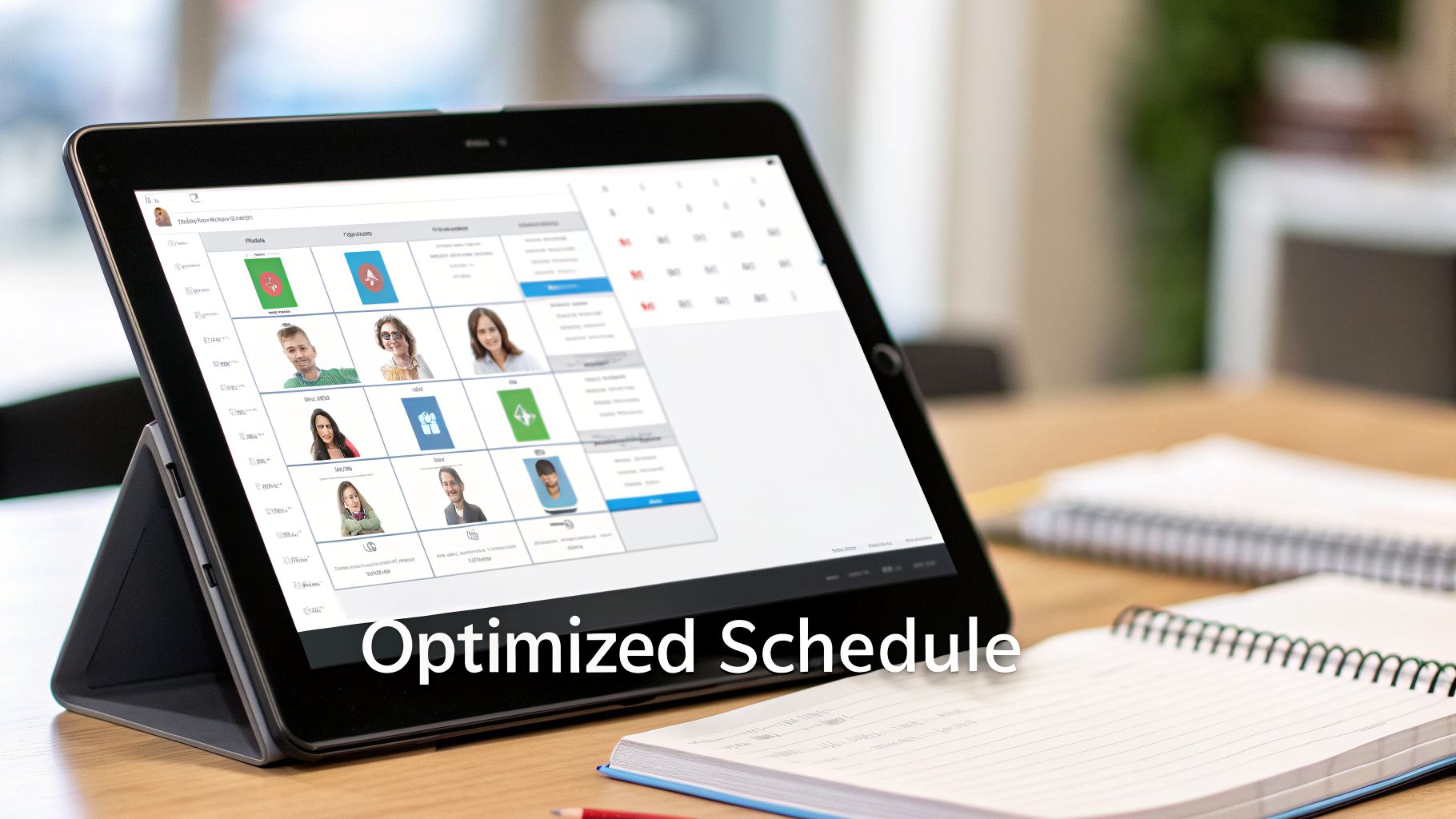
Let's be honest: scheduling is the operational heart of any after school tutoring program. It's also where countless hours get lost in manual data entry and calendar-juggling. Moving from disjointed spreadsheets to an intelligent system isn't just about saving time; it's about building a stable, scalable business that eliminates booking errors.
This one shift can turn scheduling from a reactive chore into a strategic advantage, directly impacting your bottom line and keeping clients happy.
Eliminate Double Bookings And Find Slots Fast
The most common scheduling nightmare? The double-booking. It creates immediate chaos and chips away at your professional reputation. This happens constantly when you rely on manual checks across multiple calendars.
Modern scheduling systems make this scenario impossible. They use built-in conflict detection that instantly flags any attempt to create a clashing appointment. Even better, they suggest the next available alternatives on the spot.
This single feature is a game-changer. Our data shows that centers using automated conflict detection achieve zero double-bookings. That saves hours of cleanup and preserves client trust.
Instead of spending ten minutes cross-referencing spreadsheets, your admin team can find open slots in seconds. A good system instantly generates a list of viable teacher, room, and time combinations. What used to be a lengthy puzzle gets solved in under two minutes, accelerating your student onboarding by 3x.
The Impact of Moving Away from Manual Scheduling
The difference between wrestling with spreadsheets and using an integrated system is night and day. It’s a fundamental shift in how your team operates, freeing them up to focus on growth instead of administrative quicksand.
Let's look at the real-world impact.
Manual Vs Automated Scheduling Impact
| Scheduling Task | Manual Method (Spreadsheets/Calendar) | Automated System (Tutorbase) | Time Saved |
|---|---|---|---|
| Booking a New Student | 10-15 mins | < 2 mins | 85%+ |
| Finding Group Class Availability | 5-10 mins | < 1 min | 90%+ |
| Handling a Reschedule | 5-8 mins | < 1 min | 80%+ |
| Confirming Tutor/Room Conflicts | 3-5 mins (often missed) | Instant (automated check) | 100% |
| Generating Weekly Schedules | 30-60 mins | 0 mins (live view) | 100% |
As you can see, the time savings aren't just incremental, they're transformative. Across a week, this adds up to hours of reclaimed time that can be poured back into client communication, marketing, and supporting your teaching staff.
Maximize Your Group Class And Room Utilization
Every empty seat in a group class is revenue you'll never get back. An effective after school tutoring program has to be proactive about maximizing capacity, but manually tracking open seats across dozens of classes is not practical.
This is where a "Find Spot" feature inverts the process. Instead of creating a new class for one student, it filters all existing group classes to find one with an open seat that matches the student's needs.
This approach is invaluable for:
- Maximizing Profitability: Filling an existing class costs you nothing extra but adds directly to your revenue.
- Improving Group Dynamics: Fuller classes often create a more energetic and engaging learning environment.
- Optimizing Teacher Time: It ensures your teachers are instructing full or near-full classes, making their time more impactful.
The visual clarity in a purpose-built system like the Tutorbase scheduling feature makes it easy to see teacher and room availability at a glance. Your admin staff can make booking decisions in seconds, not minutes, ensuring every resource is used efficiently.
Manage Multiple Locations And Complex Schedules
As your tutoring business grows to multiple branches, the scheduling complexity explodes. Trying to manage different locations, each with its own set of rooms and teacher schedules, is impossible with standard calendar apps.
A robust management platform lets you oversee all your locations from a single dashboard. You can track every room's details, including its capacity, specific features, and any associated fees.
This centralized view empowers you to:
- Set recurring lessons for the entire semester with a single click.
- Define location-specific availability for teachers who split their time between branches.
- Automatically add room fees to invoices when a premium space is booked.
By putting these systems in place, you stop fighting with your schedule and start making it work for you. It becomes a powerful tool for growth, not a source of daily frustration.
How to Manage Teachers and Automate Payroll
Your tutors are the heart of your after school program. Finding incredible educators is half the battle; keeping them is where the real work begins. Managing their schedules, contracts, and especially their pay is a massive operational drain for most centers, where owners spend 10+ hours a week on manual admin.
Getting this right isn't just about efficiency. It’s about creating a stable, professional environment where your best people want to stay. In the U.S., where 65% of K-12 parents sought tutoring in 2023, competition is fierce. You can find more on these tutoring industry statistics to see the full picture.
Ditching Spreadsheets for Smart Teacher Profiles
The bedrock of any good people-management system is a centralized profile for each teacher. A truly useful teacher profile is your single source of truth, tracking everything you need for both scheduling and payroll in one clean place.
It should capture:
- Subjects & Levels: What can they teach? Be specific (e.g., Math - Grade 8, AP Physics, Spanish A2).
- Locations: Which of your branches are they cleared to work at?
- Availability: Their exact weekly schedule, including recurring unavailability.
- Pay Rates & Contracts: Their specific pay model and employment terms.
When you have this data locked in, you can use automated scheduling tools that instantly match the right teacher to a new student request. This eliminates frantic texts and emails trying to find who’s qualified and available.
Solving the Complex Payroll Puzzle
Payroll is a huge headache for tutoring center owners. Most off-the-shelf accounting software can't handle the dynamic pay models modern tutoring businesses use.
You need the flexibility to handle multiple pay models at the same time, sometimes even for the same tutor. A system built for tutoring lets you define rules for all sorts of scenarios, including:
- Per-Hour vs. Per-Lesson: Paying a flat rate for a lesson versus a true hourly wage.
- Per-Student Rates: Paying teachers more for larger group classes.
- Revenue Share (%): Giving tutors a percentage of lesson revenue as an incentive.
- Complex Models: Combining a base rate with variable bonuses or overtime premiums for weekend sessions.
The real magic happens when you connect payroll directly to attendance. When a tutor marks a lesson as "Attended," the system should automatically know exactly which pay rate to apply.
The screenshot below shows how a modern system visualizes payroll, automatically calculating what’s owed based on confirmed lessons. No more manual data entry.
This automated calculation turns a process that took hours of spreadsheet gymnastics into something you can do in minutes. It wipes out human error and guarantees your team is paid accurately and on time, every single time.
Putting Payday on Autopilot for Accuracy and Morale
The ultimate goal is to remove yourself from the weekly payroll grind entirely. By setting up automated workflows, you can define your pay periods (weekly, bi-weekly, monthly) and let the system do the heavy lifting. This is a core function of the Tutorbase payroll system.
For contractors, you can even enable self-billing, where the system generates invoices on their behalf based on the lessons they taught. This adds professionalism and gives them clean documentation for their own records.
Automating payroll isn't just about saving time; it's a retention tool. When your teachers trust they’ll be paid correctly and on time without having to chase you, it builds incredible goodwill. It allows them to focus on what they do best: teaching.
Streamlining Enrollment and Billing to Boost Your Cash Flow
A clunky enrollment and billing process doesn't just frustrate parents; it actively drains revenue from your after-school tutoring program. If you're still creating invoices by hand and chasing late payments, you're creating friction that costs you time and customers.
The solution is a seamless financial workflow. You need a system that guides a parent from a new lead to a paid-up client with minimal effort on your part.
This starts the moment a parent finds you. Whether they fill out a website form, send a WhatsApp message, or walk in, their information should flow directly into a clear management pipeline. This lets you track every lead from 'New' to 'Trial Scheduled' to 'Converted' without anyone falling through the cracks.
Automating Invoices to Get Paid Faster
The single most impactful change you can make is to stop creating invoices one by one. I’ve seen countless center owners lose hours every week to this manual chore, a major source of errors.
An automated system connects lesson attendance directly to your billing and will completely transform your cash flow cycle.
When a teacher marks a lesson as 'Attended,' the system should instantly trigger an invoice based on that student’s specific pricing plan. It doesn't matter if you bill per-lesson, weekly, or monthly. Automation ensures the right amount is charged at the right time. The data is clear: businesses that automate invoicing get paid significantly faster.
By automating invoice generation from attendance records, tutoring centers reduce their invoice processing time from hours to minutes. This not only accelerates cash flow but also achieves a 42% increase in monthly renewals by creating a professional, hassle-free experience for parents.
This process flow shows how automation turns key operational steps like payroll from manual chores into streamlined, dependable systems.
Just as payroll can be automated based on confirmed attendance, billing follows the same logic. This creates a dependable and error-free financial workflow you can count on.
Implementing Advanced Pricing and Payment Strategies
To truly optimize your revenue, your billing system has to handle more than simple hourly rates. Successful after-school tutoring programs use a variety of pricing models to attract and retain clients. You need the flexibility to offer options that make payments easier for parents and more predictable for you.
Here are a few key strategies that work:
- Prepaid Credit Packages: Parents can purchase a "wallet" of credits or a bundle of 10, 20, or 50 lessons upfront. The system then automatically deducts one credit after each attended lesson.
- Low-Balance Alerts: When a student’s prepaid balance drops below a set threshold (like two lessons remaining), the system automatically sends a notification to the parent, prompting them to top up.
- Automated Cancellation Policies: Set your rules once, and let the system enforce them. If a parent cancels with less than 24 hours' notice, a predefined cancellation fee can be automatically charged.
These tools do more than just collect money; they build financial stability into your business model. Prepaid packages are a game-changer for cash flow because you get payment upfront, and automated reminders for low balances prevent service interruptions and reduce churn.
Exploring a platform with robust features like Tutorbase billing gives you the tools to implement these strategies effectively. By making the payment process effortless and transparent, you remove a major point of friction for busy parents, which encourages long-term loyalty.
Tracking Attendance and Measuring What Matters
There’s an old saying in business: if you can't measure it, you can't improve it. This is the principle that turns a passion for teaching into a profitable, sustainable after school tutoring business. It all starts with two things: flawless attendance tracking and a laser focus on the numbers that actually matter.

This isn’t about getting buried in spreadsheets. It’s about making smart, data-driven decisions that grow your bottom line. And the most basic, yet most critical, piece of data you own is attendance.
Why Perfect Attendance Tracking is Non-Negotiable
Think of attendance tracking as the bedrock of your entire operation. It’s the trigger for your whole financial workflow. Every single invoice you send and every payroll check you cut begins with a simple attendance status.
Get it wrong, and you’ll find yourself in a world of pain. Errors cascade into billing disputes with parents and payroll mistakes with your tutors, quickly eroding trust and creating administrative chaos. A modern system has to let you track the messy reality of running a tutoring business.
Your tracking statuses should be more than just "present" or "absent." You need options like:
- Attended: The student was there for the lesson.
- No-show: Scheduled but didn't attend. This might trigger a fee.
- Cancelled: The student gave you enough notice, per your policy.
- Late Cancelled: The student cancelled outside the policy window, which usually means they still get charged.
On top of that, with hybrid learning now a staple, your system has to distinguish between attendance types within the same class. You need to be able to mark one student as ‘Attended – In-person’ and another as ‘Attended – Online’ for the same session. This is the only way to ensure everyone is billed correctly.
Don't forget, you're also proving your value. Research has shown that consistent tutoring can reduce student absences by as much as 11.4% on scheduled tutoring days. Accurate tracking helps you demonstrate that impact.
The KPIs That Really Signal Business Health
Once your attendance data is clean, you can start measuring what truly moves the needle on profitability. By monitoring a few core Key Performance Indicators (KPIs) from a central dashboard, you get an instant health check on your business and can spot where to focus your energy.
Your goal is to move from guessing to knowing. Instead of wondering why last month was slow, you should be able to glance at your dashboard and see that your Grade 9 Math classes are running at 95% capacity, while your Grade 7 English classes are only at 40%. That’s actionable data.
Here are the essential metrics every after school tutoring owner should have their eyes on.
Teacher and Room Utilization Rates
These two metrics tell you how efficiently you’re using your most valuable—and most expensive—resources: your teachers' time and your physical (or virtual) space.
- Teacher Utilization Rate: This is the percentage of a teacher's available, scheduled hours that are actually booked with paying students. A low rate might mean their availability is mismatched with student demand, or you simply need to assign them more students.
- Room/Capacity Utilization: This is the percentage of available seats filled in your group classes. High utilization is the key to making group sessions highly profitable.
As a benchmark, you should aim for a teacher utilization rate of 75-85%. Anything lower suggests you have room to grow revenue without adding costs. A rate consistently above 90% might be a red flag that a great teacher is heading for burnout.
Measuring What Your Students Are Worth
Beyond day-to-day operations, you need to track the metrics that tell you if you’re building a business for the long haul. These KPIs reveal customer loyalty and the real financial value of your programs.
| Key Growth Metric | What It Tells You | Why It's Critical for After School Tutoring |
|---|---|---|
| Student Retention Rate | The percentage of students who stick with your program from one period to the next (e.g., month-over-month). | High retention is the most cost-effective way to grow. It means parents see clear value and results. |
| Average Revenue Per Student (ARPS) | The average amount of money each student brings in per month or semester. | Tracking ARPS helps you see the direct financial impact of moving students into more frequent lessons or higher-value programs. |
| Student Lifetime Value (LTV) | The total revenue you can realistically expect from a single student over their entire time with you. | This is the number that justifies your marketing spend. A high LTV means you can afford to invest more to acquire new students. |
By watching these figures consistently, you can spot trends before they become problems. A dip in your retention rate might point to an issue with a specific teacher or curriculum. A low ARPS could be your signal to introduce new premium packages or group workshops. This data-first mindset is what ensures your after school tutoring program doesn't just survive, but truly thrives.
Frequently Asked Questions
Running a successful after school tutoring program is one thing. Scaling it without drowning in admin is another challenge entirely. As you grow, the same questions pop up time and time again.
Let's tackle the big ones I hear from center owners who are trying to move from chaotic to streamlined.
How do I stop double-booking teachers and rooms?
Double-booking chaos ends with a centralized scheduling system built for tutoring. These platforms have conflict detection baked right in. When you book a lesson, an AI-powered 'Find Slot' feature instantly shows you valid times that work for that specific student, teacher, and room. What used to be a 10-minute puzzle of checking three different calendars becomes a two-minute task with zero risk of error.
How can I automate invoicing for different rate plans?
A system where attendance and billing are directly connected is the solution. You set up all your pricing models, such as hourly rates, prepaid 10-lesson packages, or monthly subscriptions. When a tutor marks a student as 'Attended,' the system does the rest. It automatically applies the correct pricing, either generating an invoice line item or deducting a session from a prepaid balance. This eliminates manual invoicing and billing mistakes.
What is the most efficient way to manage a hybrid classroom?
Managing a hybrid classroom requires a roster that tracks attendance on a student-by-student basis within the same lesson. You need software where you can mark one student as ‘Attended - In-person’ and another as ‘Attended - Online’ from the same screen. This ensures your attendance, billing, and payroll records are always accurate, no matter how a student attends.
How should I track business health and profitability?
To understand the health of your after school tutoring program, you need to track a few key performance indicators (KPIs). The most important are Teacher Utilization Rate (aim for 75-85%), Room/Capacity Utilization (how many seats are filled), and Student Lifetime Value (LTV), which measures the total revenue an average student generates.
What is the best way to handle complex teacher payroll?
Standard payroll software often fails because it cannot handle tutoring-specific pay models like per-student rates or revenue sharing. The most accurate method is using a system built for tutoring. By linking payroll rules directly to attendance data, calculations become automatic. When a lesson is marked complete, the platform already knows which teacher taught it, how many students were there, and what specific rate to apply. This turns hours of manual work into a process you can run in minutes.
Ready to eliminate admin chaos and grow your tutoring business? Tutorbase consolidates scheduling, billing, payroll, and student management into one powerful, easy-to-use platform. See how you can reduce admin time by 60% and get started at tutorbase.com/register.


