


If you run a k -12 tutoring business, you probably know the pattern. The teaching side can work well, parents are happy, students keep showing up, and yet your evenings disappear into schedules, invoices, payroll fixes, room conflicts, and messages about makeup classes.
That chaos isn't a side issue. It's often the thing that limits growth.
Key Takeaways
- Demand is real, but complexity grows faster than most owners expect.
- Strong tutoring programs need strong operations, or quality drops as you add students, teachers, and locations.
- Integrated systems reduce admin drag, prevent avoidable booking mistakes, and make scaling much more predictable.
- The best operators track more than enrollment. They track utilization, collections, retention, and student progress together.
The Modern Guide to K-12 Tutoring Operations
At 9:30 p.m., the teaching is done, but the follow-up work is still sitting on your desk. A parent needs a makeup lesson. One tutor's hours do not match the attendance log. A room got double-booked for tomorrow. Two invoices are overdue, and someone updated the schedule in the calendar but not in the payroll sheet.
That is the operational problem behind a lot of tutoring businesses that look healthy from the outside.
The demand side is strong. Analysts at IMARC project continued growth in K-12 online tutoring, especially in North America. More demand sounds like good news, but it raises the standard for execution. Parents expect fast answers, accurate schedules, clear progress reporting, and billing that makes sense the first time.

I have seen this shift firsthand. Early on, a center can survive on hustle, memory, and a forgiving team. Past a certain point, those habits start costing real money.
The pattern is predictable. The center adds students, tutors, subjects, packages, and locations. Admin work grows faster than revenue because every new exception creates another manual step. Owners end up spending hours each week fixing booking mistakes, chasing attendance records, checking whether invoices went out, and answering questions that should have been visible in one place.
A busy center usually has four operational pressure points:
- Scheduling complexity, across one-to-one sessions, group classes, assessments, makeup lessons, and hybrid delivery
- Resource conflicts, including tutor availability, room capacity, subject matching, and branch-specific rules
- Revenue leakage, caused by missed charges, late invoicing, untracked cancellations, and payroll errors
- Communication overload, with parents, tutors, students, and front-desk staff all working from different information
These are not small annoyances. They reduce margin, create avoidable parent friction, and cap how many students the business can serve well.
What a well-run center actually looks like
A well-run tutoring center does not rely on staff memory to keep the week together. Booking rules are defined. Attendance records feed billing. Tutor hours flow into payroll from the same lesson data. Managers can check utilization, collections, and open issues without jumping between five systems.
That change creates measurable operational gains. Centers that move from separate spreadsheets, calendars, and invoicing tools into one connected system usually save admin hours every week, cut booking errors, and make better use of tutor time and room capacity. In practice, that often means fewer late-night fixes and more available teaching slots without hiring more office staff.
Tutorbase is built for that shift. It brings scheduling, billing, payroll, and student records into one platform, which makes it easier to run the center from shared data instead of scattered updates. If your program also depends on external academic support, an online K-12 revision platform can complement that operational setup.
Better operations protect teaching quality
Operations do not replace strong instruction. They protect it.
When the backend is handled properly, tutors start on time, parents get accurate invoices, managers can spot underused capacity early, and the owner gets out of constant cleanup mode. That is where real operational improvement shows up. Less admin drag. Fewer preventable mistakes. More confidence that growth will hold together when enrollment rises.
Understanding the K-12 Tutoring Landscape in 2026
Most k -12 tutoring businesses look simple from the outside. A parent wants help, a student needs support, a tutor teaches. Operationally, that's rarely the whole story.
Underneath, every center is making decisions about instructional model, delivery format, curriculum structure, and staffing. If those pieces aren't defined clearly, the business turns inconsistent fast.
The main tutoring models
The first variable is the teaching model itself.
One-to-one tutoring gives the highest personalization. It's easier to position as premium, and it's often the simplest format to explain to parents. It's also harder to scale if tutor matching lives in one manager's head.
Small-group tutoring can improve margin and make scheduling more efficient, but only if grouping rules are tight. Subject, level, pace, and personality all matter. Bad grouping creates parent complaints and weak retention.
High-dosage tutoring is a structured model where students meet frequently in small settings with consistent instructional support. It demands more operational discipline because consistency matters. When a center says it offers this style but keeps changing tutors, times, or lesson quality, the model loses force.
Delivery has become more complicated
Most centers now operate in one of three modes:
| Delivery mode | What works | What breaks |
|---|---|---|
| In-person | Strong routine, easier relationship building, room-based control | Room conflicts, branch coordination, travel friction |
| Online | Flexible staffing, broader reach, easier makeup handling | Lower engagement if systems and communication are loose |
| Hybrid | More parent choice, better capacity use | Complexity rises fast when attendance, billing, and teacher workflow aren't unified |
Hybrid is where many centers feel the most strain. A student joins online one week, in person the next, and asks for a catch-up lesson after that. If your setup can't handle that cleanly, staff end up creating exceptions manually.
Curriculum needs a real structure
A center runs better when curriculum is treated as a system, not a loose list of subjects.
At minimum, you need a consistent structure for:
- Subjects, such as math, reading, writing, science, test prep
- Levels, such as grade bands, exam stages, or internal progression
- Services, such as private sessions, group classes, holiday camps, revision intensives
That structure affects staffing, pricing, placement, and reporting. If a student is tagged vaguely as "English help," you can't match them well, measure progress cleanly, or group them with confidence.
Parents buy clarity as much as tutoring. They want to know what their child is taking, who it's for, and what progression looks like.
For operators designing revision support, it helps to look at how a focused online K-12 revision platform presents subject pathways and academic positioning. Even if your model is different, the lesson is useful. Clear program packaging reduces confusion before enrollment even starts.
The operators who stay sane define the rules early
The easiest centers to run aren't always the biggest. They're the ones with fewer hidden exceptions.
If your team can answer these questions quickly, you're in good shape:
- Which students fit which services?
- Which tutors can teach which subjects and levels?
- Which classes can absorb another student?
- Which lessons count differently for billing or payroll?
- Which branch or room constraints apply?
If those answers depend on one person's memory, your business is still fragile, even if enrollment looks healthy.
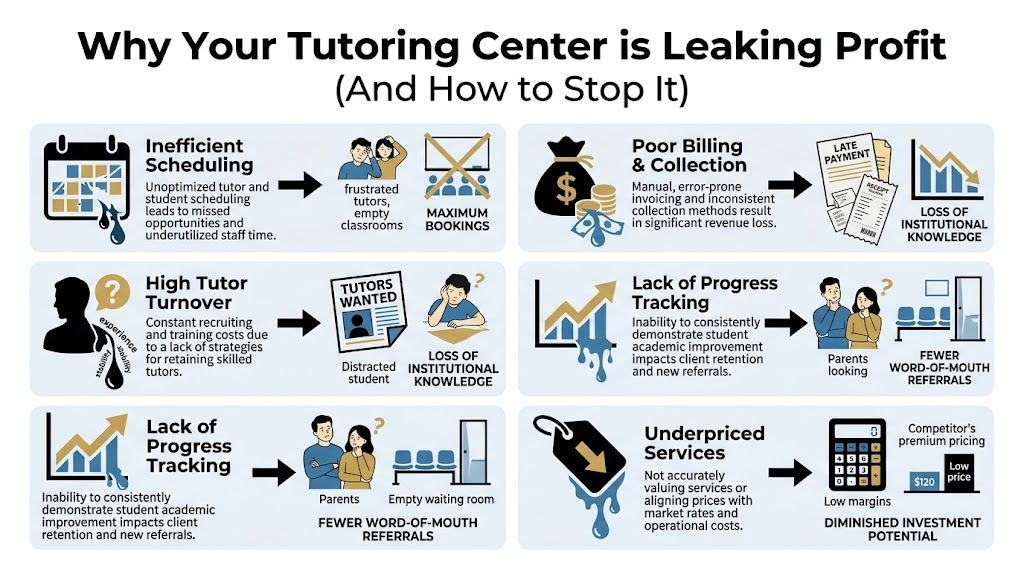
Why Your Tutoring Center is Leaking Profit (And How to Stop It)
Profit doesn't usually disappear through one dramatic failure. It leaks out through dozens of small operational misses.
A missed invoice. A room conflict that forces a class change. A specialist tutor assigned to the wrong student. A parent who doesn't renew because no one could explain progress clearly. None of these feels catastrophic on its own. Together, they wear down margin and morale.
The day usually starts behind
A common center morning looks like this. A parent wants to reschedule tonight's lesson. A tutor says they can't make Saturday. Someone notices two classes were placed in the same room. Finance asks whether last week's trial converted. Front desk needs to know whether a student still has prepaid lessons left.
None of that is unusual. The problem is when every answer lives in a different place.
One team checks Google Calendar. Another checks WhatsApp. Payroll sits in Excel. Billing lives in accounting software. Student notes are trapped in someone's inbox. By lunch, staff are already reconciling conflicting versions of the truth.
Five places margin slips away
The first leak is fragmented tools. When scheduling, billing, attendance, and payroll don't connect, your staff become the integration layer. People retype information, chase missing context, and make judgment calls under time pressure.
The second is manual finance work. If invoices don't flow from actual attendance, someone has to build them manually, check exceptions, and explain charges to parents later. That's slow, and it creates avoidable disputes.
Third comes booking error cost. A double-booked teacher doesn't just create embarrassment. It can force a cancellation, break parent trust, and waste a prime time slot you can't get back.
Then there's visibility loss. Many owners can't answer basic operational questions without asking three people. Which tutors are full. Which rooms are idle. Which classes are underfilled. Which parents are overdue. When you can't see capacity, you can't manage it.
The fifth leak is owner dependency. If every unusual booking, pricing exception, or tutor assignment needs you, then growth adds stress faster than it adds profit.
Practical rule: if your center needs late-night admin to stay functional, the business isn't running efficiently. It's running on owner overtime.
Capacity problems don't just affect schools
This issue shows up across the broader tutoring market too. A critical barrier to expansion is capacity. Approximately one-third of school leaders report lacking the capacity to provide high-dosage tutoring to all students who need it, and nearly 20% said they couldn't provide even regular tutoring to all students in need, according to Education Week's reporting on school tutoring capacity.
Private centers feel a version of the same pressure. Demand may exist, but you still need enough qualified tutors, enough usable slots, enough clean scheduling logic, and enough admin bandwidth to deliver reliably.
What not to do when things get messy
Owners often respond in ways that feel sensible but make the operation worse.
- Add another spreadsheet: This gives temporary relief, then creates another source of mismatch.
- Keep exceptions in chat threads: Staff lose context, and policies become inconsistent.
- Let each branch run its own process: Short-term flexibility turns into reporting chaos.
- Price around the mess: Raising prices can help, but it won't fix leakage caused by weak systems.
A center can have strong demand and still feel financially tight because the backend burns time and trust.
What actually stops the leak
You need one source of truth for lessons, attendance, billing, and staffing. Not because software is fashionable, but because the operation gets too interdependent to manage piecemeal after a certain point.
Once those workflows connect, several things improve at once. Booking errors drop. Collections become cleaner. Tutor assignments become more intentional. Managers stop making decisions from stale or partial information.
That is usually the moment a tutoring business starts to feel scalable instead of fragile.
How to Design High-Impact Tutoring Programs for Better Outcomes
Strong operations matter, but they aren't the end goal. Families stay when students improve and when that improvement feels visible, consistent, and credible.
That means k -12 tutoring centers can't separate program design from business performance. If your model produces uneven results, retention becomes harder. If your model works but your delivery is inconsistent, parents still lose confidence.
What effective tutoring programs have in common
The best programs usually share a few traits. They keep group sizes small enough for real interaction. They use consistent tutors where possible. They align instruction to a clear level or standard. They run often enough to build momentum instead of treating tutoring as random homework help.
That's why the structure behind high-dosage tutoring matters. It's not just "more sessions." It's a repeatable model with cadence, consistency, and instructional discipline.
Validated studies show that students in high-dosage tutoring programs outperform peers by up to 8 percentile points on NWEA MAP Growth math assessments, which is described as approximately 8 months of additional learning in this brief on K12 Tutoring's validated outcomes.
Program quality breaks when delivery gets sloppy
Many centers understand the educational idea but underestimate the operational burden.
A high-impact model falls apart when:
- Tutor consistency changes constantly
- Attendance isn't tracked carefully
- Students get moved between loosely matched groups
- Materials differ too much by teacher
- Parents can't see the plan or progress
Those aren't small admin issues. They directly affect outcomes.
A good program on paper still fails if the student experience feels improvised week to week.
Better outcomes become a business advantage
Parents don't just ask whether you offer math, reading, or exam prep. They ask whether the program works for students like their child. The centers that answer confidently usually have two things in place. A sound instructional model and enough operational discipline to deliver it the same way every week.
That changes sales conversations. It also changes renewals. When families can see that sessions are structured, attendance is consistent, and instruction follows a visible path, they have fewer reasons to leave.
What works versus what doesn't
Here's the trade-off many operators need to accept:
| Approach | What it feels like | What usually happens |
|---|---|---|
| Flexible but loosely defined tutoring | Easy to sell quickly | Inconsistent teaching, harder staffing, vague outcomes |
| Structured, repeatable tutoring model | More setup work upfront | Better consistency, cleaner staffing, stronger parent confidence |
The centers that scale well usually choose structure earlier than their competitors do. They decide what a program is, who it's for, how often it runs, how students are grouped, and what success looks like.
That discipline doesn't make the tutoring robotic. It makes it dependable.
Beyond Enrollment What KPIs Reveal About Your Business Health
Enrollment tells you demand. It doesn't tell you whether the business is healthy.
I've seen centers celebrate a full calendar while cash collection slips, tutor workload becomes uneven, and parent renewals soften. The schedule looks busy, but the operation underneath is unstable. That's why owners need a KPI set that goes beyond raw student count.

Three KPI groups that matter
Most tutoring centers should watch three categories at the same time.
Operational KPIs
These tell you whether your delivery engine is running efficiently.
- Teacher utilization: Are your strongest tutors overbooked while others sit half-empty?
- Room usage: Which rooms carry peak demand, and which stay underused?
- Class fill rate: Are group classes filling, or are you running too many low-seat sessions?
- Schedule conflict patterns: Where do reschedules, late changes, and mismatch issues keep appearing?
These metrics answer a practical question. Are you using the capacity you already have before hiring more staff or opening more slots?
Financial KPIs
These reveal whether activity is turning into cash cleanly.
A center should watch invoice status, overdue balances, credit consumption, package usage, and revenue by service type. If one program looks popular but creates more admin exceptions, cancellations, or payment chasing than another, you need to know that.
A healthy finance view also helps with pricing decisions. Many owners underprice because they only compare headline rates, not the operational burden behind different services.
Student outcome KPIs
Here, many tutoring businesses stay blind.
There is a documented gap for tutoring centers in measuring and reporting outcomes. Most platforms focus on logistics but don't provide dashboards that connect attendance and tutoring activity with grade improvement or assessment gains, as noted by K12.com's tutoring page discussion of outcomes claims and the broader reporting gap.
That gap matters because parents don't renew based on attendance alone. They renew when attendance connects to progress.
What to track for student progress
You don't need a complicated research department. You need a repeatable way to show movement.
Useful indicators include:
- Pre and post assessment trends
- Attendance consistency by student
- Tutor notes tied to clear goals
- Parent-facing progress summaries
- Time to mastery for a defined skill set
If you're building grade-level programs, curriculum resources can help anchor those progress conversations. A simple guide to what third graders learn is the kind of reference many centers can use to align parent expectations with actual academic targets.
One dashboard beats five disconnected reports
The importance of a proper student and family record becomes clear. You want lesson history, attendance, payment status, notes, subject data, and contact details living together. A system such as Tutorbase CRM reflects that model by keeping student information operationally usable instead of scattering it across admin tools.
When a parent asks, "Is this working?", you should be able to answer with records, not memory.
The deeper point is simple. KPI tracking isn't corporate theater. It helps you catch weakness while it's still fixable.
How to Reduce Admin Friction and Scale Your Tutoring Center
At 8:45 p.m., the last student has gone home, but the owner is still at the desk fixing tomorrow's schedule, checking which tutor taught which lesson, and trying to work out whether an invoice should include a makeup session or a credit. That routine feels normal in a growing center. It is also expensive.
Scale does not break tutoring centers because demand is too high. It breaks them when scheduling, billing, payroll, rooms, and lead follow-up all live in separate places and have to be stitched together by staff memory.

I have seen the same pattern repeatedly. A center adds more tutors, more subjects, and one more location. Revenue grows, but admin grows faster. Owners end up buying growth with late nights.
Fix scheduling first
Scheduling is the control point. If bookings are unreliable, every process after that inherits bad data.
For multi-branch centers, the problem is rarely just finding an open hour. Staff need to match students to the right tutor, account for branch and room constraints, respect availability, and avoid conflicts at the same time. Without a central rule set, centers lose time to avoidable back-and-forth and lose trust when families get booked incorrectly. That matching problem becomes even harder across locations, as discussed in this discussion of multi-branch tutoring matching challenges.
Before
A coordinator gets an inquiry for Grade 6 math on Tuesdays after school. They check one calendar, message two tutors, realize the room is already assigned, then ask whether another branch can take the student. Ten minutes later, nothing is confirmed, and the parent is still waiting.
After
A strong scheduling workflow should:
- Search by subject and level, not just by open time
- Filter by branch and room availability
- Respect teacher availability automatically
- Block conflicts before booking
- Suggest alternatives when the first option fails
If you are comparing tools, Tutorbase scheduling shows the kind of workflow to look for. The standard matters more than the product name. Booking should run on rules that the system enforces.
When centers get this right, two things usually happen fast. Booking errors fall sharply, and staff stop spending half the day checking exceptions manually.
Stop rebuilding invoices by hand
Manual invoicing is manageable at low volume. It starts to fail once you add sibling accounts, packages, trial lessons, hybrid delivery, cancellations, and reschedules.
The cleanest setup is simple:
- Attendance is marked at lesson level
- Billing rules sit inside the system
- Invoices generate from attended lessons or package usage
- Credits deduct automatically
- Parents receive consistent statements and receipts
That structure cuts disputes because every charge has a visible history. It also removes the end-of-month scramble where someone has to piece together what happened from chat messages, paper notes, and tutor memory.
Field-tested advice: if finance needs to ask teaching staff what happened in order to bill correctly, your process is already too fragile.
There is a trade-off here. You give up some informal flexibility. In return, you get cleaner records, faster invoicing, and far fewer billing corrections.
Payroll should follow the same lesson data
Payroll usually becomes messy for the same reason billing does. The center records lessons in one place, attendance in another, and tutor pay adjustments somewhere else.
That setup creates avoidable corrections. It also creates distrust. Tutors notice quickly when weekend premiums, group lesson rates, or no-show rules are applied inconsistently.
A better model ties payroll to the same lesson records used for scheduling and attendance. Then the system can apply pay rules based on what was delivered.
What good payroll logic includes
- Different settlement cycles for different teacher types
- Rate rules by service or subject
- Premium handling for selected time slots or formats
- Lesson-based earnings visibility
- Fewer manual corrections at month-end
This is not just an efficiency issue. It affects retention. Good tutors do not stay long in centers where pay requires repeated explanation.
Run locations and rooms like real assets
As centers expand, room usage often stays surprisingly loose. Owners track tutor schedules closely but treat rooms as an afterthought.
That gets expensive. One branch ends up overscheduled while another has empty capacity. A room meant for one-on-one sessions gets booked for a group. Staff promise a time slot before checking whether the physical space fits the lesson format.
A practical room workflow includes:
| Room question | Why it matters |
|---|---|
| How many students fit comfortably | Prevents poor in-person experience |
| What subjects or formats fit the room | Avoids bad assignment decisions |
| When the room is unavailable | Prevents hidden clashes |
| Whether the room carries extra fees | Keeps billing accurate |
Owners who monitor room usage alongside tutor load usually find hidden capacity. That can mean fitting more sessions into the same week without hiring first or signing another lease too early.
Clean up lead handling before it becomes a staffing issue
Admin friction often starts before a student ever attends a lesson.
Leads come in through calls, website forms, WhatsApp, walk-ins, and referrals. If intake is inconsistent, the center starts making staffing decisions on incomplete information. Trial lessons get booked without firm confirmation. Tutors are reserved for families who never reply. Promising inquiries cool off because nobody owns the next step.
A stronger intake flow does three things well:
- Captures the right information early, subject, level, preferred times, branch, learning goals
- Tracks stage changes clearly, new lead, contacted, trial booked, converted, lost
- Feeds directly into scheduling, instead of forcing staff to re-enter details later
Here is a useful product walkthrough for thinking about that kind of workflow in practice:
The payoff is operational efficiency across the whole center
When these systems connect, the gains stack up. Staff stop entering the same information multiple times. Onboarding moves faster because inquiry details flow into bookings. Double-bookings are blocked before they happen. Families get a more consistent experience because the office is not improvising behind the scenes.
In practice, owners usually feel the change in three places first. Fewer admin hours disappear into schedule repair. Booking mistakes drop because one system is enforcing the rules. Utilization improves because tutors and rooms are assigned with a full view of available capacity.
That is where scale comes from. One connected workflow can handle more students without adding admin headcount at the same pace.
What does not work is automating one corner while the rest of the center stays manual. A better calendar will not fix invoicing disputes if attendance is still tracked inconsistently. Faster invoicing will not solve tutor mismatch if booking data is weak from the start. Growth gets easier when the full chain works together.
What to automate first if you're overwhelmed
Do not try to repair everything in one month. Start where bad data spreads outward.
- Scheduling and conflict prevention
- Attendance-linked billing
- Payroll from lesson data
- Lead pipeline consistency
- Room and multi-branch visibility
That order works because scheduling sits upstream. Once bookings are accurate, every process after that gets cleaner input, and the center stops wasting time correcting the same mistakes twice.
Frequently Asked Questions about K-12 Tutoring Management
Do I need software if my center is still small
If you're still running a light schedule, you can survive with simpler tools. The problem starts when growth adds complexity faster than your team can coordinate it. Once you manage multiple tutors, formats, or billing rules, manual systems usually become expensive in hidden ways.
What's the first process to standardize
Start with scheduling. It touches tutor allocation, room usage, parent communication, attendance, billing, and payroll. If scheduling is inconsistent, every downstream workflow gets harder.
Can a tutoring center track outcomes without becoming overly academic
Yes. You don't need formal research methods. You need consistent records, simple assessments where appropriate, attendance tracking, and progress summaries that parents can understand.
Why do double-bookings happen so often
They usually happen because centers rely on separate calendars, manual updates, or chat-based exceptions. The issue isn't carelessness. The issue is that no single system enforces the rules.
Is high-dosage tutoring realistic for private centers
It can be, but only if the center can maintain frequency, consistency, and tutor quality. The educational model is demanding. The scheduling and staffing model has to support it.
What should I review every week as an owner
Review tutor load, open capacity, unpaid invoices, class fill, new leads, trial conversions, and any students at risk of dropping. That weekly rhythm catches problems before they become month-end surprises.
How do I know if admin work is hurting profitability
A simple sign is when staff spend evenings fixing bookings, rebuilding invoices, or answering questions that should already be visible in the system. Another sign is when growth increases stress without increasing control.
Is switching systems disruptive
It can be if you move without cleaning up your data or processes first. The smoothest transitions happen when you standardize core rules before migration, especially around services, pricing, attendance states, and payroll logic.
If you're tired of running your tutoring center through spreadsheets, calendar patches, and late-night cleanup, Tutorbase is worth a look. It brings scheduling, billing, payroll, rooms, and student management into one system so you can spend less time on admin and more time building a stronger k -12 tutoring business.


