


Summer is where a lot of tutoring centers either create momentum for the rest of the year or create chaos that drags into September.
If you're figuring out how to start a summer program, the mistake isn't usually bad teaching. It's bad operations. Centers launch a few camps, intensives, or bootcamps, then get buried in teacher availability, room conflicts, manual invoices, parent questions, and payroll spreadsheets that nobody trusts.
Key takeaway: a strong summer program starts with sharp positioning, then lives or dies on capacity planning, pricing discipline, and clean operational systems. If you build the program like a temporary side project, it will behave like one. If you build it like a repeatable business line, it can become one.
Define Your Summer Program Goals and Curriculum
There is real demand for summer learning, and the market is still underserved. A 2024 Gallup survey reported that 55% of K-12 students participated in summer programs, while 48% of parents wished their children could have participated but were unable, representing roughly 25 million underserved children. That matters because most tutoring centers don't need to invent demand. They need to package the right offer and remove friction.

The first decision isn't schedule. It's purpose.
A summer program can do several jobs, but it shouldn't try to do all of them at once. Academic recovery, enrichment, test prep, language intensives, and parent-friendly childcare-style coverage all pull your curriculum in different directions. If you mix them into one loose offering, your marketing gets muddy and your delivery gets harder.
Pick the business goal before you build the classes
Most centers do better when they choose one primary goal and one secondary goal.
For example:
- Retention first: Keep existing students active through summer so they don't disappear and need re-enrollment in autumn.
- Acquisition first: Use summer as a lower-friction entry point for new families through short programs and trials.
- Margin first: Focus on premium intensives such as SAT math bootcamps, IELTS writing clinics, or small-group language immersion.
- Capacity first: Fill underused daytime rooms and teacher hours that sit idle during the regular school term.
Each goal changes what you should sell. A retention-focused program often works best with continuity, familiar teachers, and light packaging changes. An acquisition-focused program usually needs clearer entry points, simpler offers, and fast trial booking.
Practical rule: If staff can't explain your summer offer in one sentence, parents won't understand it either.
Use diagnostic data, not instinct
For academic programs, the cleanest starting point is end-of-year student performance data. The strongest operators don't decide summer curriculum by asking teachers what sounds fun. They look at where students are weak, then build services around those gaps.
Curriculum Associates notes that successful summer learning programs start with student needs assessment and targeted support. In practice, that means reviewing school reports, internal assessments, mock exam results, reading levels, placement tests, and teacher notes before you publish anything.
Then group demand into teachable offers:
- Subject: Math, Reading, English Writing, SAT Verbal, French
- Level: Grade 4, Grade 8, A2, B1, advanced, exam-track
- Service: Small group intensive, private catch-up, hybrid clinic, bootcamp, weekly camp block
That structure matters more than people think. If your team stores everything as a vague label like "summer class," every later step gets harder. Scheduling becomes messy, teacher matching becomes manual, room planning gets inconsistent, and pricing exceptions pile up.
If you're refining that academic framework, LearnStream's curriculum guide is a useful reference for shaping programs into a clearer sequence rather than a random list of activities.
Build offers that parents can actually buy
Parents don't buy curriculum maps. They buy outcomes they can understand.
A stronger menu looks like this:
| Program type | Who it's for | What parents understand quickly |
|---|---|---|
| Reading recovery | Students below expected reading level | "Catch up before school starts" |
| Math foundation class | Students who need skill repair | "Fix gaps before next grade" |
| SAT intensive | Exam students | "Focused prep during the break" |
| French B1 summer course | Language learners with a level path | "Move up one level this summer" |
| Study skills workshop | Broad audience | "Build habits before term starts" |
The simpler your catalog, the easier it is to market and staff.
This is also where many operators should narrow their ambition. Three well-defined services outperform ten loosely described ones. Fewer offers create cleaner messaging and better group formation.
Separate enrichment from operational confusion
Enrichment has value, but it shouldn't blur your core offer. If you run academic tutoring, don't bolt on crafts, coding, drama, and sports just because summer camps do. Add enrichment only when it supports your positioning or helps with parent appeal.
A practical split is to keep the core service academic, then attach structured extras such as:
- Skills workshops: Writing, public speaking, study planning
- Project blocks: STEM build sessions, book clubs, debate labs
- Language culture sessions: Conversation clubs, themed vocabulary, presentation practice
If you need inspiration beyond generic camp ideas, this guide to program curriculum for tutoring centers gives a more relevant lens for education businesses than nonprofit camp checklists.
Parents forgive a narrow offer that is clear. They don't forgive a broad offer that feels improvised.
Model Your Capacity, Staffing, and Payroll
A summer program usually breaks on a Tuesday at 8:12 a.m. The front desk is fixing a room clash, a parent wants to move a child into a fuller class, one teacher has called in sick, and the branch manager is checking three spreadsheets that all say something different. By the end of the month, payroll is still being rebuilt by hand.

That is the primary constraint for a commercial tutoring center. Demand matters, but operational control matters more. If you run more than one branch, capacity planning has to connect rooms, teacher qualifications, delivery mode, supervision, and payroll rules in one system. Otherwise you do not have capacity. You have guesses.
Capacity is more than seat count
A 10-seat room does not automatically give you 10 sellable places.
Sellable capacity depends on whether the room is available for the full block, whether the assigned teacher can teach that subject and level, whether the format fits the room, and whether the branch can supervise that class without disrupting everything else. Hybrid classes need camera setup. Exam prep may need a quieter room. Younger learners may need more staff presence between blocks. Makeup demand also matters, because a timetable with no spare space creates parent friction fast.
I model capacity at the class level, not the room level. For each branch, list the recurring time blocks you can run, then stress-test them against four constraints:
- Teacher fit: Subject, level, age group, and delivery mode
- Room fit: Capacity, equipment, and recurring availability
- Branch coverage: Who handles arrivals, absences, and parent issues
- Schedule elasticity: Whether you still have room for trials, makeups, and substitutions
One empty classroom at Branch B does not help if all qualified maths teachers are already maxed out at Branch A. One available teacher does not help if every suitable room is taken. Multi-branch operators make money when they can see those bottlenecks early and shift demand before sales overpromise.
Build staffing in layers
Summer staffing fails when every teacher is treated as a name on a rota.
Use three operational layers instead:
Teaching staff
Match by subject, level, branch, online or in-person capability, and preferred schedule. Availability alone is a weak staffing rule.Branch lead
Put one person in charge of same-day decisions. They handle room swaps, attendance gaps, parent escalations, and teacher handoffs before small issues spread.Central operations owner
One person needs visibility across all branches. That person sees underfilled groups, duplicate hiring, substitution pressure, and idle slots before they become margin leaks.
This structure protects profit. It also protects quality. Without central oversight, each branch optimizes for itself and the business pays for it through uneven fill rates, unnecessary staffing, and bad group composition.
Keep a live skills matrix for every teacher. Include subject, level ceiling, age range, branch eligibility, online readiness, preferred hours, pay model, and any premium-rate constraints. This is one of the least glamorous documents in the building, and one of the most useful.
For service businesses that are defining operational roles more clearly, SEO playbooks for HR consultants is an interesting example of how specialized firms package expertise into clearer offers and responsibilities.
Model payroll before you publish the timetable
Summer payroll is not an admin task you sort out later. It shapes what you can run profitably.
A flat hourly rate is easy to start with, but it can create the wrong behavior. Harder classes, premium time slots, larger groups, and last-minute branch cover all carry different economics. At the other extreme, too many special arrangements turn payroll into a monthly argument. The answer is a rule set your team can apply without interpretation.
A workable model often looks like this:
| Payroll approach | Where it works | Operational risk |
|---|---|---|
| Hourly only | Simple private tutoring | Weak alignment for premium classes or group formats |
| Per lesson | Standardized short sessions | Prep, admin, and overrun time get missed |
| Revenue share | Premium services and specialist teachers | Needs accurate attendance and billing records |
| Base plus variable | Centers with mixed services and branches | Hard to manage manually |
| Overtime and premiums | Peak schedules, weekends, and branch cover | Spreadsheet errors become expensive |
The trade-off is straightforward. Simpler payroll is easier to administer but less precise. More precise payroll can protect margin and improve retention, but only if your records are clean.
That is why growing centers stop relying on end-of-month reconstruction. If pay depends on attendance, substitutions, branch differentials, weekend premiums, or group size, you need payroll that syncs with lessons taught. Otherwise your ops team spends hours checking what should already be in the system.
This walkthrough shows the operational side clearly:
Failure points to catch early
The expensive problems are usually ordinary ones.
- Teacher mismatch: A capable teacher gets placed outside their best subject because the slot needed filling
- Room conflicts: Premium classes lose the right space because room rules were not enforced centrally
- Weak substitution coverage: One absence triggers multiple changes because nobody can filter by qualification and availability quickly
- Payroll disputes: Staff challenge totals because attendance, cancellations, and makeup rules were recorded inconsistently
- Hidden idle time: Branches keep staff on the clock between low-density blocks because the schedule was built for convenience, not utilization
A summer program can survive a weak class or two. It struggles when the schedule is unreliable, the branches operate from different versions of the truth, and staff do not trust the payroll report.
Design Your Pricing, Packages, and Policies
Summer pricing isn't a line item. It's your operating model in public.
Parents compare price, but they also react to clarity, flexibility, and risk. If your center only offers a plain hourly rate, you'll force every family into the same buying behavior even though summer demand is uneven. Some want a short intensive. Some want a flexible credit pool. Some want continuity through the entire break.
Afterschool Alliance highlighted that cost is the biggest barrier, with two-thirds of parents naming it as a top concern and 46% reporting difficulty affording camp. That doesn't mean you should race to the bottom. It means your pricing needs multiple entry points.
Stop selling only hourly lessons
Hourly pricing is easy to explain, but it creates weak commitment and messy forecasting.
A stronger summer menu usually includes a mix like this:
- Fixed package: Good for SAT bootcamps, writing intensives, or holiday language courses
- Prepaid credits: Useful when families want flexibility across dates or siblings
- Subscription: Strong for retention-focused programs that continue into term time
- Trial plus conversion path: Best when summer acts as an acquisition funnel
Each model changes behavior. Packages encourage completion. Credits reduce friction for irregular attendance. Subscriptions create continuity if your summer offer feeds directly into autumn classes.
Policy design protects revenue
Most operators talk about pricing and ignore policy. That's a mistake.
The money leaks usually come from vague rules around:
- trial lessons
- late cancellations
- no-shows
- package expiry
- refunds
- makeups
- sibling exceptions
- branch-specific offers
If these rules live in a PDF, an admin inbox, and one manager's memory, they won't be enforced consistently. Parents notice that quickly. So do staff.
A practical policy structure should answer the following:
| Policy area | What you need to decide |
|---|---|
| Trial lesson | Free, discounted, or paid |
| Cancellation window | How much notice avoids a fee |
| Late cancel | Fee, lost credit, or no charge |
| No-show | Full charge or partial charge |
| Package expiry | Fixed end date or rolling validity |
| Refund handling | Cash, account credit, or no refund |
| Exceptions | Who can approve them and where they're recorded |
Consistency matters more than strictness. Parents can adapt to firm rules if they are visible and applied evenly.
Operator note: the awkward parent conversation usually isn't caused by the fee. It's caused by inconsistent enforcement.
Use layered pricing instead of ad hoc discounts
Summer always creates exceptions. One branch needs a local promotion. One student gets a grandfathered rate. One service needs a launch offer. One family wants a sibling bundle.
If you handle those manually, you'll eventually invoice the wrong amount or charge the wrong policy. Layered pricing solves that by setting a clear order of precedence. The broadest rule sits at the top, then more specific rules override it only when needed.
A practical hierarchy looks like this:
- Global rules for your default pricing model
- Location rules for branch-specific offers
- Service rules for a particular program
- Student rules for approved special cases
That structure lets you stay flexible without becoming chaotic.
What tends to work best
I've seen more centers improve summer profitability when they package value instead of discounting it.
A few examples:
- A 10-session exam bootcamp feels more concrete than open-ended hourly tutoring.
- A credit wallet works well for families juggling travel and changing summer schedules.
- A subscription with lesson bundles creates a cleaner handoff into your regular term.
- A discounted trial that auto-converts often attracts stronger leads than a totally free lesson because expectations are clearer.
What doesn't work well is layering custom deals on top of weak policy enforcement. That creates admin work, not flexibility.
Your pricing page should make buying easy. Your internal rules should make administration easy. If one is clean and the other isn't, summer still gets messy.
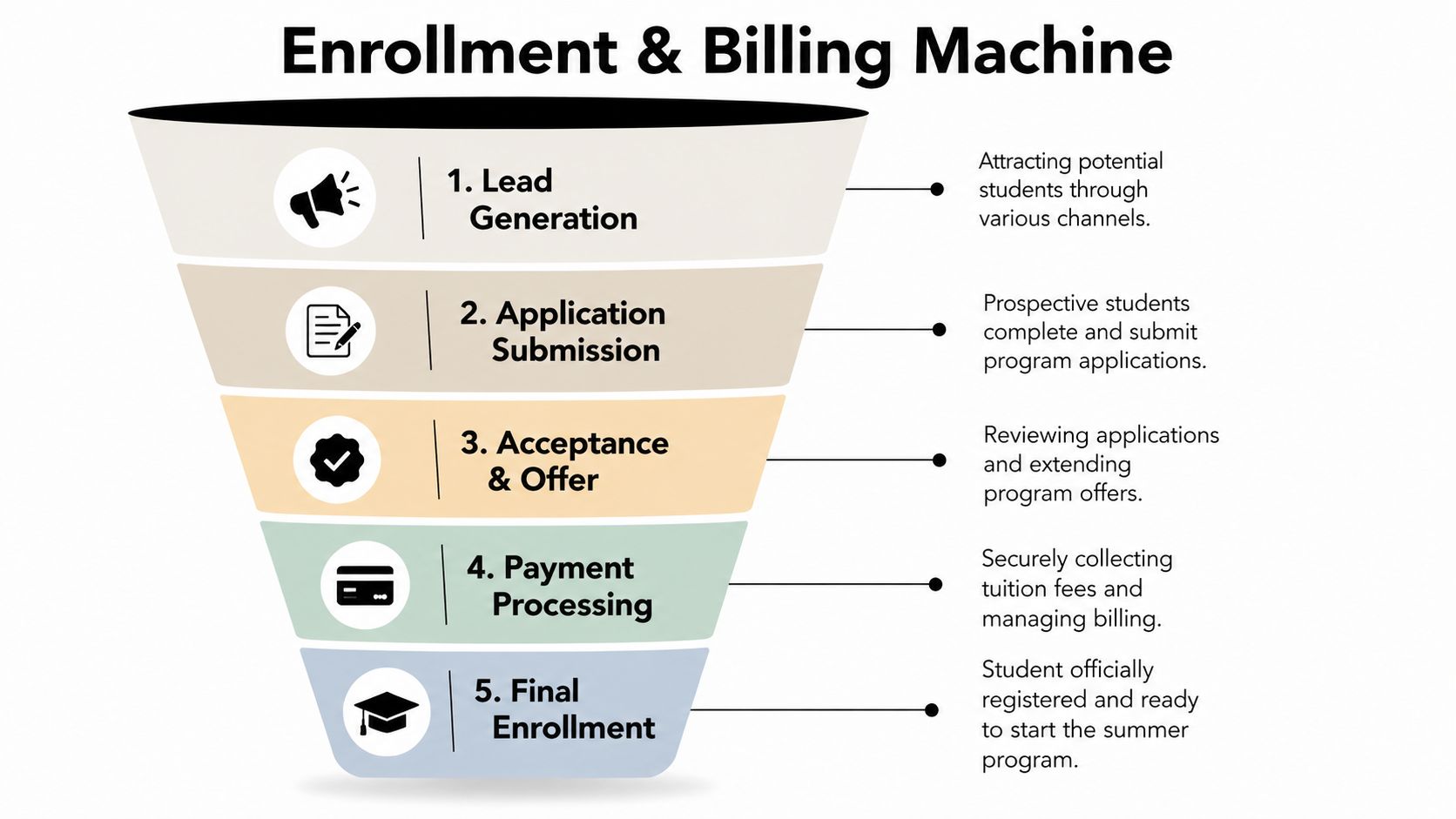
Build Your Enrollment and Billing Machine
Most centers lose summer sales in the handoff between inquiry and payment.
A parent fills in a website form. Someone replies late. A trial gets offered at the wrong level. The admin team checks teacher calendars manually. The invoice gets sent after the lesson instead of before the package starts. By then, the family has gone cold or the payment is delayed.
That's why the strongest summer programs treat enrollment and billing as one continuous system, not separate tasks.
Build one visible pipeline
At minimum, every lead should move through a defined sequence. Not every center uses the same labels, but the stages should be explicit.
A simple version works well:
| Stage | What must happen |
|---|---|
| New lead | Source captured and basic interest logged |
| Contacted | Parent contacted and needs clarified |
| Trial scheduled | Correct service, level, and format booked |
| Converted | Package, credits, or subscription selected |
| Active | Attendance and billing running normally |
If your team jumps between WhatsApp, email, phone notes, and spreadsheets, leads get stranded. Nobody is sure whether the family was contacted, whether the trial happened, or whether an invoice was paid.
That combination is why summer ops need workflow discipline. Speed matters, but clean handoff matters more.
Make trial booking fast enough to save the lead
Manual trial scheduling is one of the worst hidden bottlenecks in tutoring businesses.
A staff member receives an inquiry, opens a calendar, checks a teacher sheet, checks a room sheet, asks whether the level fits, then offers two possible times. By the time the parent replies, one of those times is gone.
A better process is direct and short:
- Capture the right intake data first: subject, level, age, branch, preferred format
- Offer only valid slots: teacher, room, and service must all match
- Use existing classes when possible: don't open a new group if a suitable one already has space
- Confirm billing logic before the lesson happens: trial status should already be defined in the system
Fast booking isn't only about convenience. It protects conversion because the family feels momentum instead of friction.
Connect attendance to money
Many centers still operate like it's a side business.
Billing should not depend on someone remembering what happened in class. It should flow from attendance records. If a lesson was attended, no-showed, late-cancelled, or marked as a trial, that status should feed the invoice correctly based on your pricing rules.
That creates a few major benefits:
- Fewer manual invoice errors
- Cleaner package consumption
- Less payment chasing
- Better payroll accuracy later
- Better parent trust because charges make sense
If you want a deeper look at how to automate tutoring invoices, focus on systems that generate billing directly from attendance rather than forcing staff to recreate lesson history manually.
Choose one primary payment behavior
Summer programs become harder to manage when every family pays in a different way.
Pick the primary behavior you want and build around it:
- Pay before the package starts
- Maintain a prepaid credit balance
- Pay on a fixed billing cadence
- Subscribe for the full summer cycle
Then allow exceptions sparingly.
Prepaid models are especially useful in summer because they absorb schedule volatility. If a family travels, changes branches, or mixes online with in-person sessions, a credit system keeps the admin burden lower than one-off invoicing.
The integrated version wins
Here's the difference in practice.
Fragmented workflow
- Lead arrives through WhatsApp
- Trial booked in a shared calendar
- Attendance tracked on paper or in chat
- Invoice created later in accounting software
- Parent follows up about balance
- Staff checks another spreadsheet for package usage
Integrated workflow
- Lead enters a defined pipeline
- Trial books into a valid slot
- Attendance sets billing status
- Invoice or credit deduction happens automatically
- Parent balance stays visible
- Staff sees conversion and payment status in one place
The second model is less about sophistication and more about survival. Summer moves quickly. Every manual handoff increases the chance of a dropped lead, a delayed payment, or a billing argument.
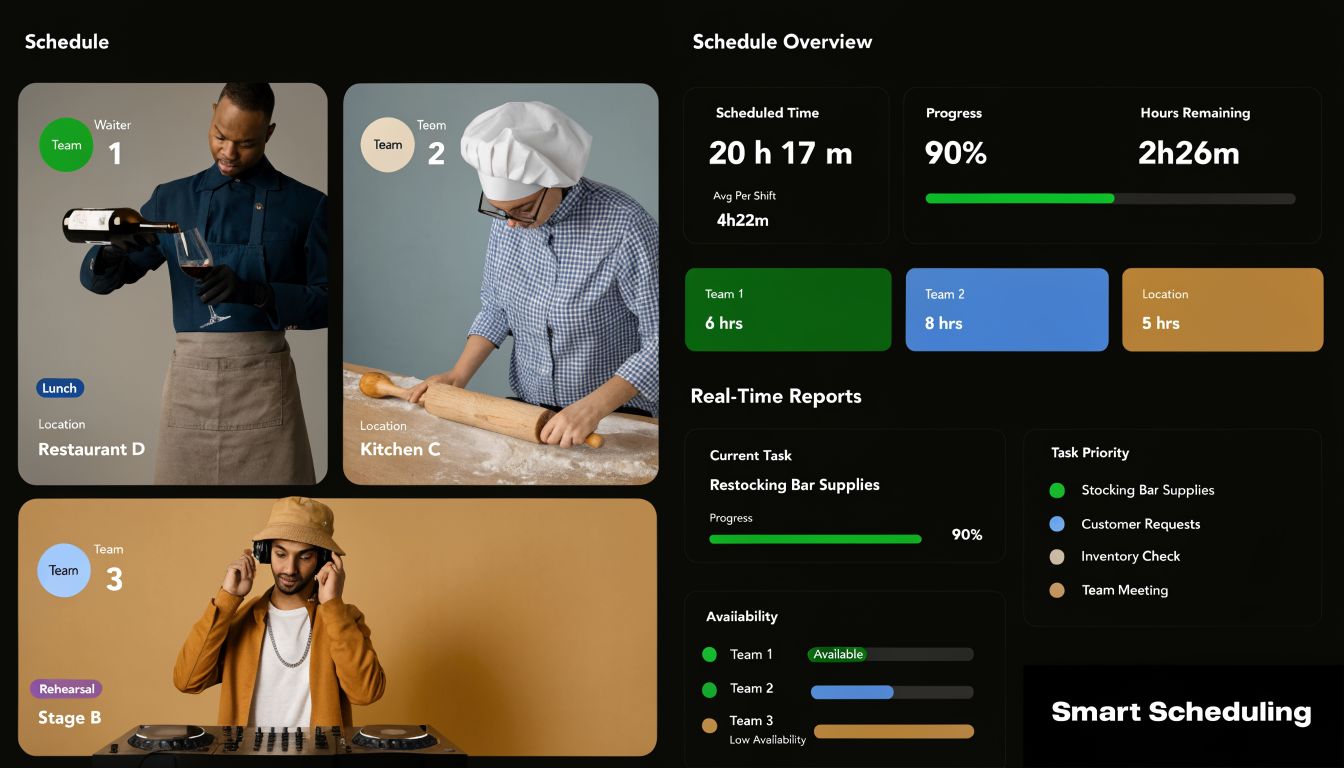
Execute Flawlessly with Smart Scheduling and Reporting
Once the program starts, the work changes. You stop designing and start controlling variance.
That means you need tight execution on attendance, recurring schedules, hybrid delivery, and reporting. If those four pieces are loose, you won't know what's happening until the summer is over, and by then the mistakes are already on your P&L.
Attendance is operational data
Attendance isn't just a register for compliance. It drives billing, payroll, parent communication, and performance review.
Use clear statuses and train staff to apply them consistently:
- Attended: Student showed up and lesson counts normally
- No-show: Student missed without valid notice
- Cancelled: Session removed under policy
- Late cancelled: Session missed inside the chargeable window
- Trial: Separate from regular attendance so conversion reporting stays clean
- Catch-up: Logged differently if it affects package use or staff pay
If teachers record attendance late or inconsistently, every downstream process gets dirtier.
Recurring scheduling prevents admin drift
Summer often looks short, so operators underestimate the scheduling load. But short-term programs are exactly where recurring scheduling helps most.
If you're running a four-week reading intensive or a multi-week language course, create the full lesson series at the start. Then handle exceptions as exceptions. Don't rebuild every week by hand.
That approach gives you:
| Operational habit | What it improves |
|---|---|
| Recurring lesson setup | Fewer missed sessions and less admin work |
| Conflict alerts | Faster correction before parents are affected |
| Room-level visibility | Better use of premium spaces |
| Teacher load tracking | Fairer workload distribution |
| Live attendance reporting | More accurate billing and payroll |
The centers that stay calm in summer usually aren't working harder. They're working from a cleaner operational baseline.
Watch the metrics that matter
Most operators already know when a class feels full or when a teacher looks busy. That isn't enough.
Use reporting to answer concrete questions:
- Which programs are filling and which are dragging?
- Which branches still have room at peak times?
- Which teachers are overloaded or underused?
- Which services produce the strongest renewals into the next term?
- Where are late cancellations and no-shows clustering?
- Which packages are close to expiry and need follow-up?
Hisawyer notes that top-performing summer tutoring programs can see 42% higher renewal rates when they use subscription models and lesson bundles with automated expiration dates. The practical lesson isn't just "use subscriptions." It's that operators need systems that show who is about to renew, expire, or drop.
The schedule tells you what should happen. Reporting tells you what actually happened.
Hybrid delivery needs one source of truth
If you run hybrid classes, don't track online and in-person students in separate places. That creates mismatched rosters, billing confusion, and teacher errors.
Keep one lesson record with student-level attendance and mode tracking. Then your team can answer simple but important questions quickly: who attended, how they attended, what gets billed, and what gets paid to the teacher.
That level of clarity matters most when you're juggling makeups, holiday travel, and families who want flexibility without administrative surprises.
Your Summer Program Launch Checklist
A summer program usually looks ready before it is. The timetable is drafted, teachers are asking for hours, and marketing wants the enrollment link live. Then the first parent calls with a simple question about makeups, split payments, or branch transfer rules, and the team gives three different answers.
Use this checklist to catch those failures before launch day. For multi-branch centers, the goal is not just to open enrollment. The goal is to open with a setup your team can repeat across locations without adding manual cleanup every week.
Launch checks that protect margin
Define each offer at service level.
Every program should be set up with a clear subject, level, age or grade band, delivery mode, session length, and branch availability. If staff still describe the same offer in different ways, enrollment errors will follow.Keep the catalog tight.
Fewer offers make demand easier to route, classes easier to fill, and staffing easier to control. A broad menu usually creates half-full groups and scheduling exceptions.Confirm real capacity by branch. Check room limits, teacher qualifications, peak-hour availability, and timetable conflicts together. A class is not available unless all four line up in the system.
Assign owners for local and central decisions.
Each branch needs someone handling day-to-day exceptions. One central owner should control cross-branch capacity, reporting, and policy consistency.Lock payroll rules before the first class is sold.
Decide how teacher pay works for group classes, 1:1 lessons, substitutions, late cancellations, and student no-shows. If payroll depends on manual reconstruction from chat messages and paper registers, disputes are coming.Set the billing structure in advance.
Choose whether families buy packages, weekly enrollments, monthly subscriptions, or fixed-term intensives. Then configure invoices, due dates, credits, and expiry rules to match.Write policies so staff cannot interpret them three different ways.
Cancellation windows, makeup rights, refunds, transfers, and sibling discounts should be documented in plain language and reflected in the booking flow.Build one enrollment workflow.
Inquiry, assessment, trial, enrollment, payment, and onboarding should sit in one process. If lead notes live in one tool and billing lives in another, follow-up slows down and conversion drops.Connect attendance, billing, and payroll.
Marking attendance should trigger the correct financial outcome based on your rules. Summer gets messy fast when admins have to remember which absence is billable and which one creates a makeup credit.Choose weekly operating reports before launch.
Review fill rate, remaining seats, teacher utilization, overdue balances, package burn-down, and branch-by-branch profitability. If a metric matters in week two, build the report before week one starts.
A practical final test
Run one real workflow from start to finish before you open publicly.
Have one staff member process a brand-new inquiry, place the student in the correct program, collect payment, explain the policy, mark a sample attendance record, and confirm what appears in billing and payroll. Then ask a second staff member at another branch to do the same thing. If the results differ, the problem is not training alone. The setup is still too dependent on memory, workarounds, or branch-specific habits.
That is the standard worth using. A profitable summer program is not the one that launches with the most noise. It is the one your team can run accurately, across branches, with software doing the repetitive work before admin chaos eats the margin.
Frequently Asked Questions
How early should you start planning a summer program?
Earlier than most centers think. Curriculum, staffing, room allocation, and pricing all interact. If you leave these decisions too late, you end up selling before the backend is stable. That usually leads to manual exceptions, not better enrollment.
Should a tutoring center run camps, intensives, or regular lessons in summer?
It depends on your existing customer base and operations. Intensives work well when families want a defined outcome, such as exam prep or skill recovery. Regular lessons work better when retention is the main goal. Camps can work, but only if they still fit your academic positioning and staff capability.
How do you know whether to launch a new class or fill an existing one?
Use existing capacity first when the level, subject, and timing fit. Opening too many small groups creates staffing and margin problems. Launch a new class when demand is clear and the existing timetable can't serve that student without lowering quality or creating a mismatch.
What's the biggest operational mistake in summer?
Treating summer like a short-term side offer. That mindset leads to scattered scheduling, improvised pricing, and weak tracking. Summer is compressed, which means operational mistakes show up faster. Tight systems matter more, not less.
Should you offer free trials for summer programs?
Sometimes, but not automatically. Free trials can help acquisition, especially for new families. They can also attract low-intent inquiries if the rest of the offer is vague. A discounted trial often creates better expectation-setting because it frames the lesson as a real service, not a casual sample.
How should you handle parents who want lots of exceptions?
Decide your boundaries before enrollment opens. Summer generates more exception requests because families travel, change plans, and compare options. If your rules are clear and your staff follows them consistently, most issues stay manageable. If you negotiate every case from scratch, admin workload grows fast and fairness disappears.
What should you track every week during the program?
Track class fill, attendance patterns, payment status, package consumption, teacher workload, and room use. Also watch which students are likely to continue after summer ends. Operators often focus on today's timetable and ignore renewal signals until it's too late.
Can a small tutoring center still run a strong summer program?
Yes, if the offer is narrow and the process is disciplined. Small centers often do well when they focus on a few defined services, use a simple enrollment path, and avoid overbuilding the catalog. You don't need a giant program. You need one that your team can execute cleanly.
If you're tired of running summer programs through spreadsheets, chat threads, and disconnected tools, Tutorbase gives tutoring centers one place to manage scheduling, billing, payroll, rooms, leads, and attendance. It's built for operators who want a summer program that stays profitable without creating admin chaos.


