


The average rate for tutoring varies, but for K-12 subjects, expect to pay between $40-$60 per hour in North America and £30-£50 in the UK. For specialized test prep like the SAT or advanced subjects, fees often exceed $80 per hour. Your final price depends on tutor experience, subject complexity, and location.
Understanding Tutoring Market Rates
Before setting your center's prices, you must understand the competitive landscape. Viewing the "average rate for tutoring" as a single, fixed number is a common mistake. It's a spectrum that shifts based on economic and academic forces. Your goal is to find the pricing sweet spot where you reflect your value, cover costs, and attract students.
A one-size-fits-all approach is ineffective for a growing tutoring business. A center in a major city has different cost structures and client expectations than one in a small town. You wouldn't charge the same for 3rd-grade reading help as you would for AP Calculus BC review.
Global Tutoring Rate Benchmarks
The demand for quality education is global. The private tutoring market was recently valued at USD 123.5 billion and continues to grow. This growth directly influences what parents are willing to pay, regardless of your location. You can find more details in this great analysis of tutoring market growth.
This infographic provides a quick visual breakdown of typical tutor charges across three major international markets.
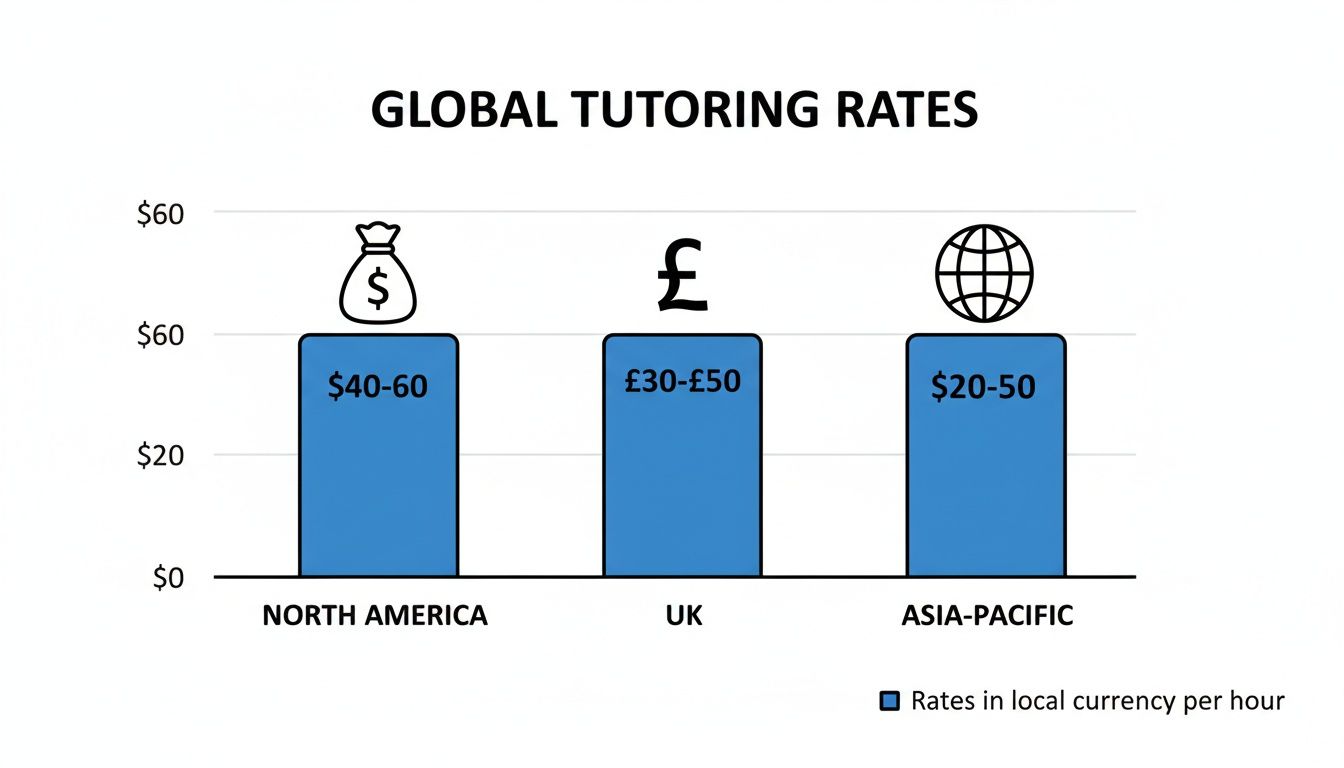
While there is some overlap, the North American and UK markets generally support higher average rates than the broader Asia-Pacific region. These benchmarks are a starting point to help you position your services.
To understand the other side of the equation, read our guide on how much tutors get paid, as this directly impacts your pricing strategy.
A well-defined pricing structure communicates confidence and quality. It shows prospective clients that you understand your market and are committed to delivering exceptional educational outcomes for their children.
To see how rates break down by service type, the table below offers a comparative snapshot of typical hourly costs.
Average Hourly Tutoring Rates by Region and Type
A comparative look at typical hourly tutoring costs across different international markets for common service types.
| Region | K-12 Subjects | Standardized Test Prep (e.g., SAT, IELTS) | Specialized/Niche (e.g., Elite STEM, Music) |
|---|---|---|---|
| North America | $40 - $75 | $60 - $150 | $70 - $200+ |
| United Kingdom | £30 - £60 | £50 - £120 | £60 - £150+ |
| Asia-Pacific | $20 - $50 | $40 - $100 | $50 - $120+ |
This table shows that specialization and test prep command a premium, a key factor when developing your service offerings.
How do I set a baseline price?
Use regional averages as your starting point. Select a standard service, like a K-12 math class, to establish your baseline rate. From there, you can adjust this rate based on factors like tutor experience, subject complexity, and whether the session is one-on-one or a group class. This foundation allows you to build a logical and defensible pricing structure that clients understand and that keeps your business profitable.
What Factors Shape Tutoring Prices?

Broad industry averages are a useful guide, but they don't determine what you should charge. To build a confident and defensible pricing structure, you must consider the specific variables that justify your value. Your final price reflects the specialized support your tutoring center provides.
Tutor Qualifications and Experience
The most significant factor driving your rates is the expertise of your teaching staff. The value proposition is simple: an experienced tutor with a proven track record is a premium asset. Parents pay for the outcomes that a tutor's qualifications deliver.
A college student tutoring basic algebra offers a different level of service than a certified teacher with a master's degree in AP Physics. The latter brings years of classroom experience and deep subject mastery, which justifies a higher price.
Subject Complexity and Demand
Not all subjects have the same market value. Basic homework help for elementary school is a different service than preparing a student for the SAT or an advanced STEM exam.
- Standard K-12 Subjects: Subjects like elementary math have a larger pool of qualified tutors, which keeps rates competitive.
- Specialized Test Prep: Services for the SAT, ACT, IELTS, or TOEFL require specific strategies and expertise, commanding a higher fee.
- Advanced STEM & AP/IB Courses: High-level subjects like calculus or AP Chemistry demand expert knowledge. Tutors for these subjects are scarcer and can charge significantly more.
Demand also plays a critical role. The focus on science and technology has created a massive market for specialized instructors. In the US alone, the private tutoring sector is projected to grow by USD 28.85 billion between 2025 and 2029, largely driven by STEM demand. You can read the full report on STEM's market impact for more detail.
Class Size and Format
The lesson format is a critical pricing lever. The level of personalized attention a student receives is directly tied to the price their family is willing to pay. For example, your private 1-on-1 rate should be your premium benchmark. All other services, such as group classes, should be priced relative to this standard.
This model benefits both you and your clients. If your private rate is $80 per hour, you might price a small group session at $45 per student. While each family pays less, your total revenue for that hour increases to $180 (for a 4-person group), making it a more profitable use of your tutor's time.
Delivery Mode and Location
You must consider the operational realities of your delivery method and physical location. Each model has distinct costs that must be reflected in your pricing.
- In-Person Tutoring: This model includes overhead like rent, utilities, and materials, which must be factored into your rates.
- Online Tutoring: This model requires investment in technology, software licenses, and digital curriculum instead of physical overhead.
- Hybrid Model: Offering both in-person and online tutoring allows you to serve a wider audience but requires managing two sets of operational costs.
Your geographic location also matters. A tutoring center in a major city like New York or London can justify higher rates due to increased operational costs and local income levels. These rates can be 20-30% above national averages, reflecting what the local market will pay.
Choosing a Pricing Model That Works for Your Business

Determining your average rate for tutoring is just the first step. Next, you must decide how to charge for your services. The right model stabilizes cash flow, improves client retention, and helps you achieve your business goals. For example, a test prep center thrives on commitment, making prepaid packages an ideal fit. An after-school program, however, needs predictable revenue, making monthly subscriptions a better choice.
Pay-As-You-Go (Per-Lesson)
This is the most straightforward model. Clients pay for each lesson individually, offering the lowest barrier to entry for new students. However, this simplicity can lead to unpredictable revenue and increased administrative work, as you must create and chase an invoice for every session. Manual invoicing for hundreds of lessons a week can consume 10+ hours of admin time.
Best for:
- New centers testing the market.
- Trial lessons or one-off consultations.
- High-cost, specialized tutoring where clients prefer not to pay a large sum upfront.
Prepaid Lesson Packages
Lesson packages are an excellent way to secure student commitment and boost cash flow. Families purchase a block of lessons, such as 10 or 20 hours, at a discounted hourly rate. This incentivizes long-term enrollment and significantly reduces weekly invoicing. For example, if your standard rate is $60/hour, you might offer a 10-lesson package for $550. The client saves $50, and you receive payment for 10 lessons in advance.
Prepaid packages shift the dynamic from a transaction to a partnership. When a family invests upfront, they are more committed to consistent attendance, which leads to better student outcomes and higher renewal rates.
This model is a core component of many successful tutoring businesses. Our complete guide to tutoring pricing models explores how to structure packages for maximum profitability.
Recurring Monthly or Term Subscriptions
The subscription model provides predictable revenue. Clients pay a flat fee each month or term for a set number of lessons. This approach stabilizes your income, making it easier to manage payroll, rent, and other fixed costs. It also simplifies billing through automated, recurring invoices. This model encourages families to view tutoring as an ongoing part of their child's education, not just a short-term fix.
To ensure your model is profitable, explore advanced strategies for service pricing profitability. This helps you look beyond the sticker price to the long-term financial health of your center.
Subscription Model Variations:
- Fixed Lessons: A set number of lessons per month (e.g., $200/month for four lessons).
- Use-It-or-Lose-It: Unused lessons do not roll over, which encourages consistent attendance.
- Rollover Credits: A limited number of unused lessons can carry over to the next month, offering flexibility.
How do I structure tutor payroll for profitability?
Your pricing strategy is only as strong as your payroll structure. If your internal pay models are inefficient, you could lose money on every class. This is where you must look beyond the "average rate for tutoring" and focus on paying tutors in a way that is fair, motivating, and profitable for your center. A simple hourly wage is straightforward but often insufficient in a dynamic tutoring center.
Common Tutor Payroll Models
Moving beyond a flat hourly rate opens up strategic opportunities. Each model has pros and cons, and the right one depends on your business goals.
- Per-Hour Rate: Tutors receive a fixed amount for every hour they teach, regardless of student attendance. It's easy to calculate but doesn't incentivize tutors to fill empty seats in group classes.
- Revenue Share (%): Tutors earn a percentage of the revenue from their classes, typically between 40-60%. This model encourages them to retain students and grow class sizes.
- Per-Student Rate: Tutors receive a fixed amount for each student in their class. This motivates tutors to manage and grow their group sessions effectively.
- Base Salary + Bonus: Often used for full-time tutors, this model provides a stable income with bonuses tied to student retention or parent feedback.
The Impact of Payroll on Profitability
Let's analyze how these models affect profitability. Imagine a one-hour group class with four students, each paying $45. Your total revenue for that hour is $180. Now, let's compare how three different payroll models impact your profit margin for a tutor who would normally earn a flat $40/hour.
Your payroll model is a strategic tool, not just an expense. The right structure motivates your staff, improves student retention, and directly increases your center's profitability without raising prices.
Here’s how the math breaks down for that single class.
Sample Class Profitability by Tutor Payroll Model
| Metric | Model A (Per-Hour) | Model B (Revenue Share) | Model C (Per-Student) |
|---|---|---|---|
| Class Revenue | $180 (4 students @ $45) | $180 (4 students @ $45) | $180 (4 students @ $45) |
| Tutor Pay Structure | $40 Flat Hourly Rate | 40% of Revenue | $15 Per Student |
| Total Tutor Payout | $40.00 | $72.00 (40% of $180) | $60.00 (4 x $15) |
| Gross Profit (per hour) | $140.00 | $108.00 | $120.00 |
This shows the per-hour model is most profitable for this specific, full class. However, it doesn't motivate the tutor to ensure all four students attend or to help find a fifth. The other models, while costing more in this scenario, reward the tutor for a full class, encouraging behavior that grows your business long-term. Our guide to teacher payroll for tutoring businesses can help you choose the right system.
How to Automate Billing for Tutoring Centers
You’ve defined your pricing models and tutor payroll. But this strategic win can be lost under administrative burdens. Tutoring center owners report spending 10 or more hours per week on manual invoicing, payment chasing, and payroll calculations. This is time that should be spent on student success and business growth, not on spreadsheets.
When you manage dozens of different rates and payroll models, manual processes lead to invoicing errors, missed payments, and inaccurate payroll. These mistakes erode your profit margin and damage client trust. This administrative drag is precisely where growth stops.
Why you should move from manual to automated systems
The solution is a system that executes your pricing strategy for you. This automates the bridge from planning to implementation, freeing you to focus on education. Modern tutoring management software like Tutorbase handles this complexity automatically, turning your financial workflows into a strategic asset. It acts as the central nervous system for your business's finances.
A pricing strategy without automation is an orchestra without a conductor. The individual parts might be excellent, but without a system to coordinate them, the result is chaos. Automation ensures every financial detail is managed perfectly and on time.
How Software Simplifies Complex Pricing
Tutoring management platforms are built to handle the real-world financial complexity of a growing center. To scale your business, consider implementing automated billing software that provides these key functions.
- Layered Pricing Policies: Set a global rate, then create specific exceptions for a location, service, or individual student. The software automatically applies the correct price every time.
- Auto-Invoicing from Attendance: When a tutor marks a student as "Attended," the system instantly generates the correct charge for the next invoice without manual entry.
- Prepaid Credit and Package Management: Software automatically tracks a student's remaining package lessons or credit balance, deducts lessons as they occur, and sends low-balance alerts to parents. This improves cash flow by 42%.
- Integrated Payroll Calculation: The system uses attendance data to calculate teacher payroll based on your specific models, whether per-hour, revenue share, or a complex bonus structure.
Automating these processes saves significant time and creates a more professional, reliable experience for your clients. This operational excellence enables you to scale your business without being overwhelmed by administrative details.
Frequently Asked Questions About Tutoring Rates
Let's address some of the most common questions from tutoring center owners about pricing. These are real-world problems that arise after you've set your initial rates.
How often should I adjust my tutoring rates?
You should review your rates at least once a year. An annual review ensures your pricing keeps pace with inflation, reflects your tutors' growing experience, and remains competitive in your local market. Certain events, like a new major competitor or a surge in demand for a specific subject, should trigger an immediate price review. A consistently full schedule with a long waitlist is a clear sign you are underpriced. When you raise prices, give current families at least one month's notice.
What is the best way to offer discounts?
Use discounts as strategic tools, not daily habits. Offering them too often devalues your service. Instead, link discounts to specific, valuable client actions.
- Sibling Discounts: A small discount for a second or third child boosts family lifetime value and loyalty.
- Referral Programs: A credit for a successful referral is a cost-effective way to generate high-quality leads.
- Early-Bird Registration: A discount for paying for a full semester upfront secures enrollments and improves cash flow.
When a discount is tied to a clear business benefit, it reinforces your value instead of eroding it.
Should online tutoring be cheaper than in-person?
Not necessarily. This common myth focuses on overhead instead of educational value. The true value is in the quality of instruction and student results. Many successful centers charge the same rate for both online and in-person sessions because a great tutor's expertise is equally valuable through a screen. If your online sessions offer unique benefits like recorded lessons or digital tools, you can confidently charge the same rate or even a premium.
Price your services based on the educational value and results you deliver. The delivery format is a secondary consideration. A great tutor's expertise is just as valuable through a screen as it is in a classroom.
Ultimately, your pricing should reflect the expertise of your tutors and the progress your students achieve.
How should I price group versus private tutoring?
The price difference between group and private tutoring must be logical for families. Your 1-on-1 private lesson rate is your premium baseline, representing the most personalized instruction you offer. For group sessions, charge a lower per-student rate, typically 50-70% of the private price, to make it an attractive option.
Here’s a sample calculation:
- Private Lesson Rate: $80 per hour
- Group Lesson Rate (4 students): $45 per student per hour
In this scenario, a family saves $35 by choosing the group session. For your center, the total hourly revenue increases from $80 to $180 ($45 x 4). This creates a win-win: families get a more affordable option, and your business maximizes its profitability.
Managing diverse pricing models, tutor payroll, and automated invoicing can feel overwhelming, but it doesn't have to be. Tutorbase consolidates all these functions into a single, AI-powered platform, reducing admin time by 60% and eliminating costly errors. See how you can streamline your operations by registering at tutorbase.com/register.


