


A balance forward is the unpaid amount or credit from a previous billing period that is carried over to a new invoice. It provides a running total of a client's account, consolidating past due amounts, new charges, and recent payments into a single, up-to-date statement.
Decoding the Balance Forward
Think of a client's account at your tutoring center like a running tab. If they underpay one month, that unpaid amount gets added to their next bill. If they prepay for a package of lessons, that credit is applied against future sessions. A balance forward is the accounting term for this continuous calculation.
This method bundles all financial activity, such as past payments, new lessons, and leftover balances, into one clear number on each new invoice. It shows clients exactly where they stand by providing a complete history of their account activity over time.
What are the key components of a balance forward invoice?
An invoice using the balance forward method will clearly lay out:
- Previous Balance: The amount owed or credited from the last statement.
- New Charges: The cost of all new lessons or services during the current period.
- Payments or Credits Applied: Any payments made or credits used since the last invoice.
- Current Balance Due: The final, total amount the client needs to pay.
This structure gives parents a complete financial snapshot without having to reconcile multiple documents. It provides continuity, making it easy to track unpaid amounts or available credit. For a deeper look at the accounting standards and legal definitions, visit yourlegal.org.
By consolidating past and present financial activity, the balance forward method creates a single source of truth for each client account. It eliminates the confusion of juggling multiple invoices and provides a clear, continuous payment history.
For a busy tutoring center owner, this is about clear communication. It reduces back-and-forth with parents who might be confused about why they owe a certain amount, especially when managing prepaid packages or occasional missed payments.
Why Balance Forward Billing Is a Game Changer for Tutors
Running a tutoring center means dealing with complex billing. You juggle multiple students from the same family, prepaid packages, and tricky partial payments. This is where balance forward billing stops being an accounting term and becomes an operational lifeline.
Instead of sending parents separate invoices for every service, this method provides each family with one continuous financial statement. It is a simple shift that brings incredible clarity, especially for families with children in different classes or those who purchase lessons in bulk.
The real benefit is how it handles the unique payment scenarios in tutoring. It effortlessly tracks prepaid lesson packages, credits, and partial payments, which are often the biggest sources of administrative work and client confusion.
How do you manage complex family accounts?
Let's use a common example: the Smith family. They have two children, one taking weekly piano lessons and the other in an SAT prep course. They purchase a 20-hour package to cover both students.
A balance forward system makes this process smooth and transparent:
- Initial Payment: The family pays for the 20-hour package, which appears as a credit on their account.
- Automatic Deductions: After each lesson, the system automatically deducts the correct amount of time from that credit balance. This replaces manual spreadsheets and prevents lost hours.
- Clear Statements: Each monthly statement shows their starting credit, the hours used, and the remaining balance.
This gives the family total transparency. They see exactly where their money is going, which eliminates awkward "What am I paying for?" conversations. For your business, it means predictable cash flow and far less time spent reconciling accounts. When you deal with dozens of families, using the best tutoring billing software is essential for scaling without drowning in paperwork.
A balance forward system turns confusing family accounts from a major administrative headache into a clear, automated process. It creates a consistent financial narrative that builds trust and frees up your time.
By showing a single, consolidated view of package hours, registration fees, and other charges, balance forward billing removes guesswork. Parents receive one statement that clearly lays out the previous balance, new charges, payments made, and the final amount due. This simple change can reduce billing questions by over 60%, letting your team focus on teaching.
How to Read a Tutoring Invoice With a Balance Forward
A clear invoice helps build trust and ensures you get paid on time. When you use a balance forward system, each statement tells a continuous story of a family's account. This keeps you and your clients on the same page, preventing confusion and reducing the need to chase late payments.
This simple flow shows how a previous balance, new lessons, and recent payments all combine to create the new balance on an invoice.
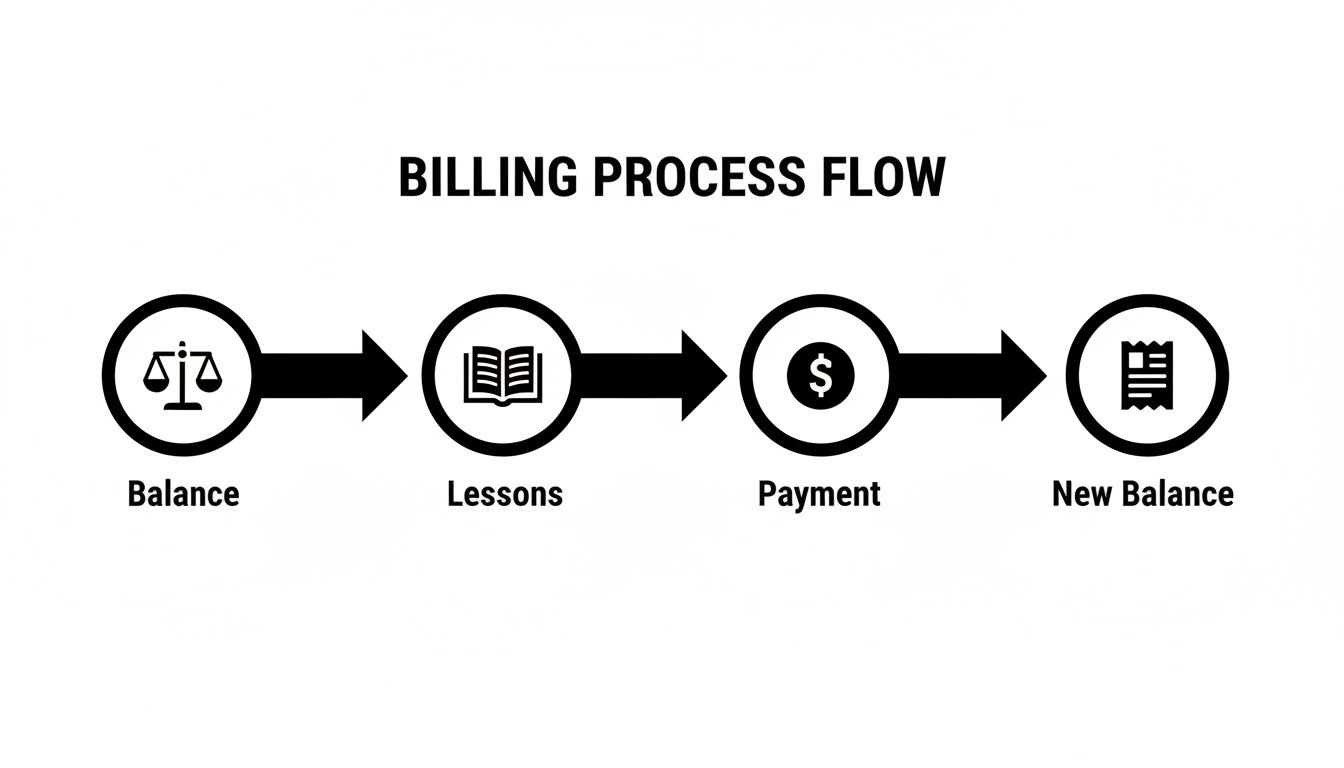
Each step builds logically on the last, giving parents a transparent look at their account activity from one billing cycle to the next.
Breaking Down a Sample Invoice
Let's walk through a typical tutoring invoice that uses the balance forward method. It all boils down to a simple formula: Previous Balance + New Charges – Payments = Current Balance Due.
This structure is designed to prevent financial surprises. It gives parents total clarity and builds their confidence in your business.
Here's what each key section of the invoice means:
- Previous Balance: This is the starting point. It’s the total amount carried over from the last invoice. It could be a positive number if they had an unpaid bill, or a negative number (a credit) if they prepaid for a package.
- New Charges: This section lists all billable activity from the current period. You’ll see every attended lesson, material fees, or charges for late cancellations that occurred since the last statement.
- Payments Received: Any money the family has paid since the last invoice is clearly documented here. This confirms that their payment was received and correctly applied to their account.
- Ending Balance (or Balance Due): This is the final, calculated amount. It represents the client’s current financial standing with your tutoring center and the exact amount they need to pay.
A well-structured balance forward invoice acts as a transparent financial ledger. By clearly outlining past balances, new services, and recent payments, it preemptively answers most billing questions a parent might have.
This level of detail is empowering for both you and your clients. It cuts through confusing billing and dramatically reduces the time you spend answering questions about invoices.
For those still creating invoices by hand, using a free tutoring invoice generator can help you structure your documents professionally and ensure all these essential components are included every time.
Practical Uses for Balance Forward in Your Tutoring Center
Knowing what a balance forward is helps, but the real value comes from seeing how it solves real-world billing problems in your tutoring center. This isn't just an accounting term; it's the engine that powers modern payment models, from prepaid packages to monthly subscriptions.
The balance forward approach is essential for any business model where unused credits must carry over. A 2024 study of 1,200 tutoring firms found that 52% lost an average of $18,500 annually from untracked credits. Conversely, centers that adopted balance forward systems saw a 42% increase in renewals because their statements were clearer. You can find the full research on carrying balances forward.
Managing Prepaid Credits and Packages
One of the best uses for balance forward is handling prepaid lesson packages. When a parent buys a 20-hour SAT prep bundle, a balance forward system turns that purchase into a credit on their account, creating a digital wallet for their tutoring hours.
Here’s how it works:
- Initial Purchase: The family’s account immediately shows a credit (e.g., -$1000 or 20 hours).
- Automatic Deduction: After each one-hour lesson, the system automatically draws down the cost (e.g., $50) or the time from that wallet. The remaining balance is updated instantly.
- Clear Invoices: The next invoice shows the starting balance, lists the lessons attended, and displays the new remaining credit.
This automation prevents revenue leakage and gives parents a real-time view of their remaining balance. That transparency builds trust and makes renewals a much easier conversation.
A balance forward system converts prepaid packages from a tracking nightmare into a simple, transparent credit wallet. It automates deductions and provides parents with a clear, running total of their investment.
Handling Recurring Payments and Subscriptions
Many tutoring centers now offer monthly subscriptions for ongoing support. Balance forward billing is built for this model, especially when you need to add extra charges or apply credits.
For example, a family on a fixed monthly plan might need an extra session for a final exam. Instead of sending a separate, one-off invoice, you just add the charge to their account. Their next statement will neatly list the standard subscription fee plus the extra lesson, all consolidated into a single balance due.
Applying One-Off Charges and Discounts
Finally, balance forward billing simplifies handling miscellaneous charges that make manual invoicing painful, such as late cancellation fees, registration fees, or charges for curriculum materials.
Instead of sending small invoices that get lost, you can add these charges directly to the client’s running tab. The same goes for credits. If you offer a referral discount, it appears as a clean deduction on their next statement. Every financial touchpoint is captured, tracked, and clearly communicated on one consolidated invoice.
Automating Your Billing to Eliminate Common Headaches
If you still track balance forwards with a spreadsheet, you know the monthly routine. You piece together old balances, new lessons, and recent payments. This process is not just slow; it leads to costly errors, wasted administrative hours, and frustrated parents.
A single typo can throw off a carried-over balance. A payment might be applied to the wrong invoice. Soon, you are sending confusing statements that trigger phone calls and emails from parents demanding clarification. That back-and-forth eats up time that should be spent growing your business.
Manual balance forward tracking often creates more problems than it solves, leading to inaccurate invoices, payment disputes, and a breakdown in client trust. Automation removes the human error that undermines your billing process.
In the tutoring industry, managing cash flow is critical. Reports show that tutoring centers using automated balance forward billing can reduce payment chasing by up to 60%. Automated invoices prevent disputes over forgotten charges or credits from ever happening.
How Software Solves Manual Billing Errors
Dedicated tutoring management software turns balance forward from a frustrating chore into a powerful, reliable tool. Instead of manually copying numbers, the system automates the entire workflow with perfect accuracy.
This shift from manual to automated allows you to scale. The right platform tackles the most common pitfalls of manual tracking:
- Auto-Generating Invoices: The system automatically pulls the correct previous balance, ensuring every new invoice is accurate from the start.
- Deducting from Credit Wallets: After each lesson, the platform instantly deducts the cost from a client’s prepaid credit wallet, providing a real-time balance.
- Allocating Payments Accurately: Payments are automatically applied to a client’s account correctly, whether they are paying for a single invoice or settling a running balance.
The table below highlights the difference between manual and automated methods.
Manual vs Automated Balance Forward Management
Managing balances with spreadsheets is completely different from using a dedicated system. Here’s a look at the differences in efficiency, accuracy, and client experience.
| Task | Manual Process (Spreadsheets) | Automated with Tutorbase |
|---|---|---|
| Invoice Creation | Manually copy previous balance, add new charges, and check for errors. Takes 10+ hours weekly. | Automatically pulls balance forward, adds new lessons, and generates accurate invoices in seconds. |
| Payment Application | Manually record payment and match it to the correct outstanding balance or invoice. High risk of errors. | Instantly applies payments to the client's account, reducing the balance in real-time. |
| Credit Management | Track prepaid packages in a separate sheet, manually deducting after each lesson. | Automatically deducts from credit wallets after each completed lesson, showing real-time balances. |
| Error Rate | High risk of typos, calculation mistakes, and forgotten entries, leading to disputes. | Virtually zero human error; calculations and transfers are handled by the system. |
| Parent Experience | Can lead to confusing or incorrect statements, requiring parents to call for clarification. | Clear, professional invoices with a transparent history. Parents can view their balance 24/7. |
The takeaway is clear: automation saves time and builds a more professional, trustworthy financial relationship with your clients.
Platforms with native billing features handle these complexities automatically. By integrating with payment platforms like Stripe, you can fully automate the entire billing cycle from invoice to payment. Ultimately, automation gives you back hours of administrative time each week, letting you focus on education instead of accounting.
FAQ: Common Questions About Balance Forward Billing
Here are answers to the most common questions tutoring center owners ask about balance forward billing.
How is balance forward different from a credit balance?
A credit balance is one type of balance forward. The term "balance forward" is a general term for any amount carried over from a previous invoice, which could be an amount owed by the client or a credit they hold. A credit balance specifically means the client has prepaid for services, and you owe them lessons.
Can I use balance forward for one-off payments?
Yes. The balance forward method works perfectly for both recurring and one-off payments. If a student who pays per session has an unpaid charge, that amount simply rolls over as the balance forward on their next invoice and is added to any new charges for the current period.
What happens if a client disputes a carried-over charge?
A detailed, professional system prevents disputes. Vague invoices invite conflict, but a clear statement resolves it quickly. Tutoring management software like Tutorbase provides a complete transaction history for any client in seconds. You can show the original charge, lesson date, and any relevant notes, resolving disputes in minutes with documented proof.
What is the formula for calculating balance forward?
The formula is: Previous Balance + New Charges – Payments Received = Current Balance Due. The "Current Balance Due" from one invoice becomes the "Previous Balance" on the next one.
Is balance forward the same as open-item accounting?
No, they are different methods. Balance forward consolidates all transactions into a single running total. Open-item accounting tracks each invoice as a separate, distinct transaction. Parents pay off specific invoices rather than a total account balance. Balance forward is simpler for businesses with many recurring transactions for the same client, like tutoring centers.
Managing balance forwards with spreadsheets leads to errors and wasted time. Tutorbase automates everything, from tracking prepaid packages to generating clear, professional invoices. You can stop worrying about who owes what and get back to teaching. See how it works at tutorbase.com/register.


