


Key Takeaway: In 2026, average tutor rates in the USA range from $25 to $80 per hour, influenced by subject complexity, tutor experience, and location. To build a profitable business, you should calculate rates based on your costs and desired profit margin, not just market averages. Adopting package or subscription models creates predictable revenue and improves client retention.
Figuring out your pricing starts with understanding the current market. In the USA, average tutor rates typically fall between $25 and $80 per hour, but that is just a starting point. It's a massive range, and it reflects all the different factors that go into the cost, from a tutor's experience to the complexity of the subject.
What Are The Average Tutor Rates Right Now?
Before you set competitive prices, you need a clear picture of the national benchmarks. For a tutoring center owner, this is a strategic tool. It helps you position your services, attract top-tier talent, and make sure your business stays profitable in a market that is always moving.

One of the biggest drivers of that price variation is the format. In-person tutoring often commands a premium because you are paying for the tutor's travel time and highly personalized attention. On the other hand, online sessions usually offer more affordability and flexibility.
A key insight for center owners is that pricing is not static. It is a direct reflection of the value, convenience, and expertise you provide. Your rates should tell a story about the quality of education students receive.
A Closer Look At Current Tutoring Costs in 2026
Let's break down what those numbers look like. As of 2026, the average tutoring rate in the USA hovers between $25 to $80 per hour, but it shifts quite a bit depending on the details.
For example, general K-12 academic help online might run you $30–$45 per hour. That same session in person will likely bump up to $35–$50. When you get to college-level subjects, the demand for higher expertise pushes in-person rates up to the $50–$70 range. For a deeper dive, you can explore more insights about US tutoring rates.
To give you a clearer picture, here is a quick snapshot of how rates vary.
Average Tutor Rates Snapshot by Format and Level
This table provides a quick overview of typical hourly tutoring rates in the USA for 2026, broken down by session format and the student's educational level.
Session Type | K-12 Level Rate | College Level Rate | Test Prep (SAT/ACT) Rate |
|---|---|---|---|
Online 1:1 | $30–$45 / hour | $45–$65 / hour | $50–$80 / hour |
In-Person 1:1 | $35–$50 / hour | $50–$70 / hour | $60–$100+ / hour |
Group Online | $20–$35 / hour | $30–$50 / hour | $40–$70 / hour |
Group In-Person | $25–$40 / hour | $35–$55 / hour | $50–$85 / hour |
Note: These are national averages and can vary based on location, tutor expertise, and specific subject matter.
This data gives you a solid foundation for structuring your own pricing. It also highlights a few key trends that every tutoring business owner should watch:
Academic Level Matters: There is a clear difference in pricing between elementary school reading support and advanced calculus prep. Higher levels require more specialized knowledge.
Format Influences Price: Online tutoring is consistently a more accessible option compared to face-to-face instruction, which carries higher overhead for the tutor.
Specialization Demands More: Niche subjects or intensive test prep will always command higher fees. You are not just paying for time; you are paying for an expert's hard-won knowledge.
By analyzing these national averages, you can map out where your center's services fit. This is not about copying others. It is about using benchmarks to create a logical and defensible pricing structure that makes sense for your business.
What Factors Determine Tutoring Rates?
Why can one tutor confidently charge $100 an hour while another asks for just $30? The answer comes down to a few key variables that should shape every pricing decision you make. Once you understand these, you can set rates that are fair, easy to justify, and profitable.
What is Subject Complexity?
Subject complexity is the level of specialized knowledge required to teach a particular subject. The single biggest lever on your rates is the subject matter itself.
Basic Subjects: Subjects with a large pool of qualified tutors, like elementary reading or middle school math, naturally sit at the lower end of the price spectrum.
Advanced Subjects: Advanced or niche subjects are where you can command a premium. Think MCAT test prep, AP Physics C, or college-level organic chemistry.
Pricing is a direct signal of expertise. A higher rate for a complex subject tells clients they are paying for a specialist who can deliver targeted results.
How Do Tutor Qualifications and Experience Impact Price?
A tutor's background is the next piece of the puzzle. It makes sense that a college student offering peer tutoring will charge less than a certified teacher with a master's degree. You are not just paying for their time; you are paying for their proven ability to get results.
Factors that justify higher rates include:
Formal Education: Advanced degrees (Master's, PhD) in a specific subject.
Certifications: Official teaching licenses or subject-specific credentials.
Track Record: Verifiable student success stories, like significant grade improvements or top-tier test scores.
Years of Experience: It is common for tutors with over five years of experience to charge 25-50% more than newcomers.
Session Format and Geographic Location
Where and how you deliver tutoring sessions also has a huge impact on your costs and prices. A student in Seattle might pay $65/hour for in-person help, while the same service in rural Kansas could be closer to $38. Online tutoring opens up a wider market and often comes with a more accessible price point. Discover more insights about private tutoring rates.
The table below breaks down how location and subject specialization can push your rates in different directions.
Rate Impact Analysis: Location vs. Subject
This simple comparison shows how much location and subject choice can swing your pricing. A tutor in a big city tackling a tough subject has a much higher earning potential than one offering basic help online from a lower-cost area.
Factor | Example 1 | Rate Impact | Example 2 | Rate Impact |
|---|---|---|---|---|
Location | In-person tutoring in a high-cost urban area | +30% | Online tutoring from a rural area | -20% |
Subject | AP Calculus Tutoring | +40% | Elementary Reading Help | Standard Rate |
Once you understand these core drivers, you can build a smart, tiered pricing system. That is how you stay both competitive and profitable.
How do you calculate your tutoring center's rates for profitability?
Pricing based on what everyone else is doing is one of the quickest ways to build a business that struggles to grow. A truly profitable pricing strategy is about understanding your own numbers. You must start from the inside out and calculate every single one of your business costs.
This approach shifts your focus from just being competitive to being sustainable. It ensures your rates are a cornerstone of your long-term success.
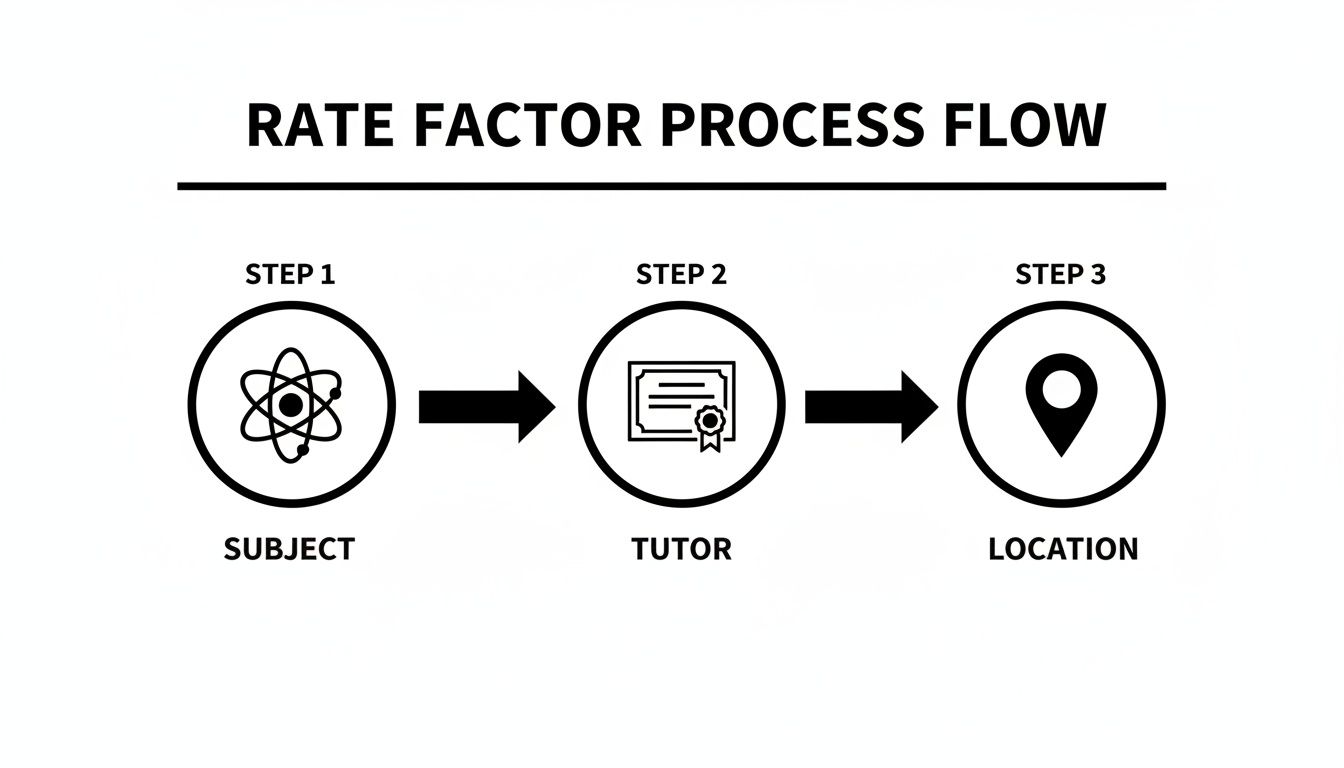
As you can see, the subject matter, your tutor's experience, and your location are the foundational ingredients that shape your pricing.
Start with Your Total Business Costs
First, you need a crystal-clear picture of what it actually costs to run your tutoring center. This is your cost baseline. You need to account for everything.
Fixed Costs: These are bills that show up every month like clockwork. Think rent, software subscriptions, insurance, and your internet bill.
Variable Costs: These expenses ebb and flow with how busy you are. This includes tutor wages, curriculum and printing costs, and marketing spend.
One-Time Costs: Do not forget initial investments like furniture or laptops. It is smart to spread these costs out over their expected lifespan.
Once you tally up your total monthly expenses, you can figure out your break-even point. This is the minimum revenue you need to cover your costs.
Your break-even number is non-negotiable. It tells you exactly how many sessions you need to sell each month just to keep the lights on. It is the starting line for building any profitable rate structure.
The Formula for Profitability
With your total costs in hand, you are ready to build your pricing formula. The goal is simple: cover all your expenses and add a specific profit margin. A healthy target for many centers is a 20-30% profit margin.
Here is the basic formula:
(Total Costs / Billable Hours) + Desired Profit Margin = Your Hourly Rate
Let's walk through an example. Say your total monthly costs are $10,000 and you plan to deliver 400 billable tutoring hours. Your cost per hour is $25 ($10,000 / 400).
To hit a 30% profit margin, you would add an extra $7.50 (30% of $25). Your target rate becomes $32.50 per hour. There are external resources that can help you improve your gross profit margin with smarter pricing tactics.
Pricing Models That Go Beyond the Hourly Rate
If you still bill by the hour, you are not alone. But simple hourly billing often means unpredictable cash flow and puts a hard ceiling on your revenue potential. To build a resilient business, you have to think beyond just trading time for money.
Adopting models like prepaid packages or monthly subscriptions creates stability. It makes your income predictable, turning financial forecasting into a reliable plan. Research shows subscription-based companies have far better client retention, which means a more committed student base.
What are Modern Pricing Structures?
Moving past the hourly rate changes how clients see your value. You stop selling individual hours and start selling consistent academic progress. You are offering predictable outcomes, not just a time slot. That shift is crucial for positioning your center as a premium service.
Here are a few proven models:
Prepaid Packages: Clients buy a block of hours (say, 10 or 20) at a slightly discounted rate. You lock in revenue upfront, and the family is committed for the long haul.
Monthly Subscriptions: The gold standard for predictable income. Families pay a flat fee each month for a set number of sessions, creating reliable recurring revenue.
Tiered Service Levels: Offer different tiers (like Basic, Premium, Elite) that bundle tutoring with other high-value services like progress reports or college counseling.
By offering packages or subscriptions, you shift the conversation from "How much is one hour?" to "Which plan best supports my child's goals?" This small change reframes your service around long-term value.
Why Packages and Subscriptions Work Better
The biggest win here is financial stability. When you know exactly how much revenue is coming in each month, you can make smarter decisions about hiring and marketing. It smooths out those painful seasonal dips that plague many in the tutoring industry.
These models also increase student engagement. When a family commits to a 20-hour package, they are psychologically invested in seeing it through. That consistency leads directly to better academic results, which fuels positive reviews. For a deeper dive, check out our guide on effective tutoring pricing models for more detailed strategies.
Understanding the Global Private Tutoring Market
Your tutoring center is part of a massive, booming global industry. Fierce academic competition and the worldwide shift to online learning are pouring fuel on the fire. Understanding these bigger forces is key to positioning your own business for success.
The bigger picture directly influences what parents in your area are willing to pay for your average tutor rates. When you see where the industry is headed, you can make smarter decisions that help your center not just survive, but thrive.
What's Driving the Global Tutoring Boom in 2026?
The global private tutoring market is exploding. Valued at $97.11 billion in 2023, it's on track to grow at a compound annual growth rate (CAGR) of 7% through 2030. A 2024 report by ConsumerAffairs states that academic tutoring makes up a whopping 68.2% of the entire market. For a full breakdown, you can discover more insights about these tutoring statistics.
A few key trends are at play:
The College Admissions Arms Race: With competition for top universities tougher than ever, parents and students are looking for any edge they can get.
Online Learning is the New Normal: Digital platforms have made tutoring more accessible and connected students with top educators from anywhere in the world.
A Craving for Personalized Attention: Traditional classrooms often cannot provide the one-on-one support kids need. Families actively seek out customized learning plans.
This global demand gives you local pricing power. As families see tutoring less as a cost and more as a vital investment in their child's future, their willingness to pay for high-quality instruction goes up.
How do global trends affect your local rates?
This worldwide growth has a direct, tangible effect on your business. When the demand for skilled tutors goes up everywhere, the talent pool gets more competitive. To attract and keep the best educators, you may need to pay them more, which means adjusting the rates you charge.
Understanding these dynamics helps you frame your pricing with confidence. You are providing access to expert instruction in a high-demand, high-value global market. You are offering a strategic investment in a student’s future.
How do you automate billing to protect profit margins?
Manual admin is a silent profit killer. If you spend more than 10 hours a week fiddling with spreadsheets to calculate tutor pay and chasing down client payments, that is valuable time stolen from growth. Automation is not a luxury; it is a necessity.
Modern software can instantly generate invoices from attendance records. It can also untangle complex payroll calculations, whether you deal with variable tutor rates or tricky revenue-sharing deals. Making the switch can slash your administrative overhead by up to 60% and wipe out costly human errors.
Why Manual Processes Are So Risky
Relying on spreadsheets and manual data entry is like walking a tightrope without a net. A single misplaced decimal or a broken formula can lead to under-billing clients or overpaying tutors. These little mistakes compound quickly over hundreds of sessions, directly draining your profitability.
Protecting your profit margin starts with accurate data. Manual entry is prone to error, whereas an automated system ensures every billable hour and payroll calculation is precise.
It all comes down to accurate timekeeping. To effectively protect those margins, you have to track tutor hours with precision. For centers using flexible tools, mastering Notion time tracking can be a great first step toward more streamlined billing.
How Automation Creates Financial Clarity
Automation does more than just save you time. It gives you a crystal-clear, real-time view of your business's financial health. When you connect attendance directly to invoicing and payroll, you get immediate insights into your revenue, costs, and profit margins.
This kind of visibility allows you to:
Identify Profitable Services: Instantly see which subjects or tutors generate the highest margins.
Optimize Tutor Schedules: Align tutor availability with peak demand to maximize billable hours.
Improve Cash Flow: Automate payment reminders and offer online payment options to get paid faster.
For a deeper dive, our guide on how to streamline sessions and payroll management is packed with more actionable strategies. Implementing these systems is key to scaling your business without drowning in administrative work.
Frequently Asked Questions About Tutoring Rates
How often should you review tutoring rates?
You should review your tutoring rates at least once a year. This annual review lets you account for inflation, rising costs, and shifts in local demand. This practice ensures your average tutor rates stay competitive while protecting your profit margins.
What is the best way to announce a price increase?
The best way to announce a price increase is with transparency and ample notice. Give current families at least 30 to 60 days' warning before the new rates kick in. Explain the "why" behind the increase, such as investing in better materials or retaining top tutors.
Should you offer discounts for siblings or referrals?
Yes, offering discounts for siblings and referrals is a smart marketing move. A sibling discount of 10-15% for a second child makes your services more attractive to families. A referral program rewards existing clients for bringing in new business, which is a low-cost way to get high-quality leads.
How do you handle requests for lower rates?
Handle requests for lower rates with a polite but firm, value-first response. Acknowledge budget concerns without lowering your hourly rate. Instead, offer an alternative like a prepaid package that reduces the per-session cost, which shifts the focus from price to value.
Do online tutors charge less than in-person tutors?
Yes, online tutors generally charge less than in-person tutors. In 2026, the average online K-12 tutor charges $30-$45 per hour, while their in-person counterpart charges $35-$50. This difference accounts for the travel time and higher overhead associated with in-person sessions.
What is a fair profit margin for a tutoring business?
A fair profit margin for a tutoring business is typically between 20% and 30%. This margin ensures you can cover all fixed and variable costs, reinvest in the business, and earn a sustainable profit. Calculate your rate by dividing total costs by billable hours and then adding your desired profit margin.
Ready to eliminate billing errors and gain a clear view of your profit margins? Tutorbase automates everything from attendance and invoicing to complex payroll. This frees up your time to focus on growth. See how you can improve your operations by visiting tutorbase.com/register.


