


Key Takeaway: Tutoring centers can reduce churn and increase student lifetime value by implementing gamification techniques such as points, leaderboards, and badging. These strategies, when automated with tutoring management software, transform routine lessons into an engaging journey, providing parents with clear, trackable proof of their investment and making renewal decisions easier.
Tutoring center owners often spend 10+ hours a week on admin, wrestling with fragmented tools like Google Calendar and QuickBooks. This administrative drain obscures a bigger problem: keeping students motivated and consistently renewing their packages. Low engagement directly causes student churn, hurting your revenue and growth. This is precisely where applying strategic gamification techniques for tutoring centers becomes a critical advantage.
By integrating game-design principles, you can transform the learning experience from a passive requirement into an active pursuit. These methods boost motivation and create a powerful feedback loop that drives student progress. Importantly, these techniques generate clear metrics that provide parents with tangible proof of their investment, making renewals much easier. To see how this works in other industries, explore how a structured approach to gamification in loyalty programs can transform customer participation.
This guide provides an actionable playbook. We will break down eight specific gamification techniques you can implement to reduce churn, increase student lifetime value, and build an engaging learning environment that scales, whether you manage one location or ten branches. You'll learn how to implement everything from Experience Points (XP) and quests to adaptive learning pathways, turning routine lessons into a compelling journey.
1. Experience Points (XP) and Level Progression
What is an Experience Point (XP) system? An XP and Level Progression system gives immediate, tangible feedback on student effort. Students earn points for completing actions like attending lessons or finishing homework. These points accumulate, allowing students to "level up" from "Beginner" to "Intermediate" and eventually to "Master."

This technique is powerful for tutoring centers managing a high volume of lessons because it automates motivation. It creates a clear, visible journey for each student. Much like Duolingo uses XP to drive daily user engagement, your center can use this system to make learning feel more like a rewarding game than a chore. The constant accumulation of points offers a persistent sense of accomplishment that keeps students invested.
How do I implement XP and Level Progression?
To effectively roll out an XP system, transparency and consistency are key. You must start by defining which actions earn points and assign clear values to them. This ensures the system feels fair and predictable for all students.
- Define Point Values: Create a simple points menu. For example:
- Lesson Attendance: 10 XP
- Homework Completion (On-Time): 15 XP
- Quiz Score (80%+): 25 XP
- Participating in a group activity: 5 XP
- Establish Level Tiers: Design a progression ladder that aligns with your curriculum. For a language school, this might look like:
- Level 1-5: Novice (0-500 XP)
- Level 6-10: Apprentice (501-1500 XP)
- Level 11-15: Adept (1501-3000 XP)
- Level 16-20: Expert (3001-5000 XP)
- Integrate and Automate: Manually tracking XP is an administrative burden that doesn't scale. A tutoring management platform like Tutorbase automates this process. You can configure the system to award points based on attendance records and completed assignments. This automation makes gamification techniques for tutoring centers scalable and effective.
2. Leaderboards and Competition Mechanics
What are leaderboards in tutoring? Leaderboards and competition mechanics introduce social motivation by creating a ranking system that compares student performance. You can implement this within a single class, across an entire branch, or even against a student's personal bests. This technique taps into the natural desire for achievement, transforming academic progress into a friendly contest.
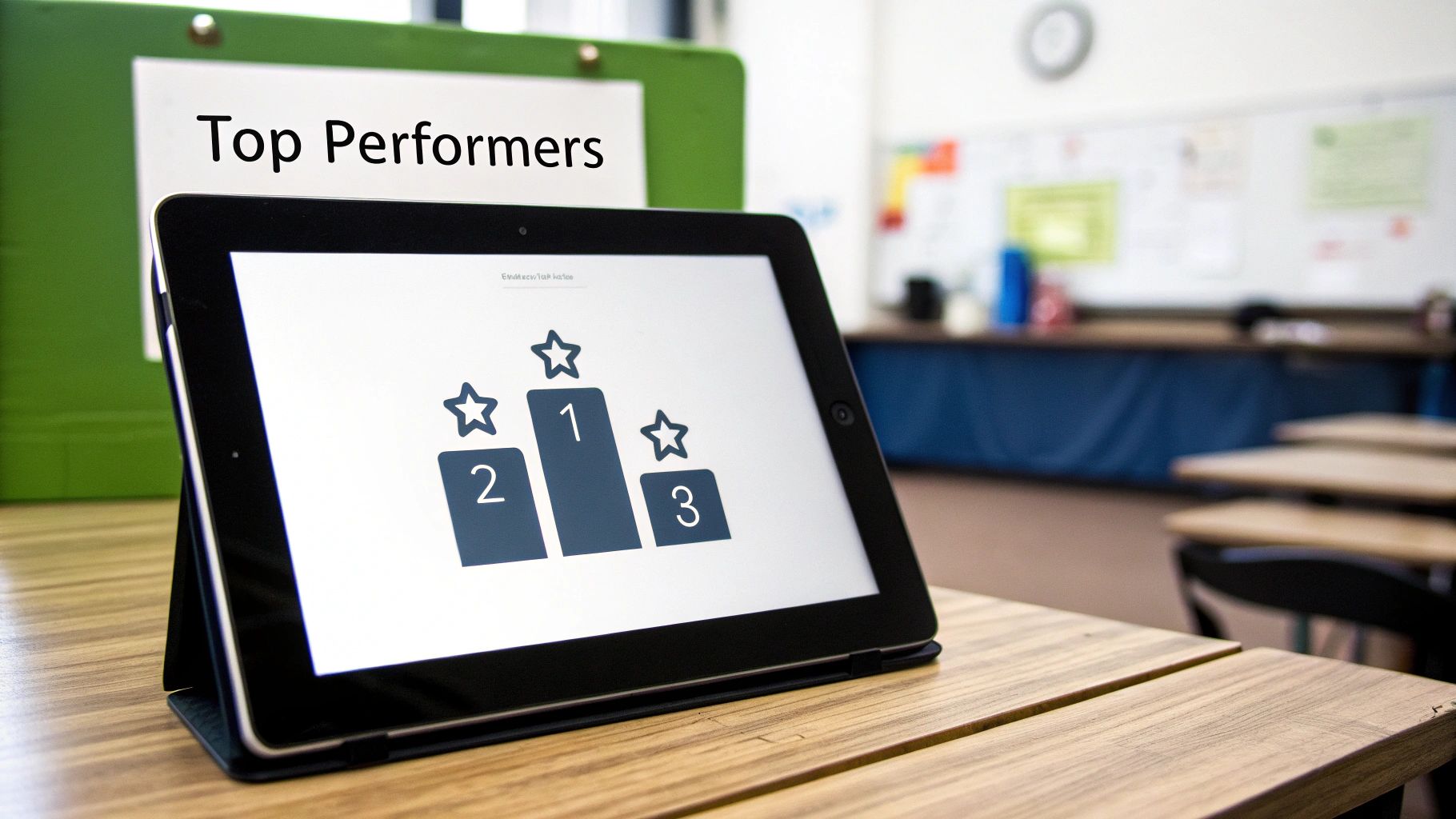
This method is effective for driving engagement in group settings like K-12 tutoring, language schools, and competitive test prep programs (SAT, ACT, IELTS). Similar to how Duolingo's weekly leagues boost user activity, leaderboards generate a sense of urgency that improves attendance and focus. By making progress visible, you encourage healthy competition that motivates everyone to improve.
How can my center use leaderboards effectively?
Successful implementation requires thoughtful design to ensure competition remains positive for all students, not just the top performers. You must offer multiple avenues for recognition and keep the competition fresh to maintain engagement.
- Create Diverse Leaderboard Types: Avoid a single, dominant leaderboard. Instead, track multiple metrics so different students can shine.
- Top Quiz Scores: For academic achievement.
- Attendance Streak: For consistency and dedication.
- Most Improved: To celebrate progress, not just high scores.
- Homework Hero: For on-time assignment completion.
- Establish a Reset Cadence: Reset leaderboards weekly or monthly. This gives all students a fresh start, preventing long-term discouragement for those who fall behind and maintaining engagement over time.
- Integrate and Automate: Manually updating leaderboards is time-consuming and prone to errors. A system like Tutorbase automatically pulls data from attendance records and assignments, allowing you to track student progress and scores efficiently. For multi-branch operations, you can create location-based competitions, fostering a sense of community between centers.
3. Badges and Achievement Unlocking
What are achievement badges? Badges and Achievement Unlocking provide students with tangible, visual symbols of their accomplishments. Learners earn digital badges for completing specific milestones, such as mastering a topic, achieving a high quiz score, or maintaining perfect attendance for a month. These badges are collectible and can be displayed on student profiles, serving as a motivating record of their progress.
This technique translates abstract learning goals into concrete, shareable rewards. For test prep centers, a "Mock Exam Master" badge is more inspiring than just a grade. For K-12 students, a "Math Whiz" badge offers social proof of their growing expertise. This is one of the most versatile gamification techniques for tutoring centers because it works across all age groups and subjects.
How do I create a badge system?
A successful badge system requires that each achievement feels meaningful and is directly tied to a learning objective. The criteria should be clear, and the reward should feel earned. You should avoid awarding badges for trivial tasks.
- Align Badges with Learning Goals: Ensure every badge represents genuine progress. Examples include:
- Academic: 'Perfect Quiz Score', 'Algebra I Master', 'Spanish A2 Certified'
- Effort-Based: '10 Consecutive Lessons Attended', 'Homework Hero' (5 on-time submissions)
- Milestone: 'First Practice Test Completed', 'Mid-Term Goal Reached'
- Create Progressive Tiers: Motivate long-term engagement by designing badge families that students can level up.
- Bronze Homework Streak: 3 assignments in a row
- Silver Homework Streak: 10 assignments in a row
- Gold Homework Streak: 25 assignments in a row
- Automate and Display Achievements: Manually tracking badges is inefficient. A system like Tutorbase automates the process by linking badges to curriculum milestones. For instance, you can configure the software to automatically award a "French B1 Expert" badge when a student's record shows they have completed all B1 level requirements.
4. Progress Tracking and Visual Dashboards
Progress Tracking and Visual Dashboards make abstract learning achievements concrete. This system provides students, parents, and tutors with real-time visibility into academic growth. It translates complex data into intuitive charts, skill trees, and milestone indicators, clearly illustrating the path from starting point to goal. It transforms the learning journey into a visible, engaging map.
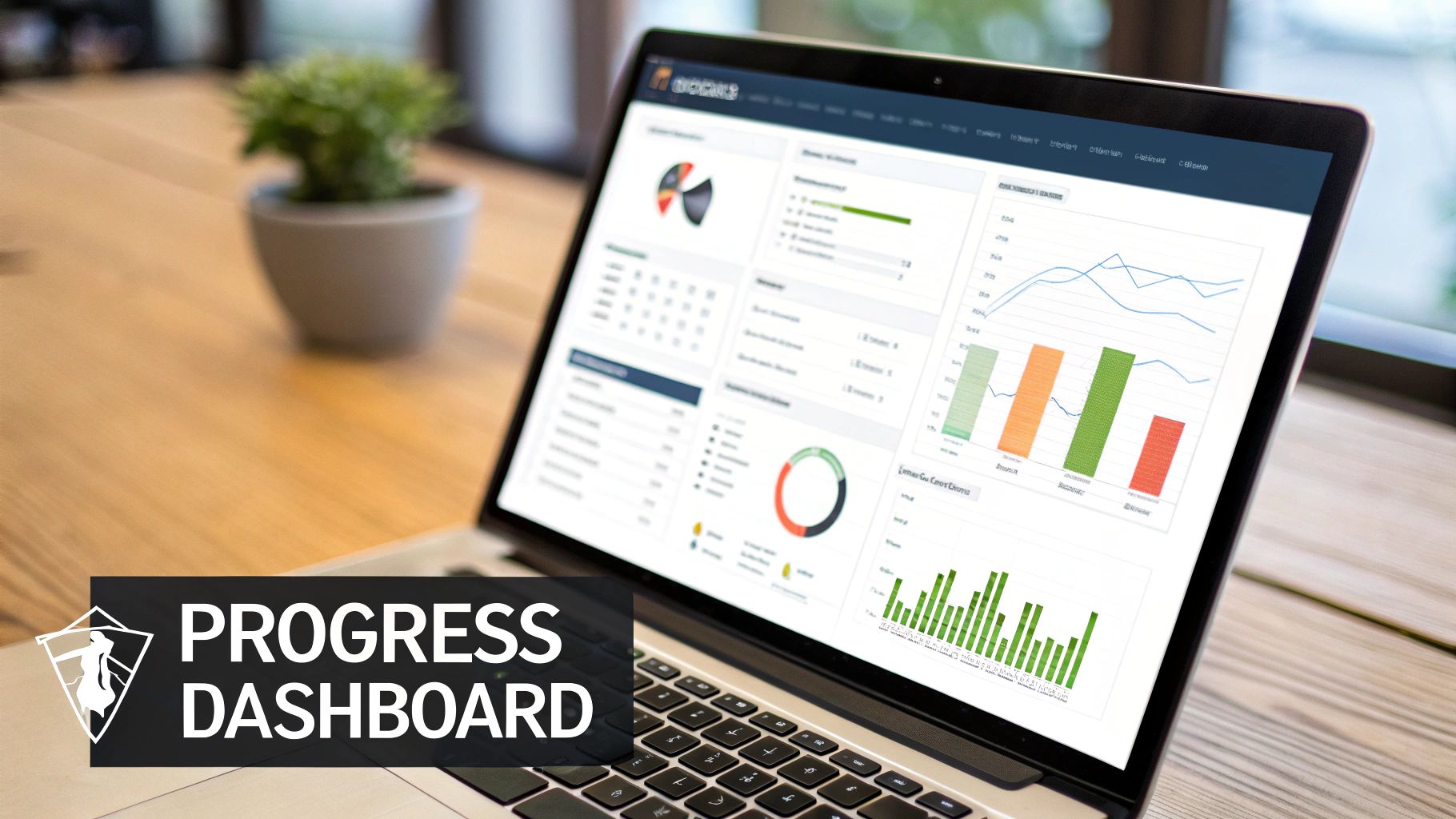
This technique is a powerful motivational tool because it answers the questions "How am I doing?" and "What's next?" For parents, this visual proof of ROI justifies package renewals by up to 42%, while for students, seeing their progress builds confidence. To maximize the impact of gamification, it is crucial to effectively track learner progress through robust data analysis and visual dashboards.
How can I implement visual progress tracking?
Effective dashboards are tailored to their audience, presenting the right information in the most digestible way. You must connect raw data, like attendance and quiz scores, to meaningful, visual outcomes to show value.
- Design Audience-Specific Dashboards: Create different views for each stakeholder:
- Student View: Focus on motivation with skill trees, earned badges, and upcoming milestones.
- Parent View: Emphasize ROI with progress against goals, attendance records, and projected completion dates.
- Tutor View: Provide diagnostic data, showing areas where a student is struggling to inform lesson planning.
- Visualize the Journey: Use metaphors to make learning tangible. Represent curriculum levels as climbing a mountain or journeying through a map. Color-code skills from "Needs Practice" (red) to "Mastered" (green).
- Automate Milestones and Projections: A platform like Tutorbase can automatically track enrollments and student progress, using attendance and curriculum data to power your dashboards. Configure the system to trigger milestone alerts, such as "You are 80% of the way to completing Level B1!"
5. Challenges and Quests (Micro-Missions)
Challenges and Quests introduce time-bound, goal-oriented missions that add purpose and urgency to learning. Unlike passively accumulating XP, quests require students to actively complete a specific, targeted task within a set timeframe. This could be a weekly goal like "Complete 5 math problems without a calculator" or a long-term quest like "Prepare for your mock SAT by Friday."
This technique is exceptionally effective for test prep and language schools because it breaks down daunting goals into manageable micro-missions. It borrows its structure from successful apps like Duolingo, which uses daily challenges to drive habit formation. This is one of the most powerful gamification techniques for tutoring centers looking to build consistent student engagement.
How to Implement Challenges and Quests
A successful quest system feels like a natural extension of your curriculum, not a separate chore. You should design challenges that reinforce learning objectives and are matched to the student's current proficiency level.
- Design Thematic Quests: Align challenges with specific learning areas.
- Test Prep: "Complete 20 SAT Reading passages this week."
- Language School: "Listening Challenge: Score 80% on a comprehension test."
- Set Clear Timelines and Rewards: Every quest needs a deadline and a small, motivating reward.
- Deadline: Daily, Weekly, or Special Event (e.g., "End-of-Month Boss Challenge").
- Reward: 5-10 bonus XP, a unique digital badge, or a small discount coupon.
- Personalize and Automate: Manually assigning quests is time-consuming. Use a platform like Tutorbase to link challenges to curriculum data. You can set rules to automatically recommend quests based on a student's level. Tutors can also use persistent student notes to assign personalized quests that target specific weaknesses.
6. Rewards and Incentive Redemption Systems
Rewards and Incentive Redemption Systems close the motivation loop by giving students a way to convert their hard-earned points into tangible value. In this model, students spend their accumulated in-center "currency" in a predefined rewards store. This turns abstract achievements, like earning 1,000 XP, into meaningful outcomes, such as a discount on next month's lessons.
This technique is a cornerstone of modern loyalty programs. For tutoring centers, it directly addresses student retention. When progress translates into real-world benefits, students become more invested in continuing their educational journey with your center. The anticipation of earning a high-value reward can be a powerful driver for consistent attendance and effort.
How do I implement a rewards system?
A successful rewards system requires a clear "economy" that feels fair and motivating. You need to balance the effort required with the perceived value of the reward.
- Create a Rewards Catalog: Design a menu of rewards with clear point costs. Include a mix of small and large goals.
- Tier 1 (Low Cost): Digital certificate (250 XP), 15-minute extra help session (400 XP)
- Tier 2 (Medium Cost): Center-branded merchandise (1,000 XP), one free group lesson (1,500 XP)
- Tier 3 (High Value): 10% discount on next lesson package (3,000 XP)
- Tie Rewards to Business Goals: Structure rewards to reinforce positive business outcomes. Discounts on future packages encourage renewals, while high-margin merchandise adds a revenue stream.
- Automate Redemption and Tracking: Manual reward management creates an administrative bottleneck. A platform like Tutorbase can integrate your reward system directly with student profiles and prepaid credit billing. This makes implementing gamification techniques for tutoring centers practical even for multi-branch operations.
7. Social and Collaborative Learning Mechanics
Social and Collaborative Learning Mechanics shift the focus from individual achievement to teamwork and shared goals. Instead of students working in isolation, this approach introduces game elements that encourage them to learn together. Mechanics can include group quests, team-based challenges, and shared progress bars that unite a class toward a common objective.
This technique is effective for improving student retention, especially in environments like language schools or after-school programs where community building is key. By fostering camaraderie, students feel more connected to their peers and the center. Your center can use collaborative gamification to transform learning into a shared, social experience.
How do I implement social learning mechanics?
Successful implementation requires balancing individual accountability with collective incentives. You must create clear, achievable group goals that are easy to track to ensure all students participate and benefit.
- Define Team Structures: Automatically group students based on existing class schedules. For example, the "Tuesday 4 PM Spanish A1 Class" becomes a team for the term. This minimizes administrative effort.
- Set Collaborative Goals: Create achievable, time-bound objectives for each team.
- Attendance Goal: "Our class will achieve a 90% attendance rate this month."
- Completion Quest: "As a group, we will complete all 250 practice problems for Unit 3."
- Inter-Branch Competition: Challenge another location, such as "Branch A vs. Branch B: Which center can complete the most lessons in March?"
- Integrate and Automate: A platform like Tutorbase simplifies this by using class data to automatically assign students to teams based on their recurring lesson schedules. You can then track group metrics like total lessons attended to power these collaborative gamification techniques for tutoring centers.
8. Adaptive Difficulty and Personalized Pathways
Adaptive Difficulty and Personalized Pathways create a learning experience that dynamically adjusts to each student's unique performance. Instead of a one-size-fits-all curriculum, this system analyzes student data to recommend the most appropriate next steps. This is a game-changer for tutoring centers, especially in K-12 and test prep, where students often enter with widely varying skill levels.
This technique addresses the challenge of managing diverse learner groups with limited instructor time. It ensures advanced students remain engaged with new challenges while others receive the foundational support they need. This maximizes the effectiveness of every lesson, preventing both boredom and frustration.
How can I implement adaptive learning pathways?
Effective implementation requires a clear system for assessing performance and translating that data into actionable curriculum recommendations. Your goal should be to guide, not restrict, student learning journeys.
- Establish a Performance Baseline: Use initial diagnostic quizzes during the first few lessons to accurately gauge a student's starting point. This data is more reliable than simply relying on their registered curriculum level.
- Create Trigger-Based Recommendations: Define rules that trigger pathway suggestions. For example:
- Test Prep: If a student scores below the 50th percentile on a diagnostic SAT Reading section, automatically recommend a "Reading Comprehension Fundamentals" module.
- Language Learning: If a student consistently scores 90%+ on A2 level quizzes, prompt them with a "Ready for B1?" recommendation.
- Leverage Your Management System: A platform like Tutorbase is essential for automating this process at scale. Use its quiz features to collect performance data. You can then tag curriculum services with prerequisite levels and use student performance reports to identify who is ready to advance.
Unifying Your Gamification Strategy with Smart Management Software
Throughout this guide, we've explored a powerful arsenal of gamification techniques for tutoring centers. Each strategy offers a unique way to boost student motivation, celebrate progress, and create a more dynamic learning environment. By transforming routine tasks into engaging quests, you can foster a culture where students are excited to learn.
However, the true power of these techniques is unlocked only when built upon a solid operational foundation. Attempting to manage a points system in a spreadsheet creates a new layer of administrative burden. This approach is inefficient and prone to errors. True scalability requires automation.
Why is software critical for gamification?
The most effective gamification initiatives are seamlessly integrated into the daily operations of your tutoring center. A robust tutoring management platform acts as the central nervous system for your gamification strategy, connecting every data point and automating the mechanics.
Consider the core components we've discussed:
- Data Accuracy: For leaderboards to be fair, they must be fueled by accurate, real-time data from attendance records, assignments, and assessments.
- System Integration: A rewards system tied to prepaid credits is far more effective when it's part of your billing platform.
- Scalability: What works for 20 students with manual spreadsheets will collapse at 200. An automated system ensures your gamification program can grow with your business without adding to your 10+ hours of weekly admin.
What are my next steps?
To move from theory to practice, your focus should be on creating a unified operational ecosystem. Before launching a complex rewards program, ensure your core processes—scheduling, attendance, and billing—are streamlined and automated. This foundational work prevents your gamification program from becoming an administrative nightmare.
A successful gamification strategy is not an add-on; it's an integrated layer on top of well-managed operations. Your ability to execute these techniques effectively depends entirely on the power of your underlying management software.
By mastering these gamification techniques for tutoring centers and supporting them with the right technology, you transition from simply providing instruction to creating a compelling learning journey. This approach not only improves academic outcomes but also significantly boosts student retention, drives referrals, and builds a thriving educational community that stands out from the competition.
Frequently Asked Questions (FAQ)
What is gamification in tutoring?
Gamification in tutoring is the application of game-design elements like points, badges, leaderboards, and challenges to educational activities. The goal is to increase student motivation, engagement, and retention by making learning more interactive and rewarding. It turns academic progress into a measurable and visually engaging journey.
How does gamification benefit tutoring centers?
Gamification directly benefits tutoring centers by increasing student retention and lifetime value. Engaged students are more likely to renew their packages. It also provides parents with clear, visual proof of their child's progress, justifying their investment and making renewal conversations easier. Operationally, it helps automate motivation and progress tracking.
Which gamification technique is best for K-12 students?
For K-12 students, a combination of Badges and Achievement Unlocking and Experience Points (XP) is highly effective. Badges provide immediate, visual rewards for mastering specific skills (e.g., "Multiplication Master"), while an XP system creates a sense of long-term progression that keeps them engaged over the entire school year.
Can gamification be implemented without software?
While you can implement simple gamification techniques manually using spreadsheets and charts, it is not scalable and creates a significant administrative burden. Manual tracking is prone to errors, which can demotivate students. Tutoring management software like Tutorbase automates data collection and reward distribution, making gamification effective for centers with 50 to 10,000+ lessons per week.
How do I convince parents of the value of gamification?
You can convince parents by framing gamification as a sophisticated progress tracking and motivation system. Use visual dashboards to show them tangible data on their child's achievements, consistency, and growth over time. Emphasize that these techniques provide a clear, transparent view of their return on investment.
What's the first step to implementing gamification?
The first step is to define your goals. Are you trying to improve attendance, increase homework completion, or boost test scores? Once you have a clear goal, start with a simple technique like an Experience Points (XP) system for attendance and on-time assignments. This provides a solid foundation before you add more complex elements like quests or rewards.
Are rewards necessary for a gamification system to work?
No, rewards are not strictly necessary but they can be very effective. Intrinsic motivators like seeing progress on a dashboard or earning a "Most Improved" badge are powerful on their own. However, adding a redemption system where points can be used for a small discount on the next package can directly link engagement to business goals like renewals.
How do leaderboards avoid discouraging students who aren't at the top?
To prevent discouragement, you should use multiple types of leaderboards. Instead of just one for "Top Scores," create others for "Most Improved," "Best Attendance Streak," or "Homework Hero." Additionally, reset the leaderboards weekly or monthly. This gives every student a fresh chance to compete and be recognized.
Ready to stop juggling spreadsheets and start building a scalable, engaging learning experience? Tutorbase is the AI-powered tutoring management software that unifies your scheduling, billing, curriculum, and payroll, providing the perfect foundation for your gamification strategy. Register for a free account at tutorbase.com/register.


