


A well-drafted liability waiver is a critical tool for managing expectations, defining responsibilities, and safeguarding your tutoring center’s financial health. It's a foundational agreement that protects your business by having clients acknowledge and accept inherent risks before the first lesson begins. More than a formality, it’s a key part of your risk management strategy.
It's far more than a formality. It's a critical tool for managing expectations, defining responsibilities, and safeguarding your center’s financial health from day one.
Why Your Business Needs a Tutoring Center Liability Waiver

Running a tutoring center means managing risks. A simple accident, like a student tripping over a loose backpack, could escalate into a major financial and reputational headache without proper legal protections. A liability waiver is your first line of defense. It's a proactive agreement that establishes clear boundaries right from the start.
This isn't about dodging responsibility. It's about defining it fairly for everyone involved, protecting your business from the costly, time-consuming chaos of potential lawsuits.
How do waivers set clear expectations?
A waiver immediately communicates professionalism. It shows parents you are a serious operator who has considered all aspects of student safety. It formally outlines the scope of your services and clarifies what you are, and are not, responsible for. This clarity helps prevent misunderstandings that can lead to disputes.
For instance, a waiver can manage expectations around academic outcomes. It makes it clear that a student's progress depends on their own effort just as much as on your instruction.
What financial and legal risks do waivers mitigate?
At its core, a liability waiver is designed to shield your business from the financial fallout of unexpected incidents. Legal challenges are expensive and time-consuming, even if you are ultimately found not at fault. A waiver provides a strong legal barrier against frivolous claims, saving you from headaches that pull you away from what matters: teaching.
Here are a few common scenarios a waiver helps address:
- Minor Accidents: Slips, trips, or falls that can happen on your premises.
- Property Damage: A student accidentally breaking a tablet or damaging furniture.
- Allergic Reactions: Issues related to snacks provided or materials used.
- Third-Party Claims: Incidents that might involve other students or visitors.
A waiver works best as part of a complete risk management strategy. For a deeper dive, check our guide on tutoring center insurance requirements.
A liability waiver is not just a legal document; it's a foundational part of your client onboarding process. It sets a professional tone, clarifies responsibilities, and provides essential protection that allows you to focus on education, not litigation.
The private tutoring market is exploding, with projections showing it will reach approximately USD 157.0 billion by 2034. As centers scale to meet this demand, robust operational systems, including solid legal frameworks, are essential for sustainable growth. As this GlobeNewswire report highlights, informal agreements are no longer enough for a modern tutoring business.
The Essential Clauses Every Tutoring Waiver Must Include

A liability waiver is only as strong as its weakest link. If you miss a key clause or use vague language, the document could be useless when you need it most. Each section must be clear, specific, and directly related to the activities in your tutoring business. Think of it like building a house: if one foundational beam is shaky, the whole structure is at risk.
Let's walk through the non-negotiable clauses you absolutely need.
What is an Assumption of Risk clause?
This is the heart of your waiver. The Assumption of Risk clause is where the client (or their parent) formally acknowledges they understand and accept the potential risks of tutoring. It is not about admitting your center is dangerous. It is about being transparent that no environment is 100% risk-free. For an in-person center, this could cover a student tripping over a backpack.
What is a Release of Liability clause?
While "Assumption of Risk" is about acknowledging potential issues, the Release of Liability is where the client agrees not to sue your business if one of those ordinary, foreseeable incidents occurs. This is the part of the waiver that directly shields you from legal action related to everyday negligence. The language must be unambiguous.
It should clearly state that the signer releases your tutoring center, its staff, and its owners from liability. Keep in mind, this will not protect you from gross negligence or intentional harm.
A well-drafted Release of Liability clause is your primary legal shield. It shifts responsibility for foreseeable, non-negligent incidents from your business to the participant, but it must be explicitly worded to be enforceable in court.
What is an Indemnification Clause?
An Indemnification Clause adds another critical layer of protection. In simple terms, it means the client agrees to cover any costs your business incurs if their action causes harm to someone else. Imagine one student shoves another, causing an injury. With a solid indemnification clause, the family of the student who did the pushing agrees to cover your legal fees.
Medical Consent and Treatment
Accidents are rare, but you must be prepared, especially when responsible for children. A medical consent clause gives your staff permission to seek emergency medical treatment for a student if a parent or guardian cannot be reached. It shows you are a responsible operator and ensures no delay in getting a student critical care if an emergency strikes.
This section should spell out key things:
- Authorization for staff to call for medical help.
- Consent for treatment by emergency medical professionals.
- A clear statement that the parent is responsible for medical costs.
Provisions for Minors
This part is absolutely crucial. When your students are minors, a waiver is legally worthless unless signed by a parent or legal guardian. The document must have a distinct section for the guardian's signature, confirming they understand and agree to everything on behalf of their child. The language must be explicit.
Just like any binding agreement, a waiver must contain the essential elements of a contract to hold up. This is one area where consulting a lawyer is vital to ensure you comply with local laws.
How To Adapt Your Waiver For Online And Hybrid Tutoring

The move to online and hybrid lessons has created new opportunities but also a fresh set of risks. Your standard liability waiver, drafted when "the classroom" was just a physical room, will not cut it anymore. An update is needed to reflect how you teach in 2026 and beyond. Without specific language for online activities, you expose your business to data privacy complaints and other liabilities.
A modern waiver signals to clients that you understand this new landscape and are prepared for it.
Addressing Digital Risks and Data Privacy
When tutoring happens on a screen, your responsibilities extend into that digital space. Your waiver needs to address the risks that come with using third-party platforms like Zoom or Google Meet. Transparency about these risks builds trust and sets realistic expectations about the shared responsibilities that come with online learning.
Your updated waiver should spell out a few key things:
- Technology Failures: State clearly that your center is not liable for disruptions caused by the student's internet or software glitches on their end.
- Cybersecurity: Acknowledge that you take reasonable steps to keep sessions secure, but you cannot guarantee 100% protection from cyber threats.
- Data Privacy: Be transparent about how you collect, use, and store student data, from session recordings to personal info shared during lessons.
Photo and Video Release Clauses
It is common practice to record online sessions for quality checks or student review. You might also want to use a great screenshot for your website. You absolutely cannot do this without getting explicit, written permission first. A Photo and Video Release clause is non-negotiable here.
Make sure it specifies:
- What you might capture: Photos, video clips, and audio recordings.
- How you'll use the content: For internal training, marketing, your website, etc.
- That no compensation will be provided for use of these materials.
Crucially, make this optional. Forcing parents to agree to marketing usage just to enroll their child can create bad blood.
Health and Wellness Policies
Health is still a major concern for any in-person or hybrid tutoring. Your waiver should include a general health and wellness policy. This is an evergreen approach to illness. The policy should require parents to keep sick children at home to prevent the spread of any contagious illness. This protects your staff and other students.
The diversification of tutoring delivery modes has significantly broadened the liability landscape. Your waiver must now release your center from claims related to tutors' actions and advice, whether delivered in-person or through a digital platform. Discover more insights about service provider terms on TutoringProf.com.
Essential Clauses for Modern Tutoring Waivers
A strong waiver must anticipate risks across every format you offer. This table breaks down key clauses every modern tutoring center should include.
| Clause Type | In-Person Focus | Online/Hybrid Focus | Why It's Critical |
|---|---|---|---|
| Technology Use | Acknowledging use of center-provided devices (tablets, computers). | Disclaiming liability for student's personal internet, software issues, or third-party platform failures. | Sets clear boundaries on responsibility for technical disruptions that are outside of your control. |
| Data & Privacy | Securing student records stored physically or on local servers. | Consent for session recording, use of cloud platforms, and protection against data breaches. | Addresses modern privacy concerns and complies with regulations regarding student data online. |
| Supervision | Defining physical supervision boundaries within the center. | Clarifying that parents are responsible for the student's physical environment during online lessons. | Protects you from liability for accidents that occur in the student's home during a remote session. |
| Photo/Video Release | Permission for photos taken at the center for marketing purposes. | Explicit consent for using screen captures, video clips, or recordings of online sessions. | Ensures you have legal permission to use student images for promotion in a digital-first world. |
By building out these clauses, your waiver becomes a comprehensive tool that truly reflects the way you operate today.
Creating a Seamless Waiver Management Process
An unsigned tutoring liability waiver is just a piece of paper. It offers zero protection. A perfectly drafted document is only as good as the system you have for getting it signed and stored for every single client. The goal is to weave waiver management so tightly into your student intake process for your tutoring center that it becomes a routine step.
This simple shift moves you from chasing down signatures to running a professional, protected business.
How to map the waiver journey from lead to client?
Your waiver process should kick in the moment a family decides to sign up. By embedding it into the first steps of onboarding, you set a clear, professional expectation. A casual approach, like asking for a signature weeks after lessons have begun, undermines the waiver's importance and opens you up to unnecessary risk.
Here’s what that ideal workflow looks like:
- Initial Contact: A parent inquires. Your first follow-up email contains a link to your digital enrollment forms, including the waiver.
- Trial Lesson Booking: Make the signed waiver a prerequisite for scheduling a trial lesson. The message is simple: "To confirm your trial spot, please complete our enrollment forms, including the liability waiver."
- Official Enrollment: After the trial, the waiver is already on file. No extra steps, no chasing.
- Automatic Confirmation: The moment the parent signs, they get an automated confirmation email with a copy of the signed document.
Why is secure digital storage non-negotiable?
In 2026, paper waivers are a liability. They get lost, damaged, or misfiled, making them impossible to find when you need them. Secure digital storage is not a nice-to-have; it is the only acceptable method for managing these critical legal documents. Digital storage offers a time-stamped, searchable, and secure record.
Shifting from paper files to a centralized digital system isn't just about convenience; it's a fundamental risk management strategy. A digital waiver attached to a student's profile provides an immediate, time-stamped, and easily searchable record of compliance.
Going digital gives you several advantages:
- Centralized Access: Your team can instantly pull up a student's signed waiver.
- Audit Trail: Digital signature platforms create a record of when the document was sent, viewed, and signed.
- Disaster Recovery: Your documents are safe in the cloud, protected from physical loss.
Implementing Reminders for Renewals and Updates
Waivers are not "set it and forget it" documents. Your process needs a plan for updates and renewals. A solid best practice is requiring families to re-sign waivers annually. This keeps them informed of any changes and reaffirms their agreement. Your system should handle this for you.
It should automatically flag accounts with upcoming expirations and send automated email reminders to parents, prompting them to sign the updated version.
How To Automate Waiver Collection And Storage With Software
A signed liability waiver is your legal shield, but it’s only as strong as your process for collecting and storing it. Emailing PDFs and chasing parents for signatures is slow, frustrating, and prone to error. This operational chaos is where technology comes to the rescue, reducing admin time by up to 60%.
Tutoring management software transforms waiver collection from a dreaded chore into a seamless, automated part of your workflow. It weaves this critical legal step right into your client onboarding process, guaranteeing 100% compliance without adding minutes to your team's workload.
Connecting Waivers Directly To Student Profiles
Automation creates a single, reliable source of truth for every student. Instead of waivers living in a forgotten email folder, modern software attaches the signed document directly to a student's digital file. A new parent signs up, and the system automatically sends your digital waiver. The moment they sign, that timestamped document is linked to their child's profile inside your Tutorbase CRM.
Automation eliminates the compliance gaps that manual systems create by default. By linking a signed, dated waiver directly to a student's profile, you create an unshakeable audit trail that proves due diligence instantly.
This is essential for growing centers. With some businesses managing 50 to 10,000+ lessons per week, the administrative weight of manual documentation is unsustainable. Automating the collection and storage of tutoring center liability waivers is a core operational need for any business that wants to scale responsibly.
This diagram breaks down the simple, automated flow of sending, signing, and securely storing waivers within a single system.
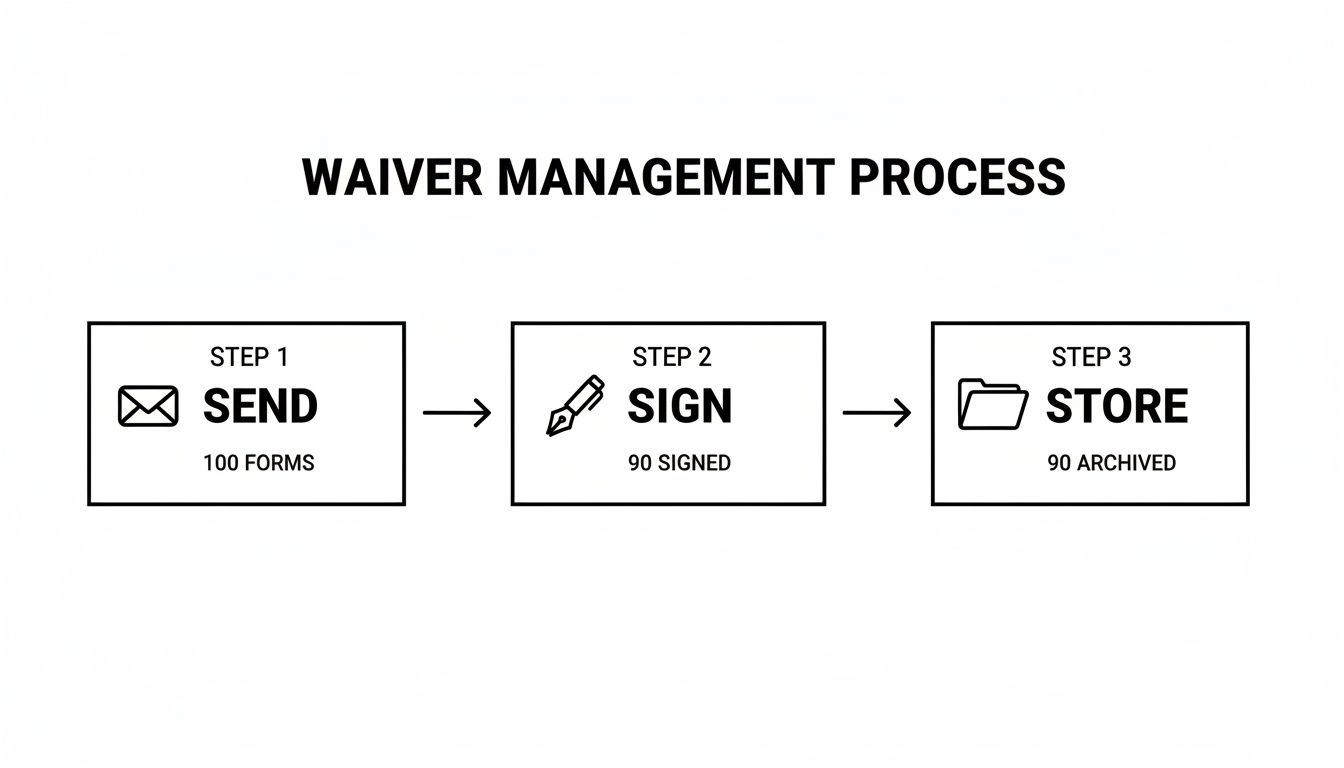
This clean, three-step process removes the risk of human error and ensures every single client completes this crucial step before their first session.
Making Waivers A Prerequisite For Booking
Here’s where automation becomes your secret weapon: enforcing your policies. You can configure your software to make a signed waiver a mandatory checkpoint before a client can book their first lesson. It is not a suggestion; it is a system-enforced rule. This completely removes the awkwardness of having your staff act as the "waiver police."
Here’s a real-world example of how this works:
- A parent fills out your inquiry form.
- The system sends a welcome email with a link to your digital enrollment packet, which includes the waiver.
- The parent logs into the portal to book a trial lesson.
- The software checks the student’s profile. Finding no signed waiver, it displays a message: "Please complete the required liability waiver before scheduling."
Automating Reminders And Renewals
Your waiver is not a one-and-done document. Best practice means renewing it annually to reflect policy updates. Manually tracking renewal dates is a logistical nightmare. Tutoring management software puts the entire renewal process on autopilot. You set an expiration date, and the system automatically sends reminders to parents.
For centers looking to streamline their document creation, using an AI contract generator can significantly speed up the process of drafting and updating these legal documents.
Your Top Questions About Tutoring Liability Waivers
When it comes to liability waivers, the details can feel a bit murky. Let's clear up some of the most common questions I hear from tutoring center owners so you can move forward with confidence.
Do I Really Need a Lawyer to Draft My Waiver?
Yes, you absolutely do. While this guide gives you the blueprint, it’s not a substitute for professional legal advice. Think of it this way: the risks at a center with hands-on science labs are completely different from those at an online-only language school.
A lawyer licensed in your state will tailor a waiver that’s actually enforceable and specific to your services. They know the local laws inside and out, especially the tricky rules around minors, which can vary wildly from one jurisdiction to the next. Spending a little upfront on proper legal counsel prevents your waiver from being thrown out in court right when you need it most.
How Often Should I Update My Waiver?
Treat your liability waiver like a living document, not something you file away and forget. The best practice is to review it with your lawyer annually. This ensures it stays current with any new local regulations or legal precedents that pop up. It’s a yearly health check for one of your most critical legal assets.
You’ll also want to trigger an immediate review anytime your business changes in a big way. For example:
- Adding new services, like in-home tutoring or summer camps.
- Opening a new physical location in a different city or state.
- Introducing new technology or software for lesson delivery.
- Changing your policies on health, safety, or data privacy.
This proactive approach means your waiver always reflects your current business risks, leaving no dangerous gaps in your legal protection.
"A liability waiver isn't a 'set it and forget it' document. An annual review with legal counsel is the minimum standard for maintaining its effectiveness as your business evolves and new risks emerge."
What Is the Best Way to Store Signed Waivers?
In today’s world, secure digital storage is the only way to go. Paper copies are just too risky—they get lost, damaged in a flood, or misfiled, making them nearly impossible to find when you're under pressure. Plus, they don’t offer a clear audit trail.
Using a dedicated tutoring management software is the ideal solution. You can attach the signed digital waiver directly to each student's profile. This creates a time-stamped, easily searchable, and secure record for every single client. If a legal issue ever comes up, you can pull up the signed document in seconds, proving compliance without having to dig through a mountain of paperwork in a dusty filing cabinet.
Can a Parent Refuse to Sign the Liability Waiver?
Of course. A parent or adult student can always refuse to sign. But you also have the right to make a signed waiver a non-negotiable condition for enrollment. Your policy here needs to be firm, consistent, and applied to every client without exception.
The key is to frame it professionally as a standard business practice that protects everyone. Your response should be clear and non-confrontational: "For the safety and protection of all our students and staff, a signed liability waiver is a required part of our enrollment process. This is a standard policy for all our clients before services can begin."
This stance makes it clear the waiver isn't personal—it's a foundational part of creating a safe, well-managed learning environment. If they still refuse, you have to be prepared to politely decline their enrollment to maintain the integrity of your policy. That consistency is what truly protects your business.
Ready to eliminate waiver headaches and streamline your entire operation? Tutorbase automates waiver collection, storage, and enforcement, so you can focus on teaching, not paperwork. See how we help tutoring centers reduce admin time by 60% when you register for Tutorbase today.


