


To succeed as an online tutor, you must operate like a business from day one. This means defining a specific, high-demand niche, setting up a professional tech stack, and using automated systems for scheduling and billing to avoid administrative chaos.
Your Opportunity in the 2026 Tutoring Boom
The demand for online education isn’t just growing; it’s exploding. This shift has created a massive opening for anyone with expertise to share. The key is to see it not just as tutoring, but as a business.
Why is the Online Tutoring Market Expanding So Rapidly?
Let's look at the numbers, because they tell a powerful story. The global online tutoring market reached $14.06 billion in 2025. It's projected to jump to $16.86 billion in 2026, which reflects a compound annual growth rate (CAGR) of 19.9%.
This isn't a small bump. It's a clear signal of massive, unmet demand for skilled tutors. You can analyze the full online tutoring market report for more details. The growth isn’t stopping there. By 2030, the market is projected to be worth an incredible $34.49 billion.
What This Means for You
This isn't just about abstract figures. It's about real students who need help and are actively looking for it. The data shows exactly why now is the perfect time to start your tutoring journey.
If you’re targeting high-demand regions like the United States and Asia-Pacific, the opportunity is even bigger. Together, they make up 38% of the market. In the US alone, 21% of all students already use a private tutor. To give you a quick snapshot, here’s a summary of the market's growth potential.
Online Tutoring Market At a Glance: 2025-2030
| Metric | Value/Projection |
|---|---|
| 2025 Market Size | $14.06 Billion |
| 2026 Projected Size | $16.86 Billion |
| 2030 Projected Size | $34.49 Billion |
| 2025-2026 CAGR | 19.9% |
| Key Market Share (US/APAC) | 38% |
| US Student Usage | 21% of all students |
These numbers confirm that the demand is real, sustained, and growing at a pace that creates significant room for new tutors to build a successful business.
The chart below visualizes this incredible trajectory. It shows just how much the industry is expected to scale in the coming years.
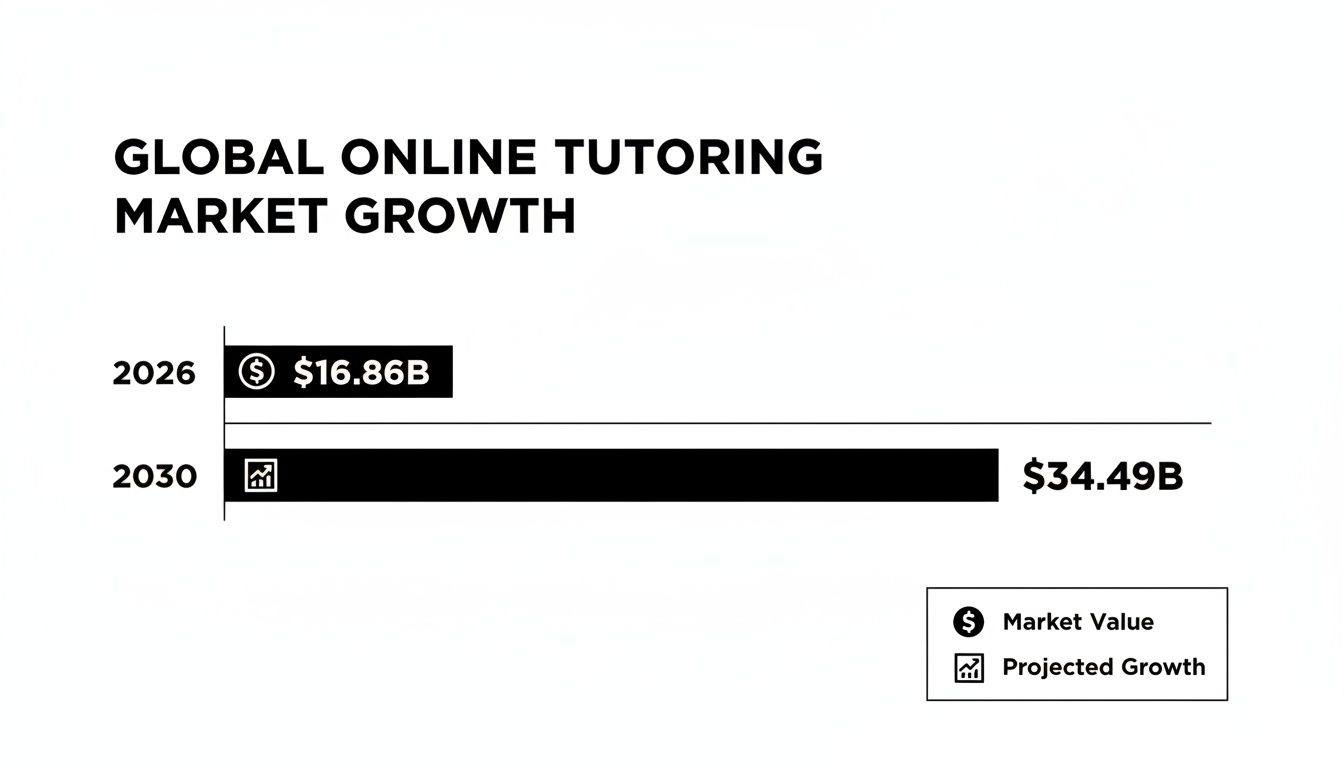
As you can see, the market is on track to more than double between 2026 and 2030. This isn't a short-term trend; it's a long-term shift in how people learn. This guide will give you a clear roadmap to tap into that demand, from setting up your first lesson to scaling your business.
How to Define Your Tutoring Niche and Curriculum
 To succeed, you must stop thinking of yourself as a general "tutor" and start thinking like a specialist. A broad, "I can help with anything" approach might seem like a good way to cast a wide net, but it actually signals a lack of deep expertise and gets you lost in a crowded market.
The secret is finding your niche, a specific area where you can become the go-to expert. Think about what you’re not only great at but also genuinely enjoy teaching. That passion comes through, making your sessions more effective and your marketing more authentic.
How do I identify a high-demand niche?
Start by looking where the real demand is. Generic math help is a tough sell, but specializing in AP Calculus or IB Math makes you a distinct, valuable service provider. The same goes for languages. Instead of just "Spanish tutor," you could focus on DELE B2 exam preparation or conversational Spanish for business professionals.
The K-12 market is an absolute giant. Online tutoring for K-12 students now dominates the market, making up a massive 48.7% of the entire global private tutoring sector. The high school segment (grades 9-12) is especially profitable, accounting for 62.2% of that K-12 revenue due to intense pressure for college entrance exams. You can find more data by checking the latest tutoring industry statistics on Tutorbase.com.
Consider these high-potential areas:
- Test Preparation: Focus on specific, high-stakes exams (SAT, ACT, IELTS, TOEFL, Goethe-Zertifikat). Parents are highly motivated to invest in proven results when college admissions are on the line.
- Specialized Academic Subjects: Don't just offer "English." Instead, offer AP Literature exam prep, essay writing for college applications, or reading support for students with dyslexia.
- Skill-Based Tutoring: Look beyond traditional academics. There's strong demand for music theory, piano, or coding languages like Python.
The most profitable tutors solve a specific, urgent problem. A parent isn't just looking for a "tutor," they are looking for someone to help their child pass the SAT, master algebra, or get into their dream college.
How do I structure my curriculum?
Once you've picked your niche, you need to structure your curriculum. A curriculum is how you organize and package your services so families understand exactly what they are buying. It's the foundation for becoming an online tutor who can command professional rates.
A well-defined curriculum has three clear components:
- Subjects: The core topics you teach (e.g., Math, French, SAT Prep).
- Levels: The specific stages of learning within that subject (e.g., Grade 5 Math, French A2, SAT Verbal).
- Services: The actual packages you sell. These combine your subjects and levels into sellable products, like a "10-Week IELTS Speaking & Writing Course" or "Beginner Piano for Adults."
For example, a language tutor might break down "Spanish" into distinct services for A1, A2, B1, and B2 levels, each with its own package and price. This structure shows parents a clear learning path and proves your expertise.
What is the essential online tutoring tech stack?
Your online classroom is your storefront. A laggy video feed or crackling audio isn't just a minor annoyance, it's a reason for a paying family to look elsewhere. A professional, reliable setup shows you're a serious educator.
Think of it this way: your tech stack is the first impression you make. Investing in a few key pieces from day one will pay for itself in client trust and retention.
Nailing the Hardware Basics
You don't need a Hollywood-style production studio, but your built-in laptop camera probably isn't going to cut it. A basic hardware setup includes:
- A Reliable Computer: This is your command center. It must handle video conferencing, a digital whiteboard, and other apps simultaneously without freezing up.
- A Quality Webcam: An external 1080p webcam makes you look sharp and professional.
- A Dedicated Microphone: Clear audio is arguably more important than perfect video. A simple USB microphone or a headset with a boom mic will ensure students hear every word.
Choosing Your Core Software
With your hardware sorted, it's time to pick the software that will create a seamless learning experience. This falls into two buckets: your teaching tools and your admin tools.
First, you need a robust video conferencing platform for lesson delivery. Look for features like screen sharing, annotation, and an interactive whiteboard. To compare the top choices, check out our detailed guide on the best video conferencing tools for online tutoring. As you dial in your setup, you can also explore some of the best tools for online teaching that can really elevate the student experience.
Finally, you need to think about your administrative backend. Many new tutors juggle a personal calendar for scheduling, PayPal for payments, and endless email chains for communication. This manual approach becomes a chaotic mess of double-bookings, missed invoices, and wasted time.
This is where dedicated tutoring management software becomes a game-changer. What is tutoring management software? It is a platform that automates the business side of tutoring. Tools like Tutorbase handle scheduling, billing, and payment tracking, which prevents the headaches of chasing late payments or dealing with last-minute cancellations. It frees you up to do what you actually love: teaching.
Pricing Your Services and Managing Payments Seamlessly

Let's talk about one of the biggest decisions you'll make: how much to charge. If you price too low, you're not just undervaluing your expertise, you're making it nearly impossible to build a sustainable business. Price too high, and you risk scaring off those crucial first students.
Your price should reflect your skills, your niche, and the results you help students achieve. Specialized services like SAT test prep or AP Calculus support always command higher rates than general homework help. Don't be afraid to charge what you’re worth. Many successful tutors set an income goal first, then work backward to figure out the hourly rate and student load they need to hit it.
How do I choose my tutoring pricing model?
How you structure your pricing is just as important as the dollar amount. Each model has its own pros and cons, especially when it comes to client commitment and your own cash flow. For an even deeper dive, check out our comprehensive guide on tutoring pricing models.
To help you decide which structure is best for your business, here’s a quick comparison of the most common approaches.
| Pricing Model | Best For | Pros | Cons |
|---|---|---|---|
| Hourly Rate | Getting started, flexible or short-term clients. | Simple to explain and implement. | Lacks income predictability; less client commitment. |
| Packages | Securing upfront payment and student commitment. | Improves cash flow; encourages longer-term learning. | Requires tracking lesson usage and expirations. |
| Subscription | Creating consistent, recurring monthly revenue. | Highly predictable income; builds strong client loyalty. | Can be complex to manage billing cycles manually. |
Choosing the right model sets the financial foundation for your business. An hourly rate is fine when you're starting out, but packages and subscriptions are what truly build a stable, scalable business by encouraging longer-term student relationships.
How do I manage payments without the headaches?
Getting paid should be the easy part. But for many tutors, it quickly becomes a huge administrative headache. Chasing late payments and manually creating invoices is a recipe for burnout.
Your payment process must be professional from day one. Set up a payment gateway like Stripe right away. This lets parents pay securely online with a credit card, which is the standard expectation for any professional service in 2026. Avoid informal methods like cash or bank transfers, they’re a nightmare to track and often lead to awkward conversations.
As your business grows, you can't afford to manually send invoices after every single session. It's just not sustainable. This is where a system that automates the whole process becomes essential.
Tutoring-specific platforms can automatically generate and send invoices for completed lessons, keep track of prepaid packages, and even send out polite payment reminders for you. Managing your business finances can be made even easier by looking into the best accounting software for small business to handle things as you scale. By automating this workflow, you reclaim hours of admin time and make sure you get paid on time, every time.
How to Find and Keep Your First Tutoring Students
An empty calendar doesn't pay the bills. Once you’ve nailed down your niche, tech, and pricing, the real work begins: getting students through the door and making sure they want to stay. Building a client base is a mix of smart, targeted outreach and creating an experience so good that families can't help but talk about it.
Your most powerful marketing tool, especially at the start, is trust. This is exactly why word-of-mouth is gold for tutors. The best place to start is by reaching out to the families of any students you've taught before.
What are strategies to acquire my first students?
You can't just build a great tutoring service and hope people find it. You have to be proactive. Your first move is to create a simple, professional online presence. A basic one-page website or a polished profile on Facebook or LinkedIn gives parents a legitimate place to check you out.
Here are a few low-cost strategies that actually work:
- Leverage Tutor Marketplaces: Sites like Wyzant or Chegg can be a fantastic source of initial leads. Yes, they take a commission, but they handle the marketing and payment processing, letting you focus purely on teaching.
- Use Social Media Purposefully: You don't need to post constantly. Instead, find local parent groups on Facebook and offer genuine, helpful advice on topics related to your subject. Answering questions builds credibility and naturally positions you as the local expert.
- Activate Your Network: Let friends, family, and former colleagues know you're now tutoring. A simple text or email explaining the specific problems you solve for students can lead to surprisingly fast referrals.
The single best way to grow is by delivering incredible results for your first few students. One tutor we know consistently makes $1,000-$1,500 extra a month with just five clients because her service was so good that they kept telling their friends. We cover this in much more detail in our guide on how to get tutoring clients, which is packed with more ideas.
How do I keep students long-term?
Getting a new student is far more expensive and time-consuming than keeping an existing one. Retention is where you build a stable, profitable tutoring business. It all comes down to two things: professionalism and consistency.
A smooth onboarding process is your first chance to impress. From the moment a parent inquires, your communication must be clear, prompt, and professional. Send a simple welcome packet that outlines your policies, what to expect, and the student’s learning goals.
Consistent scheduling and clear communication are the bedrock of loyalty. Nothing erodes trust faster than last-minute cancellations or disorganized booking. Use a reliable system to manage your calendar and send automated lesson reminders. This simple step not only prevents no-shows but also shows parents you value their time as much as your own.
Scaling From Solo Tutor to Thriving Business

As your client list grows, the very thing that made you successful—your personal touch—can become your biggest bottleneck. You’re no longer just a teacher; you’re an administrator, accountant, and scheduler all rolled into one. The leap from a solo freelancer to a thriving business owner happens when you replace manual chaos with smart automation.
If you find yourself spending more than 10 hours a week on admin, it’s a clear sign your current methods can't keep up. This is the stage where many tutors burn out, trapped by the success they worked so hard to achieve. The solution is to start thinking like a CEO, not just a tutor.
Recognizing the Administrative Breaking Point
The warning signs are easy to spot. You’re juggling lesson schedules in a personal calendar, tracking payments in a messy spreadsheet, and sending invoices one by one. This manual approach doesn't just waste time; it actively costs you money through errors and missed opportunities.
Fragmented tools are the main culprit behind this administrative drag. This operational mess is a huge drain on your resources. In fact, businesses that successfully integrate their systems can slash admin time by 60%, achieve 3x faster student onboarding, and see a 42% increase in monthly renewals. You can explore more insights on how operational efficiency is shaping the tutoring market's latest trends.
This is where a unified platform becomes essential. Shifting from scattered spreadsheets and calendars to a single source of truth is how you reclaim your time and build a sustainable business.
From Manual Chaos to Automated Control
Imagine a system where a student's attendance automatically generates an invoice, which is then sent to the parent without you lifting a finger. That's the power of automation. It’s not about losing the personal touch; it’s about freeing yourself from repetitive tasks so you can focus on what actually matters—teaching.
A dedicated tutoring management platform like Tutorbase helps you make this shift. Features like automated billing for subscription clients or auto-deducting lessons from prepaid packages eliminate the manual work that bogs you down. Conflict detection prevents double-bookings, and robust reporting gives you a clear view of your revenue and student progress.
This is how you go from being a busy online tutor to the owner of a scalable business.
Frequently Asked Questions About Online Tutoring
As you start your journey as an online tutor, a lot of questions will come up. Here are straight-to-the-point answers to the ones we hear most often.
How much can I realistically earn as a new online tutor?
Your earnings depend on your niche, expertise, and pricing structure. New tutors can typically start around $25-$40 per hour. However, if you specialize in a high-demand area like SAT prep or AP-level subjects, you could command $75 or more from the start. We've seen tutors earn an extra $1,000-$1,500 per month with just five clients by offering a highly specialized service.
Do I need a formal teaching degree to be an online tutor?
No, a formal teaching degree is not always a requirement. What matters most to parents is your expertise and ability to deliver results. Many successful tutors are college students who aced the subject, industry professionals with real-world experience, or native speakers with deep knowledge to share. Your value comes from solving a specific problem for a student.
What is the single most common mistake new tutors make?
The biggest mistake new tutors make is treating their work like a hobby instead of a business. This mindset leads to disorganized scheduling, inconsistent payment collection, and unprofessional processes that cause burnout. When you operate like the CEO of your business from day one, you build a sustainable operation, not just a side hustle.
How can I start tutoring with no initial clients?
You can start by using word-of-mouth and reaching out to families of any past students. From there, you can:
- Create a profile on tutor marketplaces like Wyzant to get your first few leads.
- Join local parent groups on social media and offer helpful, free advice to build credibility.
- Tell your personal and professional network about the specific services you offer and who you help. Remember, the initial goal is to land your first few clients and deliver incredible results. Their testimonials and referrals will become your most powerful marketing engine.
How do I legally set up my online tutoring business?
To operate legally, you should register your business as a sole proprietorship or an LLC, depending on your local regulations. This allows you to open a business bank account, which is crucial for keeping your personal and business finances separate. You should also create a simple tutoring contract that outlines your rates, cancellation policy, and payment terms to protect both you and your clients.
Is online tutoring a good side hustle?
Yes, online tutoring is an excellent side hustle due to its flexibility and low startup costs. You can set your own hours around a full-time job or other commitments. Because you can operate from anywhere, you save time and money on commuting, making it a highly efficient way to earn extra income.
Ready to stop juggling spreadsheets and start scaling your tutoring business? Tutorbase consolidates your scheduling, billing, and client management into one AI-powered platform, cutting admin time by up to 60%. See how it works and register for an account today.


