


To effectively track student progress, you must move beyond scattered report cards and build a continuous, data-driven story of each learner's journey. The best approach starts by defining clear, measurable goals for each student and then translating them into tangible Key Performance Indicators (KPIs) that your team can monitor. This process turns vague ambitions into a clear roadmap for success.
Building Your Modern Student Progress Framework
Gone are the days of trying to piece together a student's progress from messy spreadsheets, old emails, and a tutor's anecdotal notes. A modern student progress framework is a systematic approach that blends hard data with qualitative insights from your teaching staff.
This creates a dynamic, living profile for every learner. It helps your tutoring center spot learning gaps early, show parents tangible value, and empower your team to make smarter instructional decisions. The goal is to shift from reactive problem-solving to proactive guidance.
Instead of waiting for a bad test score, a well-built framework helps you see smaller warning signs. For example, you can catch a dip in homework completion or a tutor's note about waning confidence. This allows you to step in before these issues become major problems.
What are the best KPIs for tracking student progress?
Before you track anything, you need to know what success looks like. Vague goals like "get better at math" are impossible to measure. You need specific, measurable objectives that tie directly back to your curriculum. This is all about translating broad academic targets into concrete Key Performance Indicators (KPIs).
Here are a few practical examples:
- For an SAT Prep student: The goal might be to increase their score by 150 points. The KPIs would be a 20% improvement in practice test scores for the math section and hitting an 85% completion rate for all assigned practice questions.
- For a Grade 5 English student: The objective is to improve essay writing. KPIs could include achieving a rubric score of 4 out of 5 on topic sentence structure and cutting down grammatical errors by 50% over three months.
- For a beginner French learner: The aim is mastering conversational basics. KPIs might be correctly using 30 new vocabulary words per week and hitting an 80% accuracy rate in basic verb conjugation quizzes.
Why is a baseline assessment important?
You can't show progress if you don't know where a student started. A diagnostic assessment is the crucial first step, giving you a clear baseline of a student’s current knowledge and skills. This initial data is non-negotiable for creating a personalized learning plan and, later, proving how much growth has happened.
A modern system should provide a comprehensive student profile, combining all key information in one place.
When you centralize data like this, every stakeholder has access to the same up-to-date information. This eliminates confusion between your admin team, tutors, and parents. The assessment should be tailored to the specific goals you’ve set, not just a generic test.
A robust tracking framework creates more than just a report card; it builds a continuous narrative of a student's academic journey. This story, backed by data, is the most powerful tool you have for proving value and building long-term parent trust.
To help you structure this, here’s a breakdown of the core pillars you'll need.
Key Components of a Modern Progress Tracking System
Building a system that truly works involves weaving together several key data points. Each piece tells part of the story, from daily engagement to long-term academic growth.
| Component | What It Measures | Why It Matters for Your Center |
|---|---|---|
| Learning Goals & KPIs | Specific, measurable academic targets (e.g., "Improve algebra test scores by 15%") | Aligns tutors, students, and parents on a clear definition of success. |
| Diagnostic Assessments | A student's starting point and skill gaps at the beginning of their program. | Provides the baseline needed to create a personalized plan and demonstrate growth over time. |
| Attendance & Engagement | Session attendance, homework completion rates, and participation levels. | Early warning signs of disengagement; helps identify motivational issues before they impact grades. |
| Formative Assessments | Quizzes, practice tests, and in-session concept checks. | Offers real-time feedback on whether a student is grasping new material. |
| Qualitative Tutor Notes | Observations on student confidence, effort, and specific challenges. | Adds crucial human context that numbers alone can't capture. |
| Summative Reports | Periodic summaries showing progress against initial goals and KPIs. | The ultimate tool for communicating value to parents and justifying continued enrollment. |
Putting these components together transforms your reporting from a simple grade summary into a rich, compelling narrative of student achievement and operational excellence. This data-driven approach mirrors broader educational trends, which have shifted from snapshot assessments to tracking actual learning growth over time. Tutoring centers can adopt this exact mindset to measure and communicate genuine academic momentum.
Designing a Reliable Data Capture Workflow
High-quality, consistent data is the engine behind any meaningful student progress tracking. Without a solid way to capture what's happening day-to-day, your reports will have gaps and your insights will be flawed. The goal is to move from manual check-ins and scattered notes to a centralized, automated system that fuels both academic insights and accurate billing.
This simple cycle, defining goals, setting a baseline, and then continuously tracking data, is the core of it all.
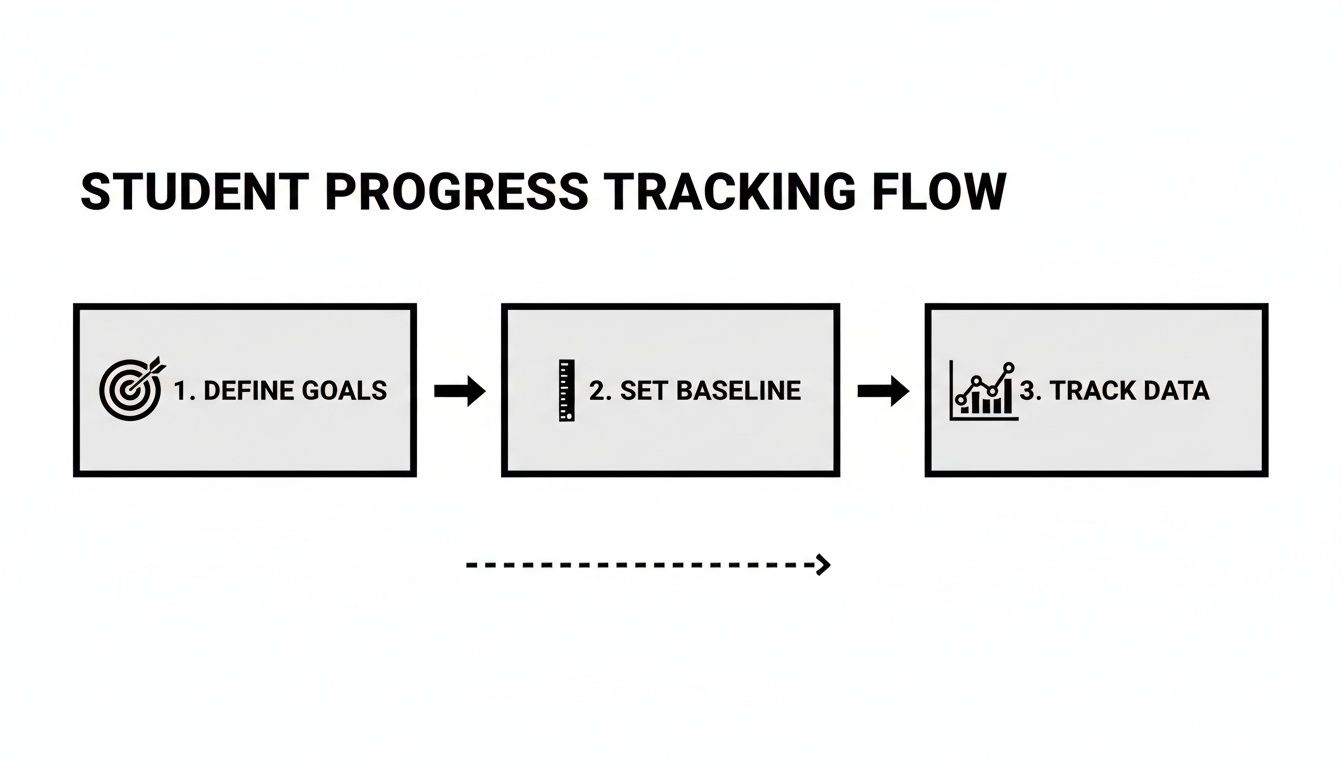
This repeatable process ensures every action contributes to a clear and measurable student journey.
How do you streamline attendance tracking?
Manual attendance sheets are a huge source of administrative headaches and billing errors. One missed checkmark can throw off an entire invoice or make a progress report inaccurate. Automating attendance is the first and most important step in building your data workflow.
Modern tutoring management software changes the game by turning attendance from a chore into a valuable data source. With a few clicks, tutors or admins can log a student’s status for each lesson. These statuses should go beyond a simple "present" or "absent."
- Attended: Confirms the student was there and participated. This is what triggers billing and payroll.
- No-show: Means the student missed the lesson without notice, which often triggers a fee based on your cancellation policy.
- Late Cancelled: Shows the student cancelled inside the penalty window, again linking directly to your center's billing rules.
- Excused Absence: Logs a pre-approved absence that might not incur a fee, keeping everyone's records clean.
Capturing this level of detail creates a much richer dataset that informs not just academic reports but your financial operations, too. A pattern of no-shows can be an early warning sign of a disengaged student, giving you a chance to check in.
How do you centralize assessment data?
Your workflow needs a smart way to handle all the different assessments you use. Juggling diagnostic test results, weekly quiz scores, and final exam results in separate spreadsheets is inefficient. The real goal is to create a single, centralized home for every piece of test data.
This approach gives you a complete timeline of a student's performance, making it easy to spot trends. A well-designed system lets you schedule, record, and analyze results from all kinds of assessments in one place.
- Diagnostic Tests: The baseline data you capture right at the start of a student's program.
- Formative Assessments: Ongoing checks for understanding, like quizzes or homework, that give you real-time feedback.
- Summative Assessments: End-of-unit or end-of-term exams that measure overall mastery against the original learning goals.
When all of your assessment data lives in one place, you can instantly compare a student's quiz score from last week to their initial diagnostic results. This lets you show parents tangible progress with concrete numbers, turning a simple score into a powerful story of growth.
How do you standardize tutor observations?
A reliable data workflow must capture the qualitative insights that numbers alone can't provide. Tutors’ observations on a student’s engagement, confidence, and specific challenges are invaluable. However, this crucial feedback often gets lost in casual emails or is forgotten after a long day of teaching.
To make this data useful, you have to standardize it. Instead of a generic, open-ended "notes" field, structure the feedback process. Good tutoring management software provides templates that prompt tutors to comment on specific areas.
For example, a post-lesson note template might include fields for:
- Topics Covered: A quick summary of the lesson's content.
- Areas of Strength: Where the student excelled or showed real confidence.
- Challenges Encountered: Specific concepts or skills the student struggled with.
- Engagement Level (1-5): A simple rating to help quantify participation over time.
This structured approach turns subjective observations into consistent, actionable data points. When this information is tied directly to a student's profile and linked to a specific lesson, it builds a rich, contextual history that helps everyone understand the full picture.
Automating Progress Reports with Tutoring Software
Manually creating progress reports is a massive time sink. It’s one of those repetitive, error-prone tasks that eats up hours of admin time and often leads to inconsistent communication with parents. Shifting this entire workflow to dedicated tutoring management software is one of the most impactful changes you can make.
The goal is to stop the manual data hunt for good. No more digging through spreadsheets for attendance, separate files for test scores, and old emails for tutor notes. Instead, you set up a system to automatically pull all that information together into one place. This change transforms reporting from a dreaded quarterly chore into an automated, value-added service that parents love.
How do you configure automated report generation?
Automation is all about setting up rules that trigger report creation for you. Good tutoring software lets you define the schedule and the content, so the system does all the heavy lifting. You can set reports to generate on a recurring basis, like the first of every month or at the end of each term.
This consistency is a game-changer for parent communication. When parents expect a detailed update on a predictable schedule, it lowers their anxiety and cuts down on "just checking in" emails. Centers that automate this workflow often cut their related admin time by over 60%.
Can you customize templates for your brand?
Your progress reports are a direct reflection of your center’s quality and professionalism. A generic, one-size-fits-all template doesn't send the right message. Your software should let you create custom report templates that look and feel like your brand.
This means you should be able to:
- Add your logo and brand colors to create a polished document.
- Pick and choose which data points to include, like attendance summaries and assessment scores.
- Structure the layout to highlight the most important information first.
By customizing your templates, you ensure every report reinforces your center's value. It’s also perfectly tailored to the specific programs you offer, whether that’s K-12 math or advanced test prep. For a deeper dive into next-level automation, it's worth exploring how Large Language Models (LLMs) can enhance automation by helping generate detailed reports and spot trends in student data.
How can tutor notes enrich progress reports?
Numbers like test scores and attendance rates only tell part of the story. The real insights often come from the qualitative observations your tutors make during each lesson. When you automate reports, you can seamlessly pull these structured notes right into the final document.
This is what it looks like inside Tutorbase, where a tutor can log structured notes immediately after a lesson.
By capturing feedback on topics covered, areas of strength, and specific challenges, you add critical context that makes the report infinitely more valuable to parents.
A great progress report doesn’t just show what a student has learned; it shows how they are learning. Including tutor notes about a student's confidence, engagement, and specific 'aha' moments turns a dry data summary into a compelling narrative of their growth.
How can parents get on-demand access to progress?
While scheduled reports are essential, modern parent communication demands more. A parent portal provides on-demand access to progress data, giving parents the transparency they're looking for. Instead of waiting for a monthly summary, they can log in anytime to view attendance records and read shared tutor notes.
This self-service model empowers parents and builds a huge amount of trust. It also gives them a central hub for all communication and data, which is easily managed within a system like the Tutorbase CRM. By giving parents direct visibility, you improve their experience and reduce the administrative burden on your team.
Keeping Parents in the Loop to Build Lasting Trust
Collecting all this data is one thing, but its real value comes alive when you share it with parents. When you can clearly communicate a student's progress, you build incredible trust and prove your center's worth. The goal is to turn raw numbers into a story of genuine growth, shifting your role from a simple service provider to an essential educational partner.

This means turning a score like "75% on the test" into a real insight: "showed mastery of fractions but needs more support with multi-step word problems." It’s that level of detail that makes parents feel you truly understand their child.
How do you handle key parent conversations?
Some conversations are make-or-break in the parent-tutor relationship. If you have a clear game plan for each one, you’ll deliver value every time and reinforce your expertise. Getting these moments right is what separates good centers from great ones.
Here are three critical touchpoints and how to handle them:
- The Post-Assessment Debrief: After the first diagnostic, don't just present weaknesses. Frame it as a strategic roadmap. "Here’s our starting point, and here is the personalized plan we've built to help them reach their goals."
- The Monthly Check-in: This should be a proactive, scheduled update. Mix hard data (assessment scores, attendance) with insights from tutor notes. This paints a complete picture of the student's experience.
- The 'Falling Behind' Alert: If a student is struggling, don’t wait for the parent to call you. A prompt, private conversation shows you're paying attention. Present the data, explain the challenge, and come with a collaborative action plan.
How do you turn raw data into real insights?
The biggest mistake centers make is just reporting scores. Parents need context. They need to understand what the numbers mean. Your job is to connect the dots for them, showing a clear link between the effort being put in and the results coming out.
For instance, instead of saying, "Maria's attendance was 95%," try this: "Maria's consistent 95% attendance has directly boosted her confidence with new vocabulary, which we're seeing in her latest quiz scores." That small shift makes all the difference.
Parents aren’t just paying for tutoring; they are investing in a result. Every email, report, and phone call should reinforce that their investment is paying off by showcasing tangible, data-backed progress.
How can shared tutor notes create an ongoing dialogue?
One of the most powerful trust-builders is transparency. A parent portal that includes shared tutor notes creates a continuous conversation that a monthly report can't match. When a parent can log in and see a tutor’s positive comment right after a great lesson, it forges a real connection.
This feature, usually found in good tutoring software, lets you decide what gets shared. You can keep internal notes private while making encouraging, parent-facing comments visible. The portal becomes a living document of the student's journey. For ideas on structuring these updates, check out our guide on tutoring progress report templates.
Using Data Trends to Improve Your Tutoring Programs
Tracking an individual student's progress is just the starting point. The real magic happens when you start looking at the bigger picture, analyzing all that data in aggregate to see what it tells you about your programs, your tutors, and your business as a whole.
This is the shift from one-off reports to powerful, cohort-level analysis. It's the difference between fixing a single leaky faucet and inspecting the entire plumbing system to prevent future problems.

When you look at data from groups of students, you can spot trends across subjects, grade levels, or even specific tutors. This bird's-eye view gives you critical feedback you simply can't get by focusing on one student at a time.
How do you identify curriculum strengths and weaknesses?
By pooling performance data, you can quickly see which parts of your curriculum are hitting the mark and which need attention. A good dashboard lets you slice and dice student performance by subject and level, revealing patterns that would otherwise stay hidden.
For example, after analyzing assessment data from your SAT prep students over the last six months, you spot a glaring trend: 80% of them are scoring below target on the quantitative reasoning section. This is a program-level insight telling you something needs to change.
With this data, you have a clear mandate to:
- Review and update your math curriculum or find better teaching materials.
- Provide targeted professional development for tutors on how to teach these specific concepts.
- Create supplemental workshops focused on the most challenging math topics.
This data-driven approach pulls you out of guesswork and lets you make precise, impactful changes that benefit every student who walks through your door.
How do you evaluate teacher performance and methods?
Aggregate data is the most objective way to understand teacher effectiveness. When you track student progress rates by tutor, you can identify your star players whose methods could be replicated across the team.
For instance, you might notice that one tutor, Sarah, has an exceptionally high student progress rate in Grade 10 Chemistry. Her students consistently outperform the center's average by 15%. This is your cue to sit down with Sarah, find out what she's doing differently, and share those best practices with your other tutors.
By linking student outcomes to specific tutors, you create a merit-based system for professional development. This not only rewards your best instructors but also provides a clear pathway for improvement for the rest of your team.
This is especially critical right now. Global data from PISA 2022 showed unprecedented declines in student performance, with math scores dropping by a record 15 points. Tutoring centers are on the front lines of bridging these gaps, and systematic tracking is the only way to prove your interventions are working.
How do academic outcomes link to business health?
The most sophisticated tutoring centers connect their academic data directly to their business KPIs. Your software should give you a clear view of how student progress impacts key operational metrics, creating a powerful feedback loop for smart decision-making.
A great analytics dashboard can help you explore more about connecting attendance to retention. By analyzing these connections, you can start answering the big business questions:
- Do students with higher progress rates have better monthly renewal rates? If yes, you have a rock-solid business case for investing more in academic quality.
- Which programs have the highest student success and the best capacity utilization? This tells you exactly where to focus your marketing budget for maximum ROI.
- Are there specific tutors whose students are more likely to refer friends? This helps you identify your most valuable brand ambassadors.
The table below gives a few more examples of how you can translate raw data into strategic business decisions.
From Individual Data to Business Insights
| Data Point / Trend | Potential Insight | Actionable Business Decision |
|---|---|---|
| Low progress rates in a new, high-demand subject. | Tutors may lack specialized training for this curriculum. | Invest in subject-specific professional development or hire a specialist tutor. |
| High attendance but slow progress for a specific student group. | The teaching method may not suit this group's learning style. | Offer alternative formats, like small-group workshops or hands-on learning modules. |
| A spike in new enrollments after a specific marketing campaign. | The campaign's messaging and targeting were effective. | Reallocate a portion of the marketing budget to double down on that channel or message. |
| Consistently high progress rates for students who use a specific online tool. | The supplemental tool is highly effective at reinforcing concepts. | License the tool for all relevant students and build it into the standard curriculum. |
By linking these data points, you stop seeing academics and operations as separate functions. You start seeing them as two sides of the same coin, where improving student outcomes directly drives business growth.
FAQ: How to Track Student Progress
How often should we formally report progress to parents?
For most K-12 academic programs, a detailed, formal report every four to six weeks is the sweet spot. This provides enough time to show measurable growth. For short, intensive courses like SAT or IELTS prep, weekly summaries are more effective. Consistency is key, and automating these reports ensures they go out on a predictable schedule, building trust and reducing admin work.
What is the best way to handle qualitative feedback from tutors?
The best way to handle tutor feedback is to standardize it with structured templates. Instead of a generic "comments" box, prompt tutors with specific fields after each lesson, such as "Areas of Strength," "Topics to Review," and an "Engagement Level (1-5)." This turns subjective observations into consistent, usable data that is easy to include in automated reports for parents.
How can we track progress consistently across multiple curricula?
To track progress consistently across different subjects like Grade 3 Math and B2-level Spanish, create a master skills framework for each subject. Instead of tracking progress by "Chapter 4," you track mastery of core concepts like "Multiplying Fractions." Tutoring management software lets you create these custom skill levels, providing a consistent metric regardless of the teaching materials used.
How much time can we save by automating progress tracking?
You can save a significant amount of time. Tutoring centers that switch from manual methods to an integrated platform like Tutorbase consistently report a 60% reduction in admin time spent on tracking and reporting. Tasks that used to take hours, like compiling monthly reports, can be set up to run automatically in minutes, freeing up your team for high-value work.
What are formative and summative assessments?
Formative assessments are ongoing, informal checks for understanding, like quizzes, homework, or in-class questions, that provide real-time feedback. Summative assessments are more formal evaluations, like end-of-unit exams or final projects, that measure a student's overall mastery of the material against the initial learning goals. Both are crucial for a complete picture of student progress.
Why is a parent portal useful for tracking progress?
A parent portal is useful because it provides on-demand, transparent access to a student's progress. Instead of waiting for a monthly report, parents can log in anytime to see attendance records, recent assessment scores, and shared tutor notes. This self-service model empowers parents, builds trust, and reduces the number of "check-in" calls and emails your administrative team receives.
Ready to stop spending hours on manual tracking and start demonstrating real, data-backed student progress? Tutorbase consolidates student data, automates reporting, and gives you the tools to improve both academic outcomes and business efficiency. See how you can cut your admin time and build stronger parent trust by signing up for a free trial at tutorbase.com/register.


