


An integral management system is a single software platform that unifies your core operations, like scheduling, billing, and payroll, into one automated workflow. It eliminates manual data entry, reduces administrative work by up to 60%, and provides a single source of truth for your business. This allows you to focus on growth instead of repetitive tasks.
What is an Integral Management System?
An integral management system acts as the central hub for your tutoring business. It is a single software platform that connects all your core operations. This includes scheduling, billing, parent communication, and payroll, creating one automated workflow.
Instead of juggling different spreadsheets, calendars, and payment apps, everything works together. This approach solves the costly problem of manual admin work. It frees you up to focus on teaching students and growing your business.
Why is an Integral System the Central Hub of Your Tutoring Business?
Imagine a tutor marks a student as present. That single action can instantly update the parent's invoice, calculate the tutor's pay, and mark the classroom as occupied. This is the core benefit of an integral system.
Because all modules are connected, you eliminate error-prone data entry. No more managing a Google Calendar for schedules, Stripe for payments, and an Excel sheet for payroll. Everything lives in one place, creating a single source of truth for your operation.
How Do Separate Tools Fail Growing Businesses?
Many tutoring centers start with separate, often free, tools. This approach works for a handful of students but breaks down as you grow. The core issue is that these tools do not communicate with each other. You become the manual link between them.
This fragmented setup leads to several common problems:
Constant Double-Bookings: Your scheduling tool does not know a tutor is already booked, frustrating parents and tutors.
Time-Consuming Invoicing: You waste hours each month manually cross-referencing attendance sheets to create accurate invoices.
Payroll Calculation Errors: Calculating tutor pay from different schedules and rates often leads to expensive mistakes.
Zero Business Insight: You cannot easily see crucial metrics like room profitability or tutor retention rates.
The Shift Towards Unified Platforms
The market recognizes this need for consolidation. The global Learning Management System (LMS) market, which includes integral management systems for educational businesses, is forecast to grow from USD 22.97 billion to USD 98.40 billion by 2033. For tutoring centers handling 50 to 10,000+ lessons weekly, these systems can slash admin overhead by up to 60%.
An integral system automates the flow of information from one task to the next. It turns your administrative grind into an efficient, self-running engine that powers your growth instead of holding it back.
This unified platform concept is standard in the corporate world. For a broader perspective, it helps to review understanding what Microsoft Dynamics 365 is, a prime example of an integral system for large enterprises. The principle is the same: connect all business functions to work smarter.
What are the Core Modules Every Tutoring Center Needs?
A solid integral management system combines several specialist modules that work together. Each module handles a specific job, like scheduling or billing, but they all communicate seamlessly. This integration is what separates a true platform from a patchwork of apps.
When these modules work in harmony, they create an effortless operational flow. You stop wasting time on manual data entry and start focusing on teaching. The learning management market, valued at USD 38.7 billion in 2022, is projected to hit USD 232.8 billion by 2032. You can read more about this educational transformation and its impact.
This diagram shows how a central hub connects all critical pieces of your business.
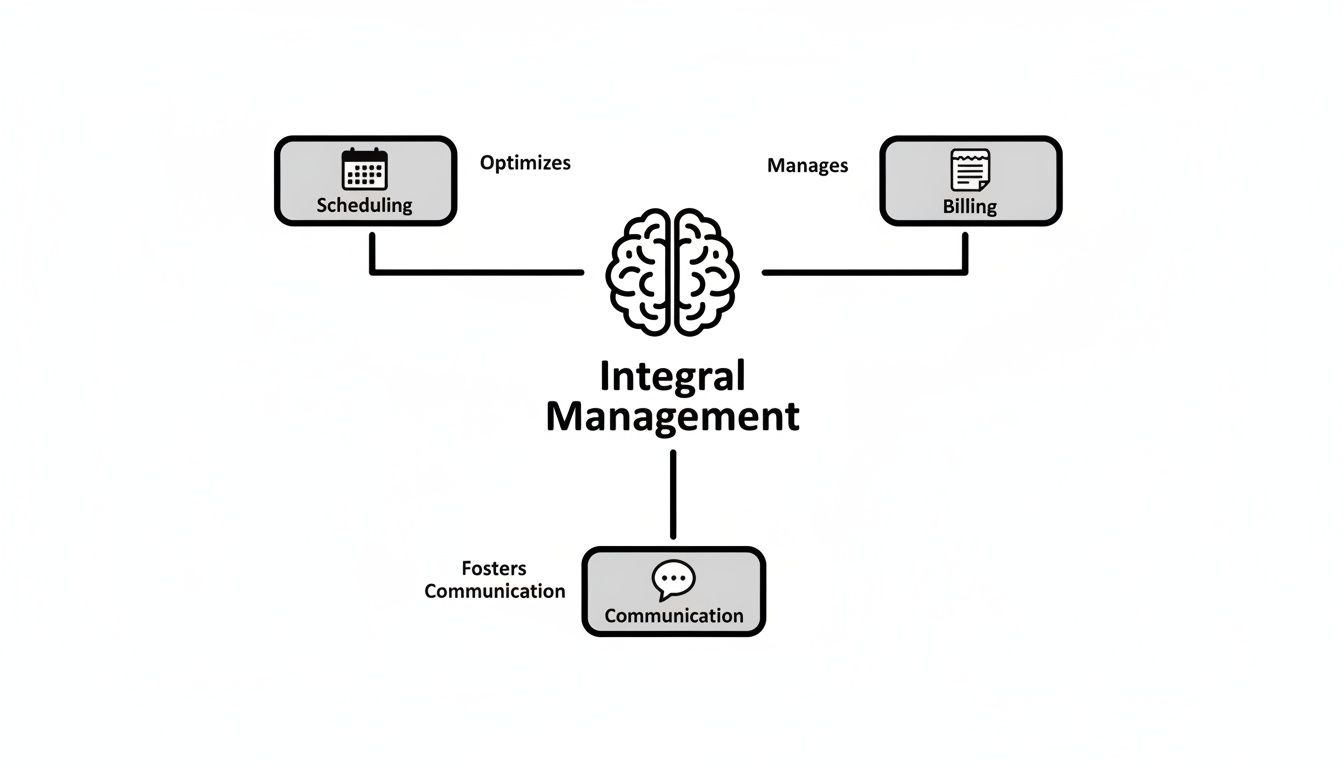
As you can see, nothing operates in a silo. Scheduling feeds into billing, which informs payroll, and everything is tied back to the people in your system.
How do I manage smart scheduling and resources?
A smart scheduling module makes double-booking a thing of the past. It is more than a digital calendar; it is an intelligent engine that understands your business constraints. It knows every tutor's availability, every room's capacity, and teacher qualifications.
When you book a new lesson, the system cross-references these details in real-time. If there is a conflict, it flags it instantly. It often suggests the next best time slot that works for everyone. This is critical for managing group lessons or hybrid classes with limited seats.
How can I automate billing and invoicing?
The billing module delivers an integral system's biggest "wow" moment. It links attendance data from your schedule directly to your finances, fully automating the invoicing process. When a tutor marks a student as "attended," the system triggers an invoice based on your preset rules.
It effortlessly handles any pricing model you use:
Pay-per-lesson: Invoices generate automatically after each completed session.
Lesson packages: The system deducts credits from a student’s prepaid balance.
Monthly subscriptions: Recurring invoices are created and sent on a set schedule without you lifting a finger.
This automation extends to payment processing. Parents can pay online, and the system automatically sends a receipt and updates their account.
Can payroll and compensation be automated?
Calculating tutor payroll can be a major headache. An automated payroll module solves this by connecting lesson data directly to your compensation rules. This ensures your tutors are paid accurately and on time, every time. The system is flexible enough to manage multiple pay models simultaneously.
An integral payroll system removes all guesswork. It handles everything from simple hourly rates to complex revenue-sharing agreements, giving you confidence that every payout is 100% correct.
It automates calculations for any scenario:
Standard hourly and per-lesson rates
Revenue percentage splits
Base salary plus performance bonuses
Higher rates for weekend sessions or specialized subjects
At the end of each pay period, the system generates detailed statements for each tutor, ready for your approval.
What is centralized people and lead management?
"People management" in a tutoring context is a single, organized database for every student, parent, and teacher. Think of it as a CRM built specifically for the unique needs of a tutoring center. This module is your central source of truth for detailed profiles.
Student Profiles: Track their complete attendance history, enrolled subjects, payment records, and learning notes.
Parent/Payer Profiles: Manage all billing information, communication logs, and prepaid credit balances.
Teacher Profiles: Store availability, assigned subjects, contact details, pay rates, and performance data.
A great system also includes lead management. This feature allows you to track new inquiries from the first call through enrollment. It creates a smooth pipeline that turns prospects into paying clients.
Legacy Tools vs. Integral Management Systems
For years, tutoring centers used a patchwork of tools like spreadsheets, separate calendars, or older platforms like Teachworks or TutorCruncher. These tools create data silos and require hours of manual work. The table below highlights the difference between this fragmented approach and a modern integral system.
Operational Task | Legacy Approach (Spreadsheets, Teachworks) | Integral Management System Approach (Tutorbase) |
|---|---|---|
Lesson Scheduling | Manual entry, high risk of double-booking, no resource conflict checks. | Automated booking with real-time conflict detection for tutors and rooms. |
Invoicing | Manual creation at month-end based on spreadsheet attendance records. | Invoices are auto-generated the moment a lesson is marked "attended." |
Payroll Calculation | Manual calculation based on tutor timesheets and varied pay rates. | Payroll is auto-calculated based on completed lessons and pre-set rules. |
Parent Communication | Scattered across emails and texts; progress notes are hard to track. | Centralized parent portal with progress notes, schedules, and billing history. |
Reporting | Requires manually combining data from multiple sources to see revenue. | One-click reports show revenue, attendance, and tutor performance instantly. |
Lead Tracking | Inquiries are managed in a separate spreadsheet or email folder. | Built-in CRM tracks leads from inquiry to enrollment in one seamless flow. |
A legacy approach forces you to connect the dots between systems. An integral platform connects the dots for you, freeing you up to grow your business.
How Automation Delivers a Measurable Return
An integral management system delivers tangible business outcomes through automation. This automation produces clear wins, like a 60% reduction in administrative overhead and a student onboarding process that's 3x faster. When you automate daily workflows, you get back your most valuable asset: time.
A tutor marks a student as present, and the system instantly triggers an invoice and updates payroll. That one click replaces the manual billing cycle. This frees up your team to focus on activities that grow the business, like talking to parents and supporting students.

What Key Performance Indicators should I track?
To prove the system is working, you need to track the right numbers. A good integral management system provides a dashboard of key performance indicators (KPIs). These KPIs show the real-time health of your business and support data-backed decisions.
Here are a few critical metrics you should watch:
Administrative Hours Saved: Track weekly hours spent on scheduling, invoicing, and payroll before and after implementation.
Student Renewal Rate: See how automated communication affects parent loyalty. Many centers report a 42% increase in monthly renewals.
Revenue Per Available Room: Use room utilization reports to find your most profitable spaces and optimize your schedule.
Average Invoice Age: Watch how much faster parents pay invoices when they can pay online.
When you track these KPIs, the value of automation becomes clear. For a deeper dive, check out our guide on calculating the ROI of tutoring management software.
Connecting System Features to Financial Gains
Every feature in an integral management system is engineered to generate a specific financial gain. It is a direct cause-and-effect relationship that strengthens your bottom line. The table below breaks down a few clear examples.
System Feature | Manual Process Cost | Automated Financial Gain |
|---|---|---|
Smart Scheduling | Lost revenue from double-bookings and embarrassing scheduling errors. | Maximized tutor and room utilization, preventing costly mistakes. |
Automated Invoicing | Hours of admin time wasted creating invoices by hand every single month. | Zero time spent on manual invoicing; faster payments improve cash flow. |
Payroll Automation | Risk of expensive overpayments or time-consuming manual corrections. | 100% accurate payroll calculations, eliminating costly human error. |
Parent Portal | Admin time spent answering the same routine questions about schedules. | Fewer inbound calls and emails as parents find the information themselves. |
The LMS market supporting these systems exceeded USD 32 billion in 2023 and is expected to grow at a 19% CAGR through 2032. This growth is driven by tutoring centers automating workflows to cut waste. You can discover more insights about this market expansion on gminsights.com.
An integral management system transforms administrative expenses into strategic assets. The hours your team once spent on paperwork are now dedicated to activities that directly increase student retention and drive new enrollments.
How do you choose the right system for your business?
Choosing the right integral management system is a critical investment in your tutoring center's future. You need a platform that can grow with you, handle your unique pricing, and be genuinely easy for your whole team to use. A methodical approach is your best defense against buyer's remorse.
The right system becomes the operational backbone of your company. It automates tedious work and provides the data you need for smart decisions. Your goal is to find a partner that scales with your success, not one that holds you back.
Your Evaluation Checklist: The Non-Negotiables
Before watching a single product demo, create a checklist of your must-haves. This step keeps you grounded and ensures you evaluate every option against the same standards. A methodical approach is your best defense against buyer's remorse.
Focus your evaluation on these core areas:
Scalability: Can the system handle a 10x increase in students, teachers, and lessons without issues?
Billing Flexibility: Does it support all your charging methods, including pay-per-lesson, packages, and subscriptions?
User Experience (UX): Is the interface intuitive for everyone, from tech-savvy admins to less technical tutors?
Automation Depth: How much of the attendance-to-payroll workflow does it truly automate?
Here’s a common calendar view from an older, legacy system. It looks familiar but often requires manual conflict checks and separate billing processes.
While functional for viewing a schedule, this design lacks the smart conflict detection and automated triggers of a modern integral management system.
Modern vs. Legacy: What’s the Real Difference?
The tutoring software market is split. On one side are legacy platforms like Teachworks and TutorCruncher. On the other are modern, integral management systems designed for automation. The differences become obvious when you look at day-to-day functionality. For more details, read our tuition management systems reviews.
Legacy systems show you your schedule. A modern integral management system manages it. It actively prevents conflicts, suggests the best booking options, and uses that schedule data to drive the rest of your business automatically.
Feature Comparison: Modern vs. Legacy Tutoring Software
Small differences in your software can save or waste hours each week. This table breaks down the core differences between a modern system like Tutorbase and older platforms.
Feature | Tutorbase (Modern IMS) | Legacy Systems (Teachworks/TutorCruncher) |
|---|---|---|
Scheduling | Intelligent "Find Slot" feature suggests optimal tutor/room/time combinations. | Manual calendar booking requires admins to visually scan for availability. |
Automation | Attendance marking automatically triggers invoicing and payroll calculations. | Invoicing and payroll are separate, manual processes done at month-end. |
Billing Engine | Natively handles complex prepaid credit systems and automated recurring billing. | Prepaid credits are often a workaround or require manual tracking. |
Support | Dedicated implementation specialists provide hands-on setup and training. | Support is often limited to email or knowledge base articles. |
This comparison reveals a fundamental split. Legacy systems digitize existing manual processes. A modern integral management system, however, was built to eliminate those processes entirely. If your goal is to scale efficiently in 2026 and beyond, a modern platform is a necessity.
What is the roadmap for a smooth system implementation?
Switching from older tools to a new all-in-one system can feel like a huge task. The secret is breaking the process down into a clear, four-phase roadmap. This methodical approach keeps the process from feeling overwhelming and ensures you do not miss a single step.
Think of it like building a house. You lay the foundation, frame the structure, install plumbing, and then move in. We will take the same approach, moving from data migration to system setup, team training, and the final go-live.

Phase 1: Data Migration and Cleanup
First, you need to move all existing information into the new system. This includes student profiles, parent contacts, tutor details, and current schedules. Most modern platforms have tools to import this data from standard CSV files. This is your opportunity for a "spring clean."
Before you import anything, merge duplicate profiles, fix spelling mistakes, and archive inactive clients. Starting with clean, accurate data is the bedrock of a successful setup.
A clean data migration is the foundation of a successful implementation. Organizing and verifying your records beforehand prevents countless headaches later on, ensuring your automated billing and payroll calculations are 100% accurate from the start.
Phase 2: System Configuration and Setup
With your clean data loaded, it is time to teach the new system how your center runs. You will customize settings to match your specific business rules for billing and payroll. You are turning a powerful piece of software into an extension of your business.
This phase usually involves a few key steps:
Setting Up Billing Rules: Tell the system how you charge, whether per hour, with prepaid packages, or monthly subscriptions.
Defining Payroll Structures: Input the pay rates for each tutor, such as an hourly wage or a revenue percentage split.
Managing Rooms and Resources: Add your physical classrooms, set their capacity, and assign them to the correct branch.
Phase 3: Team Training and Onboarding
A powerful system is worthless if your team does not know how to use it. This phase focuses on getting your admins and tutors comfortable with the new platform. Good training should be tailored to each role, showing users how the software makes their jobs easier.
Your administrative staff will master big-picture workflows like scheduling and reporting. Your tutors can focus on daily essentials like marking attendance and checking schedules. Keep the training hands-on and rooted in real-world scenarios.
Phase 4: Go-Live and Continuous Optimization
This is the moment you start running your entire operation through the new system. Schedule your "go-live" day during a slower period to give yourself breathing room. For the first few weeks, monitor everything to catch and fix any small hiccups.
The work does not stop at launch. The optimization phase comes next. With all your data in one place, you can spot patterns and find ways to improve. You might analyze room utilization reports or look at tutor performance data. The system starts paying for itself over and over again.
Frequently Asked Questions
How much time can an integral management system save my business?
An integral management system can save your business over 10 hours a week. Tutoring centers that switch to a single integrated system often reduce administrative overhead by 60%. This time can be reinvested into activities that grow your business, like marketing or improving teaching quality.
Is this type of system suitable for a multi-location tutoring center?
Yes, an integral management system is ideal for multi-location tutoring centers. It provides a central command center to track room availability, manage staff schedules, and pull consolidated financial reports across all branches. This helps you maintain consistent quality and get a true, big-picture view of your entire operation.
Can these systems handle complex payroll like revenue sharing?
Yes, modern integral management systems can handle complex payroll structures. They support various compensation models, including hourly rates, per-lesson fees, revenue percentage splits, and base salaries with bonuses. This automation eliminates payroll errors, which are both costly and damaging to teacher morale.
What is the typical implementation process?
The typical implementation process involves four steps: data migration, system configuration, team training, and go-live. First, you import your existing data. Second, you customize the system to match your business rules. Third, your team is trained. Finally, you launch the new system with vendor support.
How does automated billing actually work?
Automated billing is triggered directly by a teacher's actions. When a tutor marks a student's attendance, the system automatically generates an invoice based on your preset rules. It supports pay-per-hour, lesson packages, prepaid credits, and monthly subscriptions, and it can handle online payments and receipts.
How secure is my data in an integral management system?
Reputable integral management systems use robust security measures to protect your data. These measures include data encryption, regular security audits, and compliance with international privacy laws. Platforms like Tutorbase store your data securely in the cloud with access controls that you manage.
Will I lose control if I automate everything?
No, automation helps you gain better control, not lose it. An integral system provides a central dashboard to oversee all operations, approve key actions, and analyze detailed reports. It frees you from the daily grind so you can work on your business instead of just in it.
Ready to eliminate administrative headaches and scale your tutoring business? See how Tutorbase can automate your scheduling, billing, and payroll by signing up at tutorbase.com/register.


