


To manage the seasonal swings in your tutoring business, you must first accept their predictability. Instead of reacting to frantic peaks and quiet lulls, you can turn these cycles into a major advantage with smart planning. Analyze your past enrollment patterns to anticipate demand and prepare your operations to capitalize on it.
Navigating the Tutoring Business Cycle
Every tutoring center owner knows the rhythm: months when the phone rings constantly, and times you wonder if you'll book another lesson. This is not a sign of failure; it is the nature of the education calendar. The key is to stop treating seasonality like a surprise and start seeing it as a predictable business cycle you can plan for.
Seasonal demand can spike dramatically, with enrollment jumping by as much as 40-50% during back-to-school season. This is a global pattern. The Asia-Pacific region, which accounts for over 58% of the private tutoring market, sees demand explode before high-stakes exams. Lesson volumes can shoot up by 60% leading up to China's Gaokao. You can dig into more tutoring industry trends on Bizstim.
Recognizing these patterns lets you reframe the entire challenge. A chaotic back-to-school rush becomes a well-executed enrollment drive. A slow summer turns into the perfect opportunity to launch specialty boot camps or workshops.
The Predictable Peaks and Valleys
For most K-12 academic centers, the big peaks hit from late August through October as the school year starts, then again from March to May during the run-up to final exams. If you run a test prep center for the SAT or ACT, your busy seasons will cluster around official test dates. Language schools often see an influx of students at the start of traditional semesters and over the summer.
On the flip side, lulls almost always fall during major holidays and right after the school year ends in early summer. These quiet months can hurt your operational costs if you have not prepared for the dip in revenue.
The goal is not to eliminate seasonality; that is impossible. The goal is to smooth out the revenue curve by maximizing peak periods and creating new opportunities during the slower months. This transforms reactive chaos into proactive control over your business's financial health.
To help you visualize this, here is a breakdown of the typical demand waves and what they mean for your day-to-day operations.
The Annual Demand Cycle for a Tutoring Center
| Season | Typical Demand Level | Primary Driver | Key Operational Challenge |
|---|---|---|---|
| Back-to-School (Aug-Oct) | Very High | New school year starts; parents seek a strong academic foundation. | Managing a sudden influx of inquiries and onboarding new students efficiently. |
| Mid-Year (Nov-Feb) | Moderate | Mid-term exams and addressing early-year academic struggles. | Maintaining student engagement and preventing mid-year drop-offs. |
| Exam Prep (Mar-May) | Very High | Final exams, AP tests, and standardized test preparation. | Staffing up to meet peak demand without over-hiring; preventing burnout. |
| Early Summer (June-July) | Low | End of school year; family vacations. | Managing cash flow during a slow period; retaining tutors. |
| Late Summer (July-Aug) | Moderate | Summer learning programs, "bridge" courses, and early back-to-school prep. | Creating and marketing attractive summer programs to fill empty slots. |
This cycle shows that while demand fluctuates, it does so predictably. By anticipating these shifts, you can make smarter decisions about everything from hiring to marketing.
This timeline gives you a bird's-eye view of how demand typically flows throughout the year, pinpointing the key seasons for high and low enrollment.
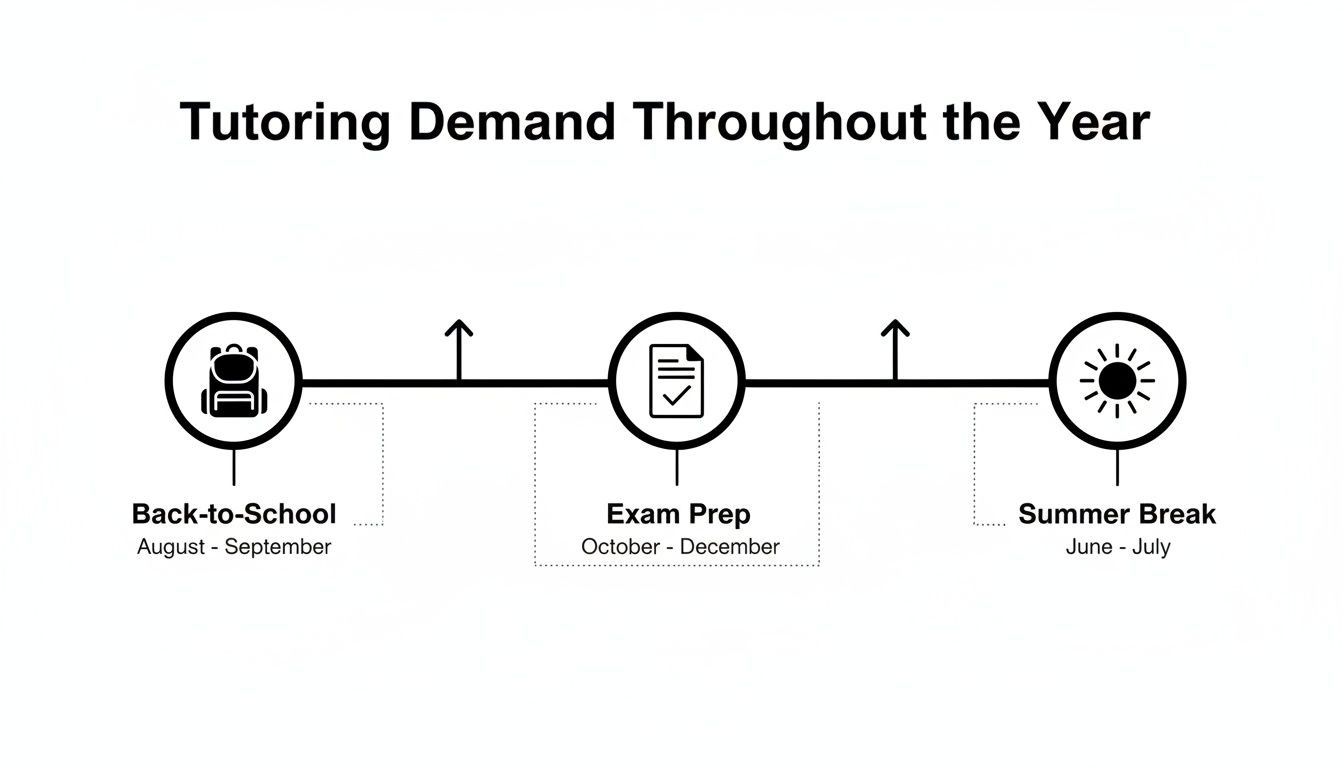
As the visual makes clear, peak demand is concentrated around specific, predictable events. This creates obvious windows for you to launch targeted marketing campaigns, adjust staffing levels, and prepare your operations. When you map your center's unique rhythm, you can move from surviving the rush to actively profiting from it.
How Do I Build a Flexible Staffing and Payroll Model?
Your staffing strategy must be agile and responsive to ride the seasonal waves of a tutoring business. Relying solely on full-time employees sets you up for bloated overhead during quiet months. The solution is building a blended team that provides stability and flexibility, allowing you to scale teaching capacity with enrollment.
This typically means combining a core team of full-time staff with a bench of part-time and contract tutors. Full-timers handle the year-round administrative and teaching load. Part-timers cover busy after-school slots, while contractors can be brought in for short, intense bursts of demand like SAT prep season.
This strategy not only controls costs but also opens up a wider pool of specialized talent. You can bring in an AP Calculus expert as a contractor for the few months their skills are in high demand instead of keeping them on payroll all year.

Designing Payroll to Match Your Business Rhythm
A flexible team requires an equally adaptable payroll system. A single, flat hourly rate is ineffective; it can demotivate tutors during rushes and crush finances during lulls. Instead, implement varied pay structures that align incentives with your business goals.
Here are a few models that work for managing seasonality:
- Revenue Share: Give tutors a percentage of the revenue they generate. This motivates them to help fill their own classes and works well for high-value workshops.
- Per-Student Rates: Pay tutors a flat amount for each student in their class. This model directly rewards instructors for handling larger group sessions.
- Premiums and Bonuses: Offer higher pay for your most in-demand slots, like weekends or evenings. You could add a 15% pay premium for a Saturday morning SAT prep session.
These models turn your payroll from a fixed cost into a variable expense that ebbs and flows with revenue. This protects cash flow when business is slow and rewards your best staff when you are busy.
Putting Flexible Payroll into Practice
Imagine you run a language school and launch an intensive summer Mandarin program. Instead of hiring full-time teachers, you bring on two specialist contractors and offer them a 40% revenue share. Your upfront risk is minimal, and they are invested in the program's success.
For tutoring centers with 5-100 teachers, a 50% revenue share combined with weekend premiums is a proven way to retain top staff. This approach leads to 3x faster onboarding for trial lessons that convert 30% better when the demand wave hits.
The real power comes from combining these strategies. You might have a core team on salary, part-time staff on a base hourly rate plus a per-student bonus, and specialist contractors on a pure revenue-share model.
Managing this complexity with spreadsheets is an administrative nightmare. Manually calculating different rates and premiums is a recipe for errors and wasted hours. This is where dedicated tutor payroll software becomes essential.
A system like Tutorbase automates these complex calculations. You can define multiple pay models and apply them to different teachers, subjects, or times of day. It ensures everyone gets paid accurately and on time, freeing you to focus on growth.
How to Optimize Scheduling and Manage Capacity
When a seasonal rush hits, your schedule becomes the central nervous system of your operation. A double-booked teacher or an empty seat in a group class is a direct hit to your bottom line. How you manage your schedule during these peaks determines your operational efficiency.
The real challenge is speed and accuracy. During a busy enrollment period, parents want an answer immediately. They will not wait while your admin cross-references three spreadsheets to find an open slot. This manual process is slow and a breeding ground for costly errors.
Consider a language school during the September back-to-school rush. A parent calls seeking a B1-level Spanish class. Manually, this starts a 10-minute hunt. The admin must check the master schedule, confirm qualified teachers, check their availability, and then see if a room is free. This process is too slow.
From Manual Chaos to Automated Clarity
An automated system changes this entire scenario. Your operations manager can use an intelligent tool to find the perfect placement in under two minutes. This is about more than saving time; it is about removing the friction that costs you students. A system that already knows teacher qualifications, room availability, and schedules makes booking fast and easy.
This approach also guarantees zero double-bookings. Built-in conflict detection automatically prevents you from scheduling a teacher or room that is already taken, a common mistake during high-volume periods.
By automating the search for open slots, you speed up onboarding and project an image of a professional operation parents can trust. This first impression is critical for converting leads during a competitive enrollment season.
Maximizing Group Class Utilization
Beyond one-on-one sessions, maximizing the value of your group classes is crucial for profitability. An empty seat in a nearly full SAT prep class is pure lost revenue. You need instant visibility into which classes have open seats that match a new student's needs.
An automated "Find Spot" feature provides this visibility instantly. Your admin can filter all existing classes by subject, level, teacher, and time to see every available seat. This makes it easy to fill the last spots in a group, maximizing revenue per session without increasing overhead. It's a key tactic for managing seasonal demand tutoring business operations.
The Power of a Centralized System
The only way to achieve this control is through a unified platform. When your teacher availability, room schedules, and student enrollments exist in one place, you gain a clear view of your center's total capacity. You can see at a glance which tutors are underutilized or which rooms are empty during busy hours.
This visibility lets you make proactive adjustments. If a popular teacher has a two-hour gap every Wednesday, your marketing team can promote that specific slot. Tools like advanced tutoring scheduling software are designed to provide this exact level of insight.
Ultimately, optimizing your schedule is a strategic weapon that helps you absorb peak demand, maximize revenue, and deliver a seamless experience for parents and students.
How Can Smart Pricing Smooth Out Demand?
Instead of just reacting to quiet months, you can actively shape them with a smart revenue strategy. Dynamic pricing and targeted promotions are levers for influencing enrollment patterns, giving you more control over your annual cash flow. It is a core part of mastering seasonal demand.
This means moving beyond a single, flat rate. Offer early-bird discounts for summer camps to lock in revenue in the spring. Create off-peak package deals to attract adult learners with more schedule flexibility than K-12 students.

Implementing Layered and Dynamic Pricing Rules
Flexibility is the secret to effective pricing. A layered pricing model lets you set different rates based on specific conditions, giving you granular control over revenue. You can incentivize the behavior you want, such as booking during slower periods or committing to long-term packages.
Here are a few real-world examples:
- Time-Based Pricing: Offer a 10% discount for lessons scheduled between 1 PM and 3 PM on weekdays to fill those difficult slots.
- Teacher-Tier Pricing: Charge a premium for sessions with your most experienced, in-demand instructors. Parents often pay for expertise.
- Location-Based Rates: Set higher prices at your prime downtown branch compared to a suburban location with lower overhead.
This approach lets you adapt to market conditions without overhauling your entire pricing structure. You can set a global rate and then create specific rules that override it for certain services, locations, or students.
Encouraging Commitment with Packages and Credits
One-off lessons get new students in the door, but long-term commitment builds a sustainable business. Prepaid packages and credit systems are two of the best ways to lock in revenue upfront and keep students returning. This turns a transactional relationship into a partnership.
By selling a package of 20 lessons, you secure that revenue today, even if the lessons are delivered over the next three months. This provides a critical cash flow buffer during your slowest periods and dramatically improves financial forecasting.
Prepaid credits work like a digital wallet for your tutoring center. Parents buy a block of credits (for example, $500 worth), and the system automatically deducts the cost of each lesson. This removes the hassle of weekly invoicing and chasing payments.
Low-balance alerts can automatically notify parents when their credit is low, prompting them to top up. This simple automation keeps learning on track without interruption and can significantly boost monthly renewal rates.
Adapting to Modern Learning Habits
The shift to hybrid learning has created new pricing opportunities. Post-2020, online tutoring grew at a 15.58% CAGR to become a $26 billion market. On-demand sessions now claim a 76% share as parents demand flexibility.
This trend allows you to create pricing tiers for in-person, online, and hybrid attendance. You could offer a slightly lower rate for online-only students to reflect your reduced overhead.
Smart pricing is not just a defensive move against seasonality. It is a proactive strategy for building a more resilient and profitable tutoring business.
Stop Leaking Revenue with Automated Billing
When a seasonal rush hits, your back office can buckle. Manual billing and lead tracking quickly become breaking points, leading to lost revenue. Your operations manager, already juggling schedules, cannot also create hundreds of invoices by hand.
Peak season for K-12 and test prep centers (IELTS, DELF) can mean 50 to 10,000 lessons per week. This crushes operations managers, who can spend 10+ hours a week chasing payments. As a result, an estimated 20-30% of revenue leaks from unbilled no-shows and late cancellations.
Tutorbase automates billing directly from attendance data. When a tutor marks a lesson "Attended," "No-show," or "Late Cancelled," the system instantly generates the correct invoice. This saves time and protects your cash flow.
By tying billing directly to attendance, you create a foolproof system where every billable event is captured and invoiced automatically. This change can slash time spent chasing payments by over 60% and ensures your revenue reflects your work.
Automated billing also allows you to set up different billing cycles (weekly, bi-weekly) to match your cash flow needs. For parents, prepaid credit systems offer a seamless wallet-style experience where lesson fees are auto-deducted, eliminating payment friction.
Capture Every Opportunity with a Structured Lead Pipeline
During a back-to-school rush, inquiries come from everywhere: your website, phone, WhatsApp, and walk-ins. Without a central system, these valuable leads get lost. A missed follow-up is a direct loss of a potential long-term student.
A structured lead management pipeline is non-negotiable for managing seasonal demand in a tutoring business. It gives you a clear, visual workflow to track every inquiry from start to finish.
This process looks like this:
- Capture: Leads are automatically pulled into your system from a WhatsApp widget or website forms.
- Qualify: Your team follows up, gathers info, and moves the lead to the "Contacted" stage.
- Engage: A trial lesson is booked, and the lead status updates to "Trial Scheduled."
- Convert: After a successful trial, the student is marked "Converted," and their profile is created.
This step-by-step process ensures no one falls through the cracks. To keep your pipeline full and avoid seasonal slumps, implementing strategies for Mastering Services Lead Generation is critical for steady growth.
Manual vs. Automated Operations During Peak Season
The tools you use can be a lifeline or an anchor during busy seasons. Here is how manual processes compare to a system like Tutorbase when managing a seasonal surge.
| Operational Task | Manual Process (Spreadsheets/Fragmented Tools) | Automated Process (Tutorbase) | Impact |
|---|---|---|---|
| Invoicing | Admin manually creates invoices, cross-referencing attendance. Highly prone to human error. | Invoices are auto-generated from attendance. Zero manual entry. | Saves 10+ hours weekly; eliminates 20-30% revenue leakage. |
| Payment Chasing | Team sends individual emails/texts for overdue payments. Inconsistent and time-consuming. | Automated reminders go out for overdue invoices. Auto-charge for credit packages. | Reduces time chasing payments by over 60%. |
| Lead Capture | Leads from web, phone, and WhatsApp are logged in a spreadsheet, if not forgotten. | All leads are captured in a single pipeline automatically. No lead gets lost. | Captures 100% of inquiries; prevents missed opportunities. |
| Lead Nurturing | Follow-ups depend on an admin's memory. Inconsistent and unreliable under pressure. | Visual pipeline shows where each lead is. Follow-up tasks are clear. | Ensures timely follow-up, boosting conversion rates. |
The contrast is stark. Manual systems force your team into reactive work, while an automated platform empowers them to be proactive and strategic, even at peak capacity. By automating billing and lead management, you build a resilient back office that thrives under pressure.
Frequently Asked Questions
Here are direct answers to common questions from tutoring business owners about managing the seasonal rollercoaster.
How Can I Accurately Forecast Seasonal Demand?
Your best forecasting tool is your own history. Pull enrollment records from the last two or three years to identify patterns like the back-to-school surge, pre-exam rush, and summer slowdown. Pinpoint which subjects drove those peaks. Then, layer in external events like local school calendars and standardized test dates (SAT, ACT, IELTS). Combining your data with public timelines creates a sharp picture of what is coming.
What Is the Best Way to Retain Tutors During the Off-Season?
Losing your best tutors during a slow period is a major risk. Keep them invested by offering professional development, such as workshops or certifications. You can also involve them in non-teaching projects like curriculum development or marketing outreach. For essential staff, consider a small retainer or guarantee a minimum number of hours to ensure they are ready when demand ramps up.
What Marketing Strategies Work Best During Slow Periods?
When enrollment dips, your marketing should shift, not stop. Focus on building a pipeline for the next peak season. Offer high-value, low-commitment content like free webinars on college prep or study skills workshops. This keeps you top-of-mind and builds a list of warm leads. Also, create new revenue streams like summer bridge programs or intensive boot camps to fill the revenue gap.
Tutoring businesses globally face 3:1 demand ratios between peak and off-peak seasons, with enrollments dropping 60-70% in summer. Strategic management can lift capacity utilization from a typical 50% to over 90%. Read more about the online tutoring services market on Grand View Research.
Can I Use Prepaid Packages to Stabilize Cash Flow?
Yes, you should. Selling lesson packages or prepaid credit bundles is one of the most effective tactics for stabilizing cash flow. When you collect payment upfront for 10, 20, or 50 lessons, you bank revenue that can carry you through leaner months. Parents appreciate this model for the bulk discount, and it reduces the administrative work of weekly invoicing.
How Can Software Help with Seasonal Demand?
Modern tutoring management software is built for this exact challenge. It gives you the tools to pivot quickly without administrative headaches.
- Flexible Payroll: Easily set up and automate different pay structures, like revenue-sharing or premium rates.
- Dynamic Scheduling: Instantly see every open slot or fill the last empty seat in a group class to maximize revenue.
- Automated Billing: Stop revenue leaks by automatically creating invoices from attendance records, ensuring every billable hour is captured.
When Should a Tutoring Business Invest in Management Software?
The tipping point is when administrative work prevents you from growing. If you spend more than 10 hours a week on manual scheduling, invoicing, and payroll, it is time. Other signs include frequent double-bookings, lost leads during busy seasons, or no clear, real-time picture of your profitability. If that sounds familiar, a system like Tutorbase provides a clear path to scale.
Ready to stop reacting to seasonal demand and start controlling it? Tutorbase consolidates your scheduling, billing, and payroll into one AI-powered platform, cutting admin time by 60% and eliminating booking errors. See how you can build a more resilient and profitable tutoring business by signing up for a free trial at tutorbase.com/register.


