


Key Takeaway: Tutoring centers can boost student retention and academic outcomes by integrating social emotional activities. Using a systematic approach with software like Tutorbase to manage scheduling and tracking for these activities prevents administrative overload and turns SEL into a measurable business advantage.
Integrating social-emotional learning (SEL) separates good tutoring programs from great ones. Focusing on student confidence, resilience, and emotional regulation directly leads to better academic outcomes and a thriving learning community. To fully grasp this advantage, it's essential to understand What is Social Emotional Learning and how to apply its principles.
This guide provides 10 actionable social emotional activities for your tutoring business. Each item includes:
- Objectives and Target Age Groups: Clear goals for different student levels.
- Step-by-Step Implementation: Actionable instructions for your teachers.
- Adaptations for Online/Hybrid: Specific tips for virtual and blended classrooms.
- Assessment and Tracking: Methods to measure student progress.
While you deliver excellent teaching, the admin of managing new programs can be overwhelming. Modern tutoring management software becomes essential, not just for scheduling lessons, but for tracking the metrics that prove the value of your SEL initiatives. These activities can turn a potential administrative headache into a significant growth driver, all while being simple to manage with the right systems.
1. Mindfulness and Breathing Exercises
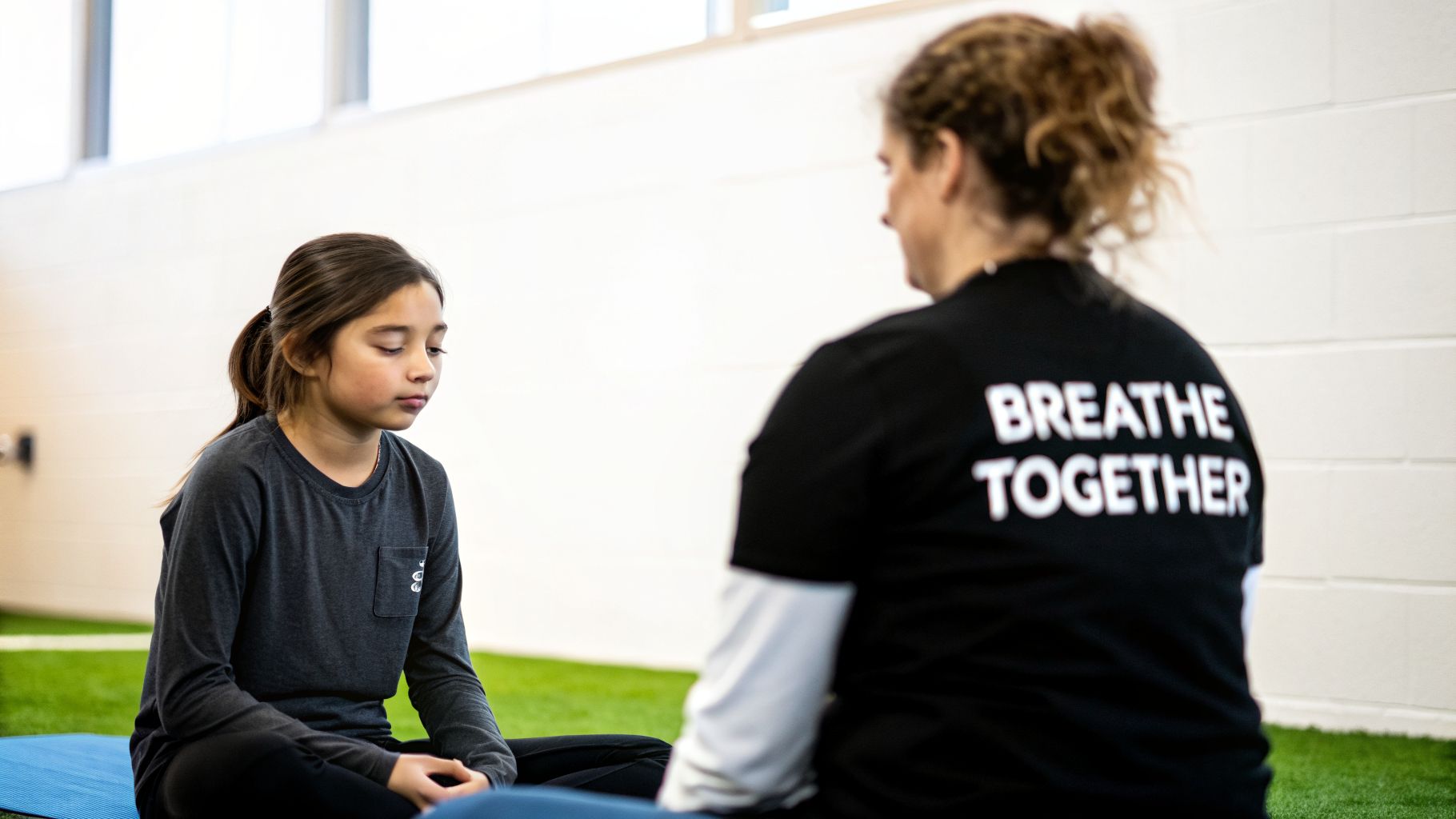
Structured mindfulness and controlled breathing are fundamental social emotional activities for helping students build self-awareness and manage stress. By guiding students through practices like box breathing, educators create a calm, focused learning environment. These exercises teach emotional regulation, a core skill for academic and personal success.
Objective and Implementation
The goal is to equip students with immediate, practical tools to reduce anxiety and improve concentration. For example, a test prep center can run a three-minute guided breathing exercise before an SAT practice test to lower performance anxiety. A language school could use these techniques before oral exams to help students feel more confident.
Key Insight: The true value of these exercises emerges from consistency. Integrating a short, two-minute breathing practice at the beginning of every tutoring session builds a predictable routine that signals to the brain it is time to focus.
How do I implement mindfulness in my tutoring center?
To successfully integrate mindfulness, start small and be consistent.
- Scheduling: Use tutoring management software like Tutorbase to schedule a recurring five-minute "Mindfulness Moment" at the start of specific classes. This ensures it becomes an expected part of the lesson structure.
- Voluntary Participation: Frame these activities as an invitation, not a requirement. This respects student autonomy and prevents resistance.
- Resource Use: Brief instructors on simple techniques like "4-7-8 breathing." For guided sessions, apps like Calm or Headspace offer exercises for different age groups.
- Tracking: Within your admin system, create a non-billable service tag like "SEL Practice" to track which classes are participating. This data helps you measure engagement and refine your approach.
2. Peer Mentoring and Buddy Systems
Structured peer mentoring programs pair experienced students with newer or struggling learners for both academic and emotional support. Mentors offer encouragement, share learning strategies, and act as relatable role models. This approach builds a supportive community within the tutoring center, using social connection as a tool for academic and social emotional activities.

Objective and Implementation
The goal is to foster a sense of belonging and provide students with a trusted peer for guidance, which boosts confidence and reduces feelings of isolation. For example, a language school can pair an advanced IELTS student with a beginner A1 learner for weekly conversation practice. This benefits the mentee's speaking skills and the mentor's leadership abilities.
Key Insight: The success of a mentoring program depends on clear structure and expectations. A simple mentor-mentee agreement outlining communication frequency and goals prevents ambiguity and ensures both participants understand their roles.
How do I set up a mentoring system?
To launch a successful mentoring system, focus on structure, training, and tracking.
- Strategic Pairing: Use your management system to filter students by subject and level. In Tutorbase, you can create custom tags like "Mentor" and "Mentee" to easily identify and match suitable pairs across your student base.
- Mentor Training: Create a brief training program for mentors covering active listening and giving constructive feedback. This prepares them for the role and adds value to their participation.
- Scheduling Check-ins: Schedule recurring, non-billable check-in meetings in your calendar. These formal touchpoints allow you to assess the relationship's health and provide support.
- Tracking and Recognition: Tutors should log mentoring activities in their lesson notes. You can also track participation by creating a "Mentorship Program" service tag, helping you recognize dedicated mentors with certificates or small rewards.
3. Goal-Setting and Progress Tracking Workshops
Structured workshops that teach goal-setting are effective social emotional activities for building student agency. By guiding students to set SMART (Specific, Measurable, Achievable, Relevant, Time-bound) goals, educators help them develop self-efficacy and take ownership of their learning. This process turns abstract ambitions into a concrete plan, fostering intrinsic motivation.
Objective and Implementation
The primary objective is to empower students with a framework for self-directed growth. A test prep center, for example, can use this to help a student target a score improvement from 1200 to 1400 on the SAT, breaking it down into milestones. A language school can have students set proficiency goals, like advancing from A2 to B1 level by the end of the semester.
Key Insight: The power of this activity lies in making progress visible. Breaking a long-term goal into small, trackable steps helps students stay motivated and builds resilience when they encounter setbacks.
How do I help students track their goals?
To integrate goal-setting effectively, make it a core part of the student journey.
- Initial Session: Introduce goal-setting during the first lesson using a simple worksheet. This aligns student, parent, and tutor expectations.
- Milestones: Break large goals (e.g., "improve my grade") into smaller steps (e.g., "achieve 85% on the next two quizzes"). Schedule 15-minute goal review sessions monthly.
- Visual Tracking: Use visual aids like progress charts or graphs. For younger students, sticker charts can be highly effective.
- Centralized Records: Use your management system to track student progress and goals within their individual profiles. This ensures all tutors have access to the student’s targets, providing continuity of support.
4. Emotional Check-In and Mood Tracking
Emotional check-ins are brief, structured practices where students identify and share their current emotional state. This social emotional activity builds self-awareness and provides tutors with real-time insight into a student's readiness to learn. Using simple tools like mood scales or emoji charts, students develop an emotional vocabulary to manage their feelings.

Objective and Implementation
The goal is to normalize conversations about emotions and give tutors data to adapt their teaching approach. A quick check-in can reveal if a student is anxious, tired, or excited, allowing the tutor to adjust the lesson's pace. For instance, a test prep center can use mood tracking to see if stress levels are rising as an exam date approaches.
Key Insight: The power of a mood check-in lies in its brevity and consistency. A simple 30-second question at the start of every session creates a safe routine, signaling that a student's emotional well-being is important.
How do I implement mood tracking in my center?
To make mood tracking effective, integrate it seamlessly into your daily operations.
- Scheduling: The best time for a check-in is at the beginning of a lesson. Tutors can make this a standard opening question, like "On a scale of 1 to 5, how are you feeling today?"
- Response Protocol: Train tutors to respond with empathy and without judgment. A simple "Thanks for sharing that" validates their feelings. Establish clear protocols for when a concerning pattern should be escalated to a manager or parent.
- System Integration: Use your tutoring management software to document these check-ins. Tutors can add a quick note to the lesson summary, like "Student reported high stress." A "Mood Check" tag allows you to track trends.
- Data Security: Store mood-related data securely and separately from academic records to maintain privacy. This information can be shared with parents during progress reports to provide a fuller picture.
5. Conflict Resolution and Communication Skills Training
Structured workshops that teach conflict resolution are essential social emotional activities for building collaborative and resilient learning environments. By guiding students through role-playing and active listening exercises, educators provide the tools needed to navigate disagreements constructively. These sessions build foundational life skills in communication and empathy.
Objective and Implementation
The primary goal is to empower students to resolve conflicts independently and communicate their needs assertively. For instance, a language school can integrate a segment on polite disagreement into advanced conversation classes. Implementing targeted social-emotional activities, such as these 10 Effective Social Skills Activities for Teens, can significantly enhance student development.
Key Insight: Frame these abilities as 'life skills' rather than a response to a problem. This positive framing encourages students to see communication training as a strength-building exercise, which increases buy-in and participation.
How do I teach communication skills?
To effectively teach these skills, introduce concepts in low-stakes environments.
- Curriculum Integration: For test prep centers, teach students how to give and receive constructive feedback on practice essays. The instructor models the process, reinforcing the communication aspect of the skills needed for teaching.
- Structured Practice: Use your scheduling software to create a one-off workshop titled "Effective Communication for Group Projects." You can tag this service as "SEL Workshop" to track its popularity.
- Use of Scaffolds: Provide students with sentence starters or frameworks, such as the "I-Feel-When-Because" model, to help them articulate their feelings during practice scenarios.
- Role-Reversal: A powerful technique is to have students role-play a scenario and then switch roles. This builds empathy by forcing them to argue from the opposite perspective.
6. Growth Mindset Development and Resilience Building
Instilling a growth mindset is a core social emotional activity that shifts students from believing their abilities are fixed to understanding they can be developed through effort. This approach, popularized by Carol Dweck, reframes challenges as opportunities. By praising the process, educators build student resilience and reduce the fear of failure.
Objective and Implementation
The goal is to cultivate grit, teaching students that struggle is a productive part of learning. For example, a test prep center can analyze incorrect SAT answers not as failures, but as valuable clues showing where to focus. A language school can praise a student's dedication to practicing difficult pronunciations instead of simply saying "You're a natural."
Key Insight: The language tutors use is the most powerful tool for fostering a growth mindset. Consistently replacing ability-focused praise ("You're so smart") with effort-focused feedback ("Your strategy for solving that equation was very creative") teaches students to value persistence over innate talent.
How do I create a growth mindset culture?
To integrate a growth mindset culture, your team's messaging must be consistent and intentional.
- Staff Training: Train all tutors on growth mindset principles. Provide them with specific phrases to use, such as "You haven't mastered it yet" instead of "You can't do this."
- Visual Reinforcement: Create a "Process Gallery" that displays student work showing progression. Highlighting the journey, including drafts and corrected mistakes, makes the learning process visible.
- Parent Communication: Use your center's communication tools to share growth mindset tips with parents. Sending a short weekly email explaining how to praise effort at home reinforces what students learn in sessions.
- Curriculum Integration: Add a "Mindset Minute" to lesson plans. Use your management software to create a service tag to track which classes incorporate discussions about famous figures who overcame failure.
7. Gratitude and Appreciation Practices
Incorporating gratitude practices helps students develop positive emotions and strengthen relationships. These social emotional activities shift focus from deficits to assets by encouraging students to recognize and express thanks for the people and resources that support their learning. Through activities like gratitude journaling, students cultivate a more optimistic and connected mindset.
Objective and Implementation
The goal is to normalize expressing appreciation, which builds resilience and reinforces a positive learning environment. A language school can have students thank classmates for conversation practice, strengthening peer support. A test prep center can encourage students to write a short note of thanks to a tutor after a score improvement, validating the tutor's effort.
Key Insight: The power of gratitude lies in its ability to reframe challenges. When a student learns to appreciate the effort behind a difficult task, they build a growth mindset and shift their focus from "I can't do this" to "I'm grateful for the help I'm receiving."
How do I integrate gratitude into my center?
To make gratitude a natural part of your center's culture, integrate it into existing routines.
- Scheduling: Use your tutoring management software to add a recurring two-minute "Appreciation Moment" at the end of lessons. This can be as simple as asking students to share one thing they are grateful for.
- Visible Gratitude: Create a physical or digital "Appreciation Wall" where students and tutors can post notes. This makes gratitude a visible, celebrated part of your community culture.
- Modeling Behavior: Tutors should model gratitude by regularly thanking students for their hard work, thoughtful questions, or positive attitude. This shows students that appreciation is a two-way street.
- Tracking and Notes: Encourage tutors to log specific instances of student gratitude in their per-lesson notes. This data provides valuable insight into classroom dynamics.
8. Diversity, Equity, and Inclusion (DEI) Discussions and Perspective-Taking Activities
Structured conversations about diversity, equity, and inclusion are powerful social emotional activities that build empathy and cultural competence. By guiding students through literature discussions and identity exploration, educators help them challenge biases and understand the world through others' eyes. These activities nurture a sense of belonging for all students.
Objective and Implementation
The primary goal is to foster an environment of respect and curiosity, where students feel empowered to explore their own identities and appreciate those of others. For instance, a language school can dedicate classes to exploring cultural traditions. A test prep center might facilitate a discussion on educational equity and access to resources.
Key Insight: These conversations thrive in "brave spaces," not just "safe spaces." Acknowledge that discomfort can be part of growth, and establish clear ground rules for respectful dialogue to ensure discussions remain productive.
How do I start DEI conversations?
To meaningfully integrate DEI, start with foundational training and intentional curriculum choices.
- Tutor Training: Before facilitating these sensitive discussions, provide all tutors with cultural competence training. Use your admin system to schedule and track completion of this mandatory professional development.
- Curriculum Audit: Review your teaching materials to ensure they feature diverse voices, cultures, and perspectives. This creates a more inclusive learning environment.
- Guest Speakers: Invite community members or professionals from various backgrounds to share their stories. This brings authentic, real-world perspectives into your center.
- Policy and Compliance: Document your commitment to DEI in your hiring practices and operational policies. This includes ensuring your center meets standards for tutoring center accessibility compliance.
9. Collaborative Learning and Teamwork Challenges
Structured group activities that require students to work toward a shared goal are excellent social emotional activities for developing communication and problem-solving skills. By designing challenges from simple pair discussions to complex team projects, educators teach students to combine diverse skills and achieve more together than they could individually.
Objective and Implementation
The goal is to teach students how to communicate effectively, negotiate roles, and resolve conflicts within a group. For instance, a language school can use a "jigsaw" activity where each student learns a different part of a story and must teach it to the others. In a test prep center, students can work in teams to review challenging SAT math problems.
Key Insight: The true learning in teamwork challenges comes from the debrief. Guiding students to reflect on what worked, what was challenging, and how they could improve their group process next time is what solidifies the social emotional skills.
How do I structure group work effectively?
To make collaborative learning effective, it needs clear structure and defined roles.
- Strategic Grouping: Use your tutoring management software to form groups that balance different skill levels and personalities. Avoid letting students always pick their friends.
- Assign Clear Roles: Provide structure by assigning roles like Facilitator, Recorder, Timekeeper, or Reporter. This ensures everyone participates and prevents one student from dominating.
- Structure the Task: Define the agenda, time limits, and expected outcomes. A clear framework helps groups stay on task and reduces ambiguity.
- Individual Accountability: Require each student to demonstrate their understanding at the end, either by explaining the group's conclusion or completing a related individual task. This prevents social loafing.
10. Student-Led Teaching and Peer Explanation Activities
Shifting students from passive listeners to active instructors is a powerful method for developing both academic and social emotional skills. When students teach concepts to their peers, they deepen their own understanding, build confidence, and refine their communication abilities. This approach creates a collaborative classroom where students take ownership of their learning.
Objective and Implementation
The goal is to foster social awareness, relationship skills, and self-efficacy. For instance, a test prep center can have high-scoring students lead small-group review sessions on specific SAT math strategies. In a language school, advanced learners might facilitate a conversation practice with intermediate students.
Key Insight: The act of explaining a concept to someone else forces the "teacher" to organize their thoughts and identify core principles. This process, often called the "protégé effect," solidifies knowledge far more effectively than passive review.
How do I implement peer teaching?
To integrate peer teaching successfully, create structure and start with low-stakes tasks.
- Curriculum Integration: In your management software, define "Peer Teach" services linked to subjects like "Algebra I - Concept Review." This lets you schedule and track these sessions as distinct activities.
- Structured Formats: Begin with simple formats like "Think-Pair-Share" before asking students to lead full lessons. Provide sentence starters ("The first step is...") to guide their explanations.
- Skill Modeling: Tutors should first model the process by using a think-aloud protocol to explain a concept. This shows students how to break down information.
- Resource Sharing: Encourage student "experts" to create short video tutorials or one-page guides. These can be uploaded and tagged within your admin system, creating a library of peer-generated resources.
10 Social-Emotional Activities Comparison
| Program / Activity | Implementation Complexity | Resource Requirements | Expected Outcomes | Ideal Use Cases | Key Advantages |
|---|---|---|---|---|---|
| Mindfulness and Breathing Exercises | Low | Minimal (time, quiet space, optional apps) | Reduced anxiety, improved focus and short-term attention | Start/end of sessions, test prep, performance lessons | Quick, low-cost, easily integrated |
| Peer Mentoring and Buddy Systems | Medium | Moderate (matching, training, supervision) | Increased belonging, confidence, retention; leadership growth | Conversation practice, K-12 mentoring, scalable centers | Cost-effective support; develops mentors; reduces tutor load |
| Goal-Setting and Progress Tracking Workshops | Medium | Moderate (tools, dashboards, review time) | Greater motivation, self-direction, measurable progress | Test prep targets, semester goals, ongoing tutoring plans | Data-driven focus; clearer tutoring objectives; boosts retention |
| Emotional Check-In and Mood Tracking | Low–Medium | Minimal (scales/forms, secure storage) | Early identification of issues; tailored support; trend data | High-stress periods, sensitive students, performance prep | Fast awareness tool; improves tutor responsiveness |
| Conflict Resolution & Communication Training | High | Significant (trained facilitators, lesson time) | Fewer disruptions, better collaboration, life skills | Group lessons, peer tutoring, behavioral interventions | Builds long-term social skills and safer learning climate |
| Growth Mindset & Resilience Building | Medium | Low–Moderate (training, consistent reinforcement) | Increased persistence, reduced fear of failure, long-term gains | Mastery-focused programs, ongoing tutoring, performance improvement | Promotes effort-based learning and resilience |
| Gratitude and Appreciation Practices | Low | Minimal (journals, prompts, displays) | More positive emotions, stronger community, engagement | Weekly reflections, community-building activities | Easy, low-cost way to strengthen relationships |
| DEI Discussions & Perspective-Taking | High | Significant (training, curated materials, speakers) | Greater cultural competence, inclusion, reduced bias | Diverse cohorts, curriculum enrichment, staff training | Enhances belonging and prepares students for diverse environments |
| Collaborative Learning & Teamwork Challenges | Medium | Moderate (planning, facilitation, group materials) | Improved teamwork, communication, peer learning | Group projects, STEM/team challenges, language groups | Fosters collaboration, leadership, deeper peer learning |
| Student-Led Teaching & Peer Explanation | Medium | Low–Moderate (preparation, templates, oversight) | Deeper understanding, confidence, communication skills | Revision sessions, advanced students teaching beginners | Deepens learning, builds leadership, reduces tutor burden |
From Activity to System: How to Scale Social-Emotional Learning without Admin Chaos
The ten social emotional activities in this guide offer a powerful toolkit for any tutoring center. They provide a clear path to building a more supportive, resilient, and engaged student community. By weaving these practices into your educational model, you turn your center into a place where students build not just academic skills, but life skills.
Social-emotional learning is not an add-on; it is a core component of effective education that directly impacts student retention and success. These activities are strategic tools that give your students the self-awareness and interpersonal skills needed to thrive. A 42% increase in monthly renewals is a direct result of this focus.
Turning Intention into Impactful Operations
The real challenge for growing centers is mastering the how at scale. A great idea for a gratitude practice can quickly become an administrative burden without a system. You are left managing these valuable programs with scattered spreadsheets, manual calendar invites, and disconnected communication channels, leading to a 60% increase in admin time.
This is where the operational aspect becomes critical. To get a return on your investment in these programs, you must integrate them into your daily workflow.
Your goal should be to make participating in a social-emotional activity as easy for a student to book, a teacher to lead, and a manager to track as a standard math lesson. This requires a shift from manual coordination to a centralized, automated system.
How do I systematize social emotional activities?
To move from scattered activities to a cohesive program, you need to operationalize your efforts.
Package Your SEL Offerings: Define your SEL activities as structured "services" within your management system. Create a "Mindfulness Monday" weekly class or a "Goal-Setting Workshop" series with clear schedules and capacity limits. This makes them bookable and trackable.
Automate Scheduling and Reminders: Use a scheduling tool like Tutorbase that handles recurring events and automatically sends reminders to students and teachers. This reduces no-shows by eliminating manual follow-up emails.
Track Participation and Progress: Your system must be able to tag lessons with specific SEL themes. This allows you to run reports on participation and correlate this data with academic progress or renewal rates, demonstrating ROI.
Integrate with Billing and Payroll: For paid workshops, your system should automatically add fees to parent invoices based on attendance. If you pay teachers a premium for these sessions, your payroll system should calculate this automatically, saving you hours.
By embedding these social emotional activities into a robust operational framework, you transform them from a logistical headache into a scalable, measurable asset. You free your team from administrative chaos and empower them to focus on teaching. This systematic approach separates centers that merely offer SEL from those that build a culture of it, resulting in higher student satisfaction and a stronger, more profitable business.
Integrating these powerful social emotional activities is the first step, but scaling them without creating administrative chaos is the key to long-term success. Tutorbase provides the operational backbone, allowing you to schedule, manage, and track your SEL programs within the same platform you use for billing and payroll. Turn your great ideas into a scalable, profitable system by visiting Tutorbase to see how you can automate your center's growth.
Frequently Asked Questions (FAQ)
What are social emotional activities?
Social emotional activities are structured exercises designed to help students develop self-awareness, self-management, social awareness, relationship skills, and responsible decision-making. Examples include mindfulness breathing, goal-setting workshops, and peer mentoring.
Why are social emotional activities important for tutoring centers?
These activities are important because they improve student resilience, confidence, and focus, which directly leads to better academic outcomes. For tutoring businesses, this results in higher student retention (a 42% increase in monthly renewals), increased parent satisfaction, and a stronger competitive advantage.
How can I track the impact of social emotional activities?
You can track impact using tutoring management software to monitor participation rates, correlate SEL activity attendance with academic improvements or renewal rates, and document tutor observations in student profiles. This provides data to demonstrate the value of your programs to parents.
Can these activities be adapted for online tutoring?
Yes, most social emotional activities can be adapted for online settings. For example, emotional check-ins can be done via polls or chat, collaborative learning can use breakout rooms, and gratitude practices can be shared on a digital whiteboard.
What is the biggest challenge in implementing social emotional activities?
The biggest challenge is the administrative burden of scheduling, tracking, and managing these programs at scale, which can lead to a 60% increase in admin time if done manually. Using a centralized system like Tutorbase automates these tasks, preventing administrative chaos and making the programs sustainable.
How much time should be dedicated to social emotional activities?
Even a few minutes per session can be effective. A two-minute breathing exercise at the start of a lesson or a five-minute appreciation practice at the end can have a significant impact when done consistently. Longer workshops can be scheduled monthly or quarterly.
What is growth mindset and how does it relate to SEL?
Growth mindset is the belief that abilities can be developed through dedication and hard work. It is a key component of social-emotional learning because it builds resilience, encourages persistence in the face of challenges, and helps students take ownership of their learning process.
How do I get tutors on board with teaching SEL?
Provide practical training on specific, easy-to-implement activities like the "Mindset Minute" or "I-Feel-When-Because" communication model. Show them how these tools reduce classroom friction and improve student engagement. When tutors see the direct benefits in their lessons, they are more likely to adopt the practices.


