


Key Takeaway: To boost student outcomes and renewal rates, tutoring centers must shift from a uniform teaching method to a multi-faceted approach. Implementing a mix of proven tutoring strategies, from the VARK model to project-based learning, allows you to cater to diverse student learning styles. Systemizing these strategies with tutoring management software reduces admin time by up to 60% and turns personalized education into a scalable, profitable operation.
Tutoring centers succeed by delivering personalized results, yet many apply a uniform teaching method to every student. This mismatch between how students learn and how they are taught leads to slower progress, disengaged students, and lower renewal rates. A one-size-fits-all approach is not just ineffective; it costs you business.
This guide provides a direct solution, moving beyond theory to offer 10 actionable student learning styles tutoring strategies you can implement immediately. We will explore how to match proven techniques to individual learners and, more importantly, how to operationalize these strategies across your entire center. By structuring lessons and teacher assignments around personalized learning, you can reduce administrative workload, improve student outcomes, and drive sustainable growth.
1. What is the VARK Learning Styles Model?
The VARK model, developed by Neil Fleming in 1987, is one of the most foundational student learning styles tutoring strategies. It categorizes learners into four primary modalities: Visual (learning through seeing), Auditory (learning through hearing), Reading/Writing (learning through text), and Kinesthetic (learning through doing). By identifying a student's preferred style, tutors can tailor lesson delivery to significantly boost comprehension, engagement, and retention.

This model's strength lies in its simplicity. For example, a language school teaching French can use videos for visual learners, conversation practice for auditory learners, and role-playing activities for kinesthetic learners. Similarly, a test prep center can explain complex SAT math problems using diagrams for visual students or repeated verbal drills for auditory ones.
How to Implement VARK in Your Tutoring Center
To operationalize the VARK model, integrate a brief learning style assessment into your student intake process. This provides tutors with valuable insight before the first lesson.
- Systemize Content: Use a tool like Tutorbase to tag curriculum materials by modality. A geometry lesson might have a "visual" tag for its diagrams, an "auditory" tag for the recorded explanation, and a "kinesthetic" tag for a hands-on model-building exercise.
- Match Tutors to Students: In your scheduling system, use notes to identify tutors who excel with certain teaching styles. You can then assign a highly visual teacher to a student who learns best with diagrams and charts, reducing booking time from 10 minutes to under 2.
- Track What Works: Mandate that tutors log which modalities yield the best results for each student in their session notes. This data ensures consistency and continuous improvement, especially across different teachers or branches.
2. Differentiated Instruction (Tiered Lesson Planning)
Pioneered by educator Carol Ann Tomlinson, differentiated instruction is a framework for tailoring lessons to meet students where they are. Instead of a one-size-fits-all approach, tutors adjust the content (what is taught), process (how it's taught), and product (how students demonstrate mastery). This ensures every student, regardless of their starting point, has a clear pathway to success.
This strategy is particularly effective in mixed-level group settings, a common scenario in tutoring centers. For example, in an after-school program, students can work on the same robotics project, but the complexity of the coding is tiered. Novices might use block-based coding, while advanced learners write custom Python functions. This is a powerful student learning styles tutoring strategy because it respects diverse abilities within one lesson.
How to Implement Differentiated Instruction in Your Tutoring Center
Implementing this requires organized curriculum management and clear communication. It shifts the focus from teaching a subject to teaching a student.
- Systemize Content: Use tutoring management software to create tiered subject levels, like "French B1 - Foundational" and "French B1 - Advanced." This allows you to tag lesson plans and resources by difficulty, making it easy for tutors to pull appropriate materials.
- Group Students Strategically: Use scheduling features like "Find Spot" to filter existing classes by level and fill open seats, maximizing group utilization. This simplifies the differentiation required by the tutor, allowing them to focus on a narrower range of needs.
- Track Student Progress: Encourage tutors to use session notes to document which differentiation strategies work best. This data creates a continuous feedback loop, helping future tutors prepare lessons that are perfectly targeted to that student’s needs and pace.
3. Spaced Repetition & Interleaved Practice
Spaced repetition is a learning technique based on the "forgetting curve," which shows that we naturally forget information over time. This strategy involves reviewing material at systematically increasing intervals, such as one day, three days, and then a week later. It is often combined with interleaved practice, which involves mixing different subjects within a single study session. This combination builds deeper, more flexible knowledge.

This method forces the brain to retrieve information, strengthening neural connections and leading to superior long-term retention. For example, a test prep center can use this student learning styles tutoring strategy by designing SAT practice sets with mixed question types (math, reading, writing). This approach better mimics the actual test and improves a student’s ability to switch between problem-solving modes.
How to Implement Spaced Repetition & Interleaved Practice in Your Tutoring Center
Systematizing this approach ensures students consistently revisit key concepts. It transforms tutoring from isolated lessons into a cumulative learning journey.
- Systemize Content: In your curriculum manager, tag lesson plans as "Initial Learning," "Review 1," and "Review 2," with notes on ideal timing. For a math concept, the initial lesson could be Week 1, with a 15-minute "Review 1" scheduled in Week 2's lesson.
- Automate Scheduling: Use your scheduling software’s recurring lesson feature to build natural review cycles. A weekly or bi-weekly cadence provides a consistent structure for tutors to reintroduce topics from previous sessions.
- Track Review Needs: Mandate that tutors use session notes to flag topics that a student found difficult. These notes serve as a to-do list for the start of the next lesson, ensuring concepts are revisited until mastery is achieved.
4. Multi-Sensory & Embodied Learning (Kinesthetic Integration)
Multi-sensory learning engages multiple senses at once, creating stronger neural pathways for memory. Embodied learning takes this a step further, using physical movement to represent abstract ideas. This approach is one of the most effective student learning styles tutoring strategies for kinesthetic learners, especially in STEM, language, and music education.
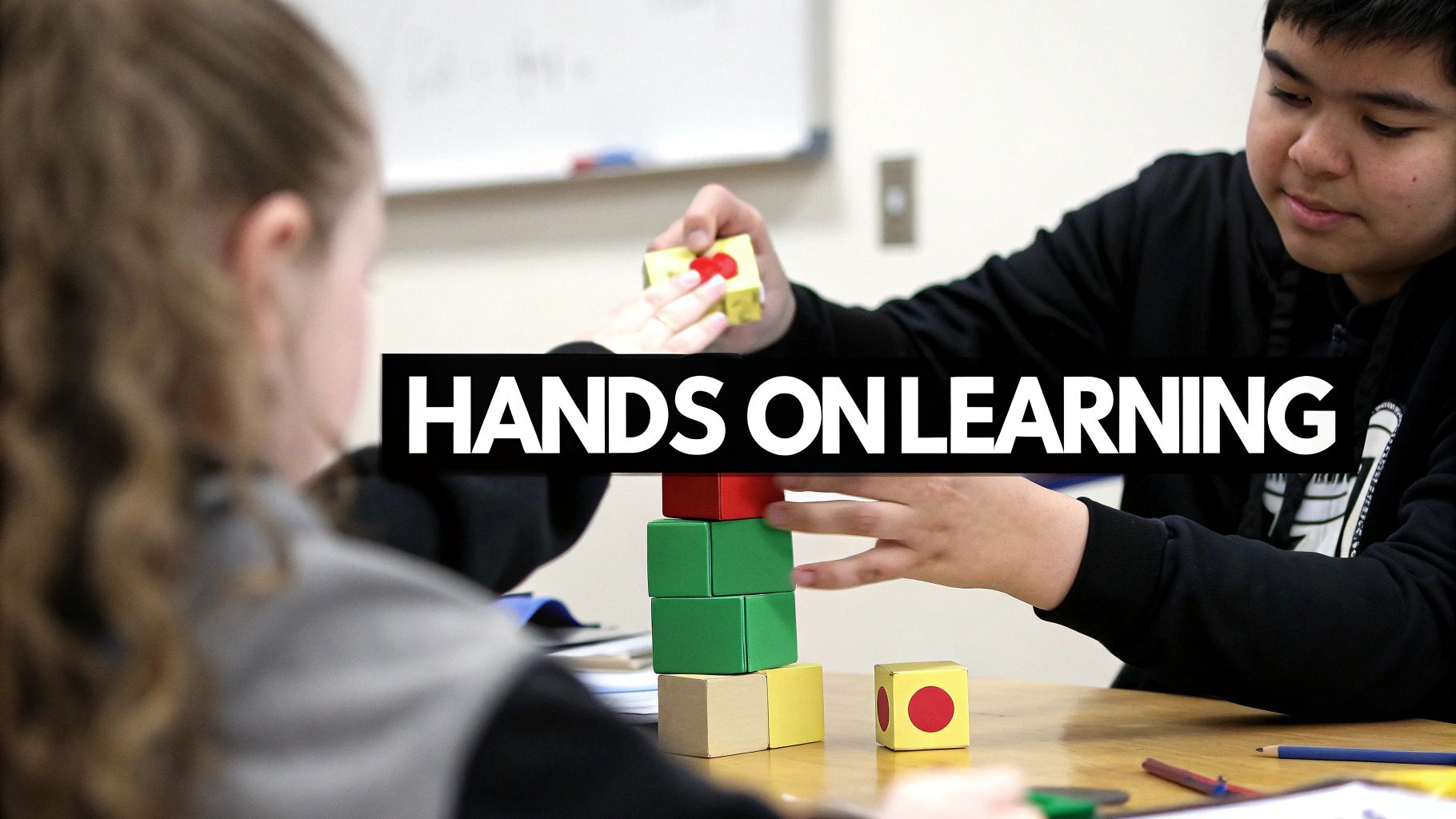
The core principle is connecting mind and body. For a K-12 math student, this could mean using hand gestures to show addition and subtraction. A language school might teach verb tenses using specific arm movements, solidifying grammar through muscle memory. By turning abstract concepts into physical experiences, tutors can unlock understanding for students who struggle with purely text-based instruction.
How to Implement Multi-Sensory & Embodied Learning in Your Tutoring Center
Integrating kinesthetic strategies requires planning and resource management. You can market this "hands-on" approach as a key differentiator.
- Standardize Activities: Within your curriculum management system, create templates for multi-sensory lessons. Include sections for required materials (like blocks or counters), setup instructions, and desired learning outcomes. This ensures consistency across tutors and branches.
- Track Student Preferences: Use a system like Tutorbase to allow teachers to make notes on which kinesthetic activities are most effective for individual students. This data helps future tutors personalize lessons and demonstrates a deep understanding of the student's needs.
- Adapt for Online and In-Person: For online lessons, design activities students can perform at home. For in-person sessions, factor the cost of specialized materials into your room usage fees or service pricing structure to maintain profitability.
5. Metacognitive Strategies & Reflection Practices
Metacognitive strategies shift the focus from what students learn to how they learn, making it one of the most empowering student learning styles tutoring strategies. Coined by psychologist John Flavell, metacognition is "thinking about thinking." It teaches students to become aware of their own learning processes, identify strengths, and self-correct weaknesses.
This approach's power is its transferability across all subjects. For instance, a test prep student can identify not just wrong answers but why they chose them, revealing patterns in question interpretation. Similarly, a language learner can keep an error log to spot recurring grammar mistakes. To further develop metacognitive skills, consider introducing techniques like the Blurt method to help students actively recall information.
How to Implement Metacognitive Strategies in Your Tutoring Center
Embed reflection as a standard part of your lesson structure. This trains students to see learning as a process they can control and optimize.
- Systemize Reflection: Create simple, standardized reflection templates within your lesson notes in Tutorbase. Prompts like, "What was most challenging today?" or "What strategy will you try next week?" encourage active thought.
- Train Tutors on Questioning: Coach your teaching staff in Socratic questioning. Instead of providing answers, they should ask probing questions like, "Why did you choose that approach?" or "What could you do differently?"
- Track Progress: Use student profiles to log metacognitive milestones alongside academic ones. Note when a student successfully identifies an error pattern, making this "invisible" progress visible to parents and students.
6. Adaptive Learning Pathways & Personalized Pacing
Adaptive learning moves beyond static lesson plans, using real-time performance data to adjust lesson difficulty and pacing for each student. This strategy ensures learners progress based on demonstrated mastery rather than a fixed schedule. The core idea is that students should only advance after proving they understand a topic.
This approach is highly effective in environments with diverse skill levels. A test prep center, for example, can use a diagnostic to identify an SAT student's weaknesses, then generate a personalized study plan that focuses effort where it's needed most. For tutoring centers looking to implement adaptive strategies, an excellent example can be found in an online math tutoring service that uses AI to help boost students' skills and confidence.
How to Implement Adaptive Learning in Your Tutoring Center
Implementing adaptive learning requires a systematic approach to curriculum design and student progress tracking. Start by defining clear mastery milestones for each subject and level.
- Define Pathways in Your System: Use Tutorbase’s curriculum features to build distinct pathways. Create subjects (e.g., IELTS Prep) and levels (e.g., B1, B2) with corresponding services that dictate lesson frequency.
- Use Diagnostic Assessments: Integrate diagnostic tests into your intake process using custom forms. Store the results in student profiles to place learners in the correct starting pathway and inform the initial lesson plan.
- Adjust Pacing Based on Performance: Tutors should use session notes to log performance data, noting areas of strength and weakness. This information is crucial for effective student progress tracking and allows managers to adjust the difficulty of subsequent lessons.
- Automate Logistics: Set up policy packs with flexible billing cadences to support different pathways. An accelerated student might be on a twice-weekly plan, while another requires a standard weekly schedule, with billing automated for both.
7. Peer Tutoring & Collaborative Learning Structures
Peer tutoring and collaborative learning are dynamic student learning styles tutoring strategies that shift the focus from a single instructor to an interactive group dynamic. This approach leverages students teaching and learning from one another in structured settings. It promotes deeper understanding, enhances social skills, and builds confidence as students articulate concepts to their peers.
This method is highly effective because it transforms passive learners into active participants. For instance, a test prep center can use peer review for practice SAT essays where students use a rubric to provide feedback. Similarly, an after-school program could use a history jigsaw activity where each group becomes an expert on one topic and teaches it to the others.
How to Implement Peer Tutoring in Your Tutoring Center
To successfully integrate this strategy, you must create a structured environment where collaboration is intentional and guided. It requires clear roles, objectives, and careful group composition.
- Structure Your Groups Intentionally: Use a feature like Find Spot within your tutoring center software to filter existing classes and fill them with students of complementary levels. This ensures that peer pairings are productive.
- Define Clear Roles and Objectives: Create specific lesson plans that outline the goals of the collaborative activity. For a language school, you might pair an advanced ESL student with a beginner to prepare a dialogue. Document each student's role and the success criteria in their shared lesson notes.
- Train Tutors as Facilitators: Equip your teaching staff with the skills to facilitate rather than just instruct. Tutors should be trained to monitor group interactions and ask guiding questions to redirect discussions. The goal is to guide discovery, not just provide answers.
8. Cognitive Load Theory & Scaffolded Instruction
Cognitive Load Theory posits that the human brain’s working memory is limited. Effective instruction minimizes unnecessary mental effort to maximize the resources available for learning. This theory pairs perfectly with scaffolding, a strategy that provides temporary, structured support that is gradually removed as a student’s mastery grows.
This approach is highly effective because it respects a student's mental bandwidth. For instance, a test prep tutor teaching essay writing would first model how to create an outline, then create one together with the student, and finally have the student draft one independently. This gradual release of responsibility is one of the most reliable student learning styles tutoring strategies for building complex skills.
How to Implement Cognitive Load Theory in Your Tutoring Center
To apply this theory, focus on breaking down complex topics into manageable chunks and systematically building student autonomy. Your goal is to make difficult concepts feel achievable.
- Design Scaffolded Lessons: Use a tool like Tutorbase to create lesson plan templates that explicitly follow a "model → guided practice → independent practice" sequence. This ensures all tutors deliver instruction that prevents cognitive overload.
- Isolate Key Concepts: Structure your curriculum to focus on one core concept per lesson. Avoid introducing multiple new ideas at once. In your lesson materials, use worked examples that clearly demonstrate the problem-solving process step-by-step.
- Track Scaffold Fading: Encourage tutors to use session notes to document when a student is ready for less support. A note like, "Sarah can now solve two-step equations without prompts," provides a clear signal for the next tutor to remove that scaffold.
9. Project-Based Learning (PBL) & Real-World Application
Project-Based Learning (PBL) engages students in extended, hands-on projects centered around authentic challenges. This approach immerses learners in real-world problem-solving, which is especially effective for kinesthetic and tactile students. By applying knowledge to meaningful tasks, students develop a deeper, more contextual understanding of the material.
PBL is a powerful tool for various educational settings. A K-12 enrichment program could have students design a sustainable community garden, integrating biology and math. Similarly, a language school can task students with creating a travel guide in the target language. This method transforms abstract concepts into tangible outcomes, boosting motivation and critical thinking.
How to Implement PBL in Your Tutoring Center
Implementing PBL requires shifting from single-lesson planning to multi-session arcs. This model can be offered as a premium service, justifying a higher price point.
- Systemize Projects: Use a tool like Tutorbase to create "Project Lessons" in your curriculum. Tag these multi-week services with clear milestones, resource links, and due dates, ensuring a structured learning journey.
- Form Project Groups: Maximize resource use by grouping interested students. The "Find Spot" feature can help you identify students with similar interests, making it easy to form cost-effective project teams.
- Track Engagement: Encourage tutors to log student progress for PBL in their session notes. This data is a strong indicator of potential student retention and can be used to generate testimonials and project portfolios for marketing.
10. Formative Assessment & Real-Time Feedback Loops
Formative assessment is not a one-time test but a continuous process of checking for understanding during a lesson. This student learning styles tutoring strategy uses low-stakes, frequent checks and immediate feedback to help tutors adjust their instruction in real-time. By catching and correcting misconceptions as they happen, tutors prevent them from becoming ingrained.
This method's value is in its responsiveness. For instance, a music teacher might listen to a student play a passage and offer specific, instant feedback like, "Your tempo sped up in measure four, let's slow that down." A test prep center can use weekly practice quizzes, analyze widespread errors, and immediately re-teach those concepts before introducing new material.
How to Implement Formative Assessment in Your Tutoring Center
Embed quick comprehension checks directly into every lesson plan, aiming for at least one check every 10-15 minutes. This creates a dynamic learning environment where instruction is constantly tailored to the student's needs.
- Document Adjustments: Use a platform like Tutorbase to have tutors log formative assessment results and the instructional adjustments they made in their lesson notes. This creates a detailed learning journey for each student.
- Track Patterns Over Time: Leverage student profiles to track recurring challenges noted during formative checks, for example, "consistently struggles with verb tenses." This data informs long-term learning plans and helps tutors prepare for upcoming sessions.
- Communicate Progress: Share formative assessment data in parent progress reports. Showing parents how their child overcame small, specific hurdles week-by-week provides concrete evidence of progress and demonstrates the value of your tutoring.
Frequently Asked Questions (FAQ)
What are the main student learning styles?
The most widely recognized model is VARK, which identifies four primary learning styles: Visual (learning by seeing), Auditory (learning by hearing), Reading/Writing (learning through text), and Kinesthetic (learning by doing). Effective tutoring strategies often blend techniques to appeal to multiple styles simultaneously.
How can I identify a student's learning style?
You can identify a student's learning style through a combination of methods. Start with a simple intake questionnaire for the student or parent. Observe the student during the first few lessons to see which activities they respond to best. Finally, ask the student directly what helps them learn, empowering them to reflect on their own process.
Why is it important to use different tutoring strategies?
Using a variety of student learning styles tutoring strategies is crucial because no single method works for every student. A one-size-fits-all approach leads to disengagement and slow progress. By adapting your teaching style, you increase comprehension, boost confidence, and deliver better results, which directly leads to higher student retention and parent satisfaction.
Can these strategies be used in group tutoring sessions?
Yes, absolutely. Strategies like Differentiated Instruction and Peer Tutoring are specifically designed for group settings. By tiering assignments or creating collaborative tasks, a tutor can effectively manage a group of students with diverse needs and learning styles, ensuring everyone is challenged and engaged.
How does technology help implement these strategies?
Modern tutoring management software like Tutorbase is essential for scaling these strategies. It allows you to tag curriculum by learning style, track student progress in detailed profiles, match tutors to students based on teaching strengths, and automate scheduling for complex learning pathways. This reduces administrative work by over 60%, freeing up time to focus on high-quality instruction.
What is the most effective tutoring strategy?
The most effective strategy is a flexible, multi-faceted one. Instead of relying on a single method, great tutors build a toolkit of approaches. They might combine kinesthetic activities (Multi-Sensory Learning) with reflection prompts (Metacognitive Strategies) and use real-time feedback (Formative Assessment) to adjust their plan on the fly. Adaptability is the key to success.
How do I measure the success of a new tutoring strategy?
Measure success by tracking both qualitative and quantitative data. Quantitatively, look for improved scores on practice tests, higher assignment completion rates, and increased student renewal rates. Qualitatively, use tutor session notes to track student engagement, confidence levels, and the student's ability to articulate their own learning process.
Ready to turn these powerful tutoring strategies into a scalable, efficient system? Tutorbase provides the all-in-one platform to manage scheduling, student profiles, and curriculum, so you can deliver personalized learning without the administrative burden. Stop juggling spreadsheets and start building a smarter tutoring business today. Learn more at tutorbase.com/register.


