


A formal tutoring business partnership agreement is the bedrock of your venture, laying out the roles, responsibilities, and financial plumbing between partners. It's not just a legal formality. It’s a shared playbook that moves you from a handshake to a sound plan for running your business, preventing disputes over money, students, and direction.
Why a Handshake Is Not Enough

Starting a tutoring business with a partner is exciting. You share a vision and mutual trust, so a handshake can feel sufficient. But this informal approach leaves your business vulnerable. When critical details are left to memory, interpretations will diverge under pressure, creating chaos.
Consider a common scenario. Two partners verbally agree to a 50/50 profit split. One partner contributes $10,000 in cash for a new learning space, while the other provides "sweat equity" by writing the curriculum and handling tutor recruitment. Six months later, business is booming, but conflicts emerge.
- Who owns the curriculum that was developed?
- How is the $10,000 repaid? Was it a loan or a capital contribution affecting ownership stakes?
- What happens if one partner wants to sell their share?
These aren't just hypotheticals. They are the exact disputes that sink growing tutoring centers. A verbal agreement provides no clear answers, often leading to expensive legal fights that burn cash and destroy friendships. A partnership agreement turns assumptions into agreed-upon rules, preventing this.
The Strategic Value of a Formal Agreement
A partnership agreement isn't about mistrust; it’s about creating a shared operational rulebook. It forces you to have tough, crucial conversations before they become real problems. Understanding the basic principles of contract formation helps any business move beyond informal promises toward legal clarity and security.
This document is your business’s constitution. It guides decisions on everything from daily operations to long-term strategic pivots, ensuring all partners are aligned on the path forward.
For example, a solid agreement clarifies decision-making authority. If you need to invest in new tutoring management software to reduce admin time by 60%, does that require a unanimous vote or a simple majority? This clarity prevents operational gridlock when critical decisions arise.
It's also critical for defining roles. Nailing down whether your tutors are employees or independent contractors has massive legal and financial ripple effects. This distinction must be crystal clear from day one to avoid payroll and tax issues down the road.
Ultimately, investing time to draft a comprehensive agreement is one of the smartest strategic moves you can make. It protects your investment, preserves partner relationships, and gives your tutoring business a stable foundation for growth.
Building the Core of Your Agreement

A solid partnership agreement is built clause by clause, turning ideas into concrete rules for how the business will run. This is where you lay the foundation, defining everything from who answers the phone to who owns what percentage of the company. It's the blueprint everyone refers to when questions arise.
Getting these core components right from the start is what separates a thriving partnership from one that implodes at the first sign of trouble. Let’s walk through the essential clauses you must include.
Defining Partner Roles and Responsibilities
Ambiguity is the silent killer of partnerships. If roles aren't clear, you end up with two people doing the same task while another critical job gets missed. Your agreement needs to spell out, in plain language, who is responsible for what to prevent resentment from building.
For example, one of you might be the academic lead, handling curriculum design and tutor hiring. The other could be the operations lead, focused on marketing, finances, and the daily chaos of scheduling and billing. This isn't about micromanaging; it’s about creating clear lanes of ownership.
- Partner A (Academic Director):
- Designs and updates all curriculum (e.g., K-12 Math, SAT Prep).
- Recruits, interviews, and onboards all new tutors.
- Conducts bi-annual performance reviews for teaching staff.
- Partner B (Operations Director):
- Manages the marketing budget and all lead-generation efforts.
- Oversees student onboarding, scheduling, and invoicing.
- Handles payroll, bookkeeping, and business finances.
This level of detail creates accountability. When a task is dropped, you know whose responsibility it was, making it easier to solve the problem instead of pointing fingers.
Capital Contributions and Ownership Structure
Money is a massive source of conflict. Your agreement must tackle it with total transparency. Document every contribution, whether it's cash, equipment, or intellectual property like a pre-developed curriculum. Assign a clear, agreed-upon value to every asset.
The ownership split dictates more than just profit division. It determines voting power and ultimate control over the business's future. Ensure the percentages reflect each partner's total contribution, not just initial cash.
Your ownership structure might look something like this:
- Partner A: 50% ownership, based on a $20,000 cash investment.
- Partner B: 50% ownership, based on a $15,000 cash investment plus $5,000 worth of tutoring equipment and materials.
Be precise. Vague terms like "sweat equity" are a recipe for disaster unless you assign a clear monetary value to that work from the start.
Decision Making and Dispute Resolution
Even the best partners disagree. A smart agreement anticipates this by building a framework for making tough decisions and resolving conflicts before they escalate. This process prevents the business from grinding to a halt during a stalemate.
First, outline which decisions require a unanimous vote versus a simple majority.
- Unanimous Vote (Both partners must agree):
- Taking on business debt over $10,000.
- Selling the company or merging with another business.
- Shifting from in-person to 100% online tutoring.
- Majority Vote (If you have three or more partners):
- Hiring key employees like a full-time administrator.
- Approving the annual marketing budget.
- Purchasing new software or educational tools over $1,000.
Your dispute resolution clause is the emergency plan for when you can't agree. It should outline a clear, stepped process. For more specifics, our guide on tutoring contract templates offers clarity on structuring key clauses.
A common resolution process includes these steps:
- Informal Negotiation: Partners agree to meet and discuss the issue in good faith within 14 days.
- Mediation: If that fails, a neutral third-party mediator helps find common ground. The costs are split equally.
- Arbitration: If mediation fails, the dispute goes to a legally binding arbitration process.
This structure ensures disagreements are handled professionally, protecting both the business and your relationship from collapsing under the weight of a single conflict.
Structuring Your Financial and Revenue Models
Let's talk about money. If you don't define the financial structure of your partnership now, you're setting yourself up for serious conflict. A solid financial model in your agreement ensures fairness, transparency, and predictability. It’s the engine that powers your business, so every part must be clear.
This is about more than a simple profit split. We need to map how money flows through the business, from paying tutors to compensating each other. There is zero room for ambiguity. Every dollar needs a job, and that job should be written down.
Establishing Profit Distribution Models
Figuring out how partners get paid is one of the most important clauses you'll write. A one-size-fits-all model doesn't work because no two partnerships are the same. Perhaps one partner invested more startup cash, while the other handles daily operations. Your model must reflect that reality.
Here are a few common ways to structure partner compensation:
- Fixed Salary: Each partner receives a set salary, regardless of business performance. This offers stability but may not incentivize growth.
- Percentage of Profits (Pro Rata): Profits are split based on ownership percentage. This is simple but doesn't account for unequal contributions of work.
- Tiered or Performance-Based Distribution: A hybrid model where partners get a base salary plus bonuses tied to hitting goals like revenue growth, student retention, or opening a new location.
For example, a partnership could agree that each partner draws a $4,000 monthly salary. After all expenses are paid, the remaining net profit is split 60/40. This rewards the partner driving sales and marketing with a larger share of the profit they helped create.
Defining Capital Accounts and Draws
Your agreement needs to establish individual capital accounts for each partner. Think of these as a running tab tracking initial investments, additional contributions, and money taken out (draws). This provides a clean financial record of each partner's stake in the business.
You must have explicit rules for taking money out. Can partners take draws anytime, or only after profits are calculated at quarter's end? Clear policies prevent a partner from draining the bank account, which could jeopardize payroll or rent payments.
A smart approach is allowing quarterly profit distributions, but only if the business maintains a minimum cash reserve, for instance, enough to cover three months of operating expenses. This protects the company's financial health while still rewarding partners.
For this level of financial planning, working with a qualified certified public accountant (CPA) is invaluable. They can help you structure these models in a tax-efficient and compliant way.
Integrating Financials with Your Management System
In 2024, a financial model that only exists on paper is a liability. The terms you define in your agreement must be programmable into your tutoring management software. This is how you turn legal jargon into an automated workflow that prevents mistakes and arguments.
Imagine your agreement specifies a complex payroll model where senior tutors get a base rate plus a 10% revenue share for any new student they convert from a trial lesson. Calculating that manually for a dozen tutors is an administrative nightmare.
A system like Tutorbase handles this complexity automatically. You can set up complex payroll rules with multiple variables:
- Revenue Share (%): Automatically calculates and assigns a percentage of lesson revenue to the tutor.
- Base + Variable Pay: Combine a fixed rate with bonuses for weekend hours or high-demand subjects.
- Per-Student Rates: Easily adjust pay based on the number of students in a group session.
By automating these financial rules, you slash human error, guarantee your tutors are paid accurately, and reclaim countless hours of admin work.
Integrating Operations and Technology
A great partnership agreement does more than just spell out who does what. It details how things get done, baking your daily workflow right into the legal framework. Ignoring this invites a chaotic mess of scattered spreadsheets and clashing manual processes. Any agreement that ignores technology is built to fail.
The single most important operational clause you can add is a mandate for one unified management platform. When scheduling is in Google Calendar, billing is in QuickBooks, and payroll is in Excel, you create data silos. This fragmentation is where expensive mistakes, like double-booking a star tutor or botching payroll, are born.
Standardizing Processes Through Software
Your agreement should name the chosen software and require its use for core admin tasks. This isn't about control; it's about creating consistency and efficiency. By standardizing your tech stack on day one, you guarantee every partner and manager works from the same playbook.
Define the key operational areas:
- Student Onboarding: Mandate a system-based process for capturing leads, scheduling trials, and converting them into clients.
- Scheduling and Room Management: All lessons must be booked in the platform to catch conflicts and maximize room usage.
- Invoicing and Payments: Specify that all invoices will be auto-generated from lesson attendance data within the system.
- Teacher Payroll: Outline that payroll, including complex models, will be calculated through the software to ensure accuracy.
The goal here is to eliminate ambiguity. Your agreement should state, "All client invoicing shall be generated automatically via Tutorbase based on completed lesson attendance records." This simple sentence prevents a partner from reverting to manual invoicing, which invites errors and payment delays.
Why Your Agreement Needs Technology Clauses
Baking your tech requirements into the agreement solves the biggest operational headaches. For centers with 5-100 teachers, this approach can slash admin time by up to 60%. We've seen tutoring businesses use auto-scheduling to cut double-bookings to zero, a common and costly problem.
This flowchart shows common financial models that can be seamlessly built into a modern management system.
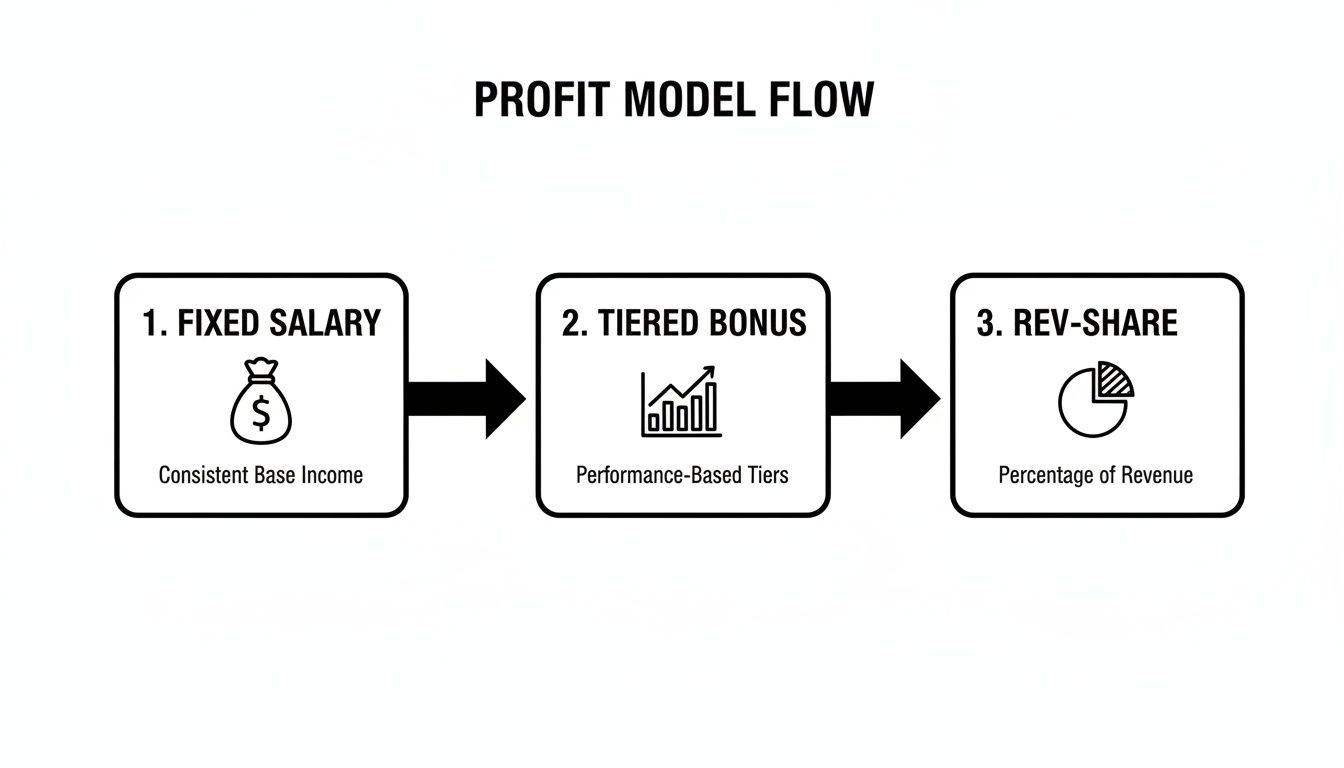
This visual shows how different pay structures, from fixed salaries to performance-based revenue sharing, can be clearly defined and automated. When you program these rules into your software, a contractual clause becomes an error-free, automated workflow.
A partnership agreement should be a living document that guides daily actions, not a piece of paper you file away. Integrating technology makes the agreement an active part of your operational DNA, enforcing best practices automatically.
See how a technology-centric agreement transforms day-to-day operations.
Operational Clause Comparison: Manual vs Integrated System
| Operational Area | Clause in a Manual System Agreement | Clause in an Integrated System Agreement |
|---|---|---|
| Scheduling | "Partners will coordinate tutor schedules via a shared Google Sheet and confirm bookings via email." | "All lessons must be scheduled in Tutorbase, which will serve as the single source of truth for tutor availability." |
| Invoicing | "The administrative partner will manually generate and email invoices by the 5th of each month based on paper attendance logs." | "Invoices will be auto-generated by Tutorbase upon lesson completion and sent to clients via the parent portal." |
| Payroll | "Tutor pay will be calculated using an Excel spreadsheet, cross-referencing hours with attendance sheets." | "Tutor payouts, including bonuses, will be calculated automatically by Tutorbase based on completed lessons and predefined pay rates." |
| Reporting | "Partners will meet bi-weekly to review manually compiled reports on revenue and student attendance." | "Partners will review real-time revenue, attendance, and tutor performance dashboards available 24/7 within Tutorbase." |
The difference is night and day. One approach invites human error and administrative bloat; the other builds efficiency and accuracy directly into your business model. Specifying your technology in your partnership agreement is a strategic move that gets all partners on the same page, eliminates administrative chaos, and builds a solid foundation for growth.
Planning for Growth, Changes, and Exit Strategies
Great partnerships don't just plan for sunny days; they prepare for every possibility. Your agreement needs to be a living document, creating a clear roadmap for rapid growth, unexpected shifts, and an eventual, amicable split. Skipping this part is a classic mistake, turning a future opportunity or a tough conversation into a business-ending dispute.
Think of these clauses as your business’s prenuptial agreement. They’re there to protect everyone's investment and ensure major transitions, whether it’s a partner leaving or you're expanding, are handled smoothly and fairly. Thinking about the end at the beginning is one of the smartest things you can do.
Structuring Buy-Sell Agreements
What happens if a partner wants out due to retirement, disability, or death? A buy-sell agreement is the clause that answers these tough questions before they become emotional, high-stakes problems. It outlines a clear, legally binding process for one partner to buy out another’s share, preventing chaos and costly fights over business valuation.
A solid buy-sell agreement should specify:
- Triggering Events: A clear list of what puts the clause into motion. This could be anything from a voluntary departure and disability to divorce or death.
- Valuation Method: How will you determine the business's worth? Will you use an agreed-upon fixed price, a formula based on annual revenue, or a neutral third-party appraiser?
- Funding Mechanism: How is the buyout paid for? Options include personal funds, a business loan, or life insurance policies taken out on each partner.
Without this clause, a departing partner could theoretically sell their shares to anyone, forcing you into business with a complete stranger. A well-structured buy-sell gives remaining partners the first right of refusal, keeping control where it belongs.
Protecting Your Business with Non-Compete Clauses
When a partner leaves, you must protect the business you built. A non-compete clause is designed to do just that, preventing a former partner from opening a competing tutoring center within a specific geographic area for a set period. This protects your client base, curriculum, and market position from being immediately poached.
An intellectual property (IP) clause is also critical. It must state, without ambiguity, that all curriculum, teaching methods, and branding developed for the business belong to the business itself, not the individual partners. This stops a departing partner from walking away with your proprietary materials to launch their own venture.
A partner leaving shouldn't cripple your business. Non-compete and IP clauses ensure that the value created within the partnership stays with the partnership, providing crucial stability during a transition.
Planning for Expansion and Scalability
Your agreement should be a launchpad for growth, not a cage. As you succeed, you’ll want to expand. This could mean opening a second location across town or launching a separate online-only brand for niche test prep. Your agreement must provide a framework for these scenarios.
You'll want clauses that address how new locations will be funded, how profits from different branches will be divided, and the decision-making process in a multi-location operation. Modern tutoring platforms are built for this growth, often offering multi-brand support from a single dashboard. Your legal agreement needs to lay the groundwork to use these tools effectively.
Smart partnership agreements are already fueling this kind of growth. With the global tutoring industry projected to maintain a 7% compound annual growth rate through 2030, strong legal frameworks are key. These pacts help K-12 and language schools formalize collaborations, leading to a 60% reduction in admin time through integrated tools. You can read more about the latest tutoring statistics to see how solid agreements underpin this expansion.
Frequently Asked Questions About Tutoring Partnership Agreements
Here are direct, practical answers to common questions tutoring center owners ask when creating partnership agreements.
How often should we review our partnership agreement?
You should formally review your partnership agreement at least once a year. This annual check-in ensures the agreement still aligns with how your business actually operates. Beyond that, certain events should trigger an immediate review: major business changes (like expansion), shifts in partner roles, or new funding.
What is the biggest mistake partners make in their agreements?
The single biggest mistake is avoiding tough conversations upfront. Founders get caught up in the excitement and gloss over potential conflicts, like what happens if someone wants out or isn't pulling their weight. A strong agreement forces you to map out worst-case scenarios while everyone is on good terms, creating a fair, logical plan.
Can we change the tutoring partnership agreement later?
Yes, and you should. A static document is useless. Your business will evolve, and your agreement must evolve with it. The key is to include a specific amendment clause in the original document. This clause should detail the process for making changes, typically requiring the unanimous written consent of all partners to ensure any adjustments are collaborative and legally enforceable.
Do we really need a lawyer to draft our partnership agreement?
While you can find templates online, hiring a lawyer specializing in business law is a crucial investment. A generic template can't account for your unique situation or local laws. A good lawyer acts as a neutral third party, guiding you through "what if" conversations and spotting blind spots you would have missed. The upfront legal cost is a fraction of what a messy dispute would cost later. In fact, a 2024 report from TutorCruncher highlights legal counsel as a best practice for ensuring your contracts are comprehensive and compliant.
How does a partnership agreement interact with tutor contracts?
Your partnership agreement is the internal constitution for the business owners. Tutor contracts are the external agreements with your staff. The partnership agreement should define who has the authority to hire tutors and approve their contracts. For instance, it might state the "Academic Director" is responsible for all tutor hiring and that all tutor contracts must include specific clauses you’ve all agreed on, such as cancellation policies or payroll schedules.
A well-structured Tutorbase system can bring your partnership agreement to life. It helps operationalize all those important clauses, turning legal requirements into automated workflows for scheduling, billing, and complex payroll, ensuring every partner is working from the same playbook. See how Tutorbase can make your agreement a reality.


