


Key Takeaway: The best tutoring software for Singapore centres streamlines operations by managing multiple brands, supporting local curriculum like PSLE and JC, and integrating with Singaporean payment habits like PayNow. It automates scheduling, billing, and lead capture via WhatsApp to help you reclaim administrative time and focus on growth.
Think of it as your digital centre manager. It handles everything from multi-brand and multi-location management to aligning class schedules with the local curriculum (PSLE, Secondary, JC). It even accepts payments through essential local methods like PayNow. This isn't just about replacing spreadsheets; it's about getting your time back.
What is the best way to manage a Singapore tutoring centre?
Moving away from a messy collection of separate tools, a dedicated software platform lets you get back to what matters: student growth and expanding your business. Instead of wrestling with a billing spreadsheet while coordinating class changes over WhatsApp, everything works together seamlessly.
This kind of integrated system is a lifesaver. This is especially true for centres managing the complexities of multiple branches across the island, from Orchard and Tampines to Jurong.
Before we dive deep into specific features, it helps to see a clear picture of what you stand to gain. Juggling multiple manual tools isn't just inefficient. It creates blind spots and adds hours of administrative work to your week.
Manual Methods vs. Integrated Tutoring Software
Operational Task | Manual Method (Spreadsheets, WhatsApp, Email) | Integrated Tutoring Software |
|---|---|---|
Class Scheduling | Constant back-and-forth messages to confirm slots. High risk of double-booking or errors. | Parents can book online 24/7. Central calendar prevents clashes and shows real-time availability. |
Invoicing & Payments | Manually creating invoices, tracking payments in a spreadsheet, and sending individual reminders. | Automated invoice generation and payment reminders. Accepts online payments via PayNow, Stripe, etc. |
Parent Communication | Disjointed conversations across multiple WhatsApp chats and email threads. Hard to track history. | Centralized parent portal with all communication, progress reports, and schedules in one place. |
Attendance Tracking | Paper lists or manual spreadsheet entries that are tedious to compile for reporting. | Tutors mark attendance digitally. System automatically logs data for payroll and student records. |
Tutor Payroll | Manually calculating hours from different sources, leading to potential errors and disputes. | Automatically calculates tutor pay based on logged attendance and hourly rates. |
Reporting | Spending hours manually compiling data to understand revenue, enrolment, or attendance trends. | Instant, real-time dashboards showing key business metrics with just a few clicks. |
Switching to an integrated system is a strategic move. You can reduce errors, improve the parent experience, and free up valuable time that you can reinvest into growing your centre.
Why does generic software fail Singapore tutoring centres?
If you've tried to run a Singaporean tutoring centre on generic software, you know the frustration. These platforms, often designed for a Western market, simply can't keep up with the unique demands of our local education scene. They lack the DNA to handle multi-brand management or local payment habits.
The result? Centre owners get stuck patching together a messy quilt of spreadsheets, WhatsApp chats, and manual workarounds. This fundamental mismatch between global software and local reality creates friction, wastes time, and holds your business back.
The Multi-Brand and Multi-Location Problem
A single company running multiple, distinct tutoring brands is a common setup here in Singapore. You might have one brand for Primary-level Math and a completely separate one for JC H2 Chemistry. Most generic software sees these as two different businesses, forcing you to create siloed accounts for each.
This means you constantly log in and out just to get a complete picture of your own company. It's a massive operational headache, especially when your brands share classrooms across locations like Orchard, Tampines, and Jurong. To run efficiently, you need a system that offers:
Unified Management: Control every brand and location from a single, central dashboard.
Centralized Room Booking: See classroom availability across all branches at a glance, killing double-bookings for good.
Consolidated Reporting: Get a clear, top-down view of your entire business's financial and operational health, not just one brand at a time.
Without this, you're left juggling separate calendars and reports, a recipe for costly errors and wasted administrative hours.
Mismatched Educational Structures
Another huge pain point is how these systems handle curriculum. Generic software uses broad terms like "Grade 5" or "High School," which just don't map cleanly to Singapore's specific educational pathway. This makes setting up classes and tracking student progress a nightmare for your staff and parents.
A system built with Singapore in mind gets it. It understands the local context and lets you structure your classes precisely according to the Ministry of Education's framework.
A purpose-built tutoring software Singapore solution should natively support levels such as Primary 1-6 for PSLE preparation, Secondary 1-4, and Junior College (JC) H1/H2 subjects. This ensures your class setup is intuitive and perfectly aligned with parent expectations.
This isn't just a "nice-to-have" feature; it's fundamental to running a smooth operation. It simplifies everything from student enrolment to generating accurate progress reports that parents can actually understand.
Ignoring Local Payment and Communication Habits
Many international software platforms push hard for credit card payments through gateways like Stripe. While useful, this approach completely ignores the overwhelming preference for PayNow and FAST bank transfers in Singapore. Forcing parents into a card-only system creates unnecessary friction and could even cost you clients.
It's the same story with communication. These systems default to email and web forms for capturing leads, but in Singapore, the real conversations happen on WhatsApp. An inability to integrate with the channels your customers actually use puts your centre at a serious disadvantage. This is a common challenge across the region, something we also cover in our guide on choosing the right tutoring software for centres in Hong Kong.
The private tutoring market is exploding. The Asia Pacific region commanded a massive 58.63% of the global market share in 2023. This growth underscores the need for digital tools built for regional habits, not against them. You can read the full research on the private tutoring market from Fortune Business Insights.
To truly grow your centre, you need software designed for how Singaporean parents actually communicate and pay. Anything less is just a compromise.
Must-Have Features Built for the Singaporean Market
Picking the right tutoring software in Singapore is about more than grabbing a generic scheduler off the shelf. To really get ahead, you need a system that understands the unique headaches and opportunities of running a centre here. You need tools built for how local centres are structured and how parents expect to communicate and pay.
The best platforms don't just bolt these on; they’re woven into the core of the software. This means you can manage a portfolio of different subject brands from one dashboard. You can structure your classes around the local curriculum and stop worrying about double-booking a classroom across your branches in Tampines and Jurong.
How do I manage multiple tutoring brands and locations?
Think about how many tutoring businesses in Singapore operate. It’s less like a single shop and more like a portfolio. A parent company might run separate brands for PSLE Math, O-Level Physics, and JC H2 Chemistry. This structure instantly breaks most generic software, forcing you to juggle separate accounts.
A top-tier tutoring software Singapore solution gives you a single command centre. From one login, you can see everything that’s happening across every brand and every physical branch. This isn't a "nice-to-have"; it's fundamental for anyone serious about scaling.
Here’s what that looks like in practice:
Single Dashboard Control: No more logging in and out. Manage all your brands and locations from one place for a complete, real-time picture of your entire operation.
Consolidated Financial Reporting: Pull comprehensive revenue and enrolment reports that combine data from all your brands. This gives you a true, birds-eye view of your company’s financial health.
Shared Resource Pools: Centralize your team of tutors and admin staff. This flexibility lets you assign your best chemistry tutor to a class at your Orchard branch one day and a relief class in Tampines the next.
Why Is Centralized Room Management So Important?
As soon as you open a second location, the risk of double-booking a classroom or a star tutor skyrockets. A manual system makes it impossible to see real-time availability. This leads to frantic last-minute calls, frustrated staff, and disappointed parents.
Centralized room management kills this problem at the source. It’s a master calendar showing the availability of every single classroom across all your centres. When your admin in Tampines books Room 3, it instantly shows as unavailable to your team in Jurong. No conflicts, no chaos.
Built-in Singapore Curriculum Support
Generic software from overseas often uses vague levels like "Grade 5" or "High School." This just doesn't map to Singapore's specific educational framework. It creates a mess for your admins setting up classes and for parents trying to enrol their child. Your software needs to speak the same language as the Ministry of Education.
A system truly built for Singapore lets you structure courses and levels with precision. Think dedicated support for Primary 1-6 for PSLE prep, Secondary 1-4, and Junior College (JC) H1/H2 subject bands. This brings instant clarity for everyone involved.
This alignment isn't just a label; it simplifies the entire student journey. From the first inquiry to the final progress report, the terminology is familiar and correct. It’s a small detail that shows parents you understand their world, building trust right from the start.
What Is a Parent Portal and Why Do You Need One?
A parent portal is a secure online hub where parents can log in anytime to see everything related to their child's classes at your centre. It replaces the endless, chaotic stream of WhatsApp messages, emails, and phone calls with a single, organized source of truth.
A well-designed portal empowers parents with 24/7 access to:
Class Schedules and Attendance: They can see all upcoming lessons and check if their child made it to class on time.
Invoices and Payment History: No more "Did I pay yet?" questions. They can view outstanding balances, pay online, and see every past transaction.
Progress Reports and Feedback: Tutors can upload academic updates and comments directly, giving parents the insights they crave.
Direct Communication: A secure, built-in messaging system keeps conversations organized and professional.
For your centre, the payoff is huge. A parent portal slashes the admin time spent answering routine questions. It automates communication and delivers a polished, professional experience.
How to Capture Leads with a WhatsApp-First Strategy
In Singapore, the traditional "Contact Us" form is dead. Parents today are busy, mobile-first, and they live on WhatsApp. If you're still asking them to fill out a clunky form and wait for an email, you're losing leads.
A WhatsApp-first strategy means meeting parents where they already are. It turns the world's most popular messaging app into your most effective enrollment tool. You can convert casual website visits into booked trial classes with surprising speed.
This is all about streamlining your process. Good software connects your core operations (management, curriculum, and scheduling) into a single, smooth workflow.
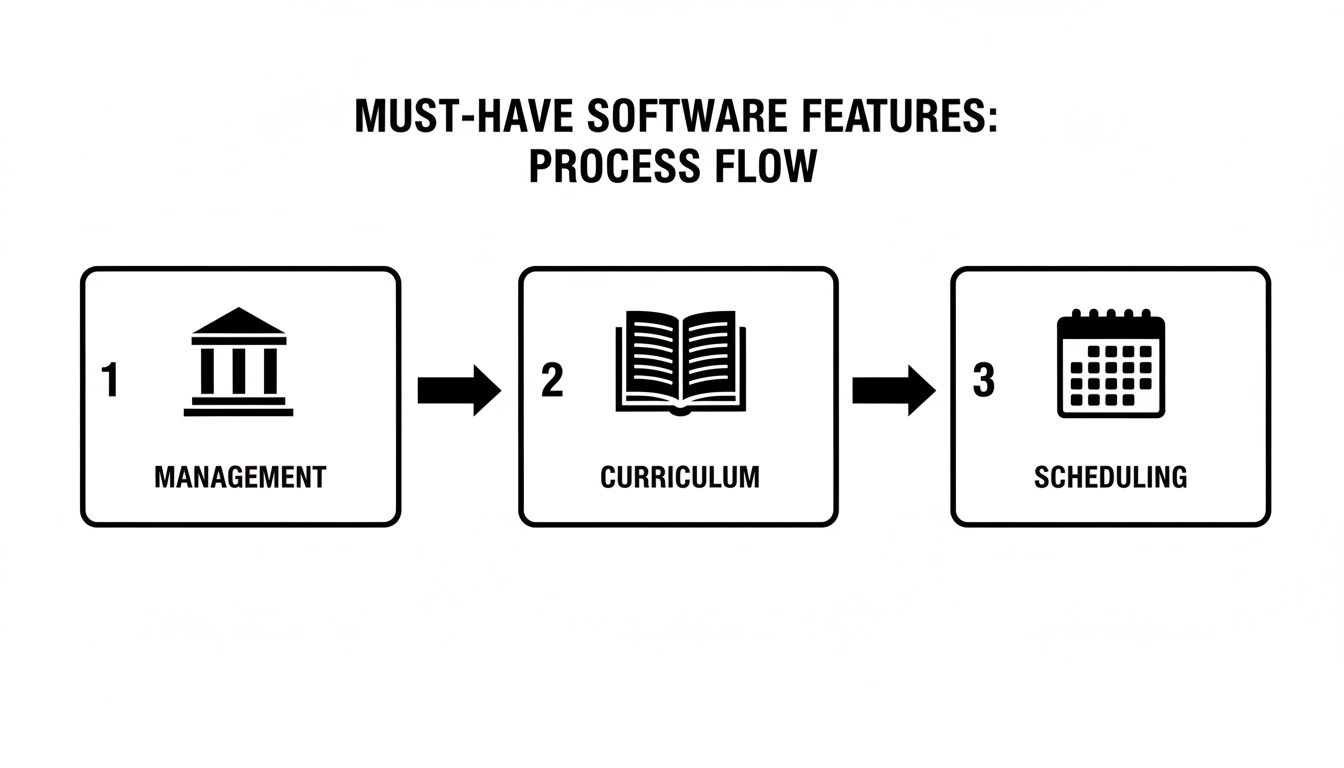
Think of it this way: the moment an inquiry comes in via WhatsApp, the clock starts ticking. Your system should be ready to handle everything that follows, seamlessly.
Why do traditional contact forms underperform in Singapore?
For a busy Singaporean parent juggling work, school runs, and family life, filling out a form is a hassle. It creates friction. They have to type in their name, email, and phone number, then wait for a response that might get lost in their inbox.
In a market where everyone expects instant communication, this slow, formal process feels outdated. It’s a major reason why potential students drop off your website and go to a competitor.
WhatsApp, on the other hand, is instant, personal, and already a daily habit. A quick tap and a message are far more appealing than a multi-field form. The best tutoring software Singapore platforms build their lead capture tools directly around WhatsApp.
How does a WhatsApp widget work?
A WhatsApp widget is a small, clickable button that sits on your website. Instead of leading to a form, it opens a direct conversation with your centre.
Here’s how that journey usually plays out:
Initial Contact: A parent lands on your site and clicks the WhatsApp button.
Instant Connection: They're taken straight to a WhatsApp chat. The best systems even pre-fill the message for them.
Automatic Capture: The second they hit 'send', your tutoring software automatically captures their name and phone number, instantly creating a new lead in your CRM.
No more manual data entry. No more delays. Your admin team gets a notification about a warm lead and can reply in real-time. You can dive deeper into this strategy in our guide on using WhatsApp for your tutoring business.
From Inquiry to Enrollment
The real magic happens when this instant connection integrates with your management software. Once that lead is captured, your team has everything they need to convert it into an enrollment.
By meeting parents on their preferred channel, you can reduce the lead response time from hours to minutes. This speed is a critical competitive advantage, often making the difference between securing an enrollment or losing the prospect to another centre.
Your team can see real-time class availability and share different scheduling options. They can also send a booking confirmation link all without ever asking the parent to switch apps. The entire journey can happen in a single, convenient conversation.
While a WhatsApp-first approach is incredibly effective for capturing inbound interest, you can supercharge your growth by pairing it with a proactive outreach strategy. For centres looking to build a more robust pipeline and accelerate enrollment, you can explore dedicated lead generation services.
Making Payments Easy with PayNow and Flexible Billing
Financial admin is often the biggest headache for tutoring centres in Singapore. The best software tackles this by understanding how parents actually want to pay. It must easily track manual payments like PayNow and FAST bank transfers, because forcing everyone to use a credit card is a surefire way to frustrate local families.
Your system has to juggle different billing models without breaking a sweat. Whether it’s prepaid credit packages, standard term-based fees, or pay-per-lesson options, the software should automate the invoicing and make life simpler for both you and your clients.

Why is manual payment tracking for PayNow a must-have?
A common mistake we see centres make is only accepting credit card payments. While gateways like Stripe are great, a huge chunk of local payments in Singapore happen via PayNow or FAST bank transfers. This trend is only set to grow into 2026 and beyond.
A system that only takes automated card payments creates unnecessary friction. Parents are pushed into a method they don’t like, or you end up tracking their bank transfers in a separate spreadsheet. That disconnect completely breaks your workflow.
The right tutoring software Singapore solution gives you the best of both worlds:
Stripe Integration: For parents who love the convenience of paying by card.
Manual Reconciliation: A simple button to mark an invoice as "Paid" the moment you confirm a PayNow or bank transfer has come through.
This dual approach means you can cater to 100% of your parent base while keeping all your financial records accurate and in one place.
How do I accommodate different billing models?
Very few tutoring centres run on a single payment structure. Your software needs to be agile enough to handle the different ways parents prefer to pay. This can change depending on the course or their child's commitment level.
A one-size-fits-all billing system just won't cut it. For example, a parent might want a flexible pay-per-lesson option for a trial class but prefer a discounted package for a long-term PSLE Math programme. Your software should handle all of this automatically.
By offering multiple payment models, you remove barriers to enrollment. A parent hesitant to commit to a full term might readily agree to a prepaid package of 10 lessons. This gives you a chance to prove your centre's value and convert them into a long-term client.
What Is a Flexible Billing System?
A flexible billing system is software that can manage multiple payment structures at the same time without needing manual intervention. It automates invoicing and tracking for different models, giving both you and your parents more choice. For a deeper look, check out our guide on setting up a flexible billing system for your tutoring center.
This adaptability is a hallmark of modern tutoring software Singapore platforms. Here’s a quick breakdown of the common models a good system should support:
Billing Model | How It Works | Best For |
|---|---|---|
Prepaid Credits | Parents buy a block of credits upfront (e.g., 20 credits for $1000). The system automatically deducts credits as their child attends lessons. | Parents seeking flexibility and bulk discounts. Centres wanting to secure revenue upfront and reduce payment chasing. |
Pay-Per-Lesson | An invoice is generated for each lesson after attendance is marked. Parents pay for classes as they go. | Trial classes, ad-hoc sessions, or families who prefer not to make large upfront payments. |
Term Packages | Parents are invoiced a flat fee for a full term (e.g., 12 weeks of classes). This often includes a discount compared to pay-per-lesson. | Core academic subjects where consistent attendance is expected, such as PSLE or O-Level preparation courses. |
When you automate these models, you provide a far better customer experience while slashing the time your staff spends on financial admin. This frees them up to focus on what really matters instead of chasing payments.
To scale your centre effectively, you need a system that can grow with your offerings. Start offering more flexible payment options in 2026 with a powerful platform.
Choosing the Right Software Partner for Your Centre
Picking a software provider isn't like buying a new printer; it's more like choosing a business partner. This decision will shape how your centre runs for years to come, so looking past the monthly price tag is absolutely critical. You need a partner who can grow with you, keep your data safe, and actually pick up the phone when you need help.
This isn't just a local trend. The global market for intelligent tutoring systems is expected to hit a staggering USD 44.2 billion by 2034. This represents a growth at an explosive 31.7% compound annual growth rate. Technology is becoming the backbone of education everywhere. You can see the full picture in the industry report from Astute Analytica.
How do I figure out the return on investment?
It’s easy to get fixated on the monthly subscription fee, but that’s missing the forest for the trees. The real value of good software is measured in time. To justify the cost, you need to put a dollar value on the hours your team gets back.
If your admin staff currently spends 15 hours a week on manual tasks and the new software slashes that time by 60%, you’ve just reclaimed 9 hours of productive work every single week. At a typical admin salary, that translates directly into thousands of dollars in annual savings.
Your Must-Have Evaluation Checklist
Don't get distracted by flashy features that don't solve your real problems. A simple, structured checklist keeps you honest and focused on what will actually help your centre run better and scale without headaches.
When comparing different tutoring software in Singapore, here are the non-negotiables:
Can It Scale? Your system needs to handle the jump from 50 to 500 lessons a week without breaking a sweat.
How Secure Is My Data? You're holding sensitive student and financial information. Ask pointed questions about their security protocols.
Is There Real Local Support? You need a team that operates on Singapore business hours and understands the local context.
What’s the Migration Plan? A good partner will have a clear, step-by-step process to move your data without causing chaos.
What does switching software actually involve?
Moving from an old system or a tangled web of spreadsheets can feel overwhelming, but it doesn't have to be. A reliable software provider will hold your hand through the entire process, making sure your daily operations aren't disrupted.
Here’s what that journey typically looks like:
Data Export and Cleanup: First, they’ll help you pull all your data out of your current setup.
Guided Data Import: The new software team takes over, carefully mapping your old data fields to the right places in their system.
System Configuration: This is where you work together to set up the system to match your centre's rules.
Team Training: A great partner ensures your admin staff and tutors get solid training so everyone feels confident from day one.
Often, this whole process starts with a simple first step, like filling out a clean, straightforward registration form.
A simple sign-up form like this is a good sign. It shows the company values a clean, user-friendly experience from the very beginning. When you choose a partner who prioritises simplicity and provides rock-solid support, you’re not just buying software; you’re setting your centre up for smooth, sustainable growth.
Frequently Asked Questions about Tutoring Software in Singapore
1. Can this software handle multiple brands and locations?
Yes, a robust tutoring software for Singapore lets you manage multiple brands and physical locations from a single account. This allows you to centralize room booking, share tutor resources across brands like an Orchard and a Jurong branch, and get consolidated financial reports for your entire business.
2. Does it support PayNow and other local payment methods?
Absolutely. While most systems integrate with Stripe for card payments, a solution built for Singapore must also allow for manual payment tracking. This lets you easily mark invoices as paid when parents use PayNow or FAST bank transfers, accommodating local payment habits without creating accounting headaches.
3. Is the system aligned with the Singapore education curriculum?
Yes, the best software is designed to align with the Singaporean MOE curriculum. You can structure your programs and classes using familiar grade bands like Primary 1-6 for PSLE prep, Secondary 1-4, and Junior College (JC) H1/H2 subjects. This ensures clarity for both your staff and parents.
4. How does the WhatsApp lead capture work?
A WhatsApp widget is placed on your website. When a parent clicks it, they are taken directly to a WhatsApp chat with your team. Their contact information is automatically captured as a new lead in the software's CRM, eliminating manual data entry and reducing response times from hours to minutes.
5. Can it automate tutor payroll and invoicing?
Definitely. The software automates tutor payroll by calculating pay based on marked attendance and pre-set rates. It also automatically generates parent invoices from the same attendance data, which can reduce administrative work by up to 60% and eliminate human error in billing.
6. What is involved in migrating from my current system?
A good software provider will offer a guided migration process. This typically includes exporting data from your old spreadsheets or system, cleaning it up, importing it into the new platform, configuring the software to your specific rules, and providing comprehensive training for your team.
7. Why is a parent portal important for a Singapore tutoring centre?
A parent portal provides a secure, centralized hub for parents to access class schedules, view invoices, make payments, and check their child's progress reports 24/7. It significantly reduces administrative workload from answering routine questions and provides a professional experience for parents.
8. How does this software help with room management across different branches?
It provides a centralized calendar that shows room availability across all your locations in real-time. When an admin at your Tampines branch books a room, it immediately becomes unavailable to staff at your Orchard branch, preventing double-bookings and scheduling conflicts.
Ready to eliminate administrative headaches and focus on growth? Tutorbase provides all the tools your Singaporean tutoring centre needs to scale efficiently. See how our smart scheduling, automated billing, and multi-location management can transform your operations. Get started today at tutorbase.com/register.


