


You can teach content well and still lose points on test day because a student mishandles the answer sheet. That's why the ACT bubble sheet deserves direct instruction, not a quick reminder to “be careful.”
For tutoring centers, this is even more important in 2026. If you want reliable score gains, you need repeatable systems. Bubbling is one of the few parts of the ACT that you can standardize almost completely.
How the ACT Bubble Sheet Works and Why It Matters
A student can finish a section with solid accuracy, then give points back in the last few minutes by bubbling one row off or leaving a changed answer half-erased. I have seen that happen often enough that I treat bubble-sheet control as part of test performance, not test housekeeping.
The ACT answer document is a standardized OMR form. Optical Mark Recognition software reads the bubbles during scoring. The scanner reads the marks on the page, not the answer the student intended to choose.
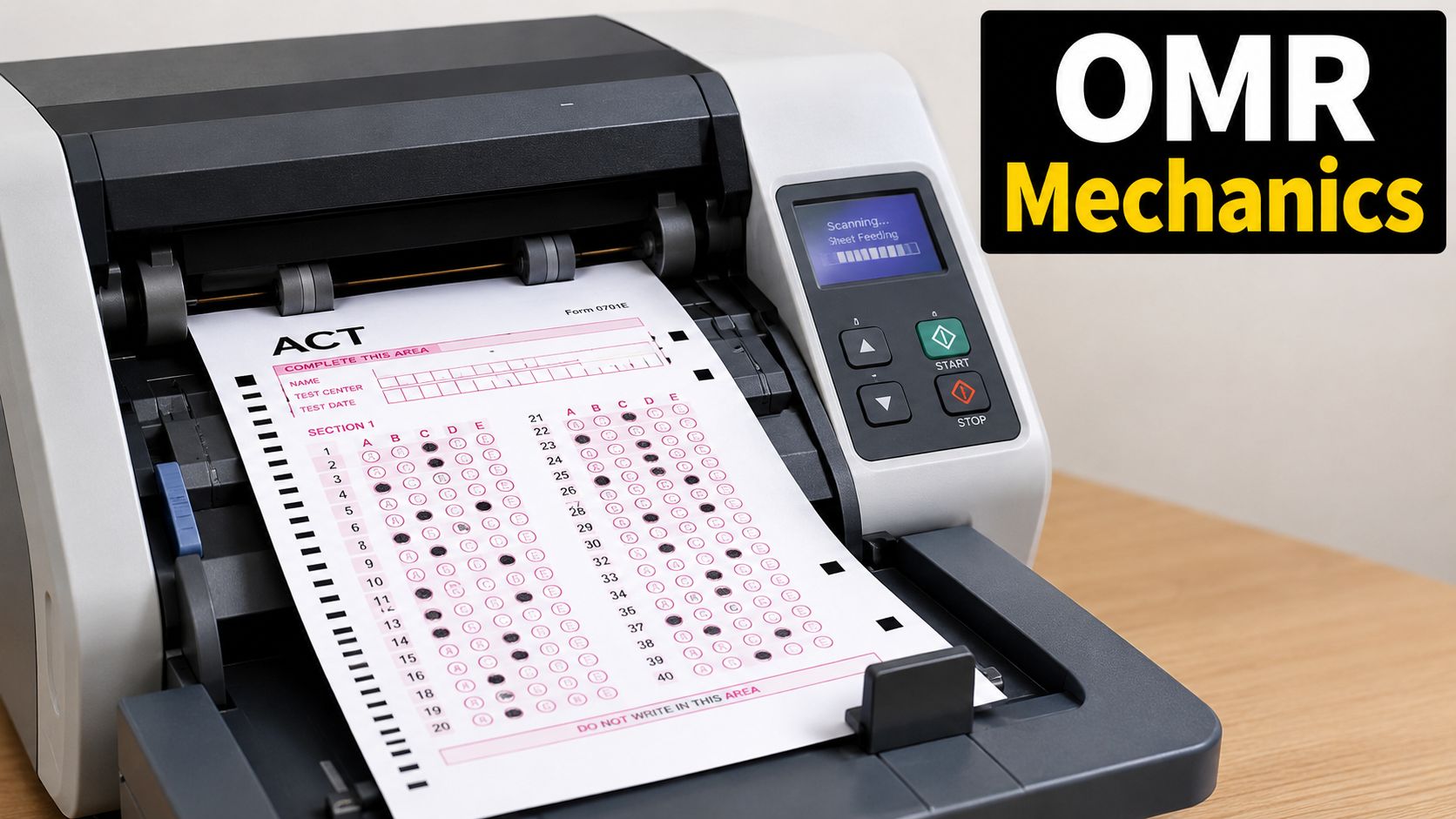
That has a practical implication for tutoring centers. Bubbling needs to be taught as a repeatable motor and attention skill with clear standards, just like pacing, annotation, or calculator use.
What the scanner actually needs
Students need three habits on the ACT answer sheet:
- One marked response per question
- A fully filled bubble
- A clean erase before any answer change
Those sound basic. Under time pressure, they are not. Students rush, grip the pencil lightly, skip a line after returning from the test booklet, or leave enough graphite behind to create an ambiguous mark.
Here is what matters in practice:
- Light fills can be missed: A bubble should be dark and complete, not lightly shaded or partly outlined.
- Messy corrections create risk: If a student changes an answer, the old mark has to be erased cleanly.
- Row alignment matters: One offset can turn a strong stretch of correct work into a string of wrong recorded answers.
The scoring consequence is straightforward. ACT multiple-choice performance is converted into section scores on the 1 to 36 scale, and those section scores feed the composite. A bubbling mistake can lower a score even when the student solved the questions correctly.
Why tutoring centers should teach the mechanics
Centers that want predictable score gains should not leave this to chance. Bubble-sheet performance is one of the easiest parts of test day to standardize because the rules are stable, observable, and coachable.
I explain it to tutors this way. Bad bubble-sheet instruction creates the same kind of noise you get from sloppy form design. If your staff also builds student surveys, checklists, or intake documents, it helps to understand key distinctions for data collection because the principle is the same. Clear input design produces cleaner output.
Students also vary in ways that matter here. Some lose their place visually. Some rush hand movements when anxious. Some multilingual learners and students with attention issues know the content but need a tighter response routine to keep the answer sheet synchronized with the booklet. Treating bubbling as a system, rather than a reminder to be careful, gives those students a fairer shot to show what they know.
That is why this part of ACT prep deserves direct instruction, observation, and correction. Random errors become teachable errors once the process is visible.
Choosing Your Bubbling Strategy
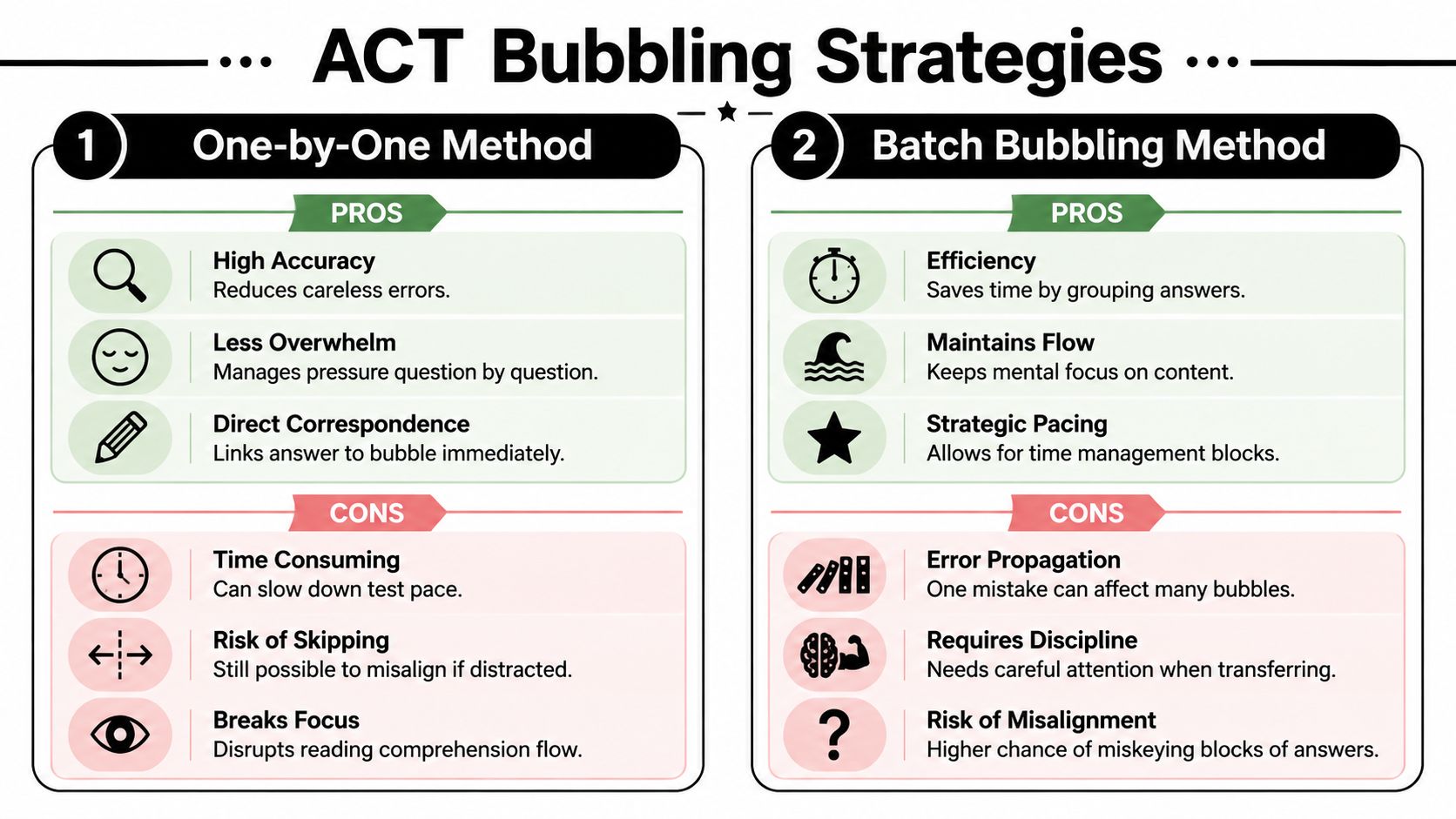
Most students use one of two methods on the ACT bubble sheet. They either bubble after every question, or they answer in the booklet and transfer in batches. Neither method is automatically “best.” The right choice depends on pacing, section type, and how easily the student loses their place.
One by one bubbling
This is the simplest method. A student solves one question, then fills that answer immediately.
It works well for students who panic when answers pile up in the test booklet. It also gives immediate closure. The answer in the book and the answer on the sheet stay synchronized.
Best for:
- Students who get disorganized easily
- Students who change answers often
- Math sections with free-standing questions
- Early-stage test takers who still need basic test-day control
The downside is pace. Every glance down to the answer sheet interrupts concentration. That interruption matters most in English and Reading, where flow and comprehension often matter more than a single question.
The one-by-one method lowers memory load, but it often taxes rhythm.
Batch bubbling
Batch bubbling means students mark answers in the test booklet first, then transfer a block at once. Many tutors teach this by passage. For example, a student may finish one English passage, one Reading passage, or a small cluster of Science questions before bubbling.
Later in this section, it helps to see a student-focused walkthrough in action:
Expert recommendations include circling answers in the test booklet and then transferring them in batches. This reduces attention switching and can reduce misalignment errors. The danger is obvious. If time runs short, the student may have answers in the booklet that never make it onto the answer sheet. That's why the standard protocol is to switch back to one-question-at-a-time bubbling at the 5-minute warning, as described in this ACT bubbling strategy explanation.
Pros and cons at a glance
| Method | What usually works | What usually breaks |
|---|---|---|
| One by one | Better alignment control, simpler routine, lower transfer risk | Slower pace, more attention switching, weaker reading flow |
| Batch bubbling | Better content focus, smoother pacing, fewer visual shifts | Higher transfer risk, more damage if alignment slips, harder under time pressure |
The hybrid strategy usually wins
For many students, the strongest system is not pure one-by-one or pure batch. It's a hybrid.
Use batch bubbling when there's enough time and the student is working in a stable rhythm. Then switch to one-by-one near the end of the section. This protects the student from the biggest late-stage failure, which is leaving solved questions untransferred.
I teach this as a traffic-light rule:
- Green phase: Work in planned batches when calm and on pace.
- Yellow phase: Shorten the batch size if attention starts slipping.
- Red phase: Bubble every question immediately once the clock feels tight.
Section specific choices matter
Not every section rewards the same approach.
- English and Reading: Batch bubbling often fits better because the test is passage-based and constant shifting can break comprehension.
- Math: One-by-one bubbling often feels safer because the questions stand alone and students skip around more.
- Science: This depends on the student. Some thrive with small batches. Others need tighter control because the section can feel visually crowded.
If a student gets mentally tired in the second half of the test, don't force the same rhythm throughout. A strategy that works in the first section may fail later. Good coaching adjusts the transfer pattern before fatigue turns into a mechanical error.
A Protocol for Fixing Bubbling Errors
Students don't need a pep talk when they realize they bubbled the wrong line. They need a script. Panic creates the second mistake, then the third.
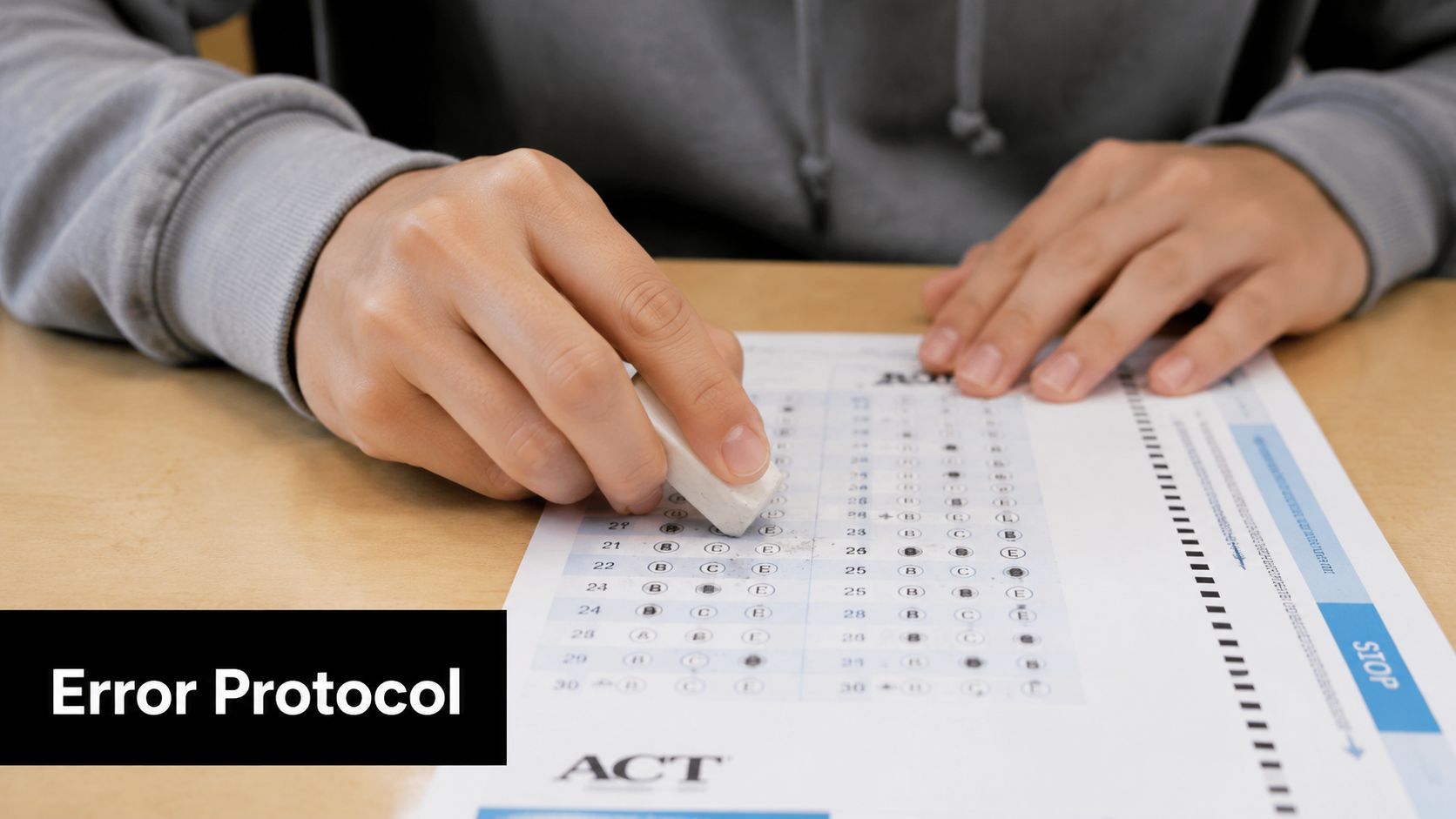
Use this correction sequence
Stop immediately.
Don't keep bubbling and hope it resolves itself. Continuing while confused usually expands the damage.Find the first mismatch.
Put your finger on the question number in the booklet, then match it to the same number on the answer sheet.Check the scope.
Decide whether the error affects one bubble or a whole run of answers.Erase fully.
Remove the wrong mark completely. A partial erasure is not “good enough” on an OMR form.Rebuild alignment.
After correcting, verify the last fixed question against the booklet before moving on.
If the student can't say, “I am on question X in both places,” they aren't ready to continue.
What tutors should rehearse
Most centers practice content review after a test. Fewer practice recovery. That's a mistake.
Run short drills where a tutor intentionally inserts a fake bubbling error into a practice section and asks the student to recover cleanly. This trains composure, not just accuracy. It also gives you a concrete observation point you can log in Tutorbase CRM, especially if multiple tutors work with the same student and need a shared note about recurring test-day habits.
A strong recovery routine has three visible behaviors:
- Pause before acting
- Erase cleanly rather than scribbling over
- Verify the question number before restarting
What does not work
Students often try one of these bad fixes:
- Rushing ahead: They assume the mistake is minor and keep moving.
- Half-erasing: They leave a ghost mark because they don't want to “waste time.”
- Trusting memory: They re-bubble from memory instead of checking the booklet.
Those shortcuts feel fast. They usually cost more time than they save.
Standardizing Bubble Sheet Practice in Your Tutoring Center
A student can know the math, read the passage correctly, and still lose points because one tutor taught batch bubbling, another taught question-by-question transfer, and nobody wrote down which method held up under time pressure. That is a training problem, not a student mystery.
Centers get better score consistency when bubbling is taught as a standard skill with a clear protocol, observation points, and a shared language across tutors. That matters even more for students who struggle with attention control, stress, processing speed, or visual tracking. Random tutor preference creates random errors.
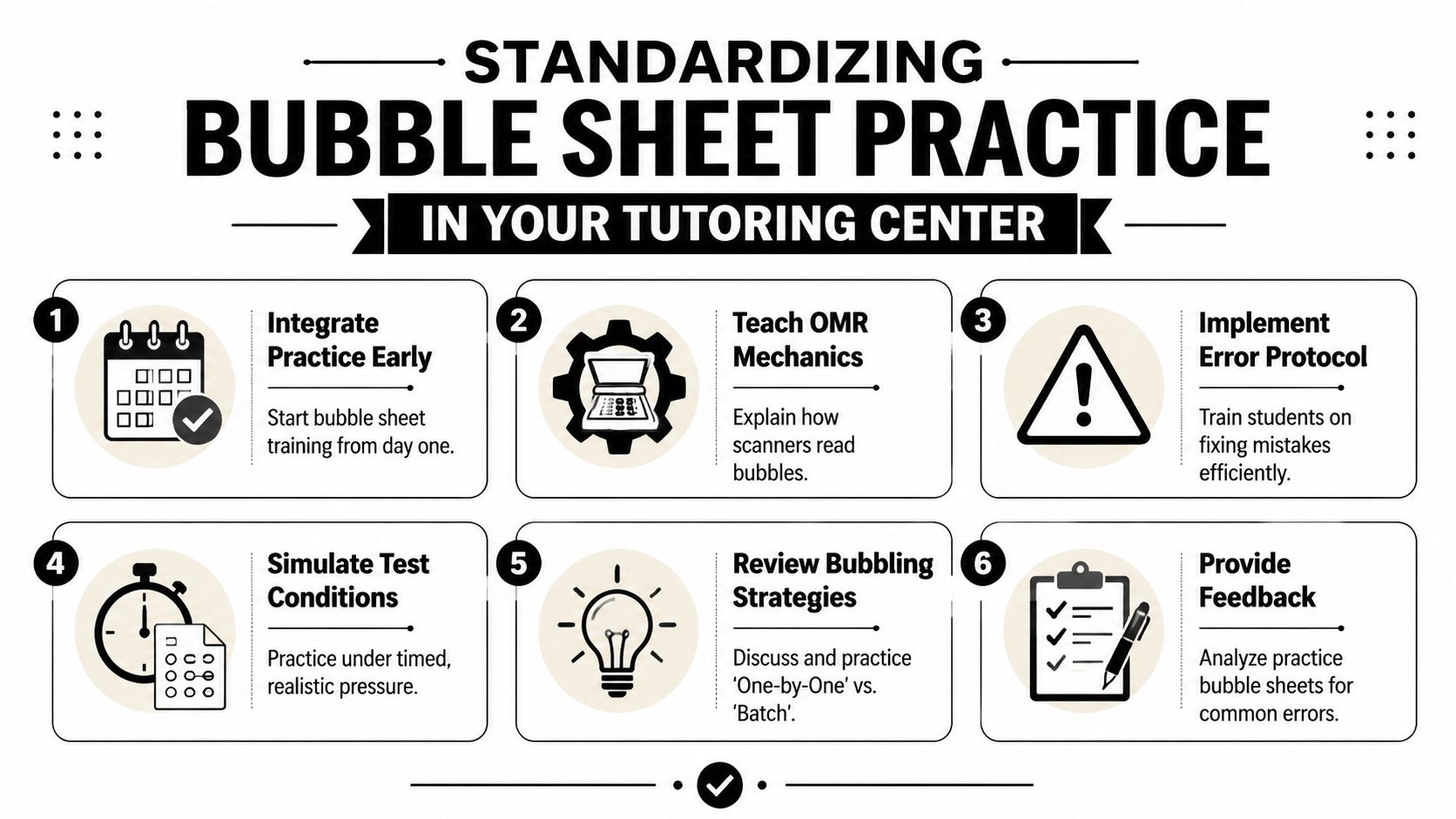
Build a center wide bubbling protocol
Every ACT program needs one default routine. Tutors can adjust for individual students, but the center should decide the core method first. Otherwise, students keep relearning the mechanics instead of improving them.
A workable protocol usually sets four rules:
- Start early: Bubble sheet practice begins on short sets and timed drills, not only on full-length mocks.
- Name the primary method: Each student has one approved default strategy.
- Name the fallback method: Each student also has a backup for sections where the first method breaks down.
- Use the same materials every time: Sharp No. 2 pencil, clean eraser, clean answer sheet, and a desk setup that matches test conditions.
I also recommend scripting the tutor language. If one tutor says “batch every four,” another says “do what feels natural,” and a third says “just don't get off,” the student gets noise instead of instruction. A standard script fixes that.
Coach observable behaviors
Scores alone do not tell you whether the process is stable. Tutors should record what the student did on the page.
Use a checklist that focuses on behaviors you can see:
- Number tracking: The student checks the booklet question number before transferring.
- Mark quality: The bubble is filled darkly and fully, without stray marks.
- Method discipline: The student stays with the assigned strategy unless the tutor calls for a change.
- Timing control: The student does not let bubbling consume the last minute of the section.
- Reset behavior: After any pause, the student reorients to the correct line before continuing.
If a tutor cannot describe the student's bubbling habit in one clear sentence, the habit is still too vague to coach well.
Standardize support for different learner profiles
Standardization does not mean giving every student the same interval or the same correction cue. It means every accommodation is deliberate, named, and repeatable.
For example, a student with stress-related rushing may need a fixed transfer checkpoint every five questions. A student who loses focus when looking down too often may perform better with passage-end transfer in Reading but tighter intervals in English. A student with visual tracking issues may need a finger check on the booklet line and the answer-sheet row before each transfer block.
Those are real trade-offs. Tighter transfer intervals reduce alignment risk but create more switching. Larger batches protect focus for some students but raise the cost of a late mistake. Good centers do not leave that decision to tutor instinct alone. They test it, document it, and keep the instruction consistent across staff.
Make handoffs operational, not informal
This system falls apart when one tutor keeps notes in a notebook, another uses memory, and a third only logs scores. Bubble sheet coaching needs operational follow-through.
If multiple tutors work with the same student, each session note should capture:
- the student's current bubbling method
- the failure pattern observed
- the cue that corrected it
- whether the method held up under timing pressure
- what to repeat next session
That is one reason many programs use Tutorbase for test prep centers. It gives tutors and managers one place to track lesson notes, student habits, scheduling, attendance, and progress across staff. For a center director, that makes bubble sheet training easier to standardize because the method is visible, repeatable, and reviewable instead of buried in scattered handoffs.
The goal is simple. Remove preventable bubbling errors from the score report. Once a center treats bubbling as a coachable system rather than a minor test-day detail, tutors can train it the same way they train pacing, annotation, or passage strategy.
ACT Bubble Sheet FAQ
A student can know the content, manage pacing well enough, and still lose points to preventable bubbling mistakes. That is why strong ACT programs treat the answer sheet as a trained procedure, not a test-day afterthought.
What pencil should students use?
Use a sharp No. 2 pencil. It gives students the best chance of making dark, readable marks and fixing mistakes cleanly.
Have students bring more than one. A broken pencil at the wrong moment creates stress and wasted time.
Should students fill in every answer, even if they guess?
Yes. Students should mark every question.
Wrong answers do not carry a penalty on the ACT, so unanswered questions are a missed scoring opportunity. In practice, center staff should coach this as part of the end-of-section routine, not as last-second advice.
How completely do students need to erase?
Fully. A partial erase can still leave enough graphite to confuse the scanner.
I tell tutors to teach a simple check. Erase first, look once, then fill the new bubble dark enough to stand on its own. Students who rush this step often create double-mark problems without noticing.
Is batch bubbling always better?
No single method fits every student.
Batch bubbling helps some students stay in the passage or problem set without constant visual switching. It also raises the cost of one skipped line or one late transfer error. For students with attention drift, anxiety, or inconsistent pacing, smaller transfer batches usually hold up better under pressure.
What should a student do if they still have blank bubbles near the end?
Fill them immediately.
At that point, the job is not to revisit every question. The job is to make sure no item is left blank. Centers should rehearse this moment in timed practice so students do not freeze, second-guess, or waste final seconds trying to be perfect.
How should a tutor decide which bubbling method to teach?
Start with the student's actual error pattern. Then choose the simplest method that reduces that pattern.
A student who loses place needs tighter control and more frequent answer-sheet checks. A student who breaks concentration every few seconds may perform better with controlled batching. A student who melts down late in the section needs a shorter, more automatic routine. Good centers standardize those decisions so tutors are coaching from the same playbook.
Can centers track bubble-sheet habits systematically?
Yes, and serious programs should.
If a center wants consistent delivery across multiple tutors, bubble-sheet habits need to be logged like any other skill: current method, observed error, correction cue, and whether the change held under timing pressure. Many owners review best ACT prep management software when they need a cleaner way to track that across staff and students.
Is the ACT bubble sheet still worth practicing if a student expects a different format later?
Yes. Bubble-sheet practice builds transfer discipline, answer confirmation habits, and calm under time pressure.
Those skills carry over well beyond one form. For diverse learners especially, a repeatable marking routine reduces cognitive load and gives tutors something concrete to coach, measure, and improve.


