


If you're running a tutoring center in 2026, you probably know this pattern too well. One tutor gets glowing parent feedback, another gets complaints for the same subject, and you end up spending your evenings fixing attendance errors, reassigning students, and calming frustrated families instead of building the business.
That usually isn't a hiring problem. It's a training system problem. The strongest tutor training programs don't just help tutors teach better. They protect retention, stabilize operations, and give ambitious candidates a reason to join and stay.
Why Most Tutor Training Fails to Deliver Results
Most centers treat training as a short onboarding event. A new tutor shadows one lesson, reads a few policies, gets shown the schedule, and starts teaching. That feels efficient. It usually creates expensive inconsistency.
When training is shallow, every weakness shows up somewhere else. Students get mixed lesson quality. Parents hear different messages from different tutors. Admin staff chase missing notes and unclear attendance. Managers step into constant exception handling.
One-off onboarding doesn't create reliable teaching
A center can have smart tutors and still deliver uneven results. Subject knowledge alone doesn't produce a strong lesson. Tutors also need a repeatable way to assess a student, pace a session, explain mistakes, communicate with parents, and document what happened.
That gap is why many operators feel like they're always firefighting. The center isn't just dealing with a "training issue." It's dealing with a broken operating system.
Practical rule: If parents describe your quality as "depends on the tutor," your training model isn't working.
The same operational chaos shows up in the back office. Tutoring centers managing 5 to 100+ teachers across 1 to 10+ branches typically spend over 10 hours per week on administrative tasks such as manual invoicing, payroll calculations in Excel, and chasing payments, which cuts into revenue capacity and increases errors, according to Tutorbase data listed on Software Advice.
Weak training creates hidden operational costs
This is what usually happens when the program isn't structured:
- Lessons drift: Tutors fill time instead of teaching toward a clear outcome.
- Notes become unreliable: One tutor writes detailed progress updates, another writes nothing useful.
- Scheduling gets messier: Managers keep moving students because the wrong tutor got assigned.
- Payroll disputes rise: Incomplete attendance and lesson records create confusion.
- Renewals get harder: Families don't buy consistency when they can't see it.
A center owner often blames staffing quality. In practice, many of these problems start before the tutor teaches lesson one. If you don't define what good tutoring looks like, train it, observe it, and coach it, you'll keep paying for inconsistency in both client experience and admin time.
Training is a business system, not an HR task
The centers that scale well don't treat tutor training programs as orientation. They treat them as infrastructure. Training decides who can teach what, how lessons should run, what records must be completed, and when someone is ready for higher-stakes students.
That's why the training conversation has to move out of "how quickly can we onboard this tutor?" and into "how do we build a system that produces the same teaching standard across every branch, class type, and subject?"
Designing Your Program's Foundational Blueprint
Before writing a single training module, define the model your center needs. Most failed tutor training programs aren't missing effort. They're missing structure. The blueprint should tell a tutor exactly what competence means in your center and how that competence connects to student experience.
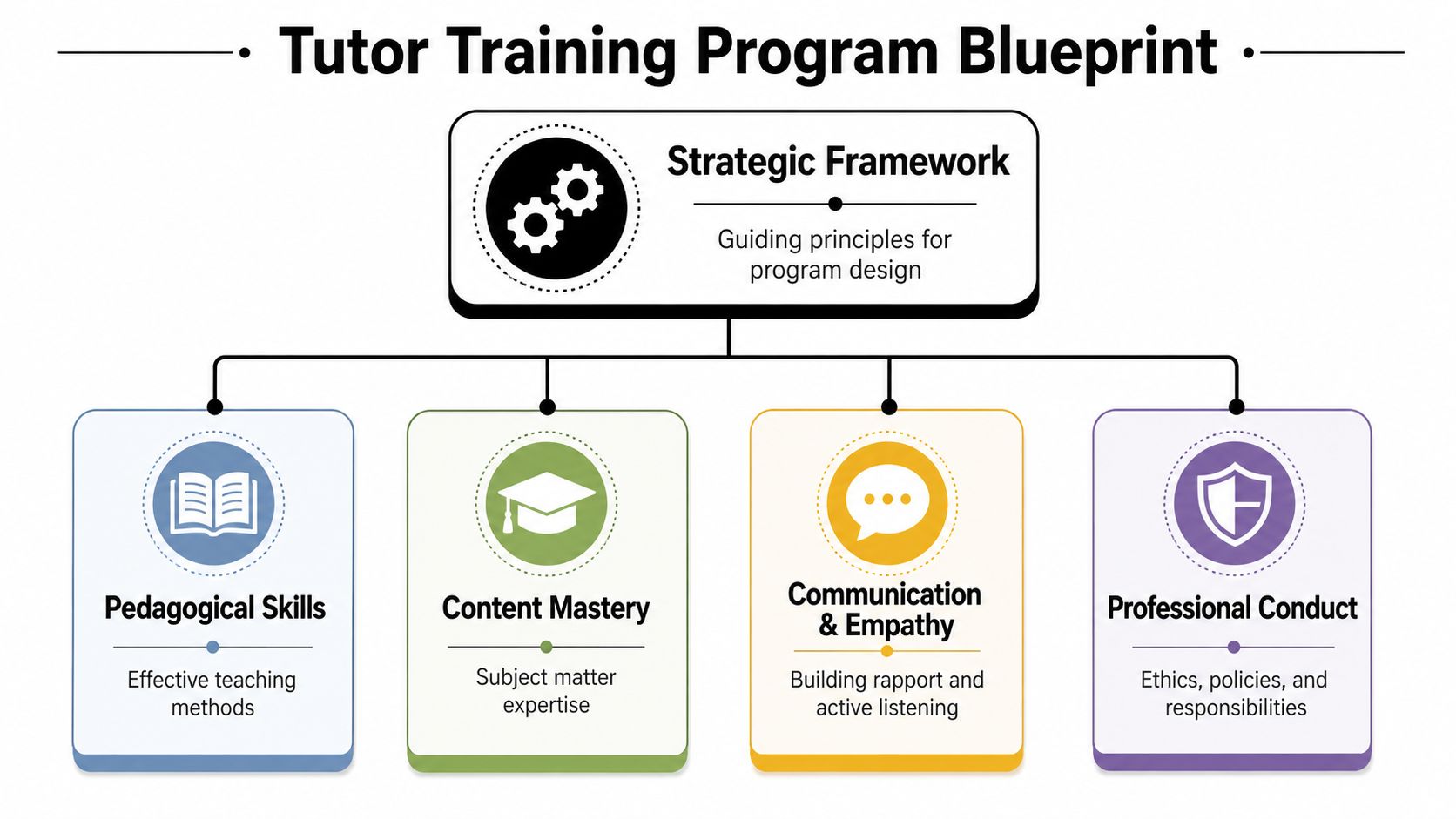
Four pillars that make the program scalable
I recommend building the whole system around four pillars. Not because it's elegant on paper, but because these are the areas where centers break when they grow.
| Pillar | What it covers | Why it matters operationally |
|---|---|---|
| Pedagogical skills | Explaining concepts, checking understanding, pacing, questioning | Makes lesson quality more consistent |
| Content mastery | Subject knowledge, curriculum familiarity, common misconceptions | Reduces poor matches and weak explanations |
| Platform proficiency | Attendance, notes, schedules, lesson visibility, communication workflows | Prevents admin errors and payroll confusion |
| Safeguarding and professional conduct | Boundaries, escalation, parent communication, policies, ethics | Protects trust and reduces avoidable incidents |
A lot of centers build only the second pillar. They recruit strong math tutors or language teachers and assume the rest will sort itself out. It doesn't. A tutor can know calculus or B2 German and still run a poor lesson, mishandle a parent conversation, or forget to mark attendance properly.
Define outcomes before content
Each pillar needs an observable standard. Don't write "tutors understand differentiation." Write what a manager can verify.
For example:
- Pedagogical skills: Tutor can open a lesson with a quick diagnostic task, adapt the pace, and close with a clear recap.
- Content mastery: Tutor can identify the most common errors in the level they teach and correct them clearly.
- Platform proficiency: Tutor can check their timetable, mark attendance correctly, add lesson notes, and follow the center's workflow without help.
- Professional conduct: Tutor knows when to escalate concerns, how to communicate boundaries, and what should never be promised to a parent.
Strong tutor training programs reduce ambiguity. Tutors shouldn't have to guess what "good" looks like.
Build for your actual delivery model
A center teaching one-to-one SAT prep needs a different emphasis from a language school running hybrid group classes in Spanish, French, German, Mandarin, or Arabic. If you run level-based progression such as A1, A2, B1, and multi-branch classes, your blueprint has to include room logistics, level tracking, and consistency across teachers.
That matters because language schools often need level progression tracking and room management by capacity, floor, and features, which generic tools like spreadsheets or Teachworks often don't handle well, as shown in this Tutorbase product walkthrough on YouTube.
A scalable blueprint also needs to reflect your growth plans. If you're expanding to more branches, adding hybrid delivery, or trying to standardize test prep across teachers, define that now. Otherwise you'll rebuild the program every time the center changes.
Building the Core Training Modules for Every Tutor
A new tutor starts on Monday. By Thursday, they have three students, one concerned parent waiting after class, and a pile of incomplete lesson notes. That is the moment weak training shows up in operations. Hours get wasted on corrections, student confidence drops, and managers end up reteaching basics they assumed onboarding had covered.
Many centers create this problem themselves by rushing tutors onto the timetable. I understand the pressure. Empty slots cost money. But a tutor who is billable in week one and inconsistent by week three is more expensive than a tutor who spends extra time in training and stays strong for a full term.
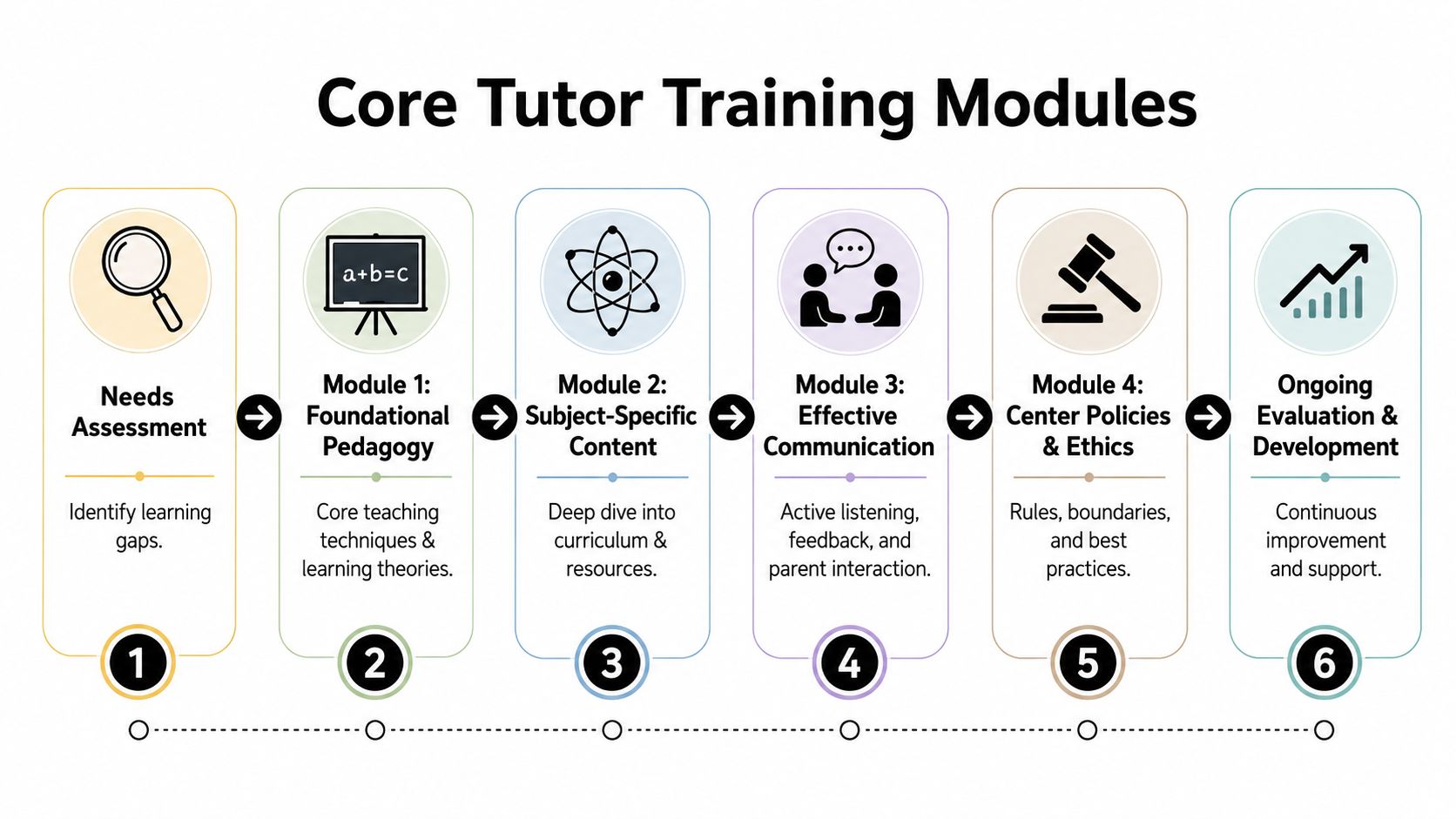
Strong training modules do two jobs at once. They protect teaching quality, and they make your center more attractive to serious candidates. Tutors who want a real career path pay attention to whether your program looks like casual onboarding or a Tutor-to-Teacher Pipeline. The second option attracts better applicants.
Start with a needs assessment
Every tutor should complete the core modules, but they should not all enter at the same point or move at the same speed.
A short intake assessment gives you a cleaner starting point:
- Teaching background: One-to-one, small group, online, in-person, or no live teaching experience yet.
- Subject readiness: Current confidence by subject, level, age group, or exam format.
- Instructional judgment: Ability to explain a concept, check understanding, and adjust when a student is lost.
- Operational reliability: Attendance habits, note quality, communication discipline, and willingness to follow process.
This first screen helps you separate three common cases. The first is the university high achiever who knows the content but has never taught. The second is the experienced classroom teacher who needs to adapt to shorter sessions and parent-facing updates. The third is the tutor who interviews well but struggles to stay consistent once systems and documentation are involved.
Build six modules every tutor must pass
Use short, practical modules tied to the work tutors will do in your center each day. Skip long theory sessions unless they change behavior on the floor.
- Module 1, Lesson structure and student diagnosis: Tutors learn how to open a lesson, spot the student's actual gap, set one or two outcomes, and close with a usable recap.
- Module 2, Content delivery by subject and level: Tutors practice the misconceptions, worked examples, and correction methods your students need most often.
- Module 3, Student engagement and behavior handling: Tutors learn how to regain attention, pace a tired student, and keep a mixed-ability session moving without losing control.
- Module 4, Parent communication and expectation setting: Tutors practice progress updates, missed homework conversations, and language that stays honest without sounding vague.
- Module 5, Systems, notes, and center workflow: Tutors record attendance, write lesson notes, flag concerns, and complete follow-up tasks accurately and on time.
- Module 6, Observation, feedback, and reteach: Tutors deliver a short lesson, receive corrections, then teach the same concept again at a higher standard.
If you are standardizing tutoring lessons, this module structure becomes more important. Standardization gives managers a reliable baseline, while tutors still have room to adapt to the student in front of them.
Here's a useful visual reference for how to think about module flow:
Put real center scenarios inside each module
Training fails when the materials sound polished but do not match the shift tutors will work. Good modules answer practical questions fast.
What should the tutor do if a student arrives ten minutes late, has not done homework, and the parent asks whether they are improving?
Build your materials around scenarios like that:
- Lesson opening scripts: Short prompts tutors can use without sounding robotic.
- Error libraries: Common mistakes by topic, level, and exam type.
- Model lesson notes: Clear examples of weak notes, acceptable notes, and notes a manager would praise.
- Parent update templates: Short written and verbal formats for progress, concerns, and next steps.
- Escalation cases: Safeguarding issues, repeated no-shows, emotional shutdowns, and academic concerns that need manager review.
The training documents that age best are rarely impressive. They are checklists, examples, scorecards, and model responses tutors can use under time pressure.
Include readiness for diverse learners
A tutor can know the subject and still lose the student.
The Stanford National Student Support Accelerator toolkit advises programs to train tutors on self-awareness, bias, and the program's teaching practices. In a commercial center, that shows up in small moments. A tutor interprets silence correctly, avoids writing off a hesitant student, and adjusts examples so the student feels included rather than judged.
This is also where your Tutor-to-Teacher Pipeline gets stronger. Career-minded candidates want evidence that your center develops teaching judgment, not just content delivery. That makes recruitment easier, especially when you are hiring tutors who could also choose schools, edtech companies, or freelance work.
Score each module before tutors touch a full schedule
Completion is not enough. Tutors should pass each module against a visible standard.
I recommend scoring three things:
- Accuracy: Did they teach the content correctly?
- Execution: Did they manage time, questioning, notes, and communication properly?
- Judgment: Did they know when to adapt, and when to escalate?
For centers that want a tighter feedback loop, it helps to borrow ideas from sports coaching on how to measure coaching effectiveness. The principle is simple. If you cannot define what better performance looks like, your training team cannot improve it consistently.
That scoring step keeps training from turning into a box-ticking exercise. It also gives ambitious tutors a clearer path forward. They can see what separates a new hire from a lead tutor, and eventually from a classroom teacher or academic manager.
Turning Training into High-Quality Teaching
Tuesday at 4:30 p.m. is where weak training gets exposed. Two students arrive late, one parent wants an update before leaving, the next tutor is waiting for the room, and a new hire has to keep the lesson on track without losing control of the session. That moment decides whether your training program produced a tutor who can teach.
Centers that handle this well treat the handoff from training to live teaching as a managed stage, not a hopeful guess. I use three controls: certification, supervised teaching, and short feedback cycles.
Certify tutors by subject and level
“Approved to teach” is too vague to run a center on. Tutors need approval tied to the work they can do well right now. A tutor may be ready for Grade 5 math interventions, still need support with Algebra II, and have no business taking a high-stakes exam prep student yet.
A workable certification process usually includes:
- Mock lesson review: The tutor teaches a short lesson to a manager or lead tutor.
- Observation criteria: Clarity, pacing, error correction, checks for understanding, professionalism.
- Scope approval: Specific subjects, age groups, levels, and online or in-person delivery.
- Probationary teaching period: A limited caseload until performance is consistent under normal scheduling pressure.
That level of specificity protects student outcomes and saves managers from subjective arguments about hours, promotions, and difficult class assignments.
It also strengthens the Tutor-to-Teacher Pipeline. Strong candidates want to know what growth looks like. A subject-based certification system shows them how they move from new hire, to trusted tutor, to lead instructor, and eventually into teacher or academic management roles.
Coaching keeps good teaching from slipping
The first ten live lessons tell you more than onboarding ever will. Some tutors connect quickly with students but lose pacing. Others know the content but struggle to correct errors without killing confidence. If nobody watches for those patterns, small issues become parent complaints, stalled renewals, and avoidable tutor turnover.
Coaching needs to be light enough to run every week and structured enough to be useful. The guide on how to measure coaching effectiveness is a good reference for building that structure, especially if your center wants clearer definitions of what improvement looks like across observations.
In practice, I recommend one focus area per review. Fix pacing. Fix questioning. Fix transitions. Do not hand a tutor eight pieces of feedback after one lesson and expect any of it to stick.
Build feedback loops tutors trust
Tutors improve faster when feedback feels specific, fair, and tied to real lessons. They shut down when every comment sounds personal or inconsistent.
Use a simple review loop:
- Student and parent comments: Short check-ins after the first few lessons.
- Peer observation: One senior tutor reviews one teaching skill at a time.
- Manager scorecard: A quick record tied to visible behaviors in session.
- Tutor reflection: What felt strong, where they got stuck, what support they need next.
Keep that record in the same operational system you use for scheduling, notes, and staff management. Centers that understand how tutoring centers manage operations as one connected workflow make better staffing decisions because training history is visible when assigning students, reviewing performance, and deciding who is ready for tougher cases.
That makes promotions, pay reviews, and schedule decisions far more defensible. It also gives ambitious tutors something many centers fail to offer: a visible path from part-time tutoring into serious teaching work.
How to Integrate Training with Center Operations
A training program only proves its value when it affects scheduling, payroll, assignment quality, and renewals. If training lives in a folder while operations run somewhere else, managers still have to remember who is approved for what, who deserves a higher rate, and who shouldn't teach advanced students yet.
That's where most centers hit a ceiling.
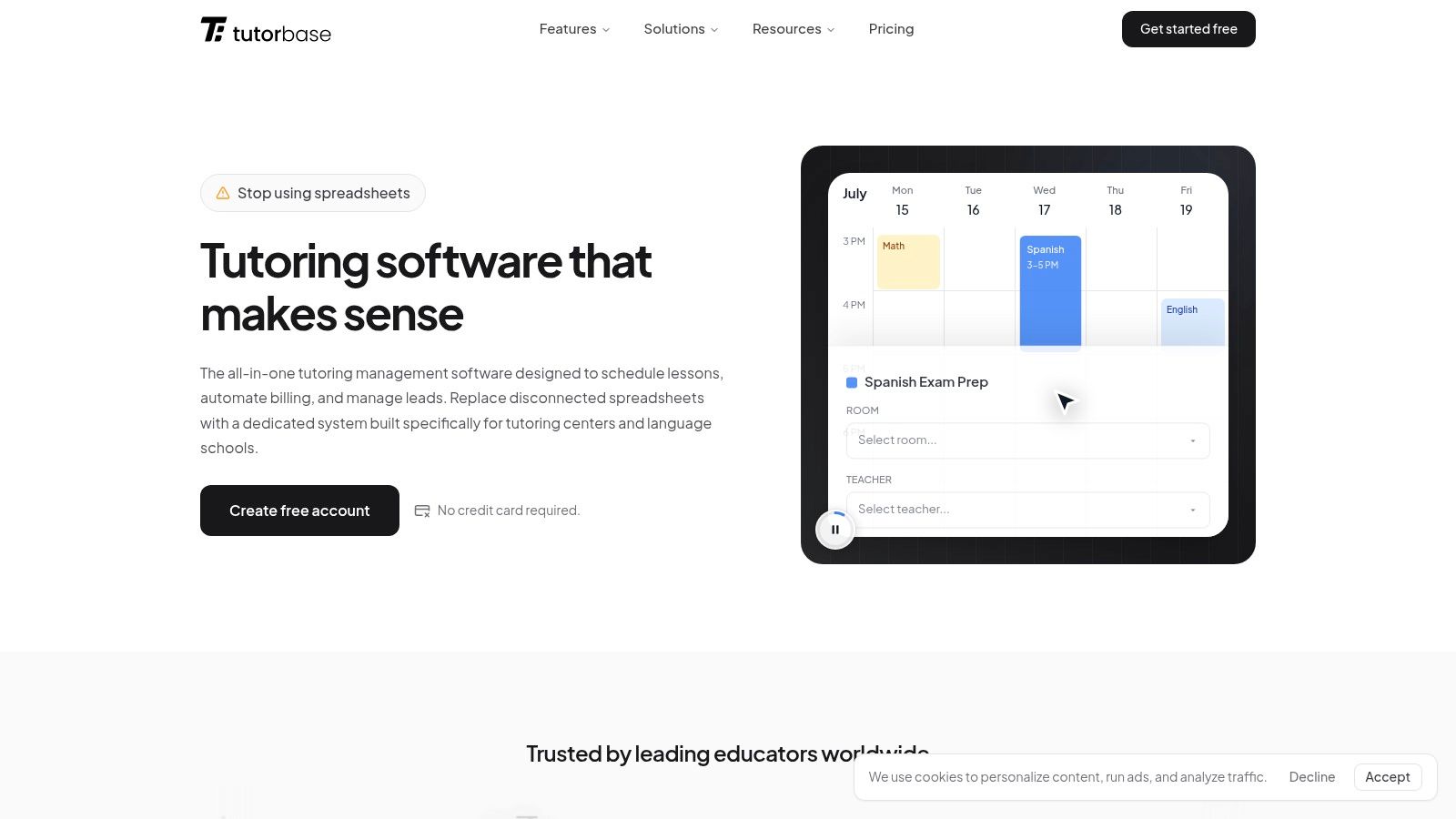
Connect certification to scheduling and pay
In a healthy operation, tutor status should affect real decisions automatically. A probationary tutor shouldn't get booked into your hardest retention-risk cases. A senior tutor with subject specialization should qualify for more advanced assignments or different pay rules.
This is why operators eventually have to think about how tutoring centers manage operations as one connected system, not separate tools for calendars, payroll, and notes.
Here's a simple example of how that plays out:
| Tutor status | Booking rule | Payroll logic | Management purpose |
|---|---|---|---|
| Probationary | Introductory students and lower-risk classes only | Entry rate | Protects quality during ramp-up |
| Certified | Full standard schedule in approved subjects and levels | Standard rate | Expands capacity safely |
| Senior or specialist | Advanced levels, parent-sensitive cases, mentor duties | Premium or blended rate | Rewards depth and supports team quality |
Operational visibility changes training from cost to asset
Once training status sits inside the same operational workflow, you can answer questions that matter:
- Tutor utilization: Are your strongest tutors underused?
- Renewal rates by tutor: Which tutors keep families longest?
- Student progress patterns: Which tutor-level combinations work best?
- Branch consistency: Are some locations certifying too loosely?
- Workload balance: Are high-performing tutors carrying too much of the difficult work?
Without centralized visibility, these become guesswork. With it, you can see whether your tutor training programs are improving client outcomes and reducing managerial friction.
Reduce admin without losing control
Centers often worry that tighter systems will make the teaching side feel rigid. In practice, the opposite happens. Tutors get more freedom inside lessons when the operational basics are clean.
The back-office side matters here too. Tutorbase is AI-powered tutoring management software that replaces Teachworks, TutorCruncher, TutorBird, and spreadsheet-based operations. It consolidates scheduling, billing, payroll, room management, and student tracking into one platform for tutoring centers and language schools with 5 to 100+ teachers across 1 to 10+ branches, including K-12 tutoring, language schools, test prep, music schools, and after-school programs.
Its feature set covers the operational work that usually gets disconnected from training:
- Scheduling tools: Find Slot for teacher-room-time combinations, Find Spot for open seats in existing classes, recurring lessons, and conflict detection
- Locations and rooms: Multi-branch management, room capacity, floor, features, fees, and room availability
- Curriculum structure: Subjects, levels, and services across in-person, online, or hybrid delivery
- Billing and payments: Auto-generated invoices from attendance, prepaid credits, packages, Stripe, bank transfer, cash, and FPS
- Teacher payroll: Per-hour, per-lesson, per-student, revenue share, base plus variable, overtime, and contractor self-billing invoices
- CRM and communication: Website forms, WhatsApp widget, walk-ins, pipeline tracking, reminders, and notifications
That operational integration is what turns a training program from a manual management burden into something you can scale.
Beyond Lessons The Strategic Value of Your Program
A candidate is comparing two tutoring jobs at 10 p.m. after class. One center offers flexible hours and decent pay. The other shows a clear path from tutor to lead instructor, mentor, and classroom teacher. Better applicants notice the difference fast.
That is why strong centers treat tutor training as part of recruitment, not just compliance. A well-run program signals standards, coaching, and upward movement. You attract candidates who want to build teaching skill, stay longer, and take feedback seriously.
I have seen this play out in hiring. Candidates with stronger academic backgrounds and better judgment rarely ask only about hourly rate. They ask who coaches them, how they get certified on new subjects, and whether there is a path into more responsibility. If your answer is organized and credible, you win people that weaker centers never even reach.
This is the Tutor-to-Teacher Pipeline in practice. Your training program becomes a talent filter and a talent magnet at the same time.
That shift changes staffing economics. A center that develops tutors internally can fill senior instructional roles faster, reduce bad-fit hiring, and promote from a known bench instead of restarting the hiring cycle every term. You also get better retention because people can see what the next 6 to 18 months might look like if they perform well.
The internal ladder needs to be real, not decorative. A practical version looks like this: new tutor, certified tutor, senior tutor, mentor, then academic lead or classroom teacher. Each step should come with clearer standards, tighter evaluation, and a pay structure that matches added responsibility. If your systems support how to pay tutors automatically, those role changes are easier to administer without creating payroll disputes or manual exceptions every month.
There is a trade-off. Building a program that attracts career-minded tutors takes more work than posting for part-time help and filling gaps fast. You need written standards, coaching time, and managers who can assess teaching quality consistently. But the payoff is better than a short-term staffing patch. You build a reputation that brings stronger applicants to you.
That reputation compounds locally. University students tell each other which centers develop staff effectively. Former tutors refer friends. Parents notice lower turnover and more consistent teaching. Over time, training stops being a cost center and starts functioning like part of your recruiting engine.
A training program should reduce mistakes in the classroom. It should also help you hire better people before they ever teach their first student.
FAQ
What is a tutor training program
A tutor training program is the operating system behind consistent teaching. It shows tutors how to run a lesson, document what happened, communicate with families, and meet the standards your center promises every parent.
How long should tutor training take
Longer than a single onboarding shift, shorter than a semester-long course. In practice, strong programs usually need enough initial training to cover lesson flow, behavior management, documentation, and at least one observed practice lesson, then regular coaching once tutors start teaching real students.
Why do tutor training programs fail
They fail when the owner treats training like a one-time orientation packet. The common breakdown is predictable: no clear teaching standard, no certification gate, no live observation, and no follow-up after week one. Tutors get thrown into sessions too early, managers correct problems too late, and parents feel the inconsistency fast.
How do I know if a tutor is ready to teach independently
Do not rely on instinct. Use a simple gate: content check, mock lesson, observation rubric, and a short probation period with review. If a tutor cannot explain a concept clearly, manage time, and write usable lesson notes under pressure, that tutor is not ready yet.
Should experienced tutors still go through training
Yes. Experience helps, but it does not create alignment by itself. A tutor who worked somewhere else may still miss your pacing, your parent communication standard, or your note-taking requirements. Good training gets everyone teaching the same way, which matters even more than raw experience in a multi-tutor center.
How can training improve tutor retention
People stay longer when expectations are clear and support continues after hiring. Tutors leave faster when every shift feels improvised and feedback only shows up after a parent complaint. Centers that coach well usually keep more of their reliable tutors because the job feels structured, fair, and worth getting better at.
Can tutor training help with hiring
Yes, many centers undersell themselves on this point. A visible training program signals that the role leads somewhere. Career-minded applicants pay attention to that. If your center can show a real path from new tutor to senior tutor, mentor, or classroom teacher, you attract stronger candidates than a center offering only scattered part-time hours. That is the Tutor-to-Teacher Pipeline in practice.
What software helps manage tutor training at scale
Use software that tracks tutor qualifications, session notes, schedules, payroll status, and observations in one place. Once a center reaches multiple grade levels, multiple branches, or more than a handful of tutors, spreadsheets start causing missed certifications, pay disputes, and preventable scheduling mistakes.


