


Figuring out what to charge for tutoring can feel like a shot in the dark, but there are solid benchmarks to guide you. For private, one-on-one sessions in 2026, most rates fall somewhere between $40 and $85 per hour. This guide breaks down the factors that influence your pricing and shows you how to set rates that ensure your tutoring center is profitable.
But as a tutoring center owner, simply picking a number from a national average won’t cut it. Your pricing has to do more than just sound right—it needs to cover your costs, reflect the expertise you offer, and make sense for your local market. Profitability isn't about chasing averages; it's about mastering the variables.
What Are the Average Tutoring Rates in 2026?
Let's start with the big picture. The format of your tutoring—whether it's online, in-person, or in a group—is one of the biggest factors that will shape your pricing. It directly impacts your overhead and the perceived value for the customer.
This quick snapshot shows how the numbers typically break down.
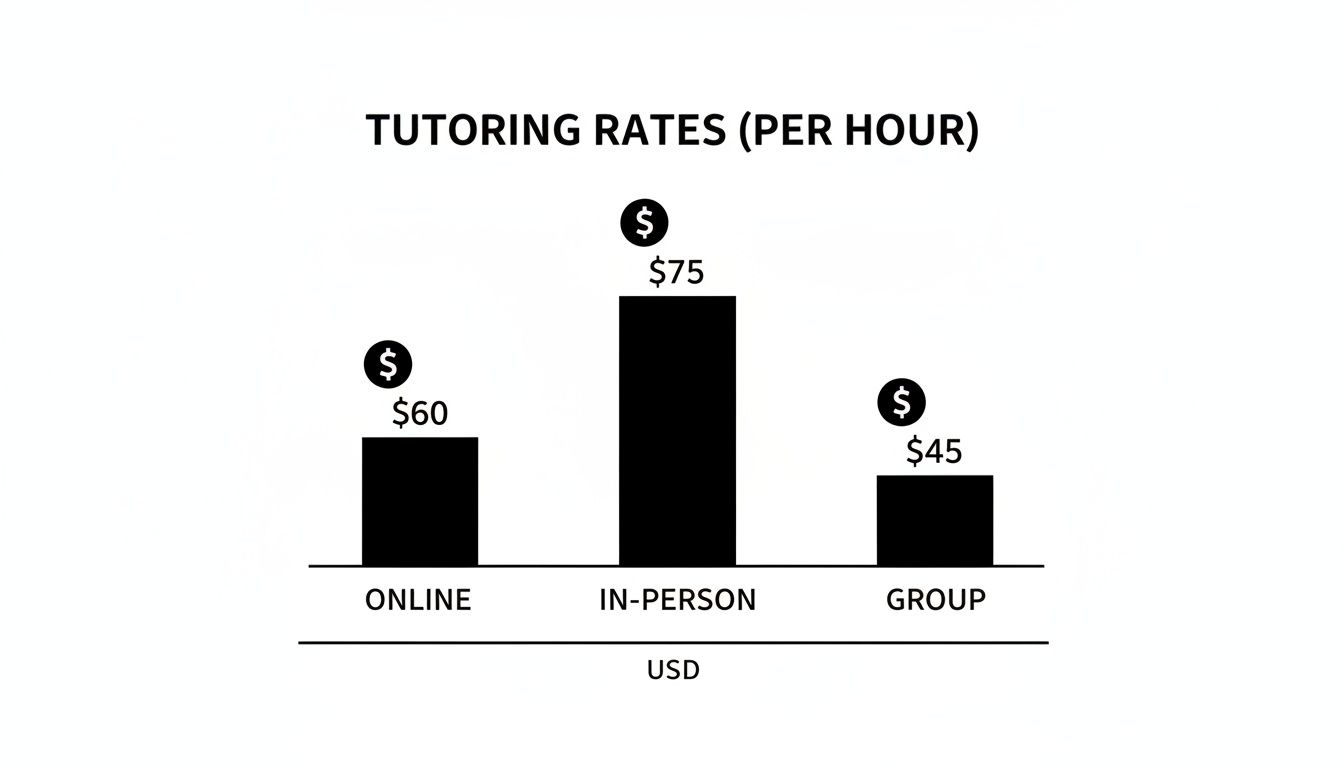
It’s no surprise that in-person tutoring often brings in the highest hourly rate, as it comes with more overhead. On the flip side, group sessions are a more budget-friendly option for families, allowing you to serve more students at once.
A Snapshot of Industry Benchmarks
To help you find your footing, here’s a look at some common rate benchmarks across different subjects and levels. Think of these as a starting point for your own pricing strategy. Highly specialized services, like test prep for the SAT or advanced language exams, can easily command rates well above these estimates.
To give you a clearer picture of the market, the table below breaks down benchmark hourly rates for private one-on-one tutoring.
Estimated Average Tutoring Rates in 2026 (Per Hour)
This table provides benchmark hourly rates for private one-on-one tutoring across different categories. Rates can vary significantly based on tutor experience, location-specific cost of living, and subject complexity.
| Category | Subject or Level | Online Tutoring Rate | In-Person Tutoring Rate |
|---|---|---|---|
| K-12 Academics | Elementary (Math, Reading) | $40 - $65 | $50 - $75 |
| K-12 Academics | High School (AP/IB) | $55 - $85 | $65 - $100+ |
| Test Prep | SAT/ACT | $60 - $120 | $75 - $150+ |
| Language Learning | Spanish, French, Mandarin | $45 - $70 | $55 - $80 |
These rates help you see where your services fit into the broader tutoring landscape.
The Growing Market for Tutoring Services
The demand for tutoring isn’t just holding steady—it’s exploding. The global private tutoring market was valued at a massive $131.04 billion in 2025 and is on track to hit $142.98 billion in 2026.
That’s a 9.1% compound annual growth rate, driven by everything from rising academic competition to parents wanting to close learning gaps. This boom means that even with more competition, there’s plenty of room for well-organized, high-quality tutoring centers to succeed. The key is to connect your pricing to both market value and your operational costs.
After all, your rates are directly tied to your profitability—just as much as managing your tutors' pay. For a deeper dive on that side of the business, check out our guide on how much tutors get paid. Ultimately, your prices send a message about the quality and value you deliver.
3 Factors That Determine Your Tutoring Rates
Knowing the average tutoring rates is a good starting point, but it won’t tell you what you should charge. To set prices that are both profitable and fair, you need to look at the specific value your tutoring business offers. This is what separates centres that command premium rates from those stuck competing on price alone.

Getting these factors right is the first step toward a pricing strategy that covers your costs, reflects your quality, and attracts the right kind of clients. Let's break down the three main pillars that should shape your prices.
Tutor Qualifications and Experience
The expertise of your tutors is your single biggest asset, and it directly ties to the rates you can justify. A tutor with a Master's degree and a decade of experience teaching AP Calculus is worth more than an undergraduate helping with elementary math.
Your pricing needs to reflect these different levels of expertise. When you're setting rates, think about what a tutor brings to the table:
- Educational Background: Tutors with advanced degrees (Master's, PhD) or specialized certifications can and should command higher prices.
- Years of Experience: A veteran teacher with a proven track record isn't just a tutor; they're a mentor. Their experience offers far more value than a novice.
- Specialized Training: Certifications in specific programs like IB, or for high-stakes tests like the SAT or DELF, are incredibly valuable to parents and should be priced as a premium service.
- Proven Results: Tutors who can point to a history of student score improvements offer a clear return on investment. Parents will pay for that.
This tiered approach ensures you can attract and keep top talent, and it gives parents clear choices based on their budget and needs.
Subject Complexity and Demand
Not all subjects are created equal. Helping a 5th grader with their reading homework is a world away from prepping a student for a university-level organic chemistry exam. The market understands this, and your pricing should, too.
A common mistake is charging a flat hourly rate for every subject. This undervalues your specialized services and can overprice your basic ones, creating an imbalance that hurts your business.
Think about your subjects in three tiers:
- High-Volume, Lower Complexity: Subjects like elementary math and English have broad appeal, but also more competition. These usually set your baseline rates.
- Specialized Academic Subjects: This is where you find AP/IB courses, advanced sciences like physics, and niche foreign languages. They require deeper expertise and justify a higher price point.
- High-Stakes Test Preparation: Think SAT, ACT, IELTS, and other standardized tests that can change a student's future. The high stakes justify premium pricing because parents are investing in a specific, life-altering outcome.
By segmenting your services this way, you can align your prices with the real value and expertise each subject requires.
Lesson Format and Delivery Mode
How you deliver your lessons—one-on-one versus a group, online versus in-person—has a massive impact on both your costs and what parents are willing to pay. Private, in-person tutoring has traditionally been the most expensive option because of the undivided attention and the overhead costs of running a physical location.
- Private vs. Group: One-on-one sessions are your premium, high-touch service. Small group sessions (3-5 students) are a great way to offer a more affordable rate per student while actually increasing your total hourly revenue.
- In-Person vs. Online: In-person tutoring often has a higher price tag to cover things like rent and utilities. Online tutoring can be more cost-effective to run, but don't sell it short—high-quality virtual instruction with great tools and experienced tutors can still command strong rates.
- Hybrid Classes: Managing a mix of in-person and online students in the same session is complex, but it's becoming more popular. Because of the flexibility and technology it offers, you can position this as a premium service.
Choosing Your Ideal Tutoring Pricing Model
Once you’ve figured out your hourly rate, the next step is deciding how you’ll sell your time. The way you package your services is just as critical as the rate itself, and it’s worth looking at various approaches to pricing services to find what fits your business.
Your pricing model has a massive impact on your cash flow, student commitment, and the hours you spend on admin. Most tutoring businesses rely on one of three models: per-hour billing, prepaid packages, or recurring subscriptions. Each one attracts a different type of client and serves a different business goal.
Per-Hour Billing
The simplest model is pay-as-you-go. A family pays for a single lesson after it happens. This offers them total flexibility, which makes it an easy sell for new students who want to try your services without a big upfront payment. But that flexibility is a double-edged sword for your business.
- Pros: It’s easy to understand and a low barrier to entry for new clients.
- Cons: It leads to unpredictable revenue, a lot of admin work chasing individual payments, and a much higher risk of last-minute cancellations.
Because your income isn't guaranteed, forecasting your finances is nearly impossible with this model. It’s best used for one-off trial lessons or drop-in sessions, not as the main engine for your tutoring centre.
Prepaid Packages
Prepaid packages are a huge step up from hourly billing. With this model, clients buy a block of lessons upfront—say, 10 or 20 hours—often at a slight discount compared to your single-session rate. This is a classic win-win: families get better value, and you secure revenue and student commitment from the start.
Think of it as a digital wallet for tutoring. A parent "loads" the wallet by buying a package, and each lesson their child attends draws down the balance. This immediately improves your cash flow and cuts down on the student churn you see with one-off bookings.
Prepaid packages shift the entire client relationship. It moves from a transactional, one-off purchase to one built on commitment. When a family invests in a 20-lesson package, they're investing in a long-term plan with your centre, which leads to better attendance and, ultimately, better results for the student.
This model is a perfect fit for services with a clear goal, like preparing for a final exam or finishing a test prep course. A platform like Tutorbase can automate the whole process by tracking how many sessions are left, sending low-balance alerts to parents, and making renewals simple.
Recurring Subscriptions
For ongoing support, like year-round academic help or language learning, nothing beats the subscription model. Clients pay a flat, recurring fee (usually weekly or monthly) for a set number of lessons. This gives your business the ultimate gift: predictable revenue.
This model is especially powerful as tutoring moves online. The online tutoring market is on track to become an $18.2 billion industry by 2030, with a stunning 14.6% annual growth rate. This trend makes recurring revenue models even more valuable for building a stable business. You can find more on this in a recent market analysis on globenewswire.com.
Subscriptions turn your service into a utility, almost like a gym membership. Tutoring becomes a regular part of a student's routine, which boosts retention by an average of 42%. For a deeper look at these models, check out our comprehensive guide to tutoring pricing models.
How to Calculate Tutoring Rates That Ensure Profitability
Setting profitable rates isn’t guesswork—it's a science. It all starts with knowing exactly what it costs to run your center each month. Before you can even think about profit, you have to find your break-even point: the absolute minimum you need to charge per hour just to cover all your expenses.
To get there, you need a crystal-clear picture of every single cost, both fixed and variable. This isn't just boring accounting; it's the foundation of a business that lasts. Skipping this step is one of the fastest ways to run a tutoring business into the ground.
Tallying Your Fixed and Variable Costs
First, let’s pin down your fixed costs. These are the bills you have to pay every single month, no matter if you teach one lesson or one hundred. They’re the predictable bedrock of your operation.
- Rent or Mortgage: The cost for your physical center or office space.
- Software Subscriptions: What you pay for tools like your tutoring management software, accounting programs, and communication platforms.
- Insurance: Business liability and property insurance are non-negotiable.
- Utilities: Your internet, electricity, and water bills.
- Salaries: The fixed pay for any administrative staff or managers.
Next, you need to track your variable costs. These expenses go up or down depending on how busy you are—think more students, more costs.
- Teacher Payroll: This is almost always your single biggest variable cost. It includes hourly wages, per-lesson fees, or any revenue-sharing deals you have with your tutors.
- Teaching Materials: Costs for workbooks, printing, science kits, and other hands-on supplies.
- Payment Processing Fees: That small percentage services like Stripe or PayPal take from every transaction.
- Marketing & Advertising: Your budget for ads, flyers, and digital campaigns to bring in new families.
Calculating Your Break-Even Rate
Once you’ve got your total monthly costs added up, figure out your total available teaching hours for that month. This number represents your total capacity to generate revenue. With those two figures, the break-even math is refreshingly simple.
Total Monthly Costs / Total Monthly Teaching Hours = Break-Even Rate Per Hour
This is the magic number. It’s the absolute minimum you have to charge for every hour of tutoring just to keep the lights on. Charging below this rate means you are actively losing money on every single lesson. This simple calculation moves you from hoping for a profit to actually engineering one.
From Break-Even to Profitable Pricing
Your break-even rate is your starting line, not your finish line. To build a healthy, growing business, you need to add a profit margin. For most service businesses, a margin between 15% to 30% is a solid target, but this can shift based on your market and goals.
For instance, a brand-new center might start with a lower margin to get those first few students in the door. An established center with a killer reputation for results, on the other hand, can easily command a higher one. This margin is what pays for future growth, covers unexpected costs, and—most importantly—compensates you as the owner. To get a better handle on your numbers, a good freelance rate calculator can be a huge help in guiding your strategy.
A huge factor here is keeping your great tutors. As of 2022, there were about 182,700 tutors in the U.S., but the total number of tutors actually dropped by 6% between 2018 and 2022. This trend is making it harder to find and keep top talent, which gives centers that excel at retention a real competitive edge and justifies stronger pricing.
A Practical Calculation Example
Let's pull this all together with a quick, real-world example. Imagine you’re running a small tutoring center. Here’s what your numbers might look like.
Example Profitability Calculation for a Tutoring Center
Here's a simplified breakdown showing how to calculate a target hourly rate by factoring in all business costs and a desired profit margin.
| Cost Category | Monthly Cost | Calculation Notes |
|---|---|---|
| Total Fixed Costs | $4,000 | Includes rent, software, insurance, etc. |
| Total Variable Costs | $6,000 | Based on 300 teaching hours/month at $20/hr average payroll. |
| Total Monthly Costs | $10,000 | $4,000 (Fixed) + $6,000 (Variable). |
| Total Teaching Hours | 300 hours | 5 teachers working 15 hours/week each. |
| Break-Even Rate | $33.33/hr | $10,000 / 300 hours. |
Based on this, the center must earn at least $33.33 for every single hour of tutoring just to break even.
Now, to actually make a profit, let's add a healthy 25% profit margin. The math is straightforward: $33.33 x 1.25 = $41.66. Rounding that up to a clean $42 per hour gives the center a clear, profitable rate that covers all its costs and fuels future growth.
Automating Your Pricing to Reduce Admin by 60%
Figuring out your pricing models and setting profitable rates is a huge strategic win. But for a growing tutoring centre, the real test is putting it all into practice. Manually tracking different rates, packages, and cancellation policies across messy spreadsheets is an administrative nightmare that invites costly mistakes and eats directly into the profit you worked so hard to build.
This is exactly where tutoring management software closes the gap between strategy and reality. Instead of just knowing your rates, you can enforce them automatically, cutting admin time by as much as 60%. It turns your pricing from a constant, manual headache into a smart, error-free system that just works.
From Manual Chaos to Automated Control
Let's look at the difference between the old way and the new way. Any centre owner juggling multiple pricing tiers on a spreadsheet knows this painful, all-too-familiar process.
The Manual "Before" Scenario:
- An admin gets a booking for "SAT Prep with a senior tutor."
- They hunt through a spreadsheet to find the correct hourly rate for that specific service and tutor level.
- They cross-reference another sheet to see if the student bought a prepaid package or is on a monthly plan.
- At the end of the week, they manually piece together an invoice, triple-checking the rate and lesson count.
- If a student cancels late, the admin has to remember the policy, calculate the fee, and generate another invoice.
This disjointed process isn’t just slow; it’s a breeding ground for revenue leakage. A single slip-up, like charging a standard K-12 rate for a premium SAT prep session, can cost you $50 or more on one lesson alone.
Now, let's see how an automated system handles it.
How Policy Packs Streamline Everything
Modern platforms like Tutorbase use a clever concept called “Policy Packs” to define and automate all your pricing rules. You set up your pricing models once, and the system does the rest. This goes way beyond setting a single rate—it’s about building the complete business logic for your entire operation.
A Policy Pack lets you configure everything:
- Pricing Models: Set up your per-hour, per-lesson, prepaid package, and recurring subscription rates for different services.
- Layered Precedence: Create pricing rules that apply in a specific order. For example, a global rate can be overridden by a location-specific rate, which can be further overridden by a student-specific discount.
- Cancellation Policies: Define your time windows (like within 24 hours), fee percentages (e.g., 50% of the lesson price), and refund rules. The system enforces these automatically whenever a lesson is cancelled.
- Trial Settings: Easily configure free or discounted first lessons that automatically switch to standard pricing after the trial ends.
By automating these rules, you eliminate the mental load and guesswork from your daily operations. The system automatically knows which rate to apply to which lesson, ensuring every single invoice is 100% accurate without any manual data entry.
The Automated "After" Scenario with Tutorbase
With a system like Tutorbase in place, the entire workflow is transformed. When that same "SAT Prep with a senior tutor" lesson gets booked, the platform instantly applies the correct, pre-configured premium rate. No questions asked. The system automatically pulls the right price based on the service, tutor, and student, completely removing the risk of human error.
If the student is on a 10-lesson package, the system automatically deducts one lesson from their balance. If they cancel late, the cancellation fee is applied without a single click from your admin team. This is the level of automation that separates centres that scale smoothly from those stuck in administrative quicksand.
Frequently Asked Questions About Tutoring Rates
Even after you’ve landed on a solid pricing strategy, the day-to-day questions will keep coming. As a tutoring business owner, you'll constantly face practical pricing challenges. This section gives you direct answers to the most common queries we hear, helping you handle the small (and big) pricing decisions with confidence.
How often should I review my tutoring rates?
You should review your rates annually. An annual review lets you account for inflation, rising operational costs (like rent or software), and shifts in your local market. However, you can also adjust prices mid-year if you make significant service improvements, such as adding a high-demand course or hiring an exceptionally qualified tutor.
Should I charge by the hour or offer packages?
The best strategy is to offer both. Hourly rates are great for trial lessons and new clients who aren't ready to commit. Prepaid packages (e.g., a block of 10 lessons) secure your cash flow and encourage student retention. This mix gives clients flexibility while providing your business with financial stability.
How do I communicate a price increase to clients?
Announce the increase with 30 to 60 days' notice. Be direct, thank clients for their loyalty, and briefly explain why the rates are changing (e.g., to cover rising costs and invest in better resources). To soften the impact, allow existing clients to purchase one more package or renew their subscription at the current rate before the new pricing takes effect.
Should my online and in-person rates be different?
Yes, in most cases they should be different. In-person tutoring typically has higher overhead costs like rent and utilities, which justifies a higher rate. However, don't automatically underprice your online services. High-quality online tutoring requires investments in premium software, digital curriculum, and specialized teacher training, which also have significant value.
What is a good profit margin for a tutoring business?
A healthy profit margin for a tutoring center is typically between 15% and 30%. New centers might start at the lower end to attract initial clients, while established centers with strong reputations can command higher margins. This margin is essential for covering unexpected costs, funding growth, and compensating you as the owner.
How can I justify charging premium rates?
You can justify premium rates by highlighting the value you provide. This includes your tutors' advanced qualifications (e.g., Master's degrees, IB certification), a proven track record of student success (like score improvements), specialized curriculum for high-stakes tests (SAT, ACT, DELF), and a superior learning experience, whether online or in-person.
What is the difference between a pricing model and a pricing strategy?
A pricing model is how you charge for your services, such as per-hour, packages, or subscriptions. A pricing strategy is the logic behind the rates you set, considering factors like your costs, your competitors' pricing, the value you offer, and your overall business goals.
How can software help manage my tutoring rates?
Tutoring management software like Tutorbase automates your pricing rules. You can set up different rates for various subjects, teacher levels, and locations. The software then automatically applies the correct price when a lesson is booked, creates accurate invoices, and manages package balances, which can reduce admin time by 60% and eliminate costly billing errors.
Trying to manage all these complex pricing rules manually is a recipe for mistakes and lost revenue. Tutorbase automates your entire pricing strategy—from packages and subscriptions to cancellation policies—so you can stop chasing payments and start building a more profitable center. See how it works by visiting https://tutorbase.com.


