


A lot of parents start looking for reading tutors for 1st graders after a teacher conference, a rough report card, or that sinking moment when homework turns into tears. Tutoring center owners see the same pattern from the other side: urgent inquiries, unclear diagnoses, and families who need answers fast.
The mistake is treating first-grade reading support like generic homework help. It isn't. A strong program depends on the right tutor, a tight screening process, clear lesson structure, and firm operational standards from day one.
What Defines an Effective 1st Grade Reading Tutor
The first thing I look for in a first-grade reading tutor isn't warmth, although that matters. I look for instructional specificity. If a tutor can't tell you exactly what skill they're teaching and why, they usually default to reading aloud, guessing from pictures, or doing random worksheets.
The U.S. National Reading Panel identified five core components for effective early reading instruction: phonemic awareness, phonics, fluency, vocabulary, and reading comprehension. A tutor's effectiveness depends on their ability to diagnose and teach those specific skills, because a child's struggle is often concentrated in one or two areas, not "reading" as a whole, as outlined in this first-grade reading overview from Sylvan Learning.
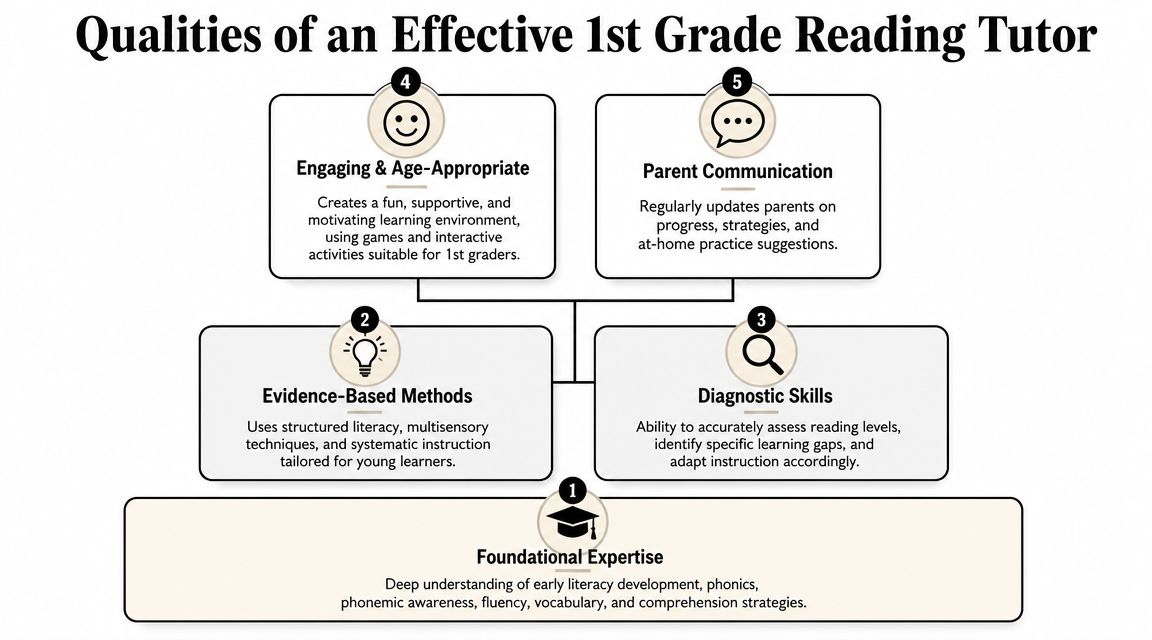
The tutor must know what each reading pillar looks like in practice
A good first-grade tutor should be able to work across all five pillars, but not in a vague way.
- Phonemic awareness means the tutor can work with sounds orally. They can help a child isolate, blend, segment, and manipulate sounds before print gets in the way.
- Phonics means they can explicitly teach letter-sound correspondence, digraphs, and decoding patterns in a planned sequence.
- Fluency means they notice whether the child reads word by word, loses accuracy, or can't maintain phrasing.
- Vocabulary means they don't assume a child knows spoken meanings just because they can decode a word.
- Comprehension means they can tell the difference between a language problem and a decoding problem.
That distinction matters. A child who can't read "ship" accurately doesn't need more story discussion first. That child needs direct decoding instruction.
Specialist thinking beats generic tutoring
When I review applications, I want evidence that the tutor understands structured literacy and can explain how they pinpoint a reading gap. "I love working with kids" is fine. "I check whether the student is missing short vowels, consonant digraphs, or blending automaticity" is what gets my attention.
Hiring rule: If a candidate describes first-grade reading support as "helping kids enjoy books," they're describing only one slice of the job.
For tutoring centers, this affects your hiring rubric and training checklist. For parents, it shapes the questions you ask before booking a trial.
A useful place to uncover key teaching skills is in how a tutor explains instruction, not just in what credentials they list.
What separates strong tutors from weak hires
Here's the operational difference I see most often:
| Tutor type | What they do |
|---|---|
| Strong hire | Assesses first, names the missing skill, teaches it directly, and tracks whether the child can apply it |
| Weak hire | Brings general reading games, listens to the child read, and gives praise without a clear corrective plan |
The best reading tutors for 1st graders are specialists in early decoding and language development. They don't just keep a child busy for an hour. They run targeted intervention.
Finding and Screening Potential Reading Tutors
Families often lose time by starting with availability instead of fit. Centers lose money by doing the same thing. The fastest way to make a bad hire is to fill a schedule slot before you define your essential requirements.
The urgency is real. A child who isn't reading at grade level by the end of first grade has a nearly 90% probability of still being behind in fourth grade, according to this early literacy summary from Ignite Reading. That is why screening needs to be rigorous, not casual.
Where to source candidates
Parents and centers should source differently.
For parents, the most useful pools are:
- Specialized tutor marketplaces where profiles mention early literacy, phonics, or structured reading support
- Local teacher networks including retired elementary teachers and reading interventionists
- University education programs where supervised literacy tutors may be available
- School referrals when a classroom teacher can point you toward someone with actual first-grade reading experience
For tutoring centers, the stronger channels are:
- Education job boards with skills-based postings, not generic tutor ads
- Local colleges with elementary education or special education pipelines
- Referral systems from your current staff, but only if you use a structured referral screen
- Your own content funnel if you already publish on literacy and attract specialist applicants
If you're comparing marketplaces, this guide to the best reading tutor platforms helps narrow where to look.
What to screen before the interview
Resume screening should be fast and ruthless. I don't mean harsh. I mean efficient.
Look for signs that the tutor has worked with:
- Early elementary students, not just older readers
- Beginning decoding instruction, not only homework help
- Skill-based intervention, where the tutor can describe what they assessed and taught
- Parent communication, because first-grade tutoring fails when no one knows what happened in the lesson
Watch for red flags too:
- Vague experience such as "helped students improve reading"
- Book-heavy language with no mention of phonics, sound work, or assessment
- Tutor profiles that cover every subject and every age, which often means no real specialization
- No examples of progress monitoring
Most weak candidates sound good until you ask what they do in the first ten minutes of a session.
Screening questions that save time
Before scheduling a full interview, send a short written screen. Ask:
- What do you assess first with a struggling first grader?
- How do you tell whether the problem is decoding or comprehension?
- What would you teach before asking a child to read connected text?
- How do you update parents or supervisors on progress?
Strong candidates answer concretely. Weak ones stay broad, sentimental, or academic.
How to Interview and Assess Tutor Candidates
A polished interview can hide a weak tutor. That happens all the time. Some candidates know the language of literacy instruction but fall apart the moment you give them a real teaching problem.
That's why I always separate the process into two parts: conversation and demonstration.
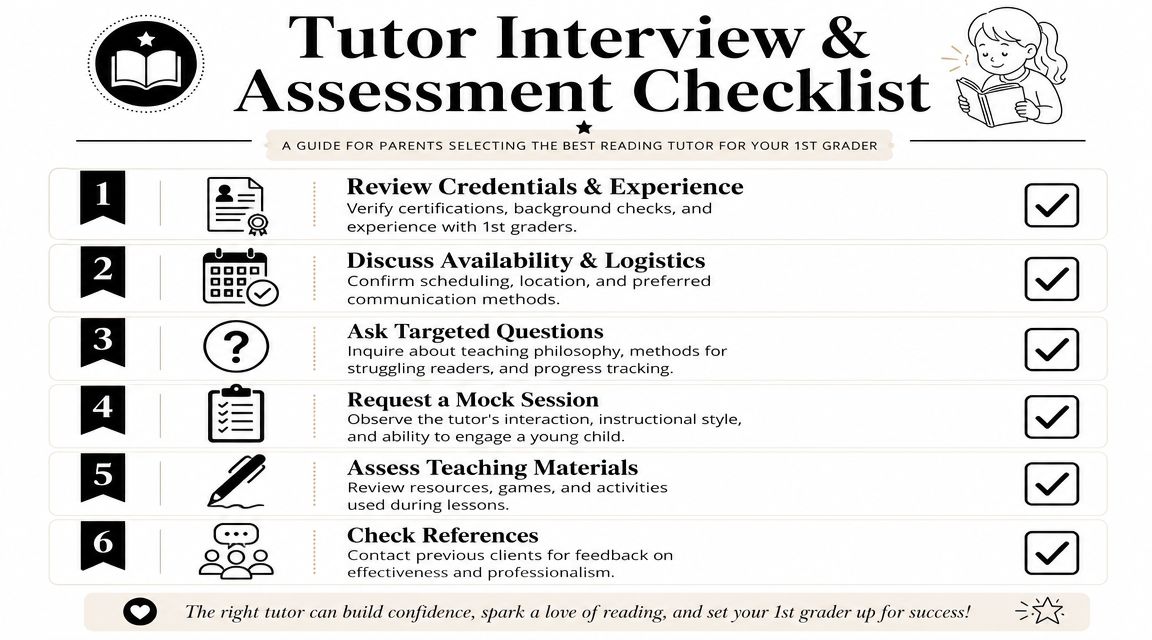
Ask questions that reveal decision-making
You don't need fancy interview questions. You need questions that force the tutor to think aloud.
Ask things like:
- A student guesses words from pictures. What do you do next?
- A child knows letter names but can't blend sounds. How would you teach that?
- A first grader reads individual words but falls apart in a simple passage. What would you check?
- What does a bad lesson look like to you?
- How do you handle a child who avoids hard tasks but enjoys games?
Listen for sequence, not charisma. The best candidates explain a process. They don't hide behind buzzwords.
Use a short mock teaching task
I recommend one practical task for every candidate.
Give them a simple prompt such as: "Teach a first grader the difference between sh and ch," or "A child reads 'slip' as 'sip.' Show how you'd respond." Then ask them to run a short mock lesson.
A good response usually includes:
- A quick check for what the student already knows
- Clear modeling
- Guided practice with correction
- A move into words or short connected text
- A way to confirm whether the child learned the skill
A weak response usually turns into chatting, overexplaining, or reading a book and hoping the skill appears naturally.
Operational test: If the tutor can't teach one small phonics concept clearly in a mock session, they won't handle a real struggling reader under pressure.
This short video is also useful for thinking about what to observe in an early reading lesson:
Score the lesson, not the personality
Use a simple scorecard. I look at five items:
| Assessment area | What to look for |
|---|---|
| Accuracy of instruction | Did the tutor teach the target skill correctly |
| Diagnostic awareness | Did they check for the source of the error |
| Pacing | Did they move briskly without rushing |
| Correction quality | Did they fix errors clearly and immediately |
| Engagement | Did they keep the child active, not passive |
A candidate can be kind and still be ineffective. For reading tutors for 1st graders, kindness is the baseline. Skill is the differentiator.
References should confirm process
When you check references, don't ask, "Was she great?" Ask:
- What did progress reporting look like?
- Did the tutor have a consistent lesson structure?
- How did they respond when the student stalled?
- Were sessions focused on specific skills or more general reading time?
That final question tells you a lot.
Structuring Effective Lessons and Tracking Progress
Once you've hired the tutor, the next failure point is inconsistency. A lot of first-grade reading programs drift because every tutor teaches differently, every note looks different, and nobody can tell whether the student is progressing or just attending.
The most useful model is a diagnostic-to-instruction loop. Expert guidance for first-grade tutoring recommends starting with a quick assessment, teaching one new skill, using guided practice, and ending with application. A typical session runs 45 to 60 minutes, as described in this lesson structure guide for first graders.
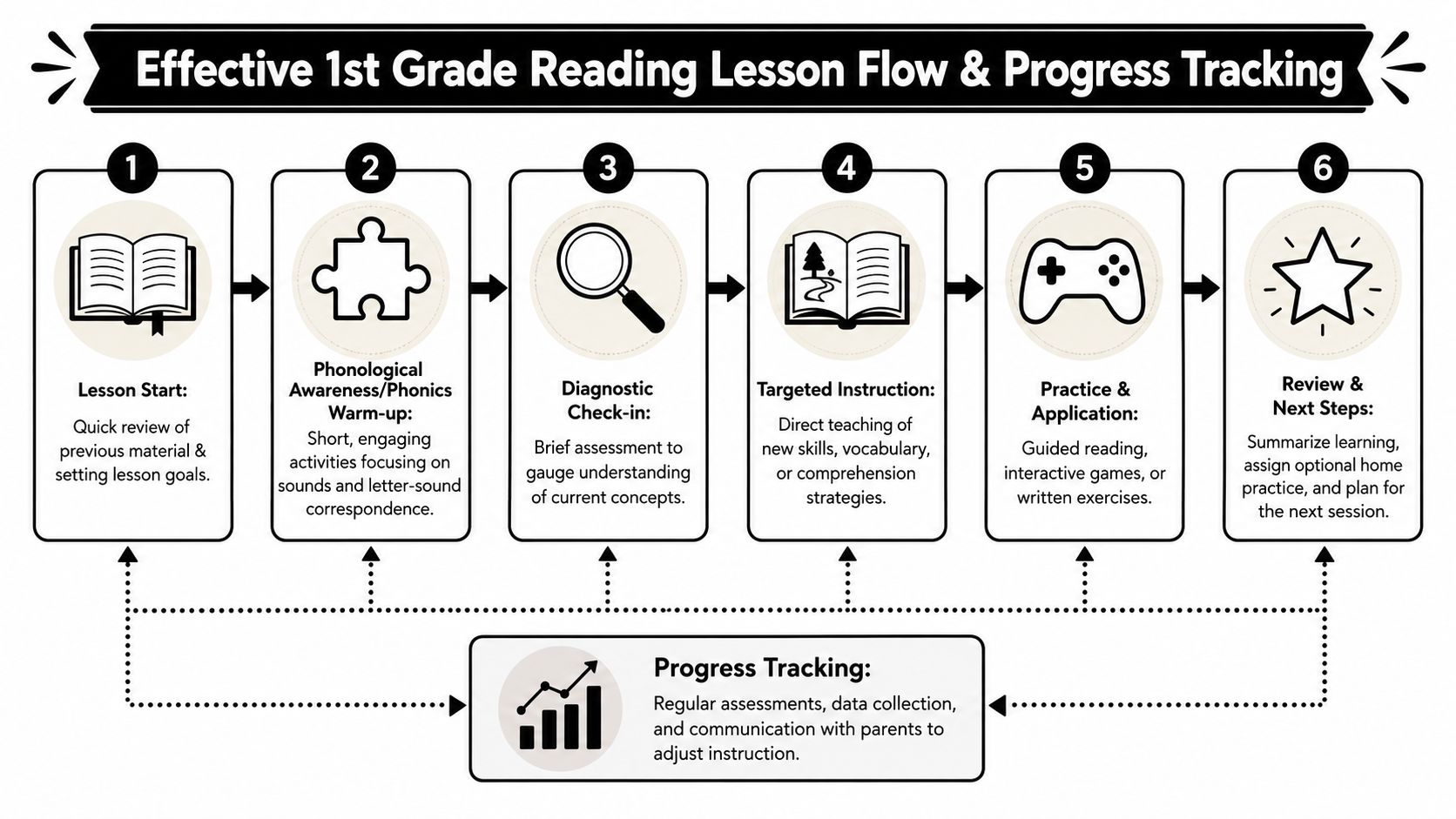
A lesson flow that actually works
A solid session for a first grader doesn't need to be complicated. It does need to be deliberate.
Brief review
Revisit the prior skill. Check whether yesterday's learning stuck.Warm-up
Use short sound work or letter-sound practice to get the child producing language quickly.Quick diagnostic check
Probe the target skill before teaching. This prevents unnecessary reteaching.Explicit teaching
Introduce one new concept only. Keep the explanation concrete and brief.Guided practice and transfer
Move from isolated sounds or words into word sorts, controlled text, or short connected reading.Wrap-up and note-taking
Record what the student did independently, what still needed prompting, and what comes next.
If you want more classroom-facing examples, these practical early literacy strategies for tutors are useful for training newer staff.
What should progress notes include
Parents shouldn't accept "good session" as an update. Centers shouldn't accept it from staff either.
Every lesson note should answer:
- What exact skill was taught
- What the student could do independently
- What still required prompting
- What error patterns appeared
- What home practice, if any, was assigned
- What the next lesson will target
A progress note should let another trained tutor step in tomorrow and know exactly where to start.
That standard matters operationally. If a tutor gets sick, leaves, or hands off the student, your program shouldn't reset from scratch.
Tracking progress without drowning in admin
You don't need a giant data system for one child. But you do need consistency across students if you run a center.
A practical tracking rhythm looks like this:
- After each session record the target skill, accuracy patterns, and next step
- Every few sessions review whether the child is generalizing the skill into connected text
- At parent check-ins summarize the reading behaviors that changed, not just whether the child "worked hard"
For centers managing multiple tutors, a tool like Tutorbase can centralize scheduling, teacher notes, attendance, billing, and student tracking in one place, which helps when you need lesson visibility across staff rather than scattered notes in messages and spreadsheets.
What doesn't work is random activity rotation. If one lesson focuses on sight words, the next on a storybook, and the next on a game with no skill progression, you won't know what's driving improvement.
Setting Rates, Contracts, and Spotting Red Flags
The business side of tutoring shapes outcomes more than people admit. When pricing is unclear, cancellations are loose, and expectations stay verbal, weak tutoring can drag on far too long.
Average posted rates on platforms like Care.com in a major city such as Los Angeles hover around $27 per hour, based on this access and pricing reference. Treat that as a market benchmark, not a universal rule. Rates vary by format, experience, location, and whether the service includes assessment and parent reporting.

What every agreement should cover
A simple tutoring agreement should spell out:
- Scheduling terms, including session length and start date
- Cancellation rules, especially for same-day changes
- Payment timing, method, and whether materials are included
- Progress communication, so nobody wonders when updates arrive
- Exit terms, including how either side can end services
For centers, I also recommend naming who owns the lesson notes, who communicates with the parent, and how substitutions are handled.
Red flags in the first few weeks
These problems usually show up early:
- No plan. The tutor can't explain what skill they're targeting.
- No records. Every update sounds like a personality report.
- Too much entertainment. Games dominate, but skill practice stays thin.
- Poor parent communication. Questions go unanswered or updates stay vague.
- Constant content switching. The tutor chases whatever seems fun that day.
If you see several of those at once, don't wait for a miracle turnaround.
Frequently Asked Questions About 1st Grade Tutoring
How do I know whether my child needs a reading tutor or just more practice?
Look at the pattern, not just the homework load. If the child avoids reading, guesses at words, can't apply phonics skills consistently, or stalls on basic decoding, targeted tutoring usually makes more sense than asking for more reading time at home.
Should a first-grade tutor focus more on phonics or comprehension?
That depends on the actual breakdown. A child who can't decode efficiently needs direct work on foundational skills first. A child who reads words accurately but can't explain meaning needs a different plan. Good tutors don't pick one philosophy and apply it to every child.
What if tutoring doesn't seem to help?
Change the question from "Is tutoring happening?" to "What exactly is the tutor targeting, and how is progress being checked?" Lack of improvement often points to poor diagnosis, weak lesson structure, or a mismatch between the child's need and the intervention.
Can attention problems affect whether reading tutoring works?
Yes. A key study found that first graders with poor early reading skills without attention problems made very large gains from tutoring, with an adjusted difference of 0.81 standard deviations, while poor early readers with attention problems showed no measurable benefit from that same tutoring approach in that analysis, according to the longitudinal reading tutoring study published at PubMed Central.
That doesn't mean tutoring never helps a child with attention challenges. It means standard reading intervention may not be enough on its own. The tutor may need shorter task cycles, stronger behavior supports, closer coordination with school staff, or a different service model altogether.
If decoding is weak and attention regulation is also weak, treat that as a dual-support problem, not a single-subject problem.
Is online tutoring appropriate for 1st graders?
Sometimes, yes. It works best when the tutor is highly structured, keeps materials simple, and can maintain active participation. It works poorly when sessions become passive screen time.
How long should I keep a tutor before deciding if it's a fit?
Don't judge after one imperfect lesson. Do expect a clear instructional plan quickly. Within the first stretch of sessions, you should be able to identify the target skill, the lesson routine, and the communication standard. If all three are blurry, the fit probably isn't right.
If you run a tutoring center and want cleaner operations around scheduling, notes, billing, payroll, and student tracking, Tutorbase is one option to review. It was built for tutoring businesses that need stronger systems behind the teaching, not more spreadsheet work.


