


If you run a tutoring center, you already know the pattern. One tutor is excellent with students but never submits notes on time. Another follows procedure but struggles to keep lessons engaging. A third teaches well in person and falls apart in hybrid sessions because they can't manage the tech, the pacing, and the parent communication at once.
That mix creates more than annoyance. It affects student outcomes, parent trust, billing accuracy, staff morale, and how much time you spend cleaning up preventable mistakes. Without a real system, quality becomes a lottery.
That's why training for tutors can't sit in the “nice to have” bucket. It has to function as part of your operating system. A 2024 evidence review on high-impact tutoring found that programs with clear structures and consistent delivery produce stronger outcomes, while weaker implementations dilute impact. That matches what most operators feel in practice. The hard part isn't finding smart tutors. The hard part is coaching them to deliver consistently, follow process, and improve without constant supervision.
If you want a center that scales without becoming chaotic, you need tutor training that covers both instruction and operations. That means onboarding, lesson routines, tech use, observation, feedback, and performance measurement working together. If you're building that kind of system, Tutorbase for tutoring centers sits in the category of tools designed to support the scheduling, tracking, and operational side of delivery.
Introduction
Most tutoring centers don't fail because their tutors lack subject knowledge. They struggle because nobody translated “good tutoring” into repeatable behavior.
A strong training system gives every tutor the same baseline. It tells them how to prepare, how to open a session, how to check understanding, how to document progress, how to use your systems, and what to do when a student shows up tired, late, or completely unprepared. That kind of clarity protects both quality and sanity.
What training for tutors needs to solve
Generic tutor advice usually focuses on rapport, encouragement, and subject expertise. Those matter, but they don't solve the operational mess that appears once you have multiple tutors, multiple branches, mixed delivery modes, and parents expecting updates.
Your training program should answer questions like these:
- Lesson consistency: What must happen in every lesson, regardless of subject?
- Documentation: When does the tutor record notes, attendance, and next steps?
- Escalation: What happens if a student stops attending, struggles emotionally, or needs a level change?
- System behavior: Where does the tutor update availability, check bookings, and confirm lesson status?
Operator mindset: If a tutor has to guess, your process is incomplete.
What good centers do differently
The best-run centers don't rely on charisma. They build routines. New tutors learn the same standards. Managers observe the same few behaviors. Coaches correct drift early. Admin teams don't chase missing information because the process makes it easier to do the right thing than the wrong thing.
That's the shift to make. Don't train tutors to be individually impressive. Train them to be reliably effective inside your system.
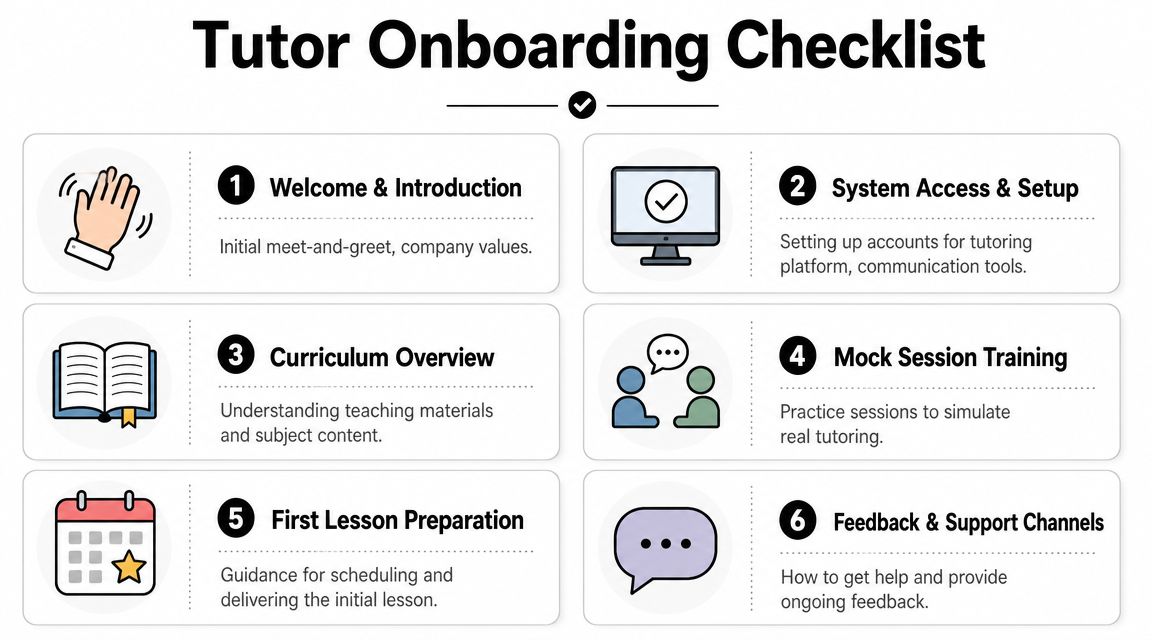
Building Your Tutor Onboarding Checklist
The first week sets the tone for everything that follows. If onboarding feels improvised, tutors assume the rest of the organization works the same way. If onboarding is clear, fast, and structured, tutors start with confidence.
Research summarized by Schoolhouse on the historical development of tutor training notes that the field shifted from subject knowledge alone toward operational consistency, with tutors trained to follow lesson plans, record student data, and execute repeatable teaching routines. That's still the right model.
Start with standards, not paperwork
Most centers begin onboarding with forms, contracts, and login details. Those matter, but they shouldn't come first. Begin with standards.
A new tutor needs to understand:
- Who you serve: Age groups, subjects, delivery formats, and common student challenges
- How you teach: Lesson flow, note-taking expectations, parent communication style
- How you behave: Punctuality, safeguarding, escalation rules, professional boundaries
Keep this short and direct. A tutor should leave that first conversation knowing exactly what “good” looks like in your center.
Use a three-part checklist
I'd structure onboarding into three blocks.
Company and culture
Here, you prevent fuzzy expectations.
Include:
- Mission and student profile: Explain whether you serve enrichment students, exam-prep students, language learners, or mixed populations.
- Communication rules: Define response times, who handles parent complaints, and what tutors should never promise directly.
- Safeguarding and conduct: Cover boundaries, incident reporting, and what to do if a student discloses a serious issue.
Administrative setup
Many centers lose time because they assume “the tutor will figure it out.”
Use a standard list:
- Contracts and payroll details: Collect everything before scheduling the first lesson.
- Availability setup: Tutors should enter real availability, not vague preferences.
- Location and subject permissions: Only assign services the tutor is approved to teach.
- Platform access: Email, calendar, lesson records, and internal messaging should work before day one.
If you need a starting point for the admin side, these employee onboarding form templates are useful for translating a loose process into a checklist your team can follow.
Pre-session preparation
This is the final gate before live teaching.
Require tutors to complete:
- Curriculum review: They should know where materials live and how levels are organized.
- Student briefing: Past notes, learning goals, known challenges, parent expectations
- Tech check: Camera, audio, screen share, whiteboard, login access
- Mock note entry: Have them submit one sample lesson note before they teach for real
A tutor is not “ready” because they attended orientation. They're ready when they can complete the whole workflow without help.
What not to do
Avoid these common mistakes:
| Mistake | What happens instead |
|---|---|
| Too much theory first | Tutors leave unclear on actual workflow |
| No system practice | Admin teams fix errors after the first week |
| No readiness check | Weak tutors get exposed in front of families |
| One-size-fits-all onboarding | Subject experts miss operational details |
A good onboarding checklist does one thing very well. It removes ambiguity.
Developing Core Pedagogical Skills
Once tutors understand your operating rules, you can train the part most owners talk about first, actual teaching. But even here, the focus should stay practical. You're not trying to build mini professors. You're trying to build tutors who can run effective sessions repeatedly, with different learners, under real-world conditions.
The strongest tutoring models don't just ask tutors to “teach well.” American Progress summarizes high-impact tutoring as depending on a repeatable instructional loop of diagnose, teach, practice, reassess, and adjust, and reports learning gains of an additional 3–15 months when those conditions are in place.
Train the lesson loop
If a tutor can follow a consistent loop, they can recover from a weak start, adapt mid-session, and explain progress more clearly to parents.
I'd train four habits.
Lesson planning and structure
Every session should have a visible shape. Not a rigid script, but a sequence.
Teach tutors to:
- Open with a fast review of the last session and today's target
- Move quickly from explanation into student practice
- Reserve time at the end for recap, error review, and homework or next steps
Weak tutors often spend too long explaining. Strong tutors shorten explanation and increase guided practice.
Formative assessment
At this point, many tutors drift into “content coverage” instead of actual teaching.
Coach them to use small checks:
- Ask one targeted question after each explanation
- Request a worked example, not just “Do you get it?”
- Change approach immediately if the student can't apply the idea
That loop sounds simple, but it's coachable. You can observe it, name it, and improve it.
Don't ask whether the tutor covered the topic. Ask whether the student demonstrated understanding during the lesson.
Train for online and hybrid reality
A modern tutor also needs delivery control. If they can teach algebra but can't manage breakout flow, screen-sharing, attendance habits, or note handoff, they're not fully trained.
That matters even more in language and literacy programs, where vocabulary work often benefits from spaced review and structured repetition. For example, teams working on language tutoring may borrow ideas from resources like improve Irish vocabulary with Gaeilgeoir AI to think more carefully about how recall practice fits into session design.
Pedagogy without system skill breaks down
This is the operational truth many centers resist. A tutor who teaches well but marks attendance late, misses schedule changes, or fails to leave usable notes creates work for everyone else.
That's why I treat pedagogy and system use as connected, not separate. The lesson isn't finished when the student logs off. It's finished when the record is accurate, the parent-facing summary is clear, and the next tutor or manager can understand what happened.
Training Tutors on Your Technology Stack
If your tutors still rely on scattered messages, private notes, and calendar guesswork, your training problem won't stay inside the classroom. It will spread into scheduling, attendance, invoicing, payroll, and parent communication.

That's why technology training has to be hands-on. A published peer-teaching study on technical skills found that 82% of tutees judged the model sufficient, and competency improved when training used standardized task steps, repeated demonstration, and coached practice rather than observation alone, as reported in the PMC study on peer technical-skills training. The lesson for tutoring centers is straightforward. Don't explain your platform once and assume tutors are ready.
What tutors actually need to practice
Most centers overestimate what “platform training” means. Watching a demo isn't the same as doing the job.
Train tutors on live scenarios:
- Booking awareness: How to check their timetable, location, lesson type, and student details
- Attendance workflow: How to mark statuses correctly and on time
- Lesson notes: What goes in internal notes, what can be parent-shared, and when it must be completed
- Availability updates: How to block time, report changes, and avoid booking conflicts
For teams standardizing operations, it helps to build these tasks around adult learning basics like relevance, repetition, and immediate application. This short guide to adult learning principles is a useful reminder that adults learn faster when the training mirrors real work.
Use a mini tech curriculum
A practical training block might look like this:
Manager demo
Show the full workflow once, from booking review to note completion.Tutor simulation
Give the tutor a mock student, mock lesson, and mock schedule change.Error correction
Ask the tutor to fix a wrong attendance mark, update availability, and locate the right student record.Readiness sign-off
Don't approve live teaching until they can complete the workflow cleanly.
If you're documenting system processes, one useful reference point is how to schedule tutoring sessions efficiently, especially for centers trying to reduce back-and-forth booking and avoid conflict-heavy calendars.
A short demo can help before practice begins:
What works and what fails
Here's the blunt version.
| Training approach | Result |
|---|---|
| Single walkthrough | Tutors forget steps and improvise badly |
| PDF manual only | Nobody uses it under pressure |
| Scenario practice | Tutors learn what to do in real conditions |
| Coached repetition | Confidence and accuracy improve faster |
Train the platform the same way you train teaching. Demonstrate, practice, observe, correct, repeat.
For tutoring businesses using one system for scheduling, attendance, billing triggers, payroll logic, and lesson records, software proficiency isn't admin trivia. It's part of service delivery.
Creating a Culture of Continuous Feedback
Initial training gets tutors started. Ongoing feedback keeps quality from drifting.
That matters more as your team grows. The Bureau of Labor Statistics projection cited here says employment of coaches and tutors is projected to grow 15% from 2022 to 2032. In practice, more hiring means more variability. Once you're running a large volume of lessons, inconsistent tutor performance affects retention, renewals, and operational efficiency.
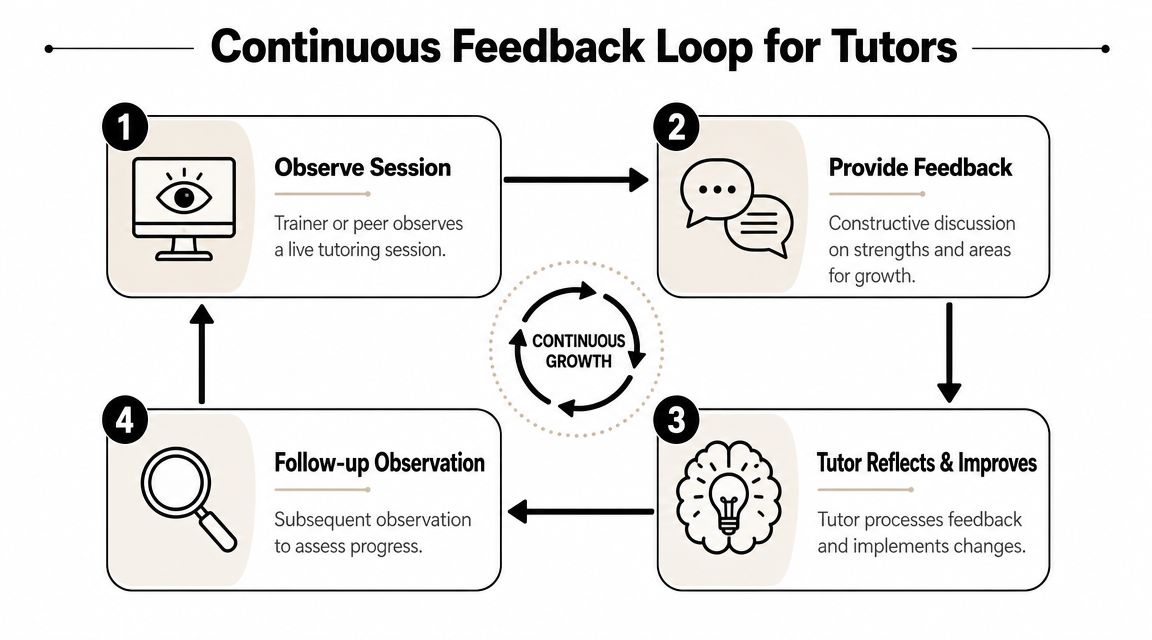
Keep the feedback loop small and frequent
Many center owners avoid coaching because they imagine formal evaluations, long paperwork, and uncomfortable meetings. That approach usually fails. Tutors feel judged, managers delay feedback, and problems become habits.
A better system is lighter:
- Observe one session
- Focus on one or two behaviors
- Debrief quickly
- Set one action for next time
- Revisit soon
That's enough. You don't need a giant rubric every time.
What to observe
Choose behaviors that connect directly to quality and consistency.
For example:
- Session start: Did the tutor begin on time and set a clear goal?
- Student checking: Did they verify understanding during the lesson?
- Pacing: Did they balance explanation and practice?
- Documentation: Did they finish notes accurately after the session?
This keeps coaching concrete. “Be more engaging” is vague. “Reduce explanation time and ask for a worked example within the first ten minutes” is coachable.
Practical rule: Feedback should name one visible action the tutor can repeat next session.
Use data, but don't weaponize it
Your performance data should guide coaching, not punish people for normal variation.
Useful signals include:
- Attendance accuracy
- Late note submission
- Student continuation patterns
- Trial lesson follow-through
- Parent comments and recurring complaints
When a tutor's data slips, the question isn't “Who's to blame?” It's “What skill or process broke?”
Separate development from emergency correction
Not every issue belongs in the same conversation.
Use two lanes:
| Situation | Response |
|---|---|
| Normal skill growth | Coaching, observation, practice |
| Serious conduct issue | Immediate management action |
| Process inconsistency | Retraining on standards and workflow |
| Student mismatch | Reassignment or support adjustment |
That distinction keeps your coaching culture credible. Tutors stay open to feedback when they know developmental conversations aren't disguised disciplinary meetings.
The strongest centers make feedback routine enough that it doesn't feel dramatic. That's the point. Improvement should feel normal.
Measuring Tutor Performance with Key KPIs
You can't manage tutor quality from gut feel alone. You need a short list of metrics that reveal whether training is working, where support is needed, and which tutors can handle more responsibility.
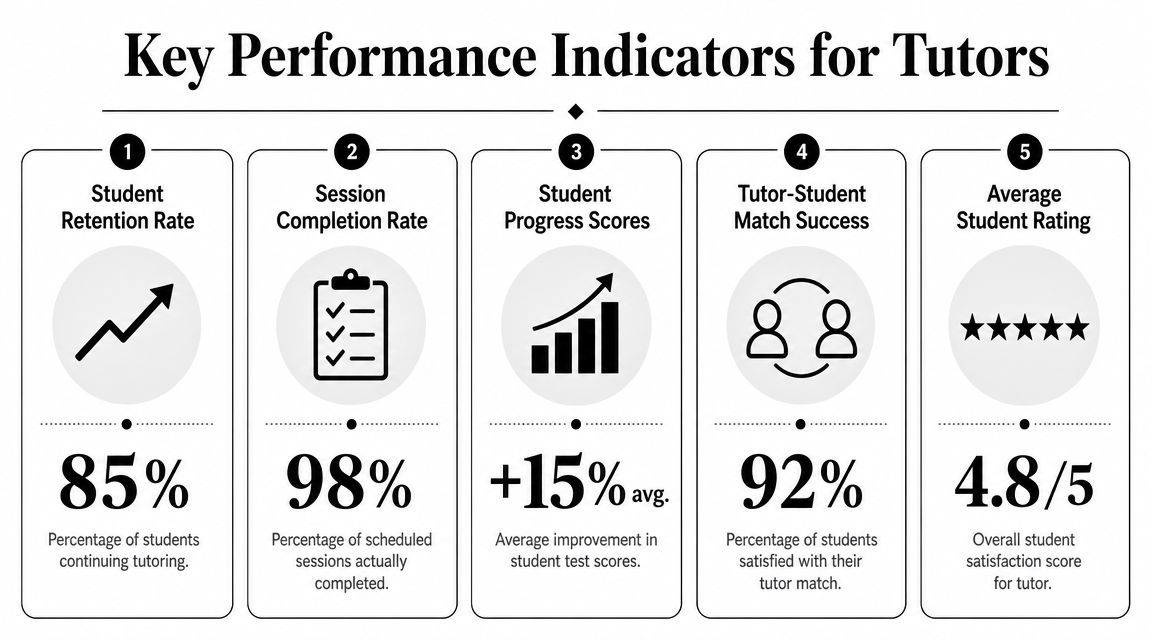
The mistake I see most often is measuring only academic progress. That matters, but it's not enough for running a center. A tutor can get decent learning results and still damage the business through poor attendance records, weak trial handling, or inconsistent communication.
The KPIs worth tracking
Use a dashboard simple enough to review regularly.
Retention by tutor
This shows whether students continue after the first few weeks and whether families stick with that tutor over time. Low retention can point to poor fit, weak communication, inconsistent lesson quality, or a mismatch between promised and delivered service.
Attendance accuracy
This is an operational metric, not a minor admin detail. If tutors mark sessions late or incorrectly, billing and payroll break downstream.
Track whether the tutor:
- Marks attendance on time
- Uses the correct status
- Records cancellations and no-shows consistently
Trial conversion
Trial lessons are where many centers leak revenue. Some tutors build trust quickly. Others teach fine but fail to create confidence in the student or parent.
Review:
- Did the student attend the trial?
- Was feedback logged?
- Did the family convert into ongoing lessons?
Use KPIs for coaching, not vanity reporting
A tutor dashboard should help you ask better questions.
| KPI | What it may reveal |
|---|---|
| Retention | Relationship quality, fit, consistency |
| Attendance accuracy | Process discipline, admin reliability |
| Trial conversion | First-impression skill, communication |
| Note completion | Follow-through and documentation habits |
Parent and student satisfaction can also help, especially if you collect comments in a simple, repeatable format after key milestones rather than after every lesson.
If you're building review cycles around this, this guide on tutoring center staff performance reviews is a helpful companion for turning observations and metrics into a structured conversation.
Keep the KPI set tight
Don't build a dashboard with twenty numbers nobody uses. Pick a few metrics that connect directly to service quality and operational reliability. Review them monthly. Use them in coaching. Reward improvement, not just raw performance.
That's how metrics become useful. They stop being reports and start becoming management tools.
Frequently Asked Questions About Tutor Training
How long should tutor onboarding take
Long enough for the tutor to complete the full teaching and admin workflow without help. Don't measure by hours alone. Measure by readiness. A tutor should not teach live until they can handle lesson prep, delivery basics, attendance, and notes correctly.
Should every subject use the same training process
Use the same operating framework, then adapt the instructional examples. Math, IELTS, piano, and early literacy all need different teaching moves, but they still need the same standards for preparation, documentation, communication, and escalation.
How do you train experienced tutors without making them defensive
Frame the process around consistency, not competence. You're not questioning whether they can teach. You're aligning how your center delivers lessons, records progress, communicates with families, and maintains quality across the team.
What if a tutor teaches well but ignores admin tasks
Treat that as a performance issue, not a personality quirk. In a tutoring business, late attendance and poor notes don't stay isolated. They create billing errors, parent confusion, and extra management work.
How often should tutors receive feedback
Frequently enough that small problems don't harden into habits. Short, focused observations usually work better than infrequent formal reviews.
What's the biggest mistake in training for tutors
Trying to solve everything in one orientation session. Tutors need staged training, practice, observation, and follow-up. A single welcome meeting doesn't build consistency.
How do I know the training program is working
Look for cleaner lesson records, fewer avoidable admin errors, steadier retention, better trial follow-through, and fewer manager interventions. The best sign is simple. Tutors stop needing reminders for basic expectations.
If you want your tutor training system tied more closely to scheduling, attendance, lesson records, billing, and payroll workflows, Tutorbase is one option built for tutoring centers and language schools managing that operational load at scale.


