


The best software for writing tutors is a central command center, not just a shared calendar. It replaces fragmented tools with one platform that automates complex scheduling, package billing, and payroll. This guide will show you how to choose a system that cuts admin time by over 60% and eliminates costly booking errors.
How to Choose the Best Software for Your Writing Center

Choosing the right software is the most critical decision for scaling your writing center. Moving away from a patchwork of spreadsheets and calendars is the first step to taming the administrative chaos that consumes 10+ hours every week.
An effective platform solves the unique challenges of teaching writing. It must manage various essay types, coordinate specialized test prep (like IELTS or AP English), and track student progress meaningfully. You need a system built for this complexity, not a generic tool requiring manual workarounds.
What are your core operational needs?
Before viewing demos, identify your operational bottlenecks. Where does friction cost you time and money?
Are you manually creating invoices from attendance records? Do you spend too much time matching a student who needs college essay help with a qualified tutor who has an open slot? A dedicated tutoring center software is built to solve these problems.
The right platform delivers:
- Intelligent Scheduling: A system that automatically finds the right tutor, room, and time for specific writing needs, reducing booking time from 10+ minutes to under two.
- Automated Billing: A tool that generates invoices directly from attendance for hourly rates, packages, or subscriptions.
- Unified Operations: A single dashboard combining payroll, student management, and lead tracking.
The gap between different systems is vast. This table compares how legacy tools, standard software, and modern AI-powered platforms handle core operations for a busy writing center.
Quick Comparison of Tutoring Software Features
| Feature Category | Spreadsheets & Calendars | Standard Software (Teachworks) | AI-Powered Software (Tutorbase) |
|---|---|---|---|
| Tutor & Subject Matching | Fully manual; error-prone and slow. | Manual search using simple tags. | AI-powered Find Slot suggests optimal tutor/room matches in seconds. |
| Complex Billing | Manual invoicing; impossible to automate packages. | Semi-manual; requires add-ons for credits. | Fully automated for packages, credits, and subscriptions. |
| Payroll Calculation | Manual calculation; high risk of errors. | Basic hourly rate calculations only. | Handles complex models like revenue share, per-student rates, and premiums. |
| Visibility & Reporting | None; impossible to track utilization or growth. | Basic dashboards on attendance and revenue. | Real-time visibility into capacity, workload balance, and lead conversions. |
Why Your Writing Center Needs More Than a Calendar

Many writing centers start with a simple calendar and spreadsheets. This patchwork system quickly becomes the biggest roadblock to growth. Manual processes cannot keep up with the real-world demands of writing instruction, creating hidden costs that drain your time and profit.
Imagine a parent calling in a panic for a last-minute AP English essay session. Your administrator must juggle multiple schedules to find a qualified tutor, check their availability, find a free room, and confirm everything. This is a 10-minute ordeal for one booking.
This friction explains why the global tutoring software market is exploding. Valued at USD 2.5 billion in 2023, it is projected to hit USD 9.3 billion by 2032, growing at 15.5% annually. Centers are ditching disjointed tools because the cost of manual work is too high. You can explore more market data at Dataintelo.com.
The True Cost of Disconnected Tools
When your scheduler, billing platform, and payroll spreadsheet do not communicate, you create invisible work that accumulates daily. Google Calendar does not know what was taught, QuickBooks does not know if a student attended, and Excel cannot calculate a tutor’s revenue-share bonus.
This fragmentation leads to real failures:
- Revenue Leakage: Forgetting to bill for a session or miscalculating a package rate directly hits your bottom line.
- Booking Errors: Double-booking your star writing tutor or only conference room leads to frustrated clients and stressed staff.
- Administrative Burnout: Your best people spend hours on tedious tasks like chasing payments and manually creating invoices.
The real problem with basic calendars is the total lack of operational visibility. You cannot see your center's true capacity, balance tutor workloads, or determine which writing programs are profitable. You're flying blind.
Managing Writing Instruction is Uniquely Complex
Writing instruction is more nuanced than math or science. A student prepping for the IELTS writing exam needs a different tutor than one working on foundational composition skills. A generic calendar cannot tell the difference.
A system built for tutoring excels here. The scheduler in a platform like Tutorbase handles this complexity. You can filter by subject (e.g., SAT Prep), level (e.g., Advanced Essay Structure), and tutor to find the perfect match in seconds.
This is not just about scheduling; it is about matching expertise to student needs, which is the core of a writing center's success. The best software for writing tutors transforms manual guesswork into an automated, error-free workflow.
Evaluating Core Features for Writing Center Management
When you pick software for your writing center, a simple feature list is not enough. You must understand how a platform handles your specific, daily scenarios. It is about creating a practical checklist that solves your actual operational headaches.
A generic tool might handle a simple booking but fails when a parent requests an "IELTS Task 2 essay structure" session with a test-prep-qualified tutor, free on Tuesdays after 4 PM, at a specific branch. Your software must manage these layered requests in seconds.
Advanced Scheduling and Resource Matching
Standard calendars show empty slots; they do not understand your resources. Intelligent scheduling knows the difference between a general English tutor and a PhD-level dissertation coach. This is what turns a 10-minute booking into a two-minute task.
When evaluating scheduling, ask:
- Can the system instantly find a qualified tutor for a niche request like "AP English Language argumentative essay"?
- Does it prevent double-booking tutors and rooms across multiple locations?
- Can you quickly find group classes with open seats to maximize enrollment?
The biggest time-saver is a system that auto-generates the best tutor, room, and time combinations based on a student's needs. This eliminates the manual "calendar hunting" that consumes hours of admin time weekly.
Integrated Billing and Payroll Automation
For a writing center, billing is rarely a simple hourly rate. You juggle different models, from 10-session SAT writing packages to premium fees. A disconnected system forces you to track attendance in one place and build invoices in another, creating opportunities for costly mistakes.
The best software for writing tutors links attendance directly to billing and payroll. When a tutor marks a student as "Attended," the system should automatically know what to do.
This means it can:
- Deduct one session from the student's prepaid package.
- Add the correct charge to the family's monthly invoice.
- Calculate the tutor's pay based on their specific per-lesson rate or revenue-share agreement.
This seamless automation is one of the most critical tutoring software features for reducing your administrative workload. It transforms hours of manual reconciliation into a task that takes minutes.
People and Curriculum Management
Your curriculum is your product. A solid management platform must connect your curriculum and tutors with precision. You need a structured curriculum database with subjects (e.g., "Creative Writing") and levels (e.g., "Intro to Poetry").
Once defined, link your curriculum to your people. A student's profile should show their current level and history, while a tutor's profile should list the subjects and levels they are qualified to teach. This structure is the backbone of smart scheduling.
Modern Communication and Lead Intake
How a potential student first contacts you sets the tone. Messy emails or phone calls create more admin work and let leads slip away. Modern platforms integrate communication into your management workflow.
Other educational organizations use communication tools to great effect. For instance, an education-focused WhatsApp case study shows how structured messaging improves intake. Integrating a WhatsApp widget on your website captures organized lead data directly into your CRM, creating a smooth onboarding process.
A Comparative Look at Leading Tutoring Platforms
Choosing software for a writing center means looking beyond a feature list. You must know how tools perform under daily operational pressure. The specific demands of writing tutoring, from matching students with essay specialists to billing for course packages, will expose a generic platform's weaknesses.
This analysis compares Tutorbase against competitors like Teachworks and TutorCruncher in real-world scenarios.
The tutoring software market is growing rapidly, valued at an estimated USD 12.81 billion in 2024 and projected to hit USD 35.94 billion by 2035. Centers are adopting tools to automate workflows and reclaim the 10+ hours of weekly admin work. Smart owners want platforms that automatically turn attendance into invoices, a feature that can cut admin time by 60%. A detailed industry report provides the full picture.
This decision tree maps out key questions for your evaluation.
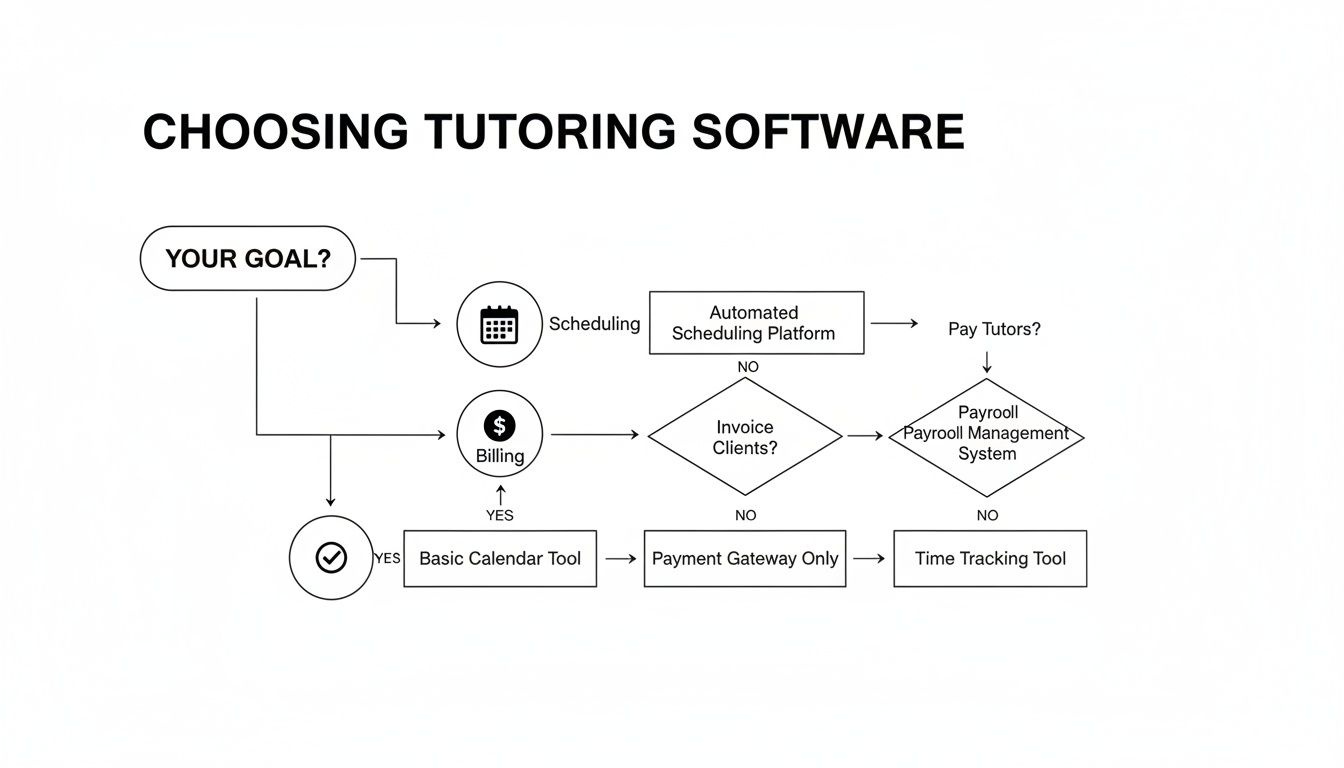
The right choice hinges on your biggest headache. Is it scheduling chaos? Billing nightmares? Payroll complexity? Pinpoint that, and the path becomes clear.
Scenario 1: Onboarding an SAT Writing Student
A parent wants to sign their child up for a 12-session SAT Writing package. They need an expert tutor in argumentative essays, available on weekday afternoons, and they want to pay upfront.
- With Teachworks or TutorCruncher: This is a manual, multi-step chore. First, you search your tutor list for anyone tagged "SAT." Next, you open a separate calendar to cross-reference availability. Then you manually create a recurring lesson series. For billing, you create a custom invoice or use a clunky add-on and track session usage on a spreadsheet. It is slow and error-prone.
- With Tutorbase: The AI-powered Find Slot feature does this in under two minutes. You enter "SAT Writing," select desired times, and the system instantly shows the best tutor/room combinations. When booking, you select the 12-session package, which automatically creates a prepaid credit balance. Each attended lesson deducts one credit. No manual tracking is needed.
Scenario 2: Managing Multi-Branch Operations
You run two branches and need to balance tutor workloads. A star writing coach at your downtown location is fully booked, while an equally great tutor at your suburban branch has open availability.
Using standard software, you have almost no visibility. You must manually switch between location calendars or pull separate reports to spot the imbalance. There is no easy way to offer the suburban tutor's slot to a new client asking about the downtown location.
Tutorbase provides a single, unified dashboard for managing multiple branches. You see all resources—tutors, rooms, across all locations—on one screen. When the downtown inquiry comes, the Find Slot tool can suggest the available tutor at the other branch, helping you fill empty slots across your entire business.
Feature Deep Dive: Tutorbase vs. Competitors for Writing Centers
This table breaks down how these platforms handle core jobs specific to a writing center.
| Core Task for Writing Centers | Tutorbase (AI-Powered) | Teachworks / TutorCruncher (Standard) | Why It Matters for Writing Tutors |
|---|---|---|---|
| Niche Tutor Matching | AI suggestions based on subject, level, availability, and location | Manual filtering and calendar cross-referencing | Instantly connects students needing "IELTS essay" help with the right expert, saving 10+ minutes per booking. |
| Package & Credit Billing | Native prepaid credit system with automatic deductions | Requires manual tracking or limited add-on features | Eliminates revenue loss from untracked sessions and manual invoicing errors for course bundles. |
| Complex Teacher Payroll | Handles revenue share, per-student rates, bonuses, and multi-rate contracts | Limited to basic hourly or per-lesson rates | Accurately pays tutors for premium work like dissertation coaching, improving retention and morale. |
| Multi-Branch Visibility | Unified dashboard for all locations, tutors, and rooms | Requires toggling between separate location views | Allows you to balance tutor workloads and maximize resource utilization across your entire business. |
The difference is between proactive automation and reactive manual work. Standard systems make you hunt for information. An AI-powered platform anticipates your needs and presents solutions.
Ultimately, choosing the best tutoring software depends on your ambition. If you want to grow and eliminate administrative bottlenecks, a platform with AI at its core provides an operational edge that standard tools cannot match.
How AI Automation Transforms Writing Center Operations

Real automation in a writing center is more than a shared calendar. It is an intelligent system that understands your business—the relationships between tutors, students, subjects, schedules, and rooms. This is where AI becomes your most valuable operational tool.
Imagine a parent needing an urgent session for a college application essay. Manually, this is a 15-minute scramble. An AI-powered system does the heavy lifting in seconds, analyzing all variables to provide the best, conflict-free options.
This smart automation connects directly to your bottom line. It means achieving zero double-bookings, optimizing tutor time, and seeing a 60% reduction in administrative overhead.
From Manual Guesswork to Intelligent Matching
The power of AI is its ability to handle complex, layered requests. Standard software shows you who is free, but it cannot tell you who is best for a student’s needs. For a writing center, where tutor specialization is key, that is a critical difference.
An intelligent platform like Tutorbase learns your business. It knows which tutors are experts in "IELTS Task 2" versus "AP English Literature" and matches them to students with precision.
This is driven by practical features that solve real-world problems:
- Find Slot: Instantly generates the ideal teacher, room, and time combinations for any new booking.
- Find Spot: Scans all existing group classes to find an open seat for a specific subject and level, helping you fill every spot.
This is not just about saving minutes. It is about optimizing your most valuable assets—your expert tutors—to ensure every student gets the perfect match, which directly impacts learning outcomes.
The Financial Impact of Deep Automation
The massive growth in intelligent tutoring systems reflects a major shift. The market is projected to grow from USD 3.7 billion in 2025 to USD 44.2 billion by 2034, driven by the need for greater efficiency. This AI backbone is what enables automation that improves your financial health.
These automated workflows are powerful financial tools. An integrated system handles a single lesson's lifecycle seamlessly:
- A tutor marks a student as attended.
- The system automatically generates the correct charge on the family's invoice.
- The correct pay is calculated for the tutor based on their specific contract (e.g., hourly, revenue-share).
This single process eliminates manual data entry that leads to revenue leaks and payroll mistakes. It turns hours of tedious weekly reconciliation into a task that takes minutes.
Beyond scheduling, other AI tools can streamline tasks. For instance, AI powered transcription software can dramatically reduce the time spent documenting sessions or converting spoken feedback into written notes. Choosing the best software for writing tutors means investing in this kind of deep, practical automation.
FAQs about Choosing Tutoring Software
When you're thinking about moving to a new system, it’s natural to have a few practical questions. Here are some straight answers to the things we hear most often from writing center owners and directors.
How long does the setup process take?
Getting your data imported and the system configured can be done in just a few days. You will feel the impact, like a 60% drop in admin time, from day one. The initial setup time pays for itself within the first month by increasing efficiency and reducing errors.
Can this software manage both online and in-person lessons?
Yes, absolutely. A modern platform is built for the hybrid model. It should seamlessly handle scheduling, attendance, and billing for students who attend the same class online one week and in person the next. This unified approach brings your entire operation under one roof.
What is the biggest mistake centers make when choosing software?
The biggest mistake is picking a platform based on price alone. This ignores the hidden costs of manual workarounds and lost revenue from operational bottlenecks. The focus should be on the return on investment (ROI), such as time saved and increased capacity, not just the monthly fee.
How quickly will my writing tutors learn a new system?
The best platforms are intuitive, so the learning curve is minimal. Tutors get a clean, simple portal to manage schedules, take attendance, and access lesson notes. Automated notifications for schedule changes and reminders also lighten their admin load, making them eager to adopt the new system.
Can it handle complex payroll like revenue share or bonuses?
Yes, a robust system should handle multiple payroll models. This includes per-hour, per-lesson, per-student, revenue share, and base plus variable pay. It should also manage premiums for weekends or specific subjects, ensuring accurate and automated payroll calculations for all employment types.
Ready to eliminate administrative chaos and grow your writing center? Tutorbase consolidates scheduling, billing, and payroll into one intelligent platform. Start your free trial today.


