


To attract the best educators, your tutor job description must be more than a list of duties; it must be a compelling preview of the role. It’s your first sales pitch to a potential star employee, selling your tutoring center as a fantastic place to work, free from the administrative chaos that burns out great teachers.
The Blueprint for a Perfect Tutor Job Description

Crafting a job post that stands out requires a plan. This isn't just about what you need from a tutor; it’s about showing them what you offer in return. A great job description acts as a powerful filter, pulling in qualified candidates and turning away those who aren’t, saving you hours of screening time. This blueprint breaks down the essential parts of a job description that gets results.
Before we dive into the details, here is a high-level view of what a strong job description includes.
| Core Components of a Tutor Job Description | | :--- | :--- | | Component | Purpose | | Specific Job Title | Attracts relevant experts like "High School AP Calculus Tutor" and improves search visibility. | | Engaging Summary | Sells your company and key benefits, like "Join a team that uses AI-powered software to minimize admin." | | Impact-Focused Responsibilities | Shows tutors how their work contributes to student success, such as "Guide students to build confidence and achieve academic goals." | | Clear Requirements & Preferences | Separates must-haves ("Bachelor's in Math") from nice-to-haves ("2+ years of SAT prep experience") to broaden the talent pool. | | Work Environment Details | Sets clear expectations about location, hours, and delivery model ("This is a hybrid role: 3 days in-person, 2 days remote"). | | Compensation & Benefits | Provides transparency on pay, which is a key factor for applicants ("Hourly rate of $35-$45, plus performance bonuses"). |
By ensuring each of these components is thoughtfully crafted, you create a comprehensive document that reflects the professionalism of your tutoring business from the first impression.
Start with a Clear Job Title and Summary
The job title is the first thing a candidate sees, so make it specific and searchable. A generic "Tutor" gets lost in the noise. Instead, use titles that target the right experts, like "High School Math Tutor," "SAT Prep Specialist," or "Online French Language Instructor." This immediately grabs the attention of people with the right skills.
Right after the title, write a brief, engaging summary. This is your elevator pitch. Mention 1-2 key benefits that make the role genuinely attractive. Do you use smart software like Tutorbase to cut down on admin work by 60%? This is the place to say it.
A great job summary answers the candidate's silent question: "Why should I work here?" It shifts the focus from a simple list of demands to a preview of a rewarding opportunity.
Frame Responsibilities as Contributions
Instead of a boring list of tasks, frame responsibilities in a way that shows their impact on students and the center. This gives the work meaning and helps candidates picture themselves thriving in the role.
For example, you can easily reframe these common tasks:
- Instead of: "Grade homework."
- Try: "Provide timely and constructive feedback on assignments to foster student growth and confidence."
- Instead of: "Track student attendance."
- Try: "Maintain accurate student progress records to inform personalized learning strategies and ensure seamless parent communication."
This small change in language transforms a chore into a meaningful contribution. It shows you value the tutor’s role in a student’s journey. For more general tips, it's always worth reviewing fundamentals on how to write a great job description.
Distinguish Between Requirements and Preferences
Be crystal clear about your deal-breakers versus what’s a "nice-to-have." This simple step manages applicant expectations and can broaden your talent pool. For clarity, create two separate lists.
- Required Qualifications: These are your non-negotiables. This might include a specific degree (like a Bachelor's in Education), a certification (like TEFL for language tutors), or proven subject matter expertise.
- Preferred Skills: These are the assets that would make a candidate a home run. Think of things like experience with specific curricula (IB or AP), familiarity with tutoring management software, or multilingual abilities.
Define the Work Environment
In 2024, being vague about the work model is a non-starter. You must specify whether the position is fully in-person, fully remote, or hybrid. This is one of the most important filters for candidates.
If your center uses a hybrid model, explain exactly how it works. For instance: "This role involves teaching 3 days a week at our downtown branch and 2 days remotely via our online platform." This level of detail ensures you only attract candidates whose lifestyle and preferences match your operational needs.
What a Modern Tutor Really Does All Day

When you write a job description, it’s tempting to just say "teach students." But a realistic look at the day-to-day work not only attracts better-fit tutors but also sets clear expectations. A modern tutor's day is a mix of rewarding teaching and necessary admin. By acknowledging both, you show that you understand their challenges.
You also create the perfect opening to explain how your center’s systems, like Tutorbase, are set up to protect a tutor’s time and energy, reducing admin by up to 60%.
Core Instructional Tasks
This is the heart of the job, the part that directly creates student success. But "teaching" isn't a single action. It’s a set of distinct skills that you should spell out clearly.
- Personalized Lesson Planning: Great tutors design lessons tailored to a student's unique learning style, pace, and goals, whether it's for K-12 math or advanced DELF exam prep.
- Curriculum Delivery: This is where tutors bring your curriculum to life. They need to be effective in different formats, like one-on-one sessions, small groups, or even hybrid classes with students both online and in person.
- Progress Tracking and Assessment: A tutor’s work isn’t done when the lesson ends. They continuously monitor student progress through informal check-ins, quizzes, and constructive feedback that builds confidence.
Your job description should frame these duties around their impact. Instead of "Conduct lessons," try "Deliver engaging, personalized instruction that boosts student confidence and leads to measurable academic improvement." This connects the daily task to a powerful outcome.
The Often-Understated Administrative Load
Here’s where many tutoring centers accidentally burn out their best people. The administrative side of tutoring is essential, but it can quickly swallow up hours that tutors would rather spend teaching.
A typical tutor’s admin work includes:
- Scheduling and Calendar Management: Juggling availability, confirming appointments, and handling rescheduling requests.
- Attendance Marking: Accurately logging student attendance—present, absent, or cancelled—which is critical for payroll and billing.
- Parent Communication: Writing post-lesson summaries, answering parent questions, and sending regular progress updates.
- Record Keeping: Maintaining organized student files with notes on performance, challenges, and goals.
How do I automate tutor administration?
This is where you can make your center stand out. Don't just list the admin tasks; show candidates how you’ve turned these burdens into simple, streamlined processes. Consider adding a "How We Support You" section to your job description.
Here are a few examples that pack a punch:
- Automated Attendance: "Forget manual spreadsheets. You’ll mark attendance with a single click in Tutorbase, which automatically logs the lesson for payroll and triggers the correct invoice. No end-of-month paperwork for you."
- Centralized Notes: "Share lesson notes and progress updates with parents directly through our portal. No more back-and-forth emails; everything is documented and accessible in one spot."
- Conflict-Free Scheduling: "Our smart calendar prevents double-bookings and gives you a clear, real-time view of your week. You can focus on preparing great lessons, not just organizing your time."
By detailing both sides of the role, you paint a realistic picture. More importantly, by showing how you use technology to crush admin headaches, you position your center as a place where tutors can focus on what they love: teaching.
Specifying Essential Qualifications and Skills
If you want to attract great tutors, you need to be clear about who you're looking for. A precise list of qualifications and skills in your job description is your best filter; it draws in the right people and saves you from sorting through mismatched applications. It shows you know what it takes to succeed, whether that's for high school chemistry or early years reading support.
Differentiating Hard Skills and Soft Skills
To build a team that parents trust and students love, you need both hard skills (what a tutor knows) and soft skills (how they teach). Your job description should call out both to find an expert who can connect with and motivate students.
Hard skills are the teachable, black-and-white qualifications. These are your non-negotiables.
- Subject Mastery: Be specific. Instead of "good at math," write "Expertise in AP Calculus BC" or "Native or C2-level fluency in Spanish."
- Curriculum Knowledge: If you follow a specific framework, say so. "Experience with the IB Diploma Programme" or "Proven success with Orton-Gillingham methods" are great examples.
- Educational Credentials: List any must-have degrees or certifications. This could be a "Bachelor's degree in a related science" or a "Valid TEFL/TESOL certification."
Soft skills are the personal traits that define how a tutor delivers their knowledge. They’re harder to measure, but they are what keep students coming back.
Hard skills might get a tutor the interview, but soft skills get them the job. A tutor with a PhD in physics who lacks patience won't last long with a student who's struggling with the basics.
The Growing Importance of Tech Fluency
In a modern tutoring business, being comfortable with technology is a core competency. Your job description needs to reflect this, or you’ll attract tutors who are stuck in the past.
When you list tech skills, be specific about the tools you use.
- Online Teaching Platforms: Mention the software you use for virtual lessons, like Zoom or Google Meet.
- Management Software: Be upfront that tutors will use a platform for their admin. For instance, "You should be comfortable using management software like Tutorbase for scheduling, attendance, and parent communication."
- Digital Content: Note if tutors need to create or use digital resources like interactive whiteboards or online quizzes.
How you phrase this can even be a selling point. Frame it as a benefit for the tutor: "We use an integrated platform, Tutorbase, to handle all your scheduling and billing, so you can focus on teaching, not admin." This shows you value their time.
For a deeper look at the full range of abilities that make a great educator, check out our guide on what skills are needed for teaching.
How to Customize Job Descriptions for Different Niches
If you post a generic “tutor wanted” ad, you’ll get generic applicants. To hire real experts, your job description of a tutor has to speak their language. You can’t use the same template to find a K-12 math whiz, an advanced test prep coach, and an immersive language instructor. Tailoring your post to the specific niche is how you attract top-tier talent.
K-12 Math Tutor Example
For K-12 roles, your focus should be on building confidence, mastering core skills, and communicating well with parents. The tone needs to be encouraging and supportive.
Job Title: K-12 Math Tutor (Grades 6-12)
Key Responsibilities:
- Deliver personalized one-on-one and small group math instruction for middle and high school students.
- Create engaging lesson plans that match local school curricula, focusing on core concepts in algebra, geometry, and pre-calculus.
- Use diagnostic assessments to spot student learning gaps and develop targeted strategies that build both skills and confidence.
- Give regular, constructive feedback to students and share progress updates with parents through our central portal.
Qualifications:
- Bachelor's degree in Mathematics, Education, or a related field.
- Proven expertise in K-12 math subjects, with a knack for explaining complex ideas clearly and patiently.
- 1-2 years of previous tutoring or teaching experience is a huge plus.
- Great communication skills and a genuine passion for helping young learners succeed.
Language Instructor (French DELF B2) Example
When hiring a language instructor, the job description needs to show you understand fluency, cultural context, and specific exam frameworks like the CEFR.
Job Title: French Language Instructor (DELF B2 Specialization)
Key Responsibilities:
- Lead immersive French lessons for individuals and small groups specifically preparing for the DELF B2 exam.
- Use a communicative teaching method focused on developing all four key skills: listening, speaking, reading, and writing.
- Create lesson plans and find materials that align with the Common European Framework of Reference (CEFR) for languages.
- Track student progress against DELF B2 standards and provide targeted coaching to tackle their specific weak points.
Qualifications:
- Native or C1/C2-level fluency in French.
- Verifiable experience preparing students for official language exams (DELF/DALF, TCF).
- Deep knowledge of the CEFR and how to apply it in a practical tutoring setting.
- A degree in French, Linguistics, or a related discipline is an asset.
Test Prep Specialist (IELTS) Example
Test prep roles are all about results. Your job description needs to be data-driven and speak to candidates who are motivated by seeing scores go up. The best applicants here think like coaches, so you need to highlight the analytical and strategic side of the job.
Test prep is a performance-based field. Your job description should attract tutors who think like coaches, focused on strategy, data, and helping students achieve a target score.
Job Title: IELTS Test Preparation Specialist
Key Responsibilities:
- Deliver expert, strategy-based instruction for all four modules of the IELTS Academic test.
- Administer and break down diagnostic tests to find student weaknesses and build a custom study plan for score improvement.
- Teach specific test-taking strategies, time management skills, and scoring criteria to help students maximize their performance.
- Track student progress with practice test scores and detailed feedback, aiming for a demonstrable increase in their target band score.
Qualifications:
- A minimum IELTS score of 8.0 or higher, or equivalent native proficiency.
- At least 2 years of experience successfully coaching students for the IELTS exam, with a portfolio of student success stories.
- Strong analytical skills and the ability to deconstruct exam questions and scoring rubrics.
- An exceptional talent for motivating students during the intense prep journey.
Structuring Compensation and Employment Type
How you structure compensation says a lot about your tutoring center. To attract high-quality educators who see tutoring as a career, you need to get this right. Vague promises like "competitive pay" don't cut it anymore. Being transparent about your compensation model and employment type builds trust from the get-go.
Choosing the Right Compensation Model
The pay structure you pick will directly shape the kind of tutors you attract. There’s no single "best" model. The right fit depends on your business. If you're new to this, it’s worth understanding different compensation structures like wages, salary, commission, and bonuses to see the full landscape.
Here are the most common models we see successful tutoring centers use:
- Per-Hour Rate: The simplest and most common approach. It’s easy for tutors to track and straightforward for you to calculate.
- Per-Lesson/Session Fee: This model pays a flat fee for each lesson taught, ideal for classes of a standard length like 45-minute or 60-minute sessions.
- Revenue Share (%): The tutor earns a percentage of the lesson revenue. This can be a huge motivator for entrepreneurial tutors who excel at retaining students.
- Base + Variable Pay: A hybrid model that provides a secure base rate plus performance bonuses tied to metrics like student retention or test score improvements.
Different tutoring niches often lend themselves to different pay models. A one-size-fits-all approach rarely works.
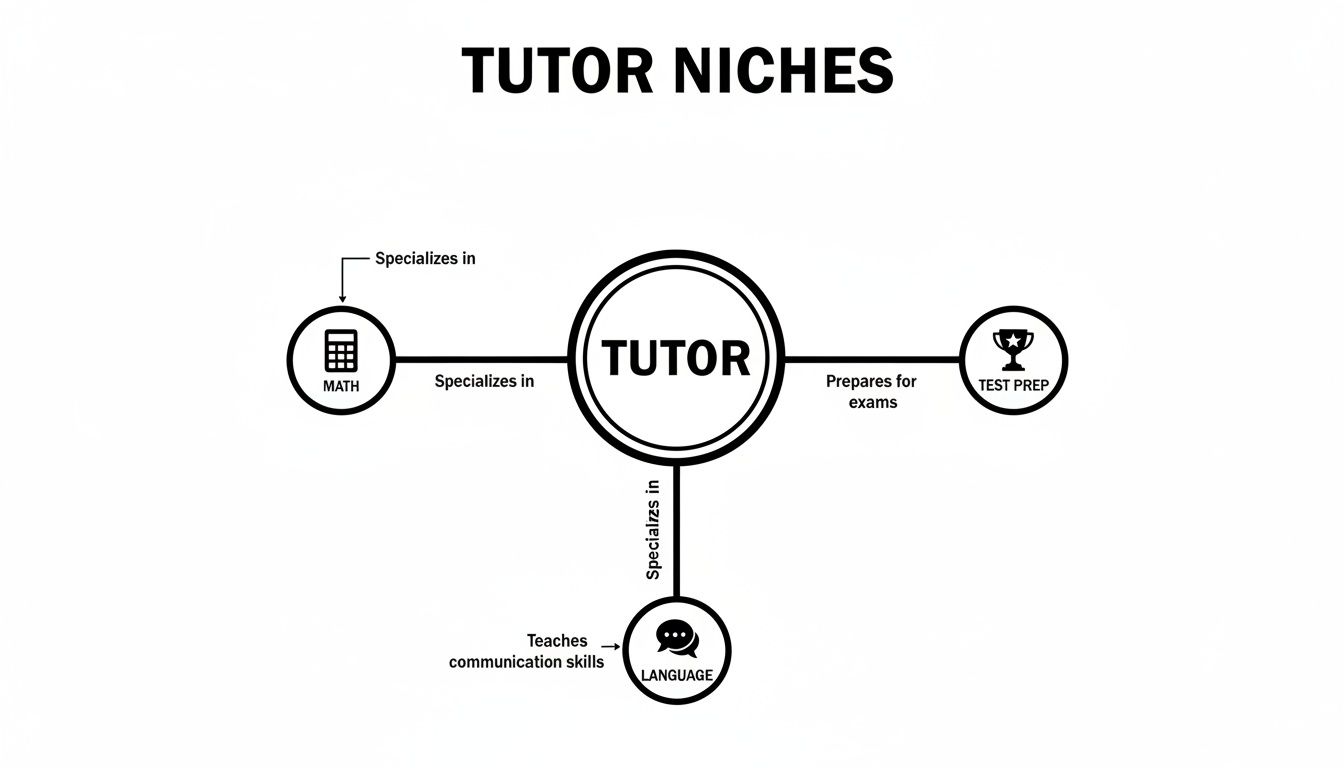
As you can see, what works for a math tutor might not be the best fit for a specialized test-prep coach. Think about what motivates the kind of experts you want to attract.
Clarifying Employment Type: Employee vs. Contractor
This is a big one. The difference between an employee and an independent contractor is a critical distinction you must state clearly in the job description of a tutor.
- Employees are on your payroll. You handle withholding taxes and have more control over their schedules and teaching methods.
- Contractors are self-employed individuals who manage their own taxes. This model offers more flexibility but gives you less control.
Be direct in your job posting. Use clear headings like "Employment Type: Part-Time Employee" or "Position: Independent Contractor." This clarity prevents misunderstandings and ensures you attract candidates looking for the type of relationship you're offering.
Showcasing Your Payroll Competence
Juggling different pay rates, weekend premiums, and a mix of employment types can quickly become an administrative mess. You can turn your operational strength into a recruiting advantage.
Mentioning that you have a solid system for handling payroll complexity shows candidates that you're an organized and reliable employer. For instance, you could add: "We use an automated payroll system to manage all pay complexities, ensuring you're always paid accurately and on time."
This is where having the right software makes all the difference. The advanced https://tutorbase.com/features/payroll system automates these calculations, whether you’re using hourly rates, revenue share, or a hybrid model. It removes administrative headaches and gives tutors peace of mind that they'll be paid correctly, every time.
How to Stand Out From Other Tutoring Centers

A great job description of a tutor does more than list duties. It sells your center as an organized, modern place where talented educators can build a career. In a crowded market, the best tutors are looking for a workplace that respects their time and lets them do what they love: teach.
This is your chance to turn your operational smarts into a recruiting magnet. By showing how you use management software to eliminate the headaches that plague the industry, you’ll catch the eye of top candidates. It signals that you’re a forward-thinking business that invests in making your team’s life easier.
From Frustration to Focus
Ask any experienced tutor. They’ll have a story about administrative chaos like double-booked lessons or chasing down payroll corrections. Your job description is the perfect place to tackle these pain points head-on. A promise of less stress can be more valuable than a slightly higher hourly rate.
You can weave this advantage directly into your job responsibilities.
Instead of a vague duty like "Manage your schedule," reframe it as a benefit: "Maintain a clear and conflict-free schedule using our centralized calendar, which prevents double-bookings and gives you a complete view of your week at a glance."
This one small tweak shows you’ve actively removed a huge source of friction from the job.
Highlighting Tech as a Tutor Benefit
When you talk about using software like Tutorbase, frame it as a direct win for the tutor, not just a back-office tool. The goal is to show them exactly how your systems will make their day-to-day work more rewarding. This is how you differentiate yourself from centers still clinging to spreadsheets.
Here’s how you can translate your operational strengths into compelling bullet points for your job post:
- No More Paperwork: Mention that attendance is a one-click process that automatically kicks off payroll and billing. This tells them they can forget about manual timesheets.
- Clear Communication: Highlight your parent portal for sharing lesson notes and progress reports. Tutors will see they won’t be buried under endless email chains just to keep families in the loop.
- Fair and Simple Payroll: Emphasize that your system easily handles complex pay rates, like premiums for different subjects or weekend hours. This builds trust that you have a reliable process for accurate, on-time payments.
By showcasing these benefits, you’re sending a clear message: at your center, tutors invest their time where it truly counts—helping students succeed. To take this a step further, see our guide on developing a world-class tutor training program.
Frequently Asked Questions About Hiring Tutors
When it’s time to write that tutor job description, every center owner runs into the same handful of questions. Nailing the answers can be the difference between a flood of so-so résumés and a short list of genuinely great educators. Let's clear up the most common sticking points so you can hire with confidence.
Should I list the exact pay rate in a job description?
Yes, absolutely. Listing a clear pay range is one of the smartest things you can do. Transparency builds instant trust and shows candidates you respect their time. A range like “$25-$35 per hour, based on experience” immediately filters out applicants whose expectations don't match your budget, saving you hours of wasted interviews. Top talent appreciates honesty and will gravitate toward employers who are upfront about compensation.
What are the biggest mistakes to avoid in a job description?
The two quickest ways to kill a good job post are being vague and being unrealistic. If you want great people, you have to be crystal clear.
- Vague Responsibilities: Don't just say "teach students." Get specific: "Develop and deliver personalized lesson plans for K-8 students struggling with reading comprehension."
- The "Unicorn" List: Don't ask for a PhD, 10 years of experience, and fluency in three languages for an entry-level role. Split your needs into "must-haves" and "nice-to-haves" to attract a realistic and qualified pool of applicants.
How can my job posting attract better candidates?
To stand out from other "Tutor Wanted" ads, sell your center's culture, especially how you make a tutor's life easier. Mentioning that you use a modern management system like Tutorbase is a huge signal that you value their time.
Frame your operational efficiency as a perk. Try this: "We handle all scheduling and payroll with an automated system, so you can focus on what you love—teaching, not paperwork." That one sentence tells a great tutor that you’re an organized, professional place to work.
What legal points should I consider in a job description?
First, ensure your job description is compliant and inclusive. Clearly state whether the role is an employee or a contractor. This has massive legal and tax consequences, so get it right from the start. Second, use inclusive language. Avoid any wording that could imply a bias toward a certain age, gender, or background. You're not just being fair; you're widening your net to attract the most diverse and talented team possible.
Ready to eliminate the administrative chaos that burns out great tutors? Tutorbase consolidates scheduling, billing, and payroll into one smart platform, reducing admin time by 60%. Get started today.


