


High school tutoring has evolved from a quick fix for a bad grade into a strategic part of a student's long-term success. For many families, it's a critical investment to navigate intense college admissions, demanding AP/IB courses, and high-stakes standardized tests.
But as demand explodes, tutoring centers are hitting an operational wall. Owners and managers spend over 10 hours a week on admin tasks that should be automated, leading to booking errors and lost revenue. This guide shows you how to conquer that chaos and build a scalable business.
Why High School Tutoring Is More Crucial Than Ever

The pressure on high school students today is immense. The road to a top university is a fiercely competitive arena, changing the game for tutoring. It has shifted from a remedial safety net to a proactive tool for building a competitive academic edge.
This isn't just a feeling; the numbers prove it. High school students are the engine of the global tutoring industry, driving a massive 39.8% of all tutoring revenue back in 2022. With the market swelling to $120.25 billion in 2024, their share has only grown. For students, the investment pays off, as they show a 13% higher pass rate in their classes. You can dig deeper into the tutoring industry's growth and key statistics for the full picture.
The Forces Driving Tutoring Demand
What’s fueling this unprecedented demand? A few key pressures have turned high-quality tutoring from a "nice-to-have" into a "must-have" for many families.
- Intense College Admissions: Acceptance rates at top colleges have hit all-time lows. Students need more than a solid GPA; they need standout test scores and a compelling academic story.
- Rigorous Curricula Demands: Advanced Placement (AP) and International Baccalaureate (IB) courses are now standard for college-bound students. These are college-level classes that often require support beyond what a packed classroom can provide.
- High-Stakes Standardized Testing: The SAT and ACT still carry enormous weight for many colleges. Specialized test prep is not just about content review; it's about mastering strategy and time management to maximize scores.
For tutoring centers, this boom is a double-edged sword. On one hand, it’s a massive growth opportunity. On the other, it creates an operational hurricane. More students mean more lessons to schedule, invoices to track, and tutor payroll to process.
The Operational Challenge for Growing Centers
The manual systems you used to manage 50 lessons a week will completely fall apart when you hit 500, let alone 5,000. Owners and operations managers quickly find themselves sinking 10+ hours per week just keeping the administrative gears turning.
This isn't just a time-suck; it's a direct threat to your business. When you’re juggling spreadsheets for payroll, Google Calendar for scheduling, and QuickBooks for billing, you create a minefield of potential errors. You risk double-booking tutors, missing payments, and running inaccurate payroll. The very growth you worked so hard for now strains your resources and eats into your profits.
Choosing the Right High School Tutoring Model

How you deliver tutoring is a core business decision that shapes everything from student outcomes to your bottom line. Deciding between one-on-one, group, online, or in-person sessions defines your entire operation and profitability.
Each model strikes a different balance between personalized attention, cost, and scalability. To build a program that is both effective and profitable, you must understand the trade-offs for your students and your center.
One-on-One vs. Group Tutoring
This is the classic debate. One-on-one tutoring offers the gold standard in personalized support. The tutor can focus on a single student’s hurdles and move at their exact pace, perfect for students who have fallen behind or are grappling with tough AP-level material.
But that focus comes at a cost. It’s the priciest option for parents and the hardest to scale for you. Your revenue is directly tied to your available tutor hours, creating a hard ceiling on growth. This is where group tutoring changes the game.
By grouping students, you fundamentally shift your business economics. A single tutor who once served one student per hour can now teach three, five, or even ten, dramatically boosting your revenue potential and making the most of every tutor's time.
Group sessions also create a space for students to learn from each other, which works well for subjects that thrive on discussion. The catch? You have to be brilliant at managing capacity. Every empty seat in a group class is lost revenue, a puzzle nearly impossible to solve without smart scheduling software.
In-Person vs. Online vs. Hybrid Tutoring
Next up is where the learning happens. Traditional, in-person tutoring provides the direct, face-to-face connection many families still value. It helps build strong rapport and avoids tech headaches. The downside is your business is limited to a small geographic area, and you sink costs into a physical location.
Online tutoring smashes those geographic walls, opening your center to a statewide or even national market. It also slashes overhead like rent and utilities. For centers focused on standardized tests, a slick online program is no longer optional; it’s a critical growth engine. Many top programs use platforms like Tutorbase for test prep centers to manage these digital offerings effectively.
Then there's the hybrid model, which offers the best of both worlds. In a hybrid class, some students are in the room while others join remotely. While it sounds great, it brings significant operational headaches if not managed correctly.
Your technology must be able to:
- Track attendance for both online and in-person students in the same lesson.
- Juggle room bookings and virtual meeting links without conflicts.
- Give every student a great experience, whether they are in the front row or on a laptop miles away.
Trying to manage a hybrid classroom without one integrated system is an administrative nightmare waiting to happen. It leads to frustrated students, burned-out staff, and a disorganized reputation.
Comparing High School Tutoring Models
Which model is right for you? It's not about picking one but about understanding the pros and cons of each so you can offer the right mix. This table cuts through the noise.
| Model | Best For Students | Pros for Centers | Cons for Centers |
|---|---|---|---|
| One-on-One | Maximum personalized attention for specific learning gaps. | High-margin service, strong student outcomes. | Limited scalability, revenue capped by tutor hours. |
| Group | Collaborative learning, more affordable than one-on-one. | Highly scalable, maximizes revenue per tutor. | Requires careful management to fill open seats. |
| Online | Flexible scheduling and access from anywhere. | Broader market reach, lower overhead for facilities. | Requires robust tech, potential for disengagement. |
| Hybrid | Combines the benefits of in-person and online learning. | Extends class reach without adding physical seats. | High operational complexity without integrated software. |
Ultimately, the strongest tutoring businesses blend models. They offer a flexible menu of services that meets families where they are while building a resilient, scalable operation.
The Blueprint for a Profitable Tutoring Program
Building a quality high school tutoring program is one thing; building one that’s profitable is another. A successful center needs more than just great tutors. It needs a solid operational backbone that supports growth instead of getting crushed by it.
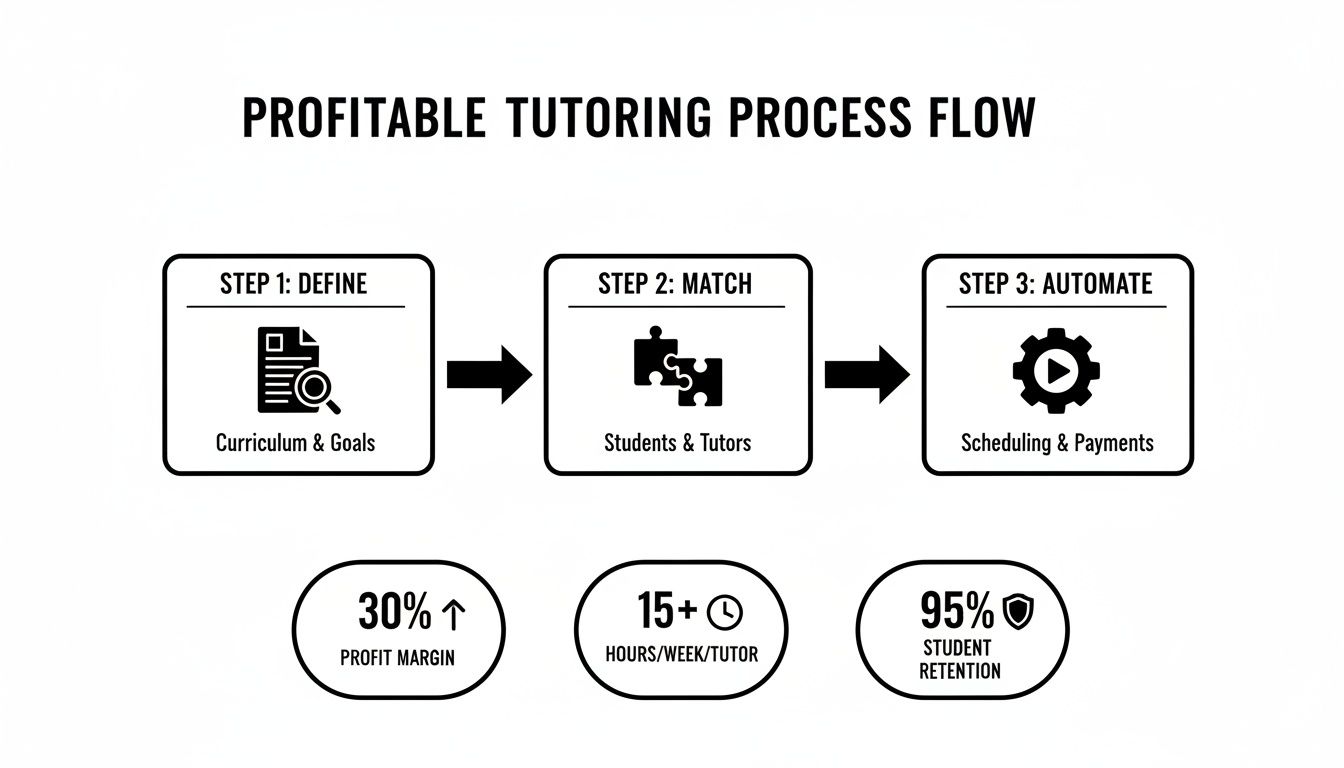
This is your blueprint for designing a program that scales without the chaos. It starts with defining what you sell and matching the right tutors to students. Most importantly, it’s about tackling the operational burnout from disorganized systems that quietly eats away at profit margins as you grow.
Start with a Well-Defined Curriculum
You can’t manage what you haven’t defined. Vague service offerings like “Math Help” are a recipe for scheduling and billing nightmares. A structured curriculum isn't just an academic exercise; it's the bedrock of an efficient business.
Start by breaking down broad subjects into specific, sellable services. This means creating detailed offerings that parents understand and your system can track.
- Subject: Math → Service: AP Calculus AB Exam Prep
- Subject: English → Service: Grade 10 Essay Writing Workshop
- Subject: Language → Service: Spanish B1 Conversation Practice
This level of detail is a game-changer. It lets you precisely match a tutor’s skills to a student’s needs, set accurate pricing, and eliminate confusion. This is where unified tutoring management software becomes essential, acting as a central library for all your services to ensure every lesson is booked and billed correctly.
A well-structured curriculum is a business tool. It standardizes what you sell, simplifies how you manage it, and makes it easier for parents to buy. This clarity is the first step toward automating your operations.
Match Expertise to Student Needs
Once your curriculum is locked in, the next puzzle is matching the right tutor to the right student. When you’re small, this is easy. The owner just knows. But as you grow across multiple locations, it becomes a massive headache for an operations manager to keep every tutor's qualifications, availability, and pay rate in their head.
This is where manual systems like spreadsheets fall apart. Relying on memory leads to mistakes, like assigning a geometry teacher to an Algebra 2 class. Those errors chip away at your reputation and send customers looking elsewhere.
The only scalable solution is to centralize that data. A tutoring center platform should hold a detailed profile for every teacher, tracking:
- Subjects and Levels Taught: Which specific courses are they certified to teach?
- Location and Availability: Which branches can they work at and during what hours?
- Contracts and Pay Rates: What are their specific payroll rules?
With this information in one place, smart scheduling tools find the perfect teacher for a new student in seconds. What was a 10-minute manual scramble becomes a 30-second click, reducing admin time by 60%.
The market is massive and growing. The after-school tutoring industry is projected to grow from $120 billion in 2023 to $250 billion by 2032. High schoolers make up the largest piece of that pie. You can dig into more details about the expanding after-school tutoring market and what it means for your business.
How to Automate Your Center's Operations
As a tutoring center grows, its biggest threat isn't competition—it's operational chaos. The spreadsheets and manual processes that worked for 50 lessons a week will grind your business to a halt at 500. It’s a classic scaling problem.
This section tackles the core operational headaches that drain your time and profits: Scheduling, Billing, and Payroll. We’ll look at the painful "before" of manual work and contrast it with the streamlined "after" of automation. The goal is to get you from spending 10+ hours a week on admin to just a few minutes.
The Scheduling Nightmare and Its Solution
For too many centers, booking a new student is a 10-minute scavenger hunt. An admin manually cross-references a student's request, checks multiple tutors' availability, and then finds an open room. It's slow, error-prone, and leads to double-booked tutors and frustrated parents.
The solution is intelligent scheduling software. Imagine a system where you input a student's needs—"AP Calculus, Tuesday after 4 PM"—and it instantly shows you every available combination of qualified tutors, rooms, and time slots. This turns a clunky, 10-minute task into a 30-second, error-free booking.
Another scheduling headache is managing group classes where every empty seat is lost revenue. An automated "Find Spot" feature lets your staff instantly see all existing classes with open seats that fit a new student's criteria. This helps you maximize your fill rate and get the most out of every class.
By automating scheduling, you don’t just save time—you eliminate costly mistakes. You can achieve zero double-bookings and ensure every resource, from your best tutors to your physical rooms, is perfectly utilized.
From Manual Invoicing to Automated Billing
Billing is often the most dreaded task in a tutoring business. It involves manually creating invoices one by one and chasing down late payments. This process is not just slow; it's a breeding ground for financial mistakes and awkward conversations with parents.
Automated billing changes the game. The system generates invoices automatically based on the attendance data you're already tracking.
- A student attends their lesson.
- The tutor marks their attendance status ("Attended," "No-show," "Late Cancelled").
- An accurate invoice is automatically generated and sent to the payer.
This workflow eliminates hours of manual data entry and guarantees every lesson is billed correctly. For centers offering prepaid credits, an integrated system can auto-deduct from a family's balance and send low-balance alerts, keeping your cash flow consistent. You can explore what to look for in tutoring software to see how these tools work.
Solving the Complex Payroll Puzzle
Paying your tutors should be simple, but it rarely is. You might have tutors on hourly rates, per-lesson fees, or even revenue-share models. Calculating this manually every pay period is a spreadsheet nightmare.
A specialized payroll system built for tutoring centers solves this. It lets you create unique, flexible pay rules for each tutor.
- Pay Models: Easily set up hourly, per-lesson, per-student, or revenue-share rates.
- Premiums: Automatically add bonuses for teaching on a weekend or a high-demand subject.
- Settlement: The system calculates the exact amount owed for any period—weekly, bi-weekly, or monthly—with a single click.
What used to take hours of calculation now takes minutes. This not only cuts admin time but also builds trust with your staff by ensuring they are always paid accurately and on time.
Choosing the Right Technology for Your Tutoring Center
Moving away from spreadsheets is the biggest jump you'll make when scaling your high school tutoring business. But be careful—not all software is created equal. A basic tool that only handles scheduling just moves the mess somewhere else.
The right platform acts as a central nervous system for your entire operation, connecting scheduling, billing, and payroll into one cohesive system. It’s less about buying a tool and more about adopting a smarter way to run your center. Some centers even integrate tools like a homework helper AI to give students on-demand support.
Your Non-Negotiable Feature Checklist
When you're looking at the best tutoring center software, focus on what will solve your biggest headaches. Anything less will just give you the same old problems in a new interface.
Your checklist must include:
- Multi-Branch Management: Can you see and manage all your locations, rooms, and teachers from a single login? This is a dealbreaker if you plan to open a second location.
- Integrated Room Booking: Your schedule needs to know about your physical rooms—their capacity, availability, and any fees. Otherwise, you’re setting yourself up for overbookings.
- Conflict Detection: The system has to be smart enough to automatically block you from double-booking a teacher or a room. It should flag the conflict instantly and show you alternatives.
- Complex Pricing Support: Can it handle per-hour rates, lesson packages with expiration dates, and custom cancellation policies? A one-size-fits-all model won't work.
- Automated Billing & Payroll: The platform must generate invoices automatically from attendance data and calculate payroll for complex teacher contracts.
The real test of any system is its ability to handle complexity. If a platform chokes on your mix of group classes, hybrid lessons, and multi-branch payroll, it's not a growth tool; it’s an anchor holding your business back.
The Real Difference Advanced Platforms Make
At first glance, traditional tutoring software and modern AI-powered platforms might look similar. But the day-to-day difference in your operations is massive. Older systems often just semi-automate tasks, while advanced platforms like Tutorbase offer true, hands-off automation for centers managing 50 to 10,000 lessons per week.
Imagine you need to find a spot for a new student. A traditional system forces you to hunt for an open slot that works. In an advanced system, a "Find Slot" feature instantly gives you a list of every valid teacher, room, and time combination. It cuts a 10-minute chore down to 30 seconds.
The gap isn't just about saving time; it's about making smarter decisions that maximize every resource.
Software Feature Comparison for Tutoring Centers
This head-to-head comparison shows how key features stack up between advanced platforms and traditional tutoring software. For a growing center, these differences directly impact your efficiency, scalability, and bottom line.
| Feature | Advanced Platform (e.g., Tutorbase) | Traditional Software (e.g., Teachworks, TutorCruncher) |
|---|---|---|
| Scheduling | AI-powered "Find Slot" finds perfect openings instantly. | Manual calendar search required to find available slots. |
| Billing | Fully automated invoice creation from attendance data. | Semi-manual process, requires review and manual generation. |
| Prepaid Credits | Native wallet system with auto-deduction and low-balance alerts. | Limited functionality or requires a paid add-on. |
| Payroll | Handles complex models like revenue share and premiums. | Basic hourly or per-lesson rates only. |
| Scalability | Designed for 10,000+ lessons/week without slowdown. | Performance degrades at high volume. |
| Multi-Brand | Manage multiple brands with shared resources from one account. | Not supported; requires separate accounts. |
While older platforms from providers like Teachworks or TutorCruncher can digitize basic tasks, they struggle as your business becomes more complex. Advanced systems are designed to handle that complexity, turning operational hurdles into growth opportunities. Choosing the right technology directly impacts your ability to provide high-quality high school tutoring at scale.
Measuring Success with Key Tutoring Center Metrics
Running a high school tutoring center on gut feelings is a surefire way to hit a plateau. To grow, you must track the numbers that show how healthy and efficient your business truly is.
Think of these Key Performance Indicators (KPIs) as your business’s vital signs. They fall into three buckets: operational, financial, and student success. Keeping a close eye on them gives you a real-time picture of what’s working, allowing you to fix problems before they get serious.
Key Operational and Financial Metrics
Operational efficiency is the engine of your profitability. Start with teacher utilization, which shows what percentage of a teacher's paid hours are spent teaching. If that number is low, you’re paying for idle time. Similarly, track room capacity utilization to ensure your physical spaces generate as much revenue as possible.
When it comes to finance, focus on these critical KPIs:
- Monthly Recurring Revenue (MRR): This is your predictable, stable income from subscriptions and ongoing lesson packages. It’s the bedrock of a healthy business.
- Average Revenue Per Student (ARPS): This shows how much each student is worth on average and helps you spot opportunities to offer more value.
- Customer Lifetime Value (CLV): This tells you how much revenue you can expect from a student over the entire time they’re with you.
With an integrated platform, these numbers are on your dashboard, ready to be acted upon. Getting a handle on your performance means taking a deep dive into essential client success metrics and what they mean for your center.
Student Success and Growth Indicators
Happy students who get great results are your best marketing. Their success is directly tied to your center's growth, making progress tracking an absolute must for any serious high school tutoring program.
Tracking student outcomes isn't just about providing good education; it's about proving your value. Powerful results like a 42% increase in monthly renewals or 3x faster student onboarding don't happen by accident. They come from running a tight, data-informed operation.
Start by tracking these key metrics:
- Student Retention Rate: What percentage of your students stick around month after month? This is a direct measure of satisfaction.
- Trial Conversion Rate: How many students who try a free or discounted lesson sign up for a full package? This tells you how effective your initial offer is.
In the US alone, high school tutoring is a huge slice of an $18.9 billion market. With 21% of students using tutoring services, running an excellent operation is how you stand out. Smart platforms that automate scheduling and billing can lead to a 60% cut in admin time and zero double-bookings. You can find more insights on the scale of the US tutoring market.
Frequently Asked Questions About High School Tutoring
Whether you're a parent making a choice or a center owner looking to streamline operations, the same questions often come up. Here are direct answers to the most common ones.
How many hours of tutoring per week is effective for a high school student?
For consistent academic progress, 1-2 hours per week, per subject is a good rule of thumb. This rhythm reinforces classroom learning without overwhelming the student. For intense test prep like the SAT or ACT, this often increases to 3-5 hours per week in the months leading up to the exam.
What is the biggest operational mistake tutoring centers make?
The most damaging mistake is sticking with a patchwork of spreadsheets and disconnected apps for too long. It seems cheap at first, but as you grow, it descends into chaos. This leads to double-bookings, payroll errors, and hours wasted on manual tasks, stopping a promising business from scaling.
The real cost of manual operations isn't just the time you waste. It's the lost revenue from booking mistakes and the hit your reputation takes when admin errors impact parents and tutors.
Is group tutoring as effective as one-on-one for high schoolers?
It can be, but you must match the format to the student's goal. For closing a specific knowledge gap, nothing beats the focused attention of one-on-one tutoring. However, for test prep strategy or collaborative subject review, small groups of 3-5 students are fantastic. They’re more affordable and highly effective.
How can I track the ROI of my tutoring center's software?
Measure the return on investment by looking at what changes before and after implementation. The most obvious metric is time saved. Look for a significant drop in hours spent on admin tasks like scheduling and billing, which often falls by 60% or more. Also, track growth metrics like a 42% increase in monthly renewals and a 3x faster student onboarding process.
Ready to escape the spreadsheet maze and build a more profitable, scalable tutoring business? Tutorbase brings scheduling, billing, payroll, and parent communication into a single AI-powered platform designed for growth. Stop juggling apps and start building your center by visiting tutorbase.com/register.


