


Math tutors in the United States usually charge $40 to $65 per hour, with a typical standard session rate of $45 per hour. In practice, rates can swing from about $25 to over $150 depending on the tutor's experience, your location, whether lessons happen online or in person, and how advanced the math is.
That price spread is exactly why parents get confused. One center quotes a modest hourly rate, another offers a package, and a third pushes a monthly membership. From the operator side, the problem looks different. If you set rates too low, you stay busy and still lose money. If you set them too high without a clear reason, families walk.
For parents, the key question isn't only how much do math tutors charge. It's what you're buying. For owners, the sharper question is whether your pricing covers teacher pay, admin time, rooms, no-shows, and billing complexity.
Understanding Math Tutoring Costs in 2026
U.S. math tutoring often lands around $40 to $65 per hour. That average is useful, but parents rarely shop the average. They compare a college student charging at the low end, a licensed teacher in the middle, and a specialist for test prep or advanced math at the high end. Those are different services with different results, expectations, and costs to deliver.
The better question is what kind of support your child needs, and how often. A student who needs weekly Algebra 1 accountability may do well with a solid general tutor. A student preparing for the SAT, catching up after a bad semester, or working through calculus usually needs more experience and a tighter lesson plan. The hourly rate rises because the tutor is doing more than showing up for 60 minutes.
For families, that is where budgeting gets tricky. The cheapest option can work well for short-term homework help, but it often becomes more expensive if progress is slow, sessions are inconsistent, or you end up switching tutors midstream.
For tutoring center owners, the pressure runs the other way. Parents see one number. The business carries payroll, training, scheduling, room costs, taxes, cancellations, and the admin work tied to every package, makeup, and recurring invoice. That is why rate setting cannot be based on competitor pricing alone. It has to reflect delivery cost and margin.
Some families also compare private tutoring with membership-style support, including options listed in MasteryMind subscription details, especially when they expect ongoing help rather than occasional sessions. Owners weighing those models can also review this guide to profitable tutoring fees to see how market pricing connects to capacity, staffing, and profit.
Practical rule: Parents should judge tutoring by fit, consistency, and likely progress per month. Owners should set rates that cover real operating costs and still leave room to grow.
Typical Math Tutor Rates and Pricing Models
Parents usually focus on the hourly number first. That makes sense. But the billing structure often has a bigger effect on the monthly total, attendance consistency, and whether tutoring stays on track long enough to help.
A $50 hourly tutor can end up costing less than a discounted package if sessions get missed, rescheduled, or abandoned halfway through. On the business side, the reverse can also be true. A lower advertised package rate may produce better margins if it improves retention and reduces weekly scheduling gaps.
Hourly, package, and subscription models
Hourly billing is the clearest option. Families pay session by session, which suits short-term help, uneven schedules, or situations where a parent wants to test fit before making a bigger commitment.
Packages lower the per-session price in exchange for commitment. Industry reporting from Fortune Business Insights' private tutoring market overview describes package discounts of about 10 to 15 percent compared with single-session billing. In practice, that lines up with how many tutoring centers price 4-session and 8-session bundles to improve attendance and reduce churn.
Subscriptions are different. They are built around routine. Families usually choose them for predictable monthly budgeting and ongoing academic support, not because each session is always cheaper in isolation. For owners, subscriptions can stabilize revenue, but only if the plan has clear rules on session frequency, makeups, and rollover credits.
Comparison of Math Tutoring Pricing Models
| Pricing Model | Average Cost Range | Best For |
|---|---|---|
| Hourly | $40 to $65 per hour | Families that want flexibility |
| 4-session package | $150 to $300 | Students who need short-term consistency |
| 8-session package | $280 to $560 | Ongoing support with some savings |
| Monthly plan | Varies by session count and support level | Families that want predictable budgeting |
| Unlimited monthly plan | Varies widely by provider and usage limits | High-frequency tutoring users |
The best model depends on what the student needs.
Hourly pricing works well for occasional help, a tough unit in algebra, or a few weeks of test review. It is less reliable for students who need steady weekly reinforcement, because families are more likely to pause once the immediate pressure fades.
Packages fit clear goals. A student who needs eight weeks of geometry support, for example, often benefits from the built-in commitment. For owners, packages also reduce payment friction, but they create admin work around expirations, refunds, and unused credits.
Subscriptions can be strong for retention and cash flow. They can also become expensive to deliver if the center is loose with makeups or allows unlimited access without usage controls. I have seen centers fill their roster with “good recurring revenue” on paper, then give back the margin through over-servicing and payroll creep.
That is why pricing model decisions should include delivery cost, cancellation behavior, and staff utilization, not just what looks attractive on a flyer. Owners who want to understand pricing for education businesses should compare each model by revenue per student, average attendance, admin time, and gross margin, not by headline price alone.
Key Factors That Influence Tutoring Prices
A low rate doesn't always mean good value, and a high rate doesn't always mean better teaching. The biggest pricing differences come from the tutor's background, the student's grade level, the delivery format, and whether the work is routine support or high-stakes preparation.

Grade level changes the market
The jump from elementary arithmetic to algebra, geometry, and advanced high school work is real. Tutoring rate data shows elementary school tutoring ranges from $23 to $75 per hour, middle school from $25 to $88 per hour, and high school from $30 to $100 per hour. The same source notes that specialized test prep like the SAT starts at $45 per hour and climbs to $100 per hour, according to TutorCruncher's tutoring rate analysis.
That tracks with what most operators see every year. Parents often expect “math is math,” but the staffing pool gets narrower as subject complexity rises. A tutor who handles Grade 4 fluency work is easier to find than someone who can reliably teach Algebra II, AP-level content, or exam-focused problem solving.
Credentials and teaching experience
A college student can be a strong fit for routine practice, confidence building, and homework support. A certified teacher often brings stronger diagnostic skill, better pacing, and more experience with curriculum gaps.
What families are paying for at the higher end usually includes:
- Better diagnosis: The tutor spots whether the issue is content, attention, confidence, or missing foundations.
- Cleaner lesson structure: Strong tutors move quickly from confusion to targeted practice.
- Curriculum alignment: Experienced teachers often connect support to school expectations more effectively.
- Stronger communication: Parents get clearer updates about what's happening and what to do next.
Here's a useful visual overview of what drives tutoring demand and differentiation:
Online versus in-person
Online tutoring usually costs less than in-person tutoring, but cheaper doesn't automatically mean worse. For focused middle school and high school learners, online sessions can be efficient because travel disappears and scheduling opens up.
In-person tutoring still makes sense when attention, routine, or parent preference matters more than convenience.
Parents usually overpay when they chase credentials without checking fit. Centers undercharge when they offer specialist teaching but describe it like generic homework help.
How Tutor Costs Vary by Location
In many markets, geography shifts tutoring prices by more than tutor title alone. I see parents compare one quote from a large metro area to another from a small suburb and assume one provider is overpriced. Often, they are looking at two different cost structures.
Regional differences matter
A math tutor in New York City, San Francisco, or Boston usually has to cover higher rent, wages, and travel time than a tutor serving a smaller town or outer suburb. That pressure shows up in the rate. Urban markets also tend to have more demand for AP math, SAT or ACT prep, and accelerated coursework, which pushes prices higher for experienced tutors and specialized centers.
Rural and lower-cost suburban areas usually come in lower, especially for general homework help or foundational math support. Online tutoring compresses some of that gap because the family is no longer paying for local travel and facility overhead in the same way.
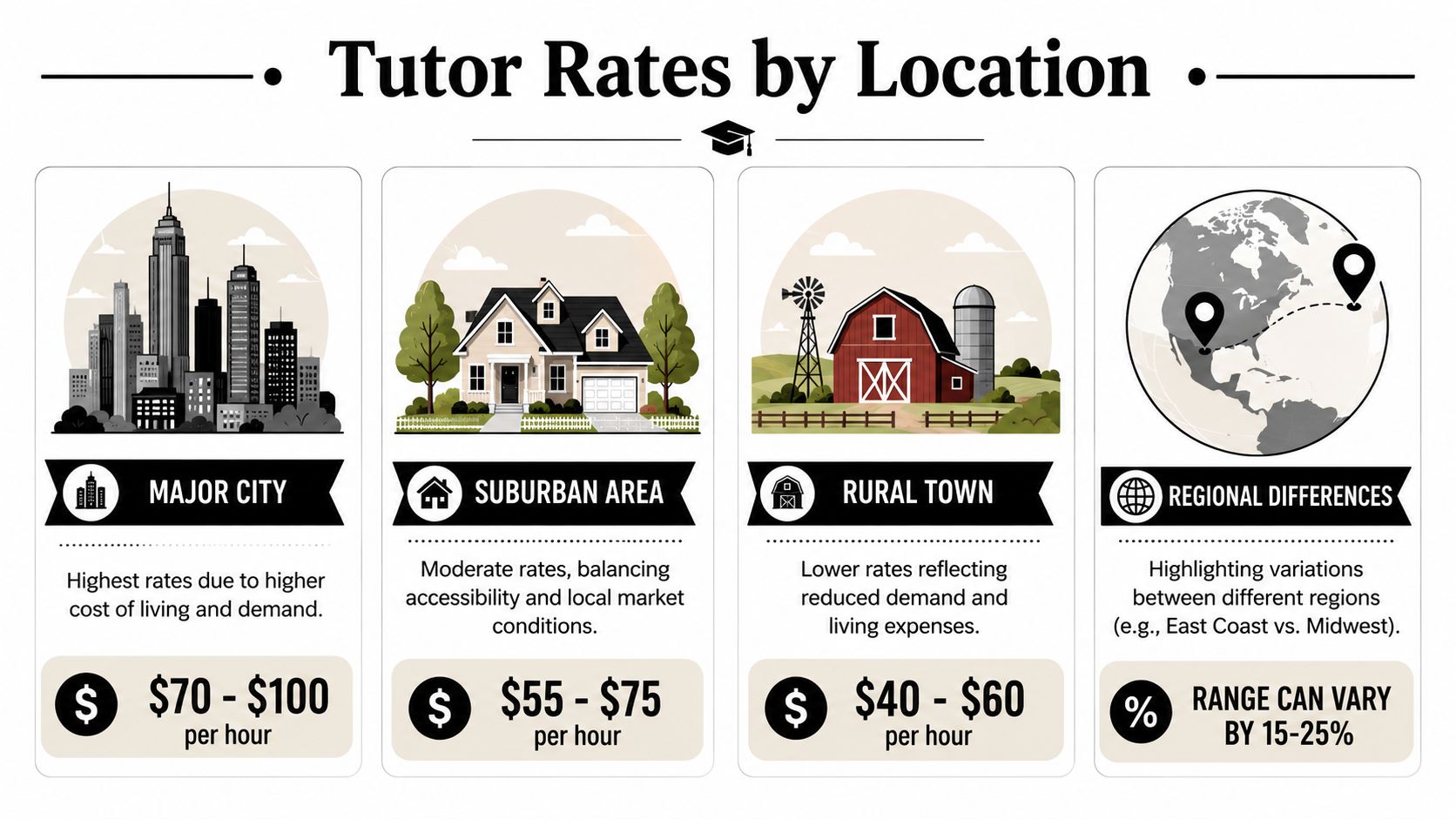
What families should take from that
Parents get the clearest answer by comparing quotes inside their own area first. A rate only makes sense in context. Two tutors can charge very different prices in the same city, but the meaningful question is what the family is getting for that difference.
Check three things before deciding a quote is too high:
- Local fit: Compare with nearby tutors or centers serving similar students and grade levels.
- Service model: In-person sessions often include travel, office space, and scheduling limits that online providers do not carry.
- Subject level: Algebra support, calculus tutoring, and test prep are usually priced differently, even within the same ZIP code.
A parent on a tight budget should ask whether weekly tutoring with a strong generalist will solve the problem faster than occasional sessions with a premium specialist. That trade-off matters more than chasing the lowest posted hourly rate.
What multi-location operators should take from it
Owners run into a different problem. A single price sheet across every branch is easy to manage, but it often creates margin problems. One location may lose enrollments because the rate sits above local expectations. Another may stay full and still underperform because payroll, rent, and admin costs are eating the difference.
The better approach is location-aware pricing with clear guardrails. Keep the offer consistent, then adjust rates based on local wage pressure, occupancy cost, travel expectations, and the mix of services sold in that branch. A center can deliver the same teaching standard in two markets and still need different prices to stay healthy.
I usually tell owners to treat market pricing as the ceiling and internal costs as the floor. Profitable pricing sits between those two numbers. If the gap is too small, the answer is not always to raise rates. Sometimes the fix is tightening scheduling, reducing unpaid admin work, or changing who delivers which type of session.
Your market shapes what families will accept. Your operating costs determine whether that rate actually works.
How to Find a Great Tutor and Get the Best Value
The best tutor isn't always the cheapest, and the most expensive option isn't always the best one for your child. Value comes from fit, consistency, and whether the tutor can move the student from confusion to confidence without wasting sessions.
Start with the problem, not the rate
Parents often start by asking for a price. Start by naming the actual need. Is your child behind on fundamentals, struggling with school homework, preparing for a test, or losing confidence?
Those are different tutoring jobs. A tutor who's excellent at confidence-building with younger students may not be the right person for exam pacing or advanced high school problem sets.
A good first conversation should clarify:
- The goal: Homework support, catching up, enrichment, or test prep.
- The timeline: Ongoing support needs a different structure than short-term help.
- The learning style: Some students need calm repetition, others need challenge and pace.
- The parent role: Some tutors expect regular home follow-up, others build more accountability into sessions.
Use the trial lesson carefully
A trial lesson can save money if you use it to assess fit. It can waste money if you treat it like a one-off event and never define success.
Ask yourself after the lesson:
- Did the tutor explain clearly?
- Did your child stay engaged?
- Did the tutor identify a real issue, not just work through homework?
- Did the session feel organized?
The strongest tutors usually do more than “help with tonight's worksheet.” They notice patterns, explain why mistakes happen, and set a plan for the next lesson.
Watch for what doesn't work
Some warning signs show up quickly.
- No diagnosis: The tutor jumps into problems without checking gaps.
- No structure: The lesson drifts from question to question.
- No communication: Parents don't know what happened or what comes next.
- No student connection: The child leaves more frustrated than when they started.
Paying less for a tutor who doesn't create momentum usually costs more in the long run because you end up buying more sessions without progress.
For Tutoring Centers How to Set Competitive Rates
Parents see a rate. Owners carry the full equation behind it. Teacher pay, admin time, room costs, software, payment fees, cancellations, and seasonal swings all sit inside that number. If you don't price deliberately, you can fill your schedule and still erode margin.
Build from cost, then test against the market
Start with your actual delivery cost per lesson. Include teacher compensation, room expense if relevant, admin handling, and the operational drag from invoicing, rescheduling, and makeups.
Then compare that floor to the market ranges covered earlier in this article. If your cost structure forces you above what your local market accepts, you don't have only a pricing problem. You have a staffing, format, or operational model problem.
A practical approach looks like this:
- Define core services clearly. Separate private tutoring, small-group tutoring, and premium test prep.
- Assign rates by value tier. Don't price all math the same if the staffing difficulty differs.
- Protect margin with policy. Late cancellation rules, package expiry, and makeup limits matter.
- Review by branch. Multi-location businesses should avoid blanket pricing.
Use tiered pricing without confusing families
Most centers undercharge because they flatten everything into one number. That creates two bad outcomes. Easier services subsidize harder ones, and premium services look too expensive because parents don't see the distinction.
A cleaner structure usually includes:
- Standard support: Routine school math and weekly reinforcement
- Premium academic support: Higher-level coursework or more experienced teachers
- Exam preparation: Test-focused instruction with tighter outcomes and stronger specialization
- Group formats: Lower price point per student, better margin if managed well
Think beyond today's branch
If you plan to expand, your pricing system needs to scale before your footprint does. Owners exploring additional sites or franchise development should lock down pricing logic early, because inconsistency across branches creates parent confusion, staff disputes, and weak financial control.
The strongest pricing model is one your team can explain easily, enforce consistently, and still earn from after cancellations, payroll, and admin are accounted for.
Don't ignore administrative complexity
A center with hourly pricing, package discounts, trial conversion offers, and different teacher rates needs more than a spreadsheet. The more exceptions you add, the easier it becomes to bill the wrong family, underpay a teacher, or lose track of prepaid lessons.
That's where many owners misread profitability. The rate card looks fine. The back office leaks.
Streamline Your Business with Automated Pricing and Payroll
Pricing strategy breaks down fast when operations stay manual. A center may offer hourly lessons, packages, monthly billing, teacher premiums, and multiple branches, but if staff still track all of that in spreadsheets, errors show up everywhere.
Where manual administration starts to hurt
Most tutoring businesses don't lose control in one dramatic moment. They lose it in small repeated tasks:
- Scheduling across tools: Google Calendar for lessons, spreadsheets for room tracking, notes in chat threads
- Billing by hand: Staff build invoices manually and then chase payment
- Payroll guesswork: Teacher pay changes by lesson type, student count, or time slot
- Poor visibility: Owners can't quickly see capacity, workload balance, or credit usage
That's the operational gap tutoring management software is meant to close. When lesson attendance flows directly into invoices and payroll, you remove a large share of the friction that makes pricing feel harder than it should be.
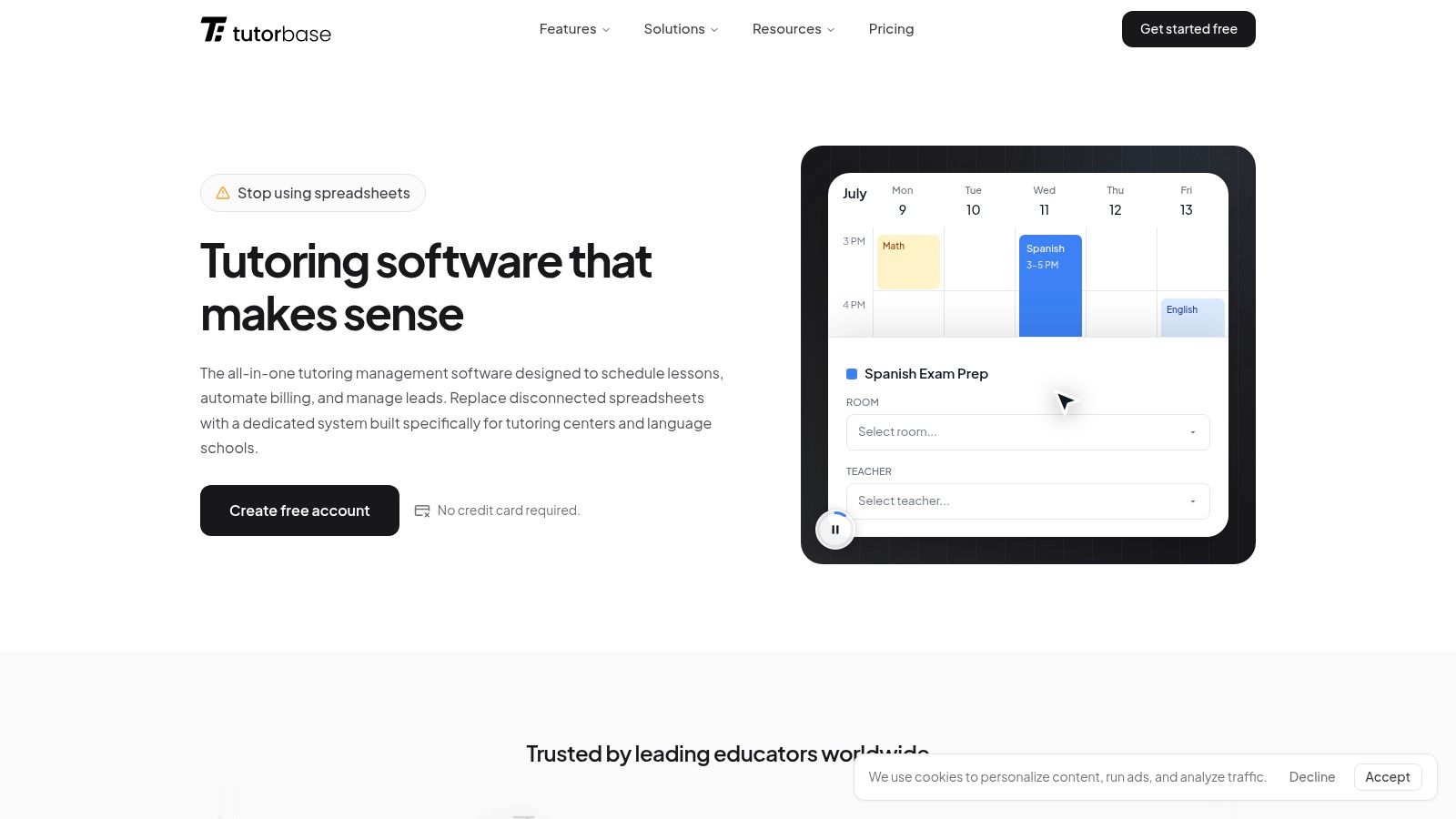
What a modern tutoring platform should handle
Tutorbase is AI-powered tutoring management software built to replace Teachworks, TutorCruncher, TutorBird, and spreadsheet-based operations. It brings scheduling, billing, payroll, room management, and student tracking into one system.
For centers and language schools with 5 to 100+ teachers, 1 to 10+ branches, and 50 to 10,000+ lessons per week, the point isn't just convenience. It's margin protection and administrative control.
Core areas matter most:
- Scheduling: Find Slot auto-generates teacher, room, and time combinations, while Find Spot filters existing classes with open seats. Conflict detection prevents double-bookings, and recurring lessons take one click.
- Pricing and billing: Policy Packs support per-hour, per-lesson, per-package, and subscription models. Pricing can follow layered rules from global to location to service to student. Invoices move from draft to paid automatically from attendance.
- Teacher payroll: The platform supports per-hour, per-lesson, per-student, revenue share, base plus variable, overtime, and subject or time-slot premiums.
A lot of owners also need broader context when evaluating payroll options for medium-sized businesses, especially once contractor payments and branch-level complexity start growing.
Why automation changes the economics
Tutorbase serves K-12 academic tutoring, language schools, test prep, music schools, and after-school programs. It also supports multi-branch operations, multi-brand setups, hybrid classes, WhatsApp lead capture, custom forms, attendance tracking, prepaid credits, and contractor self-billing.
That matters because tutoring centers often lose money through fragmented tools, booking errors, and manual work. The platform's published operating metrics show a 60% reduction in admin time, 3x faster student onboarding, a 42% increase in monthly renewals, zero double-bookings, and invoice processing that moves from hours to minutes.
If payroll is one of your biggest pain points, it helps to see how to pay tutors automatically in a system designed specifically for tutoring centers.
Frequently Asked Questions About Math Tutor Pricing
Is math tutoring more expensive than other subjects
Often, yes. Market data cited earlier shows math as a high-demand specialty and notes an average of $52.50 per hour in one broader tutoring rate analysis. Parents usually see that difference most clearly when moving from general homework help into algebra, geometry, or test-focused instruction.
Do online math tutors charge less than in-person tutors
Usually they do. The U.S. cost guide cited earlier notes lower online ranges than in-person ranges, and that matches what many centers see in practice. Online tutoring removes travel and can widen the available tutor pool, which often helps control price.
Is group math tutoring worth it
It can be, especially for students who learn well with peers and don't need constant one-to-one correction. The trade-off is attention. Group tutoring lowers cost per student, but it won't suit every learner, particularly if the student has uneven foundations or needs close pacing control.
Should I pay for a trial lesson
A paid trial can make sense if the tutor uses it to diagnose the problem and recommend a plan. It's less worthwhile when the session is only a sales meeting with light homework help attached. Ask what the trial is meant to achieve before you book it.
How many sessions per month do families usually buy
The market ranges cited earlier place 4 to 8 sessions per month as a common planning point. That's a useful budgeting framework for weekly tutoring, although the right cadence depends on the student's goal and urgency.
Are tutoring centers cheaper than private tutors
Sometimes yes, sometimes no. Centers may offer group options, monthly plans, and structured packages that lower the effective cost. Private tutors may charge less at the entry level, but highly specialized private tutors can also charge more than many centers.
When does it make sense to pay premium rates
Premium rates make sense when the tutor solves a more demanding problem. That includes advanced coursework, standardized test prep, or a student who needs very targeted intervention from an experienced teacher.
What's the biggest mistake parents make when choosing a tutor
They focus on hourly price before checking fit. A slightly higher rate from a tutor who diagnoses well, teaches clearly, and keeps the student engaged often produces better value than a lower rate from someone who merely sits through homework.
If you run a tutoring center, language school, test prep academy, music school, or after-school program and you're tired of juggling scheduling, billing, payroll, rooms, and student tracking across disconnected tools, Tutorbase is built for that exact problem. It helps operators replace Teachworks, TutorCruncher, TutorBird, and spreadsheets with one platform, so you can set smarter pricing, automate admin, and run a more profitable business.


