


If you're still reconciling attendance, cancellations, room changes, and tutor rates in Excel at night, your pay system isn't just annoying. It's shaping your margins, your hiring, and the kind of teachers you can keep.
For tutoring centers, a teacher pay scale is not a back-office detail. It's one of the clearest operational decisions you make, because pay affects profitability, retention, payroll accuracy, and how fast you can grow without drowning in admin.
Why Your Teacher Pay Scale Is Your Most Important Business Tool
Most owners first feel the problem at the end of the month.
A teacher covered two private lessons, one hybrid group class, a trial, and a weekend workshop. One student late-cancelled, another joined with prepaid credits, and the workshop used a premium rate. If you run payroll from spreadsheets, you now need to check calendars, messages, attendance notes, and invoice records just to answer one question. How much do you owe that teacher?

Payroll isn't a small line item for most centers. In the United States, 60% of K-12 tutoring centers report that teacher pay is the single largest operational cost, often consuming 45–55% of total revenue, according to this tutoring center operations report.
When your biggest cost sits inside a messy process, small mistakes stack up fast. Underpay a strong tutor and they'll leave. Overpay on the wrong class format and your margin disappears. Delay payroll and trust erodes.
What a strong pay scale actually does
A good teacher pay scale gives you structure in places where tutoring businesses usually run on exceptions.
It helps you answer questions like:
- Who gets paid more: Experienced tutors, certified teachers, exam specialists, or multilingual instructors
- What earns a premium: Weekends, late evenings, high-demand subjects, group classes, or last-minute substitutions
- How effort connects to pay: Attendance, student load, retention, revenue, or teaching harder-to-staff programs
- How payroll stays clean: One rule set for regular lessons, trials, makeups, cancellations, and no-shows
Practical rule: If your team needs to ask you how to calculate pay more than once, you don't have a pay scale. You have a collection of exceptions.
The business lens most owners miss
Many owners treat payroll as an accounting task. It isn't. It's a staffing and pricing system.
A structured teacher pay scale helps you recruit with confidence, quote programs with real margins, and stop making emotional pay decisions after a teacher threatens to quit. It also gives operations managers something they can run without the owner approving every edge case.
That shift matters more as you add branches, group classes, language programs, or test prep. Complexity doesn't stay stable. It multiplies.
What Is a Teacher Pay Scale in a Tutoring Business
In a tutoring business, a teacher pay scale is a rule set for how you compensate tutors across different teaching situations. It's more than a list of hourly rates.
A real pay scale accounts for things your center deals with every week: one-to-one lessons, groups, online classes, in-person sessions, subject premiums, weekend schedules, trial classes, and teacher seniority. If your only rule is "pay everyone per hour," you're not really running a scale. You're running a default.
A pay scale is a business framework, not a pay list
The simplest version says Tutor A earns one rate and Tutor B earns another. That works when you're small.
It breaks once you have multiple programs and multiple branches. A Math specialist for SAT prep, a Mandarin teacher for group classes, and a junior homework support tutor shouldn't always sit in the same pay logic.
Most useful tutoring center pay scales include some mix of these factors:
- Role and expertise: Junior tutor, senior tutor, lead teacher, curriculum specialist
- Subject demand: Test prep, advanced math, science, and some language programs often need separate treatment
- Delivery format: Private, semi-private, group, workshop, online, hybrid
- Time and branch conditions: Weekend, peak-hour, or hard-to-staff location premiums
- Performance triggers: Retention, teaching load, reliability, or class utilization
Why public school logic often fails in tutoring
Public education often uses a rigid step-and-lane model. Pay rises based on years of experience and degree credits. That structure was built for standardization, not for agile private education businesses.
That model is under pressure. The traditional step-and-lane compensation model is increasingly failing, with the regression-adjusted wage penalty for teachers reaching a record 26.4% in 2022 compared to other college graduates, as noted in the Economic Policy Institute analysis.
For tutoring centers, the practical problem is simpler. A fixed ladder doesn't respond well to real market conditions. It doesn't help you fill a hard-to-staff IELTS evening course. It doesn't reward a tutor who can handle high-retention group classes. It doesn't protect margin when one service type has stronger economics than another.
A private education business needs a pay structure that follows how lessons are sold, delivered, and retained, not just how long someone has worked.
What good looks like
A strong tutoring pay scale does three jobs at once:
| Job | What it means in practice |
|---|---|
| Clarity | Teachers know how pay is calculated |
| Control | Owners can forecast payroll before the month ends |
| Flexibility | Rates can change by service, subject, or teaching conditions |
If your pay model supports growth, teachers can explain it, admins can run it, and finance can trust it.
Comparing 5 Common Tutor Compensation Models
There isn't one perfect pay structure for every tutoring center. The right model depends on your subjects, class formats, branch structure, and how much admin your team can handle without making mistakes.
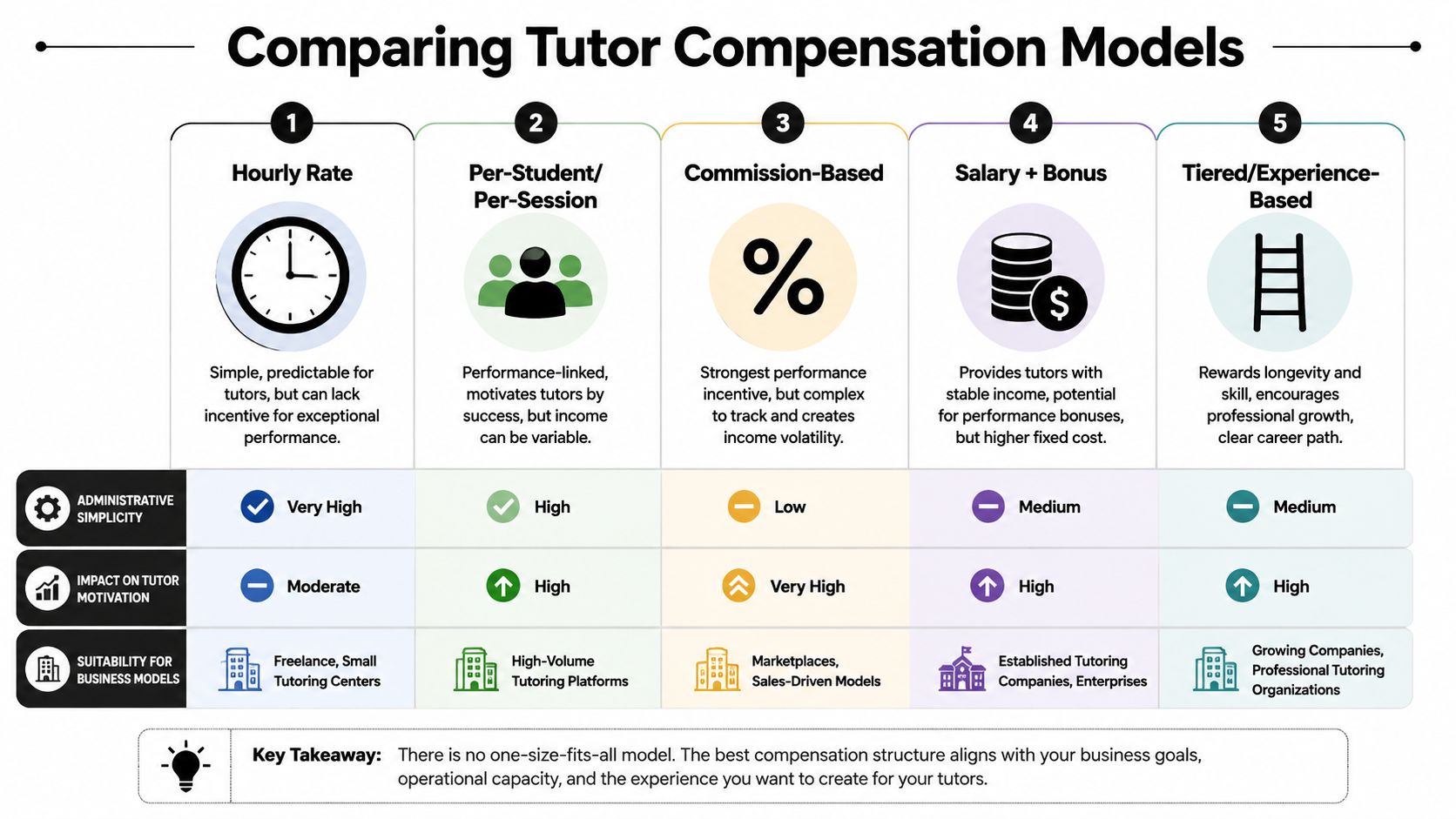
The five models below show up most often in tutoring, language schools, and test prep businesses. Each solves a different problem. Each also creates a different kind of admin burden.
Flat hourly rate
This is the easiest model to launch. A tutor teaches for one hour, you pay one set amount.
It works well when your center is still small, your services are mostly one-to-one, and your owner or ops manager needs simple payroll with very few exceptions.
Best for: early-stage tutoring centers, homework clubs, smaller language schools
What works
- Easy payroll: Admin can verify hours quickly
- Clear tutor expectations: Teachers know what they'll earn
- Straightforward hiring: Offers are simple to explain
What doesn't
- Weak incentive alignment: The tutor earns the same whether the class is full or half-empty
- Margin blindness: A low-fee service and a premium service can produce the same teacher cost structure
- More manual exceptions: You start adding side rules for weekends, group classes, or test prep
Per-lesson or per-student rate
This model ties pay to the session delivered, or to the number of students in that session. It's common in group tutoring and language schools.
A per-lesson model pays the same amount each time the class runs. A per-student model increases compensation as enrollment grows. That makes it more commercially aligned, especially in centers where group utilization matters.
Later in the section, the comparison table makes the trade-offs easier to scan.
Best for: group classes, enrichment programs, level-based language courses
What works
- Better alignment with class economics: Bigger groups can support higher teacher payout
- Useful for utilization: Teachers care more about class continuity
- More flexible packaging: Works across private, semi-private, and small groups
What doesn't
- Attendance complexity: Pay rules must define whether absent students count
- Harder payroll checks: Late changes affect compensation
- Potential frustration: Tutors may dislike volatile income
Revenue share percentage
With revenue share, you pay a percentage of collected or recognized lesson revenue. This is common when centers want pay to match the commercial value of the class.
It can be powerful for premium programs like SAT, ACT, IELTS, TOEFL, DELF, or Goethe prep, where pricing varies and specialist teachers expect a stronger upside.
Best for: premium subjects, senior instructors, workshop-heavy businesses
What works
- Strong incentive alignment: Teacher earnings move with the class value
- Margin discipline: Owners can protect a target spread between sales and payroll
- Good fit for specialists: Strong teachers often prefer upside over a flat rate
What doesn't
- Most complex administration: You need clean billing, attendance, and collection rules
- Disputes happen fast: Gross billed revenue and collected revenue are not the same
- Income variability: Some teachers won't accept it
Base salary plus variable pay
This model gives tutors a stable base and then adds variable compensation. The variable piece can reflect teaching load, premium subjects, workshops, or other agreed triggers.
This setup works well for centers that need stability. It's especially useful when teachers do more than teach, such as curriculum work, parent updates, placement assessments, or branch support.
Best for: full-time teams, multi-branch operations, academic directors, lead teachers
What works
- Predictability: Teachers can plan their income
- Lower turnover risk: Stable pay reduces stress
- Broader role design: You can compensate non-teaching duties fairly
What doesn't
- Higher fixed cost: Quiet months hurt more
- Needs tighter performance management: Variable rules must stay objective
- Can hide inefficiency: A weak schedule still carries a salary cost
Hybrid or tiered models
This is the most practical long-term option for many centers. You combine a base model with tiers, premiums, or service-based rules.
For example, you might pay one hourly rate for regular classes, a higher rate for advanced test prep, a separate per-student formula for groups, and a weekend premium for workshops. You can also create clear teacher bands, such as junior, standard, senior, and specialist.
Best for: established centers, multi-service businesses, operators who need flexibility
What works
- Matches reality: Different services carry different economics
- Clear career path: Tutors can see what moves them to the next tier
- Better staffing control: You can direct stronger tutors into the right programs
What doesn't
- Hard to manage in spreadsheets: Rule combinations multiply
- Needs documentation: Verbal exceptions create payroll disputes
- Requires regular review: Old tiers can drift away from actual business performance
Tutor compensation model comparison
| Model | Admin Simplicity | Incentive Alignment | Best For |
|---|---|---|---|
| Flat hourly rate | High | Low to medium | Small centers with mostly private lessons |
| Per-lesson or per-student | Medium | Medium to high | Group classes and language schools |
| Revenue share percentage | Low | High | Premium programs and specialist tutors |
| Base salary plus variable pay | Medium | Medium | Full-time teams with mixed responsibilities |
| Hybrid or tiered models | Low to medium | High | Growing centers with multiple service types |
The best model isn't the one that looks smartest on paper. It's the one your admin team can run accurately every single pay cycle.
How to Calculate Tutor Pay With Real-World Examples
Most pay models sound reasonable until you try to calculate them during a week with no-shows, changing attendance, and mixed lesson types. That's where weak systems break.
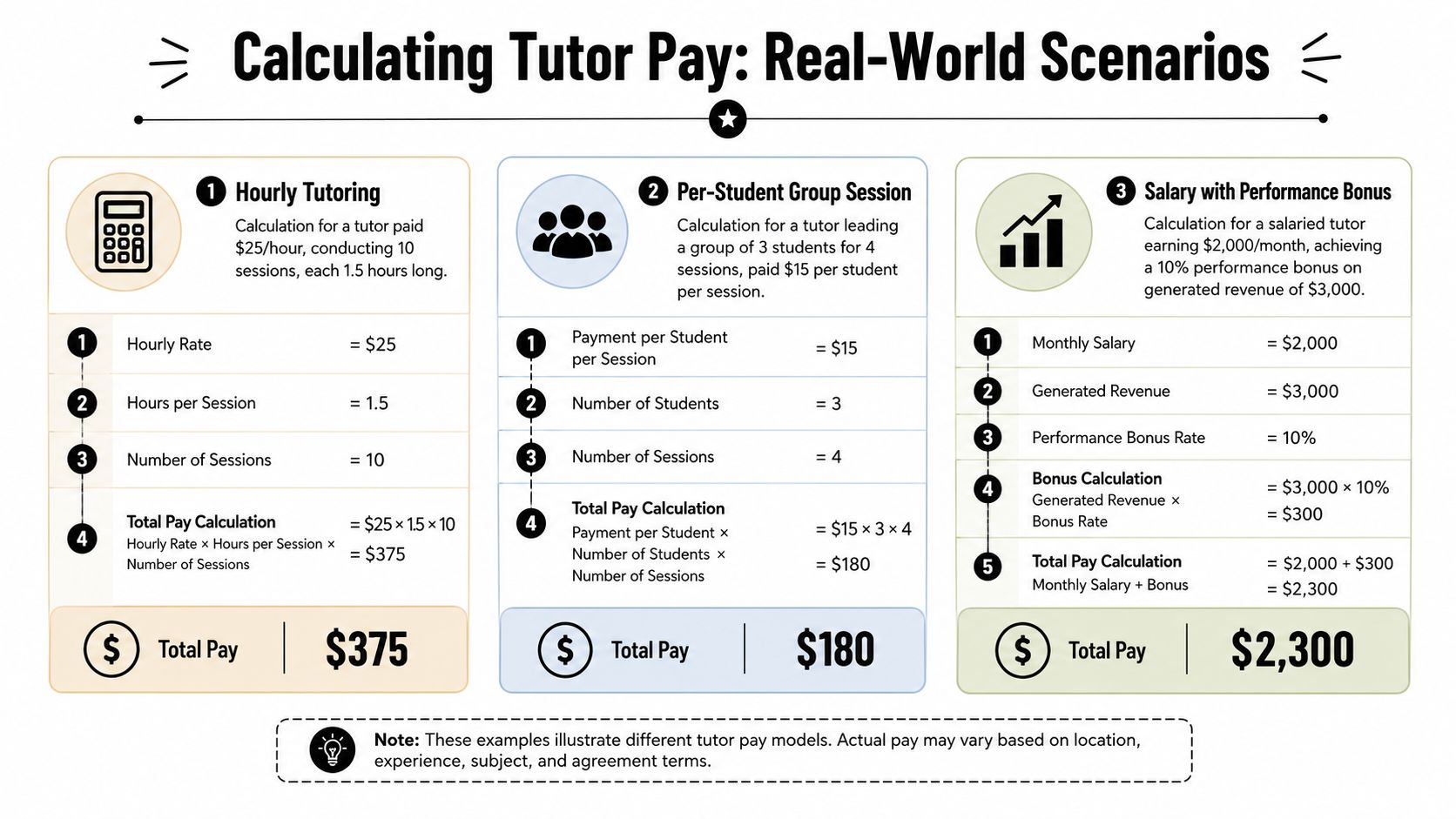
The cleanest way to build a fair scale is to define one formula per service type, then test whether those formulas keep your pay competitive. If you want a simple compensation benchmarking framework, this comp ratio formula guide is a useful reference for comparing actual pay to your intended midpoint.
Example one, revenue share for a group class
Use this when a tutor runs a group and you want pay tied to actual class revenue.
Formula:
- Lesson revenue: student fee × students attending
- Tutor pay: lesson revenue × agreed share
Example structure:
- Four students attend
- Each student pays the group lesson fee set for that service
- The tutor receives the agreed revenue share percentage for attended students
Your admin rule matters more than the arithmetic. Decide in advance whether pay is based on booked students, attended students, or collected revenue. If you don't lock that down, every cancellation becomes a negotiation.
Example two, tiered rate by teacher level and subject
Use this when a center offers different rates based on tutor band and program type.
A common setup looks like this:
- Junior tutor: standard subject rate
- Senior tutor: higher standard subject rate
- Specialist tutor: premium rate for advanced math, science, SAT, ACT, IELTS, or TOEFL
- Premium add-on: extra rate for weekend or peak-hour sessions
This model works because you can price the service and the payroll together. If your branch sells premium test prep, the pay scale should reflect that. If you're reviewing market positioning, this breakdown of what tutors really earn helps frame those conversations.
Example three, base pay plus workshop premium
This works for tutors who handle a regular weekly load and also take extra sessions.
Formula:
- Base pay: fixed amount for the agreed role
- Variable pay: extra amount for additional eligible sessions
- Premium pay: added amount for weekend or specialist workshops
Operator note: I always separate "core duty pay" from "extra duty pay" on paper, even if the teacher sees one total. When you lump everything together, nobody can audit the result later.
This approach is useful in test prep academies and multi-branch centers. A teacher can hold a stable timetable during the week and still earn more when they teach premium workshops, cover another branch, or take on specialized classes.
What to document before you run payroll
Before you approve any formula, write down these rules:
- Attendance trigger: attended, booked, or paid
- Cancellation treatment: free cancel, late cancel, no-show, center cancellation
- Premium conditions: which subject, branch, day, or time qualifies
- Settlement timing: weekly, bi-weekly, or monthly
If those four items aren't explicit, your teacher pay scale will drift into exception handling.
Legal and Tax Considerations You Cannot Ignore
A clever pay model won't save you if you've classified tutors incorrectly or ignored wage rules. Many tutoring businesses frequently show carelessness in these areas, especially when they grow from a few freelance teachers into a real operation with schedules, standards, and ongoing supervision.
The first question is simple. Are your tutors independent contractors or employees?
Contractor versus employee isn't a payroll preference
Owners often choose contractor status because it feels lighter. Less admin, fewer payroll obligations, more flexibility. But classification depends on how the work is structured.
If you set the timetable, control pricing, require use of your curriculum, assign students, supervise performance, and expect tutors to work inside your operating system, you've moved closer to an employment relationship. If a tutor controls how they work, brings their own methods, and operates more independently, contractor treatment may fit better.
For Australian operators, this hiring guide for Australian business owners is a practical read because it explains the distinction in business terms rather than legal jargon. If you're sorting out internal policy, this article on deciding tutor contractor status is also worth reviewing.
Overtime and wage rules catch owners by surprise
The second issue is overtime. A tutor can look "salaried" inside your spreadsheet while still triggering wage-and-hour obligations under local law.
That usually becomes a problem when you:
- Track fixed lesson hours: but forget prep, reporting, or waiting time
- Use flat monthly pay: without checking how many working hours the role requires
- Add workshops and substitution cover: without updating overtime treatment
- Mix employee and contractor logic: depending on which option seems cheaper that month
You need your accountant or labor lawyer to review your actual operating reality, not just your contract template.
Compliance starts with control. The more tightly you control teaching work, the less convincing a contractor label becomes.
The costly mistake
The most expensive payroll errors aren't math errors. They're classification errors.
A spreadsheet can hide them for a long time because it makes everyone look like a line item. Regulators won't view them that way. They look at supervision, dependency, work structure, and payment practices.
So before you optimize rates, bonuses, or branch premiums, make sure the legal foundation is solid.
How to Implement and Automate Your Teacher Pay Scale
Most pay systems don't fail because the model is bad. They fail because nobody can run them cleanly at scale.
A center starts with one hourly rate. Then it adds a weekend premium, a group class rule, a trial lesson exception, a test prep specialist rate, and a different cancellation treatment for private versus group lessons. Very quickly, payroll depends on memory.
Spreadsheets break when rule count grows
The admin pain usually comes from fragmentation.
Scheduling sits in Google Calendar. Billing sits in QuickBooks. Attendance lives in teacher messages or paper registers. Payroll gets calculated in Excel. If you run across multiple branches, the problem gets worse because room changes, substitute teachers, and class merges affect both invoices and compensation.
That fragmentation is exactly why operators look for tutoring management software, tutoring center software, and tutor scheduling software in the first place.
What automation should handle
A good system should connect lesson delivery to payroll rules automatically. It should pull from attendance, class type, assigned teacher, rate card, and any premium conditions without asking your team to re-enter the same information.

At minimum, your software should support:
- Multiple pay models: per-hour, per-lesson, per-student, revenue share, base plus variable, overtime
- Flexible settlement cycles: weekly, bi-weekly, or monthly
- Premium logic: subject, time slot, weekend, or branch-based additions
- Attendance-linked payroll: no separate manual calculation after classes finish
- Contractor workflows: including self-billing support where needed
A manual process can survive while you're small. It won't survive complexity.
Why flexibility matters in 2026
In 2026, review cycles matter more because pay pressure doesn't stop when nominal rates rise. The NEA's 2025 report confirmed that after adjustments, teachers earn about 5% less today than a decade ago, as summarized in this salary analysis. If your pay system is hard-coded in spreadsheets, regular updates become painful.
That's why operators should build pay rules that can be revised without rebuilding payroll from scratch. If your organization is also reviewing broader HR and employer-of-record support, this guide on switching education businesses to a PEO adds useful context.
If you're evaluating systems that support automated invoicing tutoring workflows and teacher payroll tutoring centers can trust, start with a platform that shows how to pay tutors automatically.
Software doesn't fix a bad compensation strategy. It does make a good one repeatable.
Frequently Asked Questions About Teacher Pay Scales
How do I set a competitive starting rate for tutors
Start with your local market, your subject mix, and the level of teacher you want to attract.
As a benchmark, the median wage for U.S. public school teachers was around $64,000 in 2024, while tutoring centers often pay certified teachers hourly rates of $35 to $65, based on the compensation figures summarized by US teacher pay data. Use that as orientation, then adjust for subject demand, schedule difficulty, and whether you expect teaching only or wider duties.
Should online and in-person tutors earn different rates
Sometimes yes, sometimes no.
If in-person teaching requires room supervision, branch travel, printed materials, or harder time slots, a differentiated rate can make sense. If the teaching load and expectations are basically identical, separate rates often create unnecessary resentment.
How should I pay for trial lessons
Keep trial rules simple and written. You can pay the normal rate, a fixed trial rate, or a lower guaranteed amount if the lesson includes sales support rather than full instruction.
The key is consistency. Trial lessons create confusion when admins improvise.
What should happen with no-shows and late cancellations
Decide this before the first dispute.
Many centers use one rule for center-caused cancellations and another for client-caused late cancellations. What matters is that teachers know the rule in advance and payroll follows the same logic every time.
How often should I review my teacher pay scale
Review it regularly, especially if you run premium subjects or multiple branches.
Don't wait for annual frustration to tell you something is off. Review after pricing changes, hiring difficulty, branch expansion, or repeated payroll disputes.
Which model is best for a growing center
Most growing centers end up with a hybrid model.
Pure hourly pay is easy, but it rarely fits private lessons, groups, workshops, and specialist programs equally well. A structured hybrid model usually gives you better margin control and a clearer path for teacher progression.
Can I keep using spreadsheets for payroll
You can, but the risk rises quickly once you add more teachers, more services, and more locations.
Spreadsheets don't understand attendance, cancellation policy, room changes, or branch-specific premiums. Your team does. That's exactly why payroll errors keep happening.
If you're tired of piecing together scheduling, billing, and payroll across spreadsheets and disconnected tools, Tutorbase gives tutoring centers and language schools one place to manage lessons, invoices, teacher payroll, rooms, and student records. It's built for operators handling real complexity across branches, programs, and pay models.


