


Key Takeaway: Stop relying on outdated annual plans or just fighting daily fires. Setting focused goals in a 90-day cycle for financial health, operational efficiency, student growth, and staff development is the key to unlocking sustainable growth for your tutoring center.
Running a tutoring business on a rigid annual plan often feels outdated by March. Alternatively, managing day-to-day chaos without a clear direction means you are busy, but not necessarily making progress. Quarterly planning provides the perfect balance.
This approach shifts your focus from a vague, year-long wish list to a concentrated 90-day sprint. It breaks your long-term vision into manageable segments, allowing you to adapt to the school year's natural rhythm while building consistent momentum toward your larger objectives.
Why Quarterly Planning Unlocks Tutoring Center Growth

A 90-day timeframe is long enough to achieve something meaningful, yet short enough to remain agile. You can adjust your goals for the back-to-school rush, mid-term exam season, or the summer slowdown. Instead of feeling paralyzed by a huge annual target, your team can concentrate on what is achievable in the next 12 weeks.
A quarterly plan is your operational compass. It connects the daily administrative tasks your team performs, like scheduling lessons and sending invoices, directly to the high-level growth you want to achieve.
The Four Pillars of a Successful Quarterly Plan
A strong quarterly plan addresses multiple aspects of your business. To build a healthy, sustainable tutoring center, you need to set goals for the core areas that keep your operations running smoothly. Concentrating on these four pillars ensures you are not just chasing growth at all costs.
- Financial Health: This is more than just top-line revenue. Think about profitability, healthy cash flow, and controlling operational costs like tutor payroll and room rental fees. A good goal here could be to increase your profit margin by 5% in Q3.
- Operational Excellence: How can you reduce administrative friction for your staff and parents? This pillar is all about goals to decrease admin time, improve scheduling efficiency, or eliminate double-bookings. An excellent goal is to cut manual invoicing time by 60%.
- Student Enrollment and Retention: This is the lifeblood of your business. Your goals should focus on attracting new students and, just as crucially, keeping your current families happy and enrolled. A specific goal might be to increase your trial lesson conversion rate by 10%.
- Staff Development and Utilization: Your tutors are your most valuable asset. This pillar covers goals for professional development, ensuring workloads are balanced, and maximizing teacher availability to meet student demand. For example, aim to maintain a teacher utilization rate of 80%.
By setting objectives in each of these categories every quarter, you create balanced growth. You avoid the trap of chasing new students while letting operational chaos or tutor burnout compromise your quality. For more strategies, see our guide on how to grow a tutoring business.
Defining the Numbers That Drive Your Business

Before you can set meaningful goals for the next 90 days, you must know what you are measuring. To get a real handle on your business, you need to speak its language, and that language is data.
Moving beyond simple revenue figures to track specific Key Performance Indicators (KPIs) is what separates stagnant tutoring centers from those that scale successfully. These are the vital signs of your business, turning vague ambitions like "grow more" into concrete, measurable targets. Without them, you are just guessing.
Financial Health Metrics
Revenue is important, but profitability is what sustains your business. Let's start with the core financial KPIs to understand not just what you are earning, but what you are keeping.
- Average Revenue Per Student (ARPS): This number tells you the average value of each student on a monthly or quarterly basis. It is crucial for understanding the real impact of your pricing, whether you promote group classes or high-value one-on-one sessions.
- Student Lifetime Value (LTV): How much revenue does the average student generate before they leave your center for good? A high LTV indicates happy families and strong retention, which is the bedrock of a stable business.
As a baseline, the average independent tutoring business generates around $75,000 in quarterly revenue. Franchise-operated centers can see 3-4x that amount, often thanks to their standardized systems. Knowing these benchmarks helps you set targets that are ambitious but still grounded in reality.
Operational Efficiency Metrics
Operational friction is a silent profit killer. These KPIs help you find and fix the small inefficiencies that drain your time and money. Client retention and operational smoothness go hand in hand; for example, figuring out how to reduce no-show appointments has a direct impact on your revenue.
- Classroom Utilization Rate: This calculates the percentage of time your physical or virtual rooms are actually used for paid lessons. A low rate might mean you have too much space or it could highlight a golden opportunity to fill empty slots with new programs.
- Teacher Workload Balance: Are some of your best tutors getting burned out while others have gaps in their schedules? Tracking lessons per teacher helps you distribute work fairly, prevent churn, and maximize your payroll efficiency.
By tracking operational KPIs, you shift from constantly fighting fires to proactively improving your business systems. This is how you reclaim the 10+ hours per week many owners lose to manual admin.
Growth and Retention Metrics
Acquiring new students is expensive; keeping them is profitable. These KPIs tell you how well your marketing and sales efforts are working, and more importantly, how good you are at keeping families satisfied long-term.
- Lead Conversion Rate: Of all the parents who inquire about your services, what percentage actually sign up and become paying students? This single number reveals the effectiveness of your entire intake process, from the first phone call to the trial lesson.
- Student Retention Rate: What percentage of your current students stick with you from one term to the next? A high retention rate is one of the strongest indicators of a healthy, thriving tutoring business. It means you are delivering real value.
Tracking these KPIs is the foundation for setting smart quarterly goals. For a deeper dive into which numbers to watch, check out our guide on building a powerful tutoring center KPIs dashboard.
Translating Your Vision into Actionable Quarterly Goals
Once you have identified your core KPIs, it is time to turn high-level ambitions into concrete, 90-day targets. This is where your strategy stops being a document and starts shaping your team's day-to-day actions. A vague hope like "get more students" does not provide a clear finish line. It is a wish, not a plan.
To drive real progress, you need objectives that are Specific, Measurable, Achievable, Relevant, and Time-bound, the classic SMART framework. This structure transforms a passive wish into an active mission for the next quarter.
From Vague Ideas to Specific Targets
Let's look at how to translate common tutoring center ambitions into goals that actually mean something. The key ingredients are always a number and a deadline.
Instead of: "We need more students."
Try: "Increase active student enrollment by 15%, from 100 to 115, by the end of Q3." This gives you a clear number to hit and a specific timeframe, which forces you to build a plan for how to get tutoring clients to reach that number.
Instead of: "I spend too much time on paperwork."
Try: "Cut time spent on manual invoicing by 50% by the end of Q2 by fully implementing our billing automation software." This goal names the problem, quantifies the desired improvement, and specifies the solution.
Instead of: "We should improve our trial lessons."
Try: "Lift our trial-to-enrollment conversion rate from 60% to 70% by the end of Q1." This zeroes in on a critical KPI and sets a measurable target for improvement.
As you get into the details of this process, it can be useful to see how others approach it. This piece on setting the right goals for your business offers some great perspectives that can help sharpen your thinking.
A Practical Framework for Goal Setting
To ensure you are growing in a balanced way, aim to set at least one SMART goal for each of the four business pillars we discussed earlier. This is crucial. It stops you from chasing revenue so hard that your operations start to fray or your best tutors burn out.
Your quarterly objectives should tell a clear story. A financial goal explains what you want to achieve, while your operational and growth goals explain how you plan to get there.
The table below is a great model for this, showing how you can turn vague hopes into powerful, specific objectives across your entire business. Use this as a template every 90 days to drive focused, intentional progress.
Example Quarterly SMART Goals for a Tutoring Center
Here is how this looks in practice. Notice how each "Vague Goal" is transformed into a clear, actionable mission with a number and a deadline attached.
| Business Area | Vague Goal | Quarterly SMART Goal Example |
|---|---|---|
| Financial Health | "Make more money." | "Boost quarterly revenue from $75,000 to $85,000 by filling 10 new slots in our high-demand after-school program by June 30th." |
| Operational Excellence | "Fix our scheduling." | "Achieve zero double-bookings for teachers and rooms in Q4 by fully adopting our new scheduling software's conflict detection feature." |
| Student Growth | "Get more SAT students." | "Increase SAT prep package sales by 20% compared to last year's Q2 through a targeted digital marketing campaign ending May 15th." |
| Staff Development | "Support our teachers." | "Improve teacher satisfaction score related to scheduling from 7/10 to 8.5/10 by the end of the quarter by implementing balanced workload tracking." |
This is the level of detail that turns a good quarter into a great one. It gives every person on your team a clear understanding of what "winning" looks like for the next 90 days.
Crafting Your 90-Day Action Plan
You have your SMART goals locked in. A goal sitting on a document, however, is just a well-intentioned wish. The real work happens when you translate that target into a concrete, week-by-week plan that your team can execute. This is your 90-day action plan, your operational roadmap for the quarter.
This is where we shift from the "what" to the "how." For every single goal, you need to break it down into the specific projects and tasks that will get you there. This is how high-level strategy connects to the daily grind.
From Objective to Initiative
Let’s use a classic tutoring center goal: "Increase active student enrollment by 15%, from 100 to 115, by the end of Q3." It is a solid target, but it will not happen on its own. Your action plan breaks this down into tangible projects.
So, what initiatives could drive this? Here are a few real-world examples:
- Launch a "Refer-a-Friend" Bonus: Offer current families a one-lesson credit for every new student they refer who signs up. This mobilizes your happiest customers to do your marketing for you.
- Run a Targeted Social Media Campaign: Create specific ads for your high-demand SAT prep courses and time them to run a few months before major test dates.
- Host a Free Parent Webinar: Put on a value-packed session like "Navigating College Admissions" to generate new leads and showcase your expertise.
This process is a natural flow from a big-picture vision to the small, specific steps that make it happen.
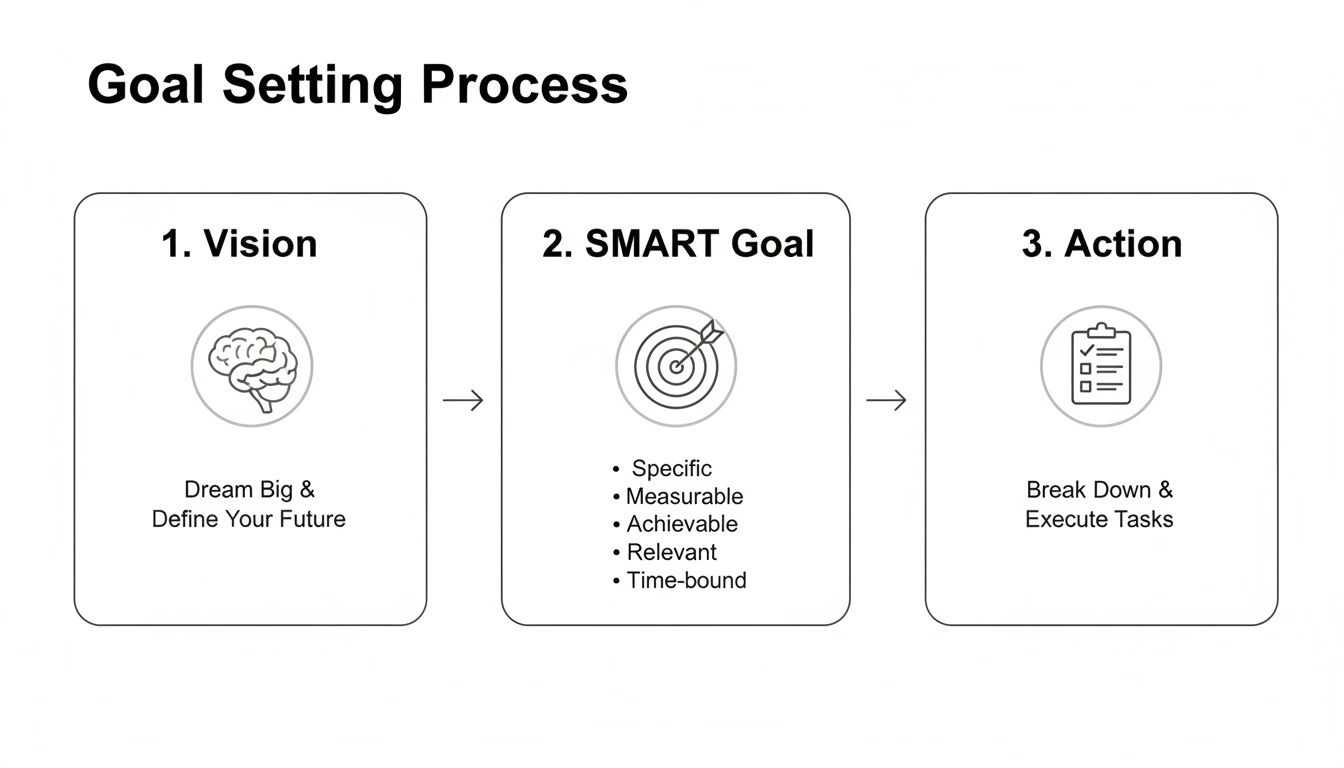
A big vision is only ever achieved through small, consistent actions that are directly tied back to a measurable goal.
Assigning Ownership and Deadlines
An idea without an owner is an idea that will die. For every initiative you list, assign a specific person who is responsible for seeing it through. Even if you are a one-person show and the owner is "you" for everything, writing it down creates a powerful sense of accountability.
A task without a name and a date attached to it will almost always fall through the cracks. Accountability is the engine of execution.
Next, give each task a realistic deadline within the 90-day window. This is not about creating a high-stress, rigid environment. It is about building momentum. Deadlines turn vague intentions into urgent priorities, ensuring your plan does not get steamrolled by the daily chaos of running a tutoring center.
By breaking down each goal into a checklist of owned, dated tasks, you are building a system that makes hitting your quarterly objectives not just possible, but probable. This proactive approach is the core of how to set tutoring business goals quarterly that actually get results.
Tracking Progress and Making Mid-Quarter Adjustments
Setting goals is the easy part. The real work is the disciplined, weekly act of checking in and having the courage to pivot when the numbers tell you to. This is what separates thriving tutoring businesses from the ones that stagnate.
A quarterly plan is not a stone tablet you carve and admire. It is a living guide you should review every week. If you are not looking at your key metrics regularly, you are essentially flying blind until the quarter ends, and by then, it is far too late to fix what is broken.
Creating Your Progress Dashboard
This is where a simple dashboard becomes your command center. You do not need an overly engineered, expensive system. A well-organized spreadsheet can work in the beginning. But this is where a dedicated platform like Tutorbase pays for itself, giving you a live, central dashboard that automatically tracks your most critical KPIs.
Your dashboard’s job is to give you an immediate, at-a-glance health check of your core objectives. For every single goal, you need just two numbers sitting side by side:
- The Target: The number you are aiming for by quarter-end (e.g., 115 active students).
- The Current Status: The real-time number, pulled right from your system (e.g., 107 active students).
This simple comparison strips away all the emotion and wishful thinking. It replaces gut feelings with cold, hard facts. You can see in a second if you are on track, pulling ahead, or falling behind.
The Rhythm of Review and Adjustment
Data is only valuable if you act on it. By setting up a consistent review cycle, you turn your dashboard from a passive report into an active management tool. This rhythm keeps the entire team locked in on the quarterly priorities.
A goal without a review cadence is just a number on a page. Weekly check-ins create accountability, while monthly reviews provide the space for strategic pivots.
This approach also keeps you in sync with the market. The global private tutoring market is projected to hit $192.09 billion by 2029, growing at a compound annual rate of 10%. That breaks down to a baseline quarterly growth expectation of about 2.4%. If your dashboard shows you are lagging behind that industry benchmark, it is a massive red flag telling you it's time to adjust your strategy now, not later. You can dig into the numbers in this in-depth market analysis.
Asking the Right Questions Mid-Quarter
During your monthly reviews, use the dashboard to anchor the conversation. Let’s say your goal to increase the trial-to-enrollment rate is sputtering. Your dashboard shows you are stuck at 62% when you should be climbing toward your 70% target.
Now you can stop guessing and start asking specific, data-driven questions:
- Are we on track to hit our goal? The data says a clear "no."
- What is slowing us down? This is where you dig deeper. Maybe you check your software and find that no-shows for trial lessons have spiked. Or perhaps you notice that conversion rates for a specific subject, like high-school calculus, are dragging the average down.
- Does our action plan need to change? Absolutely. The original plan is not delivering.
Armed with these insights, you can make an informed pivot. Instead of waiting until the quarter is over, you can immediately roll out a new action. Maybe you implement automated SMS reminders for trial lessons to reduce no-shows. Or perhaps you provide extra training to that calculus tutor on running a more compelling first session.
FAQs on Setting Quarterly Tutoring Business Goals
Here are answers to the most common questions tutoring center owners have about implementing a 90-day goal-setting framework.
How many goals should we set each quarter?
Focus is your superpower. Aim for three to five high-impact objectives per quarter. Any more than that, and you will spread your team so thin that nothing meaningful gets done. A solid mix covers these key areas: a financial goal (e.g., "Increase quarterly revenue by 10%"), an operational goal (e.g., "Cut admin time on payroll by 50%"), and a growth goal (e.g., "Improve student retention from 85% to 90%").
What should we do if we miss our quarterly goals?
Missing a goal is not a failure; it is a data point. It is telling you something important about your business, your plan, or the market. The worst thing you can do is ignore it. Get your team together for an honest review. Ask what went well, what roadblocks appeared, and why you missed the mark. This feedback loop makes your planning process smarter over time.
How can I get my team on board with these goals?
Involve your team from the beginning. When setting operational or student success goals, ask your teachers and administrators for their input. They are on the front lines and have the sharpest insights into what is actually possible. People who help build the plan feel a sense of ownership over it and are more motivated to see it through.
What are the best tools for tracking quarterly goals?
While a spreadsheet can get you started, it quickly becomes a bottleneck as you grow. Modern tutoring management software is the best tool because it provides a central, live dashboard to track your most important numbers automatically. For example, a platform like Tutorbase can show you real-time KPIs like student attendance, teacher utilization rates, and revenue per student, making your review process ten times more productive.
Why is a 90-day cycle better than an annual plan?
A 90-day cycle, or quarterly plan, allows your tutoring business to be more agile and responsive. The academic year has distinct seasons (e.g., back-to-school, exam prep, summer). Quarterly goals let you align your efforts with these natural cycles, making your targets more relevant and achievable. An annual plan set in January is often irrelevant by June.
How do I connect daily tasks to my quarterly goals?
Break each quarterly goal down into specific, weekly actions. For a goal like "Increase trial conversions by 10%," weekly actions could include "Week 1: Train staff on the new follow-up process," "Week 2: Launch targeted social media ads," and "Week 3: A/B test a new landing page." This connects high-level strategy directly to the team's daily work.
What is the first step to start quarterly planning?
The first step is to establish your baseline. Before setting any goals, you need to know your current numbers. Use your tutoring management software or records to pull your key metrics from the previous quarter, such as total revenue, student count, lead conversion rate, and student retention rate. This data provides the foundation for setting realistic and meaningful goals for the next 90 days.
Tracking KPIs, managing staff, and hitting your quarterly targets shouldn't feel like a second job. Tutorbase automates the administrative chaos—from scheduling and billing to payroll and reporting—giving you the real-time data you need to make smarter decisions. See how you can reduce admin time by 60% and get a live view of your business health by registering at tutorbase.com/register.


