


The average tutoring rate per hour for elementary students in the U.S. is between $25 to $50. However, rates in major cities like New York often reach $60-$80 per hour, influenced by tutor qualifications, subject complexity, and operational costs.
This guide breaks down the core factors that determine your pricing, how to calculate profitable rates, and how to use software to automate billing and scale your tutoring center.
Understanding Elementary Tutoring Rate Benchmarks
Setting the right price for your elementary tutoring services is a critical step in building a sustainable business. If you charge too little, you risk devaluing your services and struggling with profitability. If you charge too much, you may price yourself out of the local market. Strategic pricing comes from understanding reliable data.
The global private tutoring market recently reached $120.25 billion, with a significant portion driven by parents seeking support for elementary-aged children. With projections showing it will reach $192.09 billion by 2029, tutoring centers that optimize their pricing and operations are positioned for massive growth.
Comparing Rates By Region and Format
Your location and delivery format are two of the biggest factors that shape your pricing. An in-person session in a high-cost urban area will command a higher price than an online lesson delivered from a suburb. This difference reflects real-world costs like rent, utilities, and higher tutor salary expectations.
To give you a clearer picture, we’ve put together a breakdown of typical elementary tutoring rates across different markets.
Average Elementary Tutoring Rates Per Hour by Region
This table provides a comparative overview of typical hourly rates for K-5 tutoring, segmented by geographical market and delivery format. Use it to benchmark your services against the competitive landscape in your area.
| Region | In-Person Rate (USD) | Online Rate (USD) | Key Market Drivers |
|---|---|---|---|
| North America (Major Cities) | $50 - $80 | $35 - $60 | High demand for STEM, competitive school admissions, high cost of living. |
| North America (Suburban/Rural) | $30 - $50 | $25 - $40 | Focus on core subject support (math/reading), more price-sensitive market. |
| Europe (e.g., UK, Germany) | $40 - $70 | $30 - $55 | Strong emphasis on language learning, curriculum alignment, and exam prep. |
| Asia (e.g., Singapore, Hong Kong) | $45 - $85 | $35 - $60 | Highly competitive academic culture, demand for enrichment and advanced topics. |
Think of this table as a starting point to benchmark your services against what parents in your region expect to pay. For more ideas on structuring your offers, it’s always helpful to see how other platforms do it—checking out Kubrio's pricing page, for example, can give you some great insights.
Understanding these benchmarks is the first step in building a confident pricing strategy.
The Five Core Factors That Shape Your Tutoring Prices
Determining what to charge for elementary tutoring involves more than just matching local competitors. Your price tag communicates the value you offer. By mastering a few key factors, you can confidently define that value and justify your rates.
When you get these variables right, you shift from asking, "What are others charging?" to "What is our service actually worth?" Let's break down the five elements that give you real pricing power.
Tutor Qualifications and Experience
The expertise of your teaching staff is the single most important factor driving your rates. A certified teacher with a decade of classroom experience and a master’s degree can and should command a much higher rate than a college student. Parents invest in experience, not just homework help.
- Certified Teachers: Their formal training and real-world classroom experience are highly valued by parents.
- Subject Matter Experts: A tutor with a specialized math degree brings a higher level of authority to STEM subjects.
- Years of Experience: A veteran tutor has a proven track record of getting results, which provides parents with peace of mind.
Subject Complexity
Not all elementary subjects are priced equally. General homework help for a third-grader is different from specialized reading intervention for a student with dyslexia. The more niche the skill, the higher the rate you can charge. For example, a specialized program like Orton-Gillingham reading support can command a premium of 25-50% more per hour.
Lesson Format and Structure
How you structure your lessons directly impacts your pricing. One-on-one sessions offer a personalized experience and command the highest price. Small group sessions provide a more affordable option for parents while allowing you to boost your total hourly revenue.
- One-on-one sessions typically range from $40-$100+ per hour, offering completely undivided attention.
- Small group tutoring can be priced lower per student, from $19-$50 per hour, creating a collaborative learning environment.
Geographic Location
Your physical location matters significantly. Tutoring centers in major cities with a high cost of living, like New York or Los Angeles, can charge more than a center in a quiet suburb. Your pricing must reflect your operational costs, including rent and competitive local salaries.
Delivery Method
The choice between in-person and online tutoring also affects your pricing. In-person tutoring often justifies a higher rate due to the overhead costs of a physical space. Online tutoring can be offered at a slightly lower price, making it accessible to more families and expanding your market beyond your local area.
Calculating Your Break-Even Point for Profitable Rates
Relying on market benchmarks is a good start, but sustainable profit comes from understanding your business's unique finances. Before you set a price, you must find your break-even point—the minimum you must charge per hour just to cover all your costs. This number is your financial baseline that separates profit from loss.
To calculate it, you need to add up every fixed and variable cost associated with running your tutoring center. This infographic breaks down the core components that build your final rate.
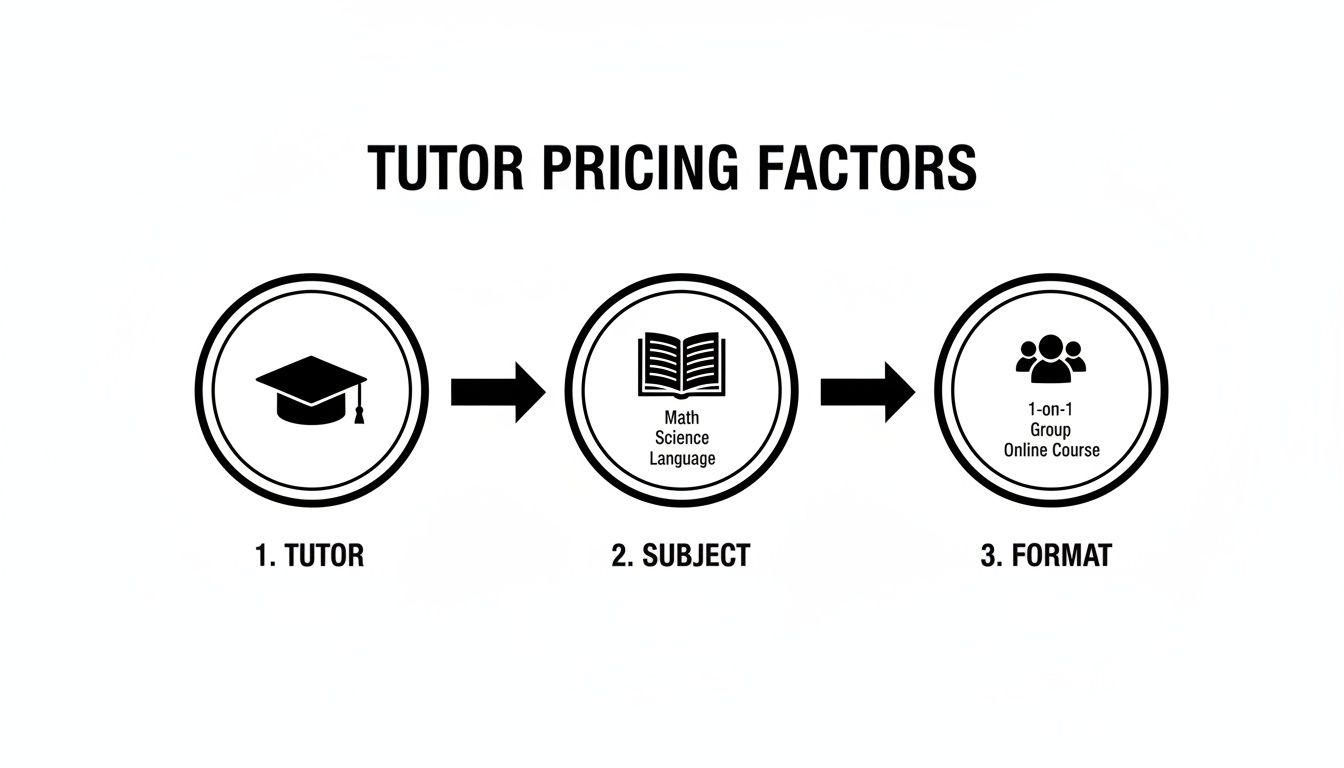
As you can see, your price starts with foundational costs like tutor pay and grows from there, adding layers for things like subject complexity and lesson format.
Identifying Your Core Costs
First, organize your expenses into two categories to ensure nothing is missed. Every dollar you spend falls into one of these buckets.
- Fixed Costs: These are your predictable monthly bills that do not change with student volume. They include rent, software subscriptions (like Tutorbase), insurance, and admin staff salaries.
- Variable Costs: These expenses fluctuate with your business activity. The largest is tutor payroll, which increases with every lesson taught. Others include workbooks and payment processing fees.
Once you have tallied your fixed and variable costs, a simple formula gives you your break-even rate. We have a detailed guide that walks you through the exact steps for calculating your tutoring center's profitability and break-even point.
Your break-even rate is your starting line, not your final price. At this rate, you are not losing money, but you are not making any either. Profitability begins after this point. Once you know your break-even number, add a healthy profit margin. For most tutoring businesses, a margin between 20% and 40% is a sustainable target. This provides capital for reinvestment and growth. Getting comfortable with concepts like budgeting for profit is key.
Moving Beyond the Standard Hourly Rate
A simple hourly rate is a fine place to start, but relying on it exclusively caps your tutoring center's growth. The pay-per-session model creates unpredictable cash flow and frames your service as a transaction, not a long-term partnership. Successful tutoring centers move beyond this model to create stability and deliver more value.
Shifting to smarter pricing structures, like packages and subscriptions, secures client commitment, boosts retention, and transforms your revenue into a predictable stream. This isn't just a billing change; it's a strategic move that enhances your entire business.
Why Packages and Subscriptions Work Better
Selling lessons in blocks, or "packages," is one of the fastest ways to increase client lifetime value. Instead of booking single lessons, parents commit to a bundle of 10, 20, or 50 hours upfront. This locks in revenue and helps you fill your schedule months in advance.
Subscriptions create reliable, recurring monthly revenue. A family might subscribe to "8 sessions per month" for a flat fee, which simplifies their budgeting and stabilizes your cash flow. This model builds loyalty and dramatically reduces the client churn that plagues hourly billing. The goal is to shift the parent mindset from "buying an hour of help" to "investing in a long-term academic partnership."
Managing these models manually across multiple branches is an administrative nightmare that erodes profits. This is where software like Tutorbase becomes essential. It automates the entire process, from managing prepaid credit balances and auto-deducting hours to processing recurring payments, slashing admin time by up to 60%. This automation enables you to implement dynamic pricing that directly lifts revenue. For more on how technology is shaping the industry, you can check out recent data on the K-12 tutoring market's growth.
Choosing the Right Model for Your Center
The best strategy often involves offering a mix of models to cater to different client needs. You can design various tiers to attract a wider range of families, from those needing a short-term test-prep boost to others seeking consistent, year-round academic support.
A platform like Tutorbase is built to handle this complexity. Its "Policy Packs" feature lets you create and automate different pricing structures—per-hour, per-lesson, packages, or subscriptions. You can apply rules globally, by location, by service, or even to an individual student. This flexibility allows you to design offerings that maximize revenue and client satisfaction, while the system handles all the tedious tracking and billing.
To help you decide which models might fit your center, here’s a quick breakdown of how these different pricing strategies stack up.
Comparison of Tutoring Pricing Models
This table breaks down the most common pricing strategies, highlighting their primary benefits for both your tutoring center and your clients.
| Pricing Model | Best For Cash Flow | Best For Client Retention | Example Use Case |
|---|---|---|---|
| Per-Hour | Low | Low | A new student taking a single trial lesson before committing. |
| Package (10+ Lessons) | High | Medium | A family buying a block of hours for targeted exam preparation. |
| Subscription (Monthly) | Highest | Highest | A student enrolled for ongoing math support throughout the school year. |
Moving clients from hourly billing to packages or subscriptions is a clear win for both cash flow and retention. While the hourly rate has its place for trials, your goal should be to make package and subscription offerings the core of your business.
How to Structure Smart Policies That Protect Your Revenue
The most challenging parts of running a tutoring business are often not related to teaching. They involve chasing late payments, handling last-minute cancellations, and managing no-shows. Well-defined policies are your best defense against these operational headaches.
Without clear rules, you face the same painful conversations repeatedly, which drains time and can damage client relationships. Smart policies set clear, fair expectations that protect your revenue and your tutors' time. The key is to apply them consistently to every client.
Establishing Firm Cancellation Policies
Your cancellation policy is the most important one you will set. Every last-minute cancellation creates an empty slot and represents lost revenue. You need a policy that is fair to families but firm enough to be a real deterrent.
First, define your notice period. The industry standard is a 24 to 48-hour window. If a client cancels inside that window, there must be a clear consequence.
- Full Lesson Charge: This is the most common approach. If a parent cancels with less than 24 hours' notice, they are charged the full amount.
- Percentage Fee: Some centers charge a partial fee, like 50% of the lesson cost, for a late cancellation.
- No-Shows: A "no-show" with zero communication should always result in a full charge, respecting your tutor's commitment.
Tracking cancellations and applying fees manually is an administrative nightmare. A system like Tutorbase lets you automate these rules in a "Policy Pack." You set the rules once, and the software automatically applies the late fee or deducts a credit from a package, eliminating awkward follow-up calls.
Driving Behavior with Strategic Discounts
Policies can also encourage desirable behaviors. Use discounts as incentives to fill your schedule, lock in commitment, and improve cash flow. Go beyond the standard hourly rate and think strategically.
- Sibling Discounts: Offering a 10-15% discount for a second or third child can make your center the default choice for families.
- Early-Bird Offers: A small discount for paying before a certain date can significantly improve your cash flow for the next term.
- Package Deals: Offer a slightly lower per-lesson rate for a pre-paid package of 10 or 20 lessons to secure revenue upfront and increase student retention.
When these policies are built into your management system, they become a seamless part of your operation, protecting your bottom line while guiding clients toward choices that benefit everyone.
Scaling Your Pricing Strategy with Management Software
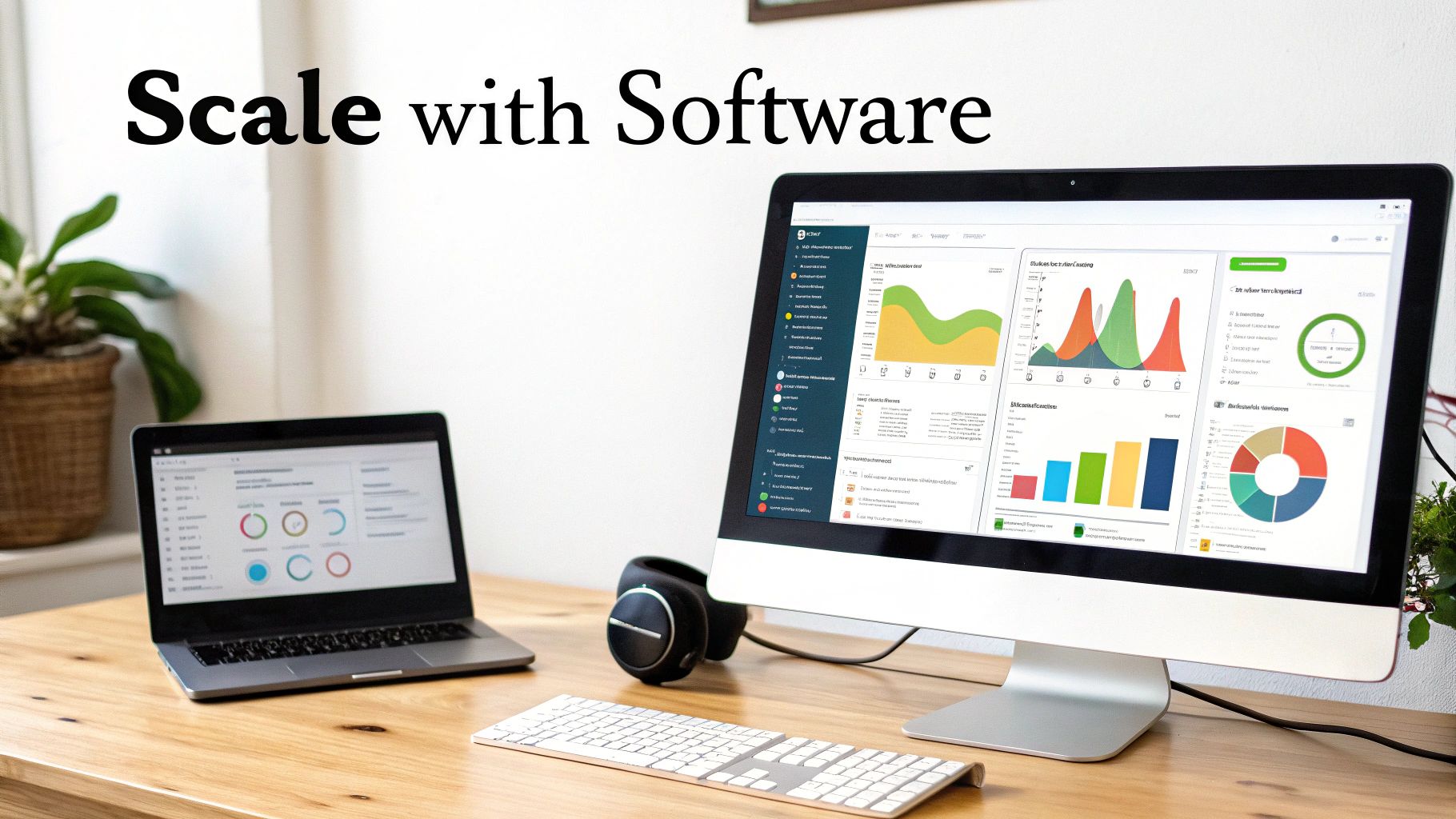
When your tutoring center grows, the spreadsheets and manual processes you relied on will begin to fail. Managing complex pricing, varied tutor payroll, and consistent invoicing becomes an administrative burden that erodes your profits. Scaling successfully requires swapping manual effort for intelligent automation.
Dedicated tutoring management software becomes a game-changer, transforming your financial operations. Instead of spending 10+ hours per week cross-referencing calendars with payroll sheets, the right system handles it all automatically.
Automate Complex Pricing and Payroll
One of the biggest scaling challenges is managing varied pricing structures. You might have different tutoring rates per hour elementary students pay at your downtown branch versus your suburban one. Your tutors also likely have unique pay rates based on experience, subject, or weekend premiums.
Tutoring management software like Tutorbase is built for this complexity. With layered pricing policies, you can set rates that apply globally, per location, per service, or to a single student. This gives you the power to implement a sophisticated pricing strategy without the manual tracking headaches. By automating the link between attendance, invoicing, and payroll, you eliminate human errors that cost centers thousands in lost revenue and overpayments.
The impact is huge. For growing centers, integrated tools are non-negotiable. The US has over 182,700 tutors, but fragmented tools lead to operational losses. Centralized platforms that offer auto-invoicing from attendance, handle complex payroll models, and prevent scheduling conflicts can cut admin work by 60% and triple student onboarding speed. You can learn more about the tutoring industry's operational landscape and statistics here.
From Manual Invoicing to Flawless Billing
Manually creating invoices is a bottleneck that prevents growth. Every hour spent on invoices is an hour not spent on marketing or curriculum development. Modern tutoring billing software automates this entire process.
Here’s how a seamless workflow looks:
- A lesson is marked as "Attended."
- The system instantly generates an invoice item based on the student's pre-set rate.
- Invoices are automatically compiled and sent to parents on your chosen schedule.
- Payments are tracked, and reminders are sent for overdue balances.
This automation frees your team to focus on high-value tasks that grow the business. By implementing a system to handle repetitive financial work, you build a scalable foundation that supports expansion without hiring more admin staff, reducing admin time by over 60%.
FAQ: Common Questions About Tutoring Rates
Setting your prices can be challenging. Here are straightforward answers to the most common questions from tutoring center owners.
What is a good profit margin for a tutoring business?
A healthy, sustainable profit margin for a tutoring center typically falls between 20% and 40%. The final number depends on your local market, operational costs, and the perceived value of your programs. First, calculate your break-even point for each tutoring hour, then add your target margin on top.
How much should I charge for online vs in-person tutoring?
It is standard practice to charge 15-30% more for in-person tutoring than for online sessions. This premium covers overhead costs like rent, utilities, and physical materials. For example, if you charge $35 per hour for an online lesson, a similar in-person session might be priced around $40-$45.
Should I display my tutoring rates on my website?
Yes, you should display your rates on your website. Being transparent with your pricing builds immediate trust and saves time for both you and potential clients. When you display your rates, or at least a starting price range, you pre-qualify leads, ensuring that families who contact you are already comfortable with your price point.
What is the average tutoring rate per hour for elementary school?
In 2024, the average tutoring rate per hour for elementary students in the United States ranges from $25 to $50. Rates can be significantly higher in major metropolitan areas with a high cost of living, where they can reach $60 to $80 per hour, especially for specialized subjects or highly qualified tutors.
How can I justify charging higher tutoring rates?
You can justify higher rates by highlighting the value you provide. Emphasize your tutors' advanced qualifications, such as teaching certifications or specialized degrees. Showcase a proven track record of student success, offer a specialized curriculum, and provide a premium learning environment, whether in-person or online.
Managing different pricing tiers, policies, and payroll with spreadsheets is a recipe for burnout. Tutorbase automates your entire financial workflow—from setting up layered pricing and packages to handling invoicing and payroll—so you can scale your business with clarity and confidence. Start automating your center today.


