


A lot of families start looking for in person tutoring services after a frustrating stretch. A child understands the material at school one week, then falls behind the next, and every option online starts to look the same. At the same time, many tutoring center owners are behind the front desk juggling lesson changes, room conflicts, missed invoices, and parent messages.
Those two problems connect more than one might assume. When a center runs clean operations, parents get reliable scheduling, clear communication, stable tutors, and better follow-through. When operations break, quality feels inconsistent even if the teaching itself is strong.
Key Takeaway: In-person tutoring still dominates because families value structure, face-to-face feedback, and dependable routines. For parents, choosing well means looking past the tutor profile and checking how the center runs. For owners, strong service quality starts with scheduling, room control, billing, and teacher workload management.
Why In-Person Tutoring Still Thrives in a Digital World
A parent calls on Tuesday asking for help in math, wants after-school availability, and needs a tutor who can explain patiently without rushing. The center owner wants to say yes, but first has to check teacher availability, room capacity, existing groups, and whether a sibling can attend at the same branch. That interaction says a lot about why in person tutoring services still matter. Families aren't only buying subject support. They're buying reliability, routine, and a place where learning happens.
The market still reflects that preference. In-person tutoring accounts for approximately 74% of global private tutoring revenue, while online tutoring holds 26%, and the global private tutoring market reached $97.11 billion in 2023 after a 6% increase from 2022, according to ConsumerAffairs tutoring market data.
Why parents still choose the physical classroom
Face-to-face tutoring gives students a defined place and time to work. That matters more than many families expect.
A good tutor notices hesitation before a student says, "I don't get it." A strong center notices whether a student arrives flustered, distracted, tired, or ready to work. Those small signals shape the lesson.
- Immediate feedback: Tutors can correct posture, writing habits, problem setup, and attention drift in real time.
- Stronger routine: Students show up to a dedicated learning space instead of trying to focus in a bedroom or kitchen.
- Lower friction for families: A recurring slot often creates more consistency than rebooking each week.
In-person tutoring works best when the center treats consistency as part of instruction, not just administration.
Why owners still build around in-person delivery
Owners see another side of this. Physical centers create operational complexity, but they also create a better service standard when managed well. Room assignments, teacher matching, branch coordination, and attendance tracking all shape the parent's experience.
That's why the quality of in person tutoring services isn't only a teaching question. It's also an operations question. The parent sees the lesson. The owner sees the system underneath it. The strongest centers learn to manage both.
Understanding the Tutoring Models In-Person Online and Hybrid
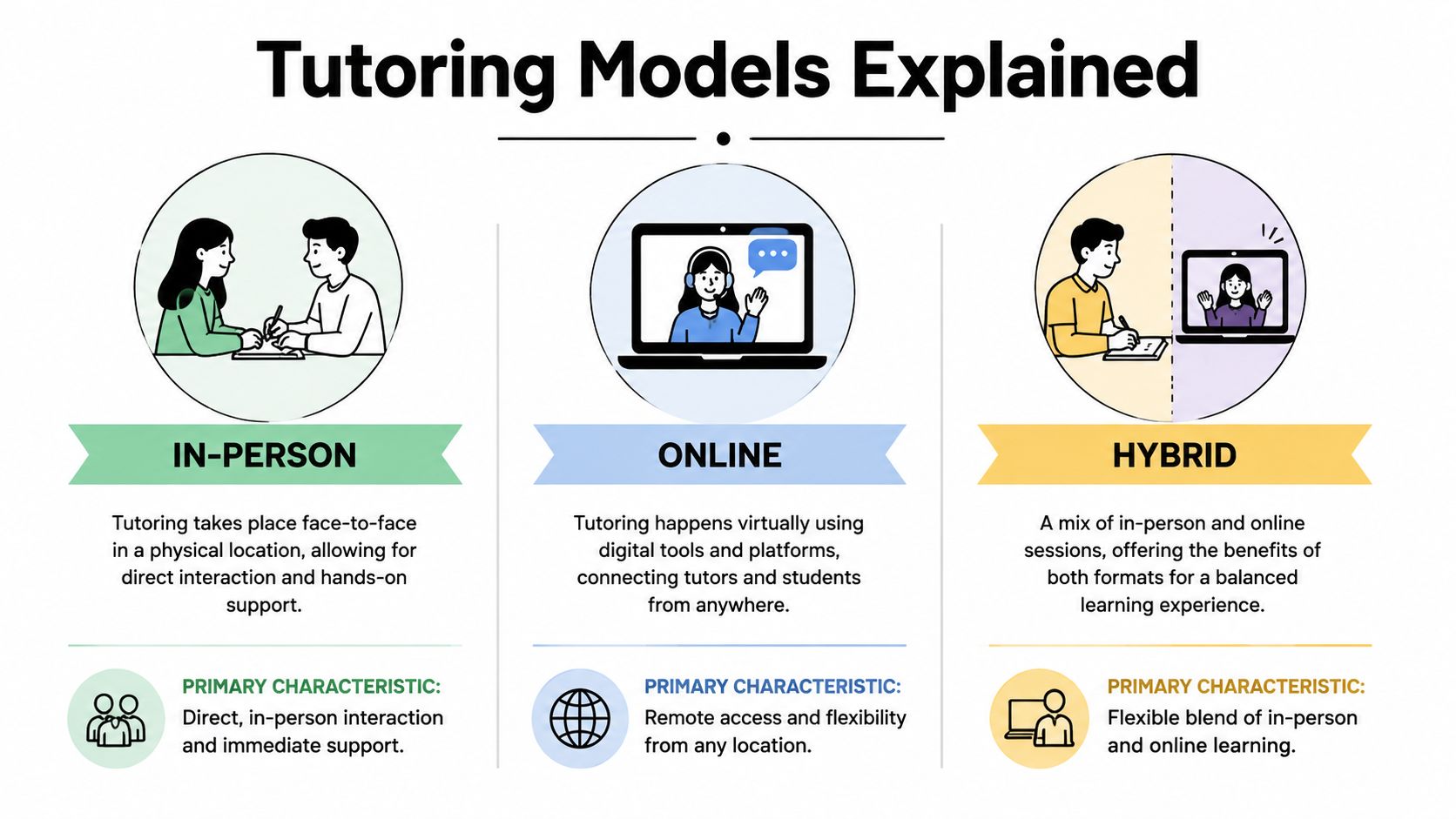
Not every tutoring format solves the same problem. Parents often compare "tutoring" as if it's one thing, but in person, online, and hybrid models work very differently in practice.
In-person tutoring
In-person tutoring happens in a physical setting. That might mean one-to-one support, a small group, or a classroom-style lesson at a tutoring center, language school, music school, or after-school program.
In-person tutoring resembles a training session at a gym. The space, schedule, and coach all matter. Students don't just receive instruction. They enter an environment designed for focus.
In a typical center, in-person services involve:
- Fixed appointments: Weekly or bi-weekly sessions at the same time.
- Room allocation: The lesson needs a physical seat, not just a tutor.
- On-site supervision: Front desk staff, branch managers, or coordinators often support check-in and transitions.
Online tutoring
Online tutoring can be live or more flexible. Live online tutoring happens through video, shared whiteboards, or chat at a scheduled time. More flexible models let students request help as needed, often without a fixed ongoing slot.
This format works like remote consulting. It can be efficient, but the student usually needs to log in, stay engaged, and manage their environment without much external structure.
Online tutoring often fits families who want:
- Location flexibility: No travel time.
- Specialist access: A tutor doesn't need to live nearby.
- Fast setup: Sessions can start quickly if the platform is organized well.
Hybrid tutoring
Hybrid tutoring blends physical and virtual delivery. A student may attend in person one week and online the next. In some centers, one class includes both students sitting in the room and students joining remotely.
This model can work well, but only if the center tracks attendance mode, teacher setup, and billing rules clearly. Otherwise, hybrid becomes messy fast.
For owners, hybrid requires stronger systems than either pure in-person or pure online. You need to know who is attending, where they are attending from, which room is booked, and what pricing policy applies. That's why many centers eventually look for better ways to manage how to schedule tutoring sessions efficiently.
Hybrid isn't a halfway option. It is its own operating model, and it needs its own rules.
A Parent's Guide to Choosing the Right Tutoring Service
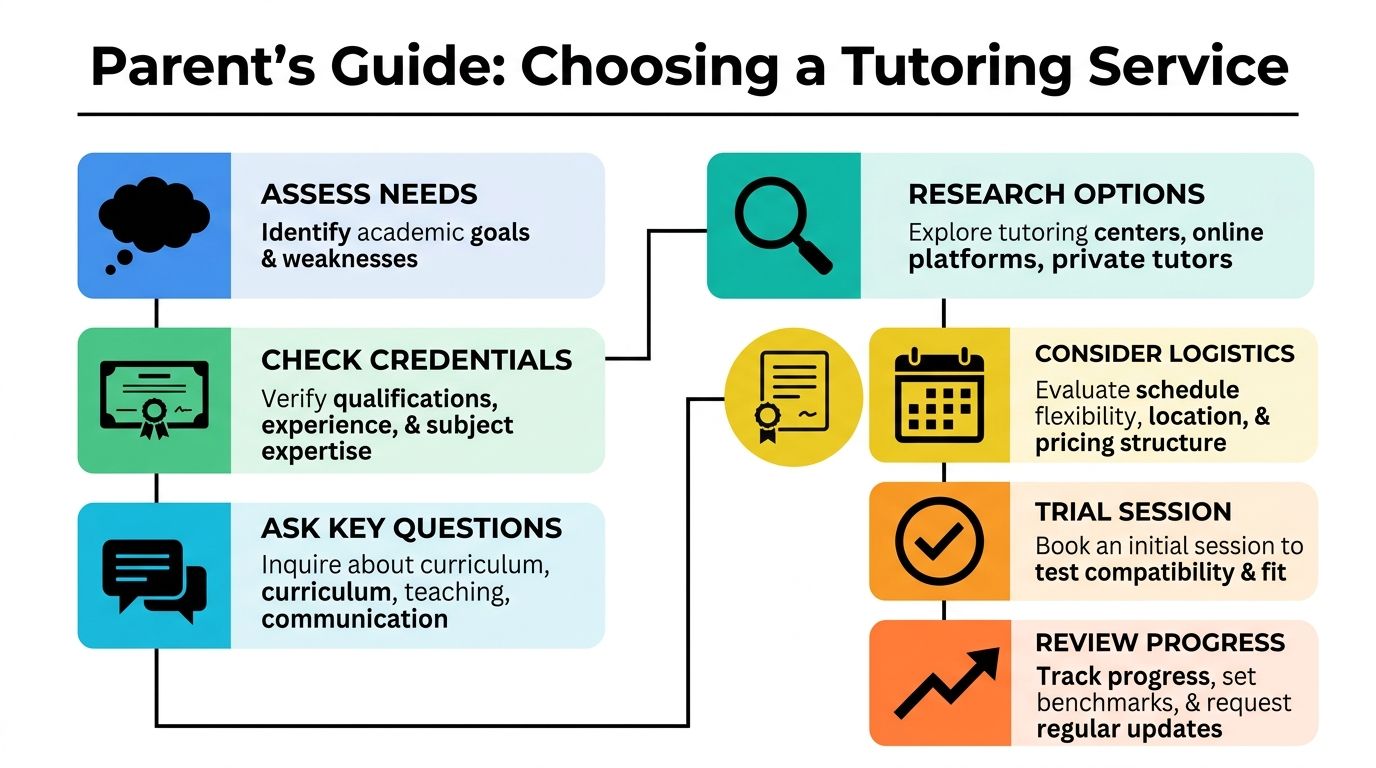
Parents usually start with the obvious question, "Is this tutor good?" That's important, but it isn't enough. A tutoring service can hire capable tutors and still deliver a poor experience if scheduling is chaotic, communication is weak, or progress reporting is vague.
Start with the learning problem
Be specific before you contact anyone. "My child needs help with math" is too broad. Is the issue confidence, homework completion, exam technique, reading comprehension in word problems, or weak foundations from an earlier grade?
Ask yourself:
- What subject needs support? Math, English, science, test prep, a language, music theory, or another area.
- What level is involved? Elementary support looks different from AP, IB, SAT, IELTS, or DELF coaching.
- What outcome matters? Better grades, stronger habits, exam readiness, or confidence.
Ask the center practical questions
Good centers answer operational questions clearly. If they sound vague, parents usually feel the consequences later.
Here are useful questions to ask:
- Tutor fit: Who teaches this subject and level, and how do you match tutors to students?
- Lesson format: Is this one-to-one, small group, or a larger class?
- Progress reporting: How will I know whether my child is improving?
- Consistency: Will my child keep the same tutor and time slot?
- Attendance handling: What happens if my child misses a lesson?
- Safety and supervision: How do drop-off, pickup, and on-site supervision work?
Practical rule: If a center can't explain its process simply, it probably can't run it consistently.
Understand the pricing model
Parents often compare only the headline price, but the billing structure changes the experience.
| Pricing model | What it means for parents | Best fit |
|---|---|---|
| Per-hour | You pay for each hour booked | Flexible support, occasional sessions |
| Per-lesson | You pay by scheduled class or session | Stable weekly routines |
| Package | You buy a block of lessons upfront | Short-term goals, exam prep |
| Subscription | Recurring monthly fee | Ongoing academic support |
A few details matter more than the advertised price:
- Cancellation terms: Ask how late cancellations work.
- Make-up lessons: Find out whether catch-up sessions are offered.
- Trial lessons: A trial can reveal fit faster than a long sales conversation.
Look for signs of a well-run center
Parents can usually spot operational quality in one visit.
A strong center tends to have:
- Clear communication
- Organized check-in
- Visible schedules
- Defined expectations
- Follow-up after lessons
A weak center often feels rushed. Staff search through messages, tutors seem surprised by new students, and no one can explain the next step cleanly.
That difference matters. In person tutoring services work best when the teaching quality and the logistics support each other.
An Owner's Guide to Streamlining Center Operations
Most operational problems in tutoring centers don't come from lack of effort. They come from fragmented systems. Scheduling lives in Google Calendar, invoices sit in QuickBooks, payroll runs through Excel, and lesson changes come through WhatsApp, email, and front-desk notes. The owner spends evenings stitching everything together.
That setup doesn't break all at once. It leaks money unnoticed until growth makes the mess impossible to ignore.
Data shows that 30-40% of tutoring center revenue is lost to double-bookings and suboptimal room scheduling, and the number of in-person private tutoring centers in the United States more than tripled between 1997 and 2022, according to Education Next on the tutoring boom and center growth.
Where centers lose time and margin
Owners usually feel the pain in five places first:
- Fragmented tools: Google Calendar for schedules, QuickBooks for billing, Excel for payroll.
- Manual admin: Hand-built invoices, payment chasing, staff cross-checking attendance.
- Booking conflicts: Teachers get double-booked, rooms get overfilled, makeup lessons pile up.
- No visibility: You can't see which branch is full, which room sits empty, or which teacher is overloaded.
- Owner dependency: Staff still need the owner to resolve routine scheduling and billing issues.
What modern tutoring management software should handle
If you're running 5 to 100+ teachers across 1 to 10+ branches, and managing 50 to 10,000+ lessons per week, the software needs to match the reality of the business.
A useful system should cover:
| Area | What you need |
|---|---|
| Scheduling | Auto-generated teacher, room, and time combinations, recurring lessons, conflict detection |
| Locations and rooms | Branch-level visibility, room capacity, room features, room fees |
| Attendance | Scheduled, attended, no-show, cancelled, late cancelled, plus in-person vs online tracking |
| Billing | Invoice generation from attendance, prepaid credits, packages, subscriptions |
| Payroll | Per-hour, per-lesson, per-student, revenue share, base plus variable, overtime |
| CRM | Lead capture from forms, walk-ins, phone, and WhatsApp, with conversion tracking |
What actually changes after consolidation
The gains aren't theoretical. They show up in the daily grind.
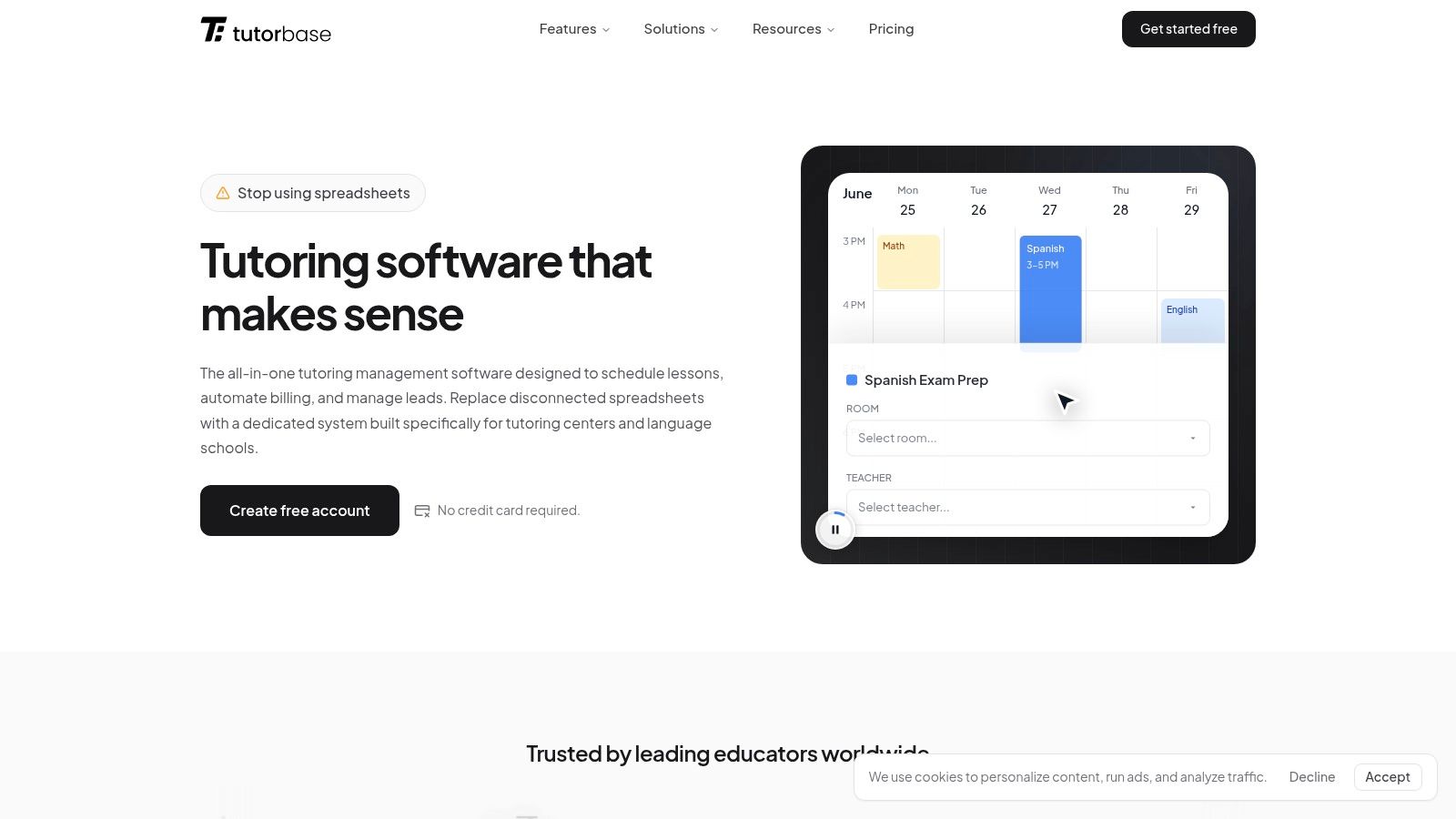
Tutorbase is one example of tutoring management software built for centers and language schools that want scheduling, billing, payroll, room management, and student tracking in one platform. It includes Find Slot for auto-generating teacher, room, and time combinations, Find Spot for filling existing classes with open seats, multi-branch room tracking, automatic room fees on invoices, hybrid attendance tracking, prepaid credits, and payroll models beyond basic hourly setups. It also positions itself as a Teachworks alternative, TutorCruncher alternative, and TutorBird alternative for centers that have outgrown manual work.
Its published operating metrics claim a 60% reduction in admin time, 3x faster student onboarding, a 42% increase in monthly renewals, zero double-bookings, and invoice processing reduced from hours to minutes. Those are vendor-reported product metrics, so owners should still map them against their own workflows and staff habits.
Clean operations protect teaching quality. When staff stop calendar hunting, they spend more time preparing students and speaking with parents.
Owners who want a broader operational lens should also study RevOps process strategies from MarTech Do. The principles transfer well to tutoring centers because the same issue shows up in both worlds. Handoffs fail when sales, service, finance, and scheduling each run on separate logic.
A practical operating standard for 2026
In 2026, a center should be able to answer these questions instantly:
- Which teachers have room for one more student this week?
- Which branch has underused rooms at peak hours?
- Which lessons happened, and which should be billed?
- Which parents need reminders, invoices, or low-credit alerts?
- Which staff members are carrying too much admin?
If your team can't answer those questions quickly, the center is still relying on memory and manual checks. That's usually the point where owners start rethinking how tutoring centers manage operations.
What to Expect from a High-Quality Tutoring Session
A strong lesson starts before the student sits down. Parents often judge quality by what happens in the room, but preparation, transitions, and follow-up shape the result just as much.
A high-quality tutoring session should feel calm, clear, and purposeful. The tutor knows the goal. The student knows what they're working on. The parent knows what happens next.
Before the lesson starts
Good centers remove uncertainty before the first minute of teaching.
That usually includes:
- Clear arrival instructions
- A prepared tutor
- A lesson goal
- Relevant materials ready
- A room suited to the student and subject
For younger students, drop-off and pickup matter. For older students, a distraction-free setup matters more. For every age, consistency matters.
During the lesson
The best sessions balance structure and responsiveness. Tutors should guide the student, not lecture for the entire slot.
Look for:
- A defined objective: One session shouldn't try to fix everything.
- Checks for understanding: Strong tutors pause, ask, and adapt.
- Visible progress: A student should leave having solved, written, read, or understood something concrete.
The staffing side matters too. The median annual wage for tutors in the United States was $40,090 in May 2024, with employment projected to grow by only 1 percent through 2034, according to the U.S. Bureau of Labor Statistics tutor occupation profile. Centers that bury tutors in admin work make it harder to retain reliable people. The sessions suffer when good teachers spend too much time on paperwork and scheduling cleanup.
A tutor should spend energy on instruction, not on checking payment status, chasing room changes, or reconstructing attendance records.
After the lesson
Parents shouldn't have to ask, "How did it go?" and get a vague answer.
A useful post-lesson process includes:
- Attendance recorded accurately
- Brief notes on progress
- Any homework or follow-up
- Notice of upcoming schedule changes
- Clear communication with the parent or payer
For owners, systems once again matter. The center needs a clean record of attendance, notes, billing status, and family communication in one place. That is the operational side of how to manage tutoring students and parents, and it directly affects how professional the service feels.
Weighing the Pros and Cons of Each Tutoring Model
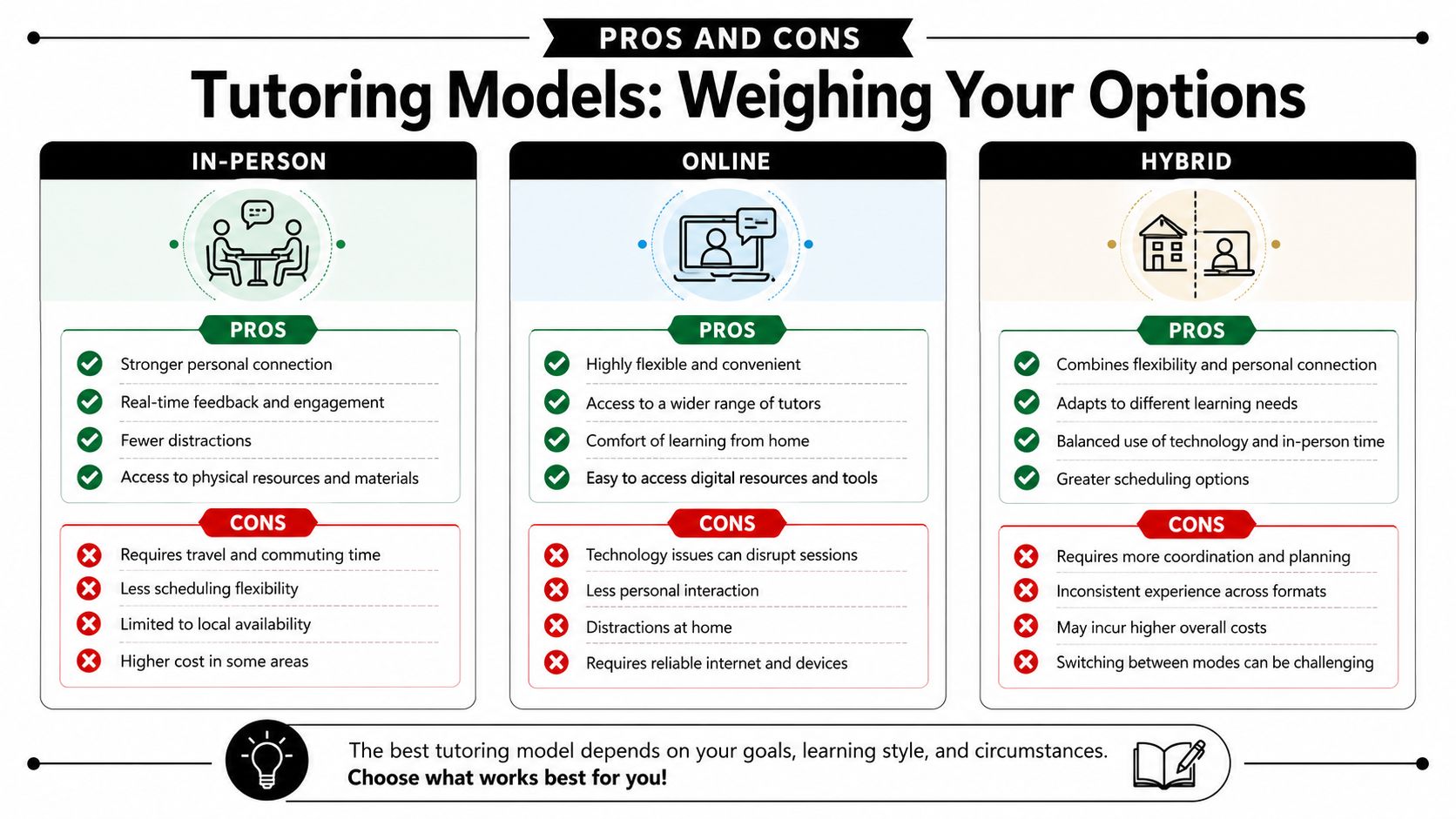
No tutoring format wins every time. The right choice depends on the student, the family's schedule, and the center's ability to deliver the model well.
The one point that does stand out is academic structure. Structured in-person tutoring delivers approximately 0.30 to 0.40 standard deviations of academic improvement per 20-hour cycle, equivalent to 3 to 4 months of learning, while unstructured online tutoring averages 0.05 standard deviations. In-person cohorts also show a 45% higher renewal rate, based on CUNY tutoring effectiveness data.
Side-by-side comparison
| Model | Pros | Cons |
|---|---|---|
| In-person | Stronger structure, easier engagement, better non-verbal feedback, dedicated learning environment | Travel time, room dependency, less flexible last-minute changes |
| Online | Convenient, broader tutor access, easier for niche subjects or remote families | More self-management required, home distractions, weaker physical accountability |
| Hybrid | Flexible mix of access and structure, useful for changing schedules | Harder to run well, more billing and attendance complexity, greater tech and room coordination needs |
When in-person makes the most sense
In person tutoring services usually work best for:
- Younger students who need routine and supervision
- Students with focus issues who benefit from a dedicated study environment
- Families who want consistency with a recurring schedule and familiar tutor
- Centers running group classes where room culture improves participation
When online or hybrid may fit better
Online can be the right choice if travel is a major obstacle or if the ideal tutor isn't local. Hybrid can help families with changing weekly schedules, especially when a center can switch attendance mode without creating confusion.
What doesn't work well is choosing a model for convenience alone. If the student needs external structure, pure convenience can backfire. If the family needs flexibility, forcing a rigid in-person plan can create unnecessary cancellations.
The useful question isn't "Which model is best?" It's "Which model gives this student the best chance of showing up, staying engaged, and continuing long enough to improve?"
Frequently Asked Questions About Tutoring Services
How do I know if my child needs a tutor?
Look for patterns, not one bad test. If your child regularly avoids homework, loses confidence in one subject, or understands less each week despite effort, tutoring may help.
What should I ask during a trial lesson?
Ask how the tutor sets goals, what the lesson structure looks like, and how progress gets communicated. Also ask who handles schedule changes and billing, because those issues affect the experience quickly.
Is one-to-one always better than group tutoring?
Not always. One-to-one works well for targeted support and confidence rebuilding. Small groups can work well when students benefit from peer interaction, shared pacing, and lower cost per session.
How often should tutoring happen?
That depends on the goal and the student's stamina. Some students benefit from one steady weekly session. Others need more frequent support during exam periods or when rebuilding weak foundations.
What makes a tutoring center feel organized?
Clear communication, stable scheduling, easy check-in, visible attendance records, and consistent follow-up. Parents notice operational discipline even if they can't name it directly.
Can a small tutoring business run professionally without a large admin team?
Yes, but only if the owner avoids stacking too many manual processes. Even a solo tutor or small center benefits from having scheduling, attendance, billing, and notes in one place so the business can grow without chaos.
Should I choose in-person, online, or hybrid tutoring?
Choose the format that your child will attend consistently and engage with. The strongest option is the one that matches the student's learning habits and the family's real schedule.
If you're running a tutoring center, language school, test prep academy, music school, or after-school program and want fewer admin bottlenecks behind your in person tutoring services, Tutorbase is worth a look. It brings scheduling, billing, payroll, room management, attendance, and student tracking into one system, which helps owners replace spreadsheets and disconnected tools with a cleaner operating setup.


