


Key Takeaway: Running a modern tutoring center with spreadsheets and disconnected apps leads to booking errors, revenue loss, and over 10 hours of weekly admin. An AI-powered tutoring management software like Tutorbase automates scheduling, billing, and payroll, reducing admin time by 60%, tripling student onboarding speed, and increasing monthly renewals by 42%.
The days of a tutoring center being a single classroom with a whiteboard are long gone. Today, you're running a complex operational hub, juggling multiple locations, a wide range of subjects from K-12 math to SAT prep, and a blend of in-person and online lessons. This level of complexity completely breaks traditional tools like spreadsheets and calendars.
What Is a Modern Tutoring Center?

Think of your business less like a quiet classroom and more like a bustling airport. Students are passengers with unique destinations, your tutors are the skilled pilots, and classrooms are the gates. Without a central control tower coordinating every movement, you’re guaranteed chaos. This is the reality for most tutoring centers heading into 2026.
What might have started as a one-room operation has quickly evolved. It's not uncommon for a center to manage anywhere from 5 to 100+ teachers, delivering 50 to over 10,000 lessons every single week across a huge variety of subjects.
The Expanding Scope of Tutoring Services
The services a modern center offers are incredibly diverse. As demand for specialized education grows, you must be more agile than ever. It is no longer just about one subject. Key service verticals now include:
- K-12 Academics: Core subjects like Math, English, and Science are still the foundation.
- Test Preparation: High-stakes exams like the SAT, ACT, IELTS, and TOEFL are massive revenue drivers.
- Language Schools: Classes for Spanish, French, Mandarin, Arabic, and German are in high demand.
- Specialized Skills: This ecosystem also includes music schools, after-school programs, and coding bootcamps.
This isn't just a small shift; it's a tidal wave of market growth. Private tutoring is on track to become a $235.7 billion industry by 2034, growing at an impressive 8.6% annually. This reflects a huge trend of parents investing more in supplemental education, putting immense pressure on centers like yours to operate efficiently. You can dig deeper into this trend with the latest private tutoring market outlook.
Why do manual operations break?
This rapid growth exposes the cracks in outdated management methods. Trying to run a modern tutoring business with a patchwork of tools is a recipe for disaster. When you use Google Calendar for scheduling, QuickBooks for billing, and Excel for payroll, you create operational silos where expensive mistakes happen.
The core problem is a lack of a single source of truth. When your information is scattered, you cannot see the full picture. This leads directly to double-bookings, billing errors, and countless hours wasted on admin. For example, operations managers spend over 10 hours a week just creating schedules and processing invoices. That’s time you could spend finding new students or improving your curriculum.
The Hidden Costs of Fragmented Tools

The costs you see, like rent and salaries, are easy to track. It’s the costs you don't see that quietly chip away at your profit. These are the hidden expenses of running your center with fragmented tools. They don't show up on a P&L statement, but you feel them as wasted hours, lost income, and constant stress.
Sound familiar? For many center owners, it’s the “Sunday Scramble.” You spend your evening trying to piece together next week’s schedule. Tutor availability is in one spreadsheet, parent requests are in your inbox, and room bookings are on a separate calendar. Just when you think you’ve got it, you realize your top math tutor is double-booked.
The True Price of Administrative Burden
That scheduling headache is just the beginning. For most tutoring businesses, the real time-suck is the financial admin that piles up every week. Think about what it takes to get invoices out the door manually:
- First, you dig through attendance sheets to see who showed up.
- Next, you cross-reference another document to find each family’s package or hourly rate.
- Then you manually create dozens of individual invoices in Word or QuickBooks.
- Finally, you spend even more time chasing parents for late payments.
This tangle of tasks is not just slow; it's an open invitation for errors. One typo can mean under-billing a family or overcharging them. The 10+ hours per week that owners and admins sink into this cycle is a massive opportunity cost. That’s over 40 hours a month, an entire work week, lost to administrative quicksand.
How do manual errors impact revenue?
The financial damage from fragmented tools goes beyond wasted time. It creates real gaps in your revenue. With disconnected systems, you have zero real-time visibility into your business performance. You’re flying blind.
- Lost Revenue from Unfilled Seats: Without a live view of your class rosters, empty spots in group sessions stay empty. You might have a student on a waitlist who’d be a perfect fit, but the opportunity is lost. Every empty seat is revenue you will never get back.
- Payroll Errors: Calculating payroll in Excel for tutors with different rates (bonuses per student, revenue-sharing) is a nightmare. Errors are almost guaranteed. These mistakes lead to frustrated tutors and potential compliance headaches, creating a high-turnover environment.
Ultimately, running a tutoring center with fragmented tools means you are always putting out fires instead of building a stronger business. The double-bookings, billing mistakes, and hours spent on admin are symptoms of a broken system holding you back.
The Core Pillars of Tutoring Center Management
To build a scalable and profitable tutoring business, you must nail four core operations. Think of them as the four legs of a table. If one is weak, the whole thing wobbles. Get these right, and you can stop putting out fires and start building predictable growth.
These are the day-to-day functions that decide whether you sink or swim. They range from booking a student's first lesson to figuring out which services make you money. Mastering them is the first step toward running a smarter center.
Pillar 1: Scheduling and Resource Management
This is the logistical heart of your business. It's the complex dance of matching the right tutors to the right students in the right rooms, often across multiple locations. When you do this by hand, it’s where double-bookings and headaches are born. Good resource management means having instant visibility into:
- Tutor Availability: Who is free to teach calculus on Tuesday at 4 PM?
- Student Schedules: How quickly can you find an open slot for a new student without endless emails?
- Room Utilization: Is your main classroom overbooked while a smaller room sits empty? You need to track room capacity and features.
- Multi-Branch Coordination: If you run more than one center, can you see all your resources (tutors, rooms, schedules) from a single dashboard?
Pillar 2: Financial Operations (Billing & Payroll)
This pillar covers every dollar that flows through your business. For centers stuck using manual methods, this is often the most time-consuming and error-prone job. Getting your financial operations right is about accuracy, speed, and automation. A healthy financial system handles the entire money flow without micromanagement.
The goal is to detach revenue collection from manual effort. Your system should automatically generate income based on the services you deliver. This means your system should handle:
- Automated Invoicing: Invoices should be created automatically from attendance records. A student attends a lesson, and an invoice gets generated. It’s that simple.
- Flexible Pricing: Easily manage different pricing models, such as per-hour rates, prepaid packages of 10 lessons, or monthly subscriptions.
- Payment Processing: Let parents pay how they want (online with Stripe, cash, or bank transfer) and have payments automatically marked as paid.
- Complex Payroll: Accurately calculate tutor pay, whether they have revenue splits, per-student bonuses, or premium rates for weekend sessions.
Pillar 3: People Management (CRM)
This pillar is about creating a single source of truth for every person connected to your tutoring center. When student details are in one spreadsheet, parent contacts are in your phone, and tutor contracts are in a filing cabinet, you set yourself up for mistakes.
Centralized people management means all your critical information is organized and easy to find. This includes detailed profiles for:
- Students: Their academic history, current subjects, attendance records, and learning progress.
- Payers: Their contact details, billing preferences, linked students, and communication history.
- Teachers: Their qualifications, availability, specific pay rates, contracts, and assigned classes.
When this information lives in one place, you can answer a parent’s question in seconds and manage your staff effectively.
Pillar 4: Growth and Reporting (CRM)
This pillar turns operational data into business intelligence. Running your center on spreadsheets is like driving with the windows blacked out. You have no clue where you're going. You need real visibility to grow.
This is about answering your most important business questions with data, not a gut feeling. It lets you:
- Track key performance indicators (KPIs) like student retention and lead conversion rates.
- Pinpoint which subjects, tutors, or class types are your most profitable.
- Analyze lead sources, whether from your website contact form, a WhatsApp message, or a walk-in.
By turning your data into insights, you can make smart decisions that move the needle.
How Tutoring Management Software Solves Your Operational Problems
If you feel like you are constantly putting out fires, you are not alone. That operational chaos is a symptom of using the wrong tools. Juggling spreadsheets, a calendar, and a billing app is like trying to run an orchestra where every musician has different sheet music. It just doesn't work.
This is not about adding another app. It’s about replacing that tangled mess with one smart system that acts as the command center for your entire business. Let's get into what that looks like day-to-day.
From Scheduling Headaches to 2-Minute Bookings
Manually finding an open slot for a student is one of the biggest time sinks. You know the drill: cross-referencing three calendars, checking tutor qualifications, and hoping you don't double-book someone.
- The Old Way: An admin spends 10+ minutes piecing together a single booking, increasing the risk of a costly mistake with every click.
- The Automated Way: An AI-powered "Find Slot" feature does the work for you. It instantly scans every variable (tutor skills, availability, room schedules) and gives you a list of perfect, conflict-free options. Booking time drops to under two minutes.
With purpose-built tools like Tutorbase scheduling, you eliminate one of the most common operational errors. This turns booking from a logistical nightmare into a simple task, making the entire student onboarding experience 3x faster.
How do I automate billing and payroll?
Manual billing and payroll are the twin anchors holding your business back. Every hour you spend creating invoices or wrestling with complex tutor pay rates in Excel is an hour you are not spending on growth. Automation breaks this cycle.
A lesson is marked "Attended," and an accurate invoice is automatically generated. For payroll, you set each tutor's specific pay rules once, and the platform calculates what you owe them down to the penny. What took hours now becomes a quick review. This can reduce your admin workload by 60%.
An integrated system connects the four core pillars of your business (scheduling, finance, people, and growth) into a single, cohesive unit.
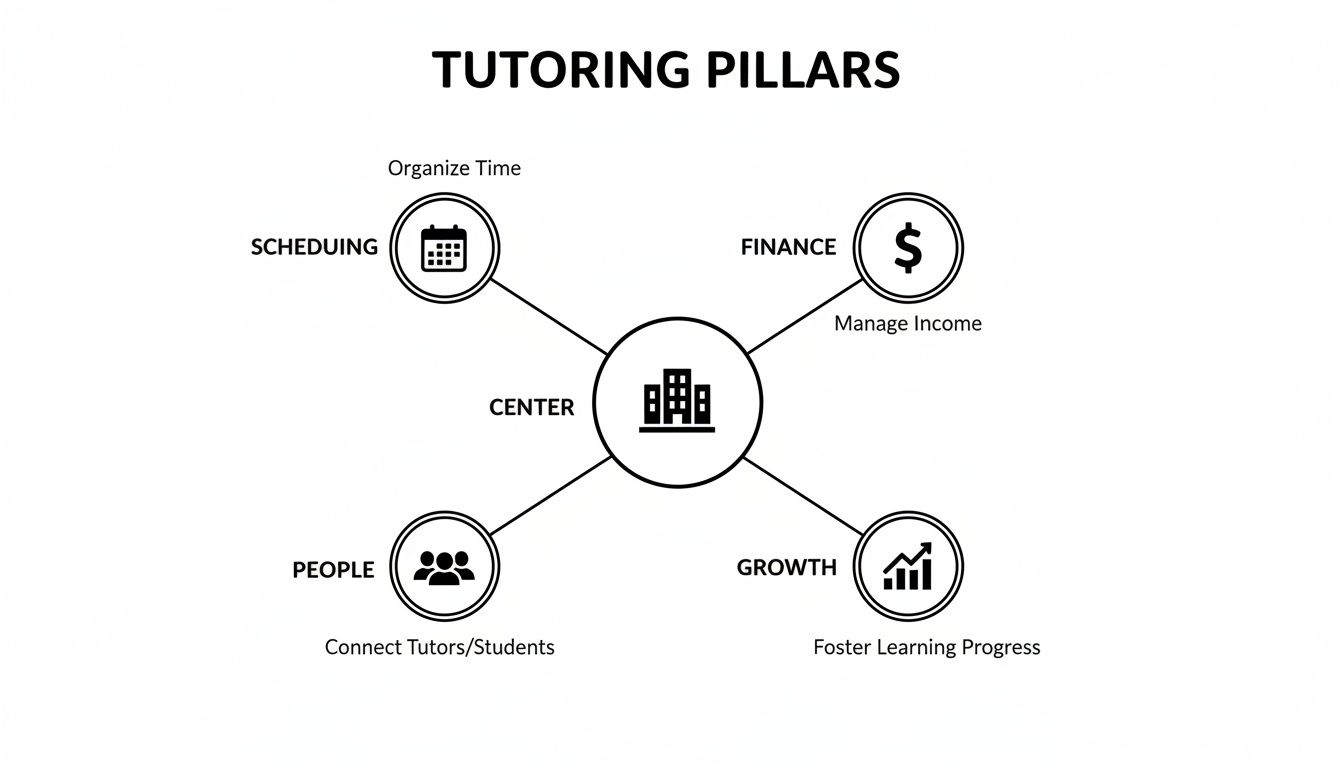
When these functions talk to each other, data flows seamlessly. No more double-entry. No more wondering if your billing records match your attendance sheets. Everything just works. Here’s a breakdown of the old way versus an automated system.
Manual vs. Automated Tutoring Center Operations
| Operational Task | Fragmented Tools (Spreadsheets, Calendar, QuickBooks) | Tutorbase (Tutoring Center Software) |
|---|---|---|
| Lesson Scheduling | 10-15 minutes per booking. Manually cross-referencing calendars. High risk of double-booking. | Under 2 minutes per booking. "Find Slot" AI instantly suggests conflict-free options. |
| Invoicing | Hours per week. Manually creating invoices one-by-one from attendance. Prone to missed billings. | Automatic. Invoices are generated instantly from attendance records. Zero manual entry. |
| Tutor Payroll | Hours per pay run. Complex spreadsheet formulas for varied rates (hourly, revenue share). | Under 10 minutes to review. Pre-set pay rates are applied automatically, generating accurate payroll. |
| Filling Empty Seats | Relies on memory or manually scanning class lists. Empty spots go unfilled, losing revenue. | Real-time "Find Spot" feature shows all open seats across all classes for easy booking. |
| Business Reporting | Pulling data from multiple sources is time-consuming and often inaccurate. | Live dashboards provide an up-to-the-minute view of revenue, profitability, and capacity. |
The takeaway is clear: manual methods actively hold back your center's potential by creating unnecessary work and costly errors.
Get a Clear View of Your Revenue and Growth
When your data is scattered, you cannot see which classes are bleeding money or where your best leads come from. An all-in-one platform gives you the clarity to make smart decisions. The K-12 online tutoring market alone hit $8.78 billion in 2023 and is expected to grow by nearly 15% annually. You can only grab that opportunity if your operations can scale. With zero double-bookings and a real-time view of your business, you can capitalize on that growth.
Ultimately, the goal is to stop wrestling with a messy tech stack and embrace unified solutions for effortless tech management. For a tutoring business, a dedicated platform is the best way to ensure every part of your operation works together.
How to Choose the Right Tutoring Center Software
Picking the right management software will define your business for years to come. It's not just another tool; it's the operational hub for your entire company. The right platform feels like hiring a brilliant operations manager, while the wrong one just creates more work.
How do you find a system that can handle the messy reality of a tutoring business? It comes down to asking the right questions that go beyond a feature list and get to the core of what drives efficiency.
A Practical Checklist For Evaluating Software
Before you sign up for a demo, run through this checklist. A basic system might look good, but a growing center needs real power.
- Can it handle complex payroll? Ask if the software can manage your specific pay models, not just simple hourly rates. You need support for revenue sharing, per-student bonuses, and different rates for weekends or high-demand subjects.
- Does it offer native prepaid credits? Many platforms treat prepaid packages as a clumsy workaround. A great system should have a built-in wallet that automatically deducts funds after each lesson and sends low-balance alerts.
- How does it manage multi-branch rooms? If you have more than one location, can you manage all your tutors, rooms, and reporting from one dashboard? This is critical for efficiency.
- Does it have modern lead capture tools? A simple contact form isn't enough. Look for smart tools, like a WhatsApp widget, that pipe inquiries straight into your CRM.
When comparing options, you need to explore the comprehensive features offered by leading platforms to see if they truly match your needs. You can also see a full breakdown of how Tutorbase features are designed to solve these specific challenges.
Tutoring Center Software Comparison: Tutorbase vs. The Alternatives
To make this even clearer, let's compare Tutorbase to alternatives like Teachworks and TutorCruncher. The differences become obvious when you focus on the features that matter for scaling your business.
| Feature | Tutorbase | Teachworks Alternative | TutorCruncher Alternative |
|---|---|---|---|
| Find Slot/Spot | ✅ AI-powered | ❌ Manual | ❌ Manual |
| Auto-Billing | ✅ Fully Automated | Semi-manual | Semi-manual |
| Complex Payroll | ✅ Native Support | Basic hourly | Basic hourly |
| Prepaid Credits | ✅ Native Wallet | Limited | Add-on |
| Multi-Branch Rooms | ✅ Unified View | Limited | Limited |
| Multi-Brand | ✅ Supported | ❌ | ❌ |
| WhatsApp Integration | ✅ Native | ❌ | ❌ |
| Scalability | ✅ Built for 10k+/week | Slows Down | Slows Down |
As you can see, the gap is huge. A basic tool like a Teachworks alternative helps you get by. An advanced platform like Tutorbase is built to automate tedious work, prevent costly mistakes, and give you the room to grow.
The Tangible ROI of Modern Tutoring Management Software

Investing in a modern platform is about getting a clear, measurable return. The right software pays for itself by saving you time, bringing in more revenue, and creating a better experience for clients and staff. These are not small tweaks. They are major financial and operational wins.
For any tutoring center, the results are easy to quantify. Centers that switch to an integrated system report a 60% reduction in administrative time. This efficiency boost also leads to 3x faster student onboarding, turning interested parents into paying customers more quickly.
From Saved Hours to Business Growth
Let's get specific. A center with 10 teachers and 200 students often loses over 10 hours of admin time every week to scheduling and manual billing. By automating these tasks, you get back 40+ hours per month. What could you do with an extra week of strategic time every month?
- Focus on Marketing: Launch new campaigns to attract more students.
- Improve Your Curriculum: Invest in better learning materials.
- Train Your Tutors: Run professional development sessions to improve teaching quality.
- Plan for Expansion: Strategize your next steps for growth, whether a new location or more services.
This reclaimed time is a direct investment back into your business. Instead of being stuck in the weeds, you can focus on high-value activities that fuel growth. The impact also ripples out to client satisfaction. With smoother operations, centers see a 42% increase in monthly renewals.
Frequently Asked Questions (FAQ)
Here are common questions from tutoring center owners, with straight answers on how the right system solves the problems you face every day.
How does tutoring center software handle complex pricing?
A modern platform moves beyond simple hourly rates. You can set up various pricing models that successful centers use, such as lesson packages with expiration dates or monthly subscriptions for predictable recurring revenue. Tutoring management software handles this by automatically tracking each student's usage and applying the correct rate to each lesson.
Can one system manage a multi-location tutoring center?
Yes, and this is a non-negotiable feature for scaling. A good platform is built for multi-branch businesses. From one central dashboard, you can see and manage everything (schedules, tutor availability, student records, room bookings) for every location. You can pull financial reports for one branch or get a bird's-eye view of the entire company.
What is the biggest time saver when switching to tutoring center software?
Automated scheduling and billing. The manual scheduling process, which takes 10+ minutes per student, drops to less than two with "Find Slot" AI. The real game-changer is automating invoices from attendance records. Instead of spending hours creating bills, the system generates them instantly. This alone saves the average manager over 10 hours of admin time per week.
How do I handle tutor payroll for my tutoring center?
Automated teacher payroll software is the solution for complex calculations. You can set various pay models like per-hour, per-lesson, per-student, or revenue share. You can also add premiums for weekends or specific subjects. The software applies these rules automatically, turning hours of spreadsheet work into a quick review.
How do I automate invoicing for my tutoring center?
Tutoring center software automates invoicing by linking attendance to billing. When a lesson is marked "Attended," the system automatically generates a precise invoice based on the student's pre-set pricing (package, hourly, etc.). This eliminates manual data entry, prevents missed billings, and ensures you get paid correctly and on time.
How difficult is it to migrate from our current system?
It is much easier than you think. The best platforms are designed for a smooth switch, with dedicated support teams and data import tools. You can pull your existing student, teacher, and schedule information directly into the new system. Most centers are fully up and running, seeing benefits like a 60% reduction in admin time, in just a few weeks.
If you're tired of spending your nights buried in administrative work, it’s time to see how a purpose-built platform can give you your life back. Discover how Tutorbase can bring order to the chaos and help you build a more profitable, scalable tutoring center. Get started at tutorbase.com/register.


