


A new family enquiry arrives by WhatsApp. Your administrator finds a suitable tutor, arranges lessons at the family's home or online, and promises a monthly invoice. Tuition agency software should connect that chain, so the lessons families pay for match the work tutors are paid for.
The difficult part isn't putting appointments in a calendar. It's keeping the original enquiry, tutor availability, lesson changes, attendance, family balances and tutor earnings consistent when different people update them.
For UK and Singapore agencies, the right choice depends on how you place tutors and collect fees. An agency invoicing families for ongoing lessons needs a different workflow from a matching business that collects an introduction fee while families subsequently pay tutors directly. A tuition centre running group classes has different requirements again.
The options below are assessed against that agency workflow, rather than ranked by the length of their feature lists. Some suit tutor placement and connected administration; others make more sense for smaller teams, class-based centres or lesson studios.
Before comparing subscriptions, settle these basics:
- Who invoices the family? Your agency, the tutor or both for different charges?
- Who confirms teaching happened? The tutor, an administrator or the family?
- What determines tutor pay? Completed lessons, payable hours, subject rates or another agreement?
Those answers matter more than a polished dashboard.
Table of Contents
- 1. Tutorbase
- 2. TutorCruncher
- 3. Teachworks
- 4. Oases Online
- 5. Teach ’n Go
- 6. TutorBird
- 7. Jackrabbit Class
- 8. Opus1.io
- 9. CLASSQR
- 10. Schedutor
- Tuition agency software compared at a glance
- How to Choose and Implement Your Tuition Agency Software
1. Tutorbase
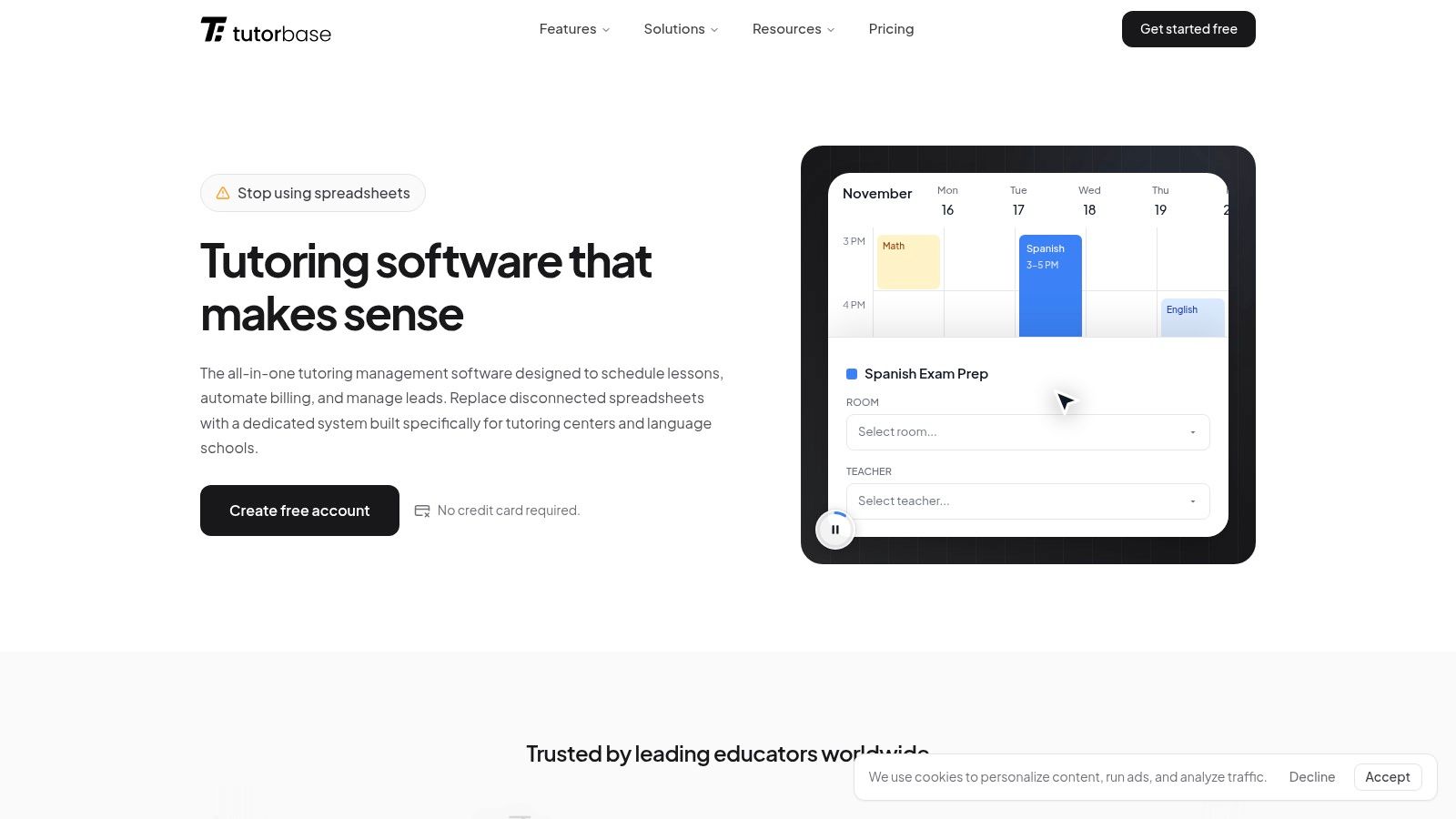
Tutorbase is an operating system for tutoring businesses that connects Students & CRM → Scheduling → Billing → Payroll. For an agency, the useful test is whether one record can carry an enquiry through tutor matching, a home or online lesson, attendance, the family invoice and tutor pay.
After a lesson is finalised, Tutorbase applies the charge to the right payer under the plan bought: prepaid package, pay-as-you-go, monthly plan period or deliberately free lesson. If work fails midway, it can be resumed or retried without charging a family twice, paying a teacher twice or losing what was attempted.
Where connected agency operations help
A common agency case is siblings on different arrangements: one prepaid package, one hourly, plus a make-up taught by a covering tutor. Tutorbase supports family payers, mixed package and hourly billing, make-ups, cancellation policies and variable teacher pay, so those differences stay attached to the lesson record.
Before a lesson is saved, scheduling checks teacher availability, student overlaps, room use and capacity, opening hours and personal Google Calendar busy time, then shows warnings. Tutors and authorised staff record attendance and payable teaching time; invoices and gross teacher compensation use those records and the agreed terms.
- Family administration: A branded portal supports eligible bookings, changes, invoices and online payments under your permissions.
- Payment collection: Online payments run through Stripe, and the payment methods available depend on your country, account and configuration.
- Tutor payouts: Its teacher compensation tools calculate gross pay from lessons and agreements, produce pay statements and record payouts.
- Limits: No tutor marketplace, online classroom, statutory payroll service or accounting service.
For growing agencies, the tutoring centre operations overview explains the connected workflow. The platform is free to use, with a 1% fee only when you create invoices through Tutorbase, so compare expected invoicing activity against the current pricing terms.
2. TutorCruncher
Best suited to agencies managing tutors, clients and ongoing lesson administration, TutorCruncher combines relationship records, scheduling, tutor availability, timesheets, billing, payments and client access.
Its agency orientation makes it a sensible shortlist candidate when administrators coordinate several tutors and families. The important test is whether the relationship between client, student and tutor reflects how your agency contracts and charges.
Test the exception, not just the booking
Run a home-lesson scenario where a tutor becomes unavailable, another tutor covers, and the replacement has a different pay arrangement. Follow the change through the calendar, client charge and tutor earnings record.
Then test a family that disputes a recorded lesson after an invoice has been issued. You need to understand who can amend it, what remains visible and how staff correct the financial records.
Practical rule: A successful demonstration ends with a correct family balance and tutor pay record, not merely a lesson appearing in the calendar.
Its breadth is attractive, but breadth also means configuration decisions. Review billing rules, payment charges, staff permissions and website connections against your actual requirements rather than buying on feature coverage alone.
For a connected-operations comparison, the TutorCruncher alternative page provides another way to assess the workflow. Request locally applicable commercial terms, since a US-facing price page doesn't establish your UK or Singapore costs.
3. Teachworks
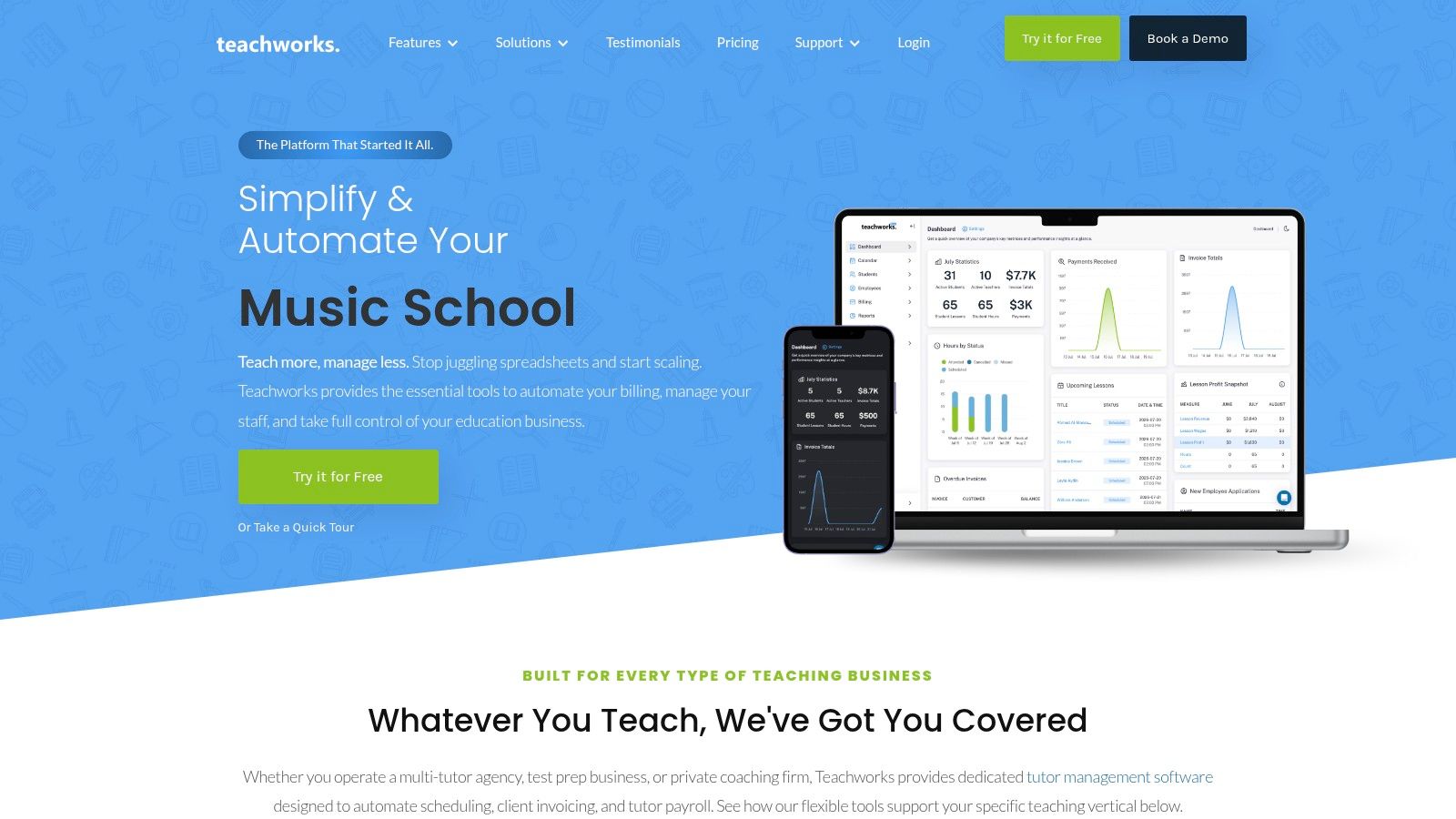
A family wants a regular maths lesson, occasional exam-preparation sessions and a temporary timetable change during school holidays. Teachworks suits businesses that need configurable scheduling and lesson-based administration rather than a simple appointment diary.
Teachworks offers individual and group scheduling, teacher and client records, invoice generation, teacher-pay tools, notifications and integrations, including QuickBooks Online. Its usage-based charging makes lesson volume an important purchasing consideration.
Model the calendar and the bill together
A busy calendar is only useful if staff can turn it into accurate charges without rebuilding the month in a spreadsheet. Test personalised student prices, different teacher rates and lessons that move between billing periods.
- Operational strength: Scheduling and invoicing sit within the same tutoring-business workflow.
- Cost consideration: Model the per-student-lesson component against your expected teaching activity, including groups.
- Implementation consideration: Test the exact add-ons and accounting connections you intend to use, not just the core calendar.
For home tuition, keep travel feasibility separate from appointment availability. An empty calendar slot doesn't prove a tutor can reach the next family's address.
The Teachworks alternative comparison is useful if you're weighing configurable lesson administration against a more tightly connected operational record. Choose based on the work administrators must still do after attendance is entered.
4. Oases Online
Tutor matching deserves more attention than most software comparisons give it. A tutor can teach the right subject and still be unsuitable because of availability, location, qualifications or the family's requirements.
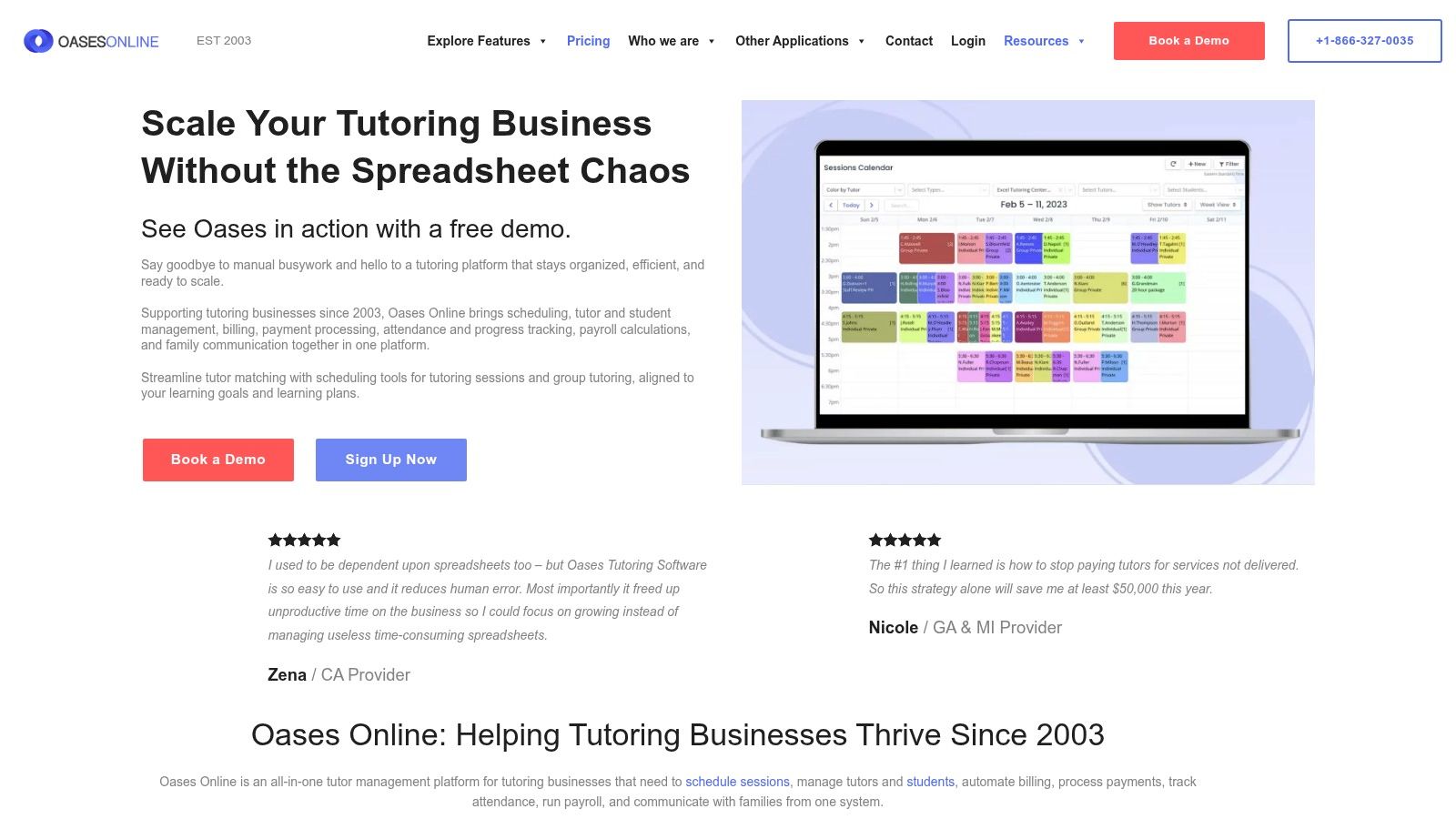
Oases Online includes tutor matching alongside scheduling, attendance, billing, payment processing, payroll calculations and reporting. It also combines business administration with learning plans, test results and student progress records.
That makes it particularly relevant to agencies that need both placement administration and structured reporting, including organisations delivering contracted programmes.
Strong fit when placement needs evidence
For a Singapore home-tuition enquiry, test whether staff can narrow suitable tutors using the family's actual requirements, then review the shortlist before assigning anyone. For a UK agency serving both private families and contracted programmes, test those billing arrangements separately.
- Matching: Evaluate availability, subject, location and qualification filters using representative tutor records.
- Reporting: Decide which progress information families or contracting organisations need.
- Trade-off: Broader operational and academic coverage means more setup decisions and staff training.
Don't buy detailed academic tracking if nobody will maintain it. Empty learning plans create another administrative obligation without improving placement quality.
Review active-student pricing and any optional services against your intended use. Oases is worth considering when matching and reporting are central requirements, rather than occasional tasks handled outside the main system.
5. Teach ’n Go
Some agencies also operate a tuition centre, employ administrators and sell places in scheduled classes. Teach ’n Go is more relevant to that school-style operating model than to a placement-only business.
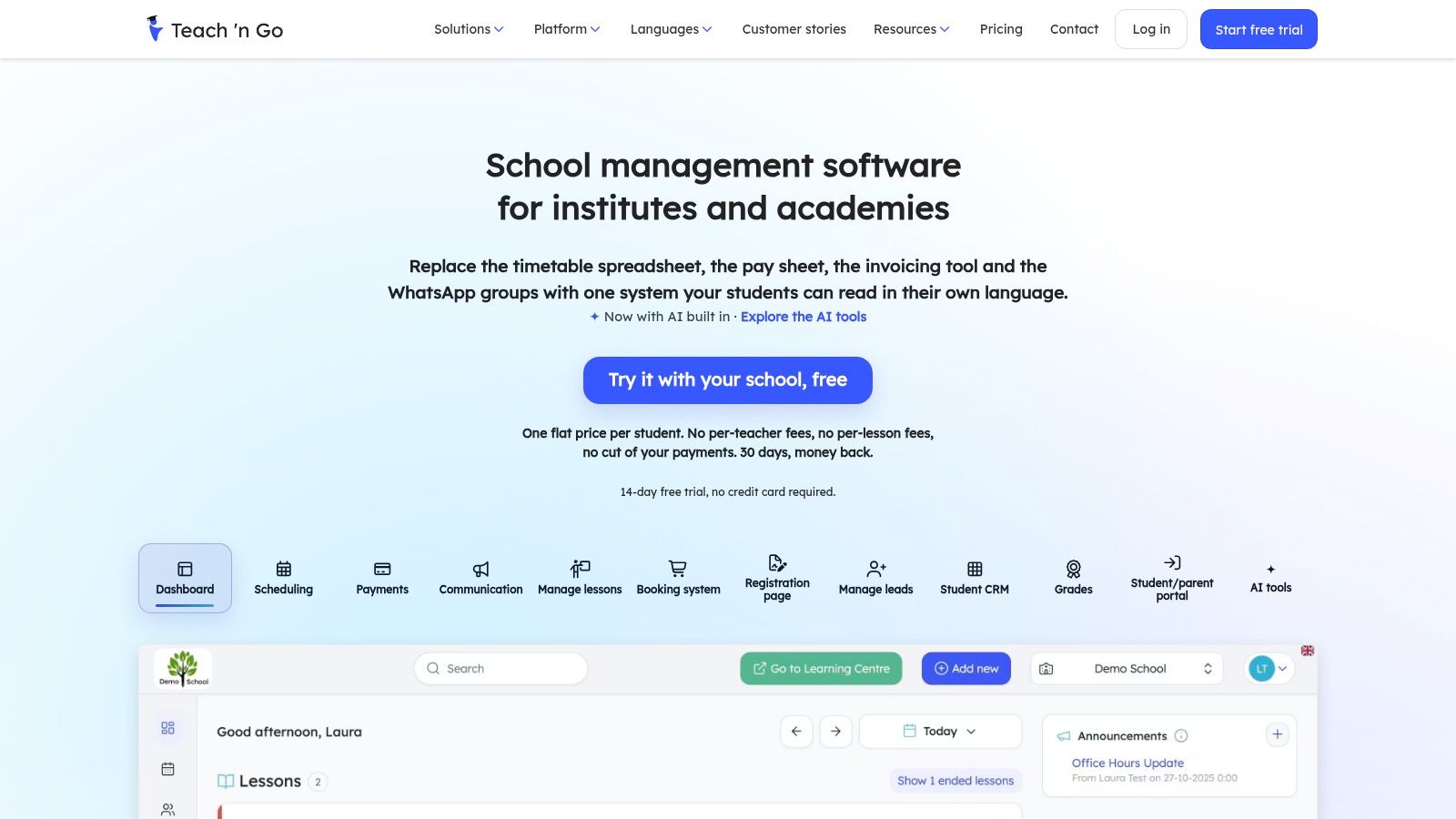
Teach ’n Go provides student, parent and teacher portals alongside scheduling, attendance, invoicing, online booking and fee tracking. Its plans distinguish between student-count tiers and access to capabilities such as multiple locations and branding.
Separate centre administration from agency requirements
Start with a centre-based enrolment, then introduce an off-site private lesson. Can administrators clearly distinguish the venue, responsible tutor, family charge and tutor-pay arrangement?
Portals can reduce routine questions, but only when families understand which actions they can take themselves. Decide whether parents should book any available tutor or request changes to an established tutor-student pairing.
- Good fit: A tuition centre with shared timetables, family access and recurring fee administration.
- Important test: Agency-specific tutor compensation and client-billing arrangements.
- Cost consideration: Student limits, location access and administrator permissions across the intended plan.
School-management coverage shouldn't be mistaken for proof that your placement workflow fits. Demonstrate an enquiry becoming a tutor assignment, not merely a student joining a class.
For mixed businesses, the deciding question is whether staff can administer centre classes and private placements without maintaining a parallel agency spreadsheet.
6. TutorBird
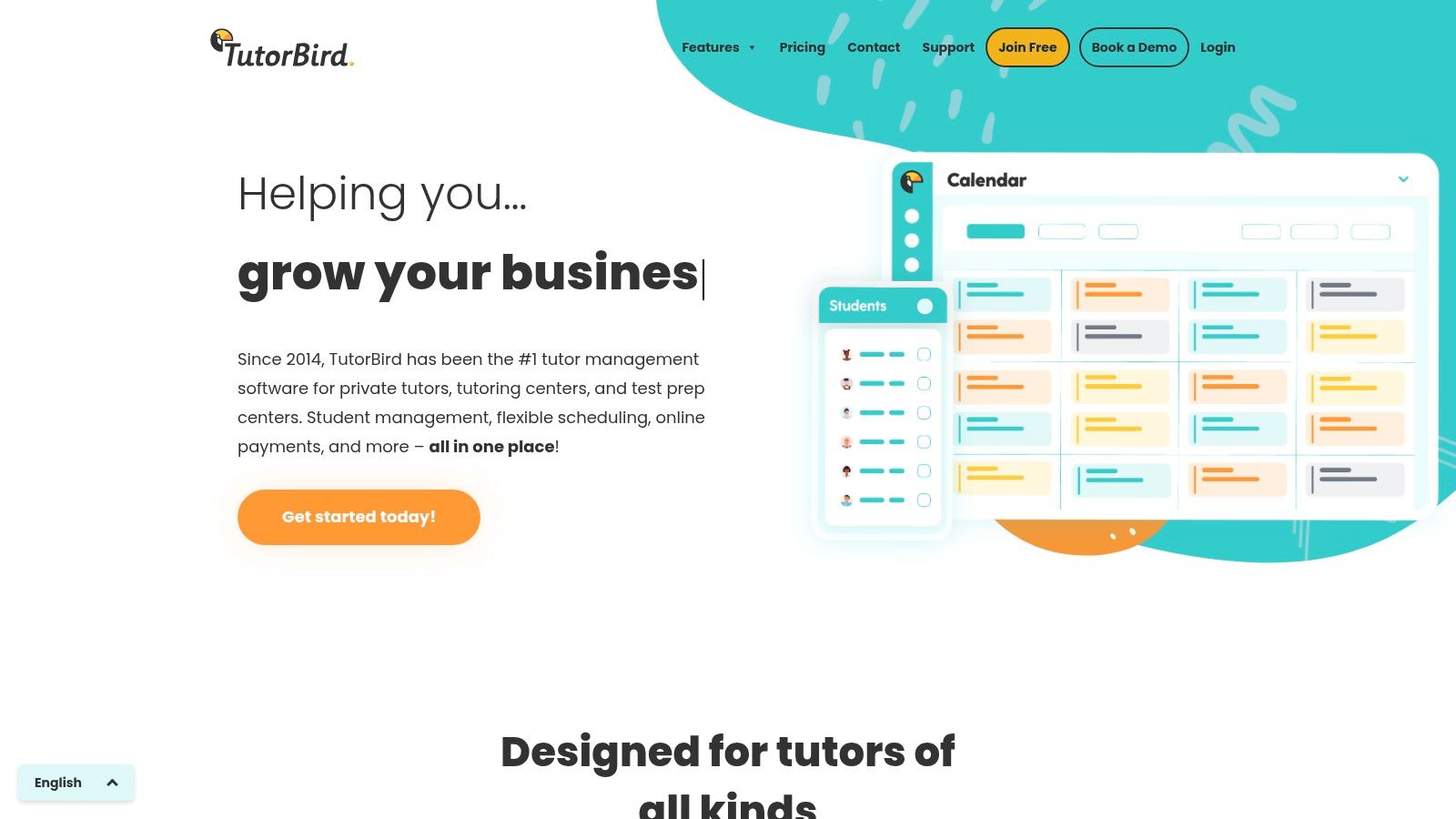
For a solo tutor hiring colleagues, the immediate problem may be modest: shared schedules, organised student records and invoices that don't require rebuilding manually. TutorBird is a sensible candidate for smaller tutoring teams with straightforward administration.
TutorBird combines scheduling, student management, invoicing, payment-related tools, a client portal and website features. Its account-based pricing means the number of tutors and administrators matters when estimating cost.
Keep the first team workflow manageable
Say you teach some families yourself while allocating others to another tutor. Test whether each person can see the information needed for their lessons without gaining unnecessary access to unrelated family or financial records.
Next, follow an amended lesson through the family invoice. The important question isn't whether you can edit the appointment, but whether the administrator can understand the resulting charge.
Buy for the next operating stage you can describe clearly, not an imagined organisation with departments you don't yet have.
As the team grows, evaluate reporting, permissions, locations and tutor compensation in more detail. Don't assume a lower starting cost means a lower total cost once staff accounts and manual reconciliation are included.
Compare its workflow with dedicated tutoring billing software, particularly if packages, sibling accounts or varied cancellation charges already consume your evenings. Smaller agencies benefit from simplicity, but financial exceptions still need a reliable record.
7. Jackrabbit Class
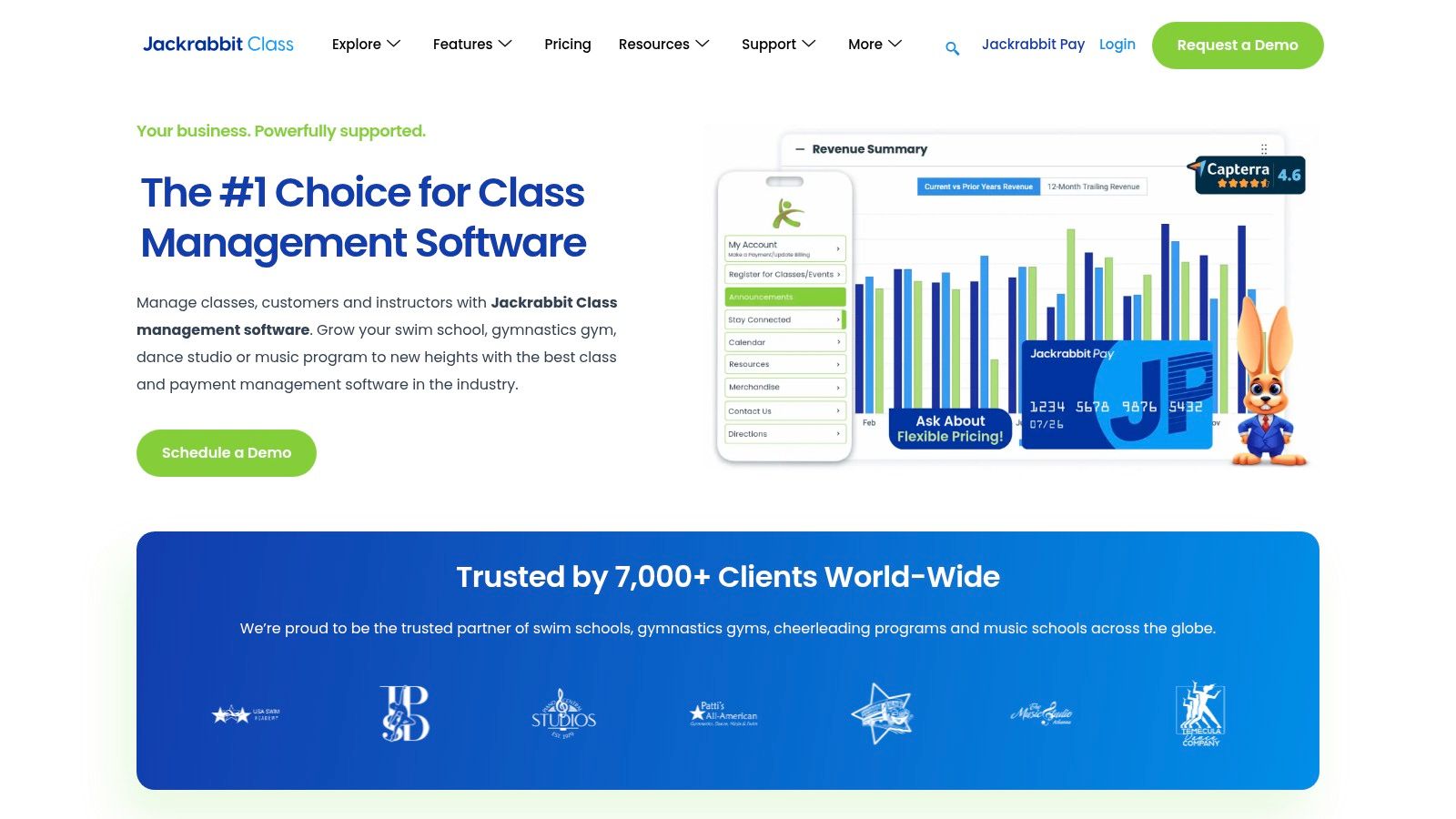
Choose a class-management model when families buy class places. Don't choose it merely because your business happens to provide education.
Jackrabbit Class is designed around youth activity businesses, with online registration, enrolment, class scheduling, attendance, tuition billing and reporting. It also supports multi-location programmes and offers a separate branded mobile-app option.
That makes it relevant to after-school enrichment, recurring group tuition and businesses where family accounts span several activities. It's less obviously aligned with an administrator individually matching a tutor to a family's home-tuition enquiry.
Where the operating model matters
Test a family enrolling siblings into different weekly groups, then transferring a child to another class. That is a different administrative problem from finding a replacement tutor for a private lesson at a family's address.
- Natural fit: Group programmes with defined classes, enrolments and recurring tuition charges.
- Agency test: Enquiry tracking, individual tutor assignment and compensation calculations.
- Commercial test: Student-count pricing, location requirements and optional app costs.
A class-based agency may find this organisation helpful. A placement agency should insist on seeing the complete enquiry-to-payment process before committing.
The trade-off isn't whether class software is good or bad. It's whether your staff organise the business around available class places or individual tutor-family relationships.
8. Opus1.io
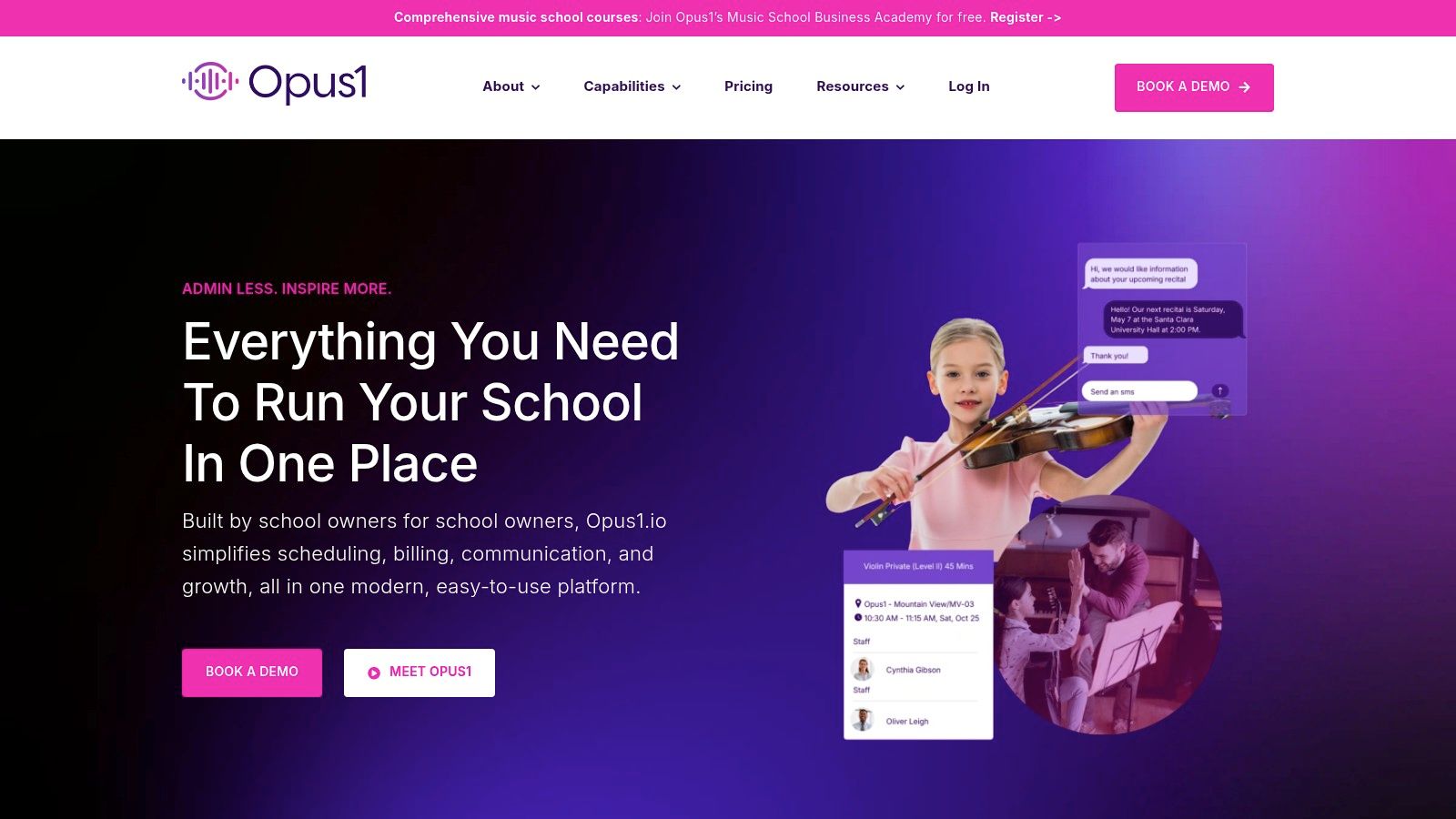
A recurring private lesson doesn't always belong to an academic tuition agency. Music and performing-arts businesses also coordinate families, teachers, make-ups and regular payments, and Opus1.io is designed primarily for that studio environment.
Opus1.io provides private and group scheduling, self-booking, tuition billing, teacher and family management, communications, prospect management and reporting. Its commercial structure considers factors such as active students and locations.
Useful overlap, different assumptions
For a music-tuition agency, that specialisation may be an advantage. For an academic placement business, establish whether the prospect and scheduling records can capture the subjects, levels, locations and family preferences your administrators use to select tutors.
Self-booking deserves particular care. A family selecting an available appointment isn't the same as an administrator approving a suitable tutor match.
- Best fit: Lesson studios and music businesses with recurring teaching and family self-service.
- Workflow test: Make-ups, teacher substitutions, lesson continuity and the resulting family charges.
- Regional test: Payment availability for your country and provider account, rather than advertised US methods.
Published references to teacher payroll should also be unpacked into payable hours, compensation calculations, approvals and payout records. Establish separately what statutory employment or accounting work remains outside the software.
Opus1.io belongs on the shortlist when your agency operates like a lesson studio, not because it supports recurring appointments.
9. CLASSQR
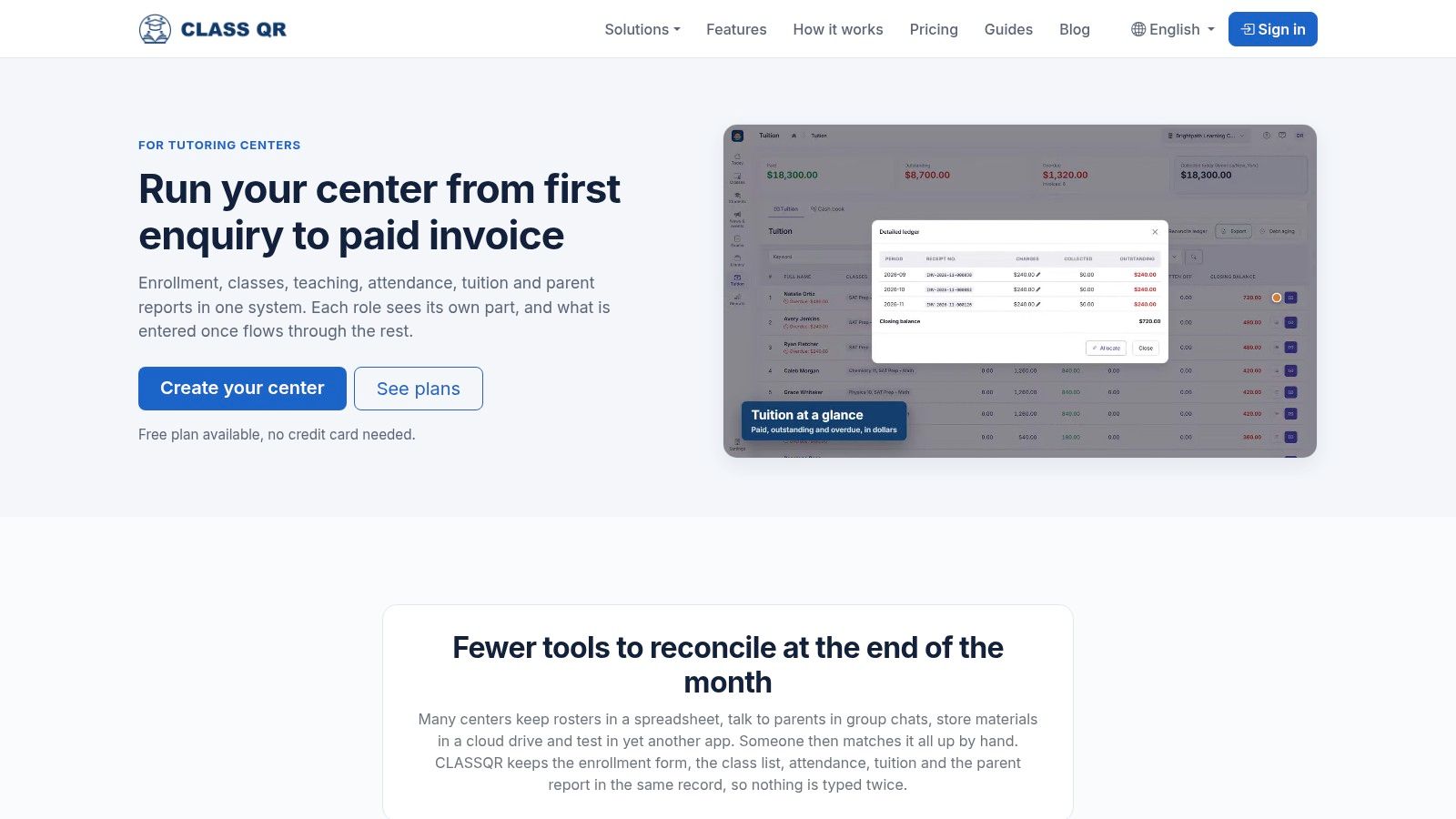
CLASSQR suits centres organised around enrolments, classes and tuition tracking. Its structure is worth considering when your administrators primarily fill class places rather than negotiate individual home-tuition arrangements.
CLASSQR offers staff roles, class management, attendance, lesson planning, parent reports and public enrolment pages. Tuition tracking and payment reminders form part of its administration, with plan-dependent access and limits.
Its free-plan option may help a small centre evaluate the basic workflow. Paid-plan suitability still depends on student numbers, staff access and the specific functions your team needs.
Follow the family account through the system
Use a sibling enrolment to assess how clearly staff can identify the responsible payer, outstanding tuition and attendance. Then introduce a missed lesson and an agreed replacement session.
For a placement agency, extend the demonstration beyond enrolment. You need to see how staff record an unassigned enquiry, evaluate tutors and determine what each tutor should earn.
Buying caution: Tuition tracking is not, by itself, proof of complete agency billing or tutor-pay administration.
CLASSQR says payments go through the centre's own Stripe account rather than being held by the software provider. Confirm the country-specific payment configuration and reconciliation process before presenting payment options to families.
Its centre-focused organisation may be appropriate for group tuition. Individual placement agencies should establish fit through a worked workflow rather than infer it from attendance and fee-management features.
10. Schedutor
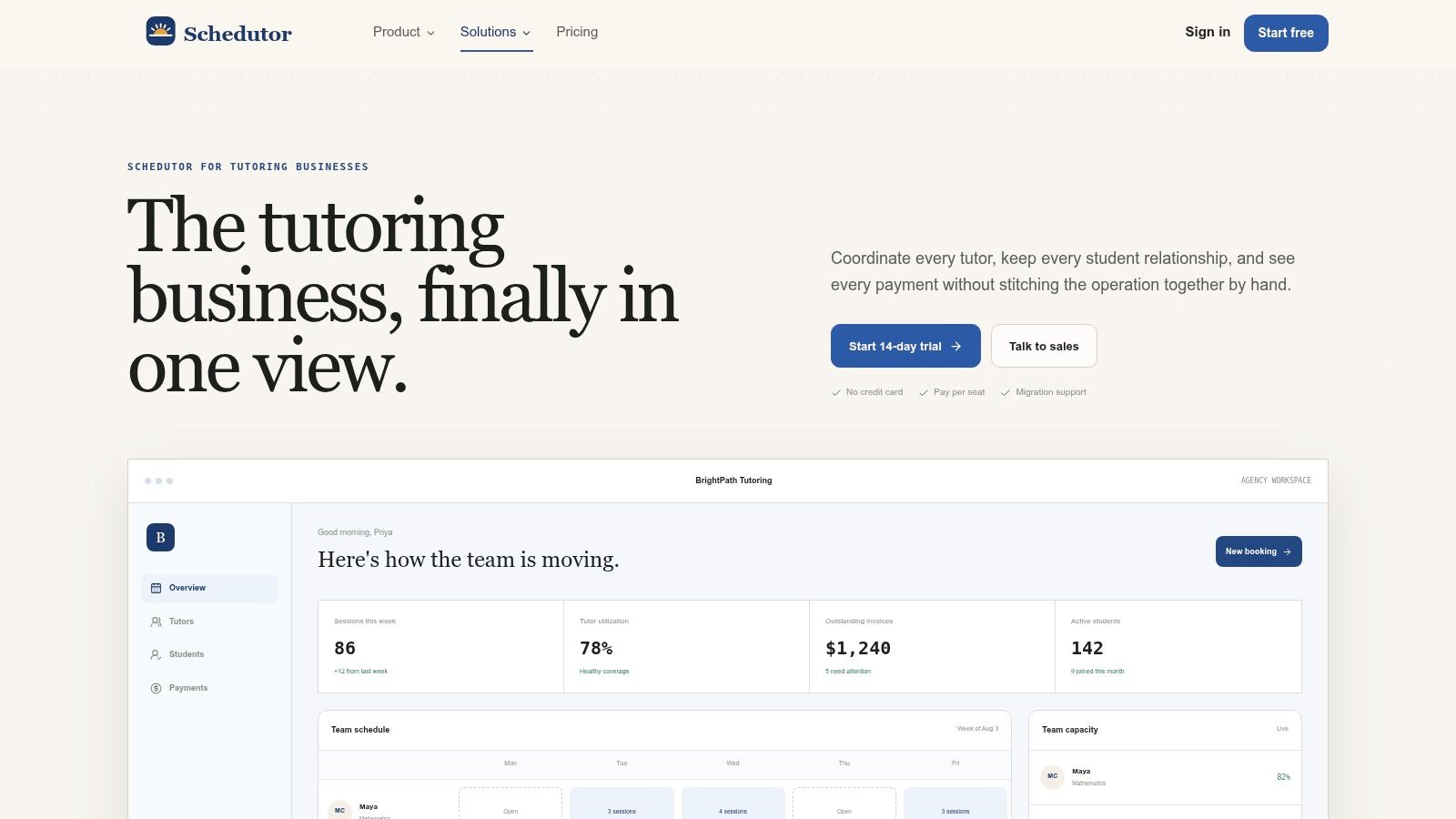
When the immediate bottleneck is coordinating tutor availability and allocating bookings, Schedutor deserves a scheduling-led evaluation. Its broader tutor-and-coach focus makes it important to test academic agency requirements explicitly.
Schedutor describes shared calendars, public booking, owner and administrator permissions, team payments, commissions, payroll-related tools, analytics and cross-team booking. It also lists data export, which matters when you need to retain usable records outside the software.
Distinguish booking allocation from tutor matching
An available tutor isn't necessarily the right tutor. Run a booking that requires a particular subject, level, teaching format and home location, then examine how an administrator approves or changes the assignment.
Follow a reassigned lesson through payment and compensation. If your agency charges the family one rate and pays the tutor another, both records must remain understandable after the change.
- Scheduling fit: Shared availability, team bookings and reassignment.
- Agency fit: Student history, responsible payers, family invoicing and tutor earnings.
- Cost fit: Seat-based charges across your active tutor roster and administrator requirements.
Compare its booking-led approach with tutoring scheduling software that connects lesson operations to billing consequences. The deciding factor is whether your staff need help filling calendars or reconciling the whole agency workflow.
Before committing, export representative records and check whether they retain the relationships needed to reconstruct a family's lesson and payment history.
Tuition agency software compared at a glance
The starting price matters less than how charges scale: per-seat plans grow with your tutor roster, student-count tiers grow with enrolment, and invoice fees grow with what you bill families.
| Item | Starting price | Pricing model | Best for |
|---|---|---|---|
| Tutorbase | Free to use; 1% invoice fee | No subscription or per-student charge; fee on invoices created | Tutoring businesses wanting an all-in-one operations platform |
| TutorCruncher | $30/month | Monthly plans; free trial available | Tutoring agencies and growing teams |
| Teachworks | Usage-based; no published starting price | Per-student-lesson charges; 21-day trial | Businesses with complex schedules and lesson-based billing |
| Oases Online | $99/month | Tiered by active students; optional services may cost extra | Tutoring centers needing academic tracking and business management |
| Teach ’n Go | $79/month | Student-count tiers; Pro starts at $109/month | Schools and tutoring centers wanting portals and fee tracking |
| TutorBird | $14.95/month | One tutor included; extra seats cost $4.95/month each | Independent tutors and small teams |
| Jackrabbit Class | $49/month | Tiers based on student count | Centers focused on recurring classes and enrollment |
| Opus1.io | $98/month | Tiered monthly plans scaled by students and locations | Lesson studios and tutoring businesses with recurring sessions |
| CLASSQR | Free for up to 30 students; paid plans from $29/month | Student-count tiers; free and paid plans | Small tutoring centers organized around classes |
| Schedutor | $19.95 per tutor seat/month | Per-seat team pricing; custom pricing above 20 members | Tutor and coach teams needing shared scheduling and booking |
Before comparing rows, confirm how each vendor counts students, siblings on one family account and administrator seats, since those definitions change the monthly cost.
How to Choose and Implement Your Tuition Agency Software
Choose tuition agency software by following a real family from enquiry to tutor payout. A demonstration using clean sample bookings won't expose the exceptions that occupy your administrators at month end.
Start with your commercial model. If your agency only collects a placement fee, don't assume you need ongoing family invoicing; if you bill for teaching, establish exactly how attendance becomes a charge and tutor earnings.
Evaluate the complete agency workflow
- Enquiry capture: Record subject, level, location, preferred times, teaching format and responsible payer. Don't assume enquiry capture includes a WhatsApp integration.
- Tutor matching: Test subject suitability, availability, qualifications and travel feasibility. Keep final placement approval with an authorised person.
- Home and online scheduling: Demonstrate recurring lessons, substitutions, cancellations and make-ups. Confirm that online lesson administration doesn't imply an included online classroom.
- Family invoicing: Test siblings on one account, packages, hourly teaching and credits. A replacement lesson shouldn't accidentally create an unintended extra charge.
- Payment collection: Confirm GBP or SGD billing, supported collection methods, processing costs and reconciliation. Don't assume UK bank-transfer or Singapore PayNow handling from a generic payments claim.
- Tutor pay: Reconcile payable teaching records with agreed rates, corrections, approval and payouts. Separate gross compensation preparation from statutory payroll obligations.
Pilot with records that expose exceptions
Use permissioned, representative records and minimise personal information during evaluation. Include an unpaid invoice, a package nearing exhaustion, a covering tutor and a disputed cancellation.
Check access as carefully as calculations. A tutor needs relevant lesson information, not unrestricted access to unrelated families; a payer doesn't automatically need every student note.
Model total cost using your own lesson volume, active students, staff accounts, invoices, payment processing and optional services. Compare quieter periods with busy teaching periods rather than relying on an advertised starting price.
Migrate and onboard deliberately
Agree how student, payer, lesson-history and billing records will move, and reconcile opening balances before switching. We provide migration support from spreadsheets and other tutoring tools, covering student records, lesson history and billing data.
Test exports before committing, then give tutors a clear attendance process and families concise instructions for schedules, invoices and payments. Avoid running competing live billing processes that could produce duplicate charges.
The best software removes manual reconciliation between what was taught, what families are invoiced and what tutors are paid. Compare your shortlist using your own lesson volumes and exceptions before making the commitment.
Tutorbase connects student and lead management, scheduling, billing and teacher pay so agencies can manage family placements through to accurate invoices and tutor payouts. Use a representative family account, a recurring lesson and a tutor-pay arrangement to test the connected workflow. Get started free and compare it against the administrative work your agency handles today.


