


You're probably looking at billing software source code because your current setup is messy. Scheduling lives in Google Calendar, invoices go out from QuickBooks, payroll sits in Excel, and someone on your team still checks attendance by hand before sending bills. That setup works until it doesn't.
For tutoring centers and language schools, billing isn't just about generating an invoice. It's tied to lesson attendance, teacher pay, cancellation rules, prepaid credits, room fees, parent payers, and multi-branch operations. The hard part isn't finding code. The hard part is making that code behave like your business.
The Allure and Reality of Open Source Billing
Open-source billing sounds attractive for obvious reasons. You can inspect the code, host it yourself, remove recurring license fees, and shape workflows around your operation instead of around a generic vendor roadmap.
That appeal is real. Approximately 28 million small to medium-level businesses globally have adopted free, open-source invoice billing software to manage their financial operations, driven by the need to reduce day-to-day administrative costs and eliminate recurring licensing fees, according to GoodFirms' review of open-source billing and invoicing software.

For a tutoring center owner, though, “free” usually describes the license, not the operating reality. Once you take responsibility for billing software source code, you also take responsibility for deployment, maintenance, bug fixing, permissions, backups, security patching, failed invoice logic, and every exception your staff finds at the end of the month.
Why the appeal is understandable
Most operators want three things from billing code:
- More control: You want pricing to match your real policies, not a simplified SaaS template.
- Lower recurring spend: A self-hosted tool looks cheaper on paper than another monthly subscription.
- Custom workflows: You want invoices to follow attendance, not the other way around.
That logic makes sense. If you're also comparing broader finance tools, Stewart Accounting Services has a useful roundup of free accounting software for UK businesses that shows how strong the low-cost software ecosystem has become.
Where tutoring businesses hit the wall
A tutoring center doesn't bill like a simple SaaS company. Your staff may need to handle:
- Attendance-driven charges: A student attends, misses, cancels late, or uses a makeup.
- Split responsibility: The student attends, but the payer is a parent or sponsor.
- Layered pricing: Branch rules, service rules, and student-specific agreements all collide.
- Payroll dependency: Teacher compensation depends on what happened in the lesson.
Practical rule: If billing depends on attendance, cancellations, credits, and payroll at the same time, you're no longer choosing software. You're choosing whether to run a software project.
That's the point many owners miss. Generic billing code can produce invoices. It usually can't reflect the full economics of a tutoring operation without serious customization.
And that changes the decision from “Should I use free code?” to “Do I want to own a mission-critical finance system?”
How to Find and Evaluate Billing Source Code
If you still want to review code before ruling it out, start in places where open-source billing projects are actively listed, such as GitHub and SourceForge. Search terms matter. Broad searches like “invoice app” return simple CRUD tools. Better terms include “billing engine,” “invoicing platform,” “subscription billing,” “usage billing,” “credit wallet,” and “multi-tenant invoicing.”
You'll quickly notice a pattern. Most repositories target recurring subscriptions, metered SaaS pricing, or narrow technical industries. They don't model education operations well.
The specific complexity of hybrid pricing and attendance-based payroll in education is absent from general billing code discussions. Existing code repositories often target SaaS usage billing or network equipment, failing to address the need to auto-generate invoices from lesson attendance and calculate variable teacher pay, as reflected in SourceForge's billing software landscape.
What to look for first
Don't start by asking whether the UI looks polished. Start with the underlying logic.
Use this checklist:
- Event handling: Can the system react to an attendance event, a cancellation, or a late cancellation without manual intervention?
- Credit support: Does it support wallet balances, prepaid lesson bundles, or package consumption natively?
- Pricing hierarchy: Can it resolve conflicts between global rules, branch rules, service rules, and student-specific overrides?
- Payer model: Can one payer cover multiple students, and can one student have a non-student billing contact?
- Payroll hooks: Can teacher compensation run off the same attendance record that triggers billing?
Questions that expose weak codebases
A lot of demos look fine until you ask operational questions.
Ask these before you invest developer time:
What creates the invoice?
If the answer is “a monthly job,” that's weak for lesson-based businesses.How does it handle exceptions?
A tutoring center lives on exceptions, trial lessons, sibling discounts, branch-specific fees, paused students, room charges.What's configurable versus hardcoded?
If every policy change needs code edits, your ops team will depend on a developer for routine work.How are audit trails stored?
Billing disputes happen. You need to trace the invoice back to attendance, pricing logic, and payer assignment.
Good billing code doesn't just calculate charges. It lets your team explain those charges clearly when a parent challenges an invoice.
A practical screening method
Review any project in this order:
| Review area | What to check |
|---|---|
| Domain fit | Was it built for lessons, attendance, or service delivery, not just subscriptions? |
| Rule engine | Can it support cancellation windows, package use, and payer-specific logic? |
| Data model | Are students, payers, teachers, services, rooms, and locations separate entities? |
| Admin usability | Can non-technical staff change rules without editing code? |
Most tutoring businesses reach the same conclusion after this exercise. They can find billing code. They can't find billing code that already understands how a school runs.
Customizing for Complex Tutoring Center Logic
At this stage, DIY projects usually turn from exciting to expensive. A generic invoicing app can often be installed in a day. Turning it into a tutoring-ready engine takes architecture decisions that affect every record, every workflow, and every month-end close.
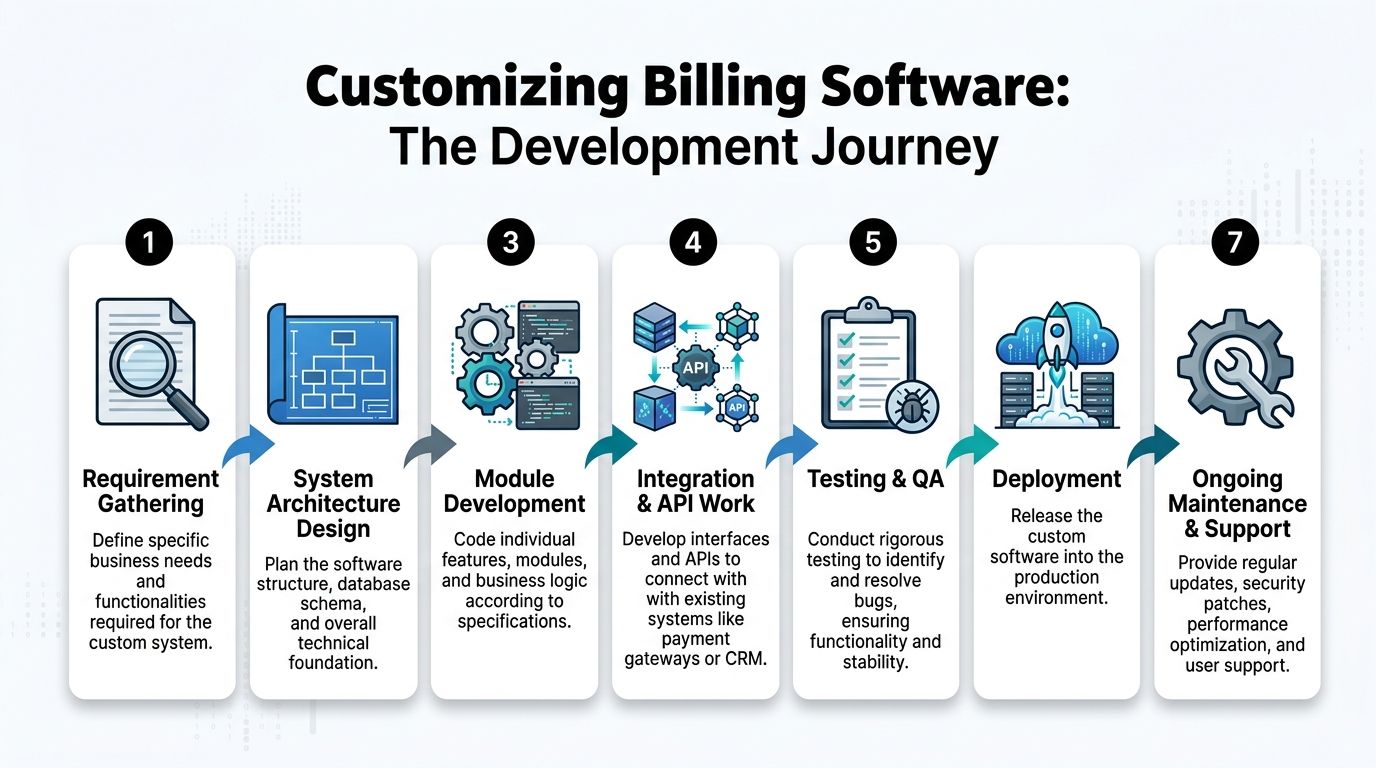
The risk is not theoretical. When building billing software source code, 68% of custom billing systems fail their first production launch due to unhandled edge cases in proration, tax overlays, and currency rounding, with a median 4.2-month rework cycle before achieving stable invoicing, according to Software Mind's analysis of custom billing system development.
Attendance is the trigger, not a side note
In a tutoring center, the invoice often shouldn't exist until attendance is confirmed. That sounds simple until you map the states:
- Scheduled
- Attended
- No-show
- Cancelled
- Late cancelled
- Trial
- Catch-up
- Hybrid attendance for in-person and online students in the same lesson
Each state can affect revenue, credit consumption, and payroll differently. If your system was built for static subscriptions, you're trying to retrofit a live operational engine onto a passive billing model.
A proper build usually needs separate services or at least separate modules for attendance capture, pricing evaluation, invoice creation, credit deduction, and payroll calculation. If you skip that separation, every future rule change gets harder.
Pricing logic gets messy fast
Tutoring pricing almost never sits in one clean table. Real operations need what many teams call policy packs:
- Global defaults for standard rates and cancellation handling
- Location overrides when branches price differently
- Service-level rules for SAT prep, piano, or A1 German classes
- Student-level exceptions for scholarships, legacy rates, or custom family agreements
Now add trials, prepaid packages, subscription plans, free first lessons, room fees, and partial month adjustments. The system has to decide which rule wins, in which order, every single time.
Operator advice: If your developer says “we can add that later,” ask whether the database and event model were designed for it from the start. In billing, later usually means rebuild.
Payroll is where many projects break
Owners often focus on invoicing first and underestimate payroll. That's a mistake. Teacher compensation can depend on:
- per-hour rates
- per-lesson rates
- per-student counts
- revenue share
- base plus variable structures
- overtime
- weekend or subject premiums
Now tie those rules to attendance and cancellation windows. A teacher may get paid for a late cancellation but not for a standard cancellation. Another teacher may receive a premium only at one branch. Contractors may need self-billing documents. Once payroll and billing rely on the same lesson record, your data model has to be precise.
That's why generic invoicing projects rarely adapt cleanly. They weren't designed for this dependency chain.
Security and maintenance never stop
Even if your team gets the logic right, you still own the platform. That means access control, release management, patching, backups, and audit logging. If you're running custom financial software, it's worth reviewing development practices that strengthen your application security, especially around permission design and update discipline.
If your actual goal is to automate lesson-linked invoicing without building these layers from scratch, studying a purpose-built category like tutoring billing software is usually more productive than extending a generic codebase.
Calculating the Hidden Costs of Your DIY System
The biggest mistake in DIY billing is comparing “free code” to “paid software” as if license cost were the only variable. It isn't. The proper comparison is total cost of ownership.
For tutoring centers and language schools, that calculation includes technical labor, bug triage, deployment responsibility, internal training, admin oversight, and the opportunity cost of pushing owners or operations managers deeper into software management.
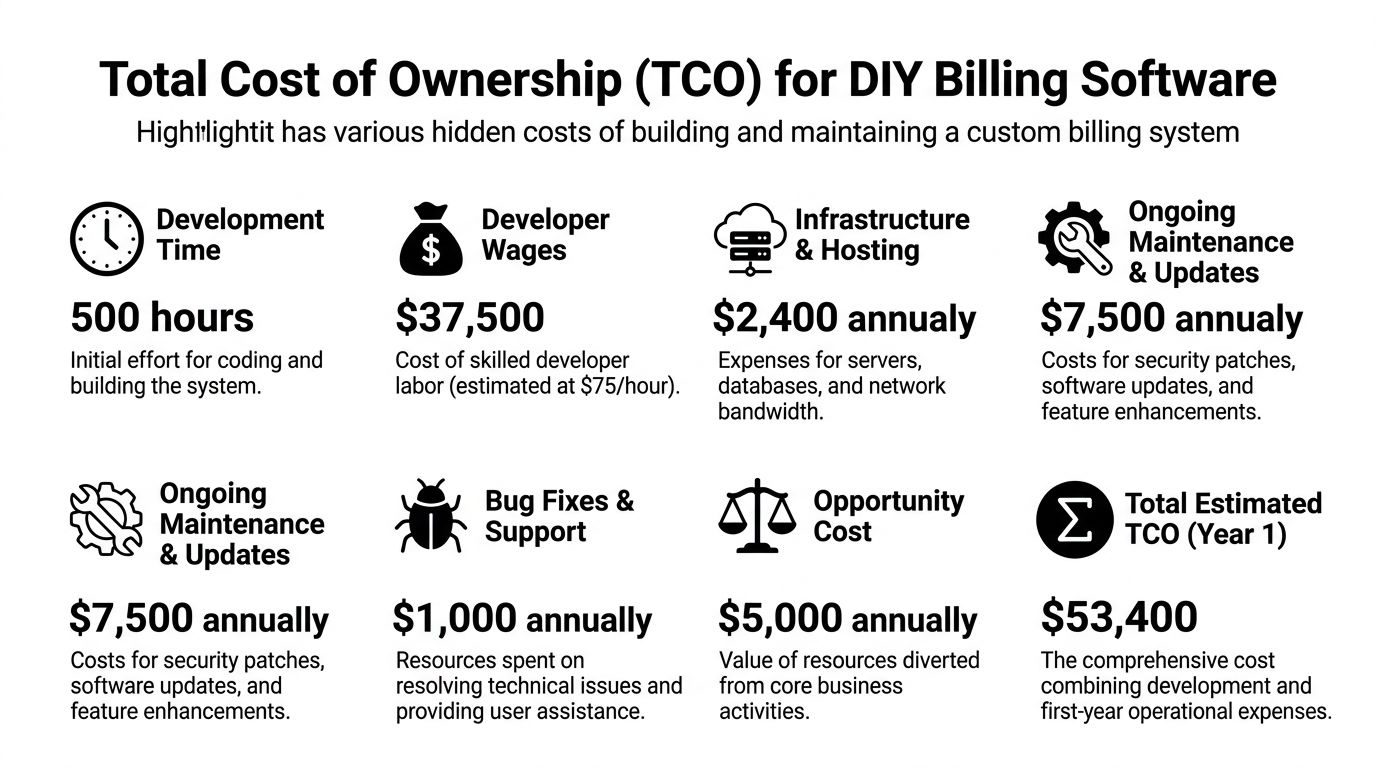
One point matters more than most open-source comparisons admit. For a 5–100 teacher school, the cost of a developer to maintain open-source billing code often exceeds the subscription fee of a turnkey solution, as noted in Flexprice's discussion of open-source billing software trade-offs.
Where the hidden cost shows up
The bill usually arrives in pieces, not in one obvious invoice.
- Developer dependency: Every rule change, from sibling discounts to revised cancellation policy, may need code review or deployment.
- Operational drag: Your ops lead becomes the translator between staff complaints and technical fixes.
- Support burden: Parents and teachers don't care whether a billing bug came from open-source code or a custom patch. They still expect answers immediately.
- Management overhead: Someone has to prioritize requests, test edge cases, approve releases, and own the result.
This is why many “free system” projects feel cheap at the start and exhausting a few months later.
The cost that owners undercount
Most center owners already spend 10+ hours weekly on admin. Adding product-owner duties on top of that makes a bad situation worse. You don't just manage classes and staff anymore. You manage tickets, regressions, and release timing.
That's also why many operators eventually revisit the real costs of free school management systems. The issue isn't whether the software license is free. The issue is whether your business can absorb the operational burden.
Running your own billing stack only makes sense when software ownership is part of your strategy, not when you're just trying to stop invoice chaos.
A better TCO question
Instead of asking, “Can we get the code for free?” ask:
| TCO question | Why it matters |
|---|---|
| Who owns billing logic changes? | Policies change often in education businesses. |
| Who tests edge cases before month-end? | Billing mistakes damage trust fast. |
| Who maintains uptime and security? | Finance systems can't drift unattended. |
| What does owner attention cost? | Time spent managing software isn't spent growing enrollment. |
For most tutoring centers, the answer is uncomfortable. DIY billing doesn't remove cost. It relocates it into labor, risk, and distraction.
The Smart Alternative A Purpose-Built Tutoring Platform
At some point, the decision stops being technical and becomes strategic. Do you want to manage source code, or do you want to run a tutoring business?
A purpose-built tutoring platform solves a different problem than generic billing software. It doesn't start from invoices and ask how to attach lessons later. It starts from the lesson, the student, the payer, the teacher, and the room, then turns real operations into billing and payroll automatically.
What Tutorbase is
Tutorbase is AI-powered tutoring management software that replaces Teachworks, TutorCruncher, TutorBird, and spreadsheet-based operations. It consolidates scheduling, billing, payroll, room management, and student tracking in one platform.
It serves tutoring centers and language schools with 5-100+ teachers across 1-10+ branches, including K-12 tutoring, language schools, test prep, music schools, and after-school programs. The buyers are usually owners, operations managers, and directors already spending 10+ hours weekly on admin.
Why this model fits tutoring operations better
Instead of stitching together Google Calendar, QuickBooks, Excel, and manual follow-up, a tutoring platform can centralize:
- Scheduling: Find Slot, Find Spot, recurring bookings, conflict detection
- Locations and rooms: Multi-branch tracking, room capacity, room fees
- Curriculum: Subjects, levels, services, delivery mode
- Pricing policy packs: Per-hour, per-lesson, package, subscription, layered rule precedence
- Attendance: Scheduled, attended, no-show, cancelled, late cancelled
- Billing and payments: Draft to paid lifecycle, prepaid credits, packages, receipts
- Teacher payroll: Per-hour, revenue share, base plus variable, overtime, premiums
- CRM and lead handling: Website forms, WhatsApp widget, pipeline stages
That matters because tutoring centers lose money through fragmented tools, hand-created invoices, payroll done in spreadsheets, double-booked teachers or rooms, weak capacity visibility, and repetitive admin that should be automated.
DIY source code vs Tutorbase
Tutorbase's commercial model also changes the risk profile. Tutorbase charges a 1% platform fee only when invoices are created through the system, with no monthly subscription or per-student charges, according to Tutorbase pricing information.
| Feature | DIY with Source Code | Tutorbase Platform |
|---|---|---|
| Setup path | Find code, audit it, customize it, host it | Start with tutoring workflows already built |
| Attendance-based billing | Usually custom development | Native workflow |
| Prepaid credits and packages | Often custom logic | Native workflow |
| Complex teacher payroll | Major build effort | Built for tutoring operations |
| Scheduling and room conflicts | Usually separate tool | Included |
| Multi-branch operations | Depends on architecture | Included |
| Ongoing maintenance | Your responsibility | Vendor-managed |
| Time to value | Slow and uncertain | Faster operational rollout |
The same comparison appears when you stack up feature depth. Tutorbase includes Find Slot and Find Spot for scheduling, automated billing, native prepaid credits, multi-branch room handling, multi-brand support, WhatsApp intake, and support for larger lesson volumes. In direct comparison, Teachworks and TutorCruncher remain more manual in several of these areas.
If you're evaluating purpose-built options, Tutorbase for tutoring centers shows what an education-specific workflow looks like when scheduling, billing, payroll, rooms, and CRM all live in the same system.
Frequently Asked Questions
Is open-source billing software always a bad choice for tutoring centers
No. It can work if you have in-house developers, clear ownership, and unusual requirements that justify custom software. Most centers don't have that setup. They need reliable operations more than code ownership.
Can't a developer just modify an invoice app for lessons
They can modify it. The issue is whether the original architecture can support lesson attendance, prepaid credits, payer relationships, cancellations, and payroll without becoming fragile. That's where many projects become expensive.
What makes tutoring billing different from normal subscription billing
Tutoring billing depends on operational events. A lesson can be attended, cancelled, late cancelled, converted from trial, paid from credits, linked to a room fee, and tied to teacher pay. Standard subscription billing usually doesn't model that complexity.
Why do owners underestimate DIY cost
Because they focus on license price first. The actual expense sits in maintenance, testing, exception handling, and the internal time required to manage the project.
When does a custom build make sense
A custom build makes sense when software itself is part of your business strategy and you're prepared to treat billing as a product. It's a poor fit when your main goal is to reduce admin quickly.
What should I ask before choosing any billing system
Ask how it handles attendance-driven invoicing, prepaid credits, teacher payroll, payer relationships, branch-specific pricing, cancellation policies, and audit trails. If the answer is vague, expect manual work later.
Should I replace spreadsheets first or billing first
Usually both need to move together. Billing problems often come from bad scheduling data, disconnected attendance records, and payroll calculations sitting outside the main system. Replacing one piece without the others leaves the core problem intact.
If you want to stop managing billing logic and get back to running your center, take a look at Tutorbase. It gives tutoring centers and language schools one platform for scheduling, attendance, billing, payroll, rooms, CRM, and student operations, without the overhead of owning the codebase yourself. You can start at tutorbase.com/register.


