


Effective reading and writing tutoring is about more than just great teaching; it's about building a structured, scalable program. A well-designed curriculum clarifies your value to parents and simplifies operations from scheduling to hiring, separating small operations from growing educational businesses.
This guide provides a blueprint for structuring your services, automating administrative tasks like scheduling and billing, and using data to drive sustainable growth.
Building Your Scalable Reading and Writing Program

To attract a steady stream of students, you need a clear, manageable program architecture. This means moving beyond offering vague "reading help" and defining specific services that parents can easily understand and buy. A messy curriculum leads to chaotic scheduling, confusing pricing, and stalled growth.
To build a program that can truly scale, mastering how to automate business processes is essential. Automation reduces the administrative burden by over 60%, allowing you to focus on growth.
The demand is undeniable. The global private tutoring market is projected to grow significantly, driven by the need for supplemental help in core literacy skills. This makes structured reading and writing tutoring a prime area for expansion for centers managing 50 to 10,000 lessons per week.
Defining Your Subjects And Levels
First, organize your offerings into a logical hierarchy. Think of "Subjects" as your broad categories and "Levels" as the specific steps a student takes within them. This brings immediate clarity to your program and simplifies management.
- Subjects: These are your main teaching areas. Examples include Foundational Phonics, Reading Comprehension, Creative Writing, or Test Prep (like SAT/IELTS).
- Levels: These create a clear progression path. A student in "Reading Comprehension - Grade 4" knows their next step is "Grade 5." For test prep, levels might be "IELTS Writing Task 1" and "IELTS Writing Task 2."
This structure allows you to market specific solutions to specific parent problems, making your services far more compelling and easier to manage in a tutoring center software.
A well-defined program transforms your tutoring center from a collection of individual tutors into a cohesive educational institution. Parents aren't just buying time with a teacher; they're investing in a structured pathway to their child's literacy success.
Creating Specific Tutoring Services
Once you have your subjects and levels mapped out, you can build your "Services." A service is the actual class or session you sell. It’s where you package your curriculum into a tangible product that can be scheduled and billed.
For instance, a "Subject" of Reading Comprehension at "Level" Grade 5 becomes a sellable "Service" like 'Grade 5 Reading Comprehension - Group Session'.
Each service you create should have key attributes clearly defined:
- Service Name: Make it clear and descriptive.
- Capacity: The maximum number of students, like 1 for private tutoring or 6 for a small group workshop.
- Delivery Mode: Specify if the class is in-person, fully online, or a hybrid model.
This detail is critical for management software like Tutorbase. The system uses this information to automate scheduling, prevent double-bookings, and ensure your billing is always accurate. For a closer look at digital tools, check out our guide on the top platforms for reading tutors.
Sample Curriculum Structure For A Literacy Center
| Subject Area | Target Levels | Example Service (Class) | Delivery Mode |
|---|---|---|---|
| Foundational Reading | Pre-K to Grade 2 | 'Phonics Foundations - Group' | In-Person |
| Reading Comprehension | Grade 3 to Grade 8 | 'Grade 6 Reading & Analysis - Private' | Online |
| Expository Writing | Grade 9 to Grade 12 | 'High School Essay Writing Workshop' | Hybrid |
| Test Prep - Writing | IELTS / SAT | 'IELTS Writing Task 2 - Small Group' | Online |
By designing your program this way, you create a system that’s easy for parents to navigate and simple for your team to manage. This clarity is the engine of scalability, allowing you to add students, tutors, and even locations without creating administrative chaos.
How To Master Student Intake And Assessment
A parent's first call is your make-or-break moment. How you handle that initial inquiry—from the first hello to a scheduled assessment—separates thriving tutoring centers from those drowning in admin chaos. A polished intake process is your secret weapon to build a reputation for professionalism.
Your goal is to turn that first flicker of interest into a paid enrollment, fast. A polished intake process makes it easy for parents to say "yes" and can increase your monthly renewals by up to 42%.
The journey starts the second a parent finds you. To avoid dropping leads, you need a simple way to track them. Forget messy spreadsheets; a visual CRM pipeline is the cleanest way to see where everyone is at a glance.
A typical CRM pipeline for a reading and writing program has a few key stages:
- New: A parent just reached out via your website form, WhatsApp widget, or phone.
- Contacted: You've made a call or sent an email.
- Trial Scheduled: The student is booked for their assessment or a trial lesson.
- Converted: The family has signed up and paid.
This gives you a clear, bird's-eye view of your sales funnel. Many growing centers rely on administrative support. Using services to Hire LatAm Virtual Assistants can be a game-changer for handling scheduling and initial communications without bogging down your teaching staff.
Conducting a Meaningful Student Assessment
Once you’ve made contact, the assessment is your next critical step. This is your chance to uncover the specific struggles and strengths of a student so you can recommend the perfect program. For reading and writing, this means gathering concrete details.
This is where a dedicated Tutorbase CRM becomes invaluable. As you talk to the parent and student, you can log key information directly into the student's profile. Capture their current school grade, specific goals (like "improve essay structure"), and any known challenges, such as dyslexia or phonics difficulties.
A great assessment accomplishes two things: it provides the data you need to recommend the perfect class, and it shows parents you have a structured, professional approach. This builds confidence and makes the decision to enroll much easier.
From Assessment To Enrollment In Minutes
Let's walk through how this looks in the real world. A parent calls, worried about their 7th-grade son, Leo, who can’t seem to organize his thoughts for writing assignments. Your admin schedules a quick, 30-minute online assessment.
During the session, the tutor has Leo outline a short essay. The problem is clear: Leo has good ideas but no framework to structure them. The tutor logs these observations directly into Leo's profile in your management system.
Now, instead of manually searching through class schedules, your admin uses a "Find Spot" feature, filtering for:
- Subject: Expository Writing
- Level: Grade 7
- Delivery: Online
The system instantly pulls up your "Grade 7 Essay Fundamentals" group class on Wednesdays, which has two open seats. The admin offers this perfectly matched spot to the parent on the phone, turning an inquiry into a paid enrollment in a single conversation.
Automating Your Scheduling And Room Management
If you're still juggling spreadsheets, calendars, and sticky notes to schedule your reading and writing sessions, you're on a fast track to burnout. This tedious, manual process eats up over 10 hours of admin time per week and quietly costs your center money in double-bookings and lost opportunities.
The real bottleneck in growing a tutoring business isn't finding students; it’s the administrative drag from bad scheduling. Every minute you spend manually cross-referencing a teacher's availability with room bookings is a minute you aren't spending on marketing or helping students.
From Minutes To Seconds With Smart Scheduling
Let's walk through a common scenario: a parent wants to book a private reading session for their child every Tuesday afternoon. Manually, this can easily take 10 minutes as you open multiple tabs—teacher availability, room calendars, and student details.
A smart "Find Slot" feature changes the game. Instead of you hunting for a match, the system does the work. You just plug in the requirements:
- Student: Maya Rodriguez
- Subject: Reading Comprehension
- Teacher preference: Any certified Level 2 reading tutor
- Time: Tuesdays, 3 PM - 5 PM
In seconds, the software generates a list of every valid teacher, room, and time combination. The booking time drops from ten minutes to under two, and the risk of a double-booking vanishes. This is a huge efficiency gain, reducing admin time by up to 60%.
Manual vs Automated Scheduling Efficiency
This table breaks down how much time is wasted on manual scheduling compared to using an integrated software solution. The difference isn't just in minutes; it's in the reduction of costly errors and improved parent satisfaction.
| Task | Manual Method (e.g., Spreadsheets/Calendar) | Automated With Integrated Software | Time Saved |
|---|---|---|---|
| Finding a new recurring slot | 10-15 minutes (cross-referencing multiple docs) | < 2 minutes (using a "Find Slot" feature) | ~85% |
| Booking a trial lesson | 5-7 minutes (back-and-forth emails) | < 1 minute (parent self-service booking) | ~90% |
| Finding a spot in a group class | 5-10 minutes (checking rosters and capacity) | < 30 seconds (filtering existing classes) | ~95% |
| Managing room assignments | Prone to double-booking; constant checking | Automatic assignment based on availability and needs | 100% (errors eliminated) |
As you can see, the time saved adds up quickly, freeing your team to focus on growth-oriented activities. The reduction in errors alone can save your reputation and prevent lost revenue.
The flowchart below shows how this speed helps you move a new lead toward a scheduled trial. This process relies on swift, error-free scheduling to keep momentum.
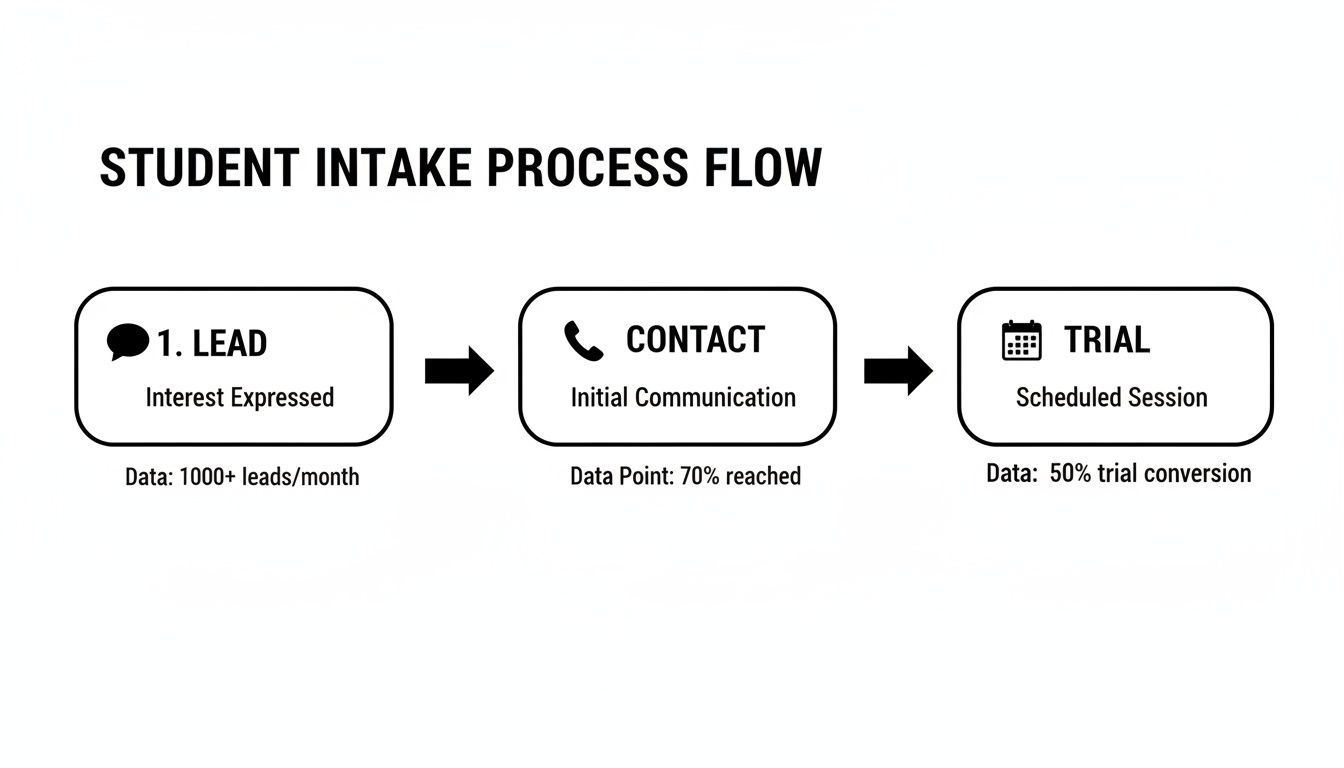
This streamlined intake, from lead to trial lesson, shows how automation directly supports a 3x faster student onboarding process and a much better experience for parents.
Maximize Your Group Class Revenue
Empty seats in your group writing workshops are lost revenue. But how do you fill them on the fly? When a new inquiry comes in for a popular time, your staff shouldn't have to guess which classes have space. This is where a "Find Spot" tool becomes a money-maker.
Instead of turning a potential customer away, your admin can filter all existing classes by subject, level, teacher, and day. They can instantly see that your "IELTS Essay Writing" class on Thursday has one seat left and offer it on the spot. This move not only fills the class but turns a scheduling dead-end into an immediate sale.
By instantly identifying and filling open seats in group sessions, you directly increase your capacity utilization and monthly revenue without adding any new classes or teachers. It's about working smarter, not harder.
The impact of flexible scheduling is huge in the online tutoring market, which hit USD 10.42 billion in 2024. The on-demand segment—think quick essay reviews or last-minute help—is a massive part of this growth. You need a flawless, agile scheduling system to capture it. You can read the full research from Grand View Research to get a better sense of the market dynamics.
Managing Multiple Locations And Rooms From One Place
As your reading and writing business expands to multiple branches, the complexity of room management explodes. Juggling schedules for your downtown and suburban locations in separate systems is a recipe for disaster. A centralized platform is non-negotiable for any multi-branch operation with 1-10+ locations.
With integrated room management, you can track every detail from a single dashboard:
- Location: Which branch is the room in?
- Capacity: How many students can it hold?
- Features: Does it have a smartboard for interactive phonics lessons?
- Availability: Is it booked, or is it blocked for maintenance?
When you book a lesson, the system automatically assigns an available room that fits the class requirements. This ensures you never have two teachers trying to use the same room for different writing workshops. It gives you a single source of truth, providing the operational control you need to scale confidently.
Implementing Smart Pricing And Automated Billing
If there's one part of the business that can quietly drain all your time and profit, it's billing. Manually creating invoices, chasing late payments, and wrestling with spreadsheets are hours you're not spending on teaching or growing your reading and writing program. It’s time to stop the admin bleed and set up a system that gets you paid automatically.
The answer isn’t just about getting paid, but how you get paid. By combining flexible pricing with automated billing, you can eliminate the end-of-month scramble, dramatically improve your cash flow, and increase monthly renewals by up to 42%.
Structuring Your Pricing For Flexibility
A one-size-fits-all price list doesn't work for a tutoring center with a diverse set of reading and writing services. You need a system that can handle different rates for specific classes, tutors, or even individual students without creating a manual mess.
The best way to do this is with a pricing hierarchy, where specific rates automatically override your general ones. Think of it like a set of rules.
- Global Rate: This is your standard, company-wide hourly price.
- Location Rate: Got a downtown office with higher rent? You can set a specific rate for just that branch.
- Service Rate: Your intensive "SAT Writing Prep" workshop should cost more than a standard grammar session. This lets you price it accordingly.
- Student Rate: Need to give a discount to a long-term client or a family with multiple kids? You can set a custom price just for them.
Let's say your standard rate is $60/hour. But your premium "IELTS Essay Review" service is $85/lesson. When you enroll a student in that specific service, the system knows to apply the $85 rate, ignoring the global default. This simple logic removes all the guesswork and ensures every single lesson is billed correctly.
The single biggest change you can make to your cash flow is switching from billing after lessons to a pre-paid model. It ensures you're paid upfront and practically eliminates the need to chase payments.
Automating Billing From Lesson Attendance
The real magic happens when your billing is tied directly to your schedule. Forget about manually counting lessons at the end of the month. With an automated system, the entire billing cycle is triggered the moment a tutor marks a lesson complete, turning hours of invoice processing into minutes.
Here’s how it works: a tutor finishes a session and marks the student as "Attended." That's it. The system instantly drafts an invoice for that session, pulling the correct rate from your pricing rules.
At the end of your billing cycle—whether it's weekly, bi-weekly, or monthly—all you have to do is log in, give the pre-generated invoices a quick review, and hit "Publish." A process that used to take hours of tedious data entry now takes just a few minutes.
Supercharging Renewals With Prepaid Credits
One of the most powerful ways to secure your revenue and boost retention is by using a prepaid credit system. Instead of chasing invoices, parents purchase a package of credits upfront, which works like a wallet or a gift card balance for your services.
This model transforms your business operations:
- Positive Cash Flow: You get paid before you deliver the lessons, putting you in a much stronger financial position.
- Effortless Consumption: After a tutor marks a lesson "Attended," the cost is automatically deducted from the family's credit balance. No invoices needed.
- Zero Payment Chasing: The funds are already in the account, so you never have to send an overdue payment reminder again.
- Higher Renewals: Tutorbase customers see a 42% increase in monthly renewals with this model. The system automatically sends low-balance alerts to parents, prompting them to top up before their credits run out, ensuring there's no interruption in their child's learning.
This creates a seamless financial experience for parents and a predictable, steady income stream for you. It replaces the awkward "it's time to pay" conversation with a simple, automated notification, letting everyone focus on what really matters: the student's progress.
How to Handle Teacher Payroll Without Losing Your Mind
Paying your reading and writing tutors accurately and on time is non-negotiable. Get it wrong, and you risk losing your best people. But as your tutoring center grows, so does the payroll headache, especially when you have 5 to 100+ teachers on staff.
One tutor is a salaried employee. Another is a contractor paid per lesson. A third earns a premium for a popular weekend writing workshop. Trying to manage this mix with spreadsheets is a recipe for mistakes, frustrated tutors, and hours wasted at the end of every month.
The key is to stop treating payroll like a manual chore and start treating it like a system you set up once and let run on its own. It all starts by ditching the spreadsheets for a platform where complex payroll rules are built directly into your operations.
Build Payroll Models as Unique as Your Tutors
Your tutoring center isn't a one-size-fits-all operation, so why would your payroll be? A rigid system just won't cut it. You need the flexibility to create multiple pay structures that can all run at the same time.
For instance, you should be able to set up rules for:
- Hourly vs. Per-Lesson Rates: Assign a standard hourly rate for some tutors and a flat per-lesson fee for others.
- Revenue Share: Pay a specialist writing coach a percentage of the revenue from their high-value workshops.
- Per-Student Pay: Compensate a group session leader based on the number of students who actually show up.
- Premiums and Bonuses: Automatically add a bonus for lessons taught on weekends, after 6 PM, or for advanced subjects like SAT essay prep.
Once you configure these rules, the system does the heavy lifting. When a tutor marks attendance for a lesson, the correct pay is calculated instantly and accurately. What used to be hours of painstaking calculation at the end of the month becomes a simple review.
Bring All Your Teacher Information Into One Place
Effective payroll isn't just about the numbers; it's about having all your teacher information in one spot. When contracts are in one folder, availability is in a calendar, and pay rates are on a spreadsheet, you create chaos for yourself.
A central teacher database solves this by consolidating everything. For each tutor, you should be able to see their entire profile at a glance:
- Employment Type: Contractor, part-time, or full-time.
- Subjects & Levels: The specific reading and writing topics they're qualified to teach.
- Locations: Which branches they can work at.
- Pay Rates & Contracts: Their specific payroll model and any associated agreements.
- Availability: Their set working hours and any one-off unavailability.
When your scheduling, attendance, and payroll are all connected, a single action—like marking a lesson as 'Attended'—triggers a perfect chain reaction. The student's package is updated, an invoice is drafted for the parent, and the teacher's pay is calculated, all without any manual data entry.
This unified view is a massive time-saver. Need a last-minute sub for a Grade 4 reading group? Just filter by teachers qualified for that level and available at that time. When it’s time to run payroll, the system already knows each tutor's unique rate and has linked it to their attended lessons.
With the right tools, like the comprehensive Tutorbase payroll features, you can turn a tedious administrative chore into a streamlined, automated process that cuts down on errors and keeps your talented tutors happy.
Using Data To Track Outcomes And Drive Growth

You can't effectively scale what you can't measure. In a thriving reading and writing tutoring business, growth isn't just about getting more students—it’s about making smarter decisions backed by data. Relying on intuition alone is a path to burnout and missed opportunities.
A data-driven approach is what separates the ambitious centers that grow from 50 to over 10,000 lessons per week from those that collapse under the weight of administrative chaos. It lets you see what’s working, what isn't, and where you can get better.
Tracking The Student’s Academic Journey
The single most important data you have tracks a student’s progress. Vague feedback doesn’t cut it for parents or tutors. To show real value, you need a system for capturing specific, actionable insights after every single lesson.
This is where per-lesson teacher notes become your best friend. Think of them as a running log of a student's journey. In a central place, a tutor can quickly document milestones, challenges, and what's next.
- Academic Progress: "Liam successfully identified the main idea in three of four paragraphs today. Next week, we will focus on supporting details."
- Behavioral Observations: "Chloe was much more engaged during the creative writing exercise. Using visual prompts seems to be a key motivator."
- Parent Communication: You can keep these notes internal or share them with parents through a portal, giving them concrete updates on their investment.
This creates a detailed, chronological record. When a parent calls with a question, any admin can instantly pull up the student’s history and give a specific, informed answer. No more guessing.
Using Attendance Data To Protect Your Revenue
Attendance isn't just about taking roll; it's a powerful business metric. When you track attendance statuses—like Attended, No-show, and Late Cancelled—you start to see patterns that directly hit your bottom line.
For example, if you notice a particular student has a high rate of last-minute cancellations, you can have a proactive conversation with the family. But more importantly, this data lets you enforce your cancellation policies without any awkward back-and-forth.
By linking attendance directly to your billing system, you stop revenue leakage. A 'Late Cancel' status can automatically trigger a fee or deduct a credit from a prepaid package, ensuring you're compensated for your tutor's time.
This isn't about being punitive. It’s about setting professional boundaries and protecting your center's financial health, ensuring fairness and consistency for all your clients.
Monitoring Business Health For Smart Growth
Beyond individual students, you have to track the health of your entire operation. This means moving beyond feelings and looking at hard numbers. An integrated dashboard gives you an at-a-glance view of the key performance indicators (KPIs) that actually drive growth.
Here are the essential metrics every tutoring center owner should have their eyes on:
- Capacity Utilization: Are your group writing workshops consistently at 90% capacity, or are they hovering around 50%? This tells you which programs are making money and which ones might need a marketing push or a total rethink.
- Teacher Workload: Is one tutor slammed with 30 hours a week while another only has 5? Balancing workloads is key to preventing burnout and keeping your best teachers.
- Location Performance: If you have multiple branches, you can compare revenue, enrollment, and profitability between them. This helps you spot what your top-performing branches are doing right so you can apply those lessons elsewhere.
This is how you shift from being a reactive manager putting out fires to a proactive strategist. You can make informed decisions about where to spend marketing dollars, when to hire, and which programs to expand, ensuring every move is calculated for impact.
FAQs for Scaling a Reading and Writing Tutoring Business
As you grow, new operational questions pop up all the time. Here are a few we see tutoring directors grapple with, along with some practical advice.
How Can I Stop Double-Booking Teachers For My Writing Workshops?
Double-booking happens when you rely on fragmented tools like Google Calendar and spreadsheets. The solution is tutoring management software with built-in conflict detection. It automatically prevents you from booking a teacher or room that is already occupied, eliminating errors entirely.
What Is The Best Way To Handle Billing For Lesson Packages?
Manual tracking of lesson packages is prone to error and wastes admin time. The most efficient method is a prepaid credit system. Parents buy a package, and their account is credited. After each lesson, the system automatically deducts one credit, providing clear visibility for both you and the parent.
How Do I Manage Tutoring Operations Across Multiple Locations?
Running multiple branches with separate systems creates chaos. A platform with multi-branch management is essential. It provides a single dashboard to view schedules, room availability, teacher assignments, and financial reports across all locations, allowing for scalable growth.
What is the fastest way to book a new student?
The fastest way to book a new student is by using an AI-powered "Find Slot" feature. This tool instantly finds all available teacher, room, and time combinations based on your criteria, reducing the booking process from over 10 minutes to under 2 minutes.
How can I improve my center's cash flow?
Switching from post-paid invoicing to a prepaid credit model is the most effective way to improve cash flow. Parents pay upfront for lesson packages, which eliminates chasing payments and ensures you have the capital you need to operate and grow.
Ready to stop wasting hours on admin and start scaling your tutoring business? See how Tutorbase can help you automate your operations by visiting tutorbase.com/register.


